
Home » Posts tagged 'motorcycle taxis'
Tag Archives: motorcycle taxis
On the rideshare competition among 4 and 2-wheeler companies.
Grab is the current market leader for rideshare or TNVS involving cars or 4-wheeled vehicles. Others like Joyride and Angkas went the way of legalizing motorcycle taxis. Grab applied for the same as they were already operating motorcycles for food and deliveries; competing with another company, Lalamove, which focuses on deliveries. Disallowed by the LTFRB to deploy MC taxis under their brand, they acquired Move It to circumvent the decision.
Meanwhile, as Grab continued their dominance of the rideshare market, the other players decided to offer some competition. I say ‘some’ because the perception is that they have not really gained much vs. Grab. You don’t see many Joyride taxis though a couple of companies appear to be making some impact – In Drive and Green GSM. The latter though is a taxi company that looks to attract people back to the conventional but app-enhanced taxi services
Last week, we saw this car with a familiar brand on its side. Sporting the colors and logo of MC taxi leader Angkas, they coined a brand for their cars – Angcars.
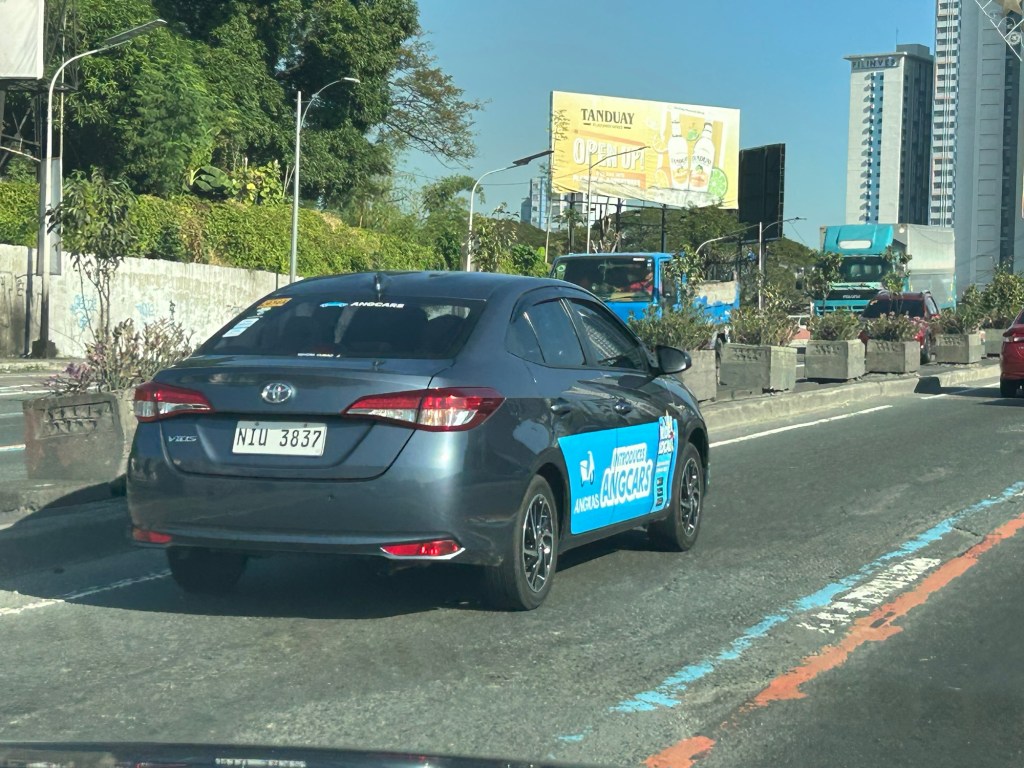
Whether people will take to these competitors for 4 or 2-wheelers so there is not an imbalance of market shares depends on public perception based on the cost and convenience, among other factors, of availing the services of these companies. Conditions may also vary depending on the cities. That is, situations may be different elsewhere like Cebu, Davao or Iloilo.
These modes, however, are still cars and motorcycles, and are regarded as private vehicles in terms of operational characteristics. Even if they are also public utility vehicles (they are for hire with fare rates), these represent a segment of private mode share. There is really a need to improve and improve and expand public transport services in order to retain or increase transit mode shares. Unfortunately, it takes a lot of time and resources to build railways so road-based public transport is still the main option where improvements need to be realized.
–
Shared article on shared mobility
Here’s is a nice short read on a Sunday about shared mobility. The article is of particular interest to me because it tackles the needs of persons with disabilities, senior citizens and those in low income households.
Seruga, K. (April 14, 2025) “Shared mobility: Making travel easier for all,” Knowable Magazine, https://knowablemagazine.org/content/article/society/2025/increasing-access-to-shared-transportation [Last accessed: 27/04/2025]
“But if you’re disabled or elderly, living in a low-income area or — imagine! — without a smartphone or credit card, using these shared mobility services becomes a lot more difficult. They tend to cluster in more affluent urban areas, and are often inaccessible to people with reduced mobility or those traveling with young children needing child seats. In part because of these factors, users are disproportionately younger, wealthier, able-bodied, white and male.
Shared mobility could be a key part of a more sustainable transportation system. But to be most effective, it needs to include everyone. For-profit shared mobility providers have largely failed to deliver on this, but various initiatives and projects are finding creative solutions to reach underserved communities.
The potential benefits are large. On-demand shared mobility that feeds into well-developed public transportation systems could reduce the number of vehicles in some cities by 90 percent and cut transportation emissions by 50 percent — but only if it largely replaces private car use. “The car has to be a guest, not the main actor,” says Luis Martinez, lead modeler at the International Transport Forum, who coauthored a paper on shared mobility and sustainability in the 2024 Annual Review of Environment and Resources.”
There is a cautionary tale on ‘for-profit’ shared mobility here but a major difference in countries like the Philippines from those in western countries is the presence motorcycle taxis and the surge in the ownership of electric three-wheelers. These have changed the way people travel though their impacts are only now being assessed.
–
Technical sessions at the TSSP 2024 Conference
I am sharing here the latest draft of the technical sessions for the 30th Annual Conference of the Transportation Science Society of the Philippines (TSSP). The conference will be held in Iloilo City this coming September 13, 2024.
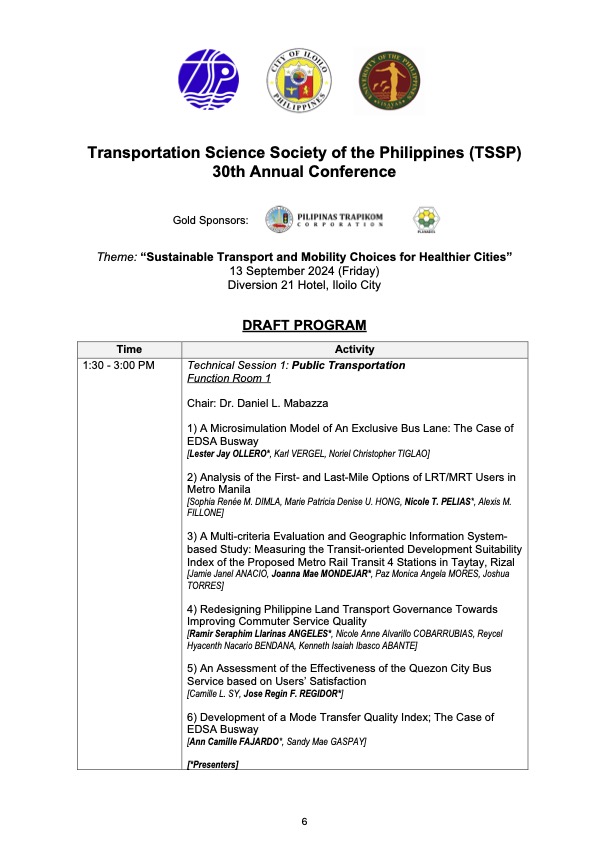
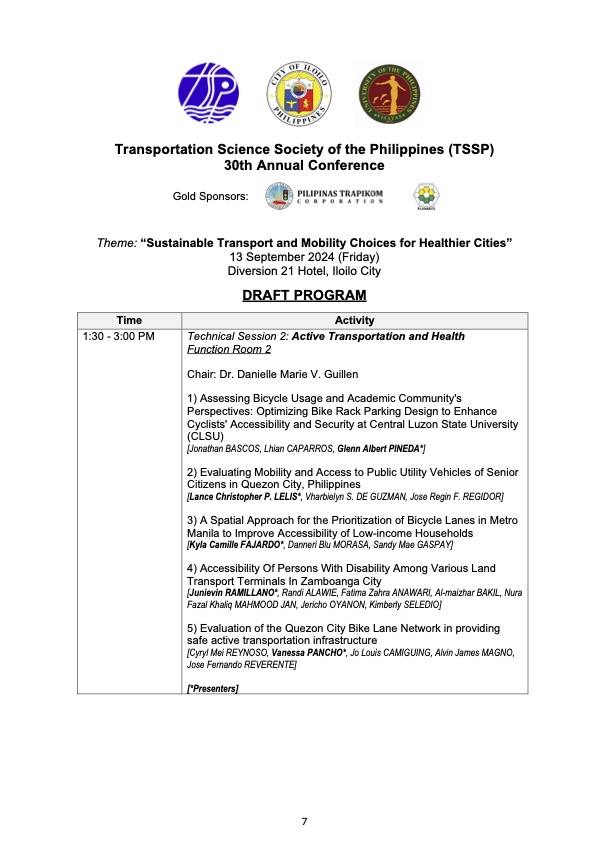
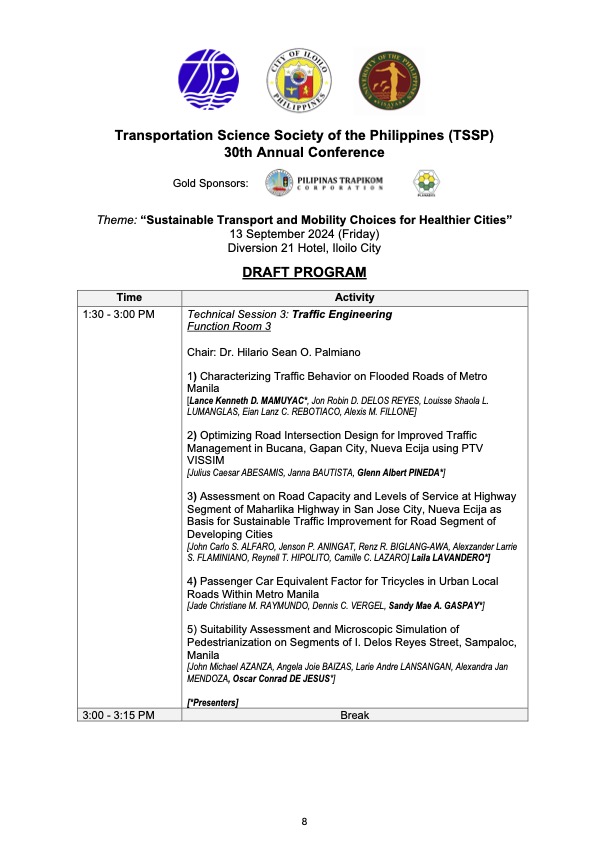
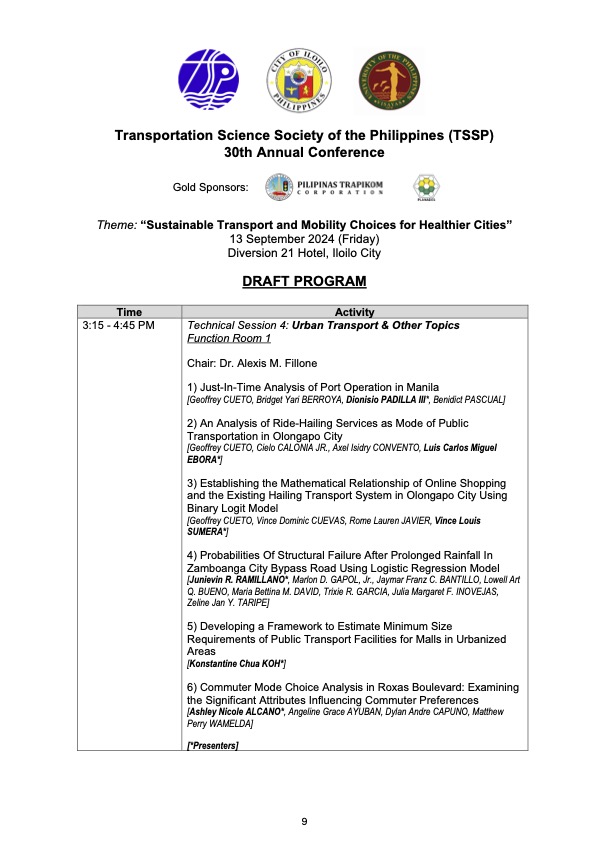
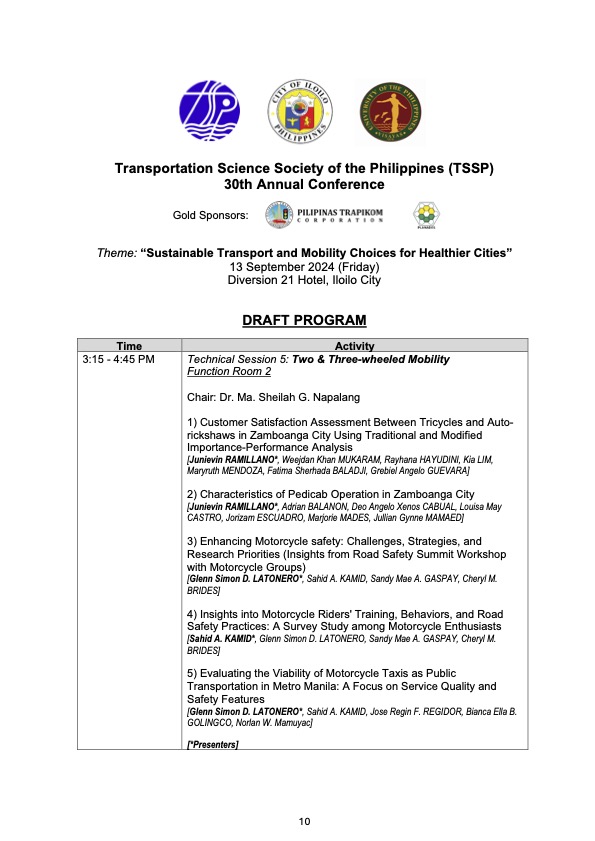
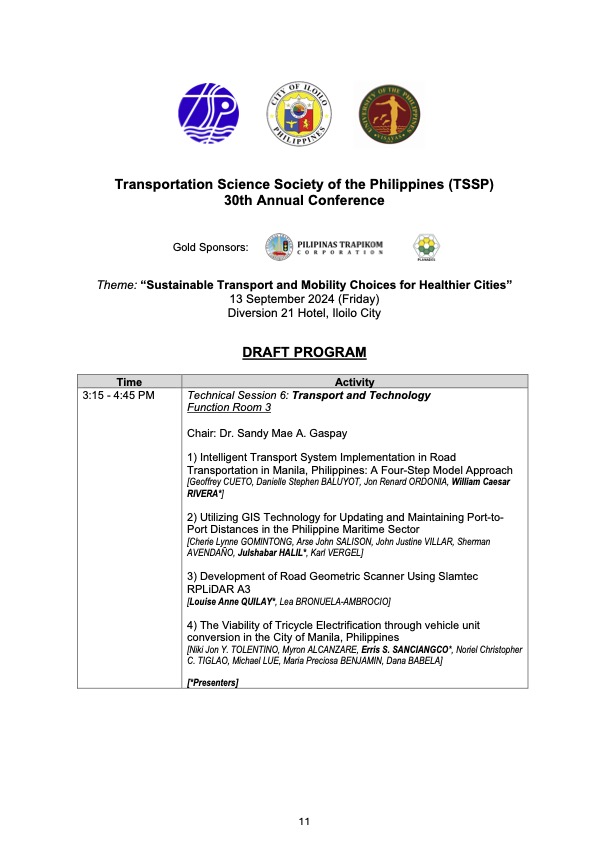
I will share the draft program for the morning plenary session in the next post.
–
On micro transit covering for regular public transport services
I am sharing this very interesting (to me) article on microtransit making up for the conventional public transportation:
Zipper, D. (December 19, 2023) “On-Demand Microtransit Can’t Escape This Big Problem,” Bloomberg, https://www.bloomberg.com/news/articles/2023-12-19/the-inflexible-problem-with-flexible-microtransit?utm_source=website&utm_medium=share&utm_campaign=copy [Last accessed: 12/22/2023]
To quote from the article:
“Fixed-route service on large buses also offers the economies of scale that microtransit lacks. As long as empty bus seats are available, each new rider brings new revenue to the transit agency while incurring minimal added costs, thereby reducing the subsidy required for each trip. Public dollars can then be reallocated to expand service, which will make transit more useful, thus attracting more riders — and the virtuous cycle continues.
For microtransit, that flywheel effect is missing; the cost of service keeps rising as more people use it. “It would be great to have anywhere-to-anywhere connectivity for the price of transit,” said Goldwyn. ”But it’s just not possible.””
I think this article also touches on motorcycle taxis though perhaps there are also differences between the western and Asian contexts for micro mobility. Surely though, such transport modes cannot approximate transit capacities and require so many more vehicles (e.g., motorcycles) that probably means more chaos and compromised safety along our roads.
–
29th Annual Conference of the TSSP
The Transportation Science Society of the Philippines (TSSP) held its 29th Annual Conference today, December 7, 2023. Following is the program for the conference, which featured a panel discussion in the morning and technical sessions in the afternoon.


This was the first mainly face-to-face or in-person conference for the society since 2019. Previously, the conferences were online. As reported in the concluding part of the program, there were 84 participants who showed up at the venue while there were 30+ participants who were online via Zoom.
There were a couple of awards at the conference. These were the Best Paper Award and the Best Presentation Award. The Best Paper Award, based on the scores garnered from the blind review of the papers went to:
Maria Belen Vasquez and Jun T. Castro of UP Diliman for their paper entitled “Exploring Travel Patterns of Mobility of Care in Guiuan, Eastern Samar: Assessment of Gender and Sociodemographic Factors Using Spatial Analysis”
There was a tie for the Best Presentation Award. The two were Ms. Vasquez for the presentation of the paper on the Mobility of Care in Eastern Samar, and Mr. Erris Sancianco for the presentation of a paper he co-authored with Noriel Christopher Tiglao, Niki Jon Tolentino, Gillian Kate Hidalgo, Mary Joy Leanda, and Lester Jay Ollero entitled “Evaluating the Fuel Efficiency and Eco-Driving Potential of the EDSA Carousel using On-Board Diagnostics (OBD) and Mobile Crowdsourcing“. These papers will likely find their way to the Philippine Transportation Journal’s next issue.
Though it was not announced, a likely venue for the next conference will be Vigan, Ilocos Sur in the Northern Philippines. The likely host will be the University of Northern Philippines, the premier state university in that province. Previously and most recently, the conference was held in Cebu City (hosted by the University of San Jose-Recoletos) in 2019 and before that in Cagayan De Oro City (hosted by Xavier University) in 2018. TSSP was already organizing the 2020 conference when the pandemic struck and the country went on a lockdown. That conference was supposed to have been held in Baguio City in Benguet, and to be hosted by St. Louis University.
More information on the conference may soon be found at the TSSP’s official website: https://ncts.upd.edu.ph/tssp/
–
Motorcycle taxis in Cebu
The recent controversies, and issues raised vs. motorcycle taxis (habal-habal) have captured the attention of a lot of people including those who don’t use this mode of transport. I will be writing about this and more of my opinion on motorcycle taxis in another article. For now, I am sharing these photos of habal-habal in Cebu.
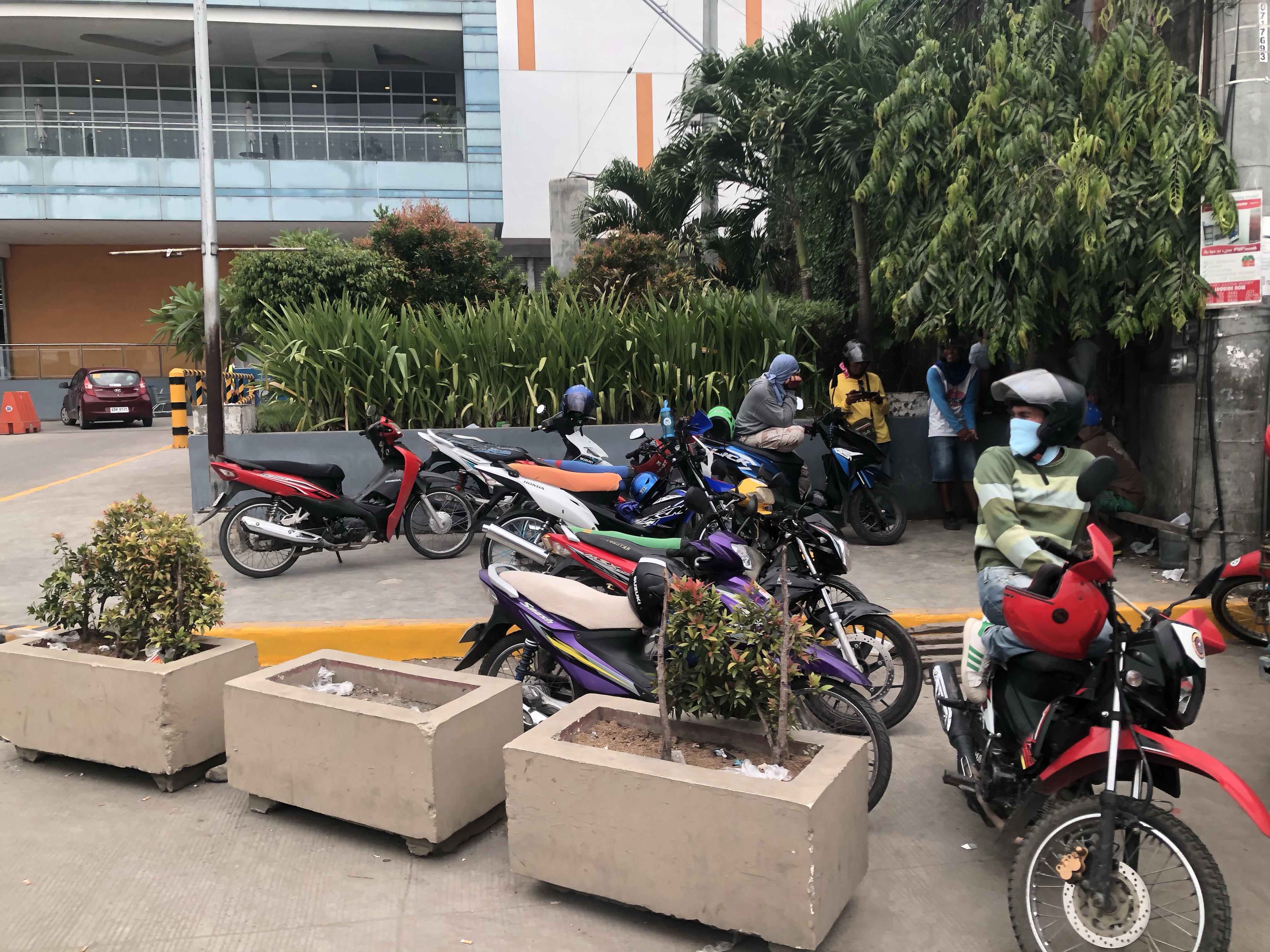 Off-street motorcycle taxi terminal at SM City Consolacion
 The terminal is located on the sidewalk at the corner of the SM lot. I assume it is tolerated by SM though it blocks the pedestrian way to the mall.
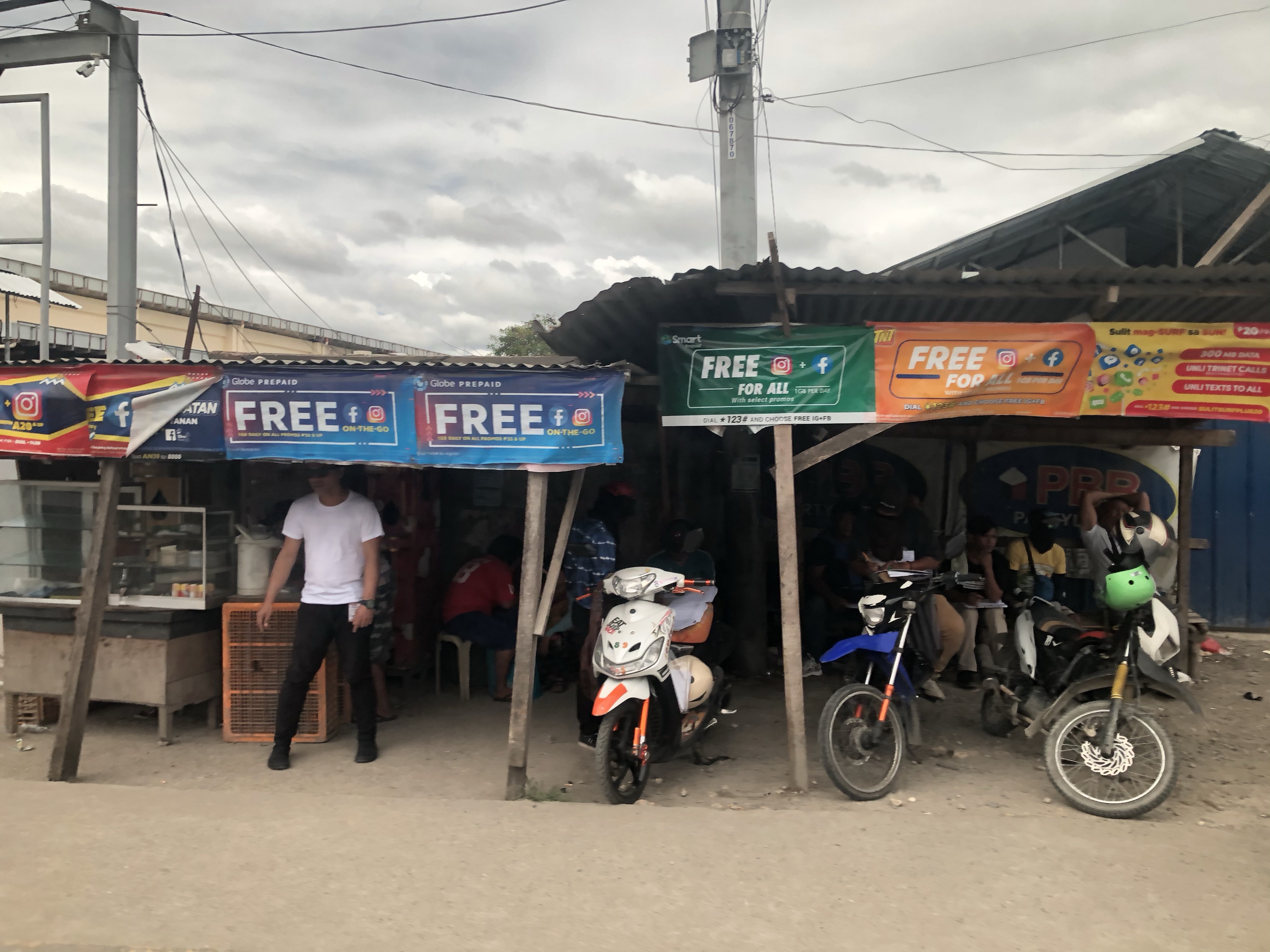 Another herbal-habal terminal near SM Consolacion but serving a different set of barangays from the previous terminal of habal-habal I mentioned.
 Fair matrix? Habal-habal minimum fares to specific destinations
Motorcycle taxis are a popular mode of transport in many Philippine cities and are generally tolerated by local government units. I guess the treatment they get from LGUs show the role they play as a mode of public transport. It is unfortunate and disappointing that the TWG that’s supposedly evaluating motorcycle taxis in Metro Manila cannot give a favorable assessment when it is clear that these habal-habal provide people with another choice for their commutes.
–
Statement of the Philippine Competition Commission on Motorcycles as Public Transport
Here is the link to the press statement of the Philippine Competition Commission on Motorcycles as Public Transport:
I will just leave this here as it stands on its own with the details and discussions provided by the PCC. I will comment on this in another post but in essence I agree with the statement, which I think is a better document in terms of provisions and clarity compared to what the TWG has released so far.
–
Innovations for motorcycles
We spotted a number of motorcycles in Cagayan De Oro with what looked like modified umbrellas to shield the rider and passenger(s) from the elements. I approached one who just unloaded a passenger near one of our field survey stations and saw how a bit complicated the umbrellas were. It turned out that these were customised for motorcycles and were being sold as some stores including some malls in the downtown area. Here is the umbrella as installed on a motorcycle taxi (habal-habal) being shown by the habal-habal rider.

–
About the habal-habal again
There’s a nice article written by the current City Administrator of Cebu City, Nigel Paul Villarete. Paul has a regular column in a major daily and one that is always a good read. The article is a consolidation of previous articles he has written about the habal-habal or motorcycle taxi.
Villarete, N.P. (2018) “Habal-habal: the Two-Wheeler “Public” Transport in the Philippines,” http://www.streetlife.com, http://streetlife.villarete.com/habal-habal-the-two-wheeler-public-transport-in-the-philippines/?fbclid=IwAR06y9lrH-j6YtXRLf6rDL_JssnewNhR0b49dJ4Muc2PKyCzxeK50X6Ul6Y [Last accessed: 12/21/2018].
The article is relevant and current in its take on the motorcycle taxi and why it is important to consider this mode of transport as a form of public transportation. For one, it obviously gives people another choice for travel that is supposed to be able to cut down travel times compared to when they use conventional public transport or private vehicles. The question and perhaps the challenge to those operating such services is to prove that they are a safe mode of transport. Also, not to forget, is the question of fares and how to set the proper structure in order to protect people against abusive or excessive fares charged by the service providers.
There is news recently that the DOTr is convening a technical working group (TWG) to look into what they perceive as an issue on habal-habal. I wish the TWG well and hope that this will lead to something constructive including regulations that everyone can agree to. That said, I also believe that service providers, especially transport network company (TNC) Angkas, should exert more effort to prove they are a safe mode of transport rather than resorting to what appears to be more a fallacy of appealing to the emotions of people while trying to evade the legal constraints imposed on them. There is definitely a difference in motorcycle taxi operations in rural areas compared to those in the urban setting including the fact that they would have to deal with more vehicular traffic along urban roads. This means more interactions with other vehicles that may lead to an increased likelihood of road crashes involving motorcycle taxis if the latter don’t exercise safe driving practices.
–
On motorcycle taxis again – in support of the habal-habal
I was writing this article when I read the news about the Supreme Court upholding the LTFRB’s decision against motorcycle taxis, particularly that vs. Angkas. Prior to that, I’ve been spotting more of the “formal” motorcycle taxis around Metro Manila. And more recently, there have been news reports about some of them, particularly Angkas, being involved in road crashes. While I support having motorcycle taxis in part to address transport and traffic issues, I still have reservations concerning the safety of these services. The recent crashes and how they were or are handled will provide us with better insights on what regulations should apply to them. I know people tend to be allergic about ‘regulations’ especially when associated with the LTFRB or DOTr. But we have to understand that regulations are important to ensure safety of users of the service. That is, of course, if we assume the regulations are properly implemented or enforced. This is still a big question mark with a host of other regulations that are already in place and spelled out and yet are not enforced.
 Angkas rider along Katipunan Avenue
More recently, I’ve spotted Angkas riders in Antipolo and Cainta along my usual commuting routes. And then I noticed quite a few of them in Cagayan De Oro, which means a more formalised “habal-habal” given the identification of Angkas riders with their helmets and shirts. Other “habal-habal” do not have anything to distinguish them from general motorcycle traffic. Former students with the DPWH who have access to data on road crashes state that there is still an increasing occurrence of motorcycle-related crashes and many involve those with passengers. However, it is unclear whether these are the typical free “riding in tandem” cases, which are likely the most common, or the “for hire” case as with motorcycle taxis like Angkas. I guess the key here is to keep the discussions ongoing and come up with solutions to address issues rather than simply ban the habal-habal.
A friend tagged me in a social media post where he explained his position on the motorcycle as a mode of public transport. He also shared some articles he wrote for his newspaper column. I replied that I also support inclusion of this mode of transport and think that authorities should engage positively and progressively. Again, there are opportunities here to help alleviate transport problems. Government should busy themselves in ensuring safety and security rather than just go for a ban. That’s a lazy approach to this matter.
–
 Caught (up) in traffic