
Home » Posts tagged 'motorcycle taxis' (Page 2)
Tag Archives: motorcycle taxis
On motorcycle ambulances and first responders
I’ve seen some articles about app-based motorcycle taxi TNC Angkas establishing what they claim as the first motorcycle ambulance service. To be accurate, they are marketing this as a first responder service rather than an ambulance so there’s something wanting about news articles highlighting the “ambulance” instead of “first responder” angle.
Here’s the post from February 2014 (4 years ago) that I wrote based on a documentary by GMA 7:
“Habal-habal ambulance,” https://d0ctrine.com/2014/02/01/habal-habal-ambulance/ [Last accessed: 12/2/2018]
Motorcycles have been used as ambulances particularly in rural parts of the country for quite sometime now. They are able to access areas that are difficult to access via 4- or even 3-wheeled vehicles. As a first responder type of service for medical purposes though, I have not seen any formal documentation or article about such application – yet. The service though is promising as you can observe emergency service vehicles like ambulances having trouble reaching their destinations due mainly to traffic congestion. First responders on motorcycles can have better chances and at the least perhaps provide the much needed first aid before the ambulances arrive. However, I think the jury is still out there in terms of how this will be a paid service. Do you pay (book?) first before someone comes to your aid or is payment made afterwards. This can be a sensitive issue and one that needs further assessment soon.
–
The case for motorcycle taxis in Metro Manila and other Philippine cities
The proliferation of motorcycle taxis (habal-habal) in Metro Manila and other cities is an “open secret”. They have become popular in urban areas mainly due to their being able to go through heavy traffic thereby reducing travel times between origins and destinations. While there are generally other modes of transport to choose from, most of these are likely to be bogged down in traffic particularly along most major roads in our cities. Conventional public transportation, after all, are usually confined to their fixed routes and not having the flexibility to take other roads that are perceived to be less congested. Being “out of line” is a violation of their franchise provision spelling out which road they can take. Taxis and TNVS are more flexible but also would eventually have to contend with traffic. Cost is also a consideration for what are actually car traffic. Motorcycle taxis offer faster and cheaper transport despite the safety concerns.
 Motorcycle taxis in Cebu City – Angkas is very visible in Metro Cebu
 Non-Angkas motorcycle taxis are not so obvious and easily blend in with motorcycles with one (or more) passengers. The Angkas in the photo actually violates its own rules regarding number of passengers with the child also not wearing a helmet.
 An Angkas rider checking his smartphone for the next fare.
I’ve written before about the informal and formal terminals for these motorcycle taxis. They are still very much around and perhaps have multiplied since Angkas got the nod from the courts to continue operations despite being prohibited by the DOTr and the LTFRB, which still do not consider motorcycles as a safe form of public transport. Perhaps it is time to reconsider this policy and give people/commuters another option while we play catch-up with mass transportation? Perhaps the right way to go about this is to require motorcycle taxi service providers to have proper attire including easy to see/easy to identify vests and helmets (helmets should be required for both rider and passenger)? Perhaps their record should speak for the motorcycle taxi services, and people should be made aware of the risks and costs involved should they choose to take habal-habal to travel? And perhaps motorcycle taxis can help alleviate transport problems in our cities?
–
On motorcycle taxis in Saigon and legalizing these in Metro Manila
Among the things I wanted to observe in Ho Chi Minh City were their motorcycle taxis. These are a popular mode of transport in Vietnam. They are so popular that ride sharing companies Uber and Grab have the motorcycle taxi as an option in their apps. They even have their own helmets for promotion and easy identification.
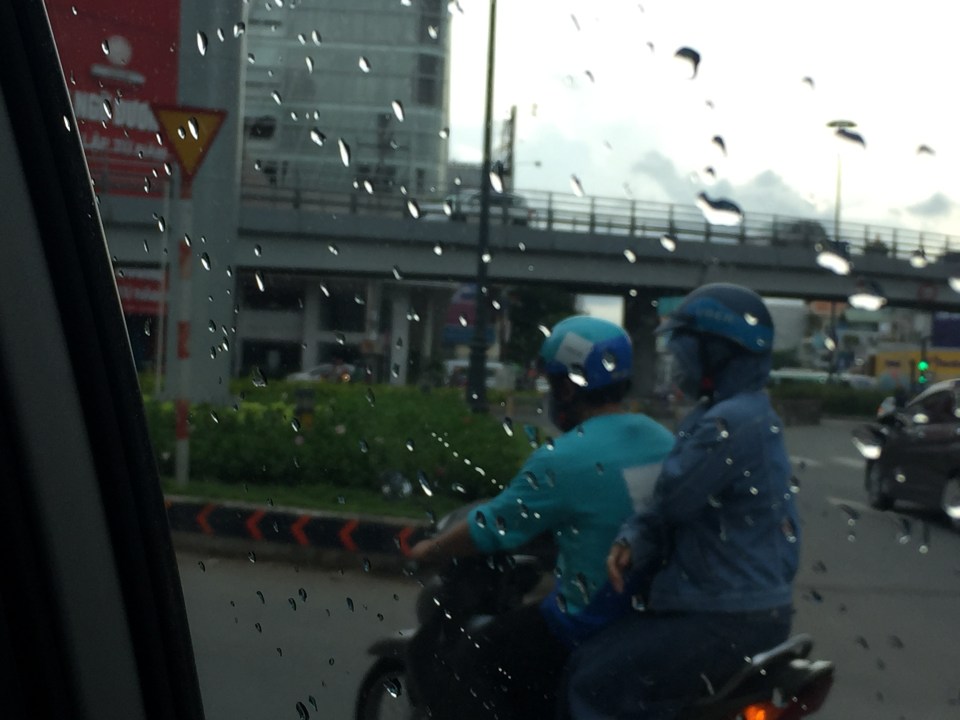 Uber moto is among the most popular options for the ride sharing app
 Grab is also popular and the photo shows people wearing other helmets that may be about other companies facilitating motorcycle taxis
 Uber has a motorcycle taxi option in its app in Vietnam. This is a screenshot I took as I loaded their promo code for our conference (Uber was a major sponsor.).
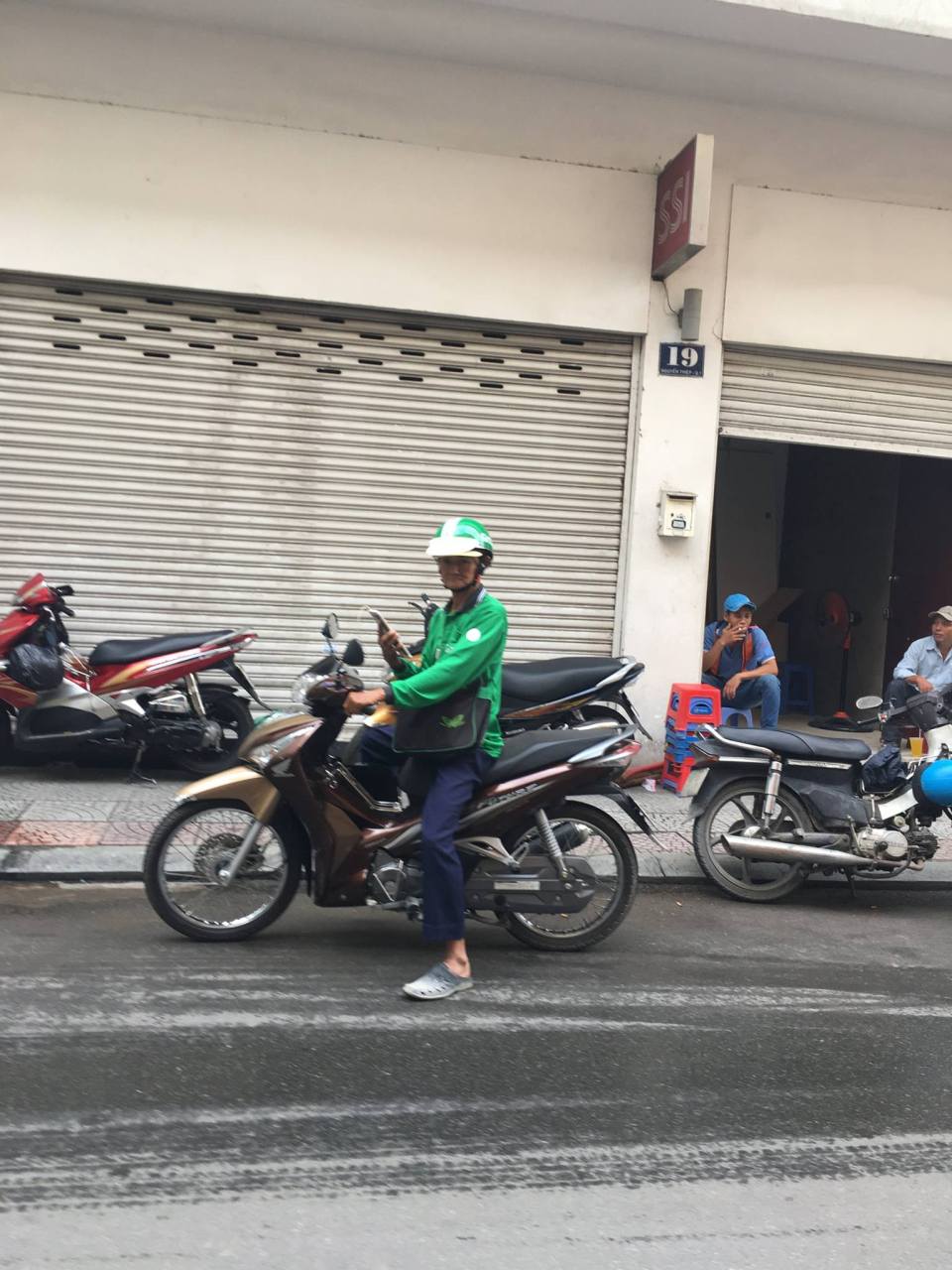 Grab moto rider browsing for his next passenger
Vietnam has shown that motorcycle taxis can be both popular while being regulated and relative safe (there are tens of thousands of motorcycles moving around their cities including Hanoi and Ho Chi Minh). Should the Philippines, particularly Metro Manila, also consider this at least while it is building more mass transit lines? Again, this is not for everyone and perhaps can help alleviate the worsening transport and traffic conditions in the metropolis. Of course, there are the expected implications if motorcycle taxis are legalized including a further surge in motorcycle sales and ownership and, more troubling, the likely increase in the number of crashes involving motorcycles (hopefully not the fatal ones). But then again, the reality is that there are already motorcycle taxis operating around Metro Manila with upstart Angkas operating against the wishes of the Land Transportation Franchising and Regulatory Board (LTFRB). It is more advantageous to recognize these and perhaps allow Grab and Uber to offer them as options. That way, LTFRB can formulate and issue the necessary rules and regulations covering these and be able to monitor as well as make companies providing them answerable to the public for concerns such as safety and fares.
–
On motorcycle taxis becoming the “new king of the road” (cont.)
This is a continuation of the yesterday’s post on motorcycle taxis. The feature appearing in Sunstar Philippines also focuses on the case of Cebu City where there is a rising demand for motorcycles and issues on public transport have given rise to a motorcycle taxi use despite their being basically illegal under current laws/guidelines. Habal-habal as these motorized 2-wheeler taxis are known have been in service in many cities and municipalities but are mostly tolerated in rural areas where conventional public transport services are scarce.
Part II of the feature by Sunstar:
New King of the Road – Part II
There are three articles in Part II:
Ramirez, J.A.C. (2017) Motorcycles on the rise, Sunstar Philippines, Retrieved from: http://www.sunstar.com.ph, April 4.
Ramirez, J.A.C. (2017) Habal-habal drivers form group to ‘professionalize’ services, Sunstar Philippines, Retrieved from http://www.sunstar.com.ph, April 4.
Ilano, M.V. (2017) Hailing a motorcycle taxi with your smartphone, Sunstar Philippines, Retrieved from http://www.sunstar.com.ph, April 4.
Part III of the feature by Sunstar:
New King of the Road – Part III
Ilano, M.V. (2017) Even with BRT, motorbikes still needed in Cebu City, Sunstar Philippines, Retrieved from www. sunstar.com.ph, April 4.
Ilano, M.V. (2017) Will Cebu City lead the way?, Sunstar Philippines, Retrieved from http://www.sunstar.com.ph, April 4.
I hope these articles on motorcycles and motorcycle taxis will generate meaningful discussions pertaining to their applications and perhaps their regulation. One issue, of course, that should definitely be on the table is safety. That is non-negotiable and assurances by motorcycle taxi transport providers should not be enough to persuade their becoming formalized as a public transport mode. The basis for mainstreaming these should be evidence-based including assessments based on crash (accident) data. Here is something that can be studied by the various schools around the country especially universities that have the capacities and capabilities to conduct such studies in aid of policy formulation at the national and local levels.
–
On motorcycle taxis becoming the new “king of the road”
There is a really nice feature on Sunstar about motorcycle taxis that came out today. This was shared by a good friend on his social media account, which got my attention as we just completed a study on motorcycles last January 2017. Here is the feature:
Part I includes two articles:
Ilano, M.V. (2017) Habal-habal invades cities, Sunstar Philippines, Retrieved from http://www.sunstar.com.ph, April 4.
Anunciado, D.D. (2017) Deadly motorcycle rides, Sunstar Philippines, Retrieved from http://www.sunstar.com.ph, April 4.
Here’s a graphic from the second article that says a lot about motorcycle safety in Metro Manila:

I would just like to comment that the graphic shows MMDA-recorded crashes in Metro Manila. There can be a lot of incidents that went unrecorded or unreported with the MMDA. It would be interesting to check with the local government units about their own statistics and compare these with the MMDA’s. Also, “crashes” is the preferred term over “accidents” as road safety practitioners and advocates argue that these are preventable incidents.
Sadly, such statistics can only be shown by cities doing the diligent work of recording such incidents. The Department of Public Works and Highways (DPWH) has already ceased collecting, processing, analyzing and reporting road crash reports many years ago (which is quite surprising for an agency mandated to plan, design, construct and maintain national roads). There is currently no agency (no, the Department of Transportation (DOTr) has not yet taken over the enormous task) that is collecting, processing, analyzing and reporting on road crashes at a nationwide scale and few LGUs do so at their levels.
I will also post about Part II once its out. There is a preview of what articles will be in the next feature and so that is something to look forward to.
–
Habal-habal and skylab in Surigao Del Sur
Following are more examples of motorcycle taxis from our recent study. The photos were taken at a terminal in a town in Surigao Del Sur. Both habal-habal and Skylab were there waiting for passengers to transport to the barrios.
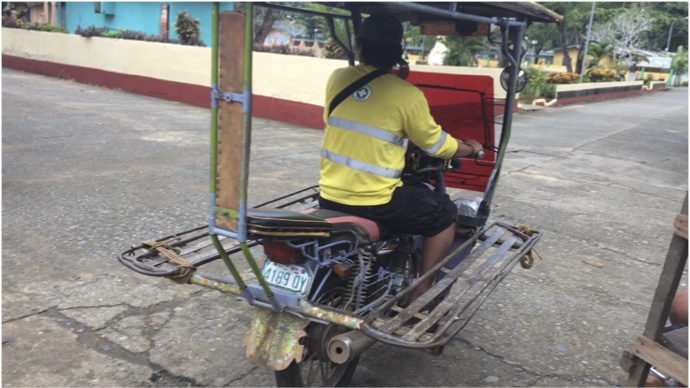 Skylab with roof integrated with the extensions
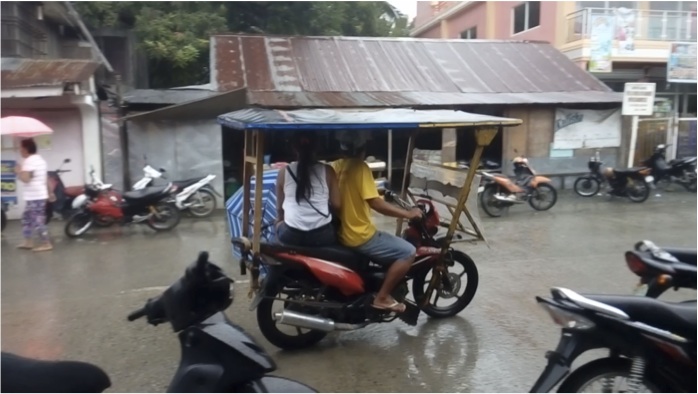 Habal-habal with makeshift roof
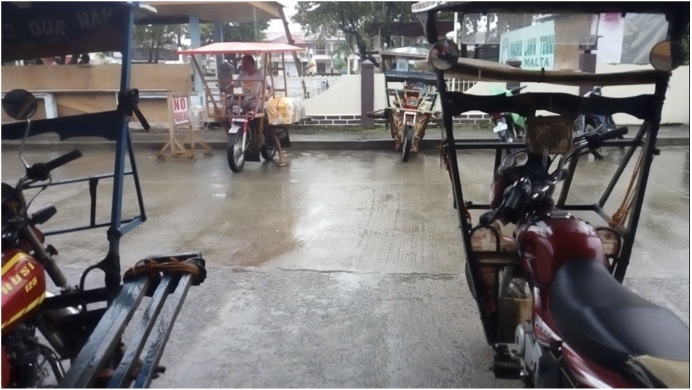 Haba-habal and skylab at terminal in Tandag, Surigao De Sur
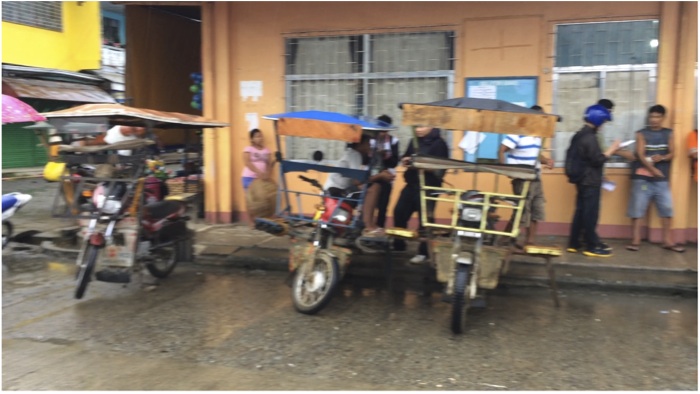 More motorcycle taxis at the terminal
Note that many have roofs and these appear to be especially fabricated for either type of vehicle. In the case of the Skylab, the roof is connected to the extensions on either side of the motorcycle similar to how sidecars of motorized tricycles are fabricated to integrate a roof for the driver. While there are similar set-ups for habal-habal, many are more makeshift where the canvass roof’s columns are made of wood or even bamboo and are tied to the motorcycle.
–
Habal-habal in Agusan
The initial part of our research on motorcycle taxis has been completed last December 2016. We are currently drafting a paper for submission to an international conference to be held later this year. The paper contains the outcomes of the surveys undertaken in Surigao Del Sur, Agusan Del Norte and Metro Manila. These include a profile of motorcycle taxi drivers and vehicles that gives us a good idea of how much these people earn and the typical range and loads (passengers and goods) they carry.
Following are photos of motorcycle taxis in Agusan. I won’t post too much detail on the net income of drivers/operators but I guess they earn enough (some even more) given the typical cost of living in these areas where they operate. Motorcycle taxi drivers/operators actually are part of the so-called underground economy where, despite the work and income, people don’t pay their taxes like regular employees or professionals at various workplaces.
[All photos courtesy of Mr. Sherman Avendano of the National Center for Transportation Studies]
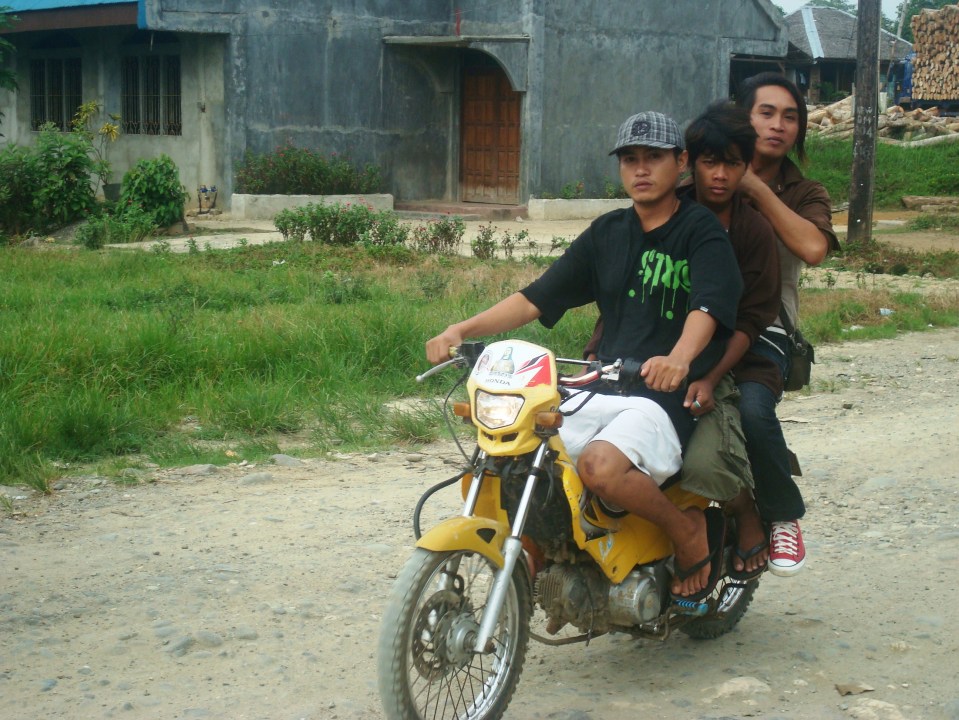 Typical habal-habal with 3 passengers
 “Skylab” with roof – the planks or extensions on either side of the motorcycle are the main features of this motorcycle taxi.
 Typical rural roads in areas served by habal-habal are unpaved. These are muddy during the wet season and dusty during the dry season. As such, it can be a rough ride for those using motorcycles and perhaps even rougher by car.
 Habal-habal passing by a puddle on the road – the passengers are obviously children likely on their way to school based on their uniforms
More on motorcycle taxis soon!
–
Habal-habal in Metro Manila
I posted about our ongoing research on motorcycle taxis. One of our subject areas are Pasig and Taguig in Metro Manila. These would likely represent the urban motorcycle taxi operations that we wanted to document and assess. One terminal I specifically asked our staff to visit as part of the recon/pre-survey activities is located at Pinagbuhatan, Pasig City near where the Pasig River connects with the Laguna de Bay. It is along Circumferential Road 6 and, based on my observation, has transferred locations several times since C-6 was being widened and paved.
 This is the terminal at Pinagbuhatan, Pasig City along C-6 and near the Napindan Ferry Terminal.
 The current terminal stands along what used to be the older C-6 lane. The newer paved section of the widened C-6 is shown in use. It used to be closer to the bridge that crossed the Pasig River and near the Napindan Ferry Terminal.
 The habal-habal riders and operators have an organization and are generally tolerated by the local government. Unlike their provincial “relatives”, they usually only take one passenger seated at the back of the rider. Two passengers are not unusual or irregular especially if one is a child.
I will post about the characteristics of habal-habal operations soon. However, I don’t want to preempt the research we are doing so I would also prefer that we submit our report first and maybe even submit a paper or two for publication before I post them here. Among the things we have obtained so far are video recordings of what its like to ride these motorcycles. We used an action camera mounted on the rider’s helmet for this purpose. Our staff also did a quick interview of the service providers and will be doing a full survey soon to get substantial information for our research.
–
“Semplang” – motorcycle self accidents
There is a Filipino word used for falling by yourself for whatever reason or factor – semplang. The term applies for those riding a bicycle or motorcycle where a person has basically no one to blame but himself/herself for falling. Of course, there will be factors like weather and road conditions. Wet, slippery roads can be very treacherous. So are roads with potholes and/or open manholes. In most cases, however, the rider’s skill more than the other so-called factors that could have affected his movement and balance.
 This is a case of a motorcycle rider losing his balance. I know because this happened as the motorcycle rider made a U-turn right in front of my vehicle at the slot across BF Steel in Cainta.
I am not certain about the condition of the rider in the photo above. While he looked shaken up (surprised?) by the incident, it did not seem to me as if he was moving abnormally (i.e., intoxicated or disabled). Perhaps its his skill that led to this? Such could not have been the case if he had sufficient training and experience and properly licensed to ride a motorcycle. Sadly, a lot of motorcycle riders are not well trained and gain skills only from experience. Yet, there are many who ride like they are stuntmen, often risking their lives and limbs as they maneuver (weave) through traffic.
–
Skylab – motorcycle taxi
We are currently doing research on motorcycles and a major part of the research is on motorcycle taxis. Motorcycle taxis are popular in many areas in the Philippines despite national and local government agencies have not sanctioned or legalized their operations. There are two popular versions of the motorcycle taxis – the habal-habal and the Skylab. Both are basically motorcycles with some add-ons to increase passenger capacity or to be able to carry more goods or cargo.
The habal-habal is carries all passengers or cargo on the motorcycle with some variants having a plank for extension to the back or a customized seat over the gas tank that is usually for children. The Skylab owes its name from the US satellite that fell to the earth in the 1970s. The shape of the satellite inspired innovative extensions along each side of the motorcycle. This enabled riders to take in triple the number of passengers they could with the habal-habal set-up. Both have variants with roofs.
The following video shows a Skylab in Surigao Del Sur care of a very good friend, Dr. Alex Ladaga of Surigao Del Sur State University, whom we are collaborating with in this research:
More on these motorcycle taxis soon!
–
 Caught (up) in traffic