
Home » Posts tagged 'policy' (Page 7)
Tag Archives: policy
On electric vehicles not being the fix we need for transport
Much has been said and written about how electric vehicles could be the game changer for transport. Those include supportive material and also those that are more critical and provide different perspectives to EVs. Here is another article that discusses EVs in the context of the avoid, shift, improve framework:
O’Riordan, V. (November 30, 2021) “Electric vehicles aren’t a fix for carbon emissions. These 3 things need to change—fast,” Fast Company, https://www.fastcompany.com/90700832/electric-vehicles-arent-a-fix-for-carbon-emissions-these-3-things-need-to-change-fast [Last accessed: 12/17/2021]
There’s a recent article about the environmental impacts of manufacturing EVs including the batteries used by these vehicles. I will share that in another post.
–
Lessons to be learned about e-scooters
I recently wrote about e-scooters and I am sharing this article on the experience of Chicago from their pilots of this emerging new mobility option.
I won’t be offering much in terms of opinions at this point as there really hasn’t been much about e-scooters at present in the country. You see them every now and again but not as frequently as motorcycles and bicycles. There seems to be something about them on social media but out on the road, they are not yet significant in terms of volume but are a concern regarding safety.
–
TSSP 2021 [27th Annual Conference]
The Transportation Science Society of the Philippines (TSSP) held its 27th Annual Conference last November 19, 2021. Here are the poster and program for the conference:
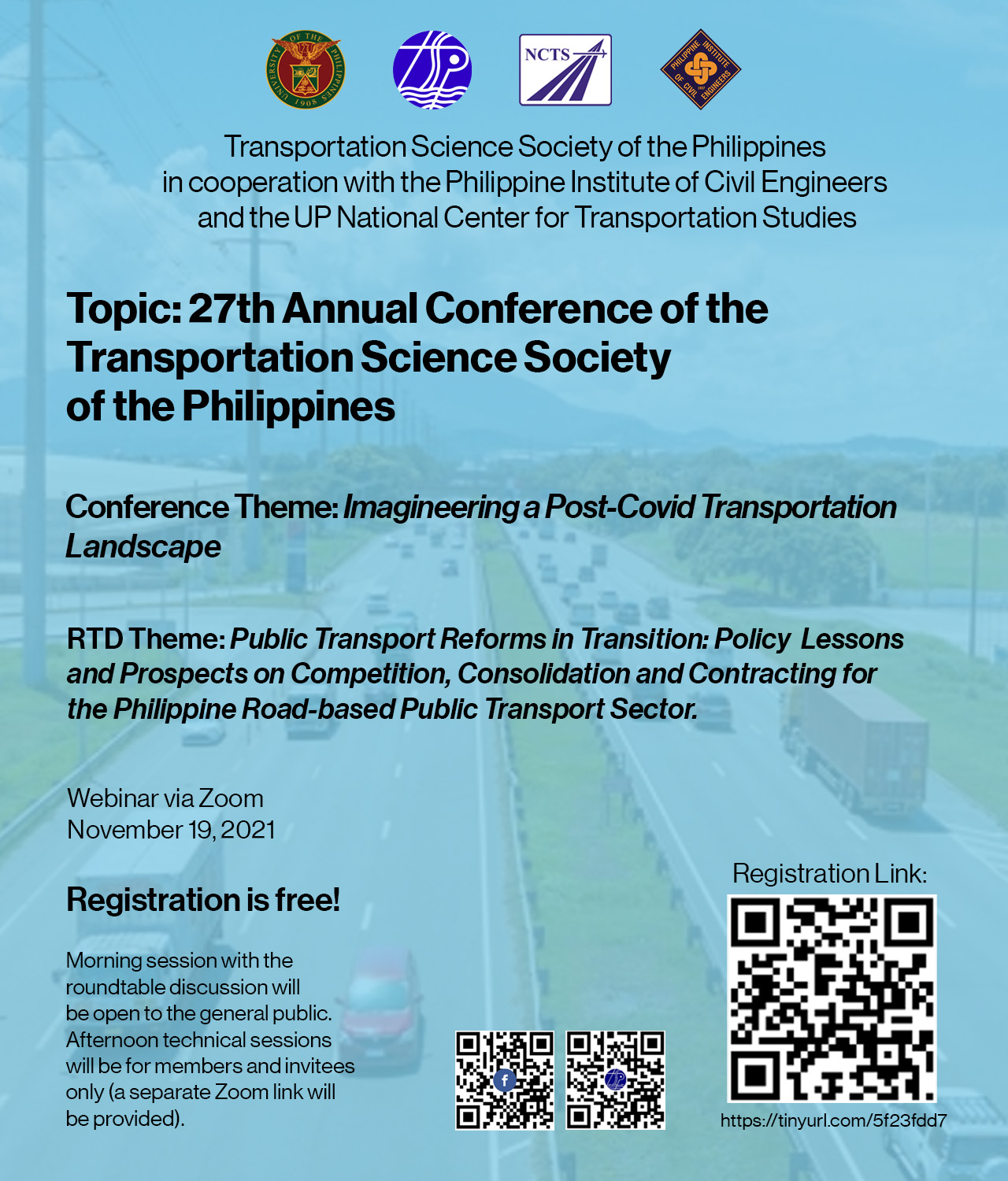
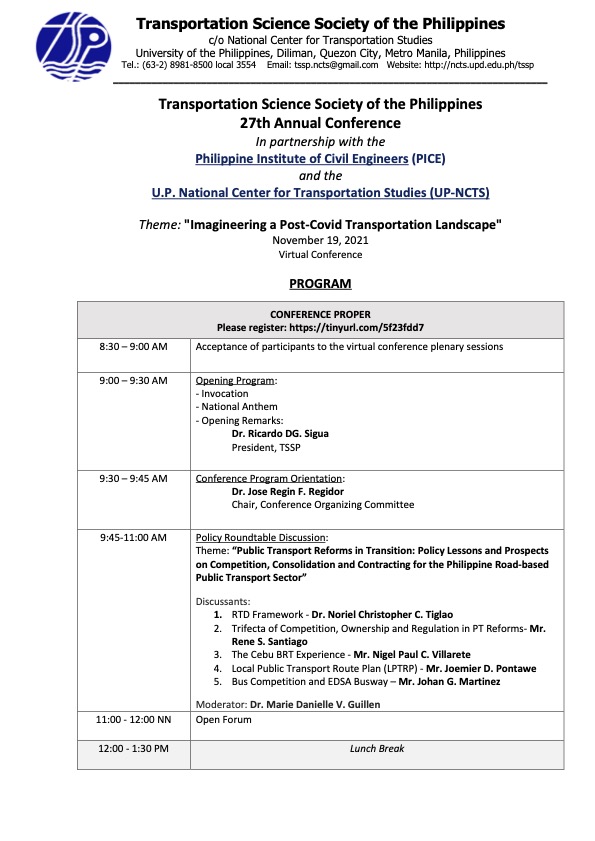
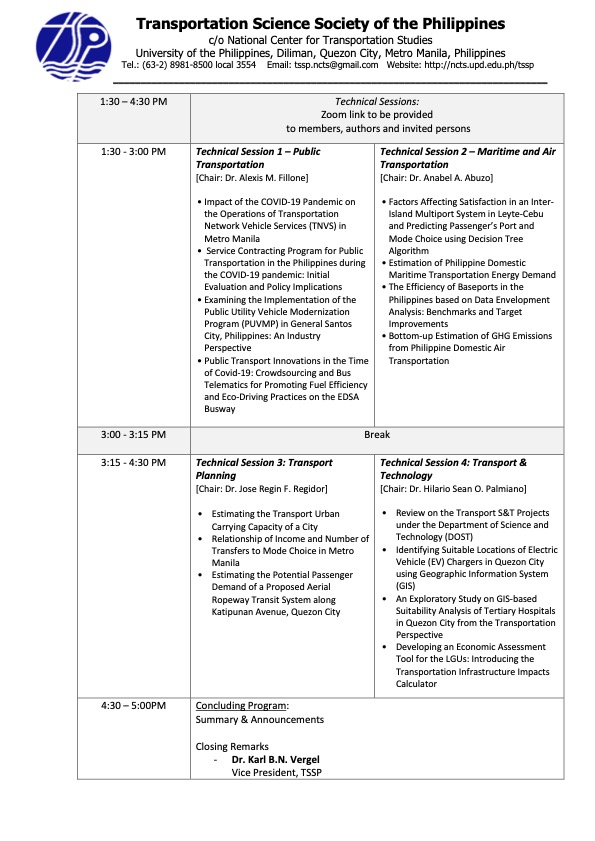
I initially intended to write about the conference before it was held but things got pretty busy last week so this is a post conference write-up. The organizers also announced the final program late (i.e., just a few days before the conference proper) so it seemed sort of anti climactic to post about it. Nevertheless, the conference proceeded as planned and the TSSP has announced it will be posting the proceedings on their official website. It is not yet there but here’s a link to the TSSP official website: http://ncts.upd.edu.ph/tssp/
–
On the key transformations needed to achieve sustainable, low carbon transport
Also related to COP26, I am sharing material from the Sustainable Low Carbon Transport (SLOCAT) partnership, of which our center is part of. SLOCAT recently released the 11 key transformations for sustainable low carbon land transport urgently needed to meet the climate targets. Here’s a link to their site:
SLOCAT also has the following Wheel of Transport and the Sustainable Development Goals (SDG’s) on the same site. The Wheel illustrates the four cross-cutting themes: equitable, healthy, resilient and green.
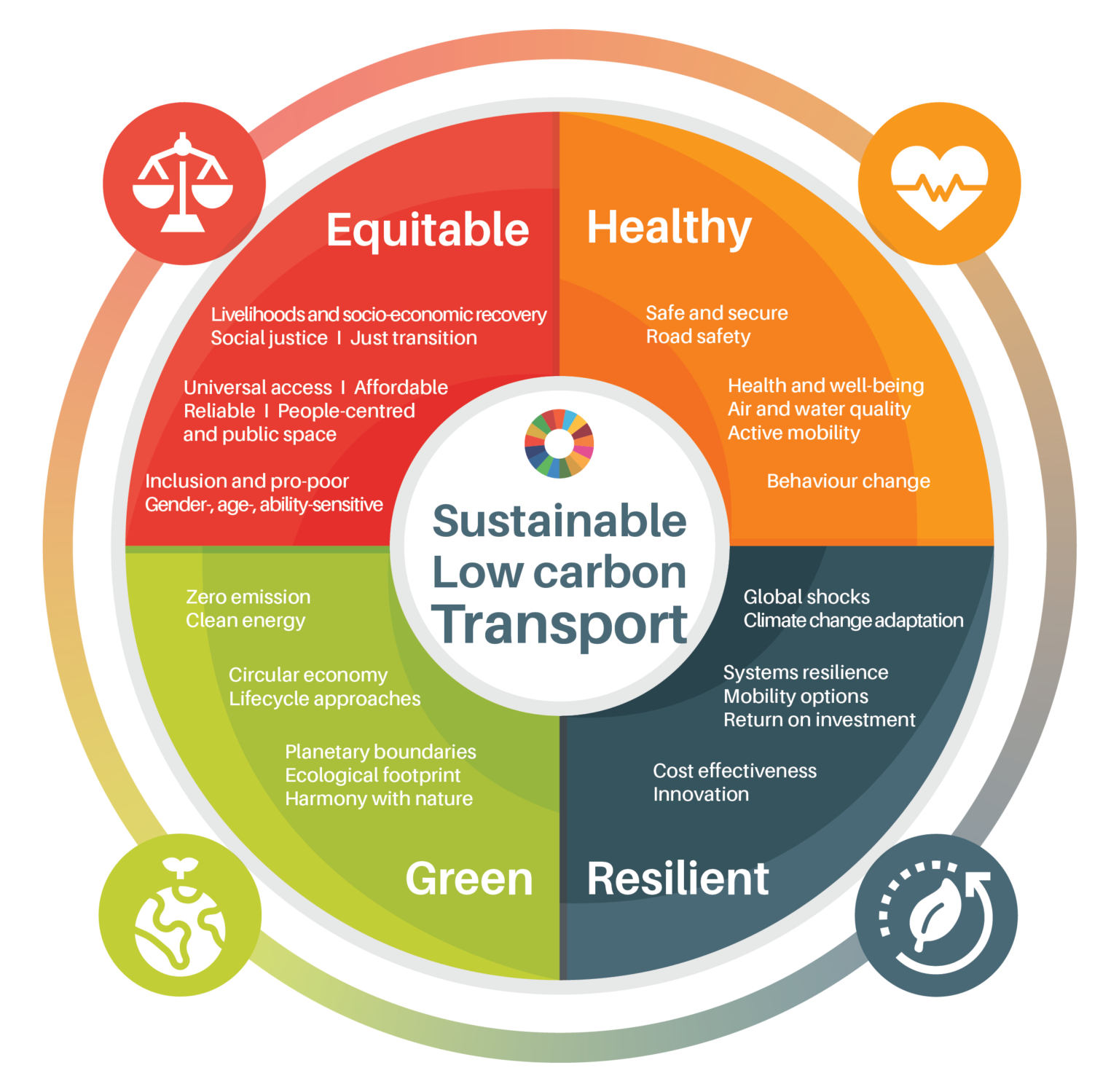
In the SLOCAT site, they list the following to support the transformations:
Overarching approaches to apply across transport modes and sub-sectors overtime
- Put people first, not vehicles and technology
- Co-create and communicate a compelling vision and targets
- Guide short- and medium-term action with clear, coherent political messages
- Combine push and pull measures: Regulate and incentivise
- Link policies within and beyond transport for synergies
- Prioritise resources by social and sustainable value for money
- Engage, empower and coordinate stakeholders across government levels and sectors
- Build capacity and improve data
- Implement pilots to learn and share, then roll out at scale
–
Parking: minimum or maximum
The National Building Code (NBC) of the Philippines stipulates the minimum number of parking spaces or slots per type of establishment and intensity of development (i.e., according to area or other parameters). These established provisions are generally called parking minimums. The NBC’s provisions are already archaic by current standards and need to be revised but not in the way it was apparently developed. The NBC needs supporting evidence from studies (are there any dependable ones around?) on parking requirements including those for bicycles and motorcycles. These should clearly not include or impede the requirements of pedestrians. And local government units must be required to enforce these NBC provisions.
Here is an article that discusses the proposal for new limits on parking, particularly in large developments in Boston, Ma. in the US:
The article points to this one:
City of Boston (September 20, 2021) Maximum Parking Ratios, https://www.boston.gov/departments/transportation/maximum-parking-ratios [Last accessed: 10/19/2021]
I must admit that I still have to do a lot of reading on this. There are some who are calling for the abolition of parking minimums but you just can’t do this so abruptly without understanding the context and current set-up. We are not Boston or San Francisco or Hong Kong or Singapore in terms of the transport infrastructure and services and the progressiveness of policies including those governing or covering housing and other factors that come into play with transportation. Sprawl and the resulting pressures (requirements for efficient travel) on the transportation system is not transport’s fault or responsibility alone like what some articles or infographics make it appear to be. It is very much about land use and land development, and the policies and the political economy behind these developments.
–
On the 12 global road safety performance targets
The UN recently released the Global Plan for Road Safety. I’m just sharing their graphic on the global road safety performance targets:

I will try to discuss each one in future posts especially as I am involved one way or another in trying to realize these targets. Note, too, that these targets are further categorized among the five pillars mentioned at the foot of the graphic. These are (1) Road safety management; (2) Safer roads and mobility; (3) Safe vehicles; (4) Safe road users; and (5) Post-crash response.
–
We need to do more to reduce transport emissions
I did some work on long term action plans on low carbon transport for the ASEAN region before. We were able identify many of interventions that were being implemented as well as those that can be done to reduce transport emissions. Such reductions for the region would ultimately contribute to alleviating global warming. Unfortunately, while ASEAN is a significant contributor to emissions, it pales in comparison to emissions by individual countries like China and the US. If these two and others in the industrialized world do not commit to reducing their emissions, all work will come to naught. Here is an article that serves as a pre-event write-up for COP26, a major climate summit that will be held in Glasgow in the coming days.
–
Is it difficult to understand the phenomena of induced demand?
I’m sharing a recent article that laments about how transport departments in the US seemingly don’t understand the concept and phenomena of induced demand. Is it really difficult to understand or are transport officials including highway planners and engineers deliberately ignoring what’s staring them in the face?
Zipper, D. (September 28, 2021) “The Unstoppable Appeal of Highway Expansion,” Bloomberg City Lab, https://www.bloomberg.com/news/features/2021-09-28/why-widening-highways-doesn-t-bring-traffic-relief [Last accessed: 10/10/2021]

The topic in the article is very much applicable to our own Department of Public Works and Highways (DPWH). The DPWH’s key performance indicators (KPIs) need to change from the typical “kilometers of road constructed” or “lane-kilometers of roads widened” to something like “travel time between points A and B”. Agencies like the DPWH always like to claim they are for solving traffic congestion but we already know widening roads just won’t cut it. It has to be more comprehensive than that and involve the entire transport system rather than just a part (i.e., the road). And it has to be a collaborative effort with various other agencies like the Department of Transportation (DOTr) and local government units. Unfortunately, too, these agencies like the DOTr and those under it, and many (not all) LGUs also like to go at it solo so we end up with piecemeal solutions that are also often out of context.
–
On electric vehicles in the Philippines – current situation and prospects
Here’s a quick share of an article on electric vehicles in the Philippines:
Fernandez, H.A. (September 7, 2021) “Electric vehicles in the Philippines: a mottled green solution,” Eco-Business, https://www.eco-business.com/news/electric-vehicles-in-the-philippines-a-mottled-green-solution/ [Last accessed: 9/8/2021]

It is interesting that the article cites past studies that covered not just e-vehicles but the bigger picture for transport. I think most if not all people who were doing work on low carbon transport including the modeling of scenarios for the long term were not able to anticipate something like Covid-19 disrupting activities around the world and curbing emissions so drastically in the last year. The so-called ‘old normal’ situation has not returned but some say that even with the pandemic affecting transport, we still won’t be able to attain the targets necessary to stave off global warming. The bottomline is that we need more aggressive actions and probably, shifting to e-vehicles is one of those that combined with others will help achieve targets.
–
On current health protocols applied to public transport
The current surge of infections attributed to the Delta variant of Covid-19 has been alarming. The recent quarantine issuances by national government have not been effective as there was basically lax enforcement or implementation. Granted, there were just a lot of loopholes designed to allow so-called “economic frontliners” to go to work and under conditions that made their commutes risky in the context of the pandemic. The same laxity and loopholes apply too, to people who have no business roaming around and yet travel with their motor vehicles (especially motorcycles) and bicycles across cities, towns and provinces in the guise of exercise or essential travel.
Meanwhile, the practice and enforcement of public health protocols in the country has been lax and misguided (e.g., do we really need to wear face shields?). In public utility vehicles, people are now crowding inside with usually only a sheet of plastic separating one from another. This is not exactly reassuring in as far as spreading the virus is concerned. And we shouldn’t pretend that we are not aware that there are asymptomatic people going around and infecting others whether knowingly or not. It’s no wonder, really, why people who have the private vehicle or active transport option use these instead of public transport.


Much has been said about government failing to address the Covid-19 pandemic from the start. And it continues to bumble through this health crisis (if you don’t want to call it one then either you don’t understand the gravity of the problem or just refuse to do so – the latter is worse). Tagging workers as ‘economic frontliners’ is probably at least as bad as calling BPO workers ‘Bagong bayani’, adding them to the Overseas Foreign Workers (OFWs) who had been branded as so in the past. This becomes a convenient excuse to ease health-related restrictions for people to travel/commute to work. It is a form of gaslighting the very same workers to believe they need to go out and work. Meanwhile, precious funds are being diverted elsewhere including the dolomite beach at Manila Bay and money spirited away in preparation for next year’s elections.
I got it from recent surveys that people give a higher priority to employment and earning income over Covid-19. Perhaps most have not had direct experiences with the frightening cases of Covid-19 (i.e., they’re asymptomatic or have encountered only asymptomatic cases with friends and families). I hate to say it but it seems like the same thinking pertaining to extra judicial killings (EJK). I can already imagine hearing the usual comments: “Malayo sa bituka.” “Wala akong pakialam diyan.” “Okay lang yan. Hindi naman kami apektado niyan.” These comments reflect an absence of empathy. Empathy I think is very much needed today in order for people to understand what’s going about. And that’s not just about us but businesses as well that definitely, likely lost a lot during this pandemic but still need to empathize if not call out those who are really responsible about the mess we are in. Do your employees really need to go to the office? Or can they continue working from home? The answer to these questions affect commuting in the time of Covid-19 and relates strongly to the protocols applied to public transport.
–
 Caught (up) in traffic