
Home » Posts tagged 'politics'
Tag Archives: politics
Some thoughts and reflections on transport and the Middle East crisis
Much has been said and written about the ongoing crisis brought about by the US and Israel attacking Iran and the latter retaliating. The prices of fuel have risen rapidly over the past weeks. Consequently, the prices of commodities have also risen. The Philippines is still very much dependent of fossil fuels for transportation with most travel using road-based transport. Even public transportation relies heavily on fossil fuels as buses and jeepneys are mostly using diesel engines. Even paratransit such as trikes and motorcycle taxis use gasoline.
While the energy mix in the country has become more diversified with renewables now having a substantial share, majority of power is produces using coal and natural gas. And so e-powered vehicles are also ultimately dependent on these fuels. Could we have had better transport that could have made our cities more resilient in light of the conflict in the Middle East? Probably, and if we followed and implemented the plans for mass transit systems that were laid out decades ago. Of course, this is already moot and academic given the current situation. The counterfactuals though point to better commuting conditions if projects have not been delayed or shelved.
A colleague and I were just discussing about how MRT 7 could have contributed to the reduction of car use along the Commonwealth Avenue corridor if it was completed according to the original schedule. That was 2019. Even with delays including the impact of the pandemic, it could have been completed a few years ago. If it was operational in 2023, commuters could have already shifted to rail from both private and public road-based transport modes. There was also actually a proposal for a Bus Rapid Transit (BRT) line along Commonwealth about 2 decades ago. That could have been constructed and operational ahead of Line 7 and could have already disrupted commuting preferences along the corridor if it were operated as a true BRT.
There’s just a lot of opportunities already missed that could have alleviated the fuel crisis we have now. Maybe we are really heading towards a bigger crisis when all these price increases lead to a more sweeping increase in the prices of commodities? We hope it doesn’t come to that but we seem to be helpless in this situation where we are caught unprepared for a war we are have nothing to do with.
–
More garbage along our streets
Election Day approaches in the Philippines and despite certain rules that are supposed to be in place and followed by candidates and their supporters. Enforcement from the COMELEC is really bad (and that’s the truth everywhere around the country). Otherwise, we’d have a lot of disqualifications every election and perhaps many incumbent politicians won’t be able to run for office. Here are a few examples in my home city of Antipolo in Rizal where a dynasty “rules” and also has connections with another family in Cavite.
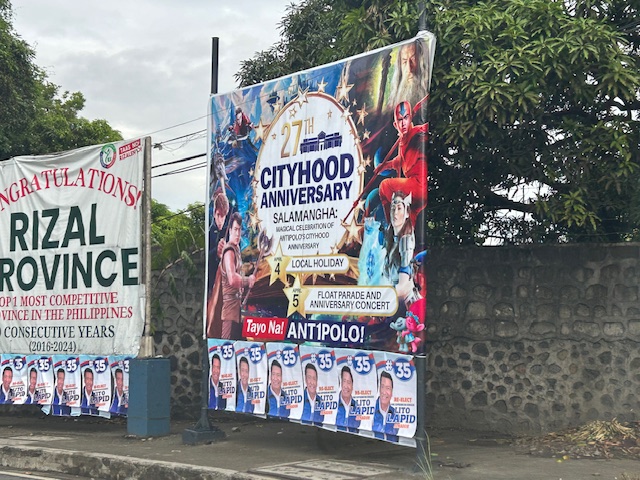 Antipolo’s city hood anniversary tarp features a Cavite politician who is closely related to the current leaders of the city and the Province of Rizal. Below the tarp are posters of a Pampanga politician who is also a movie actor like the other guy.
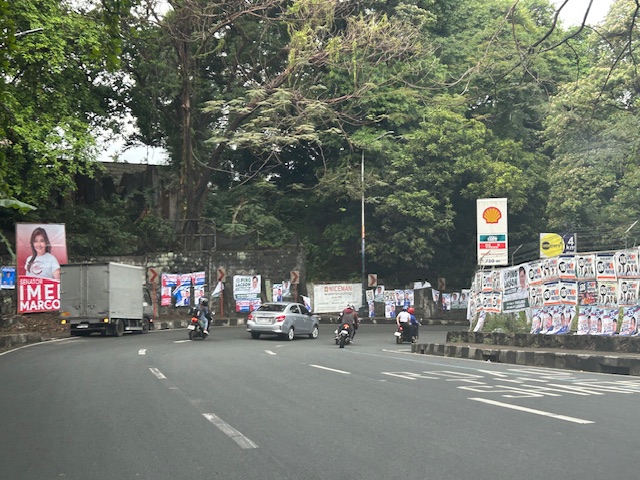 Antipolo roads are full of these campaign materials. Supporters have not spared private property of the garbage.
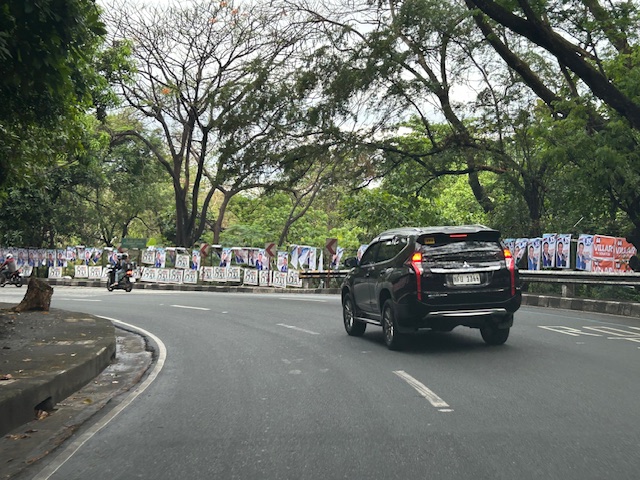 Perhaps those who will do the Alay Lakad to Antipolo this coming Maundy Thursday should each remove a poster, tarp or more as they journey to the Shrine of Our Lady of Peace and Good Voyage. This could be part of their penance and serve also as cleansing of minds in preparation for elections.
Try to explain again how these politicians are not overspending (and probably charging the costs to taxpayers). The math is pretty easy. You can check how much a politician’s monthly income is based on the salary grade of the position he/she is running for. Compare that to the amount spent for his/her campaign. You can’t recover the amount spent in one term. Are they billionaires willing to part with their money to get elected to positions that demand a lot in terms of the competence and dedication to good governance. Rather, the suspicion is that politicians will likely be corrupt and get his/her money back in a variety of ways to recover millions or even billions spent. It’s really a vicious cycle that doesn’t end well for the Filipino people in terms of the infrastructure and services we could have if only politicians moderated their greed.
–
Neutrality for public utility vehicles
I had written recently about how politicians are now using public utility vehicles for their premature campaigns. Promoting themselves illegally and ahead of the official campaign period. Today, I saw many modern jeepneys bearing posters of various politicians and party lists. Many of these PUVs are either private companies or cooperatives (i.e., in the case of modern jeepneys). I will not post their photos here as I don’t want to be inadvertently promoting these people and party lists. Instead here is an example of public transportation that does not promote any particular person or personality but instead speaks for a program that’s contributing to improve the commutes of people:
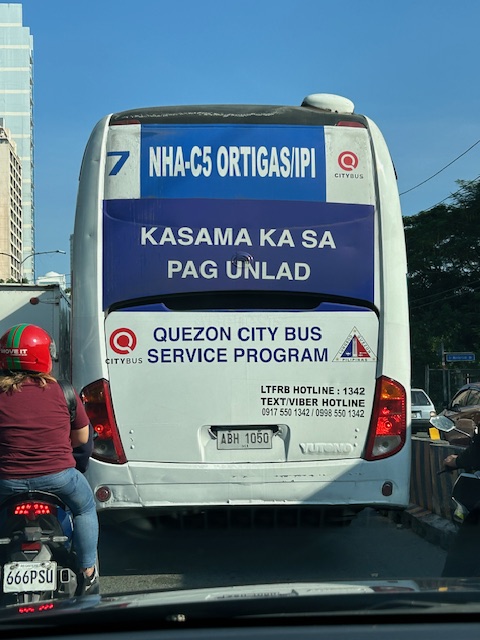 Quezon City’s buses don’t have any campaign materials posted on them.
Quezon City’s Bus Service Program is a good example of how a local government unit that has resources and the capability can help provide public transportation services to its constituents. It is a good example of what LGUs can do if they have the will, the capability, the capacity and the guidance for such initiatives. Of course, they should have good leaders who will support these endeavors and who do not have to put their faces and names on these programs.
–
Are transportation issues election issues in the Philippines?
Are transportation issues in the Philippines? Or are these issues at the local level? Here is an article about how transportation issues were brought to light and were actual topics in the ballot in Los Angele, California in the US:
Tu, M. (November 25, 2024 ) “Bike, Bus and Pedestrian Improvements Won the Vote in L.A. How Did Advocates Pull It Off? “ Next City, https://nextcity.org/urbanist-news/bike-bus-pedestrian-improvements-healthy-streets-los-angeles-ballot?utm_source=Next+City+Newsletter&utm_campaign=532838ef65-DailyNL_2024_11_18_COPY_01&utm_medium=email&utm_term=0_fcee5bf7a0-532838ef65-44383929 [Last accessed: 11/26/2024]
The three lessons in the article are:
- Build a coalition – “In the lead-up to the election in March, Streets For All successfully secured endorsements from unions, climate organizations and business groups that saw the vision for safer streets.”
- Safety wins – “We could make climate arguments, we could make equity arguments, but the thing that felt the most bulletproof to us and the most empathetic to the general Angeleno was just road safety,”
- Keep it simple – “…simple messages were the most effective. Vredevoogd fought for one billboard on Vermont Avenue that read “In 2022, more pedestrians died on Vermont Avenue than in the state of Vermont.”
Los Angeles or LA as many people fondly call the city is well known for being car-centric (as opposed to San Francisco to the north, which is more transit-oriented). Perhaps we can learn from this experience though I know there are already groups and coalitions lobbying for better transportation in the Philippines. Are they successful and to what extent are they succeeding? Granted there are different situations and conditions, even modalities, to engage politicians, there are also so-called party list groups claiming to represent the transport sector but none appear to be really standing up for issues like improving public transport or road safety. And so the challenge is still there for people to make transportation issues election issues in the country.
–
Campaign garbage
Politicians have used various media to further their personal interests and aspirations. Foremost perhaps of these interests and aspirations is getting elected. More effort it seems goes to promoting themselves however they can. While its months away from the campaign period, there are already a lot of campaigning going on with what I perceive as hard sells already having a head start when they shouldn’t be doing so at this time. You see the likes of Abalos, Marcoleta and Lee whose faces are scattered among buses, bills, billboards and tarps. And then there are the familiar names including re-electionists and relatives of incumbent or outgoing officials also ‘reminding’ people of their candidacies as if we owe them our votes.
Here is the case of this former mayor of Metro Manila City who is also a former cabinet secretary who is aspiring to become a senator. His campaign materials are on buses, billboards and posters around the country. Samahan daw nation sa Senado. Why? If he’s already doing something blatantly anomalous at this stage, I would not expect anything except more anomalies from him.
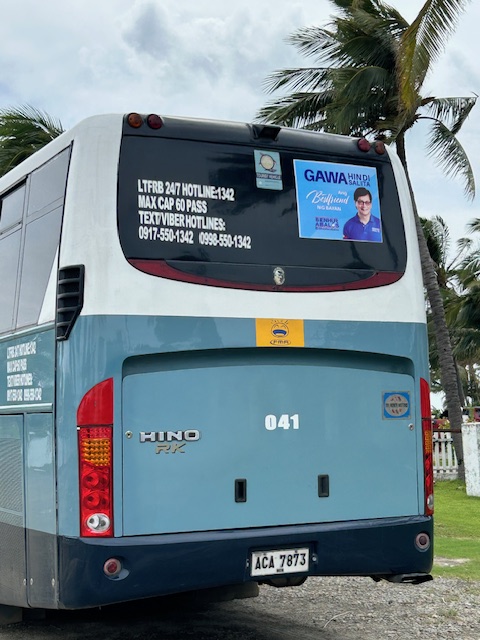
It is very frustrating that the Comelec is not doing anything vs. these premature campaigning, even stating that these are not illegal. Well, these definitely cost a lot of money. And how do you think these politicians will recover their ‘investments’?
I will post about these garbage in future posts. I just need to compile more examples to share here.
–
Political garbage along our roads
While it is not formally campaign season, you’ve probably seen all those ads, posters, tarps and other obviously campaign materials that have sprouted around the country. Even before the filing of COCs, there were already a lot of political garbage (as I refer to them) along our roads. Many that you see on large billboards promote their purported TV or radio shows. Others pretend to be concerned about your safety while traveling (e.g., “Ingat sa biyahe!”, “Ride safe!”, etc.).

The government, particularly the COMELEC, seems to be inutile and inept about these brazen, even flamboyant displays by politicians. And so we end up with a lot of literal and figurative garbage along our streets. These are the politicians that people continue to vote while stating they want changes and reforms in government and society. You vote for these clowns and you get exactly the misery and incompetence that dooms us especially during times of difficulties and calamities.
–
Is the concept of induced demand a hard sell?
Here’s a quick share of an article on ‘induced demand’ particularly why it appears to be a hard sell:
Blumgart, J. (February 28, 2022) “Why the concept of induced demand is a hard sell,” Governing, https://www.governing.com/now/why-the-concept-of-induced-demand-is-a-hard-sell [Last accessed: 3/8/2022]
To quote from the article:
“Transportation experts say that the way to defeat induced demand, and actually ease traffic, would be to price roadways through tolls and congestion fees. But such alternatives are not popular. It’s hard to imagine running a political campaign on such a promise, as opposed to pledging an answer that looks free and easy… “Highway expansion is an attractive project regardless of your political orientation or what the state of the economy is,” says Thigpen. “There’s always a good argument for why we should be expanding highways. We need more jobs, or we need to unlock economic opportunity. There’s always a good political argument in favor of that.”
That last statement there relating highway or road expansion to politics is relevant everywhere. In our case in the Philippines, politicians are perceived to be very conservative and the type to use road projects as accomplishments. They are not as progressive as politicians abroad who may have the backgrounds and/or advocacies relating to sustainable transport to pursue the more difficult programs and projects needed improve the transport system. Instead, most are content with projects that they can put their name on and claim as hard accomplishments. Many of their constituents appear to agree. And agencies like the DPWH are only too happy to support this never-ending road construction and widening projects with the length of roads and the number of lanes added being their metrics for success. Of course, these (e.g., understanding and how to address induced demand, performance metrics, etc.) need to change if we really want to transform our transportation system towards something more efficient for everyone’s benefit.


–
Placeholders and inheritors
[Notice to the reader: This post is not directly about transport or traffic.]
I like one post circulating in social media that is attributed to former Sen. Ramon Magsaysay, Jr. about the Vice President. I particularly like this part: “Did NOT choose to be a placeholder when her husband finished his term as Mayor in Naga.” If you do a scan of elected officials around the country, you can probably see how many if not most are held by political families. Even Marvel Comics recognizes this when they featured Filipino superheroes in an Iron Man series where the original team perished and was replaced by their children!
Placeholders are usually wives of politicians who have reached the maximum of their term limits. A mayor, for example, can only run for reelection twice for a total of 9 years continuously in power. After the nine years, he/she must step down to give way to a new mayor. Instead of honing someone competent from the other leaders in the local government (e.g., the vice mayor, a councilor, etc.). As they say, elective posts in the Philippines are family business and are often passed on to the next generation of what are termed as dynasties.
My most recent encounter with a “placeholder” was with the then Mayor of Tacloban City, Cristina Gonzales-Romualdez. She was on the second year of her term after she took over from her husband who was mayor for 3 terms (9 years). I must say that she had very competent staff and we thought they did their jobs well and for the benefit of many in Tacloban. And this was during the years immediately after the tragedy brought by Typhoon Yolanda (Ketsana).
Previous to that, we’ve also encountered or engaged with other local government units dominated by certain families. One town in Cebu even had the matriarch as mayor, the son as vice mayor and the uncles as councilors! The municipal hall had a portrait of the patriarch as a multiple term mayor in the recent past. You wonder if there were no other competent people in such towns and cities.
The next presidential elections will feature the son of a former dictator with the daughter of a current president as running mate. They are supported by other dynasties such those of two previous presidents including one who was been convicted of plunder but pardoned by his successor. He was allowed to run for president again despite the conviction as the Comelec failed to make a firm interpretation and stand vs. it. Now comes someone who believes he is entitled to the presidency despite also being convicted of tax evasion. While arguably a lighter crime, it is still a conviction and should mean he cannot run for the highest position in government. He’s also a fraud because he claims to have completed his education at a well known UK school when in truth he failed there. Would you trust a tax evader, fraud and one who does not admit guilt nor expresses regret or remorse for his family’s crimes with the presidency of the country? I certainly won’t and don’t!
–
What they are not saying about UTSMMA and Metro Manila’s first subway line
My social media feed is suddenly filled with shares of articles (the same PR text apparently) from the Department of Transportation, its Secretary and his fans and local rail aficionados about the progress of the Metro Manila Subway Project, which is dubbed as Metro Manila’s first subway line. While these posts start and appear as factual narratives, they are silent about certain facts that the writers conveniently did not include as part of their narrative. Perhaps it is because they are currently allied with the son of the dictator who decided vs. building what could have been the country’s first subway line and a game-changer for commuting in the metropolis.
UTSMMA or the Urban Transport Study in Manila Metropolitan Area was completed in 1973 and was immediately followed by a Feasibility Study on the Manila Rapid Transit Rail Line No. 1 that was completed in 1976. Here’s a nice render of a subway station platform from that FS:

Two things that need to be said:
- Marcos decided against the subway line in favor of LRT Line 1 after being heavily influenced by a World Bank report and the succeeding MMETROPLAN (funded by the WB). It is also said that he wanted to have the bragging rights to the first mass transit line in Southeast Asia but Singapore’s first MRT line would finish ahead of Metro Manila’s if the Philippines pursued the subway. The latter was a late and fateful decision because commitment to the RTR Line 1 could have been made earlier and construction could have started ahead of Singapore’s (and likely finished ahead if there were no major delays).
- The corruption during the Marcos dictatorship led to succeeding administrations including the current being saddled by debt and unable to put up major transportation infrastructure such as a subway line for decades (this is already well documented so denial or refusal to understand is the burden of the denier – no logic or fact can can probably change such people’s views or beliefs) without piling up more debt.
That said, I would caution vs. delaying the subway project any further. It is already almost 40 years since a subway was due and though the alignment is totally different from what was planned in the 1970s, there’s potential here to revolutionize how people will commute in Metro Manila. It will only become more expensive to build in the future.
–
Article on people-oriented traffic management
Here’s a quick share on a topic that is also very relevant especially for local government units – traffic management. To quote from the article:
“Today, when the mobility of Filipinos is severely constrained by limited public transport capacity, …and when there is heightened pressure for private vehicle use, there is no better time to re-orient traffic management in the Philippines in order to prioritize inclusive, efficient and environmentally sustainable travel modes. The crucial ingredient is not infrastructure but political will.”
Siy, R.Y. (January 8, 2022) “People oriented traffic management,” Mobility Matters, The Manila Times, https://www.manilatimes.net/2022/01/08/business/top-business/people-oriented-traffic-management/1828593 [Last accessed: 1/8/2022]
The article makes perfect sense as traffic management in the country has always been car-oriented including the strategies, policies, schemes, measures and others that have focused on facilitating private car travel over active and public transport modes. The challenge here is how to bring this up front and an election issue at both national and local levels.
–
 Caught (up) in traffic