
Home » Posts tagged 'ridesharing'
Tag Archives: ridesharing
On the rideshare competition among 4 and 2-wheeler companies.
Grab is the current market leader for rideshare or TNVS involving cars or 4-wheeled vehicles. Others like Joyride and Angkas went the way of legalizing motorcycle taxis. Grab applied for the same as they were already operating motorcycles for food and deliveries; competing with another company, Lalamove, which focuses on deliveries. Disallowed by the LTFRB to deploy MC taxis under their brand, they acquired Move It to circumvent the decision.
Meanwhile, as Grab continued their dominance of the rideshare market, the other players decided to offer some competition. I say ‘some’ because the perception is that they have not really gained much vs. Grab. You don’t see many Joyride taxis though a couple of companies appear to be making some impact – In Drive and Green GSM. The latter though is a taxi company that looks to attract people back to the conventional but app-enhanced taxi services
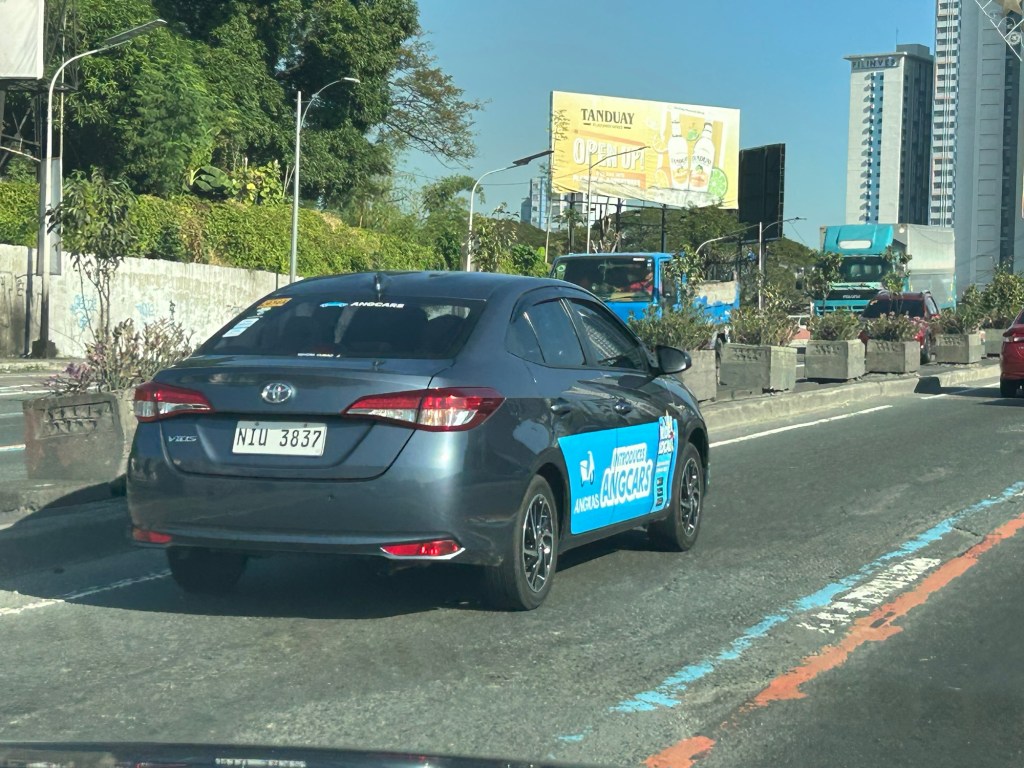
Last week, we saw this car with a familiar brand on its side. Sporting the colors and logo of MC taxi leader Angkas, they coined a brand for their cars – Angcars.
Whether people will take to these competitors for 4 or 2-wheelers so there is not an imbalance of market shares depends on public perception based on the cost and convenience, among other factors, of availing the services of these companies. Conditions may also vary depending on the cities. That is, situations may be different elsewhere like Cebu, Davao or Iloilo.
These modes, however, are still cars and motorcycles, and are regarded as private vehicles in terms of operational characteristics. Even if they are also public utility vehicles (they are for hire with fare rates), these represent a segment of private mode share. There is really a need to improve and improve and expand public transport services in order to retain or increase transit mode shares. Unfortunately, it takes a lot of time and resources to build railways so road-based public transport is still the main option where improvements need to be realized.
–
Green GSM taxi first impressions
These past months, I have been alternately using Grab and In Drive vehicles for my commutes. If I had another choice, it would have been Green GSM taxi. I have used their taxis traveling between Quezon City Pasig City and within Quezon City. So far, it’s been a good experience including in terms of the fares I’ve paid. Green GSM boasts of an all electric vehicle fleet. They are also a big company compared to the current taxi operators in Metro Manila. I think what may be comparable in terms of fleet size would be the taxi companies in Cebu, Iloilo and Davao. The difference, however, is in terms of their business models. The usual taxis are still basically rental vehicles for the drivers. The latter pay the owners/operators a fee (i.e., boundary) and usually the drivers have to cover fuel and other operating and maintenance costs.
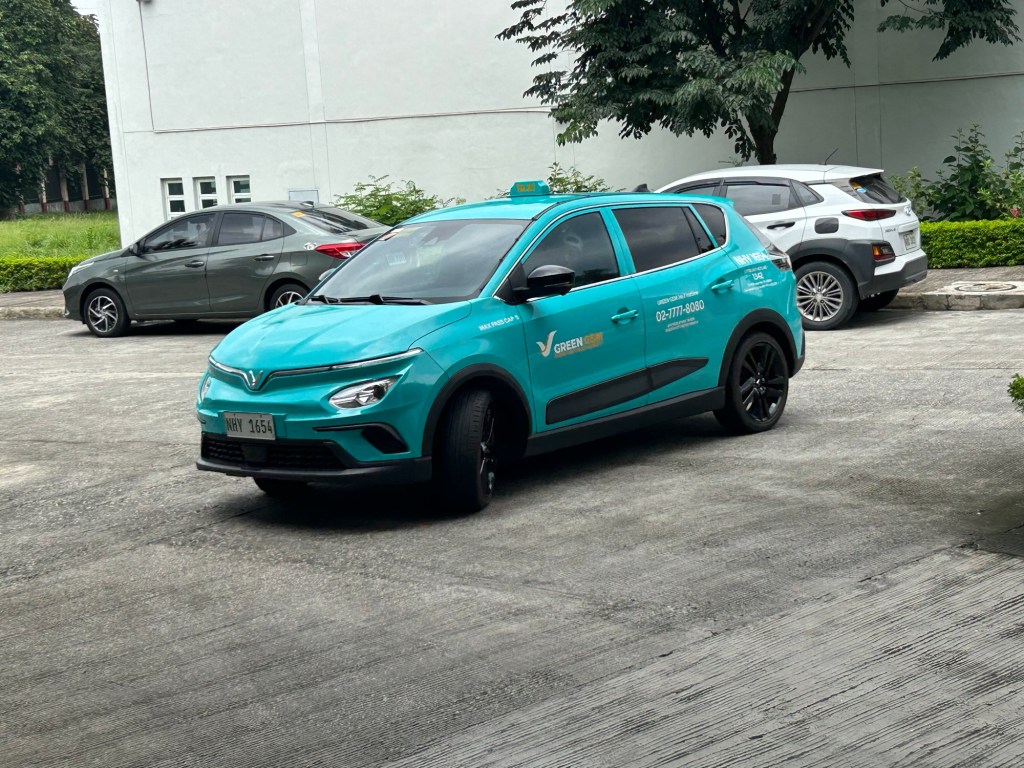
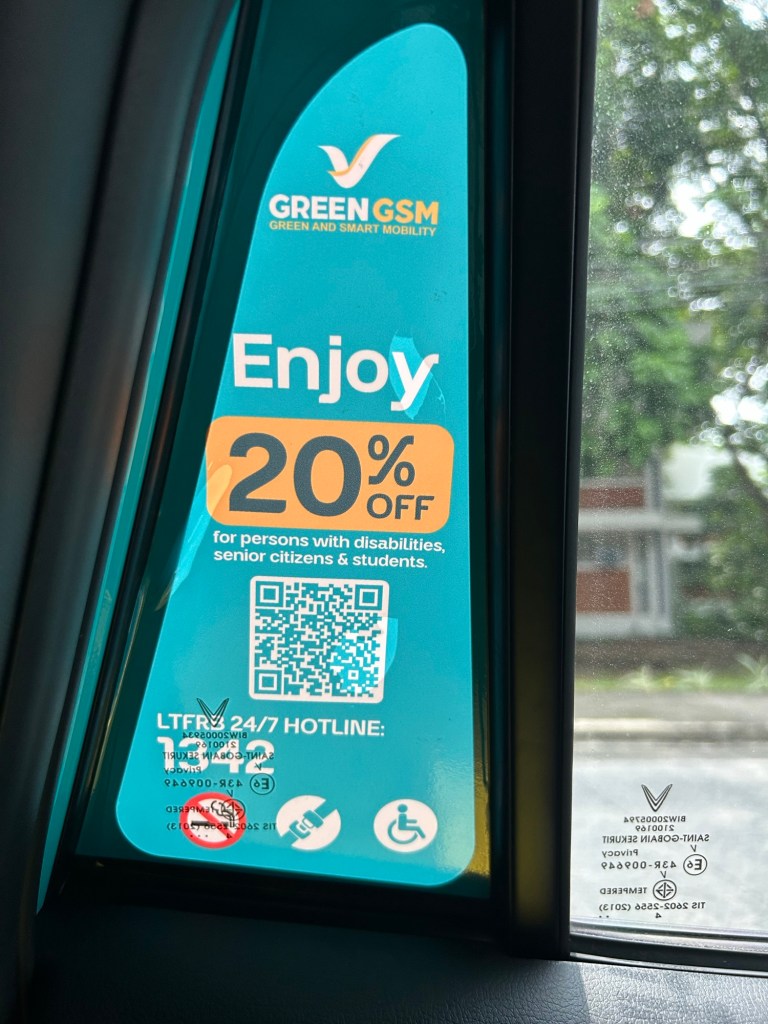
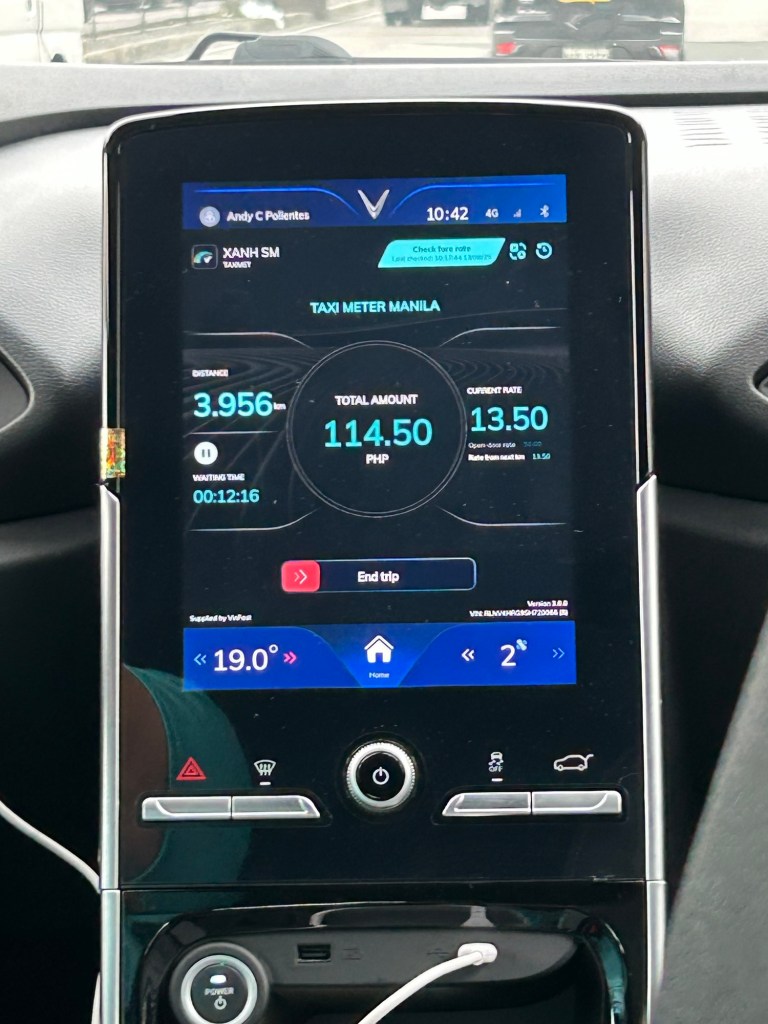
The Green GSM taxi drivers I’ve talked to say they receive a regular salary and have benefits very much like regular employees. They also had accredited stations where they can charge their vehicles or conduct maintenance such as change tires. You can also hail them on the street much like the conventional taxis. You don’t need an app to book a ride but it is more convenient to use their app. The limitation though is that currently you can only book a ride using their app for trips within Metro Manila. If you’re heading out like to Antipolo City, the app will display an error in terms of coverage area. If you happen to hail one of their taxis though, you can use them to go outside Metro Manila. I’ve seen them in Antipolo, Cainta and Taytay so I guess you can also hail them instead of being dependent on the app.
I have a couple of students whose research topic is on Green GSM Taxis characteristics. We’ll soon find out more of their operating characteristics and how their attributes compare with those of TNVS or ride-hailing services like Grab and In Drive.
–
inDrive- A cheaper alternative to Grab?
Friends have been sharing that a new player in the TNVS business is less expensive than Grab. And yet they have comparable vehicles and drivers. They are also supposed to be easier to book. I’ve tried them a few times so far but forget to get screencaps to show the difference between the new players and Grab.
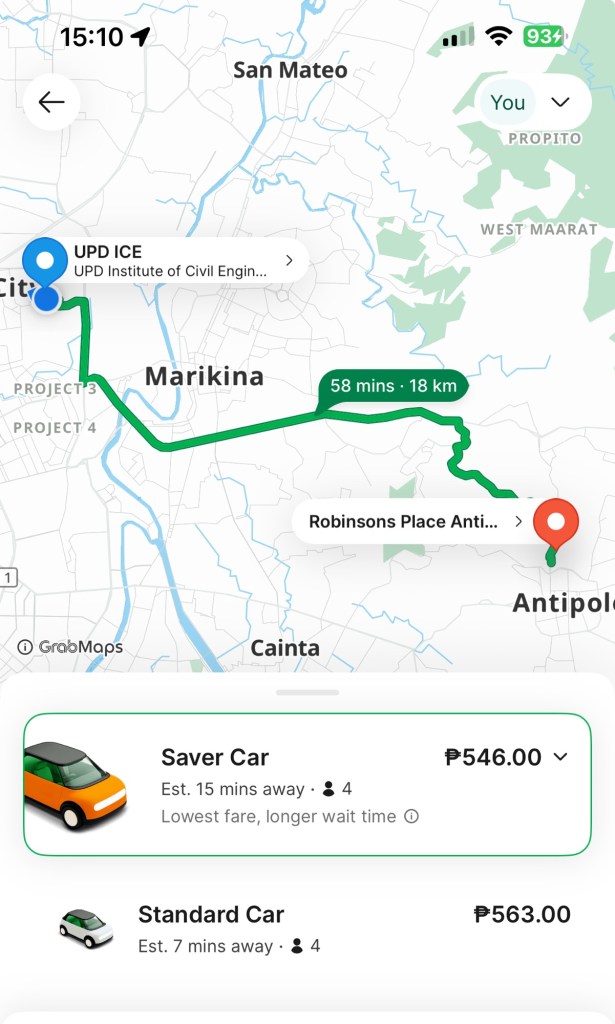
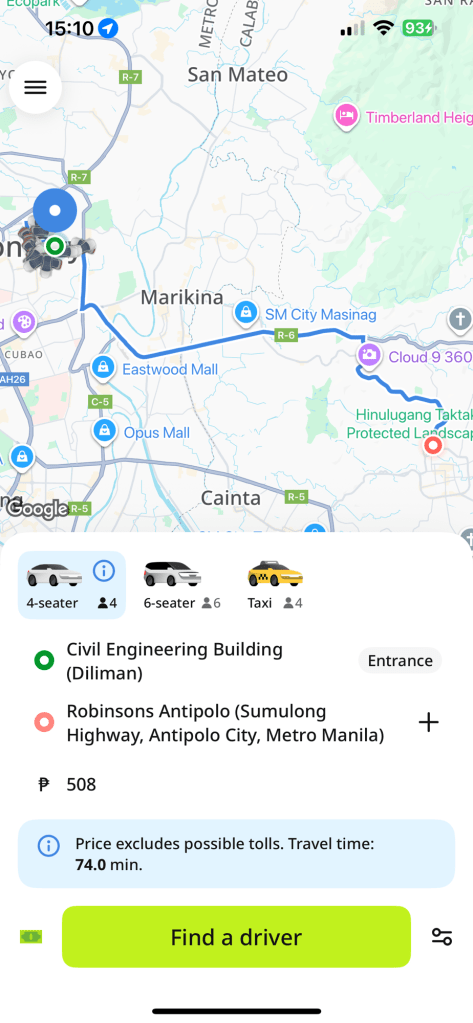
Of course, I ended up booking inDrive as it was cheaper by about 60 pesos for a standard car. I will continue taking screen caps for succeeding rides I will be taking in the future.
–
Competition for Grab?
Friends have been talking about the two new options that they say should rival and compete with Grab. These are another ride hail company and, interestingly, a taxi company. That ride hail company is In Drive and the taxi company is Green GSM.
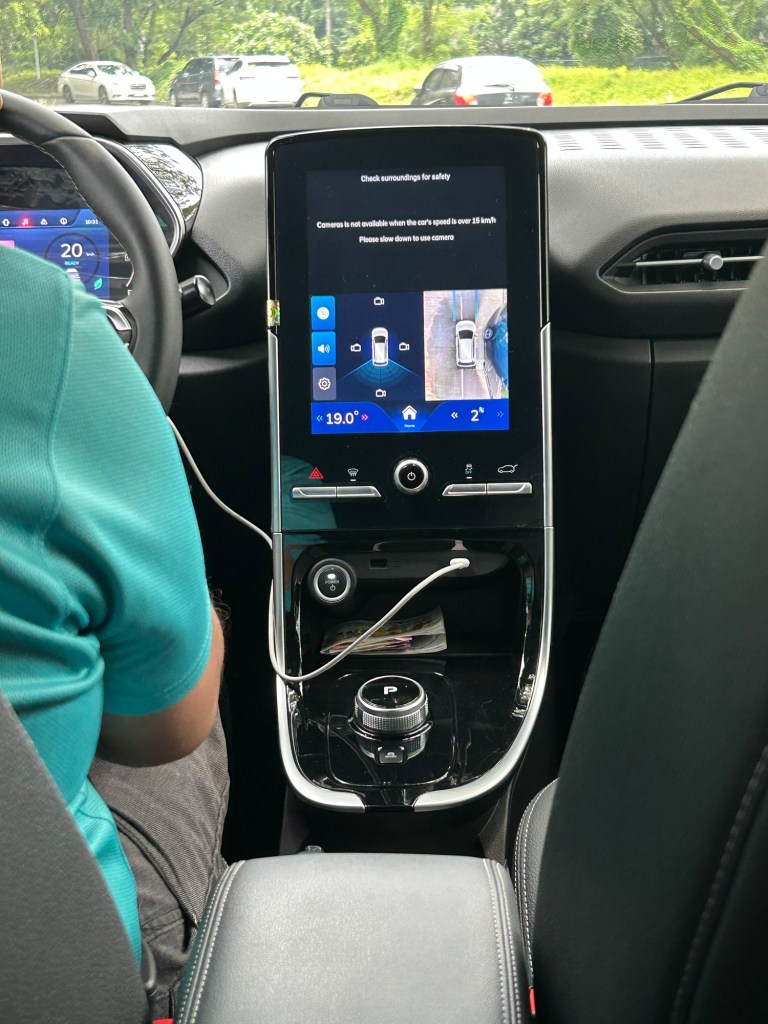
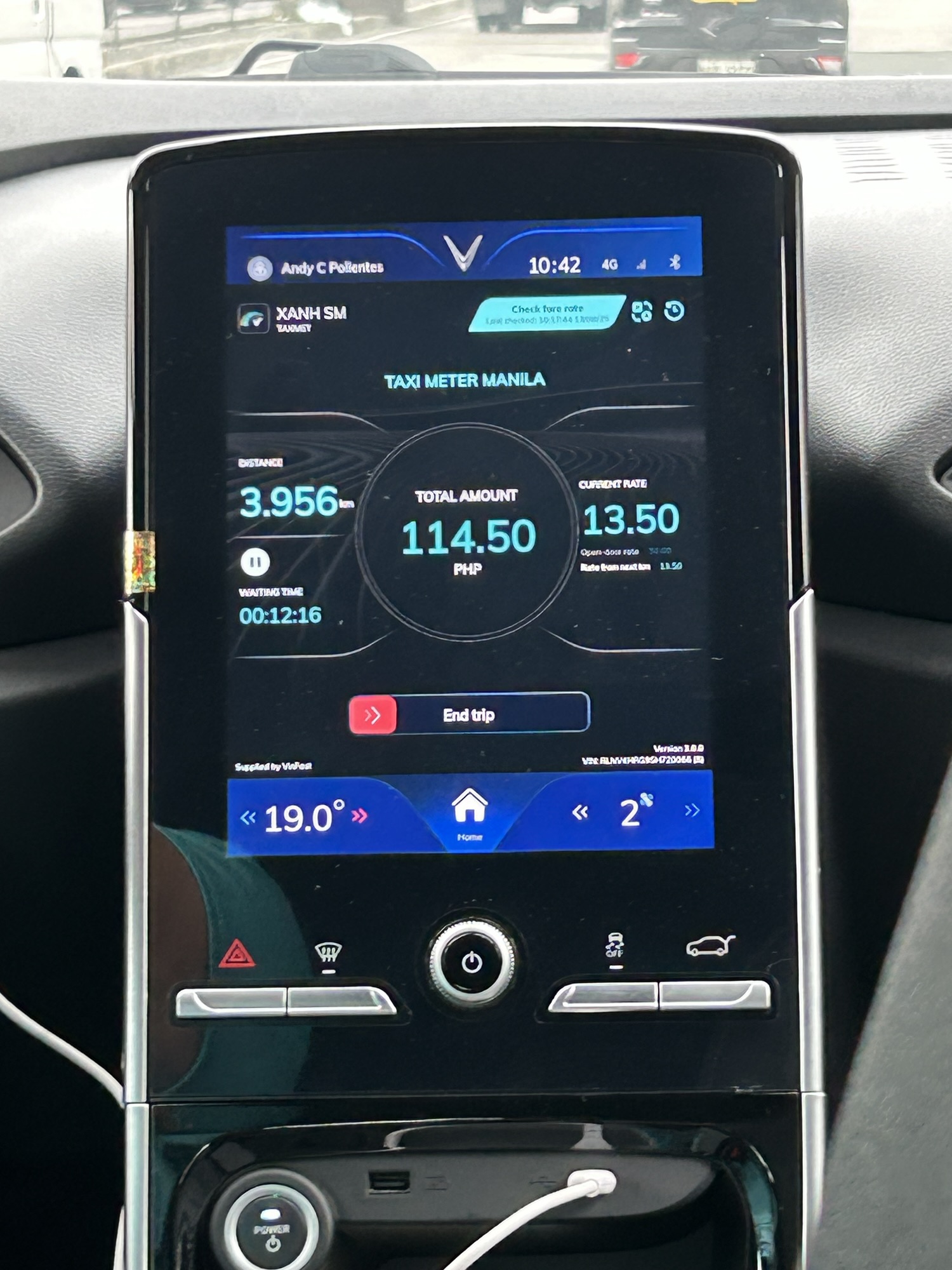 Green GSM vehicle dashboard showing the taxi meter details
The observation and consensus are that either is cheaper than Grab. My personal experience is that they are cheaper than Grab and substantially so. What does this mean? Probably that more people will eventually discover and experience the same and Grab’s ridership will decline. By how much? We don’t know that yet. What we know is that Grab’s most significant competition now are the motorcycle taxis like Angkas and Joyride. Move It is Grab’s response to the other two after it was prevented by government to compete directly with the two. More details in future posts this September.
–
Electric taxis anyone?
Finally saw one of the taxis operated by Green GSM, which is a Vietnamese company. This is supposed to be the first all-electric taxi service in the Philippines.
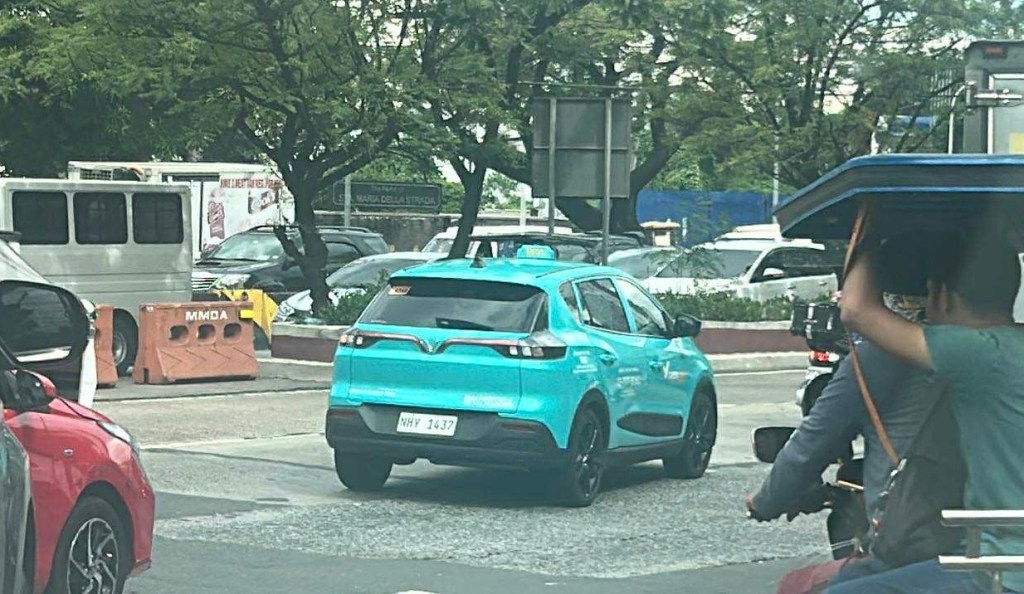
My colleagues and I were talking about this. Among other topics is whether these taxis will not encounter problems once the rains pour and many streets are flooded. We also wondered whether these vehicles will add to the congestion; slugging it out with the established competitors.
Another, more deeper and serious topic is whether these are really clean. While these are emission free as far as the proverbial tailpipe is concerned, the sources of power are not necessarily so.
While we do have renewables in the mix including hydro, geothermal, solar and wind, much of our power used to produce electricity uses fossil fuels.
–
On ride hailing replacing more sustainable options for transport
We’ve long suspected that ride hailing or ride sharing is not as sustainable as their proponents and companies would project them to be. Here is more evidence showing how ride hailing has diminished other more sustainable transport options.
Kerlin, K. (August 28, 2024) “Half of Uber, Lyft Trips Replace More Sustainable Options,” UC Davis News, https://www.ucdavis.edu/news/half-uber-lyft-trips-replace-more-sustainable-options [Last accessed: 9/8/2024]
Quoting from the article:
“About 47% of the trips replaced a public transit, carpool, walking or cycling trip. An additional 5.8% of trips represented “induced travel,” meaning the person would not have made the trip were an Uber or Lyft unavailable. This suggests ride-hailing often tends to replace most sustainable transportation modes and leads to additional vehicle miles traveled. “
The article and the study by UC Davis is limited to their experiences with Uber and Lyft and perhaps others that employ cars. In our case, we have in addition motorcycle taxis or habal-habal that further takes away passengers from public and active transportation. Motorcycle taxis provide a very attractive alternative to conventional public transport modes as these are perceived to reduce travel times among other advantages they provide to users.
I will share some information later about the current mode shares in Metro Manila and how drastically public transport mode shares have been eroded post pandemic.
–
Shared rides, anyone?
Would you share your ride with other people? This is not the conventional ride-sharing where you drive for someone else (i.e., Grab, Uber, etc.) but refers to a passenger sharing the vehicle he/she booked with another passenger or passengers. This is supposed to reduce the cost of the ride but can lead to more distance traveled as the matching of passengers has not been perfected. That is, it is likely to share a ride with a person heading to a destination that is out of the way of the passenger (in as far as typical routes are concerned).
Walker, J. (May 26, 2023) “Lyft: The End of Shared Rides,” Human Transit, https://humantransit.org/2023/05/lyft-the-end-of-shared-rides.html [Last accessed: 6/12/2023]
To quote from the article:
“I used this service once. On a departure from the airport, it paired my trip with one in a substantially different direction. The other trip was to a point further from the airport than my destination, and yet it served that trip first. I ended up with a travel time about twice what my direct travel time would have been, and much more than the app had estimated. I never used this option again. My impression was that they were overselling the product in contexts where it wasn’t appropriate, and they were offering the same discount to the person dropped off first — whose trip is exactly what it would have been if traveling alone — as to the person whose trip was being made much longer.”
We actually already have shared rides in the Philippines. This is in the form of UV Express (formerly and popularly referred to as FX after the Toyota vehicle model that became popular from the 1990s), which continue to be a popular mode of public transport. Shared rides evolved from a group of people negotiating with FX taxi drivers to take them to a common point or destination (not to their final destinations). At the common destination, the passengers will eventually part ways for their last mile trips. Here is the article on a taxi service that eventually became a shared service I wrote a while back:
That was before there were apps to facilitate the sharing. I think this also showed how people will find ways to overcome problems like a lack of public transportation for their commutes.
–
On micro transit and transportation gaps
I’ve written and shared articles before on how Paratransit, bicycles and micro transit helps alleviate the transport demand problems we are experiencing especially in highly urbanized cities. I think we should have as many options as possible for transport while also working towards the reduction of dependence on cars. Here’s an article that relates about experiences in the US:
Zukowski, D. (September 13, 2022) “Cities turn to microtransit to fill gaps in public transportation,” Smart Cities Dive, https://www.smartcitiesdive.com/news/microtransit-public-transportation-gaps-jersey-city-via/631592/ [Last accessed: 9/15/2022]
To quote from the article:
“Microtransit options are also helping to reduce the reliance on personal cars. “We’ve received feedback from people who say that because of Via they are now more consistently leaving their personal vehicle at home and using Via instead to travel within the city, which is exactly the kind of thing we want to see happen,” said Jersey City’s Patel.”
This final statement or paragraph in the article sums it up very well. Of course, we have to note that the experience in Asia is quite different especially in Southeast Asia where motorcycles are very popular and still on the rise in terms of their mode shares. While these may be considered micromobilities in western countries, they are definitely motorized private vehicles that, depending on how they are used and how the rider behaves, may be beneficial but at the same time also very dangerous for people.
–
On the future of Uber and other ridesharing/ridehailing companies
A few years ago, Uber was the darling of transportation. It and others like it were considered disruptors. They were but then eventually unraveled as their business model and practices were challenged and exposed. Here’s an article that does not mince words in describing what and how Uber is:
Doctorow, C. (August 11, 2021) “End of the line for Uber,” Medium, https://marker.medium.com/end-of-the-line-for-uber-901e3077bbbc [Last accessed: 8/21/2021]
There’s a wealth of references (links provided) in the article provided to support the arguments of the author. It is not anecdotal but an accumulation of facts from various experiences as well as a documentation of the company’s efforts to hide its flaws.
I co-authored several papers analyzing what was seen as a phenomenon. It was clear that people preferred Uber or Grab over regular taxis because of the higher quality of service they got. Similar results were obtained elsewhere and spelled the doom of many taxi drivers. Those that survived were the better serving ones like taxis in Japan and Singapore. However, the more recent of those papers have shown that what are called TNVS or transport network vehicle service have basically been deceiving and took advantage of their drivers (whom they do not want to refer to as employees). Did they help reduce congestion? They did not, and even added more cars to traffic.
–
Article on the new mobilities
Here’s a quick share of an article on what is described as the new mobilities:
Litman, T. [June 30, 2021] “Planning for New Mobilities: Preparing for Innovative Transportation Technologies and Services,” Planetizen.com, https://bit.ly/2U99Hlw [Last accessed: 7/3/2021]
What exactly are these new mobilities? To quote from the article:
“New Mobilities
- Active Travel and Micromobilities. Walking, bicycling, and variations, including small, lower-speed motorized vehicles such as electric scooters, bikes, and cargo bikes.
- Vehicle Sharing. Convenient and affordable bicycle, scooter, and automobile rental services.
- Ridehailing and Microtransit. Mobility services that transport individuals and small groups.
- Electric Vehicles. Battery-powered scooters, bikes, cars, trucks, and buses.
- Autonomous Vehicles. Vehicles that can operate without a human driver.
- Public Transport Innovations. Innovations that improve transit travel convenience, comfort, safety, and speed.
- Mobility as a Service (MaaS). Navigation and transport payment apps that integrate multiple modes.
- Telework. Telecommunications that substitutes for physical travel.
- Tunnel Roads and Pneumatic Tube Transport. New high-speed transport networks.
- Aviation Innovation. Air taxis, drones, and supersonic jets.
- Mobility Prioritization. Pricing systems and incentives that favor higher-value trips and more efficient modes.
- Logistics Management. Integrated freight delivery services.”

–
 Caught (up) in traffic