
Home » Posts tagged 'road crashes' (Page 3)
Tag Archives: road crashes
Lane discipline
Among many peoples’ pet peeves in traffic would probably be the propensity for lane changing among many drivers and riders. This is especially true for wide multi-lane roads like Commonwealth Ave., Marcos Highway and EDSA. While it can be an understandable behaviour for free flowing traffic along long stretches where weaving can be executed safely, lane changes can be quite risky at intersections and may instantly lead to crashes. These are likely the bases for the swerving violations that the MMDA and other traffic enforcers became notorious for issuing for a time.
We chanced upon a scene at the Commonwealth Ave.-Mindanao Ave. intersection in Novaliches where a car seemed to have attempted to cut in front of a bus in order to make a turn but got hit by the bus. From the angle of the collision, it appears that the driver of the car likely maneuvered for a U-turn and made the critical assumption that he could beat the bus for the turn. It was obvious that the bus was in the right position while the car was not. This is often the case for drivers who do not care for positioning themselves along the correct lanes at intersections and seem to rely on their guile to get ahead of others. Such drivers might just be the same ones who would likely do counter-flows also to get ahead of others queued along the right traffic lanes.
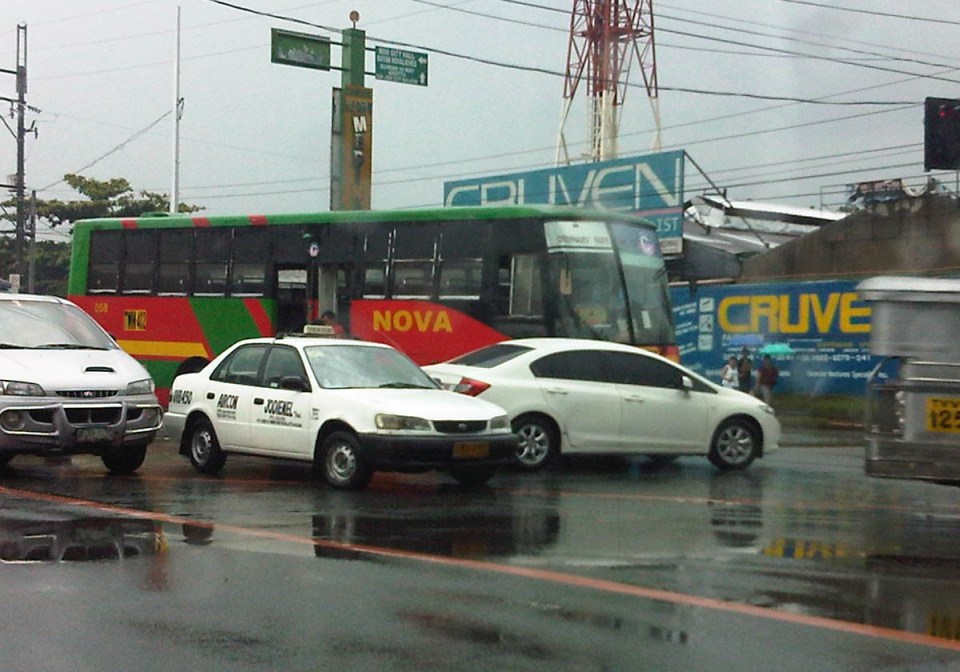 White car attempts to make a U-turn right in front of a bus and gets hit by the bus whose driver likely did not notice the white car sneaking in front of the vehicle.
Lane discipline becomes more important with the revival of traffic signals all around Metro Manila. In addition, it is also important for the appropriate lane markings to be placed at intersection approaches. Such markings are supposed to guide drivers where they should position themselves so that they will not block traffic going in another direction. These can also aid in the enforcement of lane discipline as vehicles on the wrong lanes can be apprehended. This was the case in Cebu City in the 1990s when the city adopted the SCATS traffic signal system, which employed detectors embedded on the pavement along the approaches to intersections. These detectors helped determine whether there is demand for a particular movement (left, through or right) and so requires lane discipline for the system to work effectively. –
Preventable tragedies
Last Friday, a provincial bus plunged into a ravine somewhere in the Mountain Province. The bus rolled several times before coming to a stop, instantly killing 14 people. Among the fatalities in this crash is a popular comedian/media personality who went by the name Tado and part of a group doing civic work in the area. Foreign visitors were also killed in the crash, leaving many to wonder if perhaps the Department of Tourism (DOT) should also get into the act as it is in the interest of the department to also establish that “It’s safer in the Philippines!” as part of its “It’s more fun in the Philippines!” tagline.
According to initial reports, the driver lost control due to defective brakes but later one report suggested that the driver had dozed off and awoke too late to bring the bus back in control. The slope of the road was downwards and there was significant curvature. This combination is definitely a challenging one for most drivers, even professionals who, like the bus driver, would probably have encountered such combinations of slope and curvature many times, even on a daily basis along mountain routes. One has to be awake and focused on maneuvering a vehicle for such sections. It didn’t help that probably, and I base this on photos of the section I’ve seen online, the road’s barriers were not up to standard in as far as stopping large vehicles like the bus from falling off and into the ravine.
These are preventable incidents, preventable tragedies that occur on a daily basis around the country. It is clear to many that the LTFRB needs to address these problems by taking steps to insure that public transport vehicles such as provincial buses are properly maintained and drivers are fit and in the best condition to drive these vehicles. To do that, they have to be proactive in evaluating bus, jeepney, UV express, and taxi and other franchises under them. These evaluations should delve into involvements in road crashes as well as the frequencies and types of traffic violations drivers have been involved in. Such records of crashes and violations should form part of a set of criteria to suspend and ultimately revoke franchises of public transport entities.
The LTO also has a responsibility here because they are the agency in-charge of licensing drivers. They should make sure that those applying for professional licenses are indeed qualified and not just to drive any vehicle. Therefore, perhaps there is a need to have different types of licenses for different types of professional drivers. Public utility vehicles differ in size and maneuverability so a different skill set and experience is required for buses compared with taxis. Another type of license should apply for those seeking to drive trucks as well as heavy equipment such as payloaders and bulldozers. The TESDA has certification programs for these that are sought out by people who want to drive professionally abroad. These should also be made as requirements for those seeking to drive professionally here. These would ensure that drivers will be qualified and competent as they are responsible for lives and property.
It is also clear that the DPWH and local authorities in-charge of road safety along roads should look into how to make travel safer by investing more into safety devices such as barriers. Crash or accident prone sections can be identified and sturdier barriers designed to keep vehicles on the road should be constructed/installed in order to prevent such types of fatal crashes (i.e., barriers would not prevent head-on collisions, etc.). That is why the DPWH and local governments need to have capacity and capability to assess road safety along national and local roads. These actions address vulnerabilities. These actions save lives.
What can you do to help in this effort? You don’t have to be part of an organized group or a lobbyist to be involved in promoting road safety. You can be involved in simple ways. Be aware of your rights on the road and your being among those vulnerable to road crashes. I am sure you don’t want to be involved in a crash nor would you like a loved one to get injured or, God forbid, perish in a crash. If your bus, jeepney, UV express or taxi driver drives recklessly, be firm in reminding him of his responsibility. You may enjoy a fast ride but are you sure your destination isn’t the afterlife? Think about it. Act on it. Save lives!
–
 Caught (up) in traffic