
Home » Posts tagged 'road safety' (Page 11)
Tag Archives: road safety
On the transformation from car-oriented to people-oriented streets
I saw this article shared by a friend on social media and share it here as an interesting piece providing ideas and the thinking or attitude required if we are to transform our streets:
Jaffe, E. (2020) “4 ways to go from “streets for traffic” to “streets for people”, Medium, https://medium.com/sidewalk-talk/4-ways-to-go-from-streets-for-traffic-to-streets-for-people-6b196db3aabe [Last accessed: 9/30/2020]
It is actually interesting to see how this plays out in Philippine cities. The ‘honeymoon’ or ‘grace’ period from the lockdown to the ‘normalization’ (read: going back to the old normal) of traffic might just have a window and this is closing for active transport. National and local officials, for example, who seemed enthusiastic and quickly put up facilities for active transport have slowed down efforts or even stopped or reneged on their supposed commitments. The next few weeks (even months) will show us where we are really headed even as there are private sector initiatives for active transport promotion and integration.
–
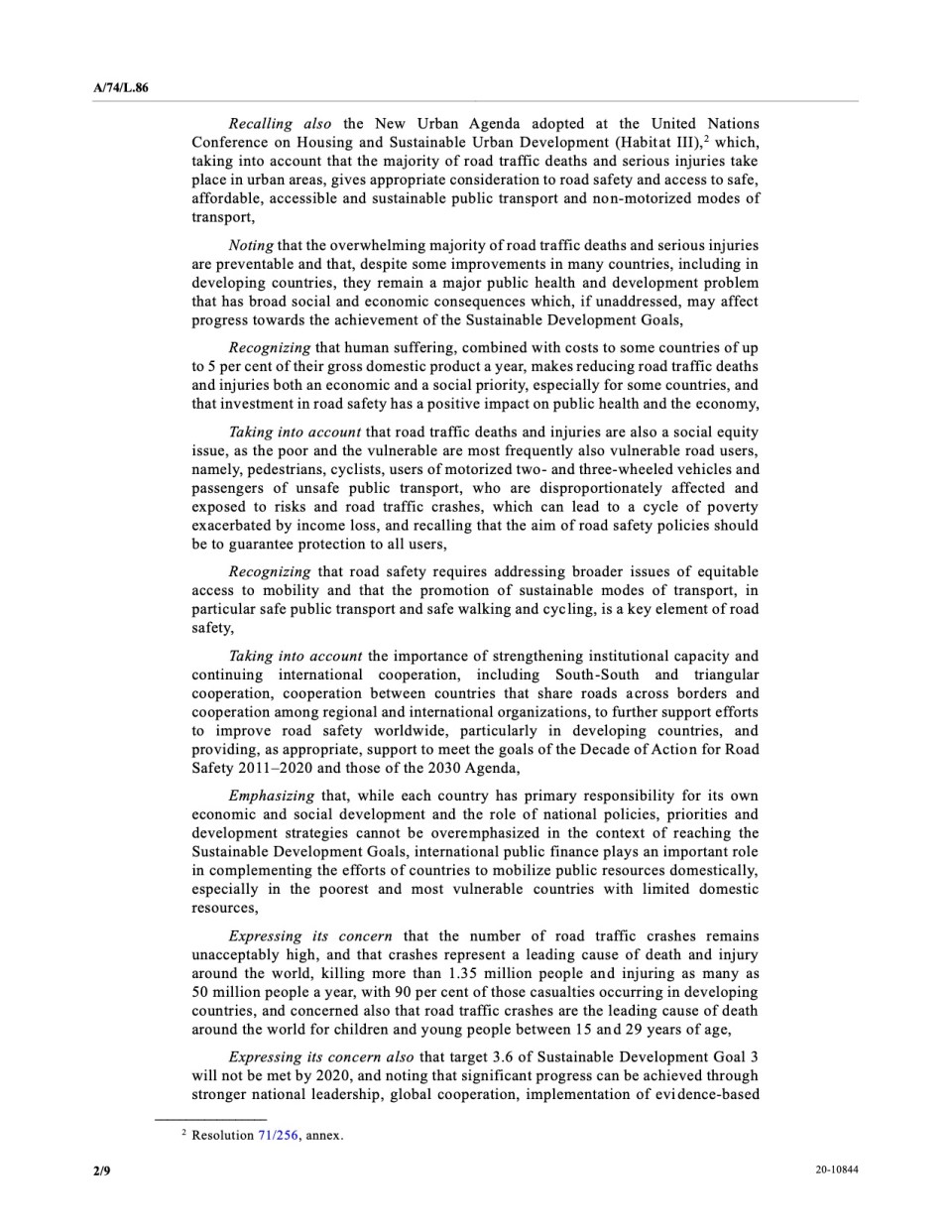
UN General Assembly resolution on road safety
I’m posting here the 9-page resolution on road safety of the United Nations General Assembly that was recently (August 2020) passed by the body. This is the key resolution that launched a second Decade of Action for Road Safety, 2021-2030. The document may also be downloaded from the net. Here is a link to the document via the Asia Pacific Road Safety Observatory site:



–
On bicycles slowing down cars
There is a perception that cyclists tend to slow down other vehicles, mainly motorized, along roads. Again, such can be the experience of some that have been generalized and accepted as fact in most cases. However, if we look closely at the evidence, the perception may not be true for most cases after all. This article comes out of Portland State University:
Schaefer, J., Figliozzi, M. and Unnikrishnan, A. (2020) “Do bicycles slow down cars on low speed, low traffic roads? Latest research says ‘no’,” EurekAlert!, https://eurekalert.org/pub_releases/2020-07/psu-dbs072320.php [Last accessed: 8/1/2020]
Check out the wealth of information through the links found throughout the article that includes references to published material in reputable journals. EurekAlert! is from the American Association for the Advancement of Science (AAAS).
–
On making roads safer for students
Here is a nice article from the National Academies of Science, Engineering and Medicine about how transportation research makes roads safer for students as they go back to school:
Transportation research makes the road safer for students to get back to school
There is a wealth of information there, and one should browse and perhaps download resources shared that can be useful references not just for those in North America but elsewhere towards making journeys between homes and schools.
 Scene near a public school in Zamboanga City [photo taken in June 2019]
We, too, have several initiatives towards making the journeys of children safer between their homes and schools. It is something that all of us find essential and worthwhile. Children, after all, represent our future and making their journeys safer gives them better chances to succeed in life. It also shows them examples that they can replicate for their own future children. I will write more about these as we obtain the data and perform our assessment.
–
Whatever happened to those ‘enhanced’ pedestrian crossings?
Before the lockdowns, a lot of people seem to have become excited with what a private company did as part of their PR campaign (I’m certain about this because their ads feature these.). That is, they painted on the existing pedestrian crossings in Antipolo City along major roads such as Sumulong Highway and the Sumulong Memorial Circle. While coordination with the LGU was done, there seems to be none with the DPWH considering these are national roads and any matter concerning them are under the agency’s jurisdiction through their District Engineering Office. The following photos were taken prior to the lockdown and as you can see (if you were objective) there’s nothing really notable about them though they appear to enhance the existing crosswalks.
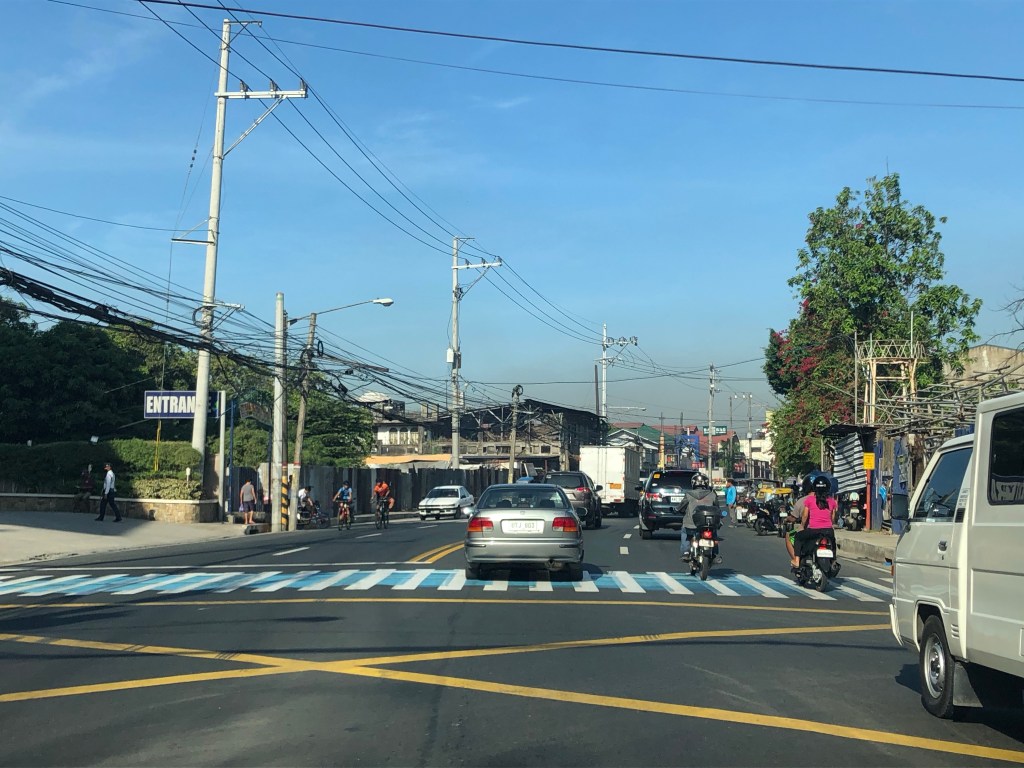
The artwork is practically invisible to motorists especially those on cars whose drivers’ eyes are lower than those driving SUVs, jeepneys, buses or trucks (i.e., larger and taller vehicles).
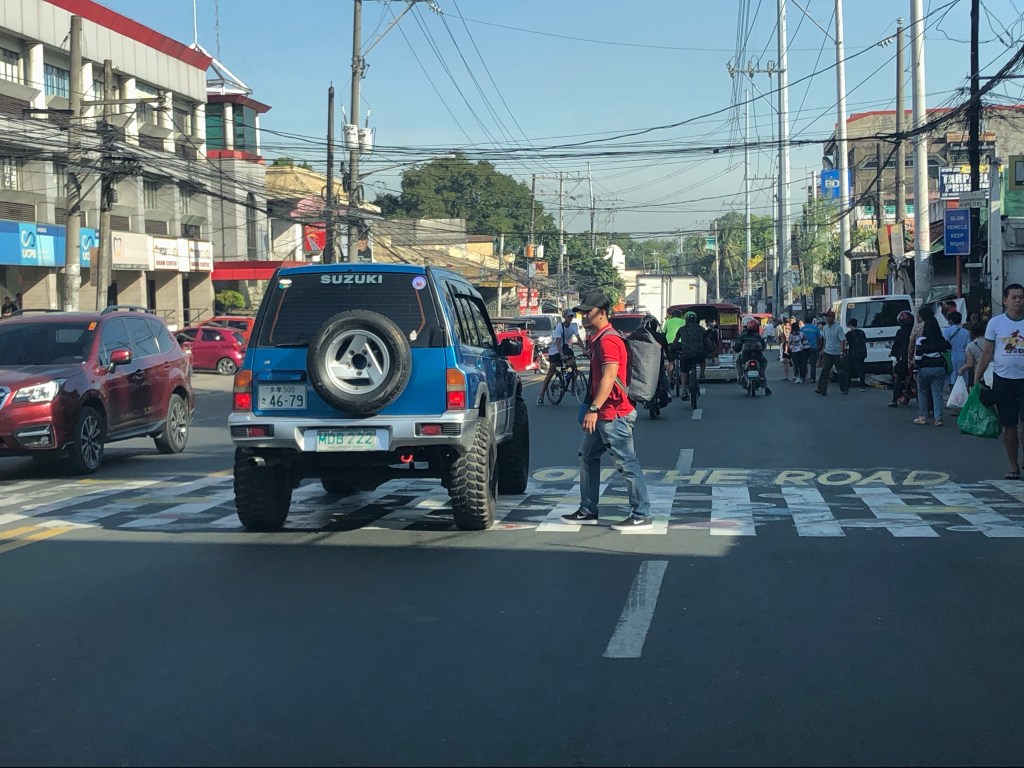
There is no strong evidence that such works enhance road safety.
There is no strong evidence that such works enhance road safety and you can check on this by doing either a quick or even an extensive search for literature proving significant impact. I guess the key here is to also install other devices such as a speed table or rumble strips for motorists to feel that they are approaching a pedestrian crossing. Also, perhaps instead of just painting on the crosswalks, they could have painted so as to widen the crosswalk. Then they could have increased the visibility for pedestrian crossings. That said, they should also have used the standard paints for these facilities that make them visible at night and could have been more resistant to weathering.
–
On the safety of e-scooters
There’s recent news about the Department of Science and Technology (DOST) launching a smart scooter system in Cauayan City, Isabela. This should be considered a positive thing in light of the scooter’s sudden popularity as a mode of transport. There are, however, much to be determined in terms of this vehicle being a safe mode of transport. Singapore, for example, has released guidelines for its use in its streets while there have been mixed reactions among American cities on how these vehicles should share spaces with other modes including walking and cycling. Here is a nice article about scooter safety that should point the way towards how we should go about in assessing safety:
Chang, A.Y.J. (2020) Demistifying e-scooter safety one step at a time, https://medium.com/@annieyjchang/demystifying-e-scooter-safety-one-step-at-a-time-956afcf12d75 [Last accessed: February 3, 2020]
As a parting shot in other cases, I have always asked: Would this have been an issue or a popular mode if we had good public transportation as well as decent pedestrian and cycling infrastructure? The answer could be a simple ‘no’ for our case in the Philippines where much is to be desired in terms of PT, pedestrian and cycling infra. But e-scooters seem to have attractive quite a few in developed cities including those with good PT, pedestrian and cycling infra. The jury is still out there if this was just a fad or perhaps, as some claim, part of the evolution for improved mobility.
–
Comments on current transport issues – Part 2: On motorcycle taxis
I continue with my comments on current and persistent transport issues. This time, I focus on one of two hot topics – motorcycle taxis or “habal-habal”.
1) On motorcycle taxis:
I am not a member of the Technical Working Group (TWG) that’s supposed to be evaluating the trial operations. I know one or two of the key members of the TWG and am surprised that they have not referred to the academe for studies that may have already been done about this mode of transport. I know there have been studies about it in UP and DLSU. Perhaps there are more from other universities in the country. Motorcycle taxis or “habal-habal”, after all, are practically everywhere and would be hard to ignore. Surely, researchers and particularly students would be at least curious about their operations? Such is the case elsewhere and many studies on motorcycle taxis have been made in the region particularly in Vietnam, Thailand and Indonesia, where these modes also proliferate.
The terms “trial”, “experimental” or “pilot” are actually misleading because motorcycle taxis have been operating across the country for so many years now. They are supposed to be illegal and yet they serve a purpose in the areas where they are popular. What is often referred to as an informal transport mode is ‘formal’ to many people who are not being served by so-called formal modes including the tricycle. Of course, one can argue that these terms (i.e., trial, experimental and pilot) refer to the app that are supposed to enhance the existing habal-habal operations.
I would strongly endorse motorcycle taxis but companies need to be held accountable should there be fatal crashes involving their riders. They are supposed to have trained and accredited them. The companies should also have insurance coverage for riders and passengers. LGUs tolerant of these should be watchful and do their part in enforcing traffic rules and regulations pertaining to motorcycle operations in favor of safe riding. This is to reduce if not minimize the incidence of road crashes involving motorcycle taxis.
I think one of the problems with motorcycle taxis is not really their being a mode of choice but the behavior of their drivers. While companies like Angkas and Joyride conduct training sessions with their riders, many revert to reckless on-road behavior including executing risky maneuvers in order to overtake other vehicles on the road. This is actually a given with many ‘informal’ motorcycle taxis (i.e., those not affiliated with the recognized app companies). But then this is also an enforcement issue because we do have traffic rules and regulations that are poorly enforced by authorities. Thus, there is practically no deterrent to reckless riding except perhaps the prospect of being involved in a crash.
I will refrain to include the politics involved in the issue of motorcycle taxis. I will just write about this in another article.
Coming up soon: hot topic #2 – Obstacles to the PNR operations
On road crashes involving trucks
We were almost late for our flight the last Friday of November because of a road crash involving at least one truck at the intersection of Sales Bridge and the SLEX East Service Road.
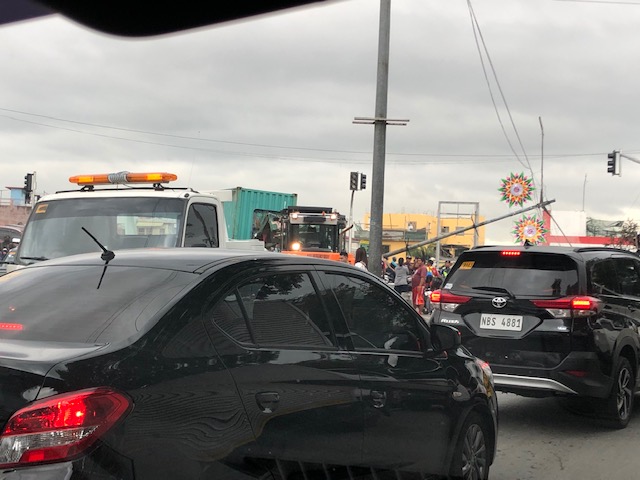 Here was our first view of the crash site showing one streetlamp post almost hitting the pavement if it weren’t for the wires holding it at its position. Waze wasn’t much help as there was only a simple description of a major crash reported. How serious it was wasn’t stated.
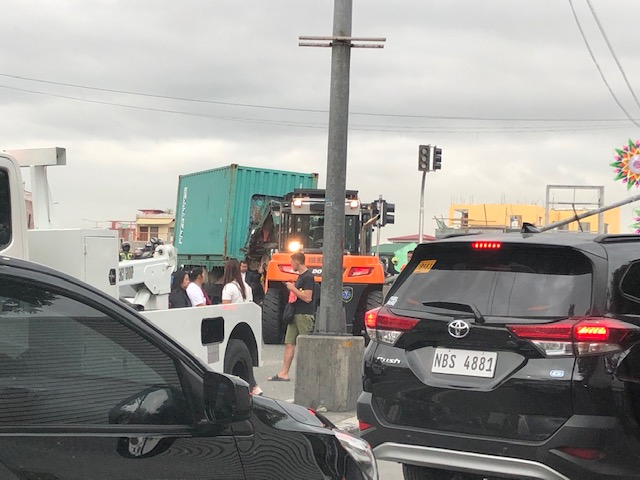 A tow truck and a forklift were already on site to help remove the truck that hit the post.
 Pedestrians continued to cross the intersection with some glancing quickly at the sight of the vehicles involved in the crash and clearance operations. MMDA enforcers were in the area to herd people away from the area.
 An enforcer looked like he was taking photos, video or both of the clearing operations.
 When we arrived in the area, we only saw this truck that was apparently the one that hit the post. The damage to the truck indicated that it likely slammed into another large vehicle. However, that other vehicle was no longer in the area.
 Another look at the truck involved in the crash
 The post obviously was in a precarious position and effectively blocked the path of vehicles that were to turn left at the intersection. Many of these vehicles including ours were heading to the airport.
There seems to be a lot of crashes involving trucks lately. I say so based on my personal observations including passing by crash sites where trucks have been the main vehicles involved. It would be good to see the statistics of truck involvement in road crashes including the typical locations (i.e., black spots), frequency and severity of the crashes. This would correlate with the maintenance and how these trucks are being driven. Too often, we read or hear about trucks losing their brakes or drivers losing control. There are clearly maintenance and driver behavior issues here that need to be addressed if we are to improve safety in relation to these large vehicles.
Despite this incident and the resulting traffic jam, the MMDA enforcers didn’t seem to know how to go about managing the flow of traffic in the area and wanted to reroute every vehicle intending to turn left at Sales towards the airport to Pasong Tamo Extension! This resulted to more confusion and many not to take heed of the enforcer waving at us to head for more congestion after what we experienced. Clearly, this was a case where the motorists knew better than to follow errant enforcers. In these times, you wonder if the MMDA’s enforcers were capable of managing traffic after road crash incidents like this.
–
On pedestrian crossings: innovating on the pavement markings?
I recently saw what looks like a project of the City of Antipolo where several pedestrian crosswalks are being painted over with artwork including a basic road safety message. The photo below shows one in progress across from the Provincial Capitol (aka Ynares) along the Antipolo City Circumferential Road.
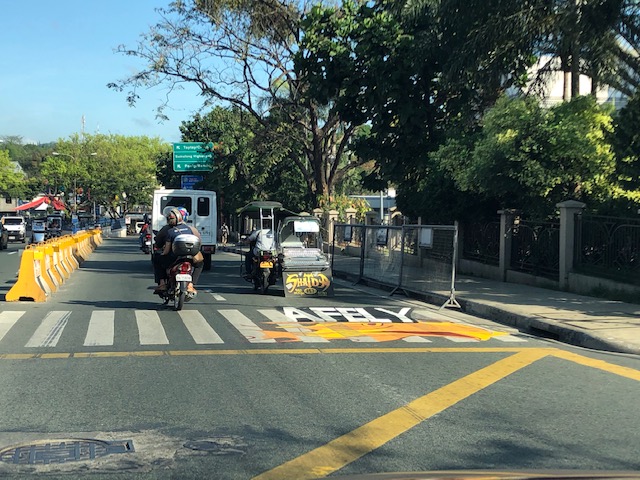 Photo of artwork in progress to cover the existing pedestrian crossing (zebra) pavement markings at the Rizal Provincial Capitol
Recently, I’ve seen news reports and posts by the proponents being shared in social media about the project. From what I’ve learned from reliable sources within the Department of Public Works and Highways (DPWH), this is an initiative with the blessing of the city and did not go through the DPWH. The main concern here is whether this ‘innovation’ of sorts will be effective and if the artist(s) behind the project used the proper materials (i.e., paint for pavement markings that are supposed to be highly visible day or night) for this project. If not, then this is just street art similar to what artists did on the UP Academic Oval a few years ago in front of Palma Hall. Sorry to blow your bubble but its more a publicity stunt than a safety device if proponents do not use the proper materials. I hesitate to use the term ‘design standards’ here because this is supposed to be artwork and perhaps the word ‘standard’ doesn’t apply. But to claim this enhances safety is at this point a stretch.
More first-hand photos soon…
–
The Barkadahan Bridge situation
The Barkadahan Bridge is currently undergoing rehabilitation. To be accurate, the old bridge is being rehabilitated and upgraded/retrofitted to be able to carry the traffic projected to use it being a vital link between the Province of Rizal and Metro Manila via Pasig and the C-6 corridor. The bridge is named after the “friendship” established among Rizal municipalities and Pasig City for an area that has been subject of a territorial dispute among them. These are the municipalities of Cainta and Taytay (Rizal Province) and the city of Pasig. The bridge spans the Manggahan Floodway, much of which is in Pasig City.
To increase the capacity for this crossing, which is the most direct route to C-6 and popular among many headed to Taguig/BGC and Makati, a new bridge had been constructed to the south of the old one. The older one had 2 traffic lanes and was no longer sufficient for the volume of vehicles crossing it after the expansion of C-6 resulting to it steadily gaining more users over the years. Use of this route cut down travel times between Rizal and BGC and Makati by at least 30 minutes based on our experiences using the route.
Late last year as far as I could recall, the new bridge opened and immediately increased capacity but then congestion quickly set-in due to two factors: the traffic management at the intersection with the East Bank Road and the constrained (two-lane, two-way) leg of Highway 2000. Add to this the lack of discipline by local traffic in the form of tricycles and motorcycles counter-flowing in the area.
Earlier this year, signs were posted around Rizal about the then impending project for the rehabilitation of the old bridge. The signs advised for most travellers to avoid using the Barkadahan Bridge due to the congestion in the area because of the project. It turns out that what was thought by most as a project retrofitting the old bridge alone was actually a bigger one involving increasing the capacity of the Highway 2000 leg of the intersection with the East Bank Road. Following is a photo posted at the official Facebook page of the Rizal Provincial Government showing the demolition of buildings and other structures along the Highway 2000 leg. The photos were taken from the new Barkadahan Bridge approaching the intersection, the southbound direction of the East Bank Road, and from the westbound side of Highway 2000.
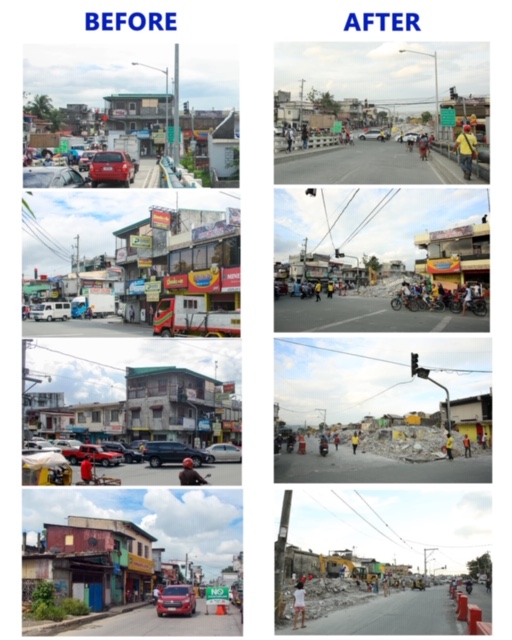 Demolition and clearing of ROW for the expansion of Highway 2000 in relation to Barkadahan Bridge [Photo collage from the Lalawigan ng Rizal Facebook page]
From the photos above, it is clear that at least 2 lanes will be added to Highway 2000 and that this leg will soon be well-aligned with the Barkadahan Bridge, which will also have a total of 4 lanes. Hopefully, this project will be completed soon and within the year (before December?) in order to alleviate the commuting woes of Rizalenos working in the BGC and Makati CBD areas. Of course, that goes without saying that there is also a need to optimise the traffic signals at the intersection and to strictly enforce traffic rules and regulations vs. erring motorists in the area.
–
 Caught (up) in traffic