
Home » Posts tagged 'road safety' (Page 17)
Tag Archives: road safety
TSSP 2016 Conference Program
I am sharing the banner and final program for the Transportation Science Society of the Philippines 23rd Annual Conference to be held on Monday, August 8, 2016. The final program features a Keynote Speech by the Undersecretary for Road Transport and Infrastructure Anneli R. Lontoc, a Panel Discussion on Road Safety, and technical sessions in the afternoon.


 –
–
TSSP 2016 Conference: Tentative Program
I am sharing below the tentative program for the 23rd Annual Conference of the Transportation Science Society of the Philippines (TSSP):

Soon, I will post on the list of papers to be presented for the Technical Sessions to be held in the afternoon part of the one-day conference.
–
TSSP 2016 Conference – August 8, 2016
I start August with an announcement, promoting the 23rd Annual Conference of the Transportation Science Society of the Philippines (TSSP). The theme of this year’s conference is “What Gets Measured, Gets Managed: Transportation, Data and Statistics.” The conference will have a panel discussion in the morning and parallel technical sessions in the afternoon.

The topic for the panel discussion is “Road Safety Data: Issues, Challenges and Opportunities”. Confirmed are resource persons from the Department of Transportation, the Department of Public Works and Highways, and the Global Road Safety Partnership Philippines. The session will feature presentations and reactions on agency or organization initiatives on road safety with emphasis on road safety data. An open forum will immediately follow for the audience to be able to participate in the discussions.
The afternoon will feature 4 parallel technical sessions where selected papers will be presented. These would be the output of researches from leading universities including the University of the Philippines, De La Salle University and Mapua Institute of Technology. I will post on the paper titles as soon as I get a copy of the program.
The one-day conference will be held at the National Center for Transportation Studies at the University of the Philippines in Diliman, Quezon City.
–
Seemingly minor violations that affect traffic and safety
The following photo shows one of the many minor violations that happen everyday along many roads and particularly at intersections. Motorcyclists and drivers frequently occupy spaces that are supposed to be clear of vehicles. The motorcycles and AUV below occupy the pedestrian crossing that is typically space for pedestrians and cyclists crossing the intersection. Both vehicles also are encroaching upon the intersection’s yellow box, which can be risky given that the intersection is signalised and other vehicles are given the right of movement according to the cycle settings of the intersection.
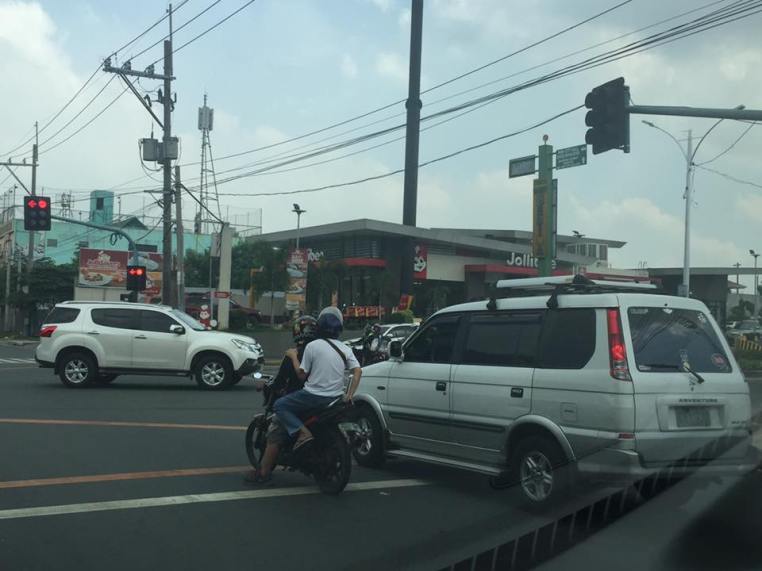
This and others like it are what seems to be minor incidents but in truth have a combining or cumulative effect on traffic streams that contribute to congestion as well as having implications on road safety. Pedestrians and cyclists are forced to go around the vehicles blocking their paths, likely putting them in harm’s way. Other motorists try to avoid these errant vehicles, which, like in the photo, may be blocking the path of vehicles proceeding towards the intersection leg to the right that is hidden in the picture. Motorists doing this must be apprehended by traffic officers/enforcers as these are clear violations of traffic rules. If one is to promote discipline among road users, then it should start with minor violations that tend to be disregarded by traffic enforcers.
–
Evidence from Montreal: Building bike lanes to reduce car use
I just wanted to share this article showing evidence of car use reduction (and therefore, car traffic along roads) with the provision of bicycle lanes.
Building Bike Lanes Really Does Get More People Out of Their Cars
The article though cautions readers against generalising or assuming great improvements. Some figures mentioned in the article including the following (I took the liberty of copying and pasting):
- “A 10% increase in bike accessibility resulted in only a 3.7% increase in ridership.”
- “…cycling infrastructure also reduced greenhouse gas emissions from cars by 1.7%, a reduction equivalent to converting transit buses to hybrids and electrifying commuter trains.”
These numbers are for the case of Montreal, Canada. Not mentioned are the number of cyclists, vehicle traffic volumes and other pertinent data that are useful in analysis. The article correctly points out the importance of using science (e.g., sound analysis based on good data) in order to convince governments to put up bicycle infrastructure. I would even add that this approach should also be applicable to pedestrian facilities.
–
Monuments to recklessness or carelessness?
Our recent trip to a resort in Batangas required for us to take a local road that was both narrow and winding. The roadside revealed what remained of a bus that was involved in a crash not too long ago. This was a crash where many of the passengers perished. Many of the fatalities were teachers who attended a workshop held in a venue in the area.
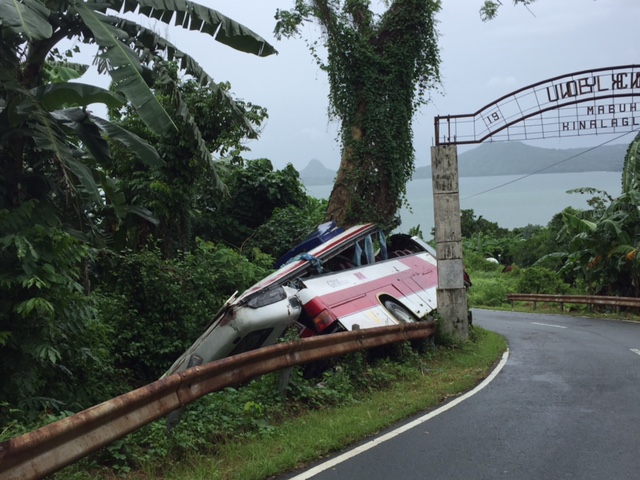 Remains of the bus wreck along the local road in Mataas na Kahoy, Batangas
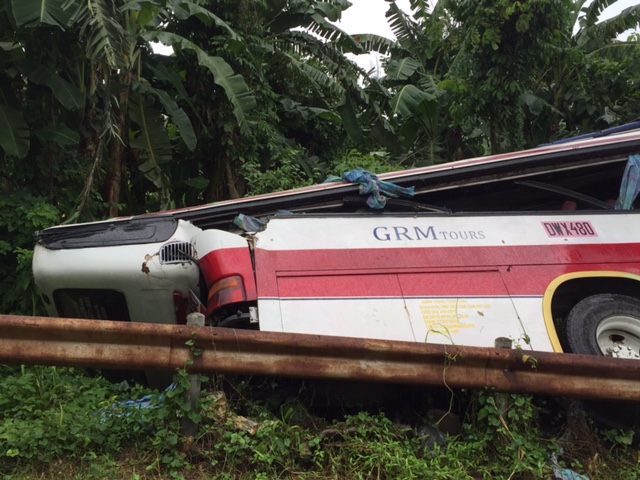 From the looks of the wreck, it is difficult to assume that no one perished here. Passengers seldom wear their seat belts when riding a bus and a crash would mean passengers literally flying around inside the bus. It would have been difficult to avoid serious injury at the least for those who were in the bus.
 This is the scene that will greet travellers to Mataas na Kahoy, Batangas. Gruesome but it drives the point regarding road safety. The wreck serves as a strong reminder to drive safely no matter what in order to avoid such incidents.
–
Roadworks along Sumulong Highway, Antipolo City
The roadworks along Sumulong Highway continues with drainage work along the sections across Palos Verdes and Cavalier’s Village. They have cleared a lot of trees along the road’s edge on the Masinag-bound side and only one lane is usable for these sections. This has recently caused several road crashes involving all types of vehicles. While there are obvious shortcomings about the worksite on the contractor’s side, many hardheaded drivers and riders continue to operate their vehicles (read: drive or ride recklessly) as if there are no hazards along the road.
 Concrete culverts line the Masinag-bound side of Sumulong Highway
 Worksite occupies one lane of the 4-lane/2-way highway. Temporary barriers often encroach upon the single lane available to Masina-bound traffic. This leads to many vehicles encroaching on the opposing traffic lane, violating the double line that states “no overtaking.” Perhaps the contractor needs a refresher or a lesson in proper traffic management and signage for worksites?
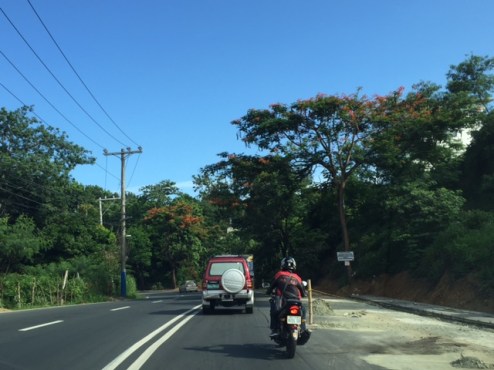 Completed sections are not immediately cleared, apparently and likely to have proper curing for the concrete. Notice in the photo that the project includes sidewalk construction. Sidewalks will enhance safety for pedestrians and even joggers or hikers going up and down Antipolo.
 Notices are nailed to many trees that will be cut down to give way to highway drainage and sidewalks along the Antipolo-bound side of Sumulong Highway.
–
On the worsening state of road safety in Metro Manila and adjoining areas
Recent days have seen some serious road crashes occurring along major roads to the east of Metro Manila. A friend posted about a crash along Marcos Highway last June 10 at the still incompletely paved Marcos Bridge. No one was killed in the crash though the driver and passengers sustained serious injuries. However, there was a high potential for this to have been a fatal crash.
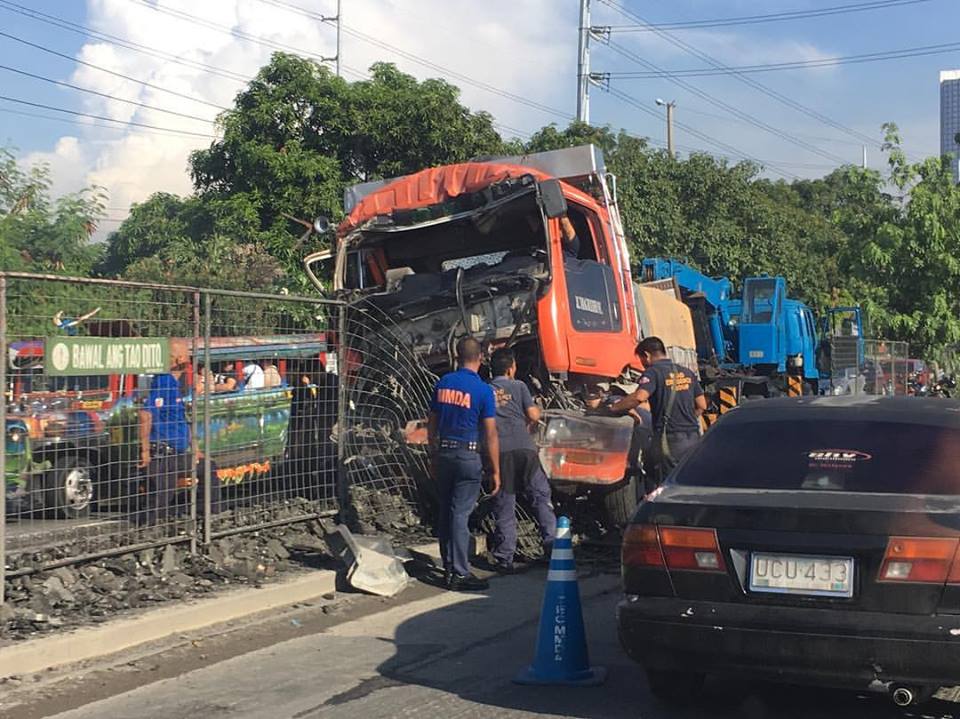 Crash involving a truck plowing into the steel fence and median of Marcos Highway near the Marcos Bridge along the eastbound direction of the highway. Both directions of the bridge’s carriageway’s asphalt overlay had been scraped off and remained neglected for several months until this morning when I observed workers laying out asphalt concrete along the eastbound lanes of the bridge.
An even more ugly crash occurred yesterday in Taytay, Rizal when a truck plowed into the tiangge are of Tatay’s public market killing scores of people and injuring more. Here is a link to some photos and videos about the Taytay crash. These two are but examples of what is happening along national and local roads all over the country with many not even being reported on mainstream or social media.
As I have mentioned in previous posts these crashes were all preventable. Truck operators and drivers need to regularly perform maintenance checks on their vehicles. Brakes are among the critical or essential parts that need to be checked especially with safety in mind. How many fatal road crashes have been reported involving brake failure? In the Marcos Bridge crash, there is also the need to make sure roads are well-maintained and projects not left out for months. In fact, poor road pavement conditions also contribute to traffic congestion as vehicles tend to slow down because of the roughness of the road (e.g., too many potholes). How can the next administration reinforce the enforcement of traffic rules and regulations as well as testing of private and public utility vehicles for these to be certified safe for driving along our roads? Will the Department of Transportation (DOT), the Department of Public Works and Highways (DPWH) and other allied agencies (e.g., LTO and LTFRB), local government units and private entities come up with a more aggressive effort to curb what seems to an increasing trend in road crashes? We hope so and look forward to positive change coming to our roads.
–
Road crashes in Antipolo
I open June with a post on road safety. Last week, I passed by many road crash scenes along my route between my home in Antipolo and my office in Quezon City. Many were the now common crashes involving motorcycles. And there were those involving vehicles that got too close to each other in heavy traffic (e.g., tailgating vehicles eventually bumping the vehicle ahead of them). I was able to get photos of the site of the more serious crashes.
 Head on collision of a car and owner-type jeepney along Marcos Highway near the junction with Amb. Neri Road. These crashes are largely preventable if drivers kept to their lanes and refrained from violating the rule of the double yellow line separating opposing flows of traffic. I’ve written about counter flowing before but focused on it leading to traffic congestion. A more serious repercussion would be crashes like this.
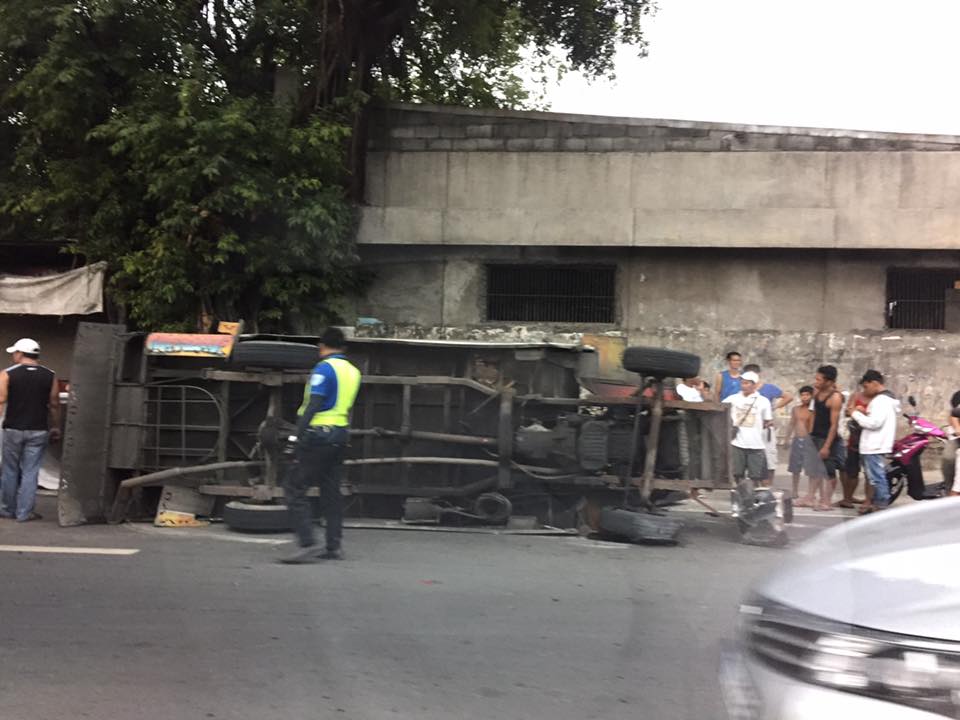 Overturned passenger jeepney along Marcos Highway in Mambugan, Antipolo. Speeding and unnecessary manoeuvres along this highway often has led to drivers losing control of their vehicles and, in this case, the vehicle turning over and likely hurting (hopefully not killing) passengers. This is again a very preventable crash considering it can be addressed by proper (read: safe) driving as well as enforcement.
 Final ‘resting place’ of a truck that apparently lost control along the Tikling bound side of Ortigas Ave. Extension in Barangay Dolores, Taytay. I’ve noticed many breakdowns and crashes involving trucks along this highway as well as Sumulong Highway and Marcos Highway. Many, it seems, involve poor maintenance of these vehicles as well as overloading. Poorly maintained vehicles may lose control with or without their loads and lead to such crashes that in many cases are fatal to innocent bystanders.
With the onset of the rainy season, many roads will be slippery and this will tend to make them more dangerous. In the cases I mentioned above, most crashes are not the fault of the roads or the infrastructure but of the drivers and/or operators of the vehicles. Most crashes are preventable and are caused by driver error, negligence or aggressive behaviour. It is often the nut behind the wheel who is responsible for such crashes rather than the vehicle or the road.
–
Is a truck ban the solution to truck-related crashes in Antipolo?
The crash near Masinag Junction in Antipolo City that led fatalities, injuries, damage to property and terrific costs due to the congestion was caused by a truck that apparently had defective brakes. I’ve read some posts on social media calling for a truck ban in Antipolo City. Some comments go as far as specifying major roads like Sumulong Highway and Marcos Highway where a truck ban can be ‘most effective’.
Is a truck ban in Antipolo City and particularly along major roads like Marcos Highway and Sumulong Highway going to solve truck-related road safety issues? It should have some success but it does not address the root causes of the problem. Among these root causes are related to driver behaviour and the maintenance or condition of trucks. Issues pertaining to driver behaviour can be seen in the form of aggressive or reckless driving (e.g., speeding trucks, trucks weaving in traffic, overtaking at critical sections, etc.). Meanwhile, issues pertaining to vehicle maintenance/condition can be seen in instances where trucks climbing Sumulong Highway, Marcos Highway or Ortigas Ave. Extension tend to slow down traffic (overloaded and/or underpowered?) as well as in crashes involving the malfunctioning braking systems. These cannot be addressed through truck bans, which are likely to be more effective for cases of severe congestion that can be directly attributed to trucks.
A truck ban will only punish the good (read: disciplined and competent) drivers and responsible truckers/truck operators. Good drivers know their traffic rules and regulations and how to position themselves on the roads as well as the speeds they need to travel by together with mixed traffic. They exercise caution especially along areas where there are a lot of pedestrian activity (e.g., Masinag area, Mambugan, Cogeo, Tikling, Cainta Junction, etc.). Meanwhile, responsible trucking company operators would likely have more structured or organised maintenance regimes for their trucks and likely would have newer and standard (read: non-modified) vehicles in their fleets. These would be able to carry load according to their specifications and maneuver safely in varying traffic and road conditions. On a larger scale, truck bans will definitely have a detrimental impact on logistics that will carry over to the local economy as well as Antipolo is the origin of many goods/freight and much also pass through the city.
–
 Caught (up) in traffic