
Home » Posts tagged 'road safety' (Page 20)
Tag Archives: road safety
Practicable road sharing in Antipolo
As there are increased calls for more bikeways, we try to look at some good examples of what I’d call “practicable” road sharing. I term it “practicable” because it is something doable or is already being done or practiced. I tried to find a few good examples of practicable road sharing to show that it can be done and usually if all road users respect each others’ right to use the road. This respect can be developed over time and requires some familiarity for each users behaviors. Of course, there will always be abusive or disrespectful people on the road including drivers of different types of vehicles. Reckless or unsafe driving is not limited to public transport or truck drivers. There are also many unruly private vehicle drivers who endanger the lives of others whenever they are on the road. Then there are the motorcyclists, cyclists and pedestrians – all road users and also with bad apples or “pasaway” among them.
Road sharing happens everyday in Antipolo City in the Province of Rizal. Along Ortigas Avenue and Sumulong Highway – the two main routes to and from Antipolo, you will see motor vehicles, bicycles and pedestrians sharing what are mostly 4 lane, undivided sections of the two major roads. Antipolo is a very popular destination for cyclists so even during weekdays you will find a lot of people cycling up and down the mountain roads even during the night time and very early mornings. While many are recreational riders, many, too, are doing this for health. I would bet that a good percentage might be biking to work or school but there are no hard statistics to show this (topic for research?).
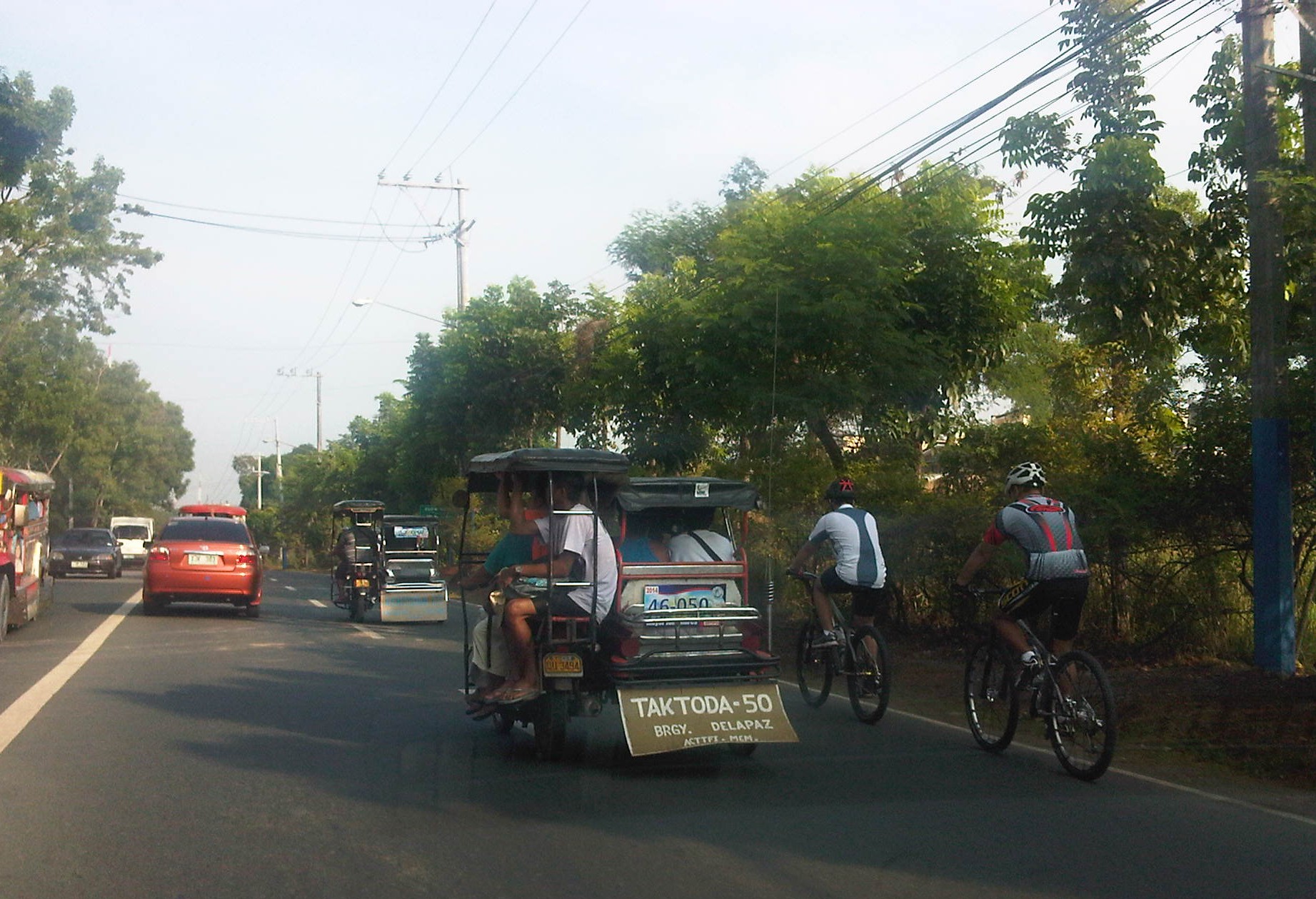 Motorists and cyclists “sharing the road” along Sumulong Highway
Sharing the road shouldn’t be too difficult. However, road users need to have respect for each other’s right to use the road. I have observed many instances where one or more road user types are guilty of “disrespect” and tend to hog the road as if making a statement that “i am king of the road” rather than “i have the right to use the road.” Here are among my pet peeves:
1. Slow moving trucks or jeepneys hogging two lanes and not giving way to other vehicles to pass them.
2. Jeepneys and private vehicles racing up or down the mountain roads and overtaking even in perilous sections (i.e., those already identified as prone to crashes).
3. Tricycles taking up the middle lanes and maneuvering anywhere.
4. Cyclists taking up the middle lanes or sometimes the entire two lanes of any direction preventing other road users to pass them.
5. People crossing anywhere along the road especially at blind sections (curves) where sight distance is limited.
There are practically no pedestrian sidewalks along most of Ortigas Extension and Sumulong Highway so pedestrians would have use the carriageway. As there are a significant number of people walking (e.g., students, workers, and even joggers or walkers), motorists and cyclists need to be careful not to hit these people. The same people, however, need to be aware of these vehicles and should exercise caution, always being alert as they use the road properly. Ultimately though, I would like to see walkways built along Ortigas and Sumulong especially since there is already an increasing demand for walking especially during the summer months when Antipolo holds its fiesta and a lot of people go on pilgrimages on foot to the Shrine of Our Lady of Peace and Good Voyage.
There is practicable road sharing in Antipolo because most road users are already familiar with each others’ behavior and accept each others’ presence and rights on the road. These road users are likely residents of Antipolo or nearby towns or regular visitors to the city. They are “nagbibigayan sa daan.” The “pasaway” people are likely the newer ones who seem to think that the way they drive or ride (i.e., unsafe) elsewhere is the norm. Of course, that goes without saying that familiarity with the roads and its users also breed risk takers who think they already know the road and have the skill and experience to drive like crazy. Here is where effective enforcement (e.g., timely apprehensions and reminders) and engineering (e.g., traffic signs and pavement markings) comes in to address the gaps in safety in order to reduce if not totally eliminate crash incidence along these roads.
–
More nuts on the road and a simple solution for traffic congestion
I have written recently about reckless drivers including one that drove as he was “busy” with his girlfriend in the car. The latter, however, is more an exceptional case rather than one you’d commonly find in our roads. Perhaps the most annoying behaviour by what I term as “nuts” on the road, is counter-flowing. Counter-flowing often happens along undivided roads (no median islands or barriers to split opposing traffic). Traveling home one afternoon, we took the bridge from C5 and the Marikina Riverbanks Road to Santolan, Pasig.
 I think we all thought that the driver of this Honda Civic was bold enough to have been able to cover a long distance before opposing traffic collectively forced the driver to back off.
While counter-flowing is dangerous and obviously a traffic violation, there seems to be few if any apprehensions regarding this behaviour. Such non-enforcement of traffic rules and regulations lead to more drivers and riders to be encouraged to counter-flow just so they could get ahead of all the others before them who did follow traffic rules by queuing properly. For one, there are issues of police or enforcer visibility in many areas, and when they are visible they are usually busy managing traffic at intersections and or watching out for number coding violations rather than enforcing all the other traffic rules and regulations that can be more or equally important than number coding violations in terms of their impacts on traffic. One such violation is counter-flowing that often leads to severe traffic congestion as counter-flowing vehicle block opposing traffic and force their way in front of queued vehicles. I think this has caused a lot more problems, congestion and safety-wise than number coding violations, and deserve to get more attention from traffic enforcers and managers looking for solutions to the traffic mess we encounter everyday.
–
Some thoughts on transport safety and security
There is an Office of Transport Security (OTS) under the Department of Transportation and Communications (DOTC). Under its mandate is coming up with plans and programs in order to ensure safe and secure travel for all. Security here is most often associated with the prevention of crime and the control of criminal elements in how they could affect transport (i.e., terrorists, robbers, etc.). I believe that this interpretation extends to safe driving as well since reckless driving is practically a criminal act especially when we realize the potential for fatal crashes due to these behaviors by drivers and riders. Unfortunately, the OTS like many agencies under the DOTC have a lack of personnel to be truly effective in carrying out their mandate.
I think passengers should be more proactive in ensuring their rides will be safe and secure. They should be in a position to pressure the driver to be more careful and responsible with the operation of the vehicle. However, there will always be apprehensions on the part of any passenger who might be thinking about the backlash or negative reactions they would get from the driver, conductor or even fellow passengers. Ironically, its the reactions from the latter that could turn something proactive to an embarrassing or humiliating experience. I recall one time a friend was conducting a survey on bus operations and one driver commented that passengers get angry with them when they slow down, saying the reason they rode buses of this particular company was because they drove very fast. Such thinking betrays their ignorance and disregard for safety – until, of course, they happen to be involved in a crash!
And so perhaps the OTS and other responsible agencies could enlist the help of other government personnel who would have the training required for authority figures on security and safety. For example, there are many of our servicemen in the armed forces and the police who take public transportation or who provide transport services by being operators or drivers (to augment their incomes with the AFP or PNP). Those who are passengers should assert themselves in the service of other passengers by accosting reckless drivers and reminding the latter of their responsibilities as service providers and the penalties for irresponsible driving. Servicemen can be formally (and legally) granted this authority by the LTO and/or LTFRB, which do not have the personnel to police the thousands of public utility vehicles around the country.
–
Bottlenecks and other traffic issues in Antipolo
Commuting between our home in Antipolo and my work place in Quezon City, I have noted a lot of issues on transport and traffic that needs to be attended to by the local government in coordination with other entities like the DPWH and Meralco. Here are some photos with my notes and comments.
 Much of Sumulong Highway have been widened to 4 lanes but many electric posts remain in the middle of the additional lanes and pose hazards to motorists and cyclists. These posts seem to have been here for quite some time now and the paint on them gives the message that they will be here for the foreseeable future. Paint or no paint, they are road hazards and have the potential to kill people on vehicles crashing into the poles. I think this is supposed to be the responsibility of the power company (Meralco) but there needs to be a firm request and coordination coming from Antipolo City Government to finally relocate these poles.
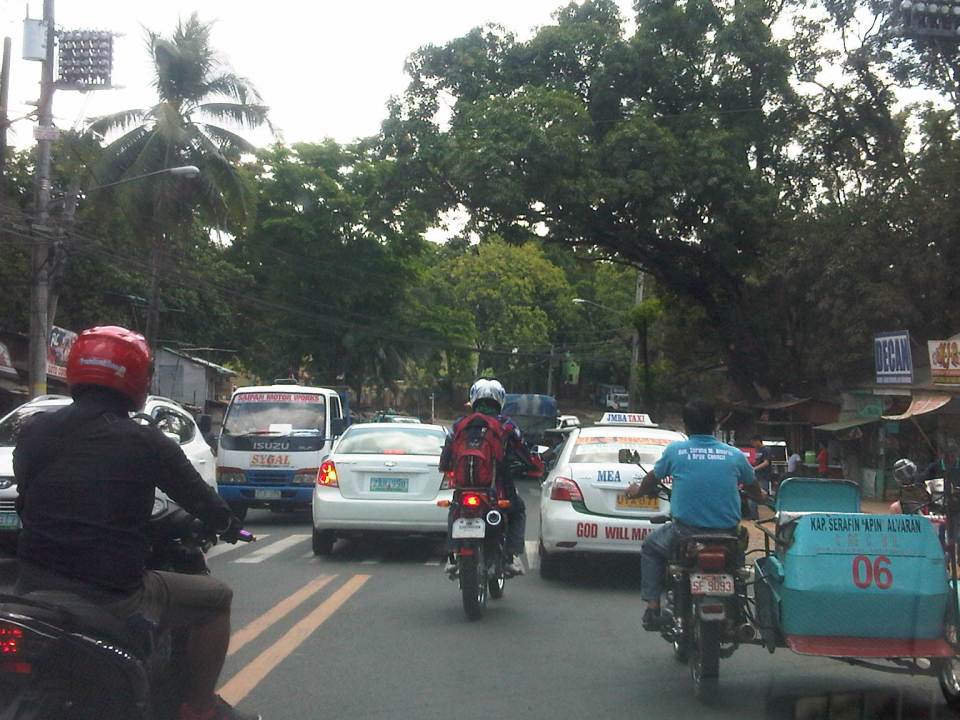 Congestion is often caused by counter-flowing vehicles forcing their way back into the right lane (like the car in the middle of the photo) upon encountering opposing traffic. It doesn’t help that there are motorcycles splitting the lanes to make for a very crowded road.
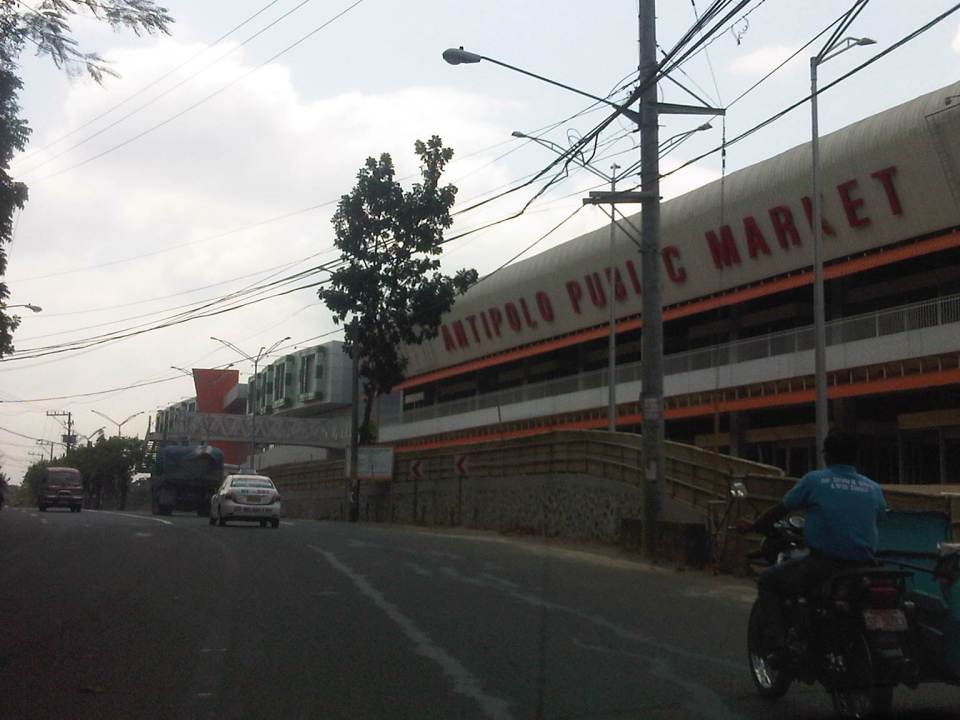 The new but still closed Antipolo Public Market along Sumulong Highway and near the intersection with Daang Bakal (the old railroad line that’s now a road). I wonder about the trip generation potential of this complex as it is not yet operational. Meanwhile, a huge Robinsons mall (looks larger than their Magnolia property) is currently under construction just across from it and will definitely be a major traffic generator in that area. The combined traffic to be attributed to these commercial complexes will surely have a tremendous impact on Sumulong Highway and other roads in the vicinity.
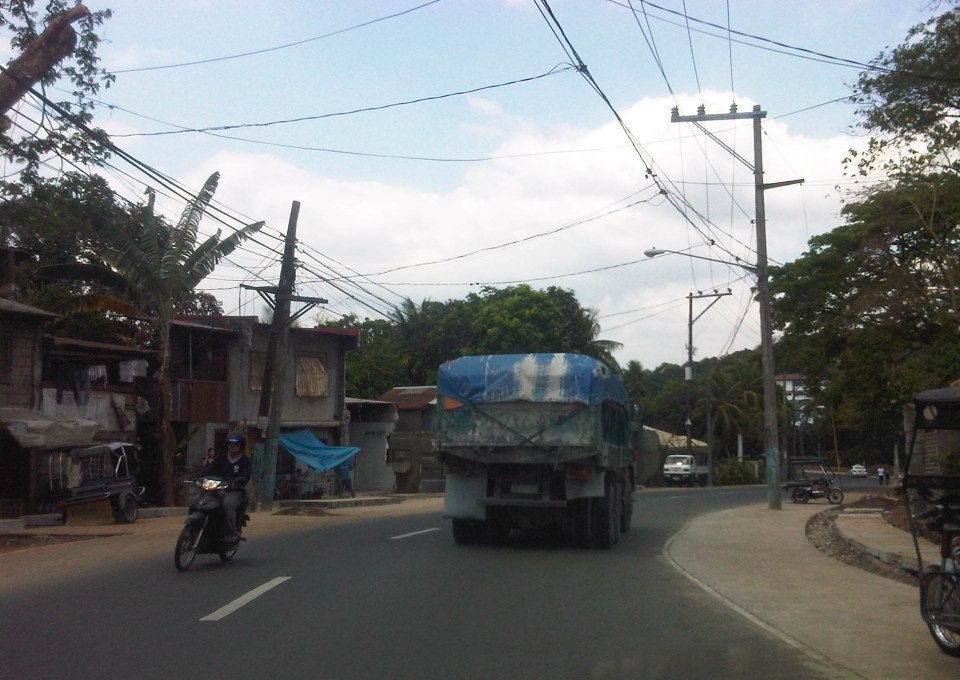 Both Sumulong Highway and Ortigas Avenue Extension carry significant truck traffic. These often cause congestion as they are slow going up to Antipolo and can block the entire road as Sumulong Highway and Ortigas Extension have some narrow sections where the shoulders could not provide enough space for other vehicles to pass the slower moving ones. In certain cases like the one in the photo above, there are electric posts in the middle of the shoulder lane.
 Tricycles occupy the outer lane of Ortigas Ave. Ext./Olivares Street. Such informal and on-street terminals are illegal along national roads and yet the city tolerates them. One explanation for this is that there are informal communities along the highway on shanties built along what is supposed to be a ledge along the mountainside (shown at right in the photo). These are where tricycle drivers and their families reside.
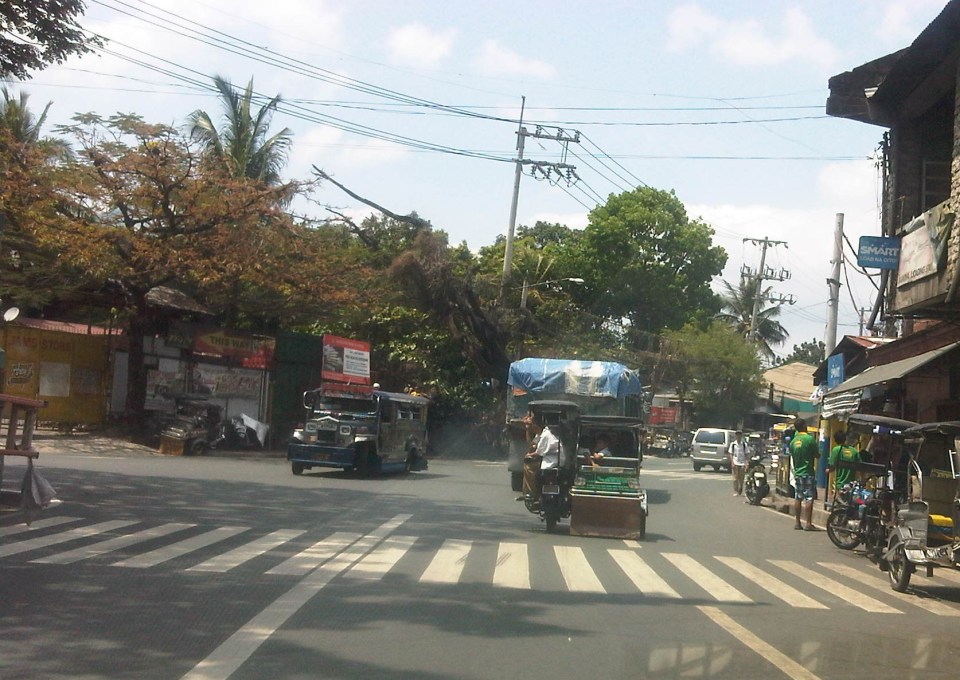 Tricycles from different tricycle operators and drivers associations (TODAs) seem to roam the entire city. This is contrary to the common practice in other cities and municipalities where tricycles are limited within a certain area or district that in many cases just overlap with others (e.g., UP Teachers Village-Philcoa-Krus na Ligas).
 Many tricycles serve as school service. However, the observation is that most tricycles tend to be overloaded with passengers. These are usually small children so the driver probably figured that they could cram more passengers than what is legally allowed.
 Sharing the road? Antipolo is very popular with cyclists and weekends bring a lot of them to the city as they come from all over via the main routes along Sumulong Highway and Ortigas Avenue (there should also be those coming from the east via the Antipolo-Teresa Road and Antipolo-Tanay Road). Most motorists are aware of these cyclists and give way to them. Most experienced cyclists are also aware of the ROW of other vehicles and so keep to the inner lanes. This mutual awareness and respect are vital to make roads safe for all. I think the only thing needed is to provide space for pedestrians as there are significant numbers of people walking, hiking or jogging along these roads.
–
Hang time
Traveling to the office one morning, I spotted a jeepney overloaded with passengers. Many were already hanging on to the jeepney at the rear and I could count eight people including 6 who were practically dangling from the jeepney. Such behaviour is common among males who do this just so they could get a ride to their workplaces. But this is also common among students who, with their bags (usually backpacks) face even greater risks when they hang on at the rear of jeepneys. This is actually illegal but poor traffic enforcement combined with the inadequacies of public transport force a lot of people to make sabit (hang-on) to the jeepney. Granted that some of these people have no intention of paying their fares but there is a real danger of lost lives if not serious injuries if one falls off the vehicles.
 Eight passengers hanging on to a jeepney as it is stopped at an intersection. Note the ones with backpacks that add to the degree of difficulty for this practice just to get a ride to work or school.
 The same jeepney with all 8 passengers dangling as the vehicle speeds up along Marcos Highway in Antipolo. These sabit passengers are actually lucky that their driver is not so reckless (e.g., changing lanes so often, making abrupt movements).
This practice is among a host of seemingly small but important items that can easily be addressed with strict enforcement of traffic rules and regulations. Prompt and timely apprehension and penalties will go a long way into influencing behaviour change among both drivers and passengers. I think the basic idea going on in the minds of both parties is that despite the practice, there’s seldom an incident when a passenger falls off from the jeepney. Such should not be the case and an acceptable reason if we are to prevent untoward incidents from happening, and it starts with sending a strong message through proper enforcement. Are the authorities up to the challenge though? Or is the ningas cogon attitude going to prevail all the time for such situations?
–
Risky business with motorcycling
I spotted what appeared to be a family of four riding the same motorcycle as I was traveling to work this morning. While they were traveling slowly, likely to be careful considering there were 4 riders, I could’t help but imagine (not really wonder) what was going on in the minds of the adults here. The children were obviously oblivious to the dangerous situation and I even saw one child smiling and apparently enjoying the ride. I am sure that the father is trying his best to be careful as he is surely aware that a mistake would likely doom his entire family.
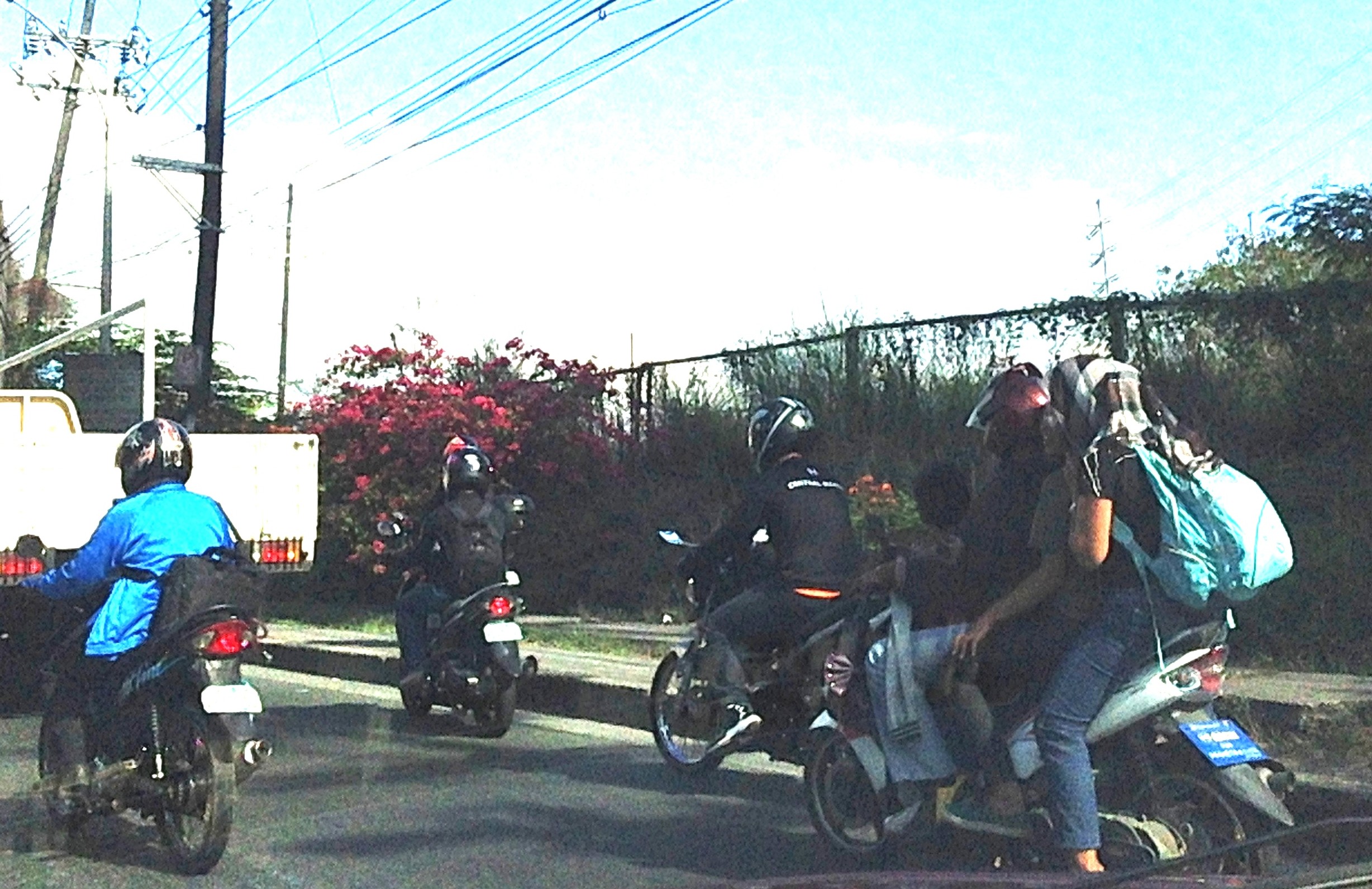 A family of 4 with one child (the younger one) in front and another child sandwiched between the adults riding a single motorcycle. The children didn’t even have helmets so if an untoward incident happens, there is a very high likelihood that the children will be killed in a crash.
These are common sights in Metro Manila and elsewhere in the country. Its worse in other places where there’s weak enforcement of road safety laws including the helmet law and the limitation in the number of passengers (yes, there is a law against passenger overloading for vehicles). I was actually wondering how these people in the photo were able to evade MMDA and LGU enforcers along major roads. And to think that there are many checkpoints to inspect those “riding in tandem.” Clearly, this is a violation of existing regulations and the only way to discourage such practices and effect behaviour change is for authorities to clamp down on such risky situations, even forcing them to discontinue travel in addition to issuing a ticket and fine for the violation. Are we really serious in promoting road safety and ensuring safety for everyone? If so, why the lax enforcement when it is perhaps, and arguably, the most important element in order to influence people’s mindsets regarding road safety.
–
Preventable tragedies
Last Friday, a provincial bus plunged into a ravine somewhere in the Mountain Province. The bus rolled several times before coming to a stop, instantly killing 14 people. Among the fatalities in this crash is a popular comedian/media personality who went by the name Tado and part of a group doing civic work in the area. Foreign visitors were also killed in the crash, leaving many to wonder if perhaps the Department of Tourism (DOT) should also get into the act as it is in the interest of the department to also establish that “It’s safer in the Philippines!” as part of its “It’s more fun in the Philippines!” tagline.
According to initial reports, the driver lost control due to defective brakes but later one report suggested that the driver had dozed off and awoke too late to bring the bus back in control. The slope of the road was downwards and there was significant curvature. This combination is definitely a challenging one for most drivers, even professionals who, like the bus driver, would probably have encountered such combinations of slope and curvature many times, even on a daily basis along mountain routes. One has to be awake and focused on maneuvering a vehicle for such sections. It didn’t help that probably, and I base this on photos of the section I’ve seen online, the road’s barriers were not up to standard in as far as stopping large vehicles like the bus from falling off and into the ravine.
These are preventable incidents, preventable tragedies that occur on a daily basis around the country. It is clear to many that the LTFRB needs to address these problems by taking steps to insure that public transport vehicles such as provincial buses are properly maintained and drivers are fit and in the best condition to drive these vehicles. To do that, they have to be proactive in evaluating bus, jeepney, UV express, and taxi and other franchises under them. These evaluations should delve into involvements in road crashes as well as the frequencies and types of traffic violations drivers have been involved in. Such records of crashes and violations should form part of a set of criteria to suspend and ultimately revoke franchises of public transport entities.
The LTO also has a responsibility here because they are the agency in-charge of licensing drivers. They should make sure that those applying for professional licenses are indeed qualified and not just to drive any vehicle. Therefore, perhaps there is a need to have different types of licenses for different types of professional drivers. Public utility vehicles differ in size and maneuverability so a different skill set and experience is required for buses compared with taxis. Another type of license should apply for those seeking to drive trucks as well as heavy equipment such as payloaders and bulldozers. The TESDA has certification programs for these that are sought out by people who want to drive professionally abroad. These should also be made as requirements for those seeking to drive professionally here. These would ensure that drivers will be qualified and competent as they are responsible for lives and property.
It is also clear that the DPWH and local authorities in-charge of road safety along roads should look into how to make travel safer by investing more into safety devices such as barriers. Crash or accident prone sections can be identified and sturdier barriers designed to keep vehicles on the road should be constructed/installed in order to prevent such types of fatal crashes (i.e., barriers would not prevent head-on collisions, etc.). That is why the DPWH and local governments need to have capacity and capability to assess road safety along national and local roads. These actions address vulnerabilities. These actions save lives.
What can you do to help in this effort? You don’t have to be part of an organized group or a lobbyist to be involved in promoting road safety. You can be involved in simple ways. Be aware of your rights on the road and your being among those vulnerable to road crashes. I am sure you don’t want to be involved in a crash nor would you like a loved one to get injured or, God forbid, perish in a crash. If your bus, jeepney, UV express or taxi driver drives recklessly, be firm in reminding him of his responsibility. You may enjoy a fast ride but are you sure your destination isn’t the afterlife? Think about it. Act on it. Save lives!
–
In-vehicle tools for road safety
I recently came across a provincial bus operator who is promoting a device for limiting the speeds of vehicles. He states that all their buses are fitted with the device and together with an on-board camera and GPS, they are able to monitor their buses and ensure the safety and security of their passengers. It’s always good to know there are responsible and progressive bus operators like him. Unfortunately, his kind is a minority among many who appear to be after the proverbial quick buck rather than ensuring a high quality of service for travelers.
Devices limiting the speeds of vehicles are not new. These have been installed in many public transport and commercial vehicles like buses and trucks in order to regulate their speeds along highways and streets. Trucks from Japan are fitted with these devices and those second hand trucks being sold in the Philippines have these but are allegedly disabled by their new owners. They are not violating any laws here as there are no regulations requiring such devices to be installed in vehicles.
Tracking devices that include GPS are more recent technologies being used mainly by logistics companies to track their vehicles. These are particularly important for trucks laden with high value cargo or for delivery vans who schedules and routes need to be managed to ensure timely delivery of packages consigned to them. Data from these devices would allow for the assessment of driving speeds and behavior such as lane changing that can be used to determine if drivers are, for example, reckless. The same data can also be used to evaluate fuel efficiency.
Such devices also have research applications because data can be used to determine real-time traffic conditions. In fact, there have been probe car studies conducted in other countries such as Japan, Thailand and Indonesia where taxis were employed to gather traffic information along urban road networks (e.g., Tokyo, Bangkok, Jakarta). Similar experiments can be implemented for Philippine cities to derive traffic information that can be used to guide travelers regarding travel times and route planning.
Perhaps the DOTC through the LTO and the LTFRB, should look into the mandatory installation and use of these devices to regulate vehicle speeds for public and freight transport and also monitor driver behavior. Mandatory speed regulation devices as well as tracking systems have a high potential for weeding out reckless, irresponsible drivers that will ultimately lead to a reduction in road crashes that have resulted in serious injuries and loss of lives. Definitely, there will be objections or opposition to such a requirement but these devices can be justified given the clamor for safer transport and safer roads. After all, everyone of us are vulnerable road users where even the safest driver can be involved in crashes. It takes only one reckless driver or rider to cause a crash.
–
Clear message to transport service providers
The cancellation of the franchise of the Don Mariano Bus Transit last January 14, 2014 is a long overdue decision. I say this because there have been so many incidents of road crashes in the past involving public transportation that led to the deaths and serious injuries of a lot of people whether they are passengers, the drivers themselves, pedestrians or even innocent people who happen to be at the wrong place and the wrong time (i.e., when and where the crash occurred). The cancellation of the franchise sends a strong message to erring operators and drivers of public utility vehicles including those of buses, jeepneys, UV express and taxis that the Land Transportation Franchising and Regulatory Board (LTFRB) is dead serious about enforcing franchise rules and regulations particularly in the light of road and public safety concerns. The decision is also a strong statement by the agency. One that says they have the balls to make game-changing decisions that is assumed to be intended for operators and drivers to take heed.
I had the opportunity to attend a few congressional hearings at the Batasan a few years ago that were convened by the Committee on Metro Manila Development. The main topics of those hearings were on public transportation. I recall that one hearing focused on the proposal to increase the penalties for traffic violations while others focused on policies being introduced by the MMDA (e.g., dispatching scheme, painting the bodies of buses with their plate numbers, RFID, etc.). In these hearings, the MMDA had been asked by the congressmen to present statistics on road traffic violations by public transport vehicles and they did present the numbers indicating also which bus companies were involved in the most crashes and which incurred the most violations. One question asked by a congressman was why, despite all the incidents and violations that bus companies were involved in, have no franchises been cancelled or revoked. The MMDA quickly and correctly replied that it is the LTFRB that has authority over the franchises. I do not recall how the LTFRB managed to answer the follow-up question trained on them but I don’t think anything close to a solution came out of those hearings. The transcript of these meetings and the data reported by the MMDA should be with the committee and, I presume, should be for public consumption given that these hearings were made in the interest of the general public.
Public transport as a form of “livelihood” should not be made an excuse for the poor quality of public transport services. A driver cannot drive like crazy, crash into other road users and claim that they were only trying to earn a living. Operators cannot scrimp on maintenance and spare parts costs (resulting in poorly maintained vehicles that are prone to mechanical failure and obviously violate emission regulations) just because they want to earn a larger profit. It is a card that is always put on play by public transport operators, drivers, conductors and their lawyers when interviewed, especially by TV reporters. One take on the news reports on TV is that those interviewed were nagpapaawa lang (acting for people to pity them or sympathize with them. Yet afterwards, once the suspension is lifted, these same drivers go back and drive as if nothing happened and still oblivious to the dangers they pose on others travelers. I have written about this in the past and share the opinion that we will get nowhere near the efficient and safe transport services we aspire to have unless we do away with the current practices of reckless driving and smoke-belching PUVs. And the improvement begins when the LTFRB starts canceling franchises of erring operators of public utility vehicles and the Land Transportation Office (LTO) starts revoking the licenses of irresponsible drivers.
Now, if we can only have the LTFRB cancel the franchises of erring jeepney, taxi and UV express operators, then that will send even clearer messages to all that government is really serious about road safety and public transport regulations. Included also are initiatives on truck operators and drivers who are also guilty of irresponsible driving. Perhaps the LTO should follow suit and be more aggressive in their part to rid our roads of erring private vehicle drivers and motorcycle riders? I think such actions are definitely what’s needed under the banner of “Matuwid na Daan” (literally “straight path” but also translates to “right or correct path”). In order to achieve “Matuwid na Daan,” we should also have “matuwid na pagmamaneho” (“responsible driving”).
–
Swapang! or the perils of walking
Walking to the jeepney terminal for a ride to the university, I was irritated by the constant honking behind me as motorcycles rode up the sidewalk to avoid the weaving into congested traffic along Aurora Boulevard. And so I tried to stand my ground allowing only half the space of the sidewalk for these motorcycles to pass through. As far as I’m concerned, I was already too generous giving part of the space that is for pedestrians and not for motorized traffic. Still, there were a few motorcyclists who seem to think they had the right of way as they attempted to convince me give up more space so they could practically take over the sidewalk. I didn’t give way and assumed they were cursing me inside their helmets. Manigas sila! I thought that in the end, sila ang asar at talo in this situation, not me.
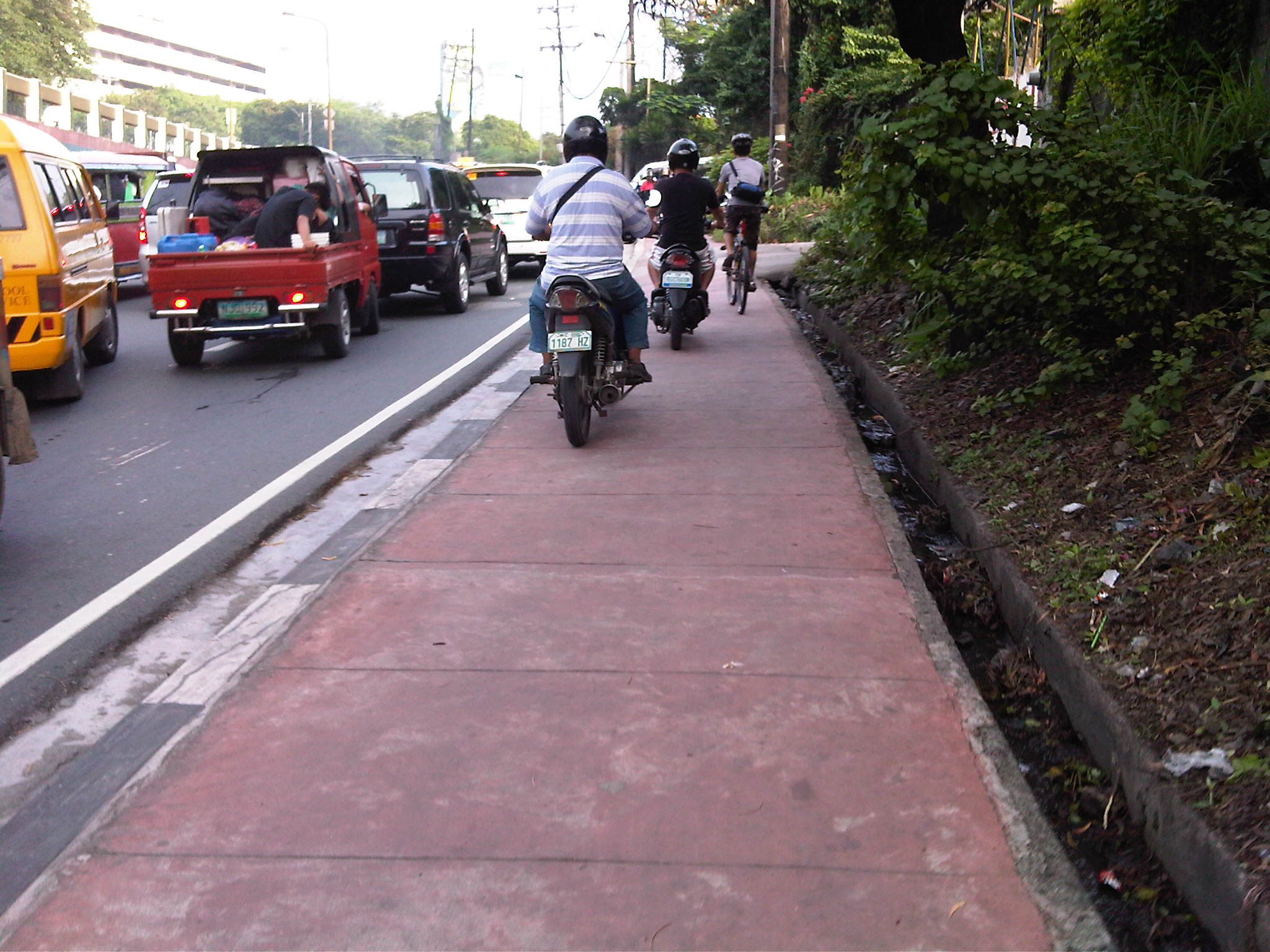 Motorcycles dominating space for pedestrians
At one point, I held my ground and didn’t give way to the motorcycles behind me [Advisory: This is not for everyone especially those who are “pikon” or who are looking for a fight.]. I knew my rights and I was walking on the pedestrian sidewalk. Unfortunately, a bicycle came along and I gave way only because I also appreciated cycling and understood that pedestrians and cyclists are sort of “kindred spirits” in a world dominated by motorized transport. The bicycle was immediately followed by two motorcycles including one that almost sideswiped the cyclist. I took the photo above to better show the situation.
The other day, I chanced upon a similar situation as I was driving in heavy traffic along Amang Rodriguez in Pasig City. What little space was available for pedestrians along a narrow sidewalk along this road connecting Marikina and Pasig cities.
 Motorcycles using a narrow pedestrian sidewalk to avoid traffic congestion along Amang Rodriguez
These cases are clear examples of swapang attitude or behavior that is prevalent among many road users. Unfortunately, these are not apprehended or accosted by traffic enforcers. The latter seem to be more engrossed with number coding and swerving violations, anyway, that they seem to have forgotten all the other traffic violations that included this brazen behavior of motorcyclists. Perhaps enforcers should go back to the basics and take more notice of all those other violations (e.g., speeding, counter flowing, beating the red light, beating the green light, etc.) to improve and promote discipline on our roads.
–
 Caught (up) in traffic