
Home » Posts tagged 'road safety' (Page 5)
Tag Archives: road safety
Article share: on using optical narrowing to make streets safer
I’m sharing this interesting article on the concept and application of optical narrowing to improve road safety:
Erfurt, E. (September 15, 2023) “How to Use Optical Narrowing to Make a Street Safer,” Strong Towns, https://www.strongtowns.org/journal/2023/9/15/how-to-use-optical-narrowing-to-make-a-street-safer?fbclid=IwAR147sLmkMBwStj51FR1ehNcVsi1YpN70etrpGOwv9DHL4ZhJIDLzP8cb1s [Last accessed: 3/14/2024]
To quote from the article:
“We all perceive the world around us through visual reference points. As we look around, we are next to the wall, or across the street from the bank—in other words, we position ourselves relative to what we see. This is even more apparent when we are driving: you may perceive yourself as behind another car, or between the lines on the road.
Drivers make decisions based on these visual cues. If things are further away, we are more inclined to speed up. The auto industry has marketed this as the “freedom of the open road,” and the visual of a wide open road is paired with the acceleration of the car. If no one is near and all the fixed objects, such as curbs and buildings, are far away, then the perception is that we have less risk and we throw caution to the wind.
If things are closer, we are more inclined to slow down. Our natural inclination is caution and possibly a little bit a fear that we may hit something. When you drive on a street where the lanes are a little narrower, or the buildings are at the back of the sidewalk, our reference points become closer. We have to focus, and in an abundance of caution we drive slower. The perspective is that we have more risk, and we pay more attention to counter that risk.”
This would be a good quick reference to planners and engineers who are involved in road safety, particularly in applying complete streets concepts to reduce the risk of crashes along streets.
–
Speed limits and danger zones for trucks
Saw these signs at the back of a long truck as we were stopped before an intersection. One states the speed limits for these vehicles along different roads while the other is a warning sign for other road users especially those who might be less visible when the truck maneuvers (e.g., motorcycle riders, cyclists).
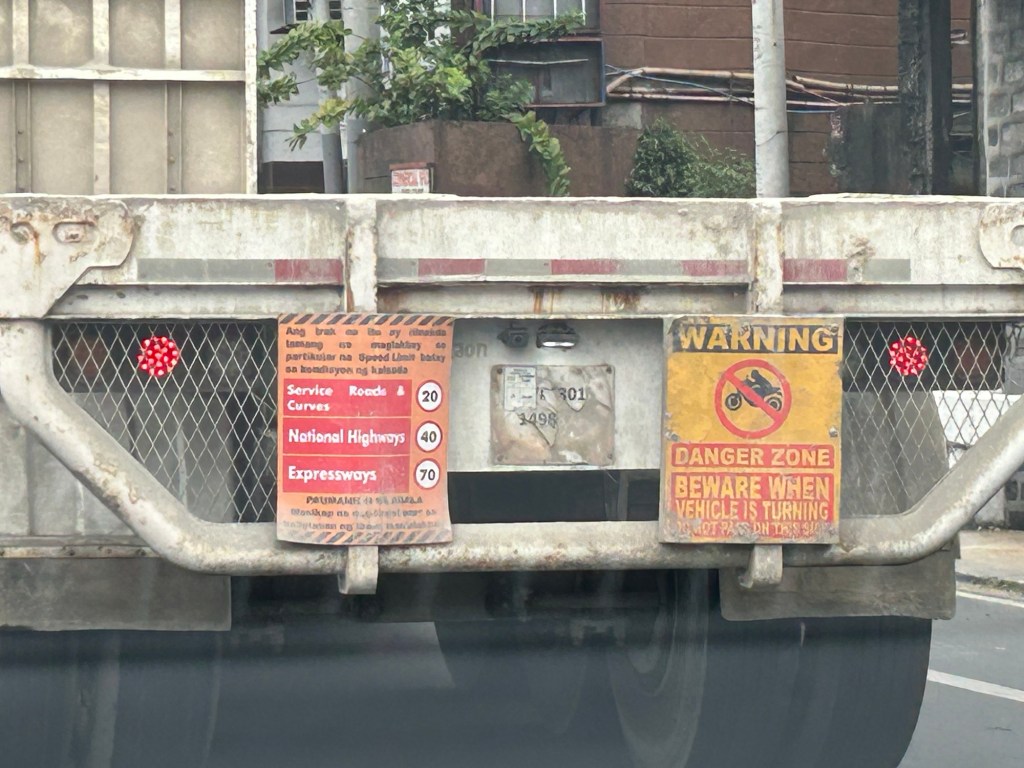
These are important information and fair warning to other road users. However, I think the signs should be bigger to be more visible or conspicuous. You have to be close to the truck for one to read and understand what the signs were. It might be too late by the time one figures out what the warning was about. I’ve read somewhere about people trying to debunk or play down these danger zones for trucks. That is bad opinion and puts drivers and riders heeding it in harm’s way. I think we should always go for what is on the safe side rather than risk being hit by these trucks.
Such information should be part of driver and rider education and perhaps education in general. While these large vehicles pose risks to other road users, they also play an important role particularly for logistics.
–
Solar road studs for Ortigas Avenue Extension bike lanes
The bike lanes along Ortigas Avenue Extension now have solar road studs for these to be more visible at night time or when it is dark. Following are photos of the bike lanes at night.
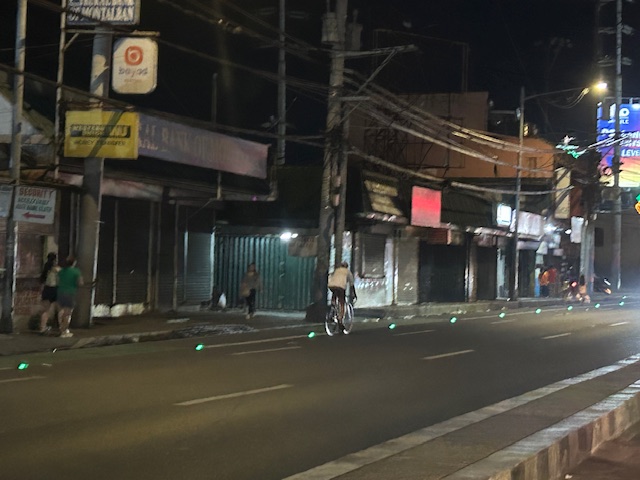
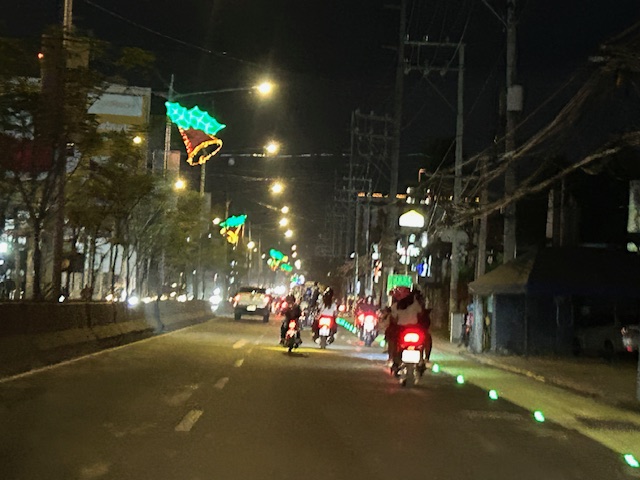

While the studs enhance the visibility of the bike lanes and perhaps also the safety of cyclists, the latter is not assured. The bike lanes are not protected and physical barriers like those installed along Quezon City roads are most effective in ensuring the safety of cyclists against motor vehicles. The solar studs do not deter motor vehicle drivers from encroaching on the bike lanes so they appear to have minimal impacts on safety.
–
On road crashes involving trucks
In the week leading to the Christmas break, there was a major crash in Antipolo City along Ortigas Avenue Extension. The crash caused a standstill for both inbound and outbound traffic as the road was impassable to traffic and later, only one lane was available and vehicles had to take turns to use the lane. Here is a photo taken by a passer-by and shared multiple times on social media:

The crash damaged electric and phone poles causing power outage and phone and internet lines to be disconnected. Obviously, the crash not only inconveniences travelers but a lot of residents of the area affected by the blackout and phone and internet disruptions. Crashes like this are preventable if only operators and drivers are extra diligent with vehicle inspection and maintenance. Apparently, the occurrence of such crashes are not enough a lesson that people could learn from. So there needs to be stronger initiatives including inspections of vehicles that can cause major damage and murder. While we expect a lot from national government, local government units must also pitch in along with the private sector in order to improve safety conditions.
We hope that 2024 will be better and that we will have safer roads for all users.
–
Happy New Year and Safer roads for 2024!
We conclude 2023 and begin 2024 with hopeful greetings for everyone especially for the coming year!
Last December 18, 2023, an event was held in Quezon City for the launch of the Global Status Report on Road Safety 2023 by the World Health Organization (WHO) and the signing of a Memorandum of Understanding for Child Road Traffic Injury Prevention (CRTIP) by the UN Children’s Fund (UNICEF). Advocates of road safety were gathered for the launch and the MOU signing including top officials of the Department of Transportation, which is the lead agency for the initiative.

 Information and links to the WHO Road Safety Data app. The app is available on Google Play and the Apple App Store. You can also scan the QR code in the photo to get the app and install it on your gadget.
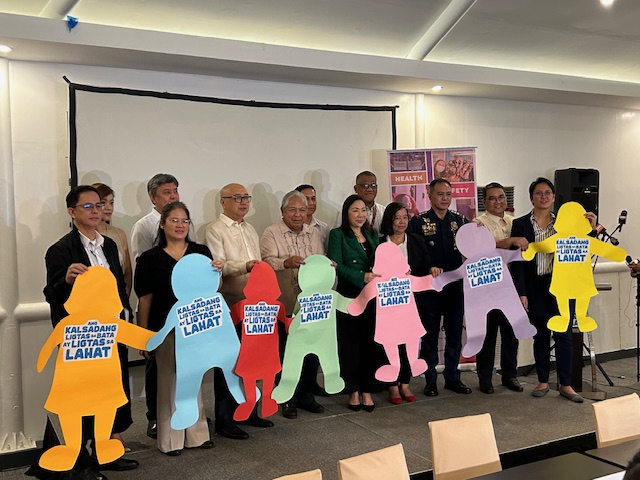 Representatives of the various agencies, offices and groups who signed the MOU for the National Coalition for Child Road Traffic Injury Prevention (NC-CRTIP).
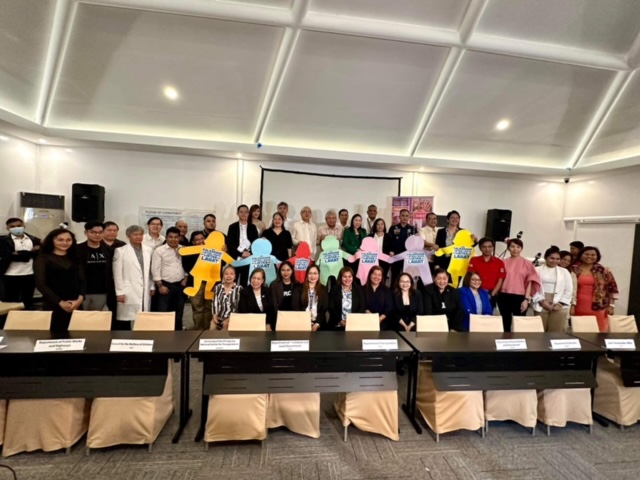 Participants to the MOU signing and Philippine launch of the WHO’s Global Status Report on Road Safety 2023
I learned there that the DOTr intends to reconstitute an inter agency committee on road safety. This is a throwback to the Road Safety Steering Committee and Technical Working Group during the time of then President Gloria Macapagal-Arroyo and then DOTC Secretary Leandro Mendoza that was co-chaired by the DOTC and DPWH. People were able to discuss road safety along various contexts and formulate programs and projects involving many if not most of the agencies and organizations at the time. These same agencies and organizations plus many others are still actively campaigning for safer roads or safer streets. Unfortunately, many are not talking with each other and there are those who seem to assume that there were no effort before to make transportation safer (sorry not sorry for pointing that out quite bluntly here). I am hopeful that this committee will be reconstituted this 2024 and that will lead to safer roads for everyone.
–
Quezon City’s bike lane barriers
Here’s a first look at Quezon City’s new bike lane barriers along Katipunan Avenue (C-5). I took these photos while crawling towards Ateneo Gate 3 on my way to the office.


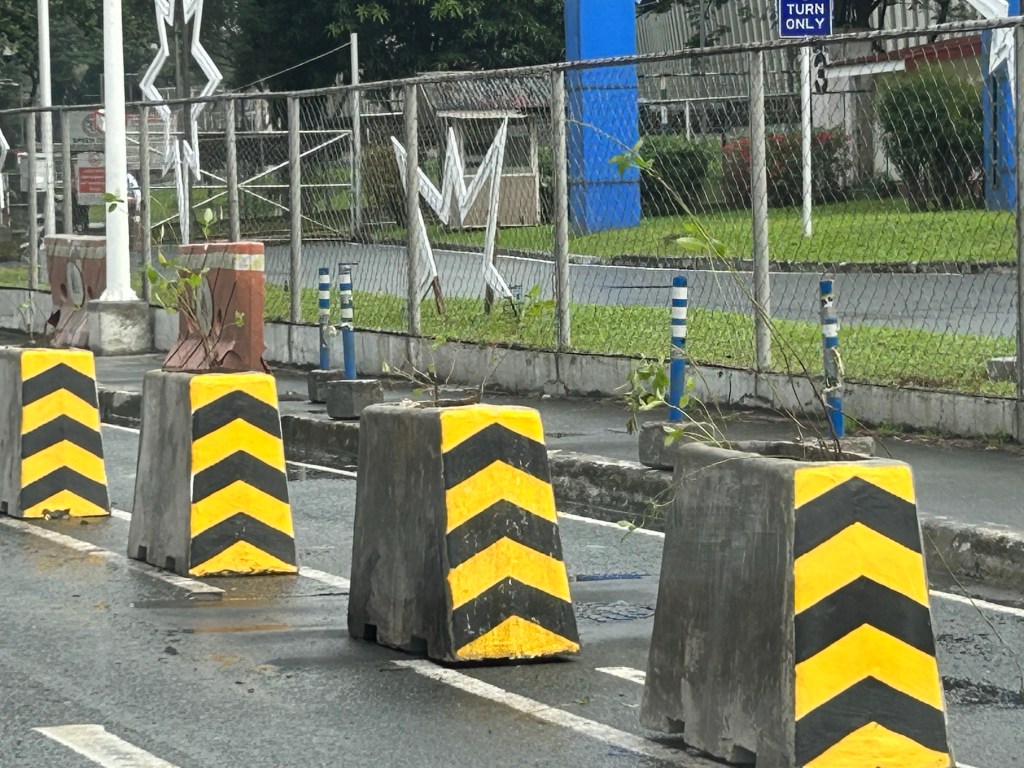

The same or similar barriers/planters have been installed along other major roads including Commonwealth Avenue. This is part of Quezon City’s commitment to building a bikeway/bike lane network and a worthy investment to encourage more people to take up cycling especially for work and school trips. The barriers serve to protect cyclists from motor vehicles thereby enhancing safety along these roads. Hopefully, other LGUs will follow suit and invest in active transport facilities.
–
On making intersections safe by ‘daylighting’
I came across this interesting article that introduced a somewhat new term to me – daylighting.
Abramson, B. (November 24, 2023) “How to Daylight Your City’s Intersections (and Why It Matters),” Strong Towns, https://www.strongtowns.org/journal/2023/11/24/how-to-daylight-your-citys-intersections-and-why-it-matters [Last accessed: 12/3/2023]
From the article:
“Daylighting is the technical term for a common-sense solution to traffic safety: By removing visual obstructions in approaching intersections, users can better see and more safely cross each other’s paths. “
There are certainly many intersections and even mid-block crossings in our cities and municipalities that could use ‘daylighting’ to improve safety. Many of these intersections and crossings are used by the most vulnerable road users like children, senior citizens and persons with disabilities. Interventions need not be expensive and may also involve the community. Examples are shown in the article, and these can easily be implemented formally or informally with the cooperation of stakeholders including the local government units and national agencies (i.e., DPWH) under whose jurisdiction many roads are.
–
On reimagining our streets
We start the last month of the year by sharing this article on complete streets:
Robertson, D. (November 15, 2023) “Safe streets are global—and it’s time for the U.S. to catch up,” Smart Growth America, https://smartgrowthamerica.org/safe-streets-are-global-and-its-time-for-the-u-s-to-catch-up/?eType=EmailBlastContent&eId=03b04320-4eeb-4bf5-9b12-71ec2a960421 [Last accessed: 12/1/2023]
To quote from the article:
“The examples mentioned here are exemplary cases, but demonstrate that the future of mobility need not follow the same dangerous status quo. They prove that with a combination of public and political will to the commitment of the prioritization of people over cars, we can produce the results we care all about.”
While the article is on complete streets, there is a very quotable section that referred to the situation in Japan:
“Anyone who wants to register a car in Japan today must prove that they have a private place to park it. This shifts the economic burden of providing parking from the public to drivers, and also ensures that supply of parking will not grossly outpace demand.”
There are many opportunities for the complete streets concept to be applied in the Philippines. A few have already been implemented but there should be more especially in light of the gains from the development of bike lanes networks in many LGUs that started during the COVID-19 pandemic. As for parking, perhaps the Japanese example should be adopted and implemented to curb car-dependence.
–
On sleepy drivers
I am sharing this article on sleep-deprived driving as there appears to be low awareness of the dangers of this behavior as opposed to the typical drunk driving or driving under the influence (DUI) cases that we often hear or read about in the news (mainstream or social media).
Britt, R.B. (April 18, 2023) “Sleep-Deprived Drivers Might as Well be Drunk,” Medium.com, https://robertroybritt.medium.com/sleep-deprived-drivers-might-as-well-be-drunk-887aab48c1c [Last accessed: 4/21/2023]
To quote from the article:
“A 2016 study by AAA linked lack of sleep in the past 24 hours to dramatically higher crash risk, in hour-by-hour increments:
6–7 hours sleep: 1.3 times the risk
5–6 hours: 1.9 times the risk
4–5 hours: 4.3 times the risk
<4 hours: 11.5 times the risk
The risk of a crash drops to zero if you simply stay off the road, of course. Otherwise, the bottom line is pretty clear:
“You cannot miss sleep and still expect to be able to safely function behind the wheel,” said David Yang, executive director for the AAA Foundation for Traffic Safety.”
So make sure you get your sleep because it is really important for you to function not just as a driver or rider. It also applies to other activities or tasks as well whether you’re working, studying or playing.
–
Child’s perspective of road safety
As adults, many of us seem to have forgotten how it was to be a child and to see things from a child’s perspective. This perspective is important in many cases, situations or scenarios. One area where we can use this perspective to improve how things are is in road safety. As they say, streets that are safe for children are safe for everyone else. I am sharing this guide that also includes a project involving coming up with a reverse periscope. The reverse periscope is intended for an adult to have the view of a child.
How Do Kids Experience Streets? The Reverse Periscope Companion Guide
This guide would be something that can be used in road safety seminars or workshops that include some field activities. Participants can use the reverse periscope to simulate being a child as they walk and cross streets. An activity can be designed for transport and highway officials, even local government staff involved in planning, design and assessment of streets.
–
 Caught (up) in traffic