
Home » Posts tagged 'schools' (Page 2)
Tag Archives: schools
Back to school – concerns about congestion and safety
Many roads again are expected to become more congested as school resumes in most parts of the country especially in cities. But while congestion is usually the top issue along roads near many schools, one concern that usually takes a back seat to congestion is safety. Many public schools in the provinces are located along national highways. Many if not most of their students walk to and from school, usually on the carriageway when the shoulders are too rough, dusty or muddy. This situation for students increase the likelihood of their being hit by vehicles using the road. The risk increases because of their exposure to the dangers posed by motor vehicles. Following are a couple of photos showing typical cases at public schools along national roads. Both are in Antipolo City.
 Typical at-grade pedestrian crossing in front of a school. Students in most public schools often commute by walking or taking public transport like jeepneys or tricycles.
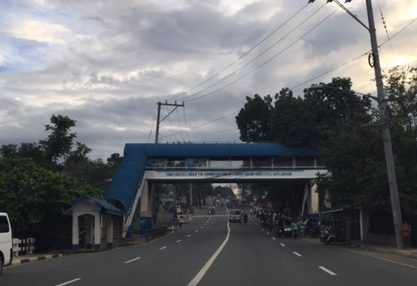 Despite this pedestrian overpass across a public school along Sumulong Highway, most students still prefer to cross on the road rather than go up and down the overpass.
Oftentimes, the seemingly obvious solution of constructing overpasses for safer crossings for students does not pan out as planned or intended. There are many underutilized pedestrian bridges since the natural way is still to cross at-grade. Then there is the issue of providing them safer walking paths or walkways. In both photos above, the sidewalks are only token (“puwede na iyan”) and insufficient for the pedestrian traffic supposed to use them. We need to plan, design and provide such facilities for our pedestrians, especially children, who are marginalized compared to those who have their own vehicles for travel.
–
Addressing congestion due to school traffic congestion
There are two important traffic news stories yesterday:
- MMDA successfully clears parked vehicles outside La Salle Greenhills
- MMDA sets drop off, pick-up points for Ateneo students
For some reason that’s a bit surprising for many, the MMDA seems to have solved two of the most enduring issues on traffic congestion along two major thoroughfares. LSGH is along Ortigas Avenue while Ateneo is along Katipunan Avenue (C-5). Both have high trip generation rates and a significant percentage of their trip gen is comprised of private vehicles. While, Ateneo’s trip generation has led to traffic congestion due to the sheer number of trips the university attracts, the congestion due to La Salle is due to the poor traffic management and lack of parking spaces for vehicles attracted by the school.
I only wonder why it took so much time to address these problems considering the solutions mentioned in the articles are basically ones that could have been implemented years ago. In the case of La Salle, good old fashioned traffic enforcement apparently did the trick. But then, the MMDA even with the LGU constraint could have been stricter before whether when they were under Bayani Fernando (BF) or any of his successors as MMDA Chair. With Ateneo, the scheme is very similar if not the same as what BF proposed over a decade ago when he was MMDA Chair. At that time though a touchy issue was the U-turn scheme he installed along Katipunan that cost trees and the former service road on the west side of the avenue. We can only hope that these claimed ‘successes’ will be sustained and ensure smoother flow of traffic along the major roads they directly affect.
–
On school trip generation and exclusive villages
In the news weeks ago is the coding scheme for vehicles that Ayala Alabang, a posh residential subdivision in Muntinlupa City, imposed on vehicles coming in and out of the village. According to media reports, affected are vehicles bound for and coming out of De La Salle Zobel (DLSZ), which is an exclusive school located inside the subdivision. There is another exclusive school inside the village but they don’t seem to be in the news regarding this issue on car stickers and access through the subdivision roads. Perhaps they generate a lot less cars from outside the village?
I lived in villages where there are exclusive schools also located inside the villages. They are smaller compared to DLSZ and likely generate significantly less vehicles than the latter. Also, the numbers of vehicles they generated from outside the subdivisions are not enough to cause traffic congestion along the main roads to and from the schools and the village gates.
For the school in the former subdivision we used to reside in, I noticed that most students arrived via school service. School service vehicles carry more passengers than private cars and so help reduce the number of vehicles generated by the school. These were mostly vans or AUVs and not the mini-buses, coasters or regular buses of when I was in grade school and high school myself. Though lower in capacity compared to buses, AUVs and vans could take in 10 to 12 students comfortably and perhaps max out at 14 to 16 people depending on the sizes of the children the ferry between school and their homes.
In the current subdivision where I live, most students go by car and the wider main road that they use translated to faster cars running between the village gate and the school. I have observed many instances when speeding vehicles do not slow down at intersections or when there are people about to cross the street. There are no humps along the main road like those in the previous village. Humps or speed bumps can be very effective in reducing speeds but improperly designed humps can eventually damage your car’s suspension. The rolling terrain of our village does not seem to be a deterrent against speeding and limited sight distances along the main road presents a significant likelihood that a crash can occur involving speeding vehicles. Thus, some traffic calming measures need to be formulated and implemented before tragedy strikes.
Now that school is almost out for most schools (including the ones inside subdivisions) I think the attention the issue has been getting will steadily die down. But that will be until schools open again in June and residents again feel the impacts of traffic generated by the schools from without the subdivision whether its traffic congestion or road safety that is the more pressing issue in residential subdivisions hosting schools. Perhaps a sticker system and the restriction of the number of vehicles of outsiders is one way to reduce the negative impacts of traffic generated and then there is also the option of not allowing a major school to be located inside a residential subdivision in the first place.
–

