
Home » Posts tagged 'sidewalks'
Tag Archives: sidewalks
Pedestrian-Friendly Cities: The Impact of Walkability Grants
Here is a quick share of an article on how to encourage cities to be more pedestrian-friendly:
Source: Pedestrian-Friendly Cities: The Impact of Walkability Grants
Many of our cities, particularly the highly urbanized ones, are not as walkable as we want them to be. Lacking are the most basic facilities such as sidewalks and safe crossings. Walkability Grants such as those in the US can encourage cities to build and/or enhance pedestrian infrastructure. Many designs such as those footbridges along EDSA and Commonwealth Avenue, for example, are anti-walking. Grants may be used to come up with better designs for walkways and footbridges.
To quote from the article:
“Walkability grants are awards for programs and projects creating innovative pedestrian infrastructure, such as new sidewalks, crosswalks, plazas, street lights and green spaces. For example, in February 2023, the Biden-Harris Administration announced the Safe Streets and Roads for All Grant Program, delivering $800 million in monetary awards for 511 projects addressing public safety and road improvements…
Reshaping the built environment into a walkable haven helps boost the local economy and sustainability. By changing the urban landscape, citizens are more inclined to walk instead of drive, allowing cities to reduce emissions, improve air quality and create healthier neighborhoods. This is critical, considering air pollution is responsible for 7 million early deaths yearly.”
Perhaps we can have similar grants coming from national government via the Department of Interior and Local Government (DILG) in cooperation with the Department of Transportation (DOTr) and the Department of Public Works and Highways (DPWH)? There was some funding for bikeways during the pandemic but this new one should put more emphasis on walkability.
–
Article share: What’s Incomplete About Complete Streets?
The concept of road diets circulated in Metro Manila more than a decade ago. I recall the Metro Manila Development Authority (MMDA) picked up the concept and attempted to apply it in some parts of Metro Manila. Since there are no evidence of that endeavor surviving now, then we can assume that it was a failure. There is no wonder there as I also recall the effort to be half-hearted and more to get media mileage (cheap talk or lip service) out of it. Road diets eventually evolved into the complete streets (though the literature now will state road diets as part of complete streets). That experience and similar initiatives of varying success (or failure) rates are not unique to the Metro Manila but is actually happening elsewhere including cities in countries where the complete streets have been applied more comprehensively and yet somehow found to be lacking or not as effective a solution as expected. I am sharing an article here that discusses what seems to be lacking or ‘incomplete’ as it is referred to.
Source: What’s Incomplete About Complete Streets?
Quoting from the article:
“What’s missing? First of all, even the best Complete Streets policy can’t solve the problem of fiscal scarcity. Even in a city committed to Complete Streets, street redesign must fight for public dollars with other worthy goals such as education and public safety. As a result, Indianapolis’s improvements are a drop in the bucket. The city maintains 3,400 miles of streets and roads, so its 100 miles of bike lanes affect only 3 percent of the city. Similarly, 2,000 miles of the city’s roads still lack sidewalks.
Second, the quantitative benchmarks seem to focus on sidewalks and bike lanes (Sec. 431-806), and the policy doesn’t mention traffic calming or similar policies. So if the city had a six-lane road with traffic going 60 miles per hour, the Complete Streets policy would not affect that road except to the extent necessary to build a sidewalk or a bike lane.** Thus, even the best Complete Streets policies don’t really address some of the most dangerous features of American street design.”
—
Article share: on pedestrian facilities and climate change
Here is an article that articulates the importance of walking and pedestrian facilities in sustainability and ultimately fighting climate change. It argues that if we had the infrastructure and facilities to make it easier for people to walk, they will and are likely to walk rather than use their cars. This is not limited to short trips as walking can be in combination with public transportation, making it an integral part of trips where public transportation covers the main commute and walking is the proverbial last mile travel.
To quote from the article:
“Walking, biking, and transit need to be prioritized, and treated as legitimate forms of transportation. This means stepping up efforts to collect data on sidewalks the way we do for roads, investing in complete walking networks before engaging in expensive new road projects and making sidewalk construction and maintenance a municipal responsibility rather than an individual one.”
Paseo Recoletos
The sidewalks around the University of San Jose Recoletos in Cebu City are named Paseo de Recoletos and Paseo de San Jose. Here are a few photos on Paseo de Recoletos.
 Arcade-type walkway along the perimeter of the University of San Jose Recoletos. This part is the Paseo de Recoletos along Magallanes Street and across from the Freedom Park Market. The other is Paseo de San Jose but is not wholly covered. The latter is along P. Lopez Street.
 The Paseo leads to the church of Our Lady of Mt. Carmel, which is on the second level from the ground.
 View of the Paseo de Recoletos from our vehicle. Note the architectural details on the USJR building.
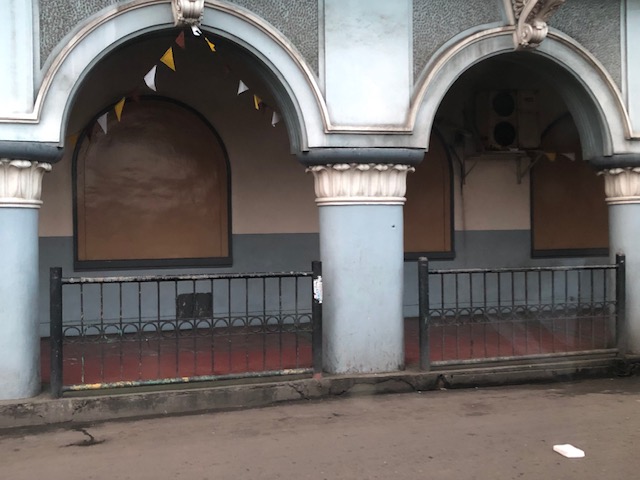 Another view of the Paseo de Recoletos
 The main gate of the USJR is at the corner of Magallanes and P. Lopez Streets. The photo capture the view towards P. Lopez and the side of the university along this street is Paseo de San Jose.
 Frontage of Our Lady of Mt. Carmel Parish Church, which is integrated with the main building of the university, which is run by the Order of Augustinian Recollects (OAR).
 Scenes along the Paseo de Recoletos included overloaded jeepneys, motorcycle taxis and various vendors both mobile and those who’ve set up shop across the street.
 Vegetable vendor pushing a cart containing his merchandise
Scenes like these are common in many Philippine cities especially the old ones that have narrow streets and have retained much of the commerce in many areas around the city centre. It gives you a glimpse of the marketplace and commerce before the arrival of the large malls. Of course, there are what are already termed as malls around the area but these are more like large department stores than the types of SM City, Ayala Center and Robinsons Place.
–
Walking in downtown Cebu City
Last month when we were in Cebu to coordinate with our counterparts at the University of San Jose-Recoletos (USJR), I took some quick photos of the sidewalk scenes near the university. We stayed at a nearby hotel so that meant we only needed to walk to/from USJR for our meetings. Here are some of those photos.
 Many buildings in the downtown area have designs where sidewalks are practically covered, protecting pedestrians vs. the elements. This alludes to arcade design architecture you find in many old cities’ downtowns including Manila, Iloilo and Bacolod.
 There are many shops and stores at ground level. Depending on the area, there will be hardware stores, electronic stores, school supplies and others.
 Along some streets, one will find makeshift stalls occupying the road itself. I assume these are allowed by the city along certain streets.
 Typical street vendor with his mobile store. Fruits, local delicacies and snacks, and refreshments are popular.
I believe these scenes reflect on the character of the city and gives the visitor a view of life in the downtown area of the city, which in this case is Cebu, the oldest city in the country. I will be back in Cebu soon and will be taking more photos around downtown. I’ll be posting these, too.
–
On prioritising pedestrians and promoting walking
We begin March with an excellent article that came out from curbed.com:
Walker, A. (2018) The case against sidewalks and how cities can create new avenues for pedestrians, curbed.com, https://www.curbed.com/2018/2/7/16980682/city-sidewalk-repair-future-walking-neighborhood [Last accessed 2/23/2018].
How do we improve the environment (i.e., facilities) to encourage people to walk? Do we simply clear up sidewalks? Widen them? Build overpasses and underpasses? What should be the context for improving pedestrian facilities for our cities and municipalities? What are the implications to planning and design?
–
 Caught (up) in traffic