
Home » Posts tagged 'Singapore'
Tag Archives: Singapore
On reducing deaths due to road crashes
Following is a link to an article on the increase in road crash-related deaths in Singapore. The city state prides itself as one of the safest places in terms of transportation yet road crash deaths recently hit a 10-year high.
From the article:
“Cellphone-related driving violations surged 39.1% to 4,193 cases, the report showed. Motorcyclists, who make up just 15% of Singapore’s vehicle population, accounted for 54.8% of all traffic accidents and 53% of fatalities.
Speeding violations jumped 25.9% to 253,550 cases, equivalent to roughly 695 motorists caught daily. While speeding-related fatal accidents dipped from 46 to 41, red-light running accidents surged 27.1% to 122, resulting in seven deaths. Drink-driving accidents fell from 166 to 156, but the number of fatal drink-driving accidents held steady at 12 in both years…
…”Road safety requires a culture of mutual respect and graciousness among all road users,” the police force said. “Simple acts of courtesy, such as maintaining a safe following distance of at least three seconds, giving way to pedestrians, reducing speed near junctions and being patient during peak hours, can create a better road culture.” “
What can we learn from Singapore’s experience? Are we capable and equipped to improve road safety in the Philippines? Can we be more courteous, respectful and gracious in the way we drive or behave as road users?
–
Learning to commute in Singapore
In a recent trip to Singapore, we took advantage of their excellent public transportation system to teach our daughter about commuting using public transport. It will be useful for future travels especially in countries we plan to visit that also have similar transit systems.
 |
| Descending to the subway station near our hotel |
 At the station level, one needs some sense of direction and the layout of the station to know where to get a card or tickets and where to enter the station towards the platforms.
 Station and train information are available and very visible in SMRT stations
 Network maps help one plan a trip including determining where you can transfer from one line to another. While there can be many transfer stations, the key is to determine the least number of stations as presumably this will lead to less travel time. Offhand, a familiarity with stations may also be useful to determine where it is easier to transfer (i.e., same platform for two lines rather than having to walk, ascend or descend to transfer).
 Singapore’s transit system employs ezlink cards for the convenience of commuters. We got one each and its nice that we got these cards with the Doraemon design.
It took only a couple of rides for our daughter to learn how to commute in Singapore. That’s how easy it was and it should be very similar if we’re traveling to Japan or Korea, even Europe at some point. The public transportation in cities in those countries are really good and easy to figure out and use. Hopefully, we can soon take her to learn how to use the LRT in Metro Manila and perhaps also the bus and jeepney. That will be an interesting experience.
–
Some advantages of transit access – the case of a stadium and an arena
One of the advantages of having mass transit access to a major venue is that mass transit can carry more people than any other modes of transport to and from the venue. In the recent U2 concert held at the National Stadium in Singapore, we experienced first hand how a mass transit system is able to serve the surge in the demand to and from the Stadium Station of the SMRT’s Orange Line.
 People filing towards the station – most people calmly I say most because there were some who apparently were not so familiar with the ways in Singapore and tried to muscle their way into the crowd. Maybe its like that in their own countries?
 It was just like rush hour conditions at the station. Only, people weren’t going to work but home from the concert
Previous to this, I had similar experiences when I was residing in Japan. One time it was a surge in demand due to the popular fireworks display at Yamashita Park in Yokohama covered by three of JR Stations and the end station of the old Tokyu Toyoko Line. There was no Minato Mirai Line at the time that terminated at the park so people had only the JR Sakuragicho, JR Kannai and JR Ishikawacho Stations and the Tokyu Sakuragicho Station.
This is the weakness of the Philippine Arena, which can only be accessed via the NLEX and by road transport. The result for the larger capacity stadium’s hosting of a U2 concert resulted in horrendous traffic jams and hellish travel times for attendees. Friends stated that whatever high that they got from the concert was steadily depleted by their commutes to their homes. This will not improve even with Manila-Clark railway line because the line will be along the other side of the tollway. It won’t make sense for a branch to be constructed for the arena given the intermittent demand for the events it typically hosts in a year. But there can be a road transport connection to the nearest rail stations to at least alleviate the car traffic generated by the venue.
–
Commuting in Singapore
Another thing we miss about Singapore is the public transportation. It was easy to go around Singapore especially with its comprehensive, extensive rail transport network. This is complemented by even more extensive bus transit services. All these are offer convenient, comfortable and reliable public transportation. As such, there is practically no need to use your own private vehicle for transportation unless there really is a need arising for their use (e.g., emergencies).
 Passengers wait for the train to arrive at an SMRT platform
 Passengers line up before the platform gates at an underground station
The transport system in Singapore actually reminded me of how efficient and reliable it was to commute in Japan where I’ve lived in three area – Tokyo, Yokohama and Saitama – for various lengths of time. These transport systems are what Metro Manila and other rapidly urbanizing cities in the Philippines need in order to sustain growth while providing for the transport needs of its citizens.
–
Walking in Singapore
The recent trip to Singapore was like a sentimental journey for us. We had lived in the Lion City for almost 2 years and consider this a second home (actually a close third for me because I consider Yokohama as a second home having lived there for 3 years). Among the things we truly missed about Singapore aside from friends (many of whom have already moved to other countries) and food were the public transport and the walking. Singapore is a walkable city and the excellent public transport along with the land use planning has allowed healthier commutes for people.
 The environment along Orchard Road is inviting and conducive for walks.
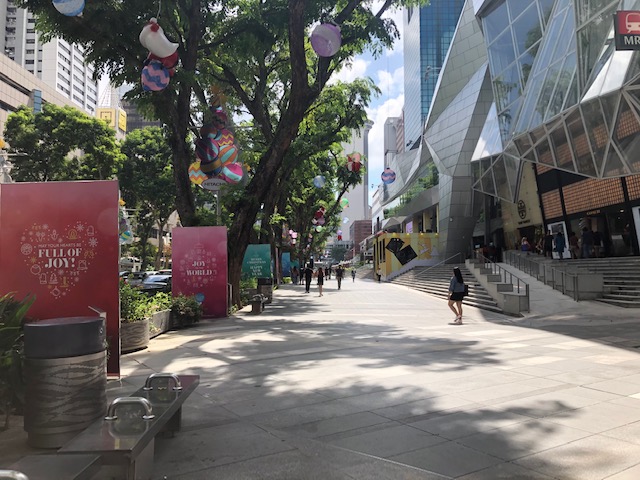 Wide sidewalks can accommodate more people and don’t make it feel so crowded even during the peak hours.
It was easy to log more than 10,000 steps per day in Singapore. In fact, I was happy to have walked an average of 11,000+ steps per day for the 3 days were there. One could only hope we can have similar infrastructure in the Philippines.
More on walking and public transport in Singapore soon.
–
Changi Jewel and transit
The trip to Sri Lanka afforded me some hours at Singapore’s Changi Airport. En route to Colombo, we made sure to go around the complex and check out one of the attractions of the top airport in the world. Changi’s Jewel is very impressive and can make you forgot you were actually inside an airport terminal. Here are some photos taken as we trekked to the Jewel via Terminal 2 and 3.
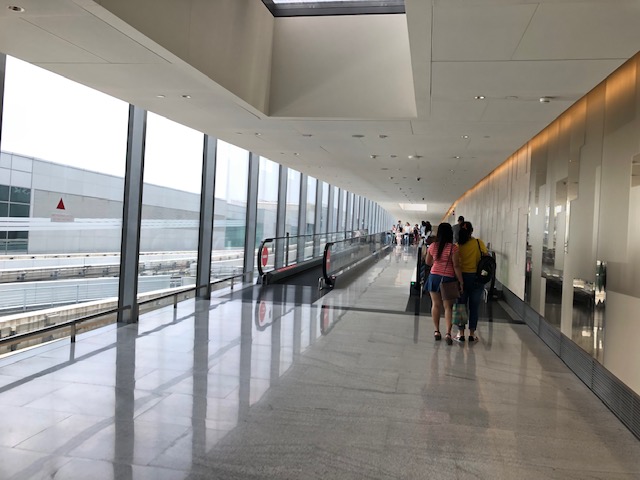 Visitors have the option of walking by themselves or using the moving walkway whenever these were available.
 The automated guideway transit (AGT) system of Changi allow you to transfer from one terminal to another with the exception of Terminal 4.
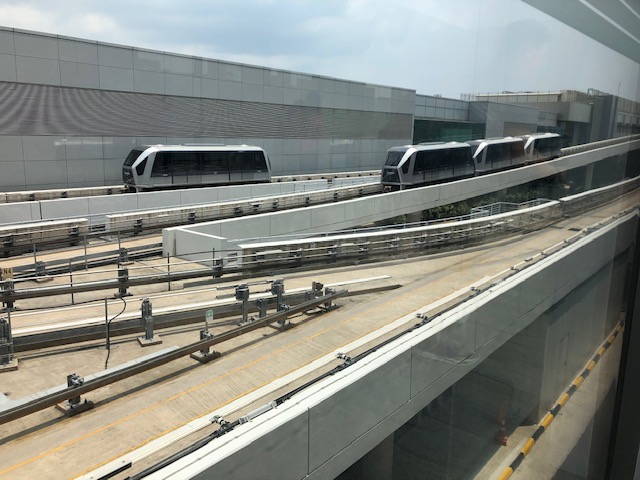 I took this photo of the guideway and the AGT as reference for my lectures
 Another view of the corridor connecting Terminal 3 to the Jewel
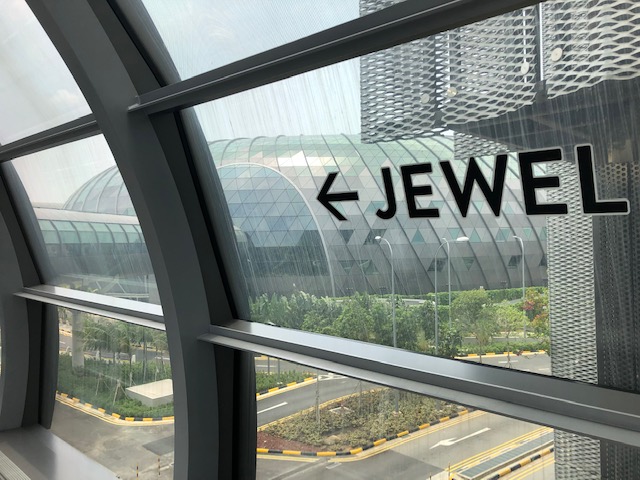 Directional sign to the Jewel
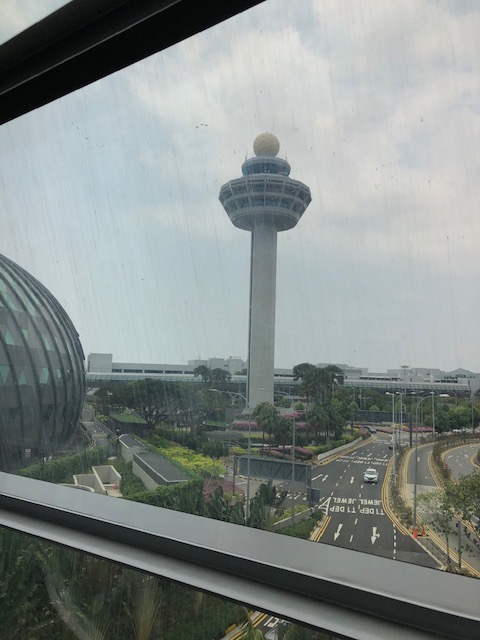 Changi’s air traffic control tower
 The main attraction is this gigantic waterfall located at a man-made complex that’s designed to imitate conditions at a rainforest.
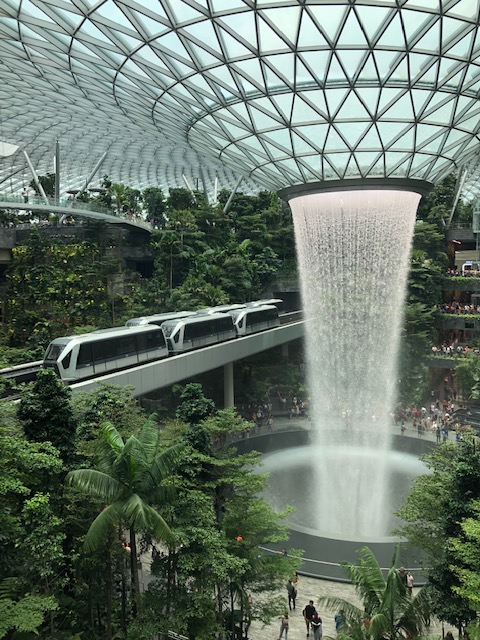 Changi AGT slow down for passengers to have a good close view of the Jewel
 All the water used is recycled and one can get mesmerised by the vortex where all the water falls and seem to be sucked into.
 Here’s another look at the Jewel and the airport AGT
 There is a mall with shops, restaurants and cafes around the Jewel.
 Another photo of the AGT guideway above the road system at Changi
 Taxis queued along airport roads
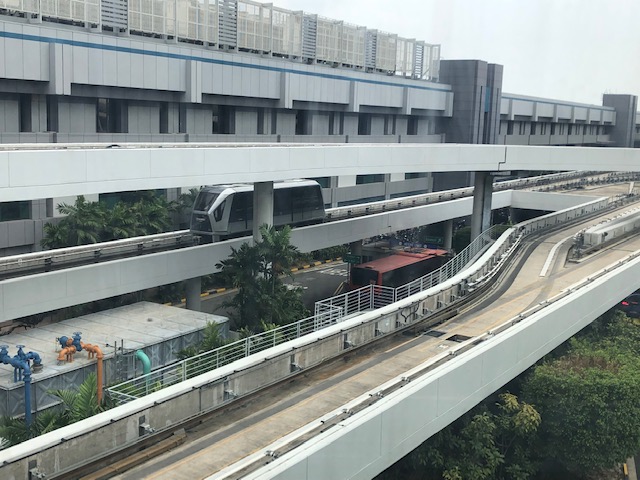 More guideways
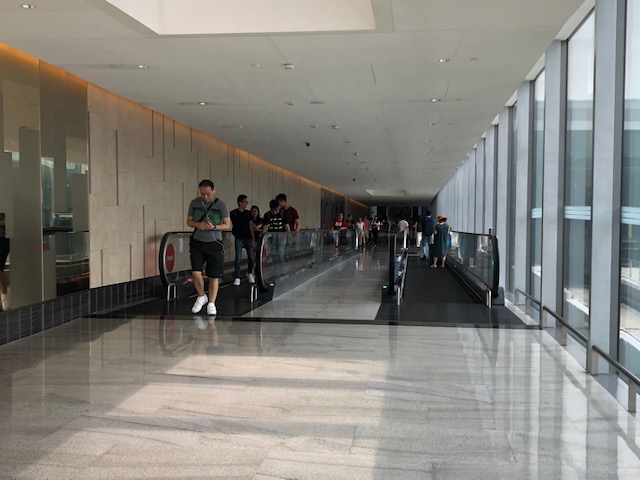 A look back at the way from the Jewel
More photos of Changi soon!
–
Contradictions in transport mode choices?
A friend posted a photo on social media and it immediately got my attention as it featured an ad by popular ridesourcing company Uber on a public bus in Singapore. There is a slogan there that reads: “Because weekends come once a week, make your move.” This statement is a promotion for Uber, which is already making inroads in the city state where taxi services are probably among the better ones in the world in terms of service quality and efficiency.
The ad itself is a contradiction in terms of who is promoting itself and where it is being promoted. Such promotion gimmicks are not beyond companies like Uber, which project themselves as mavericks in what are considered as traditional areas such as transport. Here is the photo of Uber advertising on a public bus in Singapore:

Taxi ownership and operations (i.e., driving) in Singapore is restricted to Singaporeans. Uber faced some issues with their operations as there were a significant number of foreigners, it seems, who took to Uber as a means for employment. In a city-state like Singapore, which discourages private car ownership and use through schemes like congestion pricing and the provision of high quality public transport services, Uber could face a much stiffer challenge to its march towards dominating conventional taxis.
–
Commuting conveniences in Singapore
My recent trip to Singapore allowed me to get reacquainted with its efficient and convenient public transport system. The first thing I did when I arrived at Changi was to proceed to the SMRT station beneath the airport to take a train to the city center where our hotel was located. There I got me a tourist pass for unlimited 2-day commuting over the weekend we were there. I also decided to get a new EZ link card as I saw they released a design for the Chinese New Year (Year of the Monkey). I missed getting myself a Star Wars card, which the staff said were immediately sold out.


 Escalator to the SMRT Station beneath the Changi Airport Terminal 2
 Heading down, you realize that the station is way under the airport terminal
 After a second long flight of escalators, you reach the station level for the N-S line (green)
 Ticket machines for purchasing tickets, cards or topping up (reloading) your card
 Ticket office where you can purchase a pass or EZ link card
 N-S line platform at Changi Airport Terminal 2
Singapore along with Hong Kong provides very good examples of how public transport should be and the benefits these can provide to people. Tourist passes and the EZ link card gives us a good example of how convenient commuting can be in terms of fare payment/collection.
–
 Caught (up) in traffic