
Home » Posts tagged 'social media'
Tag Archives: social media
On gruesome road crashes and how they are reported
The past days have been terrible in terms of road crashes that have been reported. Of particular interest is the one last week involving four vehicles – a provincial bus slamming into 2 passenger vehicles against a stopped truck, and crushing both vehicles and their occupants. This was along SCTEX as vehicles were approaching a toll plaza. The trucks and passenger vehicles were stopped in a queue when a bus slammed into them. As of now the reports state at least 10 have lost their lives. One child miraculously survived the crash but lost both parents as per reports.
While mainstream media seems to be still conservative in how they report these incidents, social media offers much graphic, unedited content. Last Thursday and Friday, friends have shared posts by different people who have videoed the aftermath. It was gruesome and I will not describe them here nor share those videos that also appeared in my Facebook as reels. While there is the shock effect to the shared videos, one wonders whether these ultimately contribute to improving road safety or just add to what is now regarded as another category of porn (you’ve probably heard or read about food porn, tourism porn, shopping porn and poverty porn). These now have become more like spectacles that are viewed more for (sick) entertainment rather than to move people to action to address the road safety issues we face. While there are many responses offering comfort or prayers, how many would really act and actively call for safer transportation? As one friend exclaims – “Where’s the rage?”
–
On Undas traffic 2023
The past two years, I have not written about the traffic situation or conditions during Undas or the holidays corresponding to All Saints and All Souls Days (November 1 and 2). There wasn’t much to write about really. The usual traffic congestion would be along roads near cemeteries and memorial parks. Marikina City’s Barangka area and Bonifacio Avenue near Loyola Memorial are usually congested due to the city’s public cemetery and the memorial park combining for significant traffic generation during Undas. The days leading to Undas find people traveling, usually back to their hometowns but these days many go out for vacations instead. And so the roads near the airports, seaports and bus terminals are also congested. Tollways and national roads (especially the main corridors) can also be congested with the exodus of people from Metro Manila to the provinces in Luzon Island. I assume something similar occurs for other major cities as well.
Many people I know seem to be vacationing this week as they took advantage of the October 30 Barangay elections and the declaration of November 2 as a holiday to take the week off. Many probably took leaves for the two days that were not declared as holidays – October 31 (Tuesday) and November 3 (Friday). Many if not most schools I know declared a break for the week. It is, after all, an opportunity for students, teachers and school staff to take a breather. At UP though, this week came shortly after its Reading Break so its likely people were not able to gain momentum despite the opportunity to catch up on matters like assignments and correcting exams or papers.
I saw some social media posts early this week about expressways being congested. A few even opined that tollways were a scam because of the toll fees being collected despite congestion. I found those quite amusing as the alternative would have been national and local roads that would also be congested. Tollways have been proven to provide shorter travel times (and therefore higher level and quality of service) compared to the free roads. Also, its a free country so those who have their own vehicles may choose to take free roads. We also have apps like Waze to help us find alternative routes other than those that involve tollways. But for long distance travel (e.g., Manila to Baguio, Manila to Legazpi, etc.), tollways will always have the advantage over free roads. Of course, the timing of the travel also matters and the long Undas week should allow for some flexibility in travel especially those taking the road trips.
Here’s to a meaningful and reenergizing Undas!
–
On interviews and propaganda
A colleague once mentioned that he didn’t want to grant interviews to the media because of a then recent experience of one channel splicing up his interview and making it appear as if he were arguing with a government official. True enough, these productions can be made like that in order to generate more interest on the subject. People watching that channel’s programs on news are hooked to the latter because of their sensationalised style of reporting.
When I was Director of our transport center at the University of the Philippines, I maintained a generally media-friendly policy but was selective of those I would grant interviews to or whom I would refer to colleagues whom I had to assure about the interviews not becoming similar to those a former colleague referred to. After all, we knew which programs tended to be on the sensational side. For one, you can base the “media filter” on the personalities behind these programs. At the very least, you’ve done some damage control by pre-empting
Fast forward to the present and a close friend pointed to what first appeared as propaganda material made by online supporters of the current administration (i.e., the troll army). However, upon closer review we determined to be an official production of the government. It included a lengthy part of an interview one of our former directors granted to the government station a while back when the government was embarking on its “Build, Build, Build” program. To be fair, if taken without the tags and labels attached by what people would call fanatics or die-hard supporters of the current administration, then the production is simply a information material. Sure, it can be used as propaganda material but then taken as is, it is certainly not “information, especially of a biased or misleading nature, used to promote or publicize a particular political cause or point of view” as the term “propaganda” is defined in dictionaries. In fact, a major part of the interview specifically mentioned failures of an authoritarian regime in building transport infrastructure that could have averted a lot of the problems we now experience. Context is very important and I thought that the labels attached to the video that made it look like it was something being peddled by the troll army definitely made it look bad.
I think this should be another lesson with our dealings with mainstream media and perhaps with social media, too. You cannot be too careful or meticulous about these interviews but then it is still a responsibility that should be taken on. Otherwise, we commit a sin of omission by not engaging in such activities. While we should not let our guard down in selecting which interviews to grant, there will be times when we just have to assume good faith and trust that the end product will not be fake news.
–
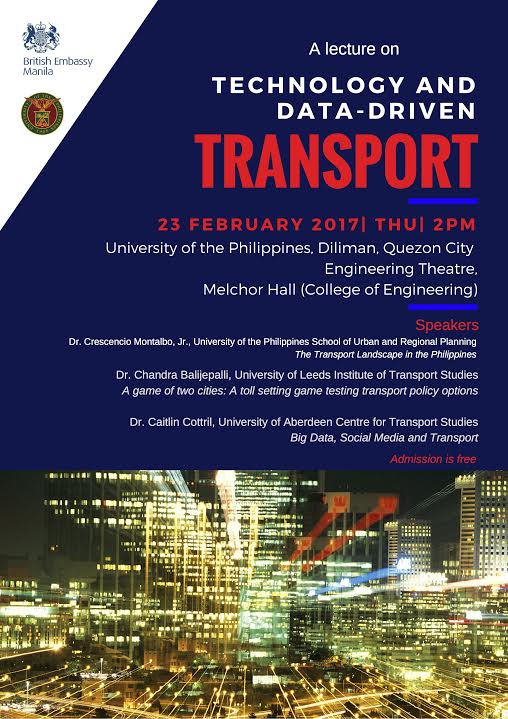
Special lectures on transport – February 23, 2017
I just wanted to share the following announcement from the University of the Philippines Diliman about special lectures on transport. The lectures will be delivered at the Melchor Hall theater at the UP Diliman campus and is open to the public.
–
 Caught (up) in traffic