
Home » Posts tagged 'TDM'
Tag Archives: TDM
Examples of congestion pricing as applied in major cities
Here is a quick share of an article on cities that have been successful with congestion pricing:
Zukowski, D. (August 8, 2025) “5 cities with congestion pricing,” Smart Cities Dive, https://www.smartcitiesdive.com/news/5-cities-with-congestion-pricing/756987/ [Last accessed: 8/15/2025]
Quoting from the article:
“As cities around the world continue to see increased traffic delays, some have implemented congestion pricing programs to ease gridlock. Congestion pricing acts as a market-based mechanism: increasing the cost to drive in certain areas may encourage drivers to take alternate means of transport or travel at different times. Toll revenues can go to improving roadways and public transit or reducing other vehicle-related taxes.”
Indeed congestion pricing has been around and yet few cities have actually implemented congestion pricing schemes and have had success with it. In the Philippines, the discussions are basically on and off or intermittent. I recall there were already mention of congestion pricing in Metro Manila transport studies back in the 1970s but nothing really came out of those. Fast forward to the present and Baguio City in the northern Philippines implemented their version of number coding, which was supposedly a prelude to some form of congestion pricing but apparently is more of a travel demand management (TDM) scheme along the lines of Metro Manila’s UVVRP. Will we have our own proof of concept sometime soon even for a smaller area or district in any Philippine city? That will also be dependent on whether our so-called leaders can engage their constituents in meaningful discussions on the benefits of congestion pricing.
–
From 9-to-5 to Anytime: How Telecommuting Changes the Traffic Game
Here’s a quick share of an article on telecommuting:
Source: From 9-to-5 to Anytime: How Telecommuting Changes the Traffic Game
To quote from the article:
“As we look across these 83 cities, it’s clear that remote work has brought relief to some areas while leaving others just as crowded as before. The cities seeing the most benefit from WFH were those with a flexible, remote-friendly workforce and a supportive economic structure. For fast-growing cities, or those with heavy industry or logistics, WFH alone wasn’t enough to solve congestion.
Telecommuting has no doubt reshaped our roadways, but it’s clear that tackling urban congestion will require more than just a remote work policy. As cities continue to grow and evolve, the future of urban mobility will rely on creative solutions, from smarter infrastructure to updated transit options, to keep America’s cities moving in this new, work-from-anywhere world.”
There are lessons to be learned here for us in the Philippines. Telecommuting is not a new thing here especially considering we have many BPOs operating across the country. Indeed, it is not to be considered as the only solution but one of many we can use to reduce congestion and improve commutes in our towns and cities.
–
City coding anyone?
Last December 8, it was a holiday at Taguig City as they celebrated their foundation day. Not surprisingly, many major roads including C-5, Ortigas Avenue and EDSA were relieved of congestion and I was among those who benefited from this as we breezed through Ortigas to get to the hospital for our daughter’s regular check-up. I also saw many posts on Facebook in agreement with this observation as they too had shorter travel times particularly between Quezon City and Taguig.
I jokingly proposed on my social media account that perhaps, instead of tinkering with the number coding scheme, we should have something like coding for cities. I recall recommending something like making a holiday for one major traffic generating city for each of the five working week days. It’s like making Mondays off for Makati City, Tuesdays off for Pasig, Wednesdays for Makati, Thursdays for Taguig, and Fridays for Manila. I got some supportive comments including one that made very good sense about commuters losing the equivalent of a day anyway because of traffic congestion. The 4-day work week is not at all unusual or new since this has been practiced in many offices including government offices. In certain cases, there are offices that allows you to work from home once a week so you only need to be physically in the office for 4 days. It would be nice for an analysis for this proposal be made and supported perhaps by some modelling so we can have metrics for the potential benefits to all of such 4-day work weeks.
–
Manila’s truck ban experiment
The City of Manila has announced that it will implement a truck ban from February 10, Monday. Trucks of at least 8-wheels and 4,500kg gross weight will not be allowed to travel in Manila’s roads from 5AM to 9PM. Manila’s City Ordinance No. 8336 calls for the daytime truck ban in the city in order to reduce traffic congestion that is perceived to be brought about by trucks. 8-wheelers are likely 3-axle trucks with a 4-wheel, 2-axle prime mover pulling a 1-axle, 4-wheel (double-tired) trailer. I am not aware of the technical basis for the ordinance. Perhaps the city has engaged consultants to help them determine the pros and cons of this daytime truck ban. I hope it is not all qualitative analysis that was applied here as logistics is quite a complicated topic. And such schemes in favor of passenger transport (and against goods movement) actually creates a big problem for commerce due to the challenges of scheduling that they have to deal with. To cope with this ordinance, companies would have to utilize smaller vehicles to transport goods during the daytime. This actually might lead to more vehicles on the streets as companies try to compensate for the capacity of the large trucks that will be banned from traveling during the restricted period by fielding smaller trucks.
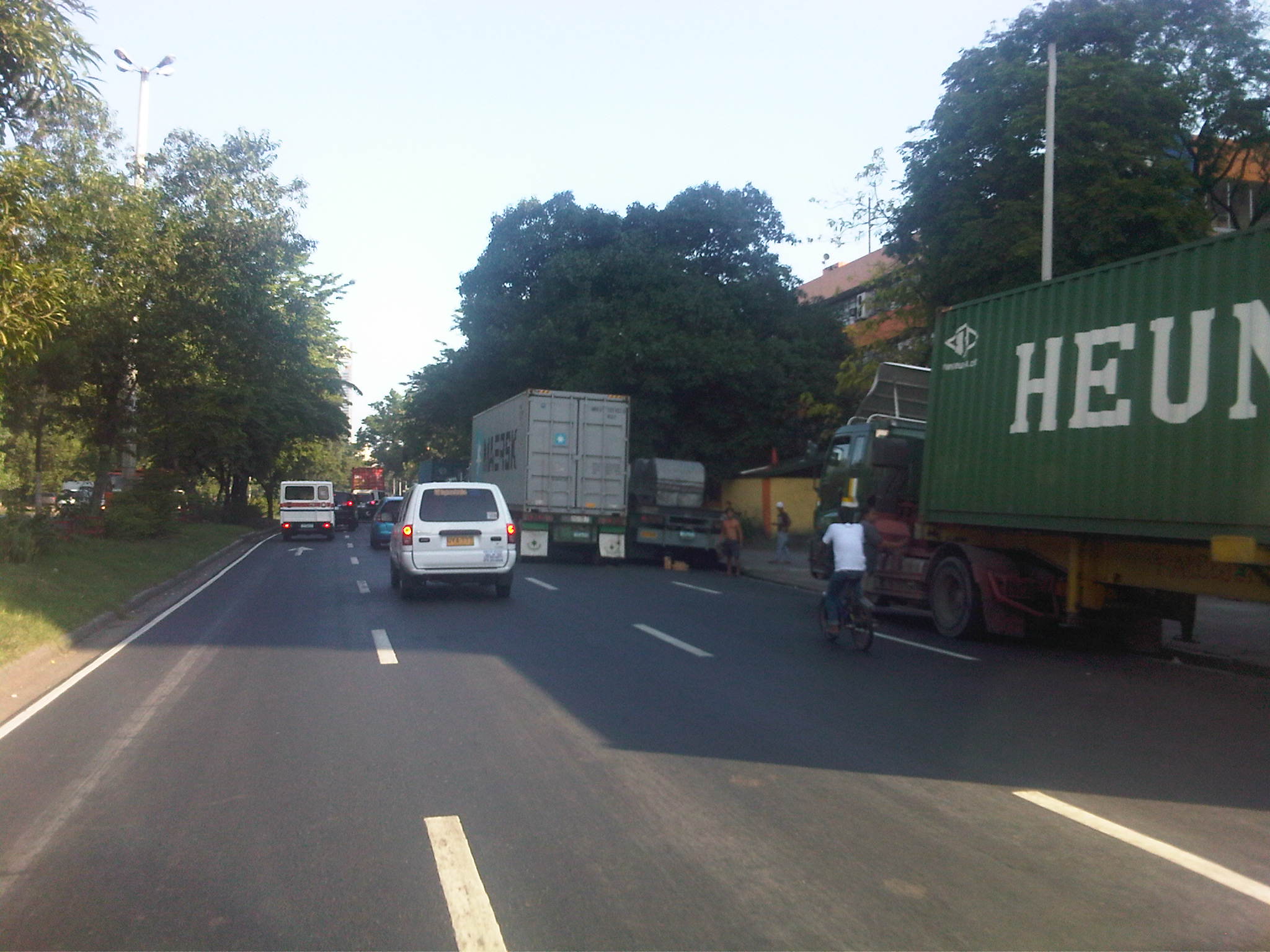 Trucks parked along Bonifacio Drive near the DPWH Central Office in Manila’s Port Area.
The latest word is that Manila has postponed implementation of the ordinance to February 24. This was apparently due to the reaction they got from various sectors, especially truckers and logistics companies who would be most affected by the restrictions. It was only natural for them to show their opposition to the scheme. Reactions from the general public, however, indicated that private car users and those taking public transport welcomed the truck ban as they generally stated that they thought trucks were to blame for traffic congestion in Manila. The truck ban will definitely have impacts beyond Manila’s boundaries as freight/goods transport schedules will be affected for the rest of Metro Manila and beyond. The Port of Manila, after all, is critical to logistics for the National Capital Region, and its influence extends to adjacent provinces where industries are located. Such issues on congestion and travel demand management measures focused on trucks bring back talks about easing freight flow to and from the Port of Manila to major ports in Subic and Batangas. There have been studies conducted to assess the decongestion of the Port of Manila as Batangas and Subic are already very accessible with high standard highways connecting to these ports including the SLEX and STAR tollways to Batangas and the NLEX and SCTEX to Subic. Perhaps it would be good to revisit the recommendations of these studies while also balancing the treatment of logistics with efforts necessary to improve public transport. After all, trucks are not all to blame for Manila’s and other cities’ traffic woes as buses are repeatedly being blamed for congestion along EDSA. In truth, there are more cars than the numbers of buses, trucks, jeepneys and UV Express combined. And the only way to reduce private car traffic is to come up with an efficient and safe public transport system. –
 Caught (up) in traffic