
Home » Posts tagged 'traffic safety'
Tag Archives: traffic safety
On reducing deaths due to road crashes
Following is a link to an article on the increase in road crash-related deaths in Singapore. The city state prides itself as one of the safest places in terms of transportation yet road crash deaths recently hit a 10-year high.
From the article:
“Cellphone-related driving violations surged 39.1% to 4,193 cases, the report showed. Motorcyclists, who make up just 15% of Singapore’s vehicle population, accounted for 54.8% of all traffic accidents and 53% of fatalities.
Speeding violations jumped 25.9% to 253,550 cases, equivalent to roughly 695 motorists caught daily. While speeding-related fatal accidents dipped from 46 to 41, red-light running accidents surged 27.1% to 122, resulting in seven deaths. Drink-driving accidents fell from 166 to 156, but the number of fatal drink-driving accidents held steady at 12 in both years…
…”Road safety requires a culture of mutual respect and graciousness among all road users,” the police force said. “Simple acts of courtesy, such as maintaining a safe following distance of at least three seconds, giving way to pedestrians, reducing speed near junctions and being patient during peak hours, can create a better road culture.” “
What can we learn from Singapore’s experience? Are we capable and equipped to improve road safety in the Philippines? Can we be more courteous, respectful and gracious in the way we drive or behave as road users?
–
On the dangers of drowsy driving
Here’s another quick share of an article on road safety. This one is about drowsy driving, which is said to be more dangerous than drunk driving. Drowsy here is equated to being sleepy – for whatever reasons may have led the driver to be drowsy. Perhaps lack of sleep, fatigue or being simply tired, or maybe due to food or medication he/she took before driving.
Here is the link to the article, which has a link to the report referred to in the article:
https://www.ghsa.org/news/drowsy-driving-new-data-analysis
From the article:
“…several strategies to combat this dangerous behavior:
-
Start with prevention: Promoting healthy sleep habits for everyone – especially for teens as they begin their driving journey – is essential. Drivers should practice good “sleep hygiene,” which includes sleeping in a quiet, cool, device-free environment and avoiding caffeine or alcohol before bed.
-
Vehicle technology that’s available now: Advanced Driver Assistance System (ADAS) features can monitor for telltale signs of drowsiness (like yawns or long blinks) and issue visual, auditory or haptic alerts to tell drivers to take a break. Notably, none of the current systems prevent a driver from ignoring them and continuing to drive, or from turning them off entirely.
-
Change the culture at work and school: Employers should implement responsible scheduling and travel policies to minimize fatigue. School districts can consider shifting high school start times later in the day to help teens get more rest. One study of high school student drivers found significantly lower crash rates with a later school start time.
-
Build more, smarter infrastructure: Infrastructure changes such as rest stops, rumble strips and cable median barriers can help prevent drowsy driving, wake drivers up or reduce the severity of a run-off-the-road crash.”
–
On at-grade crossings and footbridges
Here’s a quick share of an article on how at-grade crossings are generally better and preferred over footbridges:
When Footbridges Cost Lives and At-Grade Crossings Save Them
The article effectively articulates the case for at-grade crossings and presents the facts and references in support of these crossings. I will only add here that context is still important along with an appreciation or understanding of the volume of traffic and occupancy of vehicles along the roads. Commonwealth Avenue, for example, requires footbridges but there should be better designs for these footbridges than the current ones along this highway. I think we lack good designs that we can refer to and this leads to a summary dismissal of footbridges where they are actually most suitable.
–
A quick note on road safety parks
A new road safety park is to open today in Muntinlupa City in Metro Manila. While the objectives of the park appear to be clear enough to most people, I’ve seen some unusual reactions vs. the park. Instead of stating my piece about this and road safety parks, I will just share a couple of links on similar facilities in two countries in our region where road safety is strongly advocated not just by private citizens but by their governments:
Road Safety Park in Singapore: https://www.torque.com.sg/features/singapores-road-safety-community-park-was-built-30-years-ago/
Traffic Garden (Taman Lalu Lintas) in Malaysia: https://www.facebook.com/share/p/1BF8ruywsZ/
You can also try to Google other road safety parks or gardens in other countries to see other examples of these and how other cities have utilized the parks to promote road safety especially among children. It is better to learn about these parks and perhaps recommend how these can help rather than start shooting from the hip to discredit these and their proponents.
[Note: The MMDA has a road safety park in Manila that is patterned after the Malaysian and Singapore examples.]
–
Street legal vehicle?
I saw this motorcycle being driven along the main road to the Shrine in Antipolo. It seems more like a toy than a mode of transport. Say what you will about people’s right to transportation but it is a risky mode to use as the user can be invisible to most motorists. And I’m talking about jeepneys, buses and trucks. Huwag na lang mga SUVs and cars since the mere mention of these trigger the “car-centric” reactions.
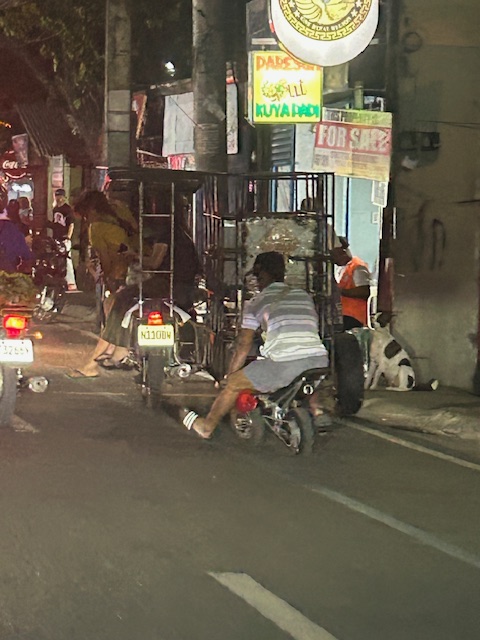 Rider seemed to be struggling with balancing on this “toy” transport. You can compare the rider to the trike in front of him.
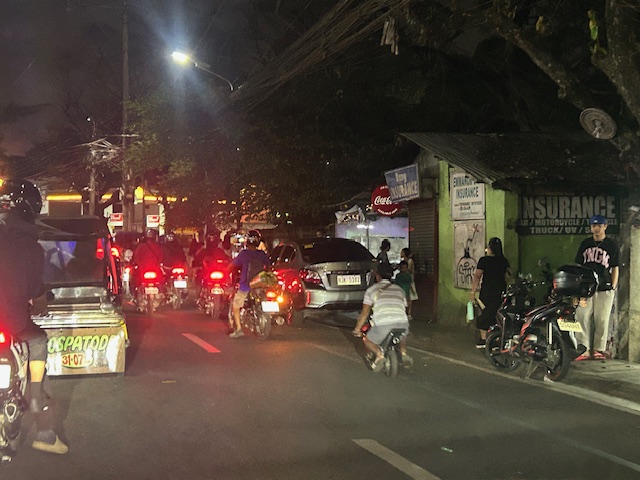 The rider and the vehicle in mixed traffic
I don’t think these can be classified as micromobilty. It would be a stretch. A colleague says these mini motorcycles are actually used for racing. We should draw the line between what is safe and unsafe given the conditions and situation along our streets rather than what is declared as the desired conditions. It is better to err on the side of safety rather than push for advocacy that will lead to road crashes involving these vehicles and their riders.
–
Old Versus New Traffic Safety Paradigms
Here is a quick share of an article on road safety:
Source: Old Versus New Traffic Safety Paradigms
To quote from the article:
“This issue is, of course, complex. Vehicle travel reductions are not the only way to reduce crashes — traditional traffic safety strategies are also important, and the two approaches are often complementary. For example, many targeted traffic safety strategies such as graduated driver’s licenses, special driver’s tests for seniors and anti-impaired driving campaigns become more effective and politically acceptable if implemented with multimodal planning, TDM incentives and Smart Growth policies so youths, seniors and drinkers can find convenient alternatives to driving.”
–
On bike lanes contributing to safer roads
Do bike lanes make roads safer? There are obviously mixed reaction to this question especially if you look as social media. If we are level headed about this topic and look at the evidence out there, the answer is yes. But there can be caveats as we try to contextualize in the local setting. The formal studies so far are in countries where the drivers arguably more disciplined than ours here in the Philippines. Driver behavior, after all, is a major factor for road traffic safety. Here is a good article for reference in the discussions and arguments for bike lanes:
Tu, Maylin (November 5, 2024) “How Bike Lanes Slow Drivers and Save Lives,” Next City, https://nextcity.org/urbanist-news/how-bike-lanes-slow-drivers-and-save-lives [Last accessed: 11/10/2024]
To quote from the article:
“Bike lanes with physical delineators (cones or bollards) were more effective than paint-only lanes at calming traffic, echoing a popular mantra for bike activists: “Paint is not protection.” (The lanes were not protected, however, because drivers could drive over the delineators.) For vehicles turning right, top speeds were reduced by 28% and average speeds by 21%. Paint-only bike lanes slowed driver speeds by up to 14% and drivers going straight slowed down by up to 8%…
The study adds that pop-up bike lanes are a cost-effective solution for studying the effects of more permanent solutions — after all, you could just borrow the traffic cones. A city could quickly implement pop-up or temporary infrastructure. Then, armed with data and community feedback, they could invest in making the changes permanent.”
The article also points to a technical paper or scientific article on the traffic calming effect of bike lanes. Here is the link to the article published in the Journal of Urban Mobility: https://doi.org/10.1016/j.urbmob.2024.100071
–
Article share: Applying the New Traffic Safety Paradigm
Here is a quick share of an article on traffic safety from Todd Litman of the Victoria Transport Policy Institute. Source: Applying the New Traffic Safety Paradigm
In the article, the author discusses the use of ‘exposure’ as a measure of risk in as far as safety is concerned. The variable ‘vehicle miles traveled’ or in our case ‘vehicle kilometers traveled’ may be considered a risk factor. That is, higher or more VMT or VKT may lead to more crashes and casualties (and additionally damage to property). The objective is to reduce VMT or VKT in order to improve traffic safety.
To quote from the article:
“The new traffic safety paradigm recognizes the additional risk resulting from increases in low-risk vehicle travel and so favors strategies that reduce total vehicle-miles such as improved public transit services with free service for students, efficient school parking pricing to discourage driving, and more compact communities that reduce distances between homes and schools. In addition to reducing traffic risk these strategies also reduce household costs, traffic congestion and pollution problems making them win-win solutions. “
–
Article share: Planners’ Complicity in Excessive Traffic Deaths
Here is a recent article on safety and the involvement on traffic engineers from Todd Litman:
Source: Planners’ Complicity in Excessive Traffic Deaths
Let me note here about the interchangeability of the terms ‘traffic engineer’, ‘transportation engineer’ and ‘planner’. This is important to contextualize who is actually complicit or involved or responsible particularly in the Philippine setting. Too often and too quickly, traffic engineers or even civil engineers (in general) are blamed for traffic deaths or flaws in road designs. Disregarded is the fact that, as the article mentions, of the two major elements of travel – distance and speed – distance is often determined by the plans and designs of non-engineers. These are planners, or to be accurate land use planners, many of whom are architects by profession. We also want to differentiate between traffic engineers and highway engineers, who in the Philippine setting are actually quite different. One common thing about many of them is that they are slow to adopt progressive ideas or concepts of road planning and design such as complete streets and road diets. The outcome of this stubbornness is the specter of road crashes that lead to fatalities and serious injuries. But then they are not solely to blame or who should take responsibility for the atrocious road safety situation. The ‘distance’ component of travel is very much a product of land use planning and land development as practiced in our country. For many if not most developments, architects and planners are the ones who call the shots for the roads and transportation in the proposals. Traffic engineers are involved later and if not progressive complicates the situation regarding safety. Thankfully, some local government units are becoming progressive and are more mindful of development proposals including implications to road safety. Hopefully, many things will change among those involved so we can improve travel safety.
–
Safety or speed?
We start June by sharing a video on why safety and vehicle speed are incompatible:
I saw this video while browsing an article on “Dangerous by Design”. The article discusses a new publication where road designs are evaluated from the perspective of safety. Most of our roads have been designed with speed in mind. That is, how to facilitate the movement of motor vehicles to ensure they travel faster. Forgotten or, even worse, disregarded is the most important element of safety. Why do we widen roads or insist on higher speeds in populated areas or school zones? Such questions are not addressed directly or not answered at all by agencies in charge of planning, designing, constructing and maintaining roads and bridges. The same is true for agencies or units in charge of traffic regulations or management. The result not surprisingly is an increase in the number of road crashes, fatalities and injuries due to our roads being ‘dangerous by design’.
–
 Caught (up) in traffic