
Home » Posts tagged 'transit'
Tag Archives: transit
Good Transit Is Simple: Lessons in Good Route Design
Here is a quick share of an article on transit route design:
Source: Good Transit Is Simple: Lessons in Good Route Design
I will not preempt the reader (you) on the content but there’s a lot of tips for stop spacing and route design based on the author’s experience in Chicago as transit planner.
–
Article share: What Is Good Transit?
Here’s an article share on transit and what should be the attributes of a good transit system:
Source: What Is Good Transit?
To derive the main points from the article:
- Good transit is frequent
- Good transit is reliable
- Good transit is (reasonably) fast
- Good transit feels safe
- Good transit is equitable by nature
This is a good read whether you’re a regular commuter taking public transportation or perhaps one looking into topics for research or advocacy.
–
Roads, railways support needed for airport upgrades — analysts
Here’s a quick share on an article on the infrastructure needed to support airport development:
Source: Roads, railways support needed for airport upgrades — analysts
Unlike many capital airports including Malaysia’s Kuala Lumpur International Airport and Bangkok’s Suvarnabhumi International Airport, Ninoy Aquino International Airport does not have rail or mass transit access. It will eventually have rail access via the currently under construction Metro Manila Subway. The airport construction in Bulacan should also have transit access in order to make it more accessible to passengers and other airport users. Railways will provide an alternative to road-based transport that would probably require much road space and likely lead to congestion just like what we experience around NAIA at present.
–
On the general benefits of public transportation
Here’s another good read that has links to the outcomes of studies pertaining to public transportation’s direct and indirect effects on vehicle miles traveled or VMT (in our case we use vehicle kilometers traveled or VKT):
McCahill, C. (November 12, 2024) “The benefits of transit extend well beyond transit riders,” State Smart Transportation Initiative, https://ssti.us/2024/11/12/the-benefits-of-transit-extend-well-beyond-transit-riders/ [Last accessed: 11/20/2024]
To quote from the article:
“…good transit has a ripple effect on land use and travel behavior. For every mile not driven by transit riders, transit accounts for another six to nine miles not driven among the larger population. “
Note the potential reduction in VKT’s attributed to mass transportation or transit.
–
‘Modern’ jeepneys in Cebu
The jeepney is actually a jitney, a paratransit mode with a capacity between the bus and the mini-bus. Jitneys are quite popular in developing countries like those in Southeast Asia and Africa. In the Philippines, the jeepney evolved from the American Jeeps left by US Forces after World War 2 that were customized in the style of the auto calesas that developed before the war.
With the government’s public transport modernization program, there are now many so-called ‘modern’ jeepney models operating around the country. The following are photos I took while doing fieldwork in Mandaue City.
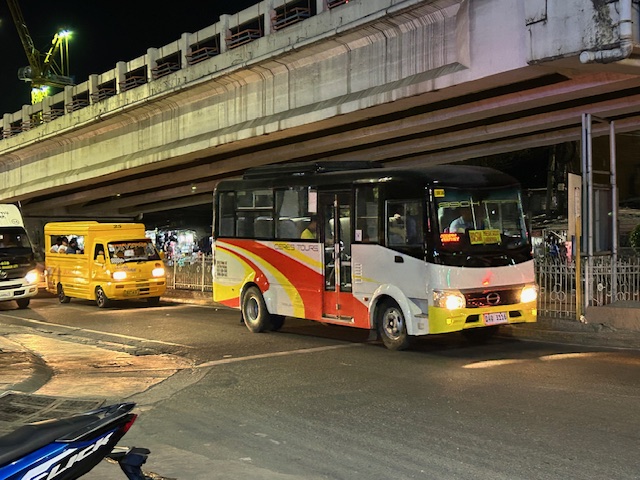 Many modern jeepneys are actually mini or micro buses like the one in the photo. They did not retain or adopt the look of the conventional jeepneys. This one is a model by Japanese automaker Hino. The one behind is another jitney form – a multi cab.
 Another modern jeepney / mini bus model manufactured by another company. I have to check which company given the emblem in front of the vehicle.
 Another Hino vehicle but by a different operator as evident in the livery.
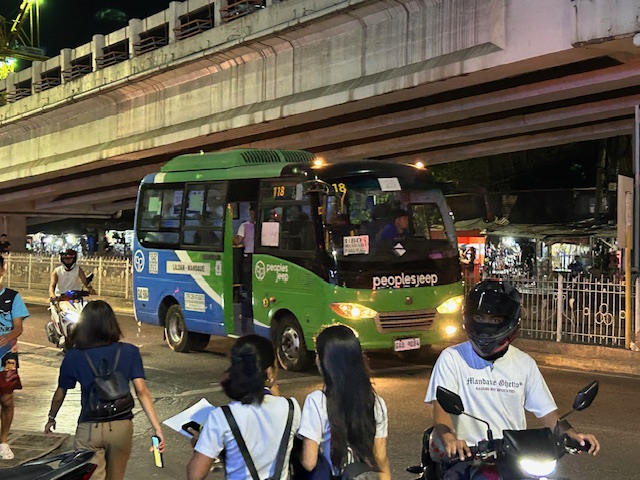 Another mini bus model

 A low floor bus operated by Ceres, a major bus company in the country that also operates RORO buses.
 Another modern jeepney model operated by another coop in Mandaue.
 Star 8 jeepneys are also operating in Mandaue City. I first saw these in Tacloban City many years ago. They were supposed to be able to recharge via solar panels installed on the roof the vehicle. That should allow them to replenish power while running. These days, we do have a lot of sun so the only question is whether the solar power feature is functional.
–
Article share: on subsidies to public transportation
Here’s a nice article that presents arguments for subsidies to support transit or public transportation:
Wilson, K. (February 5, 2024) “Study: Subsidizing Transit Actually Makes It More Efficient,” Streets Blog USA, https://usa.streetsblog.org/2024/02/05/study-subsidizing-transit-actually-makes-it-more-efficient [Last accessed: 2/18/2024]
Subsidies to public transportation can be quite tricky and may require quite a balancing act. There seems to be few options outside of the straightforward subsidies national and local governments in the Philippines provide. Rail transit, for example, is heavily subsidized but these are rare for road-based public transportation. The concept of service contracting has been considered but it also has a few variations. While there seems to have been a proof of concept tested during the pandemic, it required so much funds that government apparently lost interest (i.e., the funds were also needed by other sectors). Local governments meanwhile, or at least those that had resources, decided to operate their own public transport (e.g., Quezon City bus).
To quote from the article:
“Newmark’s study doesn’t definitively determine why, exactly, high subsidies seem to correlate with better efficiency and transit agencies collecting more fares, but he has some theories. Some systems, he says, use subsidies to increase service frequency or install dedicated lanes to speed routes up along heavily-utilized corridors — and riders are responding, predictably, by showing up in droves. (Route expansion can help, too, he said, but only if agencies expand service to places “where there’s actual demand.”) Others use subsidies to keep ticket prices low, but not to eliminate fares outright, which Newmark argues is a smart move.
“People value stuff they pay for, and they pay for stuff they value,” Newmark added. “An underlying point in this paper is that transit offers something [valuable], and it’s worth trying to capture that value, whether through fares or in other ways.”
If transit networks and the taxpayers who support them can get that recipe right, it could create a virtuous cycle.
“If people see the benefits [of subsidies], that may make them more willing to invest [their taxpayer dollars],” he adds. “Good transit leads to a real social movement for more subsidies.” “
What do you think about subsidies to public transport in the Philippine setting? Of course, we are referring to ‘formal’ public transportation here. There are many ‘informal’ or paratransit modes like tricycles and non-motorized pedicabs. There are also motorcycle taxis providing services or filling in the gaps in transport services.
–
On micro transit covering for regular public transport services
I am sharing this very interesting (to me) article on microtransit making up for the conventional public transportation:
Zipper, D. (December 19, 2023) “On-Demand Microtransit Can’t Escape This Big Problem,” Bloomberg, https://www.bloomberg.com/news/articles/2023-12-19/the-inflexible-problem-with-flexible-microtransit?utm_source=website&utm_medium=share&utm_campaign=copy [Last accessed: 12/22/2023]
To quote from the article:
“Fixed-route service on large buses also offers the economies of scale that microtransit lacks. As long as empty bus seats are available, each new rider brings new revenue to the transit agency while incurring minimal added costs, thereby reducing the subsidy required for each trip. Public dollars can then be reallocated to expand service, which will make transit more useful, thus attracting more riders — and the virtuous cycle continues.
For microtransit, that flywheel effect is missing; the cost of service keeps rising as more people use it. “It would be great to have anywhere-to-anywhere connectivity for the price of transit,” said Goldwyn. ”But it’s just not possible.””
I think this article also touches on motorcycle taxis though perhaps there are also differences between the western and Asian contexts for micro mobility. Surely though, such transport modes cannot approximate transit capacities and require so many more vehicles (e.g., motorcycles) that probably means more chaos and compromised safety along our roads.
–
On concert and sports event venues being accessible to transit
Among the major concert or sports event venues in the Philippines, perhaps the Araneta Coliseum is the most accessible to public transportation. Others like the SM Mall of Asia Arena in Pasay City is accessible to public transport but only for road-based modes. The Philippine Arena in Bulacan is accessible only by private transport or shuttle vehicles (basically also private as they are leased or rented). Compare this to say Singapore’s National Stadium, Tokyo Dome or Saitama Arena, which are all served by mass transit systems. It was so easy to go to the U2 concert in Singapore or Japan because of this. It was difficult for the same when they came to the Philippines because going to the Philippine Arena required a long drive both ways.
With all the fuss about Taylor Swift’s concert tour, I found this article about how fans or Swifties as they are called get to the concerts – they take public transportation:
Brady, T., Caldera, L. and Worthington, P. (July 14, 2023) “Transit Funding Problems Too Big Even for Taylor Swift to Solve,” Next City, https://nextcity.org/urbanist-news/transit-funding-problems-too-big-even-for-taylor-swift-to-solve?utm_source=Next+City+Newsletter&utm_campaign=c480374b80-DailyNL_2023_07_14&utm_medium=email&utm_term=0_fcee5bf7a0-c480374b80-44383929 [Last accessed: 7/19/2023]
To quote from the article:
“And how did the nation’s Swifties get to these concerts? As a recent Crain’s article explains, transit.
Fans took buses and trains to see superstar Swift, adding 43,000 bus and rail rides in Chicago and tripling the number of weekend riders in Atlanta. Her Philadelphia concerts in mid-May brought an estimated 27,000 additional riders to SEPTA’s (Southeastern Pennsylvania Transportation Authority) subway line next to Lincoln Financial field.”
If she held at least one concert here, I’m afraid that concert will generate more car traffic than transit ridership if held at the Philippine Arena. NLEX will definitely generate a lot of toll revenue but traffic will be hell for the event.
–
Another definition of the 15-minute city
We begin 2023 with an informative article defining the “15-minute city”. This is actually an entry in Planetizen’s Planopedia, which contains definitions of fundamental concepts in urban planning:
Ionescu, D. (December 2022) “What is a 15-minute City?” Planetizen, https://www.planetizen.com/definition/15-minute-city?utm_source=newswire&utm_medium=email&utm_campaign=news-12292022&mc_cid=ee083e2ee7&mc_eid=9ccfe464b1 [Last accessed: 1/1/2023]
I’ve written and shared articles about this concept before. Here are a couple from 2021 where I offered my opinions about the concept as already applied in the Philippines:
https://d0ctrine.com/2021/08/13/on-defining-the-15-minute-city/
https://d0ctrine.com/2021/04/07/didnt-we-already-have-15-minute-cities-and-towns-in-the-philippines/
–
On Metro Manila having one of the worst transit systems in the world
This is a follow-up to the previous post on the UC-Berkeley Study. Here is an example of how media featured the study outcomes:
https://www.facebook.com/CNNPhilippines/videos/1089453421728393
I didn’t see whether there was a response from government. These studies end up as features and nothing more if these do not prompt or push authorities to act on the problem. Even experts from academe or industry are reduced to being commentators or even pundits providing context, assessments and opinions, even recommendations that are perceived to fall on deaf ears. Perhaps government is already desensitized about these issues and will just trudge along at its own pace? In the end, it is the commuters mostly taking public transportation who continue to suffer and lose productive time to their daily travels.
–
 Caught (up) in traffic