
Home » Posts tagged 'Transport Planning'
Tag Archives: Transport Planning
More Buses, Fewer Riders? Thoughts on the Ridership vs Coverage Tradeoff
Here is a quick share of an article on ridership vs. coverage:
Source: More Buses, Fewer Riders? Thoughts on the Ridership vs Coverage Tradeoff
Basically, there is that question of whether planners or decision makers should prioritize ridership over coverage? Or should it be the other way around? The article provides a detailed discussion of the trade-offs. Perhaps this is again a case of determining which is more suitable for your city?
–
Quick comments on the NCAP
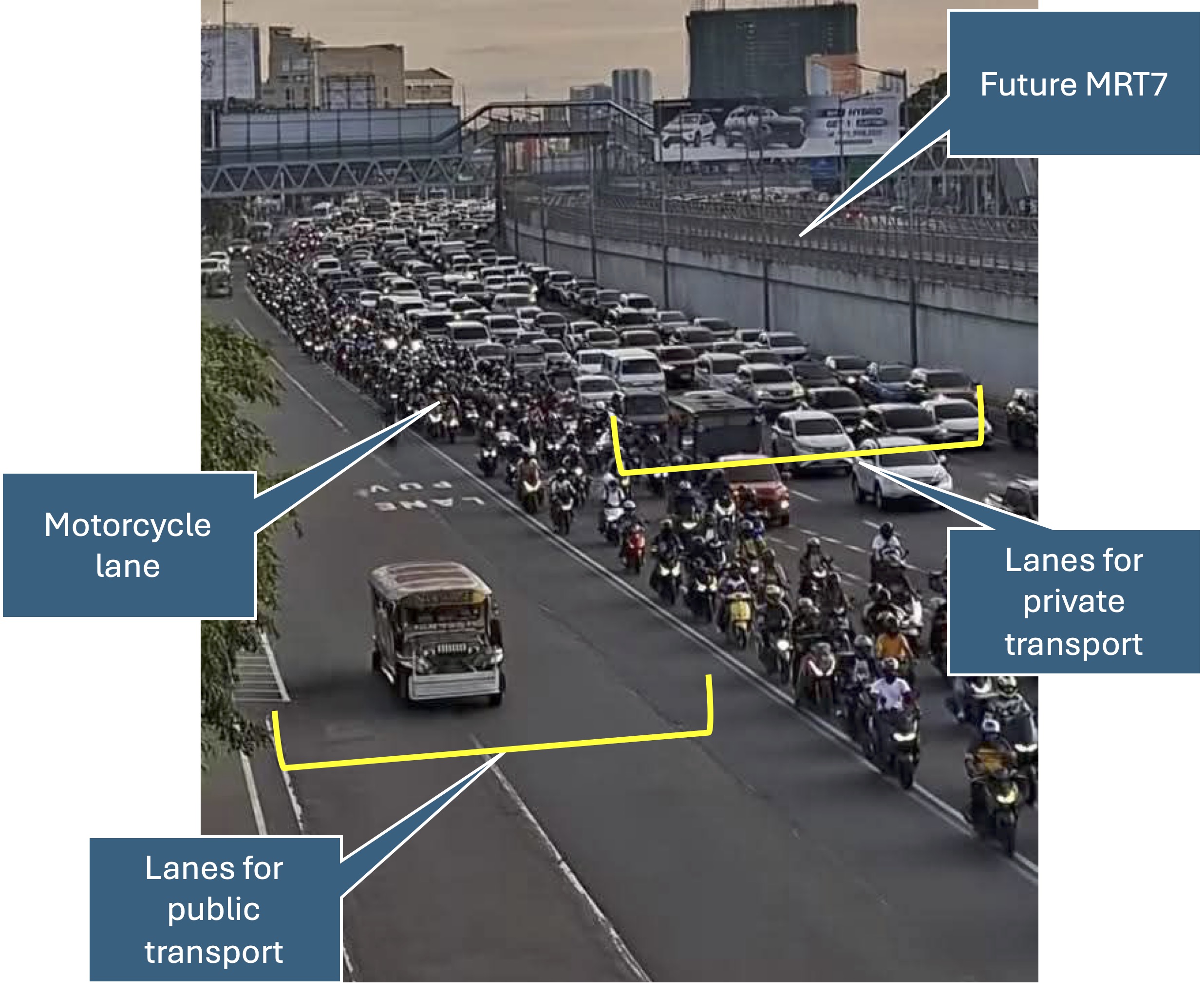
The No Contact Apprehension Policy (NCAP) is finally being implemented in Metro Manila. The results so far has been dramatic in terms of the number of violations recorded and the images being shared so far about how motorists are behaving. Below is one of those photos being shared on social media to which I added some annotations. I will use this later to comment on the NCAP and how we can use the outcomes to assess the transportation situation and determine what interventions can be done. Some are already obvious from the photo – the lack of public transport options lead to people depending on private motor vehicles like cars and motorcycles for their commutes. MRT7 is yet to be operational and road public transport has not been rationalized.
More on this topic soon!
–
On strategies for urban mobility
Here is an interesting article on other strategies for urban mobility:
Menard, T. (March 24, 2025) “Beyond Congestion Pricing: Strategies for Revolutionizing Urban Mobility,” Planetizen, https://www.planetizen.com/features/134601-beyond-congestion-pricing-strategies-revolutionizing-urban-mobility [Last accessed: 4/6/2025]
To quote from the article:
“The common thread among successful urban transportation initiatives is the use of data to make mass transit more competitive. When cities invest in improving the transit experience through technology, service enhancements, and targeted incentives, the results are clear: increased ridership, reduced congestion, and lower emissions. These outcomes benefit not just individual commuters but the broader community as well, contributing to improved air quality, reduced traffic-related stress, and more livable urban environments.
In looking ahead, the lessons from New York’s congestion pricing experiment and the initiatives of other progressive cities offer a roadmap for transit agency leaders worldwide. By embracing data-driven strategies, investing in advanced technologies, and creating the right mix of incentives and disincentives, cities can transform their transportation systems to meet the challenges of the 21st century.
The key takeaway for transit agency leaders is clear: when mass transit is made more attractive, efficient, and competitive with private vehicle use, commuters will respond positively. The data from New York and other cities proves that well-designed transportation policies can yield significant benefits for urban communities. As more cities adopt these innovative approaches, we can look forward to a future of smarter, more sustainable urban mobility that enhances the quality of life for all residents.”
Perhaps the main statement to be emphasized here should be: “The common thread among successful urban transportation initiatives is the use of data to make mass transit more competitive.” How many of our cities are doing this now and in the context of the public transport rationalization and modernization? Does the LTFRB or the DOTr collect and use data towards improving public transportation? Are these efforts comprehensive rather than selective?
–
When Driving Isn’t an Option: Steering Away From Car Dependency
Here is another quick share of an article from Planetizen. The article relates about people who cannot drive so driving for them is not an option:
Source: When Driving Isn’t an Option: Steering Away From Car Dependency
Quoting from the article:
“Zivarts shows that it is critical to include people who can’t drive in transportation planning decisions. She outlines steps that organizations can take to include and promote leadership of those who are most impacted—and too often excluded—by transportation systems designed by and run by people who can drive. “
There are actually many who can drive and who would like not to drive but then opt to drive because of limited and inconvenient or uncomfortable options. I think government agencies and local government units are supposed to work on this but like people who try to ‘solve’ traffic by isolating it from other factors such as housing, they ultimately gain little ground if not fail. It doesn’t help that the decision makers such as government officials and politicians drive or are driven. Of course, there is still such a thing as empathy so let’s not discount those who do use cars for their commutes but also work hard to improve transportation. It’s just that such people are rare these days and may not be in a position to move things to enable significant improvements to the transportation system.
–
Why College Campuses Make Ideal Models for Cities
I recently read this article on college campuses being models for cities. Of course, this refers to campuses or perhaps university towns that have developed in the US. These appear to be microcosms of cities or what cities should be. I can imagine this for the UP Diliman and UP Los Banos campuses. There are others that are similarly structured but most universities and colleges in the Philippines may not even have full campuses like UP including those in the University Belt in Manila. Many are practically just buildings. Others that have land like UST and Ateneo do not have the residential areas like UP’s that would make the campus a town in itself.
To quote from the article:
“Universities and other educational institutions make the lives of their students easier by placing amenities close to student housing so they can travel on foot or by bicycle to reach their destinations. This design encourages human interaction and improves quality of life.
The same can be done for cities and towns. Urban planners can look to college campuses for inspiration, borrow the features that enable this lifestyle, and incorporate them into city design. Such a holistic approach will make it preferable to travel on foot, make sustainable transport more accessible, and create thriving local economies.”
On home location preferences
There’s an interesting article on the preference of Americans for big houses even if these
(August 2, 2023) “Majority of Americans prefer a community with big houses, even if local amenities are far away,” Pew Research Center, https://www.pewresearch.org/short-reads/2023/08/02/majority-of-americans-prefer-a-community-with-big-houses-even-if-local-amenities-are-farther-away/ [Last accessed: 8/12/2023]
Quoting from the article:
“A majority of Americans (57%) say they would prefer to live in a community where “houses are larger and farther apart, but schools, stores and restaurants are several miles away,” according to a Pew Research Center survey conducted March 27-April 2, 2023. About four-in-ten (42%) would prefer a community where “houses are smaller and closer to each other, but schools, stores and restaurants are within walking distance.”
As general as that statement appears to be, as they say, “the devil is in the details.” The article goes to qualify the statistics according to partisanship, age, education, race and ethnicity, ideology, community type, and community type & partisanship. The resulting stats are quite revealing and helps one understand the survey results.
I wonder what would be the result of a similar survey if one were conduced in the Philippines. There is no partisanship factor here that is similar to the characteristics of Republicans and Democrats in the US. What will it reveal about our preferences? Do Filipinos prefer to have their own houses even if these are located far from workplaces and schools? Or do Filipinos prefer living closer to their workplaces and schools even if it means living in smaller homes? Certainly affordability, which was not mentioned in the article, is a major factor considering the cost of homes in cities compared to prices in the suburbs.
There is a link in the article for the methodology and questions used in the study. That means it would be possible to replicate or adapt these for the Philippine setting.
–
Another definition of the 15-minute city
We begin 2023 with an informative article defining the “15-minute city”. This is actually an entry in Planetizen’s Planopedia, which contains definitions of fundamental concepts in urban planning:
Ionescu, D. (December 2022) “What is a 15-minute City?” Planetizen, https://www.planetizen.com/definition/15-minute-city?utm_source=newswire&utm_medium=email&utm_campaign=news-12292022&mc_cid=ee083e2ee7&mc_eid=9ccfe464b1 [Last accessed: 1/1/2023]
I’ve written and shared articles about this concept before. Here are a couple from 2021 where I offered my opinions about the concept as already applied in the Philippines:
https://d0ctrine.com/2021/08/13/on-defining-the-15-minute-city/
https://d0ctrine.com/2021/04/07/didnt-we-already-have-15-minute-cities-and-towns-in-the-philippines/
–
On the impacts of bicycle use
I’ve probably read a lot of posts on social media advocating for bicycle use. Here is another article that provides us with evidence about the impacts of cycling on travel, emissions and health:
Timmer, J. (August 20, 2022) “Here’s What Happens When Countries Use Bikes to Fight Emissions,” Wired, https://www.wired.com/story/bike-more-curb-global-emissions/ [Last accessed: 8/24/2022]
To quote from the article:
“Globally, adopting a Danish level of bicycle use would reduce annual emissions of CO2 by 414 million metric tons, approximately equivalent to the UK’s emissions in 2015. Boosting that to a Dutch level would eliminate nearly 700 million metric tons, or most of the emissions from Germany in that year.
The researchers also noted that countries like the Netherlands and Denmark have much lower rates of obesity than their peer countries. Based on the known health risks there, they estimate that, globally, we’re already avoiding 170,000 deaths annually due to cycling. Expanding this globally, they found that Denmark-equivalent bicycle use would prevent 430,000 deaths per year. Dutch levels of cycling would prevent 780,000 deaths.
That said, the vulnerability of cyclists to cars poses its own lethal risks. But these aren’t anywhere close to outweighing the benefits from exercise and lower obesity. (They’d add about 90,000 and 160,000 additional deaths per year for the two levels of use.) And if fewer drivers are using cars, there’s a chance that those numbers would come in even lower.
It’s worth noting that these numbers almost certainly underestimate the benefits of shifting to bikes. Bicycles use far fewer resources to produce, and they last longer than most cars. Maintenance is likely to be far less resource-intensive as well. So simply focusing on the use of the bike omits a lot of things that would show up in a detailed life-cycle analysis.
The researchers are certainly correct that there are a lot of locations where weather makes cycling a less-than-ideal option—and the range of places where heat makes it a positively dangerous option is expanding in our changing climate.
But some of the other issues are less severe than they might appear at first. For example, the advent of bicycles with electric assist means that hilly locales aren’t necessarily the barrier they might have been a decade ago. And while a number of countries have large open spaces where cars will remain a necessity, the trend toward urbanization means that most people in those countries will live in places where cycling can be made an option.
So, the biggest barrier is likely to remain the social will to rethink transportation.”
Indeed, social will (as well as political will) is perhaps the biggest barrier in our country. Many people may not agree but the evidence for this is so clear and obvious that one has to be naive or oblivious to not see it. How else will one explain people sticking to their cars and more readily shifting to motorcycles rather than the bicycle. Of course, there are other factors to be considered and the article actually cites wealth and geography as strong prerequisites in developing a cycling culture. We need to do much more to determine where interventions are needed including land use planning and land development as well as the provision of affordable housing closer to workplaces, schools, shops and other places of interest (Hello 10- or 15-minute cities!).
–
Flashback: Transport Infrastructure Framework Plan for the Philippines
I was reading an article yesterday about the outgoing NEDA Director General stating that Philippines needing a long term strategy for infrastructure development that will address the shortcomings or gaps due to unsolicited proposals. There was already something like this drafted almost a decade ago and under the auspices of the returning NEDA DG. Unfortunately, while NEDA accepted the Final Report of the study, they never adopted it as a policy that could also be imposed on agencies like the DOTr (still DOTC back then) and the DPWH. So for a sort of Throwback Thursday and on the last day of the Duterte Administration, I am sharing the promotional video produced for the framework plan that was supported by The World Bank.
The study was conducted by Cambridge Systematics (not related to Cambridge Analytics as far as I know) and was implemented at the same time as the JICA Dream Plan study for Mega Manila. I recall there is also a video on the latter and it listed all the infrastructure projects needed to address the transport problems of the Greater Capital Region. The Infra Framework Plan for the country mentions the various infrastructure projects ongoing and proposed for the Philippines but focuses on the soft side (i.e., strategies) including the reforms and institutional set-up that need to be in place for everything to come together and produce the desired outcomes in the long term. Sadly, strategies and plans are not well appreciated despite their being essential as foundations. While the Build, Build, Build mantra of the outgoing administration is worth praising for attempting to do the catch-up needed in as far as certain transport infrastructure is concerned, it falls short of what are necessary and to be prioritized. Instead, it ended up accommodating projects that are “nice to have” but should not be prioritized considering our limited resources and the undesirable foreign debt racked up by government. Hopefully, the returning NEDA DG and other officials will be able to steer the country clear of the current and future crises that may end up bringing more hardships on Filipinos.
–
History: article on how jaywalking came to be
I am sharing this article on the invention of jaywalking. It is a very informative articles and gives context to the current situation where cars dominate streets and car-centric policies and infrastructure diminish pedestrians and walking. I’ve always said that history should enlighten us about how it was, how it came to be and what we need to change now if we are to attain a more sustainable transport system that will contribute to improving safety and ultimately, quality of life.
Thompson, C. (March 29, 2022) “The invention of ‘Jaywalking’,” Marker, https://marker.medium.com/the-invention-of-jaywalking-afd48f994c05 [Last accessed: 4/2/2022]
To quote from the article:
“It’s not totally clear who invented the phrase, but it was a fiendishly clever portmanteau. In the early 20th century, the word “jay” mean an uncultured rube from the countryside. To be a “jaywalker” thus was to be a country bumpkin who blundered around urban streets — guileless of the sophisticated ways of the city…
Ever after, “the street would be monopolized by motor vehicles,” Norton tells me. “Most of the children would be gone; those who were still there would be on the sidewalks.” By the 1960s, cars had become so dominant that when civil engineers made the first computer models to study how traffic flowed, they didn’t even bother to include pedestrians.”
The article showed photos of pre-automobile times in the US. Here’s a photo of pre-automobile Manila for context:

And here’s Manila during the American period but with most people walking or taking public transport in the form of the tranvias:

Chaotic as the scenes appear to be, these streets were definitely safer and perhaps saner than what he have now. The challenge is how to re-orient our streets and reclaim it to favor people instead of cars.
–
 Caught (up) in traffic