
Home » Posts tagged 'trip purpose'
Tag Archives: trip purpose
Trip purpose, Antipolo City
In the same workshop with Antipolo LGU staff, the following graph was presented showing the purposes of trips made by residents of the city. The data was gathered with the assistance of barangays, which deployed personnel to do a version of the household information surveys (HIS) usually conducted to collect data on transportation and trip making among residents.
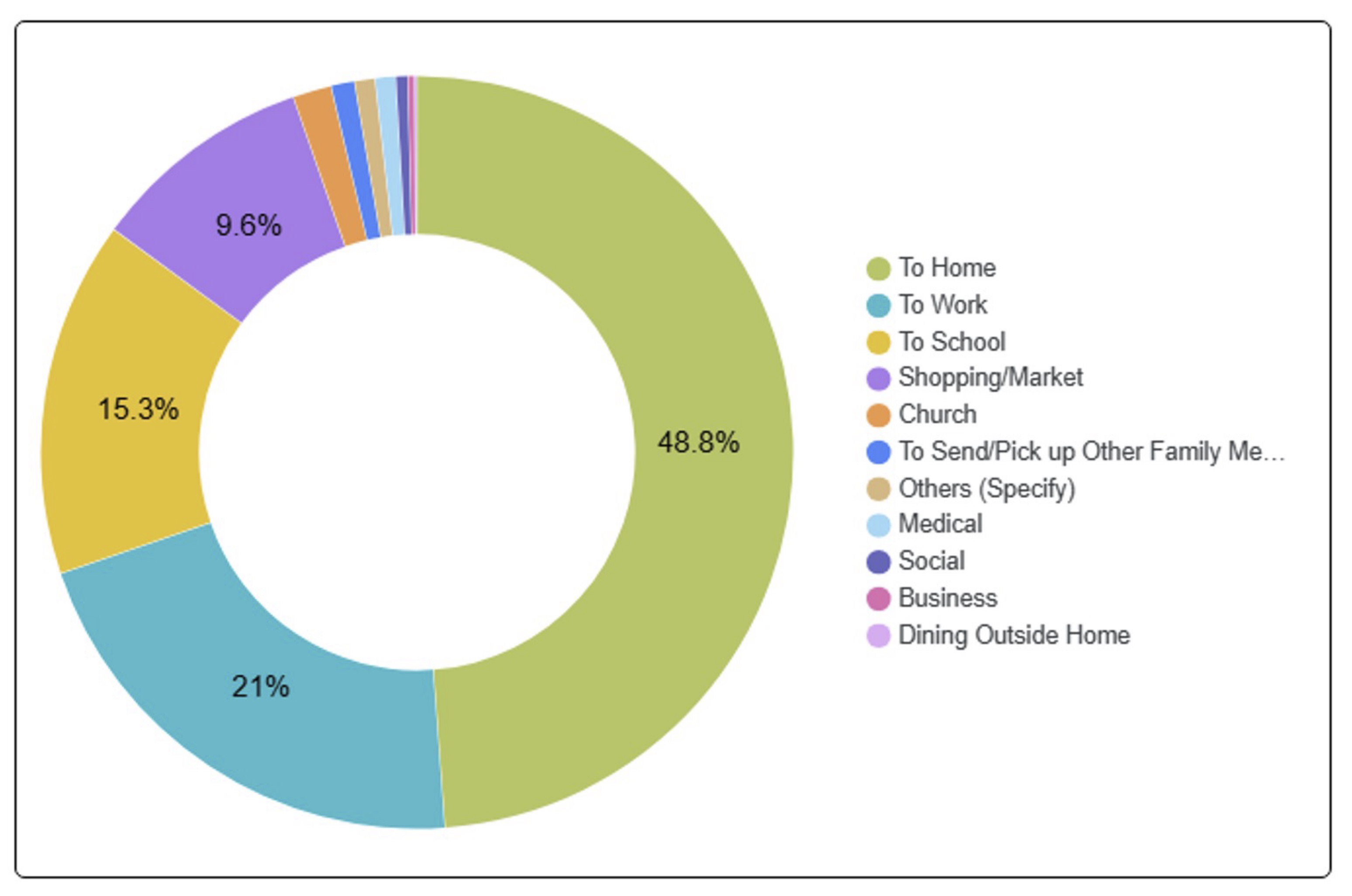
It is important to note that most if not all trips eventually end up at home (i.e., coming home from the workplace, school, market, etc.). Thus we can interpret the graph in a way where we can derive the trip purpose other than “to home”. For example, perhaps the real % of work trips is not 21% but 41.0% of trips made other than “going home.” School trips come in second with 29.9% of trips. Third would be shopping trips at 18.8%. These three combine for 89.7% of all trips made by Antipolo City residents. Work and school trips are most likely the most regular or frequent trips. These are the purposes associated with daily commutes whether by public or private transportation. In the next post, I will share data on mode share and try to relate the latter to the trip purpose.
–
Dominant trips during the day
I read this post on social media stating:
“The work commute is statistically the longest and least frequent type of journey we make in a day. Yet it dominates transport planning.Now more than ever, cities must build cycle networks to support recurring local trips: to the corner store, café, community center, or school.”
I am not sure about the context of the word “dominate” as it is used in the statement but this originates from the Dutch so perhaps there is a difference, even slight, between their case and ours. I would like to add though that aside from “going home” trips, the most dominant in the Philippine context are “to work” and “to school”. And dominant here covers frequency and distance traveled. Consequential are travel times as these are affected by the quantity and quality of facilities and services available to commuters.
I think there should also be restructuring of how surveys are conducted to capture these more frequent trips. Typical surveys like JICA’s usually ask only about the main trips during the day so those will have responses of “to work”, “to school” or “to home”. For the metro level, maybe that’s okay but at the local levels, LGUs would have to make their own surveys in order for data to support initiatives for local transport, most especially active transport. A possible starting point would be the trip chains collected that appear to be a single trips with “original origins” and “final destinations”. These can be separated or disaggregated into individual trips made by different modes rather than be defined or associated with a single (main) mode of transport. That surely would expand the data set and redefine the mode shares usually reported.
–
 Caught (up) in traffic