
Home » Posts tagged 'trucks'
Tag Archives: trucks
On unwanted traffic
I just want to end this first month of 2025 with a commentary on unwanted or undesirable traffic. Last year, one of our neighbors leased their property to a trucking company. This was without information to the homeowners’ association and certainly without the knowledge or notice to neighbors, particularly those near their property and along the routes the trucks use. The result was unwanted truck traffic along roads that we usually used for our daily walks. Truck drivers’s usually drove the vehicles as if they were not in a residential area. That is, they were usually fast and belching smoke. Add to this the drivers hanging around and even loitering around the village. Many neighbors complained about this but the resident did not respond favorably or in a neighborly manner. And so each one of us had to confront the drivers ourselves and reminded them to drive carefully and slowly as they were in a residential subdivision. The village security was also told about them and the roving guards also reminded the drivers about safe driving.
And so I was pleasantly surprised when during my first walk of the year, I found that there were no more trucks along the road and parked in their property. I thought this was a nice New Year’s gift and ended what is generally regarded as an external cost to society.
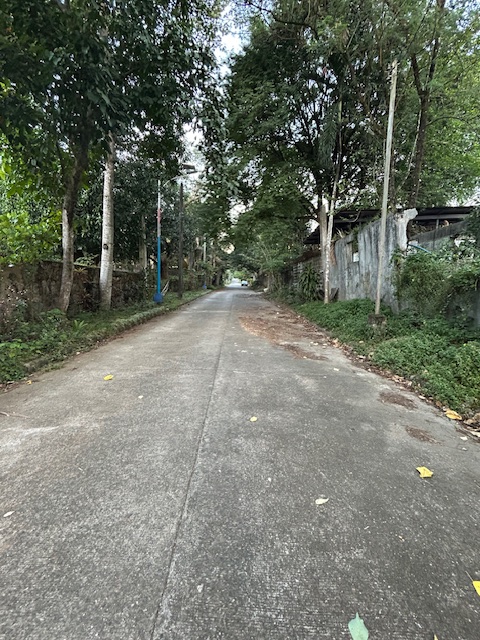
The now clear street in our neighborhood used to be lined with trucks. This street was quite busy, noisy and smelled of emissions from idling trucks. It’s good to recover the road space for walking again. Do you have something similar happen in your neighborhood?
–
On the fatal Katipunan road crash
The vehicles involved in a recent road crash that killed at least 4 people are still there and parked under the Aurora Flyover. A truck apparently lost its brakes and control and the driver ended up plowing into other motor vehicles, likely trying to gain some control in order to stop the truck. It was reported in news articles that there were 4 immediate fatalities and many suffered serious injuries. We probably won’t know the final fatality count unless someone reports on those hospitalized for injuries.


The crash highlighted again the need for vehicles, especially trucks, to be roadworthy. This time of year, most of these trucks run busy schedules with the logistics requirements. But maintenance is just one part of the problem here as the truck was reported to be speeding. So driver behavior is also a factor and apparently there was no monitoring (having those CCTVs don’t count if they are only used in a passive manner such as for evidence after a road crash had already occurred) or enforcement versus speeding for these large vehicles. Also, was the truck overloaded? This practice may also lead to the deterioration of the truck’s brakes and the vehicle’s mass contributes to the severity of the crash including the damage to other vehicles. The MMDA and LGUs have their work cut out for them to address these road safety concerns.
–
Speed limits and danger zones for trucks
Saw these signs at the back of a long truck as we were stopped before an intersection. One states the speed limits for these vehicles along different roads while the other is a warning sign for other road users especially those who might be less visible when the truck maneuvers (e.g., motorcycle riders, cyclists).
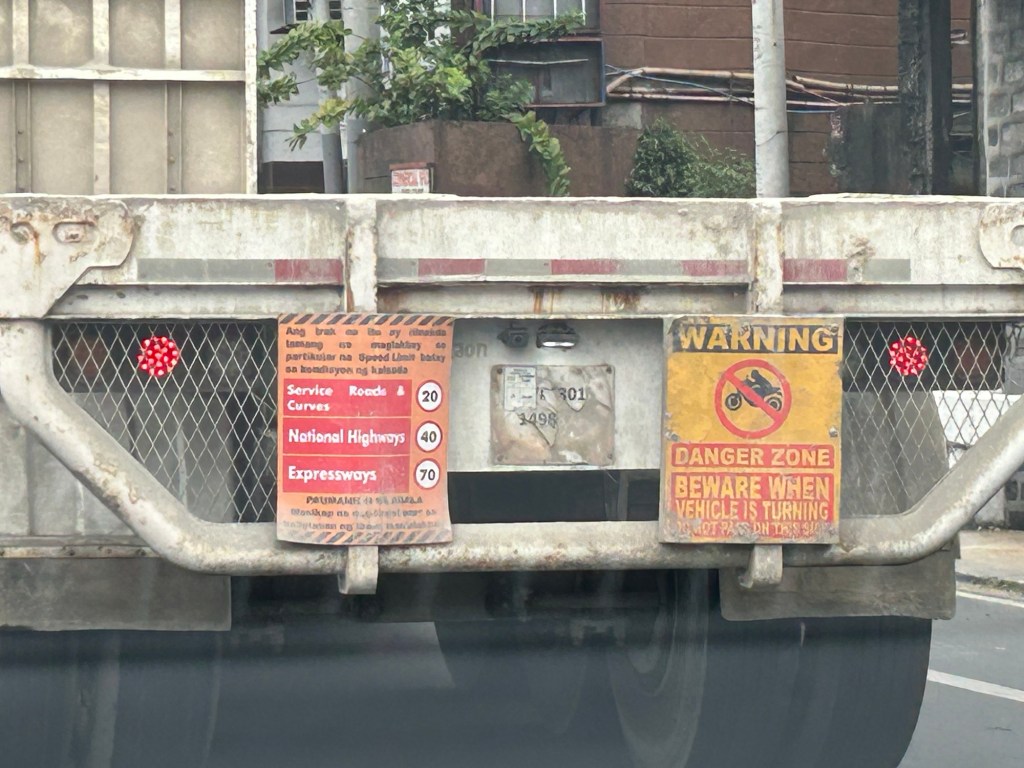
These are important information and fair warning to other road users. However, I think the signs should be bigger to be more visible or conspicuous. You have to be close to the truck for one to read and understand what the signs were. It might be too late by the time one figures out what the warning was about. I’ve read somewhere about people trying to debunk or play down these danger zones for trucks. That is bad opinion and puts drivers and riders heeding it in harm’s way. I think we should always go for what is on the safe side rather than risk being hit by these trucks.
Such information should be part of driver and rider education and perhaps education in general. While these large vehicles pose risks to other road users, they also play an important role particularly for logistics.
–
On road crashes involving trucks
In the week leading to the Christmas break, there was a major crash in Antipolo City along Ortigas Avenue Extension. The crash caused a standstill for both inbound and outbound traffic as the road was impassable to traffic and later, only one lane was available and vehicles had to take turns to use the lane. Here is a photo taken by a passer-by and shared multiple times on social media:

The crash damaged electric and phone poles causing power outage and phone and internet lines to be disconnected. Obviously, the crash not only inconveniences travelers but a lot of residents of the area affected by the blackout and phone and internet disruptions. Crashes like this are preventable if only operators and drivers are extra diligent with vehicle inspection and maintenance. Apparently, the occurrence of such crashes are not enough a lesson that people could learn from. So there needs to be stronger initiatives including inspections of vehicles that can cause major damage and murder. While we expect a lot from national government, local government units must also pitch in along with the private sector in order to improve safety conditions.
We hope that 2024 will be better and that we will have safer roads for all users.
–
On trucks and road safety again
The past days saw many trucks being involved in crashes along my commuting route. My social media feed also gives me updates on the traffic situation in my home city. And there are many reports of the same – trucks involved in road crashes or stalled due to a variety of reasons (engine problems, flat tires, etc.) . It is not an understatement to say that such incidents are a matter of concern especially since these may have been fatal (i.e., deaths due to road crashes). Here are a couple of photos we took as we passed a truck on its side along Ortigas Avenue Extension along one of my usual commuting routes.
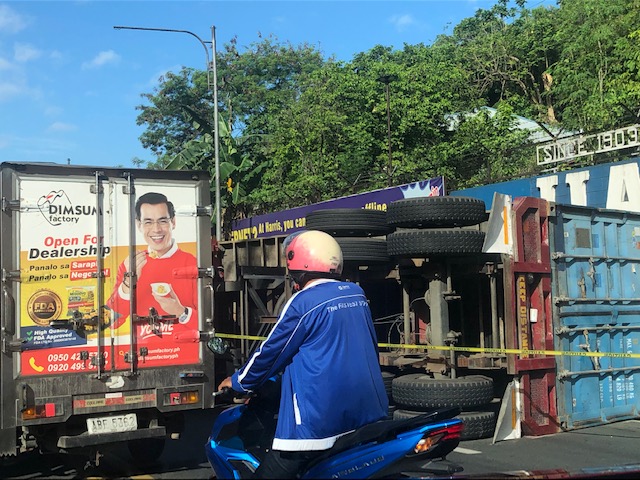
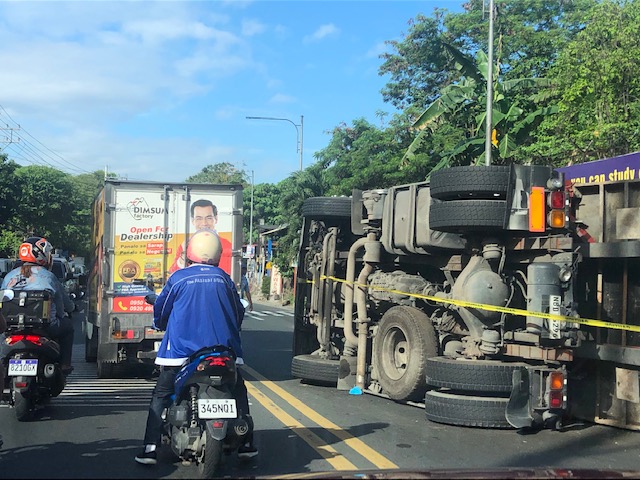
It is fortunate that this did not result in any fatality but from the photos one can surmise the potential or likelihood of serious injuries if not death/s. Such underlines the importance of both proper maintenance and operations of these vehicles including how they are loaded. Shifting or unbalanced loads on moving trucks negotiating turns or maneuvering, for example, will result in loss of control and overturning that also leads to traffic congestion. Are the drivers competent, awake, alert? Or are they sleep or perhaps driving under the influence of alcohol or other substances?
–
Where do trucks fit in complete streets?
The complete streets concept usually involve transforming streets to favor active and public transport. The typical discussions and presentations on complete streets are often focused on taking away road space from cars to allocate to pedestrians (e.g., wider sidewalks), cyclists (e.g., bike lanes) and public transport (e.g., transit lanes). Seldom do we read about trucks, deliveries and related items even in guides and manuals and are often just implied to be addressed in street transformation examples.
Evans, T. (March 24, 2022) “”Complete Streets” and Goods Delivery: What are Streets For?” New Jersey Future, https://www.njfuture.org/2022/03/24/complete-streets-and-goods-delivery-what-is-a-street-for/ [Last accessed: 4/5/2022]
To quote from the article:
“Not every final destination for a package needs to be accessible to large trucks. Rather than proposing truck-focused modifications (wider lanes, bigger turning radii, etc.) to local streets in order to accommodate truck deliveries, transportation planners and logistics industry professionals should focus instead on matching the type of delivery vehicle to the environment in which the destination is located.”
I recall the mainly pedestrianized shopping streets (shotengai) in Japan when I try to make sense of how delivery vehicles can be included in the discussion. The Japanese use small trucks or vans for deliveries and mostly these are confined to the side streets. However, during certain times of the day, usually early mornings or after business hours, they are allowed inside the shopping street for quick deliveries or pick-ups. This show what kind of goods vehicles and operations may be permitted.
–
Safety remains a big issue in transportation
Even with the supposedly reduced traffic due to the pandemic, there has been a perceived increase in the road crashes. Many of these are speeding and reckless driving/riding related, and many involve pedestrians and cyclists who are most vulnerable considering the reckless behavior of drivers and riders. Following are photos taken in Antipolo along Ortigas Avenue Extension (the section leading up to the capitol):


Much has been said and written about Philippine roads not being up to par with international standards. I would agree with certain roads with designs encouraging speeding and other reckless behavior. However, there have been significant efforts to correct situations involving geometric design, signs and markings where applicable. These include engaging the International Road Assessment Program (iRAP). The road and engineering are just one part of the equation. Education and enforcement are the others that affect or influence the behavior of road users whether they be drivers, riders, cyclists or pedestrians. Even with the best road designs and their intended influence to driver and rider behavior, much is to be desired for driver/rider education and actual behavior on the road.
–
On road crashes involving trucks
We were almost late for our flight the last Friday of November because of a road crash involving at least one truck at the intersection of Sales Bridge and the SLEX East Service Road.
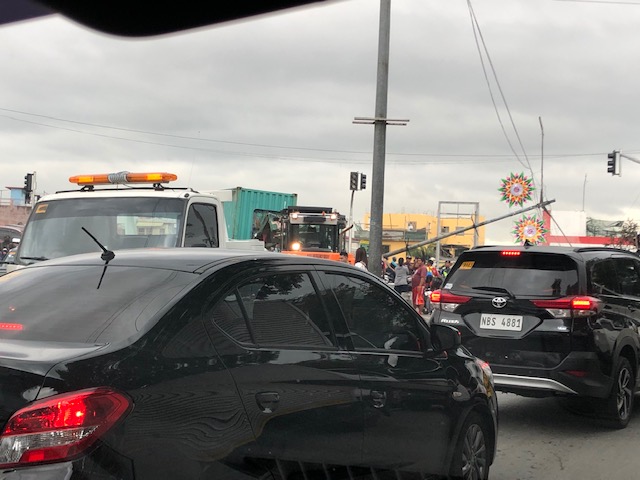 Here was our first view of the crash site showing one streetlamp post almost hitting the pavement if it weren’t for the wires holding it at its position. Waze wasn’t much help as there was only a simple description of a major crash reported. How serious it was wasn’t stated.
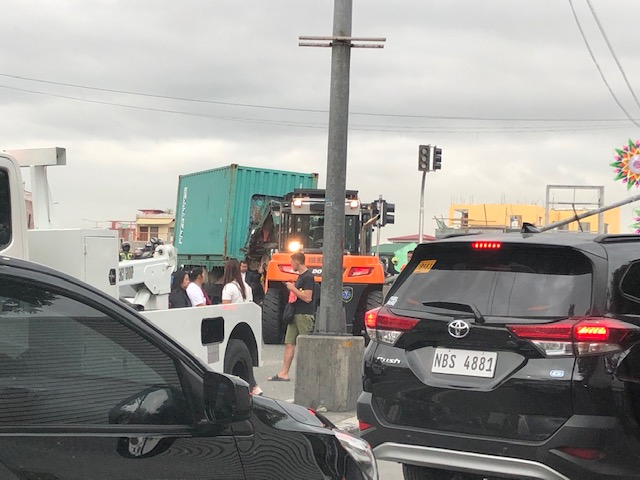 A tow truck and a forklift were already on site to help remove the truck that hit the post.
 Pedestrians continued to cross the intersection with some glancing quickly at the sight of the vehicles involved in the crash and clearance operations. MMDA enforcers were in the area to herd people away from the area.
 An enforcer looked like he was taking photos, video or both of the clearing operations.
 When we arrived in the area, we only saw this truck that was apparently the one that hit the post. The damage to the truck indicated that it likely slammed into another large vehicle. However, that other vehicle was no longer in the area.
 Another look at the truck involved in the crash
 The post obviously was in a precarious position and effectively blocked the path of vehicles that were to turn left at the intersection. Many of these vehicles including ours were heading to the airport.
There seems to be a lot of crashes involving trucks lately. I say so based on my personal observations including passing by crash sites where trucks have been the main vehicles involved. It would be good to see the statistics of truck involvement in road crashes including the typical locations (i.e., black spots), frequency and severity of the crashes. This would correlate with the maintenance and how these trucks are being driven. Too often, we read or hear about trucks losing their brakes or drivers losing control. There are clearly maintenance and driver behavior issues here that need to be addressed if we are to improve safety in relation to these large vehicles.
Despite this incident and the resulting traffic jam, the MMDA enforcers didn’t seem to know how to go about managing the flow of traffic in the area and wanted to reroute every vehicle intending to turn left at Sales towards the airport to Pasong Tamo Extension! This resulted to more confusion and many not to take heed of the enforcer waving at us to head for more congestion after what we experienced. Clearly, this was a case where the motorists knew better than to follow errant enforcers. In these times, you wonder if the MMDA’s enforcers were capable of managing traffic after road crash incidents like this.
–
Pavement distress along C-5 due to the truck lane policy
I frequently use Circumferential Road 5 (C-5), which is known by many names according to the MMDA, the DPWH and the LGUs it passes through. One thing I always notice is the deteriorating or deteriorated pavement, particularly along the lane designated for use by trucks. The MMDA had instituted and implements a policy requiring large trucks to use one lane of C-5 during times when the truck ban is lifted (10:00 AM to 4:00 PM). Smaller trucks are allowed to use other lanes.
The result has been a long platoon of large trucks along the designated lane of C-5 and this concentration of load on the highway has caused faster pavement deterioration for that lane. This is especially evident when the pavement surface is of asphalt concrete. Flexible as it is, the concentration of load has led to obvious pavement deformation as shown in the following photo.
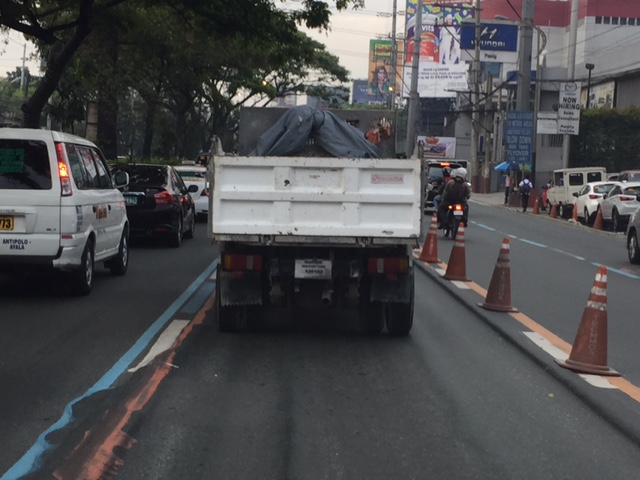
For Portland cement Concrete pavement (PCCP) cases, I would presume that there is also significant damage and the distresses (e.g., cracks) can be linked to this concentration of load. This situation and the conditions for loading likely have detrimental implications on maintenance costs for C-5 and is probably an unintended consequence of the MMDA’s policy. It would be interesting to quantify the impacts of this truck lane policy, whether it has contributed to improve traffic flow along the major thoroughfare, and whether the maintenance costs have risen (and by how much) from the time the policy was implemented.
–
“Great wall” of trucks along C5
The Metro Manila Development Authority (MMDA) has implemented a truck lane policy along Circumferential Road 5 during the last administration. It has continued at present and a long line of trucks are regularly observed along C-5 whenever the truck ban is lifted during what is designated as off-peak hours for all other traffic. Many travelers have termed the line as a “Great Wall of trucks” although in many instances, the line is “breached” by vehicles needing to shift lanes along this major thoroughfare. Strict implementation by the MMDA and the affected LGUs as well as the compliance of most trucks have led to the maximization of the occupancy of the designated truck lanes. These are easily observable along most of C-5 and particularly along sections close to the CBDs (e.g., BGC, Ortigas, Eastwood, etc.). Following are a few photos showing the long line of trucks along C-5:
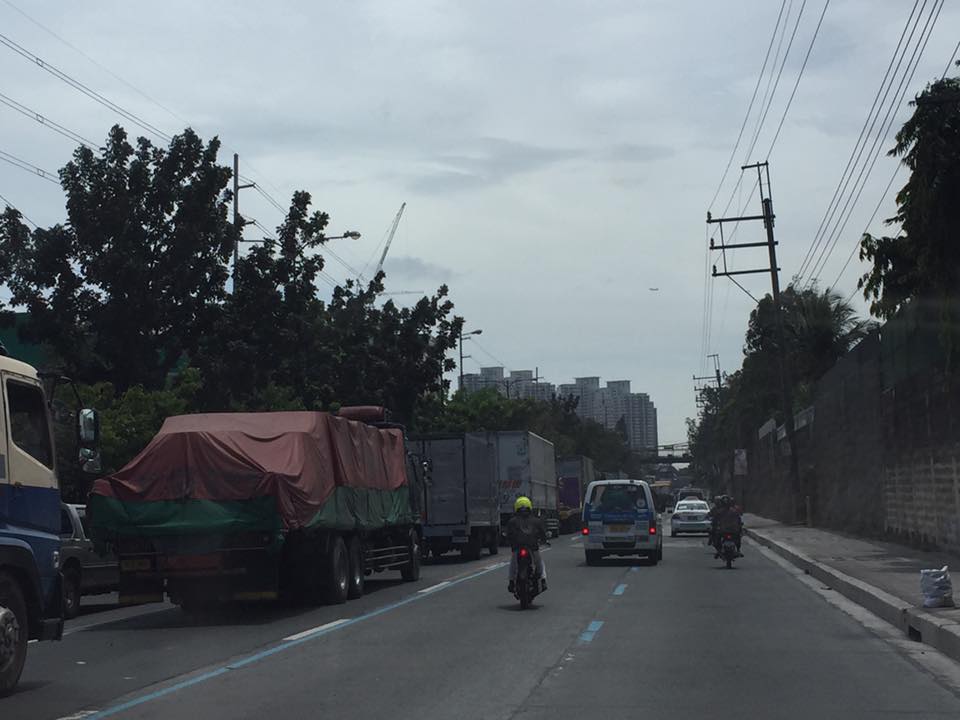
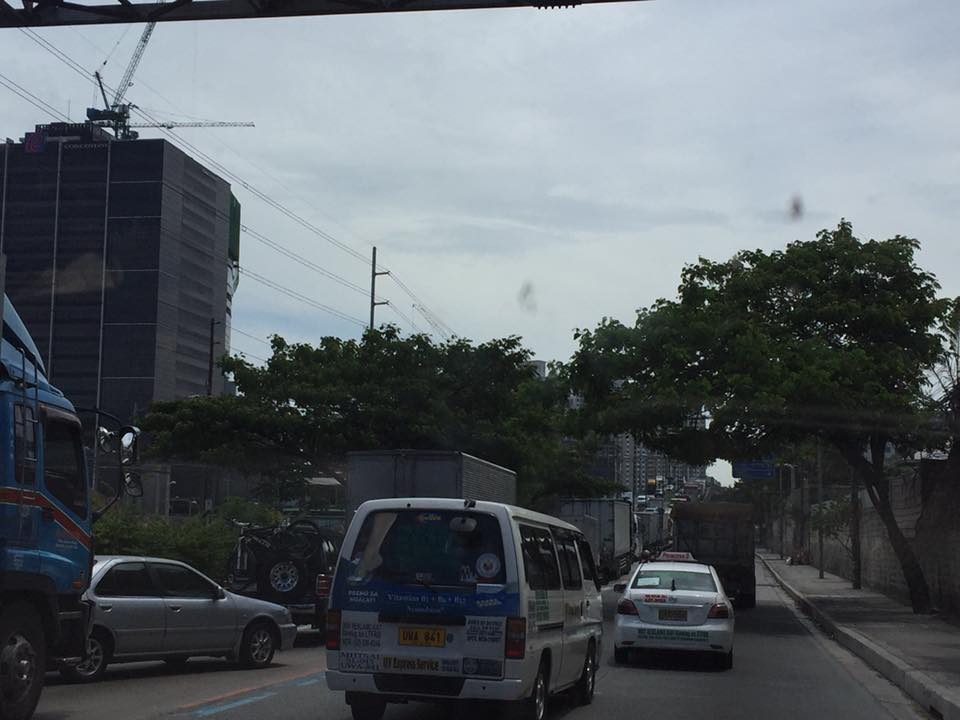

Here’s another photo I took earlier last month:

We have a couple of students now at UP Diliman who are studying the policy and taking a look at the traffic and pavement conditions along C-5. Interesting would be their comparisons of traffic along the truck and non-truck lanes during both peak and off-peak periods as well as for weekdays and weekends. Interesting, too, will be their assessment of pavement conditions. So this will be something to look forward to once the research is completed this coming May 2017.
–
 Caught (up) in traffic