
Home » Posts tagged 'vehicle ownership'
Tag Archives: vehicle ownership
Alternative reasons for the rise of SUVs in the Philippines
I recently shared an article about the rise of large vehicles in the US and how they have negatively affected road safety in that country. There are mentions there of the elements that led to people preferring SUVs including the usual technical specifications of SUVs and trucks (what they call the pick-up) that proliferate US roads. These are probably safer for transport from the perspective of the occupants including the driver. However, they are unsafe to other road users especially pedestrians and cyclists. I guess the reasons for owning large vehicles are similar for the Philippine case but there are other stories and reasons behind the preference of large vehicles in many parts of the country. A couple of these are quite common reasons that has nothing to do with people having car-centric mindsets. The latter is probably far from their consciousness.
One reason for preferring larger vehicles is practicality. I first encountered this reason during vacations in Iloilo in the 1970s and 1980s. People had pick-ups and owner type jeeps built for the rough roads at the time. Cars would not have survived the road conditions with the shock absorbers and tires being the first to go. This would probably be the same reason in other provinces as well. The unpaved and poorly maintained roads necessitated pick-ups and the SUV models of those times. Eventually, these evolved into the Pajeros, Patrols and Land Cruisers and later the Monteros, Everests and Fortuners. Add to these the AUVs (e.g., Innova, Adventure, etc.) that also became preferences depending on the affordability to people.
Another reason for preferring larger vehicles is not just about practicality but survival. People from flood prone areas tend to have larger or taller vehicles. Ground clearance is a criteria for vehicles as these have to be able to navigate flooded highways and streets. Most flash floods are probably ankle or gutter deep. But there are more severe situations where floods can be knee or waist-deep. And so people preferred vehicles that can get them out of their flooded homes if not get to their not flooded home but via flooded roads. This comes from first hand experience. After Typhoon Ondoy inundated much of Mega Manila, sales of SUVs and AUVs were up. People replaced their vehicles with these rather than regular cars. They generally didn’t transfer homes as many decided to stay as they probably couldn’t afford to get a new hour or have gotten used to the flood situation in their places. Floods, after all, are seasonal and the Ondoys are not so frequent.
The stories or reasons I cited above are real and will probably be attested to by many who share the experiences in flood-prone and/or rural areas. These narratives though have been set aside or dismissed in favor of the car-centric narrative that’s the in thing these days. If we really look more deeply, the failures of infrastructure development, whether pertaining to basic roads or drainage systems, have tremendous impacts on our lives including our preferences for vehicle types or models. In fact, weren’t those also among the questions for resisting electric vehicles? Kaya na niyan ang rough roads? Kaya ba niyan ang ahon? Kaya ba niyan ang baha? Of course, housing location preferences and options (along with affordability) are also factors. Why live in a flood prone area after all? But that’s another topic that I plan to write about as well very soon. I think I wrote something about this here or in my other blog. I should write about it again and probably in light of the flood control projects that have been the hot topics these past months.
–
On the rise of large vehicles as preference of car-owners
Here is a quick share of an article I found about the rise of large vehicles including SUVs:
These vehicles have become quite popular and the preference of many vehicle owners in the Philippines as well. Owners will probably cite safety as their primary reason for purchasing these vehicles but other reasons would likely include passenger capacity (e.g., having many members of the household), and practicality (e.g., living in or regularly traveling along flood prone areas, etc.). The concern though is that the increasing numbers of these large private vehicles that includes SUVs and AUVs have probably led to a rise in the number of fatal road crashes involving them and pedestrians. I say probably here because there are no formal studies locally like the one in the article above.
–
Ownership is not equal to use – on bike ownership in the Philippines
There is a nice graphic going around social media about bicycle and vehicle ownership in the Philippines. It is attributed to the Social Weather Stations (SWS), which conducted a survey on vehicle ownership in the country during the first quarter of 2023. Most conspicuous is the inclusion of bicycles considering that past national surveys (especially those conducted by the PSA or NSA) did not include bicycles but only motor vehicles in their surveys.
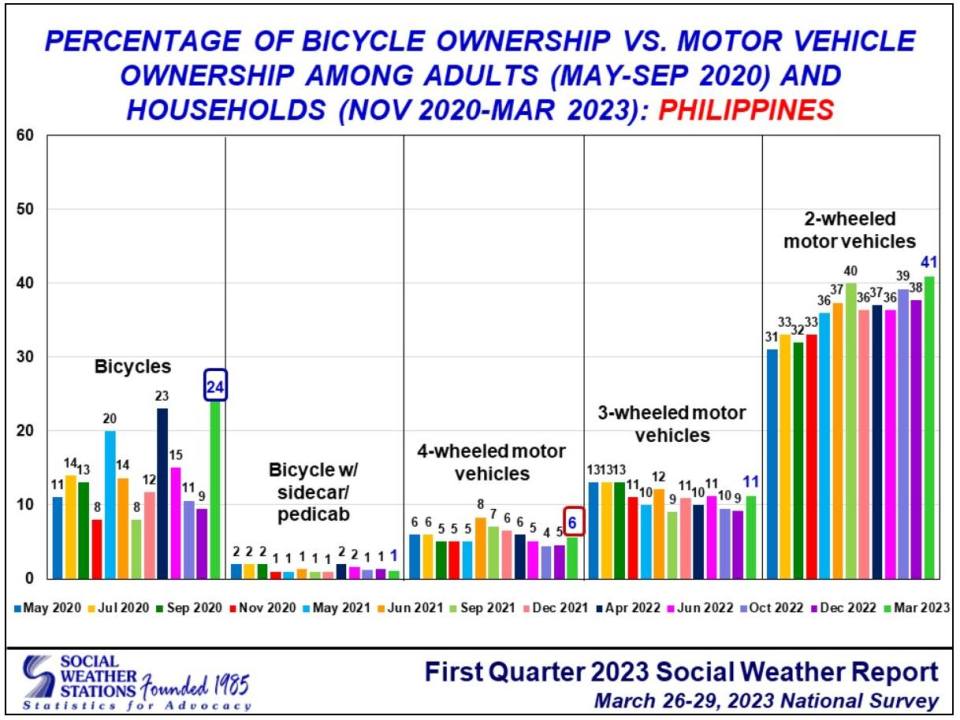
The graph shows many households owning bicycles (24% as of Mar 2023) while those who owned 4-wheel motor vehicles are only at 6%. The quick conclusion I see in many social media posts is that only 6% of HH use cars and that 24% use bicycles. This is actually fallacious and therefore misleading. Such assessments and conclusions is far from being factual considering ownership in this case does not necessarily translate to use, particularly for the most important trips made during the day – commutes to work and school. In other words, a household owning at least one bicycle does not mean they use it for their regular commutes.
The graph also states that the data is for the entire country. Thus, it does not give us a more accurate take for cities, particularly the highly urbanized ones. Are the % the same for cities like those in Metro Manila? How were the samplings conducted? These are important because if we have the wrong data and assumptions, we won’t be able to understand the problem at hand. We will not be able to formulate the most suitable solutions to address the transport problems we are experiencing. On the part of SWS, they should be clarifying what the data means rather than be content of people using their data to mislead or peddle narratives for advocacies that may be worthy yet use misinformation as a means to an end.
–
Article share: On a future with fewer cars
Advocates of sustainable transport including those pushing for more efficient public transport and more bike lanes often cite what is supposed to be car ownership data from past studies like the one conducted by JICA for Mega Manila. Most recently, I read an article that mentions only 5% of Filipinos own a car so they shouldn’t be hogging the road space against the rest. It seems so simple yet does not take into consideration geographic and demographic factors. It seems to underestimate vehicle ownership across the country and especially in cities. Also, do we equate vehicle ownership with just car ownership? Many may not have cars per se but own and operate motorcycles or tricycles.
I share the following article from the Washington Post as it presents on initiatives and studies from the Institute of Transportation Engineers concerning car ownership in the US. The data is presented in a way that we can clearly understand car ownership from various perspective including income level, household size, age and disability, among others.
Aratani, L. (February 18, 2023) “How a future with fewer cars may change how communities are designed,” Washington Post, https://www.washingtonpost.com/transportation/2023/02/18/automobile-ownership-street-design/ [Last accessed: 2/27/2023]
Here is an excerpt from the article: “There are people who are car-free and those who are carless. The car-free are the people who are choosing not to have a vehicle because they have access to other means of transportation or they work from home. The carless are people who either can’t afford or don’t have access to a car for other reasons.”
It would be nice to have a similar data set and analysis for the Philippines so we can really understand mode choice or preferences with respect to various factors including household income. Among the data sets we can probably use are the census data and the Family Income and Expenditure Survey (FIES) that are regularly collected and from which we can ascertain vehicle ownership vs. various parameters.
–

