
Home » 2011 (Page 7)
Yearly Archives: 2011
A glimpse of transport in the Philippines – General Santos
I’ve been fortunate to travel around the Philippines due to my line of work. In some cases, it is for our training programs, for others we do fieldwork for technical assistance or consultancies. You get to see not just the nice places around the country but also get to see transport in other cities and towns including a glimpse of its character and the behavior or preferences of its users. In the previous posts, I have included photos I’ve taken myself of some transport curiosities and there are many more that I have collected over the last few years. I guess I just need to find time to sort through the many folders containing these photos. Unlike before when the conventional cameras required photo development and I had to scan each one that I intend to save for my lectures or for posterity, nowadays there seems to be no limit with what you can take with a digital camera except perhaps the battery life and the size of you storage media.
Below are a couple of shots I took during one visit to General Santos City (GenSan) in south western Mindanao. The scenes do have similarities with others I have taken in other cities like the one I took while traversing Kennon Road en route to Baguio City. I believe the first 2 photos were taken along the Digos-Makar Road also known as Asian Highway 26 (AH 26). Note what seems to be the comfortable state of the passengers sitting on the roof of the jeepney and the disregard for safety for the bunch on top of a local truck.
 Passengers sitting on top and hanging behind a jeepney in GenSan
 Typical tricycle and people riding on top of a local truck
 Typical tricycle and multicab in GenSan (photo taken along Catolico Sr. Avenue)
Local transport services for moving about in the city are generally provided by jeepneys, multicabs (which are actually a form of jitney service), tricycles and non-motorized pedicabs. There are also the informal motorcycle taxis (habal-habal) but these are to be found mainly in the outer parts of the city. Taxicabs generally ferry passengers to and from the airport. Buses and vans are used for inter-city or inter-town transport (i.e., long distance transport) and are banned from plying routes in the city center. These may only use the national roads to get to the terminals. Tricycles are actually banned from the national roads and this is indicated in the sidecar bodies. However, the enforcement is usually lax and you can take the tricycle almost anywhere using any road in the city. Perhaps it is really too difficult to implement the ban due to the number of tricycles?
Sustainability and the roads to Baguio
News about the garbage in Baguio City and the slide that caused the death of many in that city brought back memories of my last visit. That was back in June 2009 when we were conducting consultation workshops for the formulation of the national environmentally sustainable transport strategy. We stayed and held the workshop at a hotel that was a short walk away from the Good Shepherd Convent. The convent, of course, is famous for the strawberry jams and other delicacies bearing the convent’s name. Also nearby was the Mines View Park that used to give a breathtaking view of mountains covered with pine trees. Those among my older friends who were able to experience this many years ago attest to the pleasing scent of pine in the cool breeze that is also a characteristic of this city. Nowadays, the view is mainly of mountains covered with shanties and looking downwards you would have a good view of a lot of roofs and, surprise, even a couple of structures that look like graves! If you’re unlucky enough, you would be taking in the scent of smoke coming from something that is being burned nearby.
Another thing that caught my attention in 2009 was the uncollected garbage along the streets and in front of many houses and other buildings leading to the convent and the park. Residents explained to us that Baguio already had a garbage problem and that waste management and disposal has been an issue in the city for quite some time. Previous to this visit, I had the chance to go to the city a few other times, even staying there for almost week in 2004 when we were conducting another study. At that time, I was not aware of the garbage problem probably because the problem has not yet manifested itself as it did in 2009. It is sad that the city has done little to address such issues considering the many indications of impending (if not ongoing) disaster due to their waste. It is also disappointing to see their leaders pointing fingers at others but seemingly refusing to take responsibility for the tragedy of the garbage slide.
On the way up to Baguio, we usually take Kennon Road, which is usually my choice when riding our own vehicle, rather than the more common Marcos Highway. The latter is a relatively easier route that was constructed as a safer alternative to the two more traditional routes via Kennon or Naguilian Roads. I usually choose Kennon because the drive provides great vistas including those you can view from observations points along the road. During bad weather, however, Kennon and Naguilian can be treacherous with both being relatively narrow as compared to the newer and upgraded Marcos Highway. There are many incidences of rockslides or landslides that have often made these roads impassable. In fact, Kennon Road is usually only for light vehicles and can be challenging to those who are unfamiliar with its combination of curves and slopes. Naguilian is no longer a choice among travelers from Metro Manila as it starts further from both Kennon and Marcos. Buses and trucks commonly use Marcos Highway, which has slope protection along critical sections and even a roof along one that makes it look like a tunnel section. It is also easier to negotiate this highway for most motorists though there is one long climbing section just before you get off the highway that has caused many radiators to overheat or brakes and clutches to malfunction.
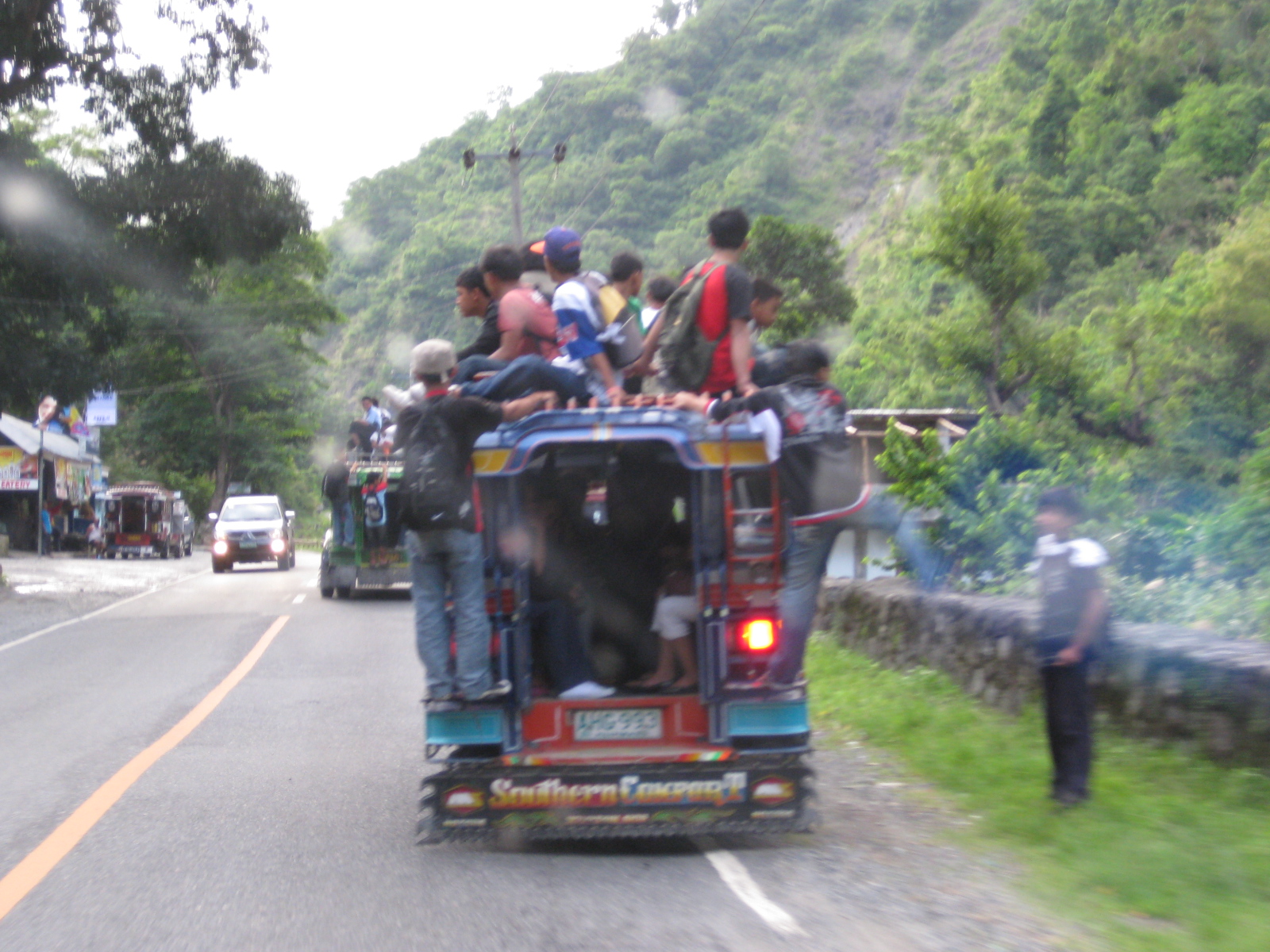
The photo below was taken as we negotiated a populated area along Kennon Road in 2009. Note the two jeepneys in the photo that are loaded with passengers. It was a surprise that no passengers were hanging by the door of the jeepney like what we usually see in Metro Manila during the peak hours. Nevertheless, such an image suggests that the public transport supply is no longer sufficient for the passenger demand along this route. Perhaps their numbers are no longer enough or maybe there is a need for a public utility vehicle with a larger capacity? One thing is sure and that the practice of overloading is unsafe and is a fatal crash waiting to happen given the geometry of Kennon Road. While this seems acceptable to many (I couldn’t even count how many people were sitting on the roofs of the jeepneys we passed.), this is not something that should be encouraged, and careful examination of services is necessary for both the local government (in this case Baguio) and the national agency in-charge (LTFRB).
More on Baguio and jeepneys on future posts.
Pedestrian overpasses along Espana Blvd., Manila
I took some photos of pedestrian overpasses along Espana Avenue in Manila while en route to a meeting in Malacanang. I was hoping to capture the conditions along such facilities and maybe compare them with my observations along Commonwealth Avenue. Following are photos taken from my trusty Blackberry. I ask my readers to excuse the reflections due to the sun bearing down on the windshield of our vehicle.
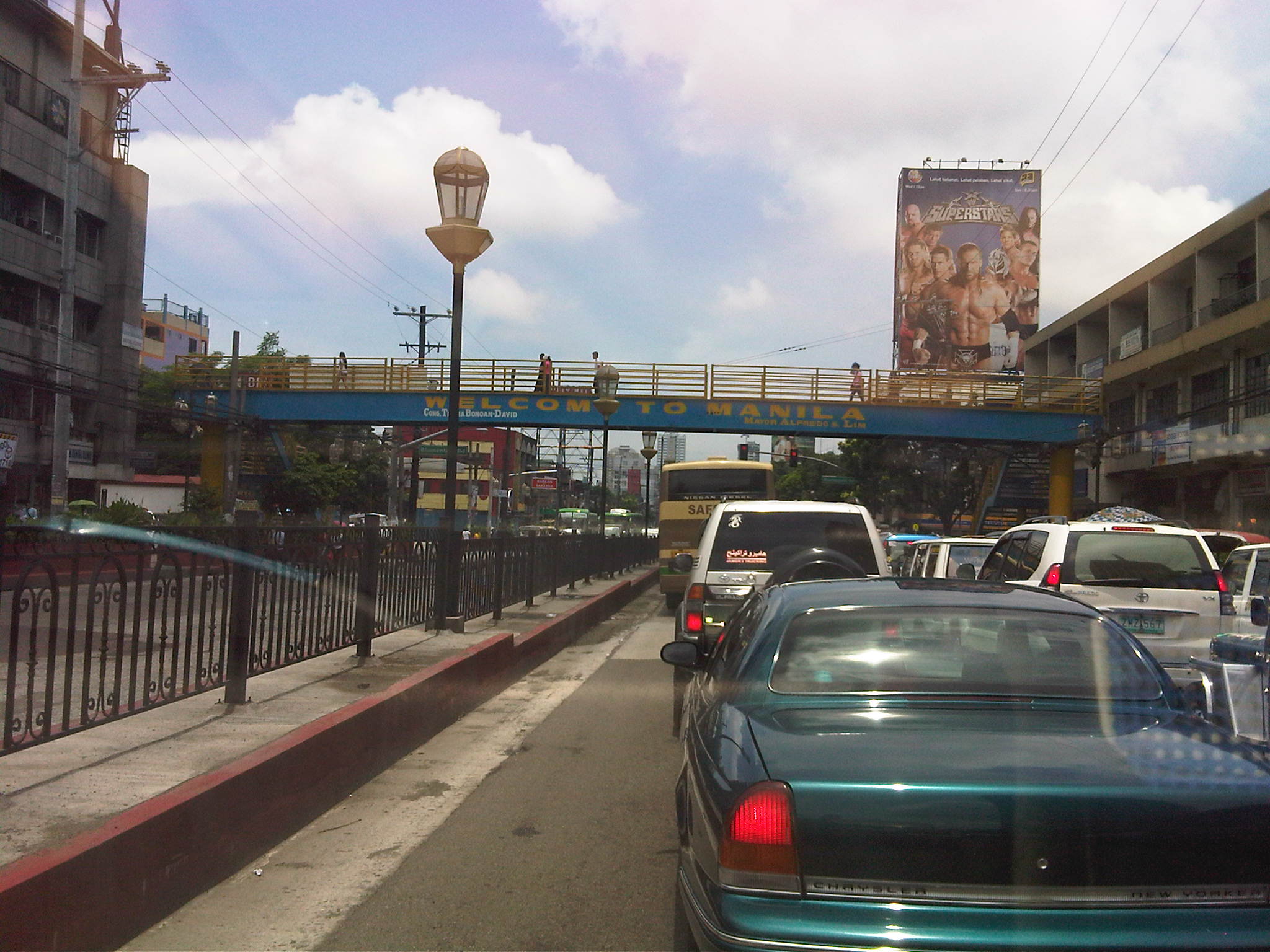 Steel overpass built during the last MMDA administration. Many pedestrian overpasses were constructed out of steel by the MMDA and this was attributed (allegedly) to the previous Chair having a construction and steel manufacturing outfit. True enough, many of these structures bear his initials that is also the name of his corporation. Many of these structures were criticized by the DPWH for not following standards (e.g., one can feel the deflection of the overpass while traversing its length) but the same agency seemed helpless in their case against such facilities.
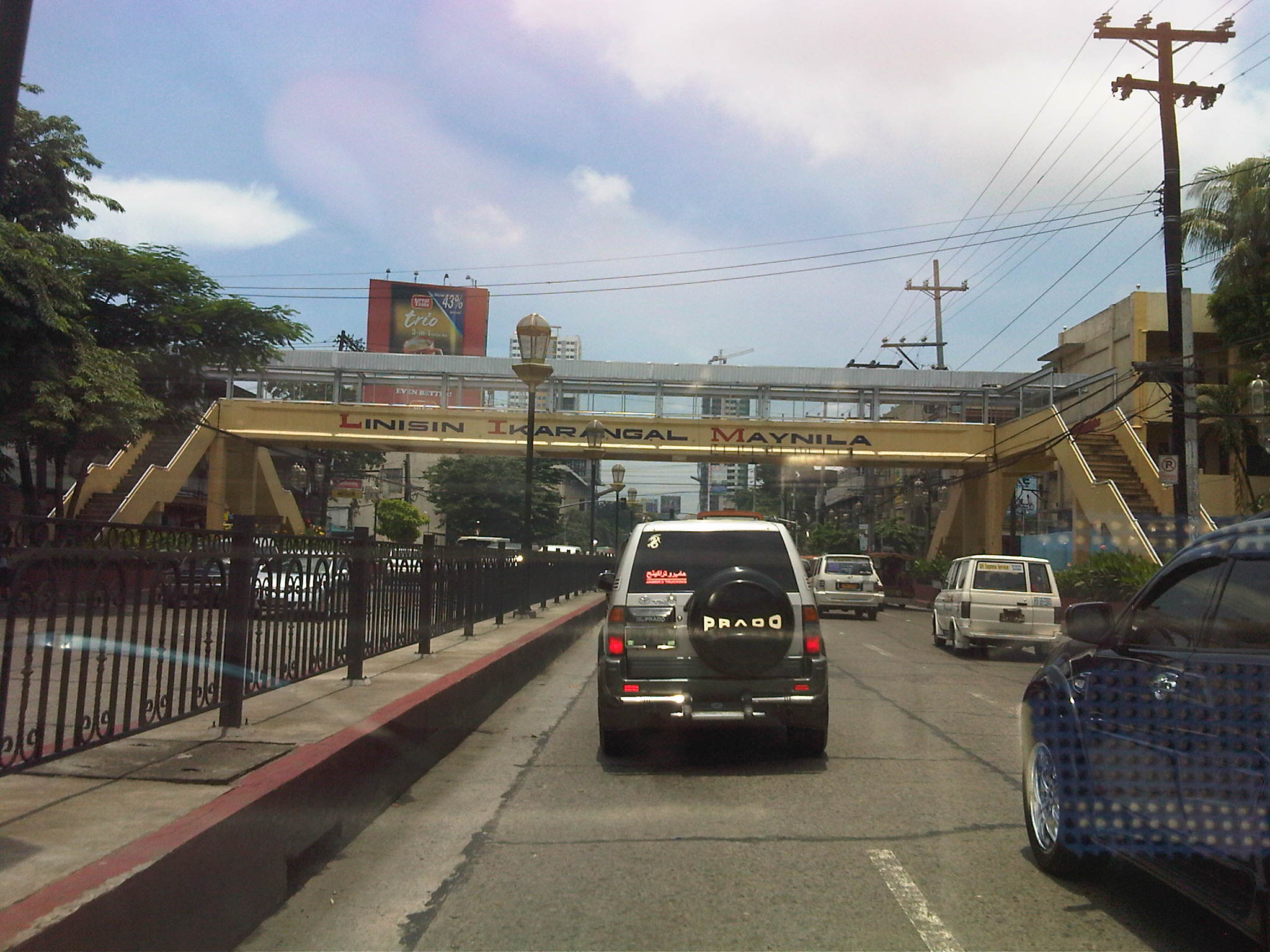 Older concrete overpass across Ramon Magsaysay School. This appeared to be clear of vendors while the roof structure is unfinished giving users no protection from the elements.
 Overpass across UST. This is one of the older and larger (widest?) pedestrian facilities along Espana considering it serves the students of one of the largest (in terms of population) universities in the country. There are vendors on this overpass but mostly those selling candies and cigarettes(!). I am not sure if UST has posted a guard along this overpass considering the safety and security interests of its constituents. Similarly situated overpasses along Katipunan Avenue are secured by personnel provided by Ateneo De Manila University and Miriam College. I would like to see this overpass retrofitted and re-designed to match UST’s heritage. The institution, after all, just celebrated its 400th anniversary.
 Overpass at P. Noval Street. It is not so clear from the photo but one can easily see vendors with their wares set-up along the overpass and clogging the flow of people. This is another relatively old structure as this is a major crossing point for people in studying or working in the University Belt.
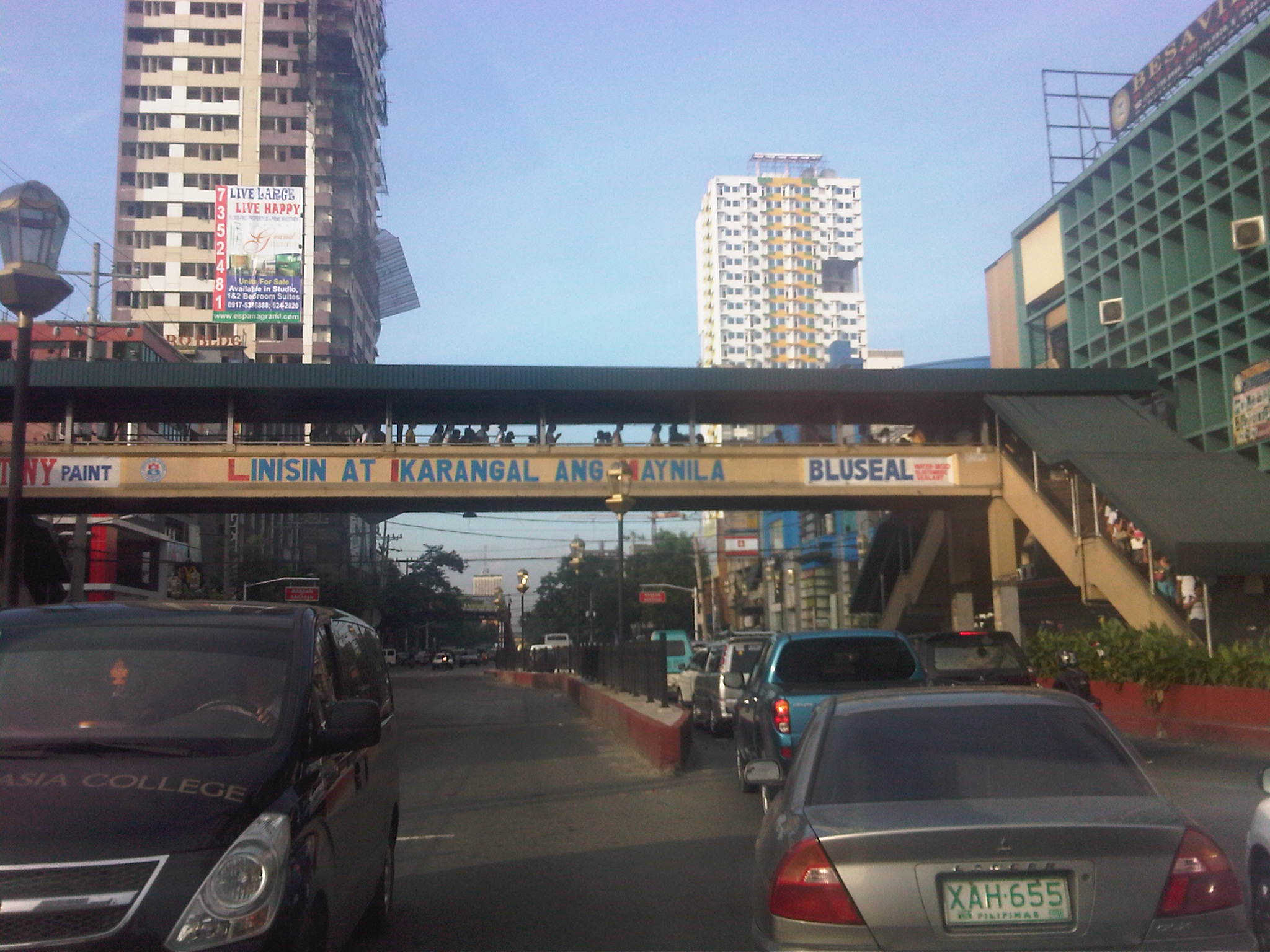 Another look at the P. Noval overpass from the Quezon City-bound side of Espana. Notice the high volume of pedestrians using the overpass? Most of these are students studying at one of the universities at U-belt or graduates reviewing for their respective licensure exams in one of the many review centers located in the area. There are many nursing and engineering review schools in the area.
If we are to encourage walking as a mode of transport and especially applicable to short distance trips, we would need to invest and build the necessary pedestrian facilities. Such facilities need to be structurally sound and therefore compliant with the standards set by the DPWH and properly located to encourage their use. Design, of course, includes capacity considerations since they should be able to accommodate volumes of pedestrians during peak periods. As such, overpasses would have to be clear of vendors or others that constrict flow. Ideally, pedestrian facilities should also be designed according to a criteria that includes aesthetics that adheres with the character of the area where it is located. It is understandable that construction of such facilities may have been rushed due to the urgency of the situation (i.e., like in the case of Commonwealth). Nevertheless, while the intent is good, the execution of the solution should still adhere with standards considering that these are often long-term investments for public infrastructure.
Car crazy: remembering an acquaintance
I met Prof. Lee Schipper for the first time when I attended the WCTR Conference held in UC Berkeley in 2007. I was presenting a paper on traffic schemes in Metro Manila at the time while a student was presenting our paper on bus operations. We had a sizable delegation from the Philippines at the conference considering Filipino students who were studying in Japan, Australia and Canada were also participating in the conference. Prior to the conference, my student was already communicating with Prof. Schipper who was reviewing our paper and he was very helpful with his comments to improve the material during the refereeing process.
I had the pleasure of meeting him a few more times in Manila at one ADB Transport Forum and at meetings organized by Cornie Huizenga’s Partnership for Sustainable Low Carbon Transport (SLoCaT). He always had a unique opinion on transport and I found his ideas quite useful for as an alternative take on a lot of things about transport that we often take for granted and orthodox.
As a tribute, here is an article by Lee Schipper published online by World Streets:
Car Crazy: Lee Schipper on the Perils of Asia’s Hyper-Motorization
Prof. Schipper was quite passionate about transport in Asia as he probably realized that motorization in Asia would have tremendous impacts on the environment (mainly on air quality and energy) and not just on the local or national levels. Perhaps the battle has been on the losing side in many industrialized countries and the huge Asian market is where efforts should be exerted in order to prevent or mitigate experiences similar to those in the US and other countries.
Prof. Schipper will be missed.
Bottlenecks along Marcos Highway
Motorists and commuters using Marcos Highway which connects towns in the Province of Rizal to Metro Manila (particularly Marikina, Pasig and Quezon City) typically experience severe congestion due to two bottlenecks. These are at Santolan in the general area of the LRT 2 Station and near the junction with Evangelista Street, and at Ligaya near the junction with Amang Rodriguez/J.P. Rizal Avenues (note that the road intersecting with Marcos Highway is known as Amang Rodriguez on the Pasig side and J.P. Rizal in Marikina). Even without the current road and drainage projects being implemented on both sides of the highway, severe congestion is experienced in these areas.
There are mainly two reasons for congestion. The first is the operation of public utility vehicles, particularly jeepneys, in these areas. The second is the traffic flow characteristics, particularly merging and weaving activities, along Marcos Highway. Undisciplined operations of jeepneys in both areas have always led to congestion as they have tended to occupy significant road space (say 2 or 3 lanes) as they compete among themselves for space and for passengers. This generally results in the reduction of road capacity as there are less lanes available for all other vehicles traversing the highway. Chaotic loading and unloading have also influenced commuters to also compete for their rides with people often found advancing to meet up with the approaching jeepneys, and occupying road space in the process.
In the case of Santolan, people occupy 2 lanes just after the junction with Evangelista street right after the bridge. Such results in usually 2 to 3 lanes available to motor vehicles. Combined with jeepneys stopped across the LRT2 station, only 2 to 3 lanes are effectively available to traffic along a stretch of the highway. I always wonder why the MMDA and Pasig City enforcers are always appear to be helpless against these people when the former should be preventing the latter from occupying road space and causing congestion that can reach as far as Aurora Boulevard along and also fill up the bridge from C5. The situation is very similar for Ligaya where Pasig-Marikina jeepneys tend to establish informal, on-road terminals at the intersection itself and clogging both sides of Marcos Highway. Again, people are everywhere and occupy road space, ensuring that only a couple of lanes are usable for general through traffic. Here also, there seems to be enough enforcers from the MMDA and Pasig City but I always observe them not doing their jobs of managing the traffic and preventing mayhem in the area.
From the perspective of traffic flow, these two areas also have weaknesses. Santolan is already located in the vicinity of an LRT2 station so it is a natural stop for both public and private vehicles. Complicating its situation is the fact that for the eastbound side of the highway, two major streams merge. One comes from the highway bridge fed by both Aurora Boulevard and Maj. Dizon (Industrial Valley), and another comes the Macapagal Bridge that connects to C5. Since the general direction of most vehicles are towards Rizal, there is tremendous weaving activity in the area causing much friction among motor vehicles. On the westbound side of Marcos Highway, there is the tendency for divergence of traffic flow again due to the two bridges plus the presence of an SM Mall whose access road is to the right of the ramp leading to Macapagal Bridge. Again there is weaving activity here that has caused not a few road crashes.
The Ligaya junction used to be a signalized intersection that was closed and replaced by a pair of U-turn slots sometime during the past dispensation at MMDA. Thus, vehicles that used to go through Rodriguez/J.P. Rizal are now required to take a right turn and weave towards the U-turn slots a few meters downstream and weave again to take a right to Rodriguez or J.P. Rizal. Many of these are public utility jeepneys, the same ones that have informal terminals at the intersection itself. Vehicles negotiating the U-turn slots tend to block through traffic as they maneuver towards the outer lanes of the highway and head for the intersection, resulting in daily congestion at the already widened section of the highway in the vicinity of the U-turn slots. The morning case is usually the more severe one and there are usually no traffic enforcers in the area between 5:30 and 6:30 AM. If there happens to be a few early birds from the MMDA and Pasig, these seem to be more concerned with setting up the barriers for the counterflow scheme they implement in relation to the road and drainage project along the highway. Pasig enforcers do not manage the traffic but seem to be engrossed in apprehending those violating the number coding scheme. During the evenings, they are unmindful of the congestion and the people spilled out and occupying the traffic lanes seemingly content on watching vehicles crawling by.
These bottlenecks along Marcos Highway are examples of situations where simple traffic management in the form of active enforcement would be enough to alleviate congestion and perhaps help reduce the potential for road crashes (that may also result in more congestion). The enforcers’ presence and absence in these cases seem to add insult to the injury that is already caused by congestion that can be solved if the enforcers were doing their jobs in the first place. I would not even consider the relocation of the U-turn slots or the criticize the flaws of the design of the bridges’ ramps because the weaving behavior of vehicles may be effectively addressed by proper traffic management. And there are many similar cases throughout Metro Manila and other Philippine cities where this is happening. Hopefully, the agencies or local governments can address such concerns and with urgency considering the time and fuel wasted due to such bottlenecks.
Congestion along Imelda (Felix) Avenue
Imelda Avenue was its original name and is taken from the first name of a former First Lady of the Republic. It was appropriate at the time considering it intersected with Marcos Highway, which was being developed as a main thoroughfare to the east and alternate to the older and established corridor of Ortigas Avenue. Imelda Avenue extends from the Cainta Junction where the road continues towards the town center of Cainta as A. Bonifacio Ave., up to Marcos Highway, across which, the road continues towards the Marikina City center as A. Tuazon Ave.
Imelda Avenue is basically a 4-lane, divided road with the division pertaining to the narrow island in the middle of the avenue than separates opposing flows of traffic. At some point in the middle of the avenue, from the Vista Verde subdvision main gate, two 2-lane undivided service roads appear on either side of the highway and continue until Karangalan Village, which has phases on each side of Imelda Avenue. Sometime in the 1990s, the avenue’s name was changed to Francisco Felix Avenue, in honor apparently of a former mayor of Cainta who was the first of a dynasty of three Felixes who became Mayor of the town. The current mayor is a former media personality on his third term and, who seems to be on the way to establishing his own dynasty by already advertising projects and accomplishments of his better half. But that’s politics and definitely another story that we will steer away from. Anyhow, the original name of the avenue was restored sometime ago as most people still referred to it as Imelda rather than Felix.
Adding insult to the injury that is congestion along Marcos Highway are the severe jams experienced by motorists and commuters passing through Imelda Avenue. The congestion is primarily attributed to the civil works related to projects of the Manila Water concessionaire whose pipes happen to be located in the middle of the road and not conveniently under one lane of the highway. Manila Water is not to blame as this was something they inherited from the MWSS who laid down the pipes, apparently without the benefit of foresight. The result of the project is severe congestion as only one lane has been practically available for Cainta-bound traffic.
But even without the project, congestion has been an issue due to the continuously increasing volume of through traffic plus the contributions in vehicle generation of the residential areas on either side of Imelda. These generators include the sprawling Vista Verde, Village East and Green Park subdivisions that have relatively high car ownership due to their mainly middle class residents. Jeepney operations along the highway where loading and unloading operations are indiscriminate and undisciplined. The two service roads offer minor comfort considering these are usually clogged by on-street parking due to commercial establishments. Tricycles operating along these service roads also contribute to slow traffic if one opts to bypass the sections affected by the water project.
The following photos were taken during a weekend trip where I had to pass through Imelda Avenue. Many areas along the highway are flood-prone (much of Imelda was submerged during Ketsana/Ondoy) so this eventuality is partly to blame for what seems to be a slowly progressing project that has already wasted a lot of valuable time and fuel. Hopefully, the project will be completed before the “ber” months arrive when traffic naturally starts to increase due to the anticipation for the Christmas season.
 Cordoned section showing only one lane of Imelda Ave southbound available to traffic. Other vehicles brave the west service road on the right.
 Pavement subgrade prepared for subsequent pouring for concrete at section approaching Vista Verde main gate. The pedestrian overpass downstream serves a national high school along the northbound side of Imelda Avenue and beside the Vista Verde gate. Notice the island on the right occupying space equivalent to 1 lane.
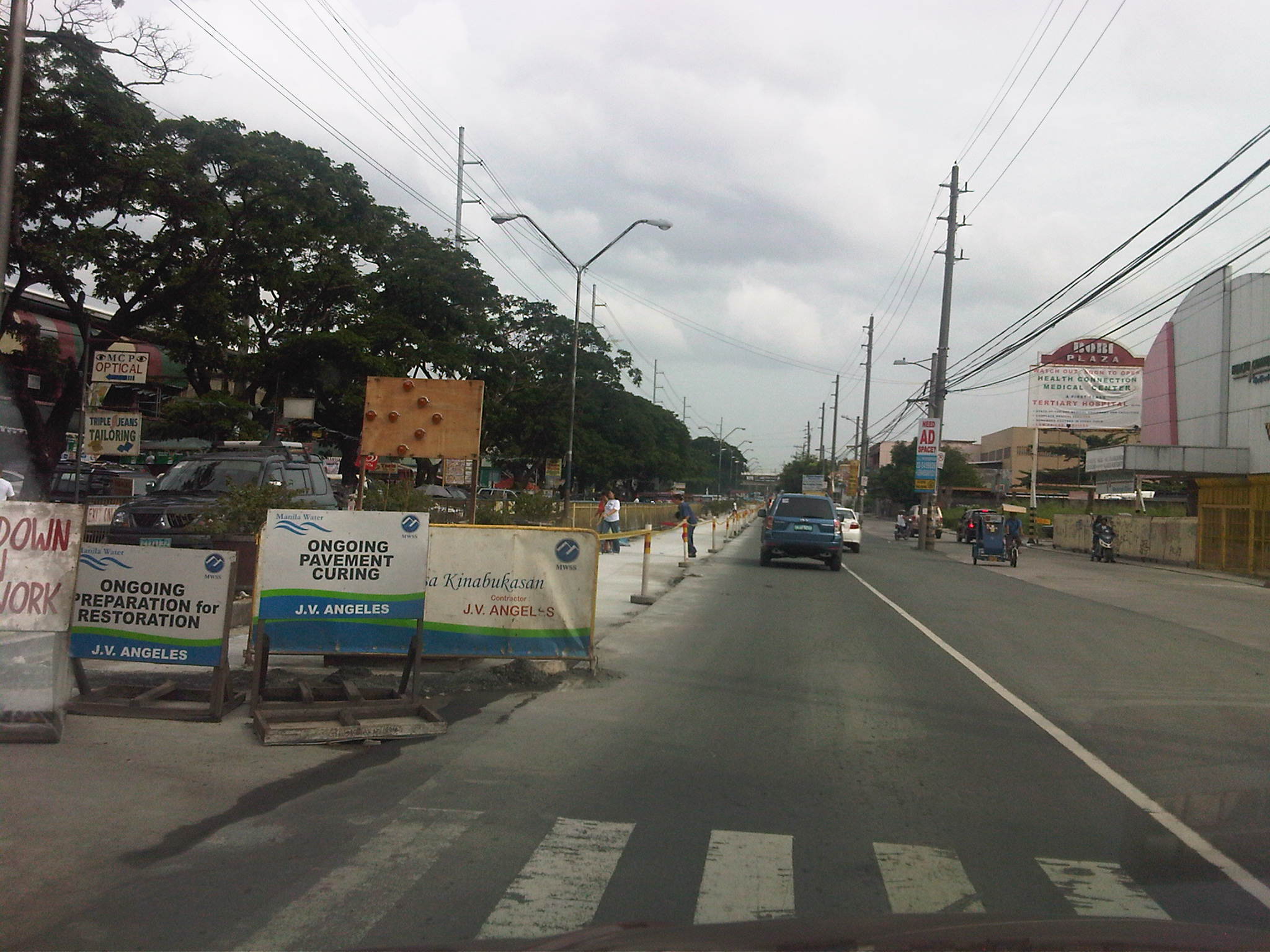 Newly paved lane along Imelda Avenue fronting the Karangalan market. The island separating Imelda from the west service road has been removed along this section to alleviate congestion and permit vehicle maneuvers in the vicinity of the market.
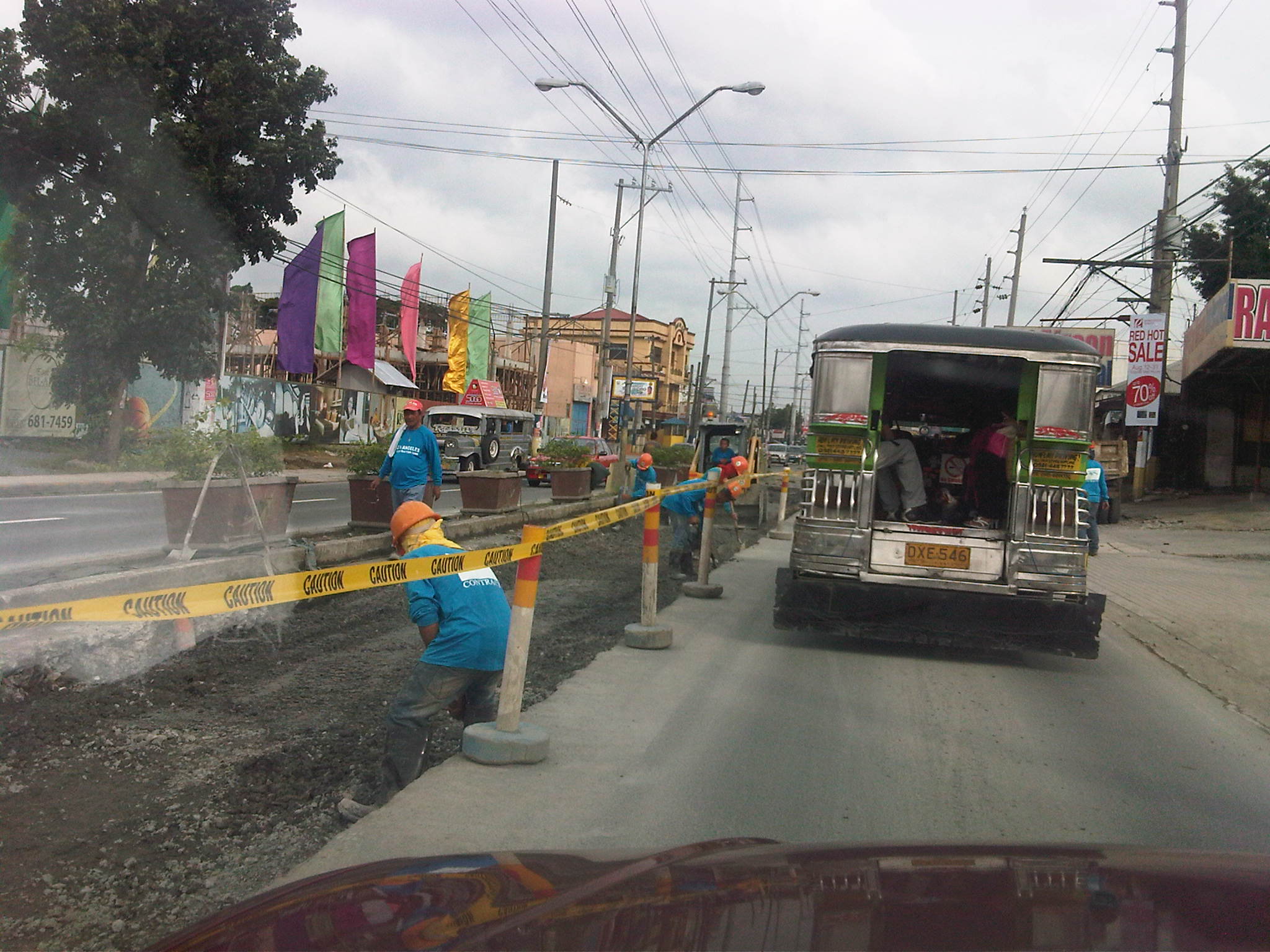 Manila Water contractor working on lane past Vista Verde main gate . Notice that there are no service roads along either side of Imelda from this point.
Road and drainage improvements along Marcos Highway
People driving or commuting from the eastern part of Metro Manila and the towns of Rizal Province have been experiencing traffic congestion for quite some time now due to the civil works associated with the improvement of Marcos Highway. The project is part of the Metro Manila Urban Transportation Integration Project (MMURTRIP) that finally pushed through after failed bids that caused significant delay to its implementation. The major components of the project include road widening and pavement rehabilitation, and the improvement of drainage along the highway. The latter component is quite important as the drainage system is supposed to contribute to the alleviation of flooding in areas along the highway. Who knows if the system could have prevented or at least mitigated the floods brought about by Ketsana (Ondoy) in 2009 if the project had been implemented according to its original schedule?
The photos below were taken during a regular commute along the highway and shows civil works in various stages of completion.
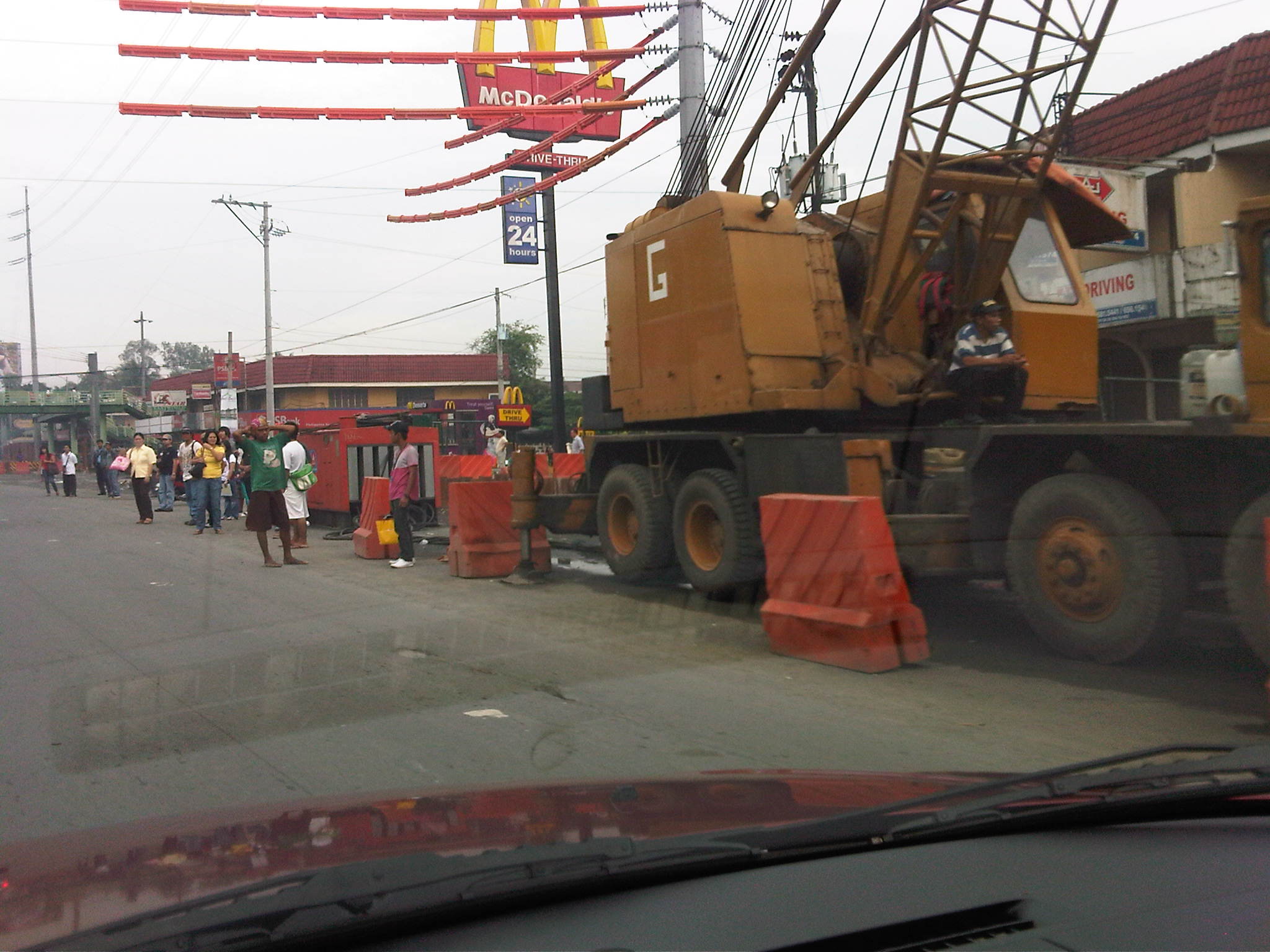 Crane deployed along westbound lane of Marcos Highway – Note the barriers and other equipment that effectively occupy about 2 lanes of the highway and the passengers waiting along the highway.
 Partly completed works along Marcos Highway westbound just after the junction with Felix Ave./A. Tuazon Ave. and across from Sta. Lucia Grand Mall
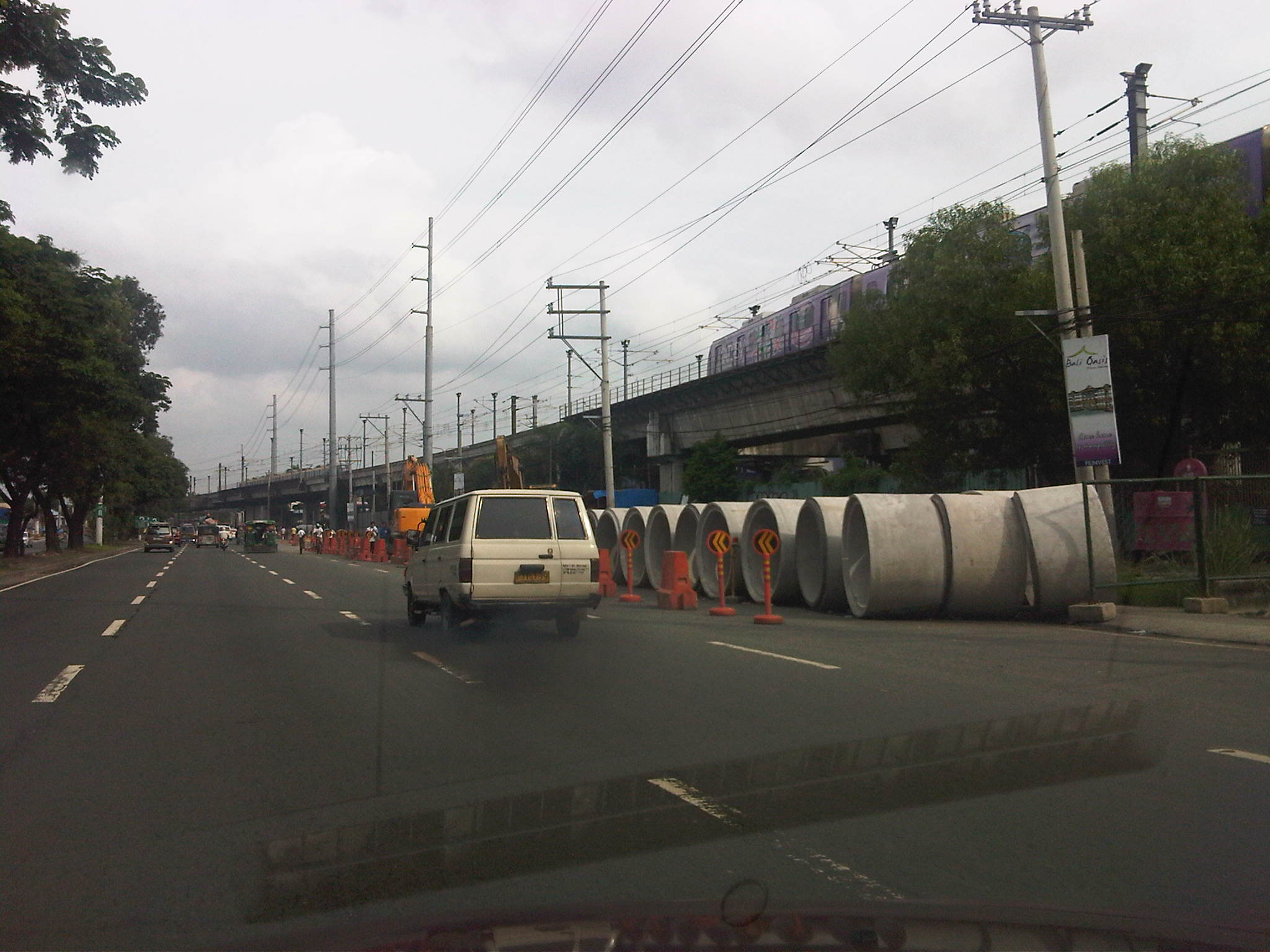 Civil works along Marcos Highway eastbound in front of the LRT2 Depot in Santolan
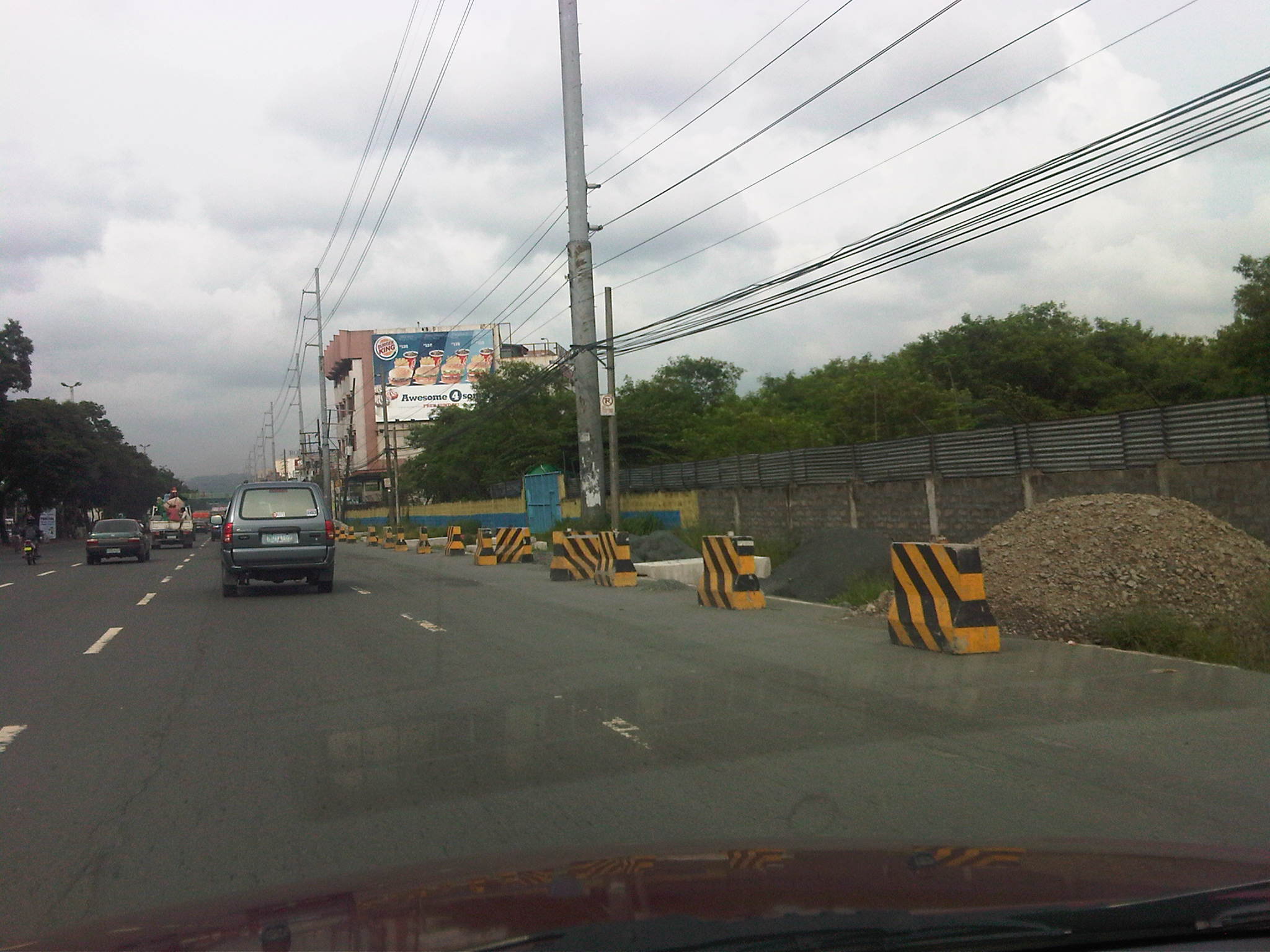 Partially completed works along Marcos Highway eastbound just after junction with A. Rodriguez Ave. (Ligaya)
 Project equipment and materials and informal barracks along Marcos Highway eastbound near the Barrio Fiesta/Slimmer’s World
 Excavations along Marcos Highway eastbound
Due perhaps to the magnitude of the project, traffic congestion along many if not most sections of the highway have been inevitable though prolonged. But partly responsible for the congestion is the Manila Water concessionaire that also did their own civil works at the same time as the DPWH project. As such, the capacity of the highway was significantly reduced with the outer lanes affected by the DPWH project and the inner lanes impacted by Manila Water works.
We should be hopeful though that once the project is completed, traffic flow will greatly improve and flooding may be alleviated along the highway and its catchment area. Works seems to be continuing although there seems to be less people working on the project these days compared to when the project started. Maybe they are just spread out along the highway? The following photos show examples of progress in the civil works.
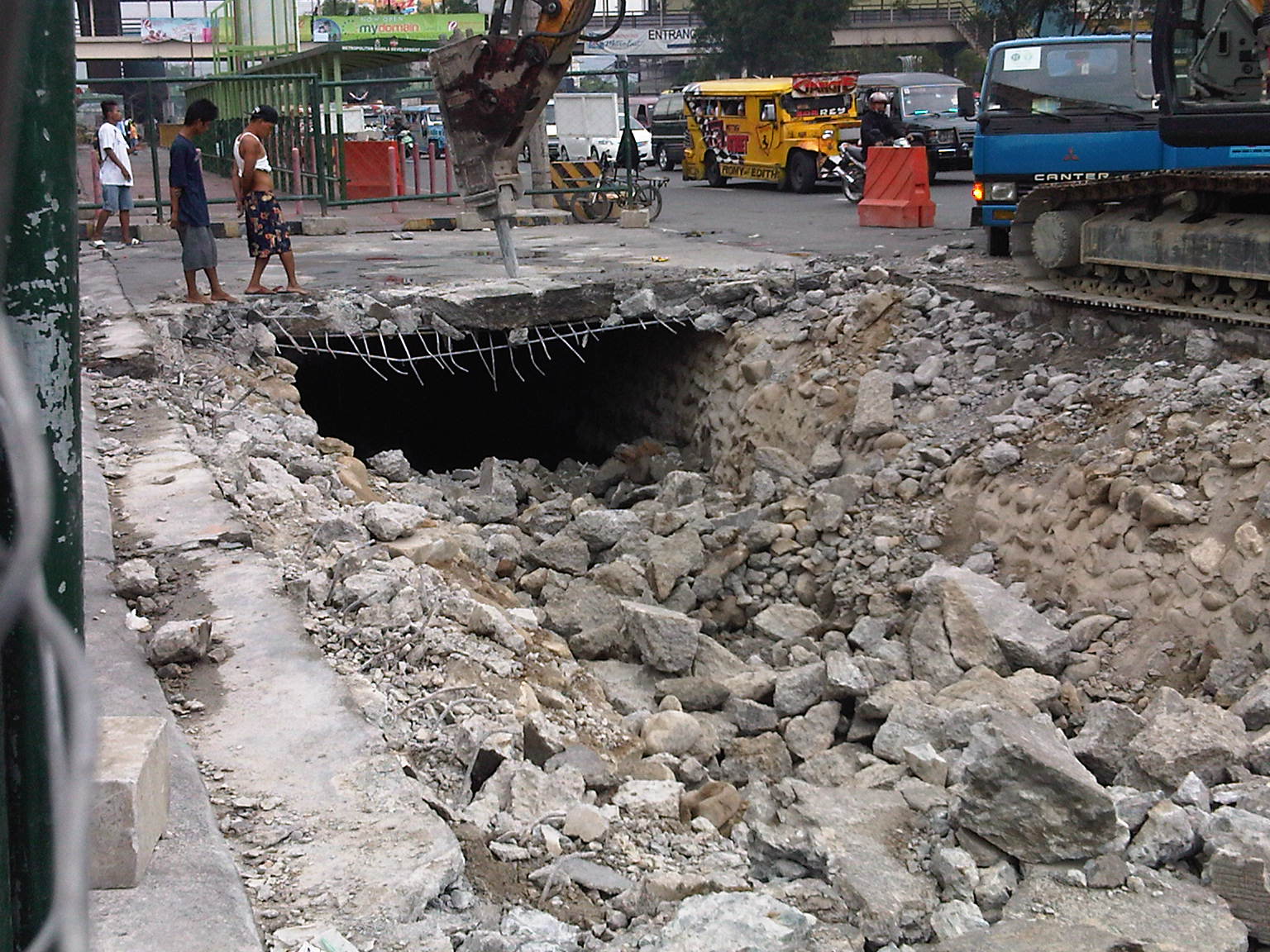 Demolition work of slab covering drainage along Marcos Highway westbound (before)
 Drainage canal covered and pavement engineering works (progress/after)
While it is expected that vehicle flow will be facilitated by the project, it can be said also that this may only encourage more vehicular traffic. As such, perhaps the next project that could be considered for this corridor is the also much-delayed extension of LRT2 towards Masinag.
Buses tagged…now what?
The MMDA issued a memo requiring all Metro Manila buses to paint their license plates at strategic areas of the bus exterior. These include standard sizes for “tags” to be placed on the roof, front, sides and back of the bus that are supposed to clearly show consistency with the license plate. Needless to say, if the license plate and the painted tags do not match, then the bus will be labeled colorum or illegally operating. Tags are also colored according to the general routes of the buses, with the yellow background applicable to buses plying routes along EDSA while an orange background applies to non-EDSA routes like those along Ortigas Ave. and Quezon Ave.
The tagging seems to be the latest in a long list of schemes that have been implemented to address the issue of colorum public transportation. While this is generally a matter for the LTFRB, the agency with the mandate to regulate road public transportation, the enforcement aspect is really quite demanding for an agency with few personnel to do this. As such, the LTFRB is usually assisted by other agencies like the MMDA or local government units. Franchise enforcement, however, is generally not the province of the MMDA or LGUs unlike their being deputized by the LTO in enforcing traffic rules and regulations (thus allowing the MMDA and LGUs to issue traffic tickets). The deputized MMDA and LGU enforcers may apprehend public utility vehicle drivers for traffic violations and in an ideal set-up, such violations should be considered when evaluating franchises for renewals. The propensity for violating traffic rules and regulations is a manifestation of poor driving habits and unsafe behavior on the road. Again ideally, such should be taken against operators who have the responsibility for hiring and training their staff. Operators should be held accountable should there be a high incidence of traffic violations and especially when there are incidences of crashes.
I am curious as to how the MMDA will be taking advantage of the bus tags in managing not only public transport but overall traffic as well. The tags present an opportunity where data collection may be facilitated and for various purposes. Such include a variation of the license plate surveys that are usually conducted to trace the movement of vehicles and determine whether they are speeding or travelling too slowly. An application of the outcomes of such surveys is the estimation of travel time along particular routes. For enforcement purposes, one can determine the reasonable turnaround time for public transport vehicles and allow for the checking of trip-cutting and the verification of the incidence of multiple plates. With the video cameras located at strategic points along Metro Manila’s major thoroughfares, sophisticated software employing image processing may be able to expedite the process, an example of an intelligent transport systems (ITS) as applied to public transportation.
The MMDA could even go further by consolidating travel time/speed data from public transport vehicles in order to derive real-time road network statistics. These could easily be visualized using digital maps that can be made online and shared to motorists and commuters alike to allow for better travel planning around the metropolis. Travel time/speed data have been used by researchers and agencies in other countries to estimate road traffic performance throughout the day and may be employed in modeling traffic in order to predict travel characteristics given typical factors affecting the traffic stream. Private vehicle characteristics are approximated by taxis that operate pretty much like private vehicles given that they do not have fixed routes and are not confined to lanes normally assigned to buses and jeepneys.
Such a comprehensive and sophisticated system for traffic management would require that all public transport vehicles be tagged including jeepneys and taxis. This also requires both hardware and software, and most importantly, capacity and on the part of Perhaps this is an alternative to requiring all to have GPS or RFID installed. Of course, the latter devices have more applications due to their potential for data storage (e.g., vehicle registration, franchise, location, etc.) but unfortunately, there are issues that still need to be addressed and questions left unanswered that are associated with these devices. Sayang! But even so, the bus tags (and maybe jeepney and taxi tags in the future) already present a lot of opportunities for monitoring, evaluation and improvement of traffic in Metro Manila. If only such potential can be realized and maximized by the MMDA and other agencies…
Still on Katipunan
Katipunan is again the subject of attention thanks to the Sunday newspaper article by Prof. Randy David in his column at the Inquirer. The problem is not really new and I have been familiar with the congestion and its derivatives from the time I first studied in UP Diliman in 1988 and up to now when I continue to pass through the avenue between home and workplace.
I was able to dig up a 2003 study on Katipunan conducted by the National Center for Transportation Studies (NCTS) of UP for a consortium chaired by then DENR Secretary Bebet Gozun. The study was the group’s response to the MMDA’s effort to install their U-turn scheme along Katipunan, encouraged at the time by the scheme’s apparent success along Commonwealth and EDSA while not acknowledging the problems experienced along Quezon Avenue. The photos below were taken during the time when the study was being undertaken and are very much the same picture of Katipunan today during the peak periods.
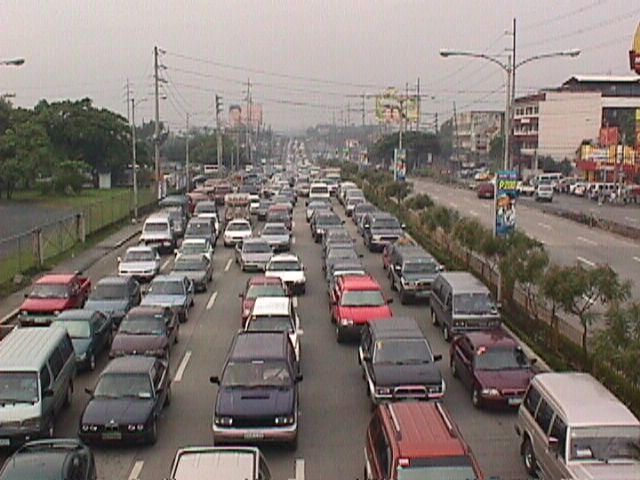 Figure 1: Morning traffic congestion in 2003 along the northbound direction of Katipunan Avenue in front of the Ateneo De Manila University (notice that there was no U-turn slot near Gate 2 at the time)
 Figure 2: Ateneo-bound vehicles blocking through traffic along the service road and the Aurora flyover
The study involved contributions from most if not all stakeholders including Ateneo and Miriam, the private sector and civil society groups, the Transportation Science Society of the Philippines (TSSP), and some government agencies particularly the DENR, who convened the group to formulate an alternative to the MMDA’s initiative that was personally being pushed by its then Chair Bayani Fernando. I reproduce below, word for word, the conclusions and recommendations from that 2003 study:
{Conclusion}
“After a thorough evaluation of the traffic problems along Katipunan as well as the solicited and unsolicited solutions from stakeholders, it becomes clear that the answer to the Katipunan traffic question is not the introduction of the U-turn scheme into the system. Indeed, while the U-turn scheme has met with relative success along major thoroughfares including Marcos Highway and Commonwealth Avenue, it has also contributed if not created congestion along Quezon Avenue. The notion that “success in EDSA and Commonwealth means there is no reason why the scheme won’t work in Katipunan” would not hold water in the light of the requirements for effective implementation of U-turns. Simply said, the traffic volume along Katipunan during the peak periods alone will assure that the U-turn scheme will cause more congestion rather than mitigate it.
{Recommendations}
- Optimization of traffic signals – coordination of signals need to be implemented particularly for the intersection pairs identified in this report. The Traffic Engineering Center (TEC) must be consulted with respect to the operation of the traffic signals along Katipunan.
- Restriction of roadside parking – parking restrictions must be strictly enforced and establishments along Katipunan should adhere to the required parking slots corresponding to the traffic they generate.
- Removal of parts of the islands to improve flow – geometric improvements to ease flow (i.e., increase road capacity) may be explored. Note that this report is not entirely opposed to removal of parts of the islands. However, their outright removal with the trees for the sole purpose of the U-turn scheme is not acceptable to most stakeholders. This must be carefully evaluated.
- Construction of an internal road between Ateneo and Miriam – the internal road will allow common vehicles to circulate within the campuses thereby eliminating traffic that would otherwise make several entries and exits to the campuses via Katipunan.
- Open additional gate at Ateneo – the possibility of opening another gate at Ateneo between the existing Gates 2 and 3 must be explored.
- Encourage carpooling or car-sharing – it is strongly recommended that Ateneo and Miriam consider carpooling or car-sharing schemes. It has been found that traffic along Katipunan is primarily composed of private vehicles will low occupancies bound for the two schools. While the surveys showed high return rates from grade school and high school students, very low returns came from college students. It is these people who account for a majority of the vehicles that clog Katipunan and they should take part in the formulation and implementation of such schemes that would lead to a significant improvement to traffic along Katipunan.
- Strict implementation of the zoning laws – this last recommendation points to the inconsistency in the granting of building permits to developers of high-rise condominiums along Katipunan. This is a constant issue and a controversial one since residents in the area and the two major schools (Ateneo and Miriam) have always opposed the “spot zoning” practice along Katipunan.” (NCTS, Study on the Traffic Management of Katipunan Avenue, 2003)
The study recommended alternative solutions in lieu of the U-turn scheme for Katipunan Avenue that was at the time being pushed by the MMDA as the solution for traffic congestion in the area. The recommended measures considered different aspects: traffic management per se, geometric improvements or road construction, travel demand management, land use, and other measures. However, it seems that 8 years after there has been practically no change in conditions along Katipunan Avenue.
The support and commitments of the different stakeholders (academic institutions, residents, business establishments, professional organizations, government agencies, and concerned citizens) are essential for the successful implementation of the recommendations contained herein. It is only through a strong partnership that sustainable and long-term solutions to the traffic problems in Katipunan Avenue can be achieved.
However, it is realized that there should be some sacrifices involved including a dramatic or drastic change in the travel behavior of those mainly responsible for the congestion. The vehicle trip generation of both Ateneo and Miriam are the roots of the problem and their continuing resistance to proposed solutions while not offering any viable countermeasures or proposals will only serve to perpetuate congestion in the area even as the external costs associated with the traffic they generate spread to a larger area. Recent studies at the UP Diliman, which is an open campus, has shown that private vehicle through traffic (i.e., traffic that has nothing to do with UP) has also grown and most of these are Ateneo and Miriam-bound trips.
It seems awkward and even confusing to see that 8 years after what was perhaps the last (maybe even the first?) serious look into Katipunan traffic, conditions have only worsened. This is due to additional developments in the area including high density residential projects that also tend to generate a lot of traffic, and commercial establishments that do not provide sufficient parking spaces. But although these contribute to congestion, their vehicle generation pale in comparison to that of the schools in the area. This is perhaps a case where one is able to see the flaws of others and yet refuses to look in the mirror to see for oneself something that needs critical attention.
Experiences and lessons on land use and zoning along Katipunan
Last Friday, a rally was held just outside the Ateneo De Manila University along Katipunan Avenue to protest the construction of Blue Residences, one of the SM group’s high-rise condominium projects that is located near the corner of Katipunan Ave.-Aurora Blvd. where a mini golf course and a few small shops used to be. The protesters wielded placards stating what could have been applicable to many of the developments now standing along Katipunan and just across from Ateneo and Miriam College. This is not really a new issue the protesters were dealing with but something that, dare I say, has festered for quite some time now.
The issue of land use and zoning along Katipunan is a continuing struggle against what the Quezon City government has maintained as its policy for “spot” zoning to accommodate high density residential and commercial development along a stretch of Circumferential Road 5 that used to be predominantly low density with small shops and restaurants lining the west side of the road and separated from the main highway by an island and a two-way service road where local traffic including tricycles flowed. This was the Katipunan I first started to be familiar with in the late 80’s when I entered UP as a freshman. Miriam was still known as Maryknoll at the time and was run nuns prior to it becoming the secular but still Catholic institution that it is today.
Traffic was more manageable along Katipunan then and a fleet of blue school buses served the Ateneans. It was a case of high occupancy transport that sadly has digressed to high vehicular volume, low occupancy traffic that Ateneo and Miriam are associated with today. Tricycles then were confined to the west service road and crossed Katipunan only at the intersections, which were strategically located just across from the main gates of Ateneo and Miriam. These intersections used to be signalized but the settings were often manipulated to favor Ateneo and Miriam traffic during the peak periods, much to the frustration of through traffic.
Fast forward to the present when the service road was removed along with the island to given way to what the previous MMDA dispensation referred to as a clearway policy to encourage faster traffic speeds combined with the much maligned U-turn scheme as applied to Katipunan. The smaller shops and restaurants have been replaced by condominiums and other establishments that have generated much traffic (not that Ateneo and Miriam have not been responsible for congestion) and which obviously do not have enough parking resulting in cars parked all over along the avenue and effectively reducing road capacity.
An article written by Randy David through his regular column at the Philippine Daily Inquirer came out today to speak about the Professor’s personal experience about Katipunan and his granddaughter’s views on development. Entitled “Katipunan Blues,” it presents a very honest and a very common observation of what Katipunan has become through the years and what different generations think about the development (or degeneration) along the particular stretch of the avenue. Its conclusion is something to ponder about and applicable not only for Quezon City and the rest of Metro Manila but for other cities across the country as well.
Is it too late for Katipunan given all the developments that have been permitted along this road? Did the universities do their part to prevent this in the first place? Or were they part of what Katipunan is today? Does Quezon City (or other local governments for that matter) even know what land use planning is about and what its policies on accommodating development have brought about in many other place? Could the DENR through its EIA process or the HLURB through its own instruments have prevented the deterioration of communities? There seems to be too many questions and we’re running out of answers for these.
Perhaps the answers were there but authorities and officials responsible refused to take heed of these or turned a blind eye to the issues. Perhaps the various developments and SM Blue were allowed because local governments became too eager for developments that also have been equated with revenues for the cities. Still, established systems and processes like the DENR-EMB’s and the HLURB’s are supposed to be there to ensure responsible and appropriate development.
We are often dumbfounded at what has actually happened and the outcomes clearly show our failures. Perhaps we are too blinded with the notion of development that we forget that it is also our responsibility to guide proponents. A lot of soul-searching should be undertaken to rethink how we plan and develop our cities. Such should properly incorporate principles of sustainability including those that address issues pertaining to transport and land use. We have a long way to go towards sustainable development as applied to city planning and development. But we need to start now if we are to even achieve a fraction of what we’d like our cities, our communities to become. We also need for champions to come forward among our current leaders and officials if only to bring order to what is perceived as chaotic development.
 Caught (up) in traffic
