Home » 2015 (Page 6)
Yearly Archives: 2015
Grab a taxi
When we were residing in Singapore, it was so easy to book a taxi wherever we might be. Comfort Taxi’s booking system allowed us to get a taxi from our home to the airport or to avoid long queues at the mall by booking a taxi by phone and waiting for it at a designated stop nearby. With the arrival of GrabTaxi and EasyTaxi in the Philippines, getting a cab became a little easier and convenient though one friend opined that the app basically mainstreams the current practice of negotiating with the cab driver for the fees (usually higher than the meter fare for metered taxis) to be paid for a ride. Hindi pa kasama ang tip dito! This ‘negotiating’ is a ‘trial and error’ thing and in certain cases, there might not even be a negotiation for the fares as Metro Manila cab drivers are notorious for being choosy about their passengers and their destinations.
Here are a few screen grabs from a booking we made last month after having some difficulty getting a ride out of UP Diliman in Quezon City.
 Information about the booking fees in various Philippine cities. The booking fee in Manila is conspicuously and significantly higher than those in other major cities.
 Grab Taxi’s interface shows the number of taxis nearby, which is apparently the number within something like a 4 or 5-kilometer radius of our location (204 is a big number!). We were at Melchor Hall at the time and the most convenient pick-up location was at the National Center for Transportation Studies, which was behind Melchor Hall.
 You can also check out the availability of more exclusive (and expensive) Grab services such as GrabCar and GrabCar Premium. When you slide to GrabCar, the status bar will also show how many drivers of that service option are nearby (i.e., 20 drivers nearby for GrabCar). GrabCar would be similar to the basic service (and vehicle) provided by the more popular Uber.
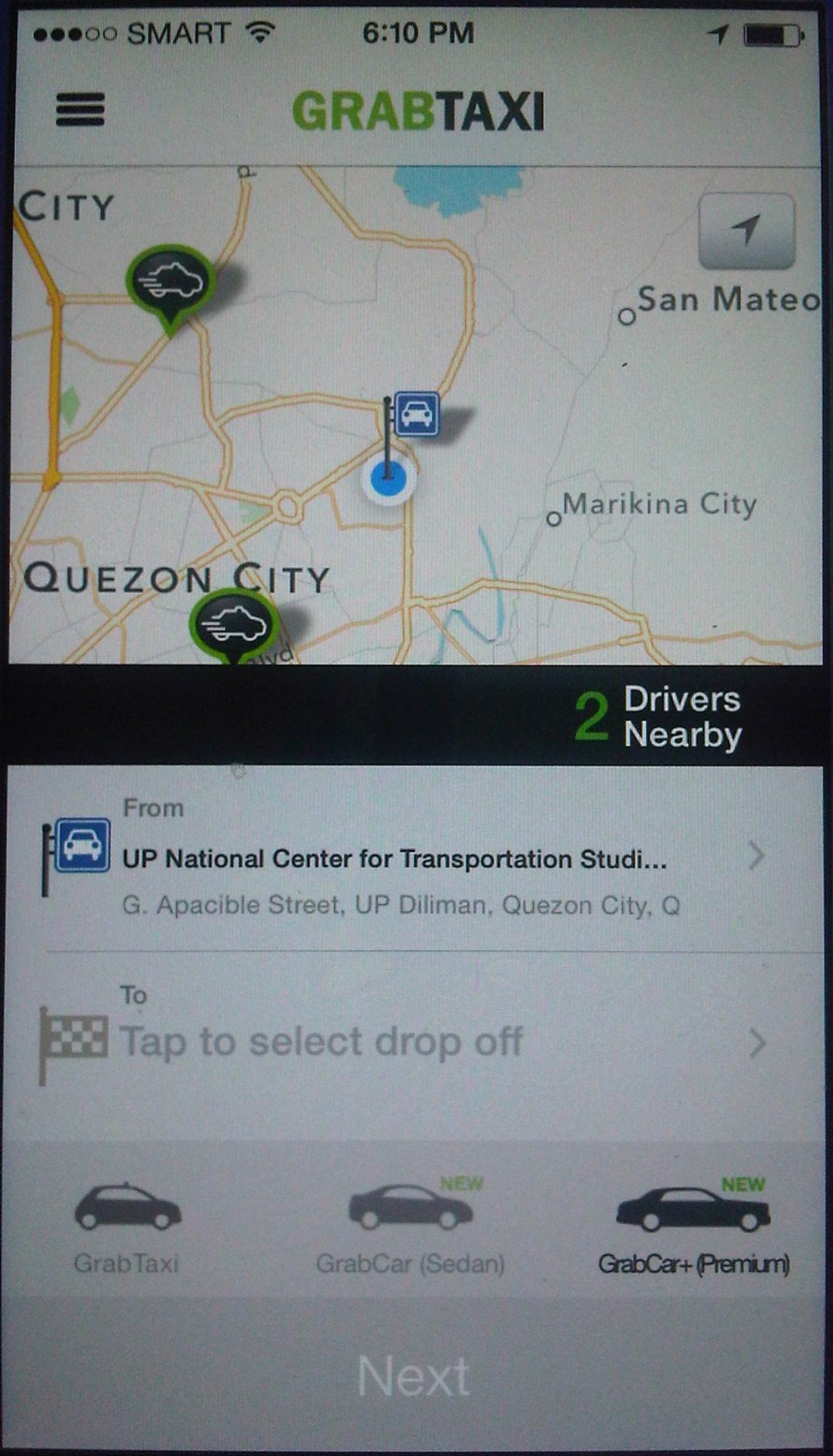 GrabCar Premium is probably the equivalent of the Uber Black Car service we have in Manila.
 Another view of the user interface showing some (or many) of the 204 taxis nearby.
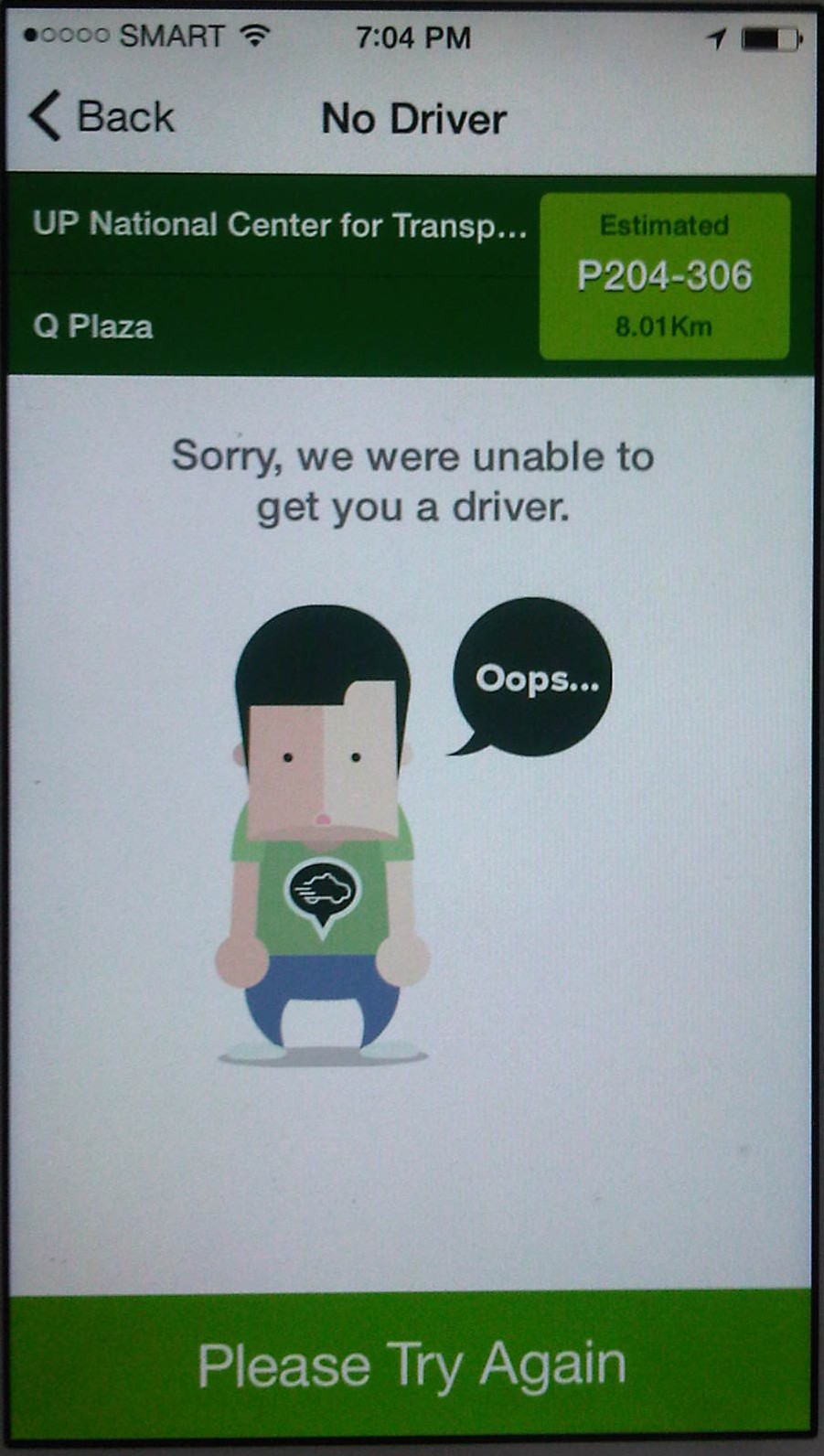 Here is an example of a message from GrabTaxi after it was unable to get a cab for us.
We were fortunate that the failed attempt at getting a cab was once only as we got a cab in our next try. This is despite all the cabs supposedly nearby. In reality only those who are willing to go to my destination from Quezon City will initially be interested in taking my request via the app. There is also a gratuity feature of GrabTaxi that allows the user to indicate how much he/she would be tipping the driver on top of the fare and booking fee. In the end, I guess my stating a very generous tip ensured my successfully getting a cab. For this, my friend’s opinion seems to be true that apps such as GrabTaxi mainstreams or makes the negotiations formal and a given when using the app. It, however, already eliminates the part where the prospective passenger gets turned down by the cab he/she hailed. When a cab responds to a request via GrabTaxi, EasyTaxi or even Uber, the driver already agrees to the terms of the deal regarding the ride. And it is a good thing that these apps now feature feedback mechanisms (e.g., rating the drivers) in order to weed out those that are still uncooperative, greedy or want to take advantage of the need for taxi service.
GrabTaxi now has a new service, Grab Express, which is an on-demand pick-up and delivery service. This is a service already provided by other companies in the US that are now giving traditional or conventional courier/logistic companies a lot of competition. I would think there is a demand for such services especially in cities where documents and other stuff still need to be submitted to offices like reports, manuscripts, letters and others that need to be delivered in “hard copy” format.
–
Some thoughts on the EDSA MRT 3 problem
A lot of people reacted when the current Philippine President practically absolved the Department of Transportation and Communications (DOTC) from any fault regarding the issues on the EDSA MRT Line 3 during his recent State of the Nation Address (SONA). The main message in some articles appearing on mainstream and social media is that the President should blame DOTC for the mess. I have the opinion that both DOTC and the private entities involved (MRT Corporation, MRT Holdings) are responsible for the problem and its being continuously unresolved.
A week ago, I got the following question in my email:
Who is it that we could blame for the current state of the rail system? What do you suggest that the government or the private partner do in order for them to improve the line?
Quite frankly, I thought the first question was too direct and blunt as to ask who we can blame for the MRT3 mess. It is also very awkward to answer the second question because it assumes that I am an expert on the legal issues on this matter. I am NOT a legal expert nor would I want to pretend to be one. Here was my reply:
That’s actually a very tricky question. We can’t really blame a specific person or persons but perhaps entire organizations that are supposed to be responsible for the mess that is MRT3. The main or root issue seems to be legal and not at all technical. The technical problems experienced are manifestations of a contract that is a textbook case for how NOT to do a PPP. I am not privy to the details of the discussions between the government and the people involved and behind MRTC so it is awkward to make comments specific to this matter of the contract and all its complexities. Perhaps the DOTC wants to follow “Daang Matuwid” by not budging to the terms laid out by MRTC? Perhaps MRTC is aware of the stakes (plight of the riding public) and is using this to force DOTC into a deal that is not favorable to government? We can only speculate on this without firsthand knowledge of their discussions.
However, from the perspective of transport as a service and as a public good, I would say that MRTC indeed is aware of the public’s clamor for improvement. This is all over the news and social media in the form of commentaries, images and even videos of the undesirable experiences of those taking the MRT3. In the end, DOTC must decide whether it is all worth it to maintain the stalemate with MRTC considering that the public interest is at stake here and things will just become worse with inaction. Perhaps the government should move towards the best compromise they can live with considering the urgency of addressing the problem at hand.
I would like to think that my reply was quite cautious. There have been many allegations and claims from both sides of the table regarding how to resolve the impasse and the conflicts that seem to be interwoven with the contract on the MRT3. Perhaps such cases test the limits of “Daang Matuwid”? Much was and is expected from DOTC considering its battery of lawyers including top officials of the department. Aren’t they supposed to have been involved in discussions and negotiations aside from strategic planning for our transportation in this country? I guess the general public especially those who take the MRT3 for their commutes already know who to blame for their plight…
–
SuperCat trips from/to Cebu
I noticed a recent surge in interest in inter-island ferries as people continue to ask us about schedules and fares. Most of these were on past articles here about my trips to Mindoro using a typical RORO ferry (Batangas to Calapan) and a fast ferry (Calapan to Batangas). I have taken ferries along two other routes before (Iloilo-Bacolod and Cebu-Tagbilaran) and have written about the trip between Cebu and Tagbilaran quite a while ago. In a trip to Cebu last June, I remember picking up some brochures while going around and checking out hotels for a conference we are helping organize this September. Among the brochures were information on ferry services to and from Cebu.
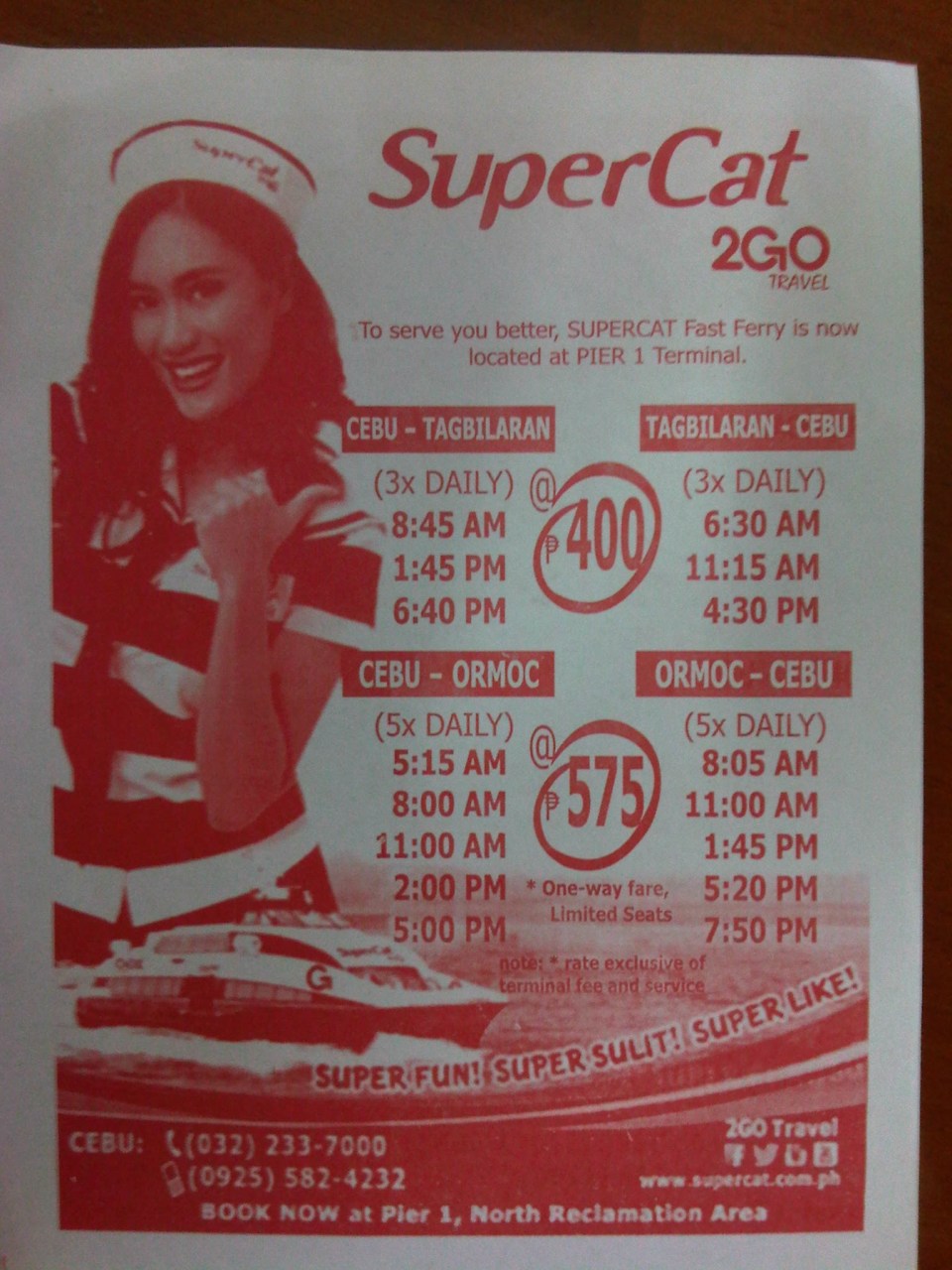 Information on SuperCat fast ferry services between Cebu and Ormor (Leyte) or Tagbilaran (Bohol).
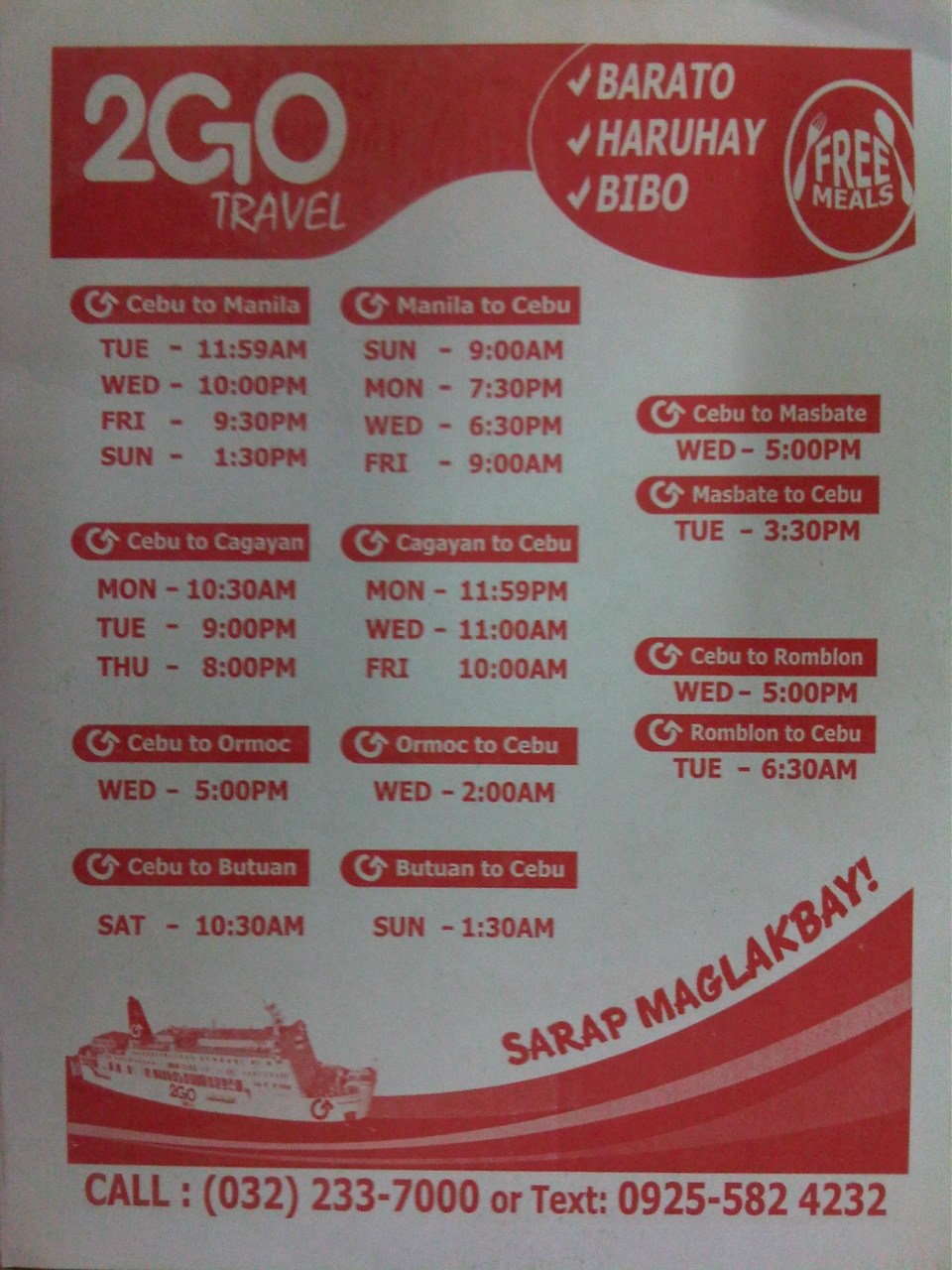 Regular RORO ferry trips between Cebu and many other destinations in Luzon, Visayas and Mindanao
–
State of the nation’s transport – 2015
The National Center for Transportation Studies (NCTS) of the University of the Philippines Diliman received a few letters from media the past week or so asking for resource persons on transport for today’s State of the Nation Address (SONA) by the Philippines President. It is something like a routine for media to come up with commentaries or reports assessing the performance of the government. This year is a bit special because today’s is the final SONA to be delivered by the current administration. The presidential elections will be in May next year and the next SONA will be delivered by whoever wins in that election. There is already a long list of aspirants, declared or expressing interest, for the top government post in the country, and this includes many who are perceived to be critical if not hostile to the current administration.
I was invited to give an assessment by a major media network back in 2010 and I remember giving that previous administration a grade (using the UP grading system) of 2.0. I explained that I could not give a very high grade because a lot of transport infrastructure remained unimplemented. These included airports, ports, highways and bridges, and, most notably, mass transit systems. I had knowledge though that many of the infrastructure projects were at the end of the project development or already have their feasibility studies and were ready for implementation by the succeeding administration. These were the so-called “low hanging fruits” that were “ripe for the picking” the following years. Sadly, many of the notable low-hanging fruits remain unimplemented. These include the LRT 2 Extension to Masinag in Antipolo City, the expansion of Clark Airport, the rehabilitation of the PNR, and the BRT in Cebu City.
 Traffic congestion along Commonwealth Avenue – whatever happened to the proposed MRT 7? [Photo courtesy of Rodel Velasco]
I recall a short exchange in social media with a government official whose favourite tagline was something like “We can do it!” He is fond of applying the tagline to a lot of things but especially with certain advocacies and politicians that he wanted to promote. When I asked him about transport and traffic at a CBD his office was involved in developing, the tagline immediately vanished in mention. He was quick to express what seemed to be his resignation that transport and traffic could not be improved in that rapidly developing CBD. This may be partly because they could not influence certain government agencies to expedite the implementation of urgent transport projects that would benefit the CBD. Clearly, to me, the tagline had a limit in terms of its applicability.
It seems the more appropriate tagline should be “Just do it!” as the Nike commercial goes and as adopted by a great senator who recently passed away (one who could have been a good president). It took the current administration a long time to evaluate projects and much of the delay appears to be related to the government’s fascination for PPP (Public Private Partnerships) to the point that their mention of projects being planned for implementation became another type of PPP – PowerPoint Presentation. It has been a frustrating last 5 years for transport infrastructure development especially public transportation and it is partly due t the insistence of the government to almost exclusively depend on the private sector for mass transport infrastructure. One opinion by a colleague that I also share in is for government to put its money (actually the people’s money) where its mouth is (in a manner of speaking) and invest in the construction of mass transit systems for major cities and then look to the private sector to operate/manage these systems. The government doesn’t have a good track record for managing transit systems (e.g., Metro Manila Transit Corporation, Pasig River Ferry Ferry, LRT Lines 1 and 2, etc.) but it has shown that it can build these (again LRT 1 and 2) and others (SCTEX, Iloilo and Bacolod Airports, etc.) if it wanted to. Perhaps we should again reflect on the real state of the nation’s transport come 2016 but do this very quickly so that we could finally alleviate the daily suffering experienced by most commuters.
2015 National Science and Technology Week and the Hybrid Road Train
The Philippines’ Department of Science and Technology National Science and Technology Week 2015 on July 24-28, 9am-6pm, SMX Convention Center, Mall of Asia, Pasay City. NSTW 2015 has 9,300 square meters showcasing 145 technologies, 51 forum sessions, 11 technology demonstrations, 25 other S&T events, 1 road train. Admission is free. Details at National Science and Technology Week  A special feature this week is the Hybrid Electric Road Train developed by the Metals Industry Research and Development Center (MIRDC) with 5 coaches and capacity of 240 passengers. You can find a description of the road train project in the MIRDC’s site from this link. Here’s a screen grab from the same site/link showing what the road train looks like:

Incidentally, the MIRDC is also the DOST center in-charge of development of Automated Guideway Transit (AGT) vehicles currently being tested in the University of the Philippines Diliman and the MIRDC Compound in Bicutan. Free rides are scheduled on July 24 12nn-4pm; July 25-28, 10am-12nn, 2-4 pm. The road train is envisioned to provide for mass transit needs of cities particularly those with long stretches of major roads like EDSA or C5 in Metro Manila.
–
Transit Lounge at NAIA Terminal 3
While waiting for the wife to arrive at Terminal 3 of the Ninoy Aquino International Airport (NAIA), I decided to go around the terminal again. It had been a while since I had explored the terminal and the delayed arrival of the plane meant I had a lot of time to burn. It seemed too lazy an option to just sit down and have some food and drink at a cafe or restaurant when you can exercise by taking a walk around the terminal.
At the fringes of Level 4 where most of the shops, cafes and restaurants are located, I stumbled upon a newly opened transit lounge. The Wings Transit Lounge is dubbed as the Philippines’ first airport lounge. It opened last May and offers travelers and even well-wishers facilities similar to that of hotels. It is actually a hotel within the airport that gives people the option of a more comfortable rest or sleeping area (accommodations). This can be a good option for people in between flights (transfer passengers) especially those arriving late at night and with long layovers before their connecting flights at the same airport terminal or the other terminals of NAIA.
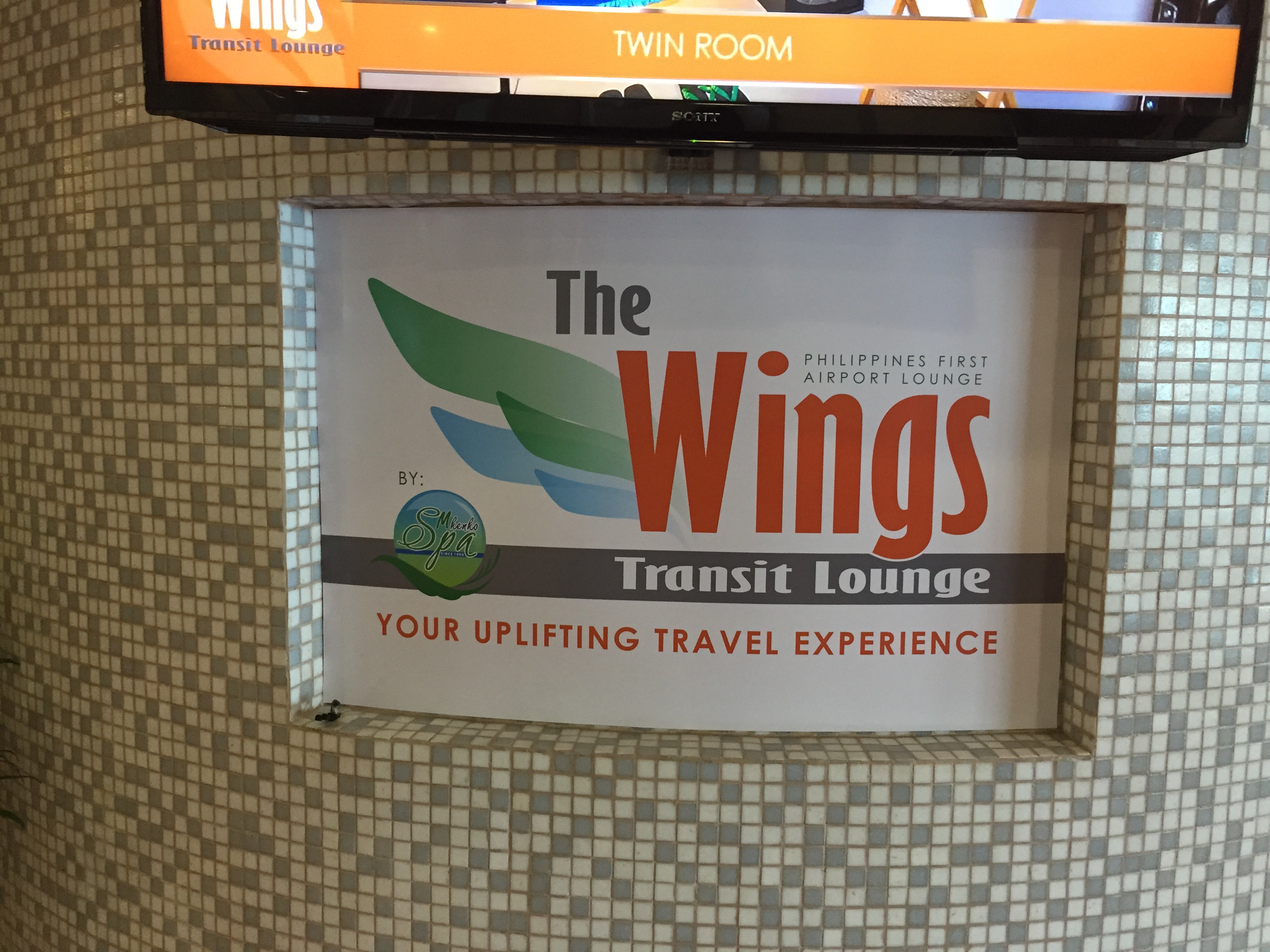 The Wings Transit Lounge opened last May at NAIA Terminal 3
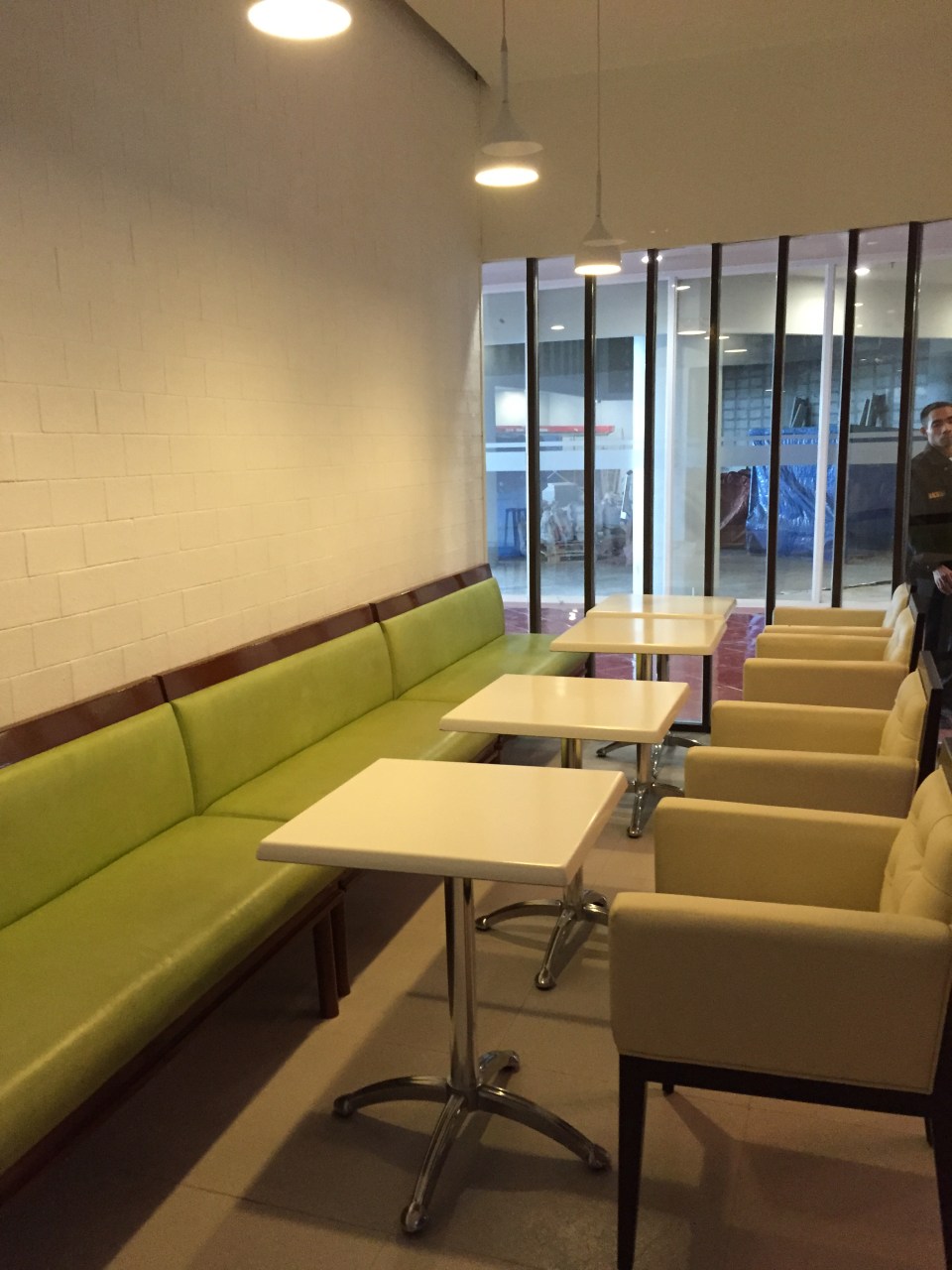 Dining or work area
 Pantry and dining area – the bright lights in the background is from the area across the corridor from the transit lounge that has a great view of the tarmac and runway; parts of NAIA Terminal 3 that have yet to be occupied (and which are prime areas for restaurants or cafes).
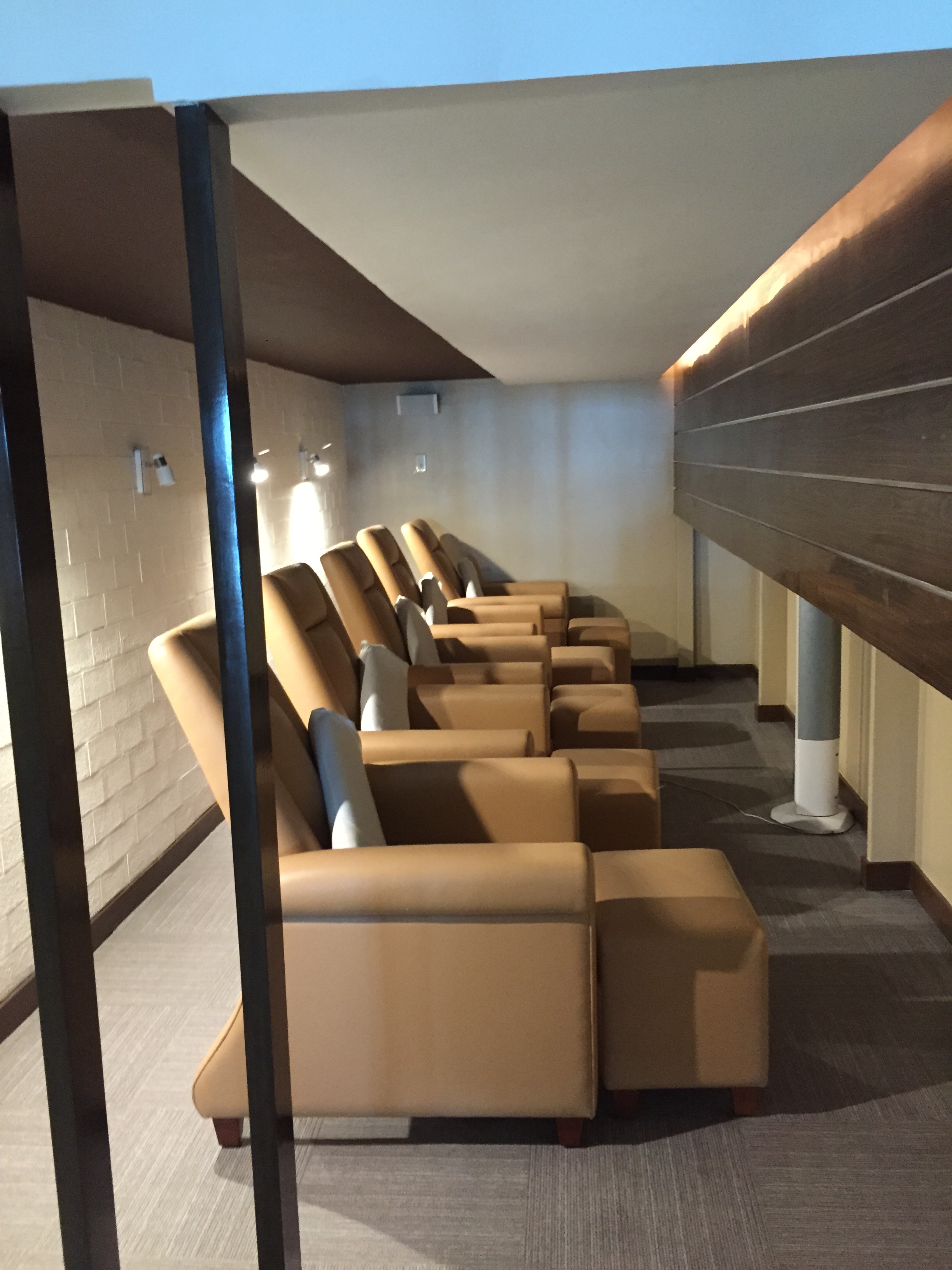 Lounge chairs for napping, waiting, a massage or a manicure/pedicure
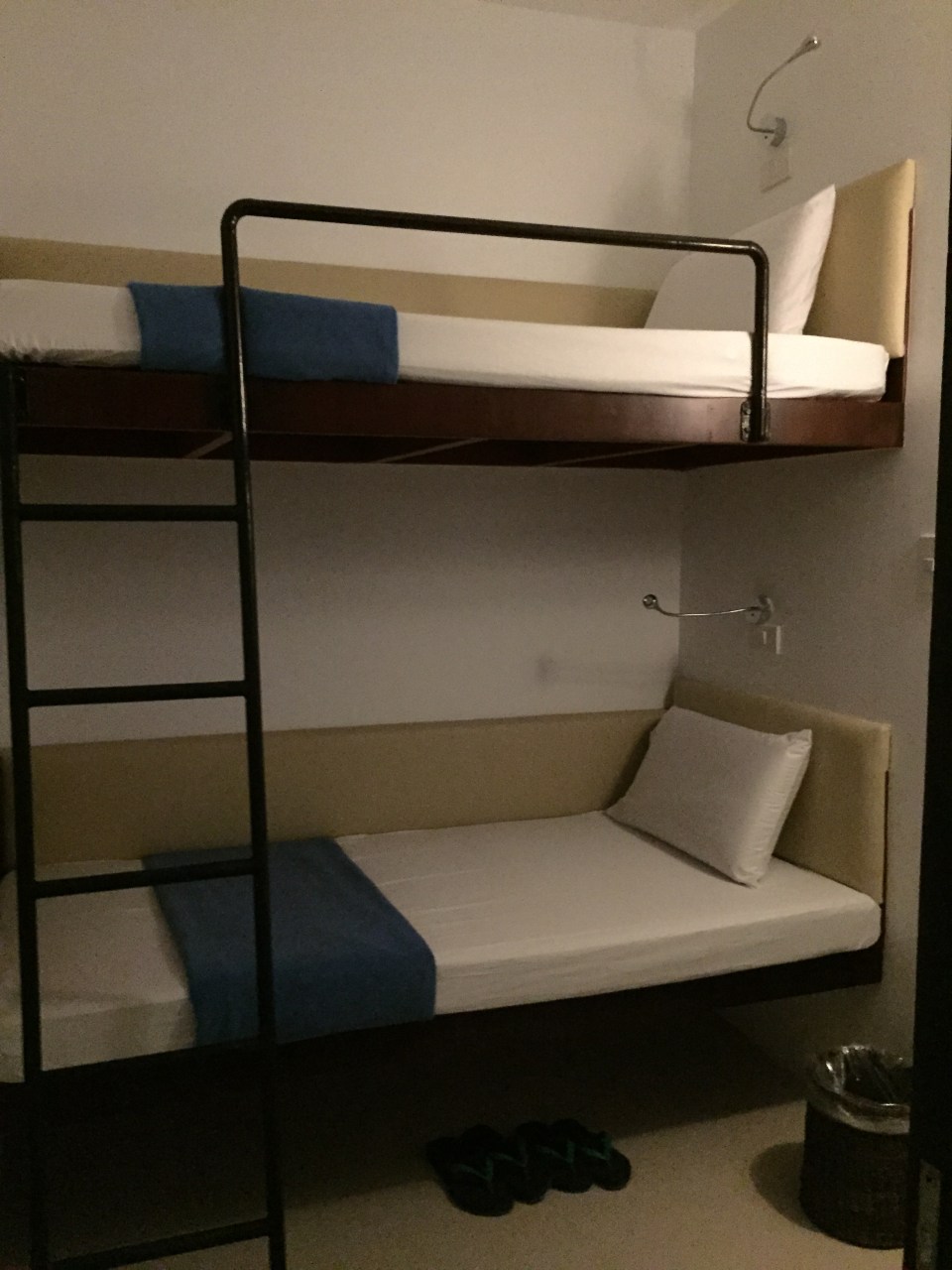 Double deck beds at the family room – note also the personal reading lights for each bed.
 Another photo of the double deck beds at a family room. I wasn’t able to get photos of their twin and bunk rooms as these were occupied when I went around the transit lounge.
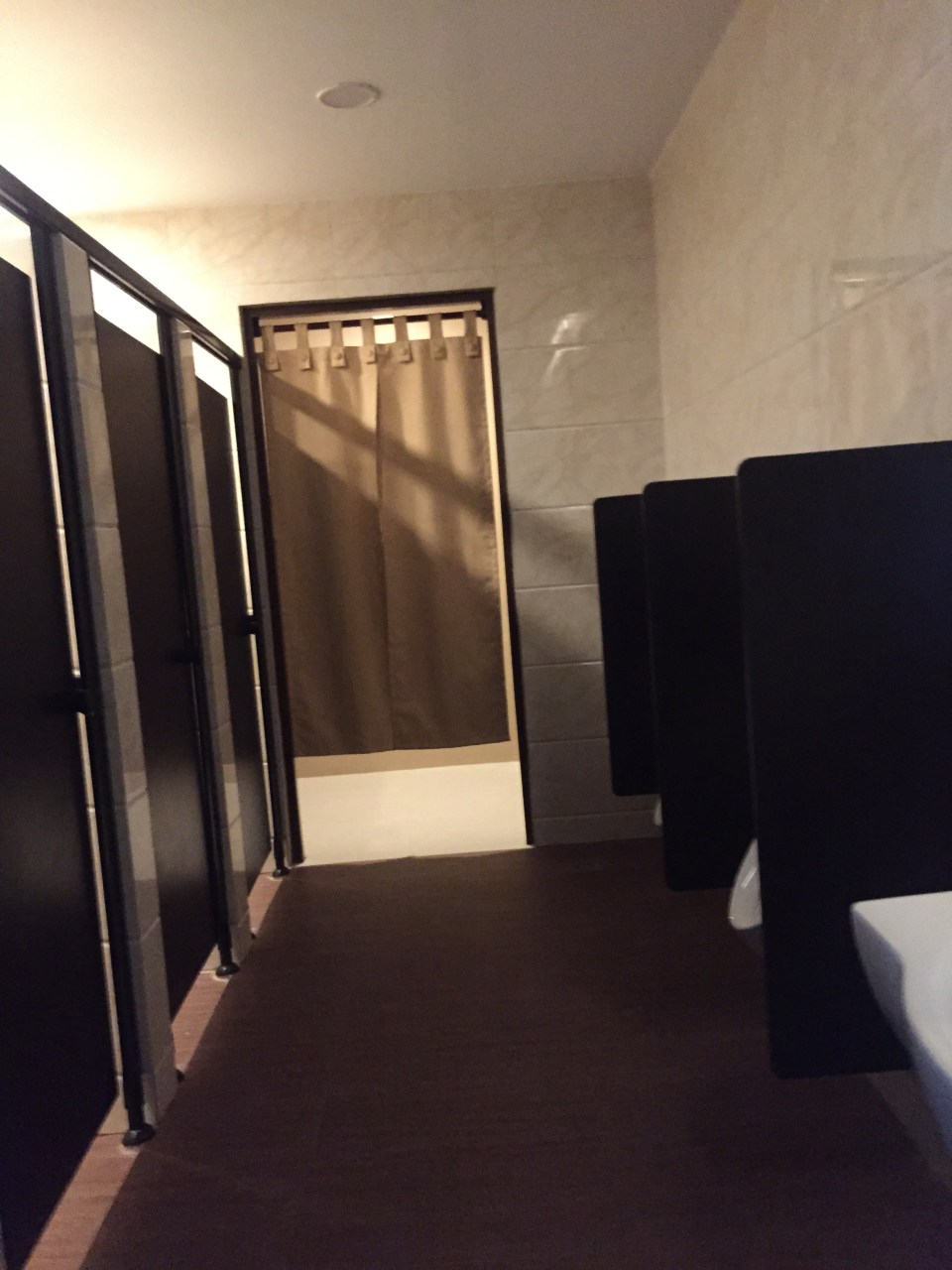 Common toilets and showers for those wanting to freshen up before or after a flight.
 Capsules include blinds for some privacy
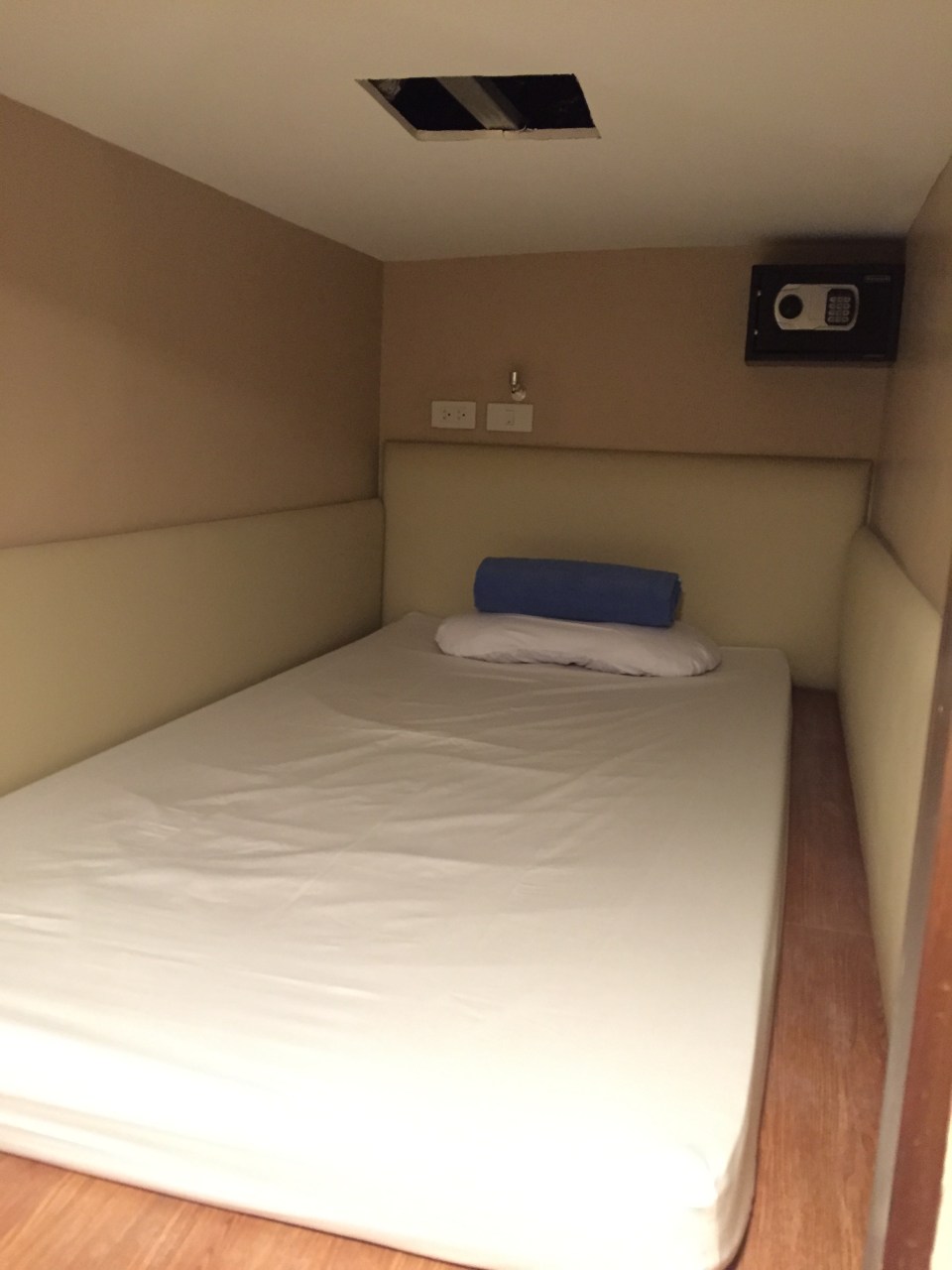 Here’s one capsule unit with a safety deposit box and reading light.
 Room and lounge rates plus rates for other services offered by Wings Transit Lounge
The rates appear to be expensive at first glance but should be considered in the context of convenience. The transit lounge provides services (mainly accommodations) that, although hotels in the area can also provide, are offered right there at the terminal itself. You can google the airport hotels to compare rates. The nearest ones to NAIA Terminal 3 are the Marriott Hotel, Maxim’s Hotel and Remington Hotel.
–
Promoting road safety to our youth
Road crashes has been regarded as one of the top killer disease worldwide. Many people have perished or have been seriously injured in road crashes. As such, road safety is and should be a top concern among national and local agencies. We are all vulnerable road users whether we are pedestrians, motorists or riders regardless of our age, gender, ability or health, income and other attributes. And so it is in our best interest to be aware of and participants to initiatives advocating road safety.
The Philippines is part of the Global Road Safety Partnership (GRSP) with its own PGRSP acting as an umbrella organization consolidating and coordinating road safety initiatives among government and private organisations. Among these initiatives are programs promoting road safety among our youth and particularly to our children. Kids are very receptive to ideas. Their minds are like sponges in terms of their absorption of knowledge and information about everything around them and what’s provided to them. If they are taught about road safety at an early age, they would hopefully be able to appreciate this and even influence their parents, siblings and relatives to be practitioners and advocates of road safety.
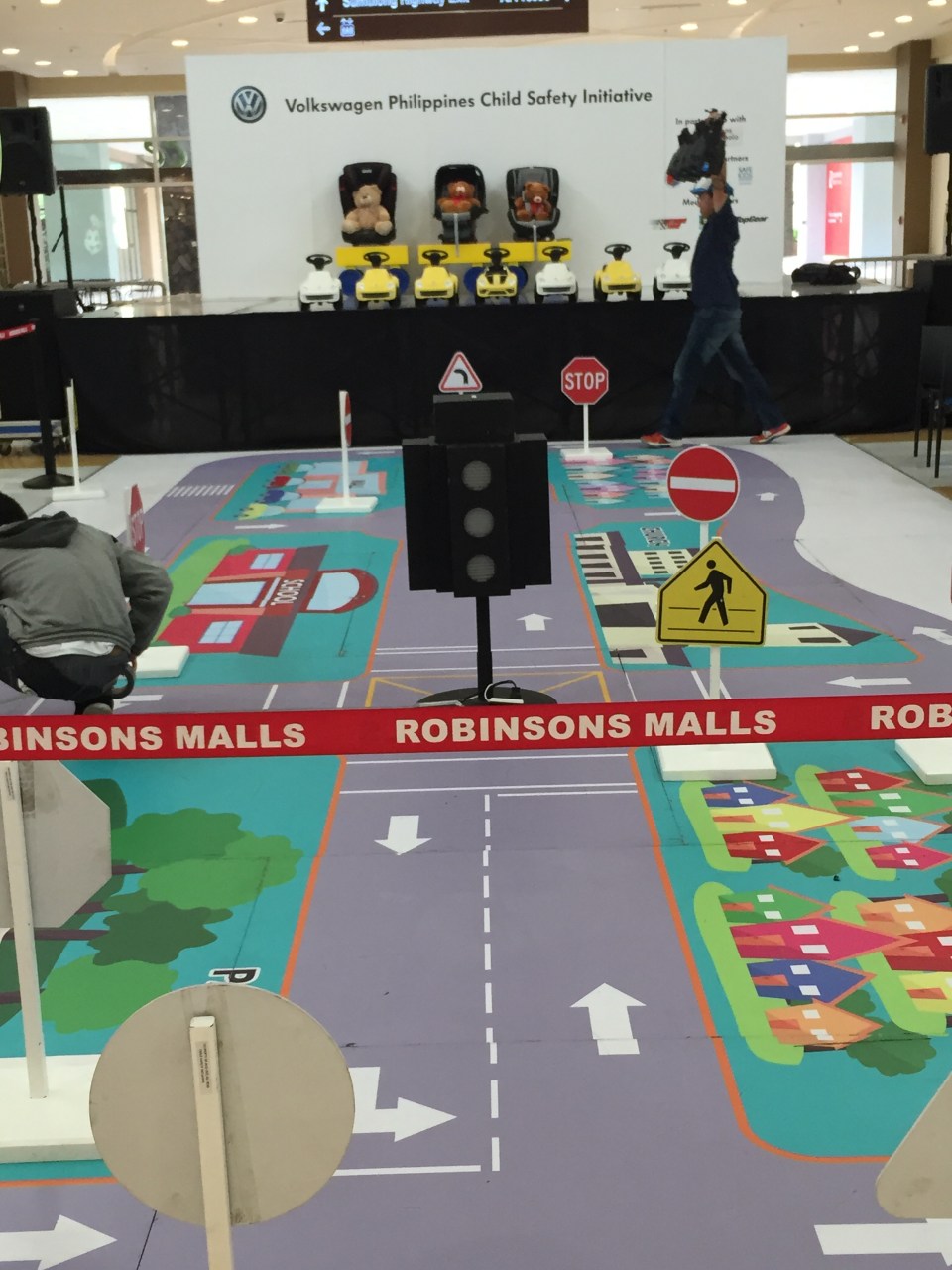 Road safety promotion initiatives like this is a collaboration of several government and non-government entities like the DOTC, PGRSP and Safe Kids Philippines with support from various partners in the private sector including Automobile Association Philippines (AAP), Top Gear, and of course, Volkswagen Philippines, which has a very active child safety program.
 Layout of the ‘portable road safety park’ that can be easily set-up in road safety promotion roadshows like those being held at malls around Metro Manila and its adjacent towns.
 Another view of the ‘park’, stage and orientation area for the road safety initiative at a major mall in Antipolo City, which is to the east of Metro Manila.
 Children and their parents/guardians flock around a resource person for the road safety initiative and park.
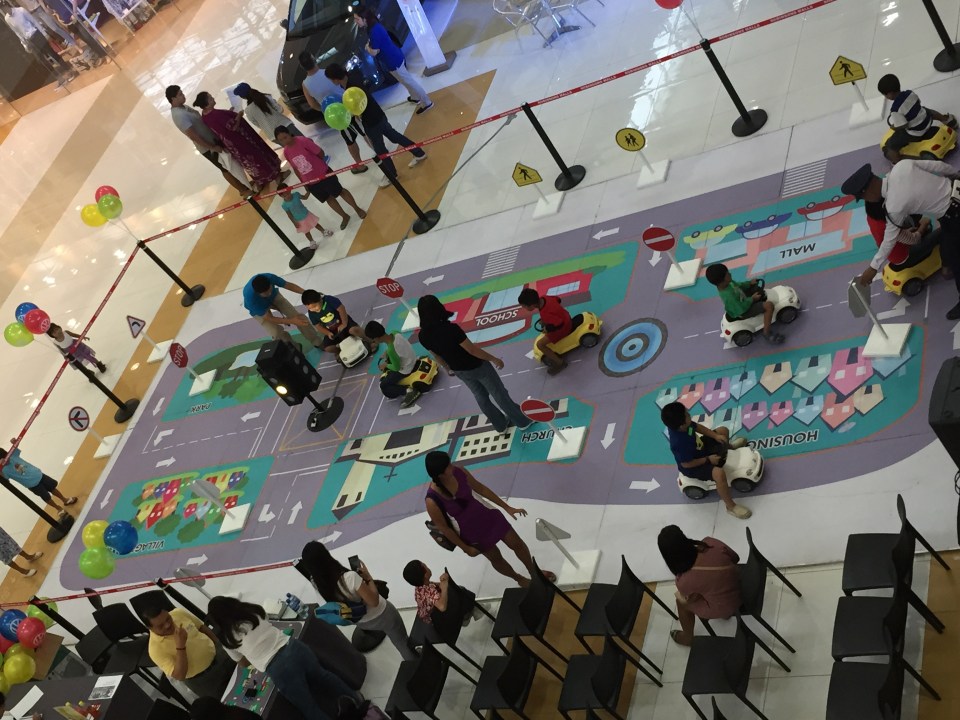 Kids try out the portable road safety park, simulating traffic using toy cars and familiarising themselves with basic traffic rules and road signs.
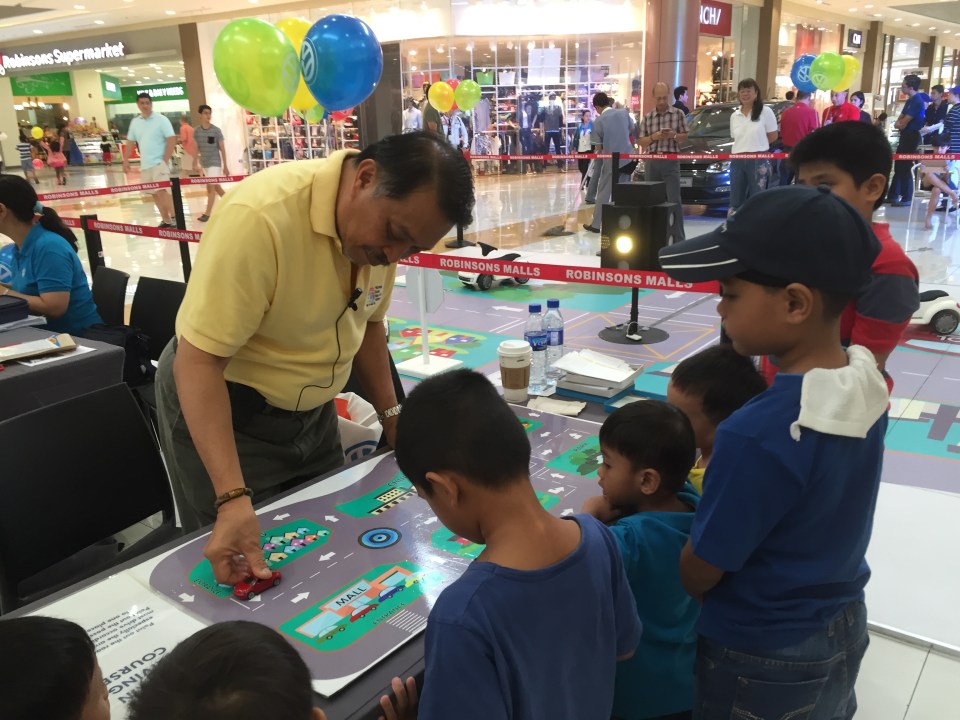 Former LTO chief and current Secretary General of the Philippines Global Road Safety Partnership (PGRSP – the local affiliate of the international group) Albert Suansing orienting children about the road safety activity
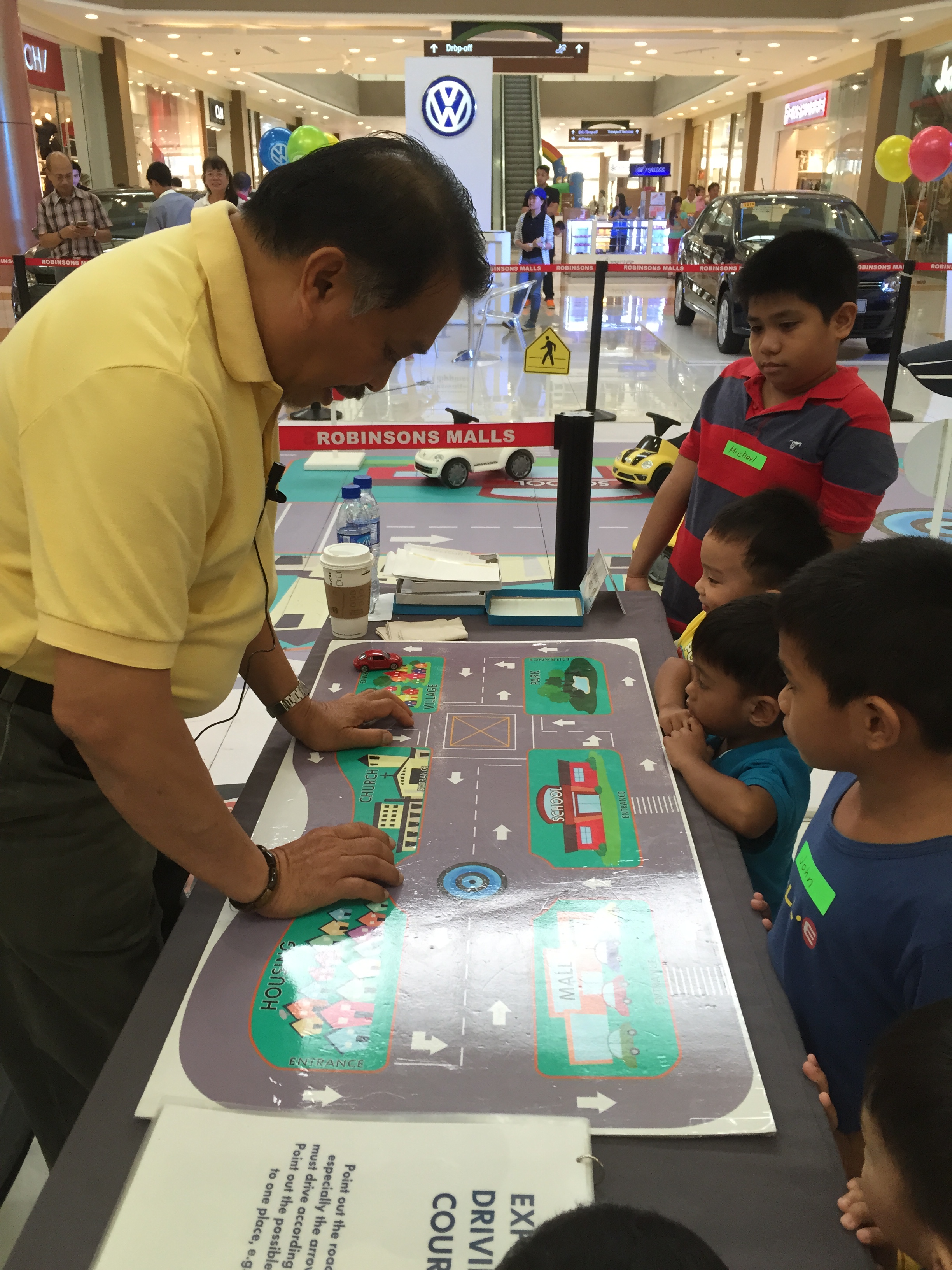 People should be taught about road safety at an early age. Children are very receptive and their minds are like sponges in terms of absorbing the information provided to them (e.g., road safety practices, correct behaviour for pedestrians and motorists, etc.).
We hope that there will be more initiatives like the one we featured here. I believe there are many who support road safety and those who are interested in promoting it among various stakeholders. Hopefully too, these will be extended and held in other cities around the country in order to increase road safety awareness and support that will ultimately lead to safer road environments for all.
–
San Diego Buses
I took a lot of photos of transport in San Diego and among these are of buses. The San Diego Metropolitan Transit System operates a variety of buses that included articulated ones. These have fixed routes and designated stops. At each stop, there is information on what buses (i.e., routes/route numbers) stop there. Here are a few photos of buses in San Diego.
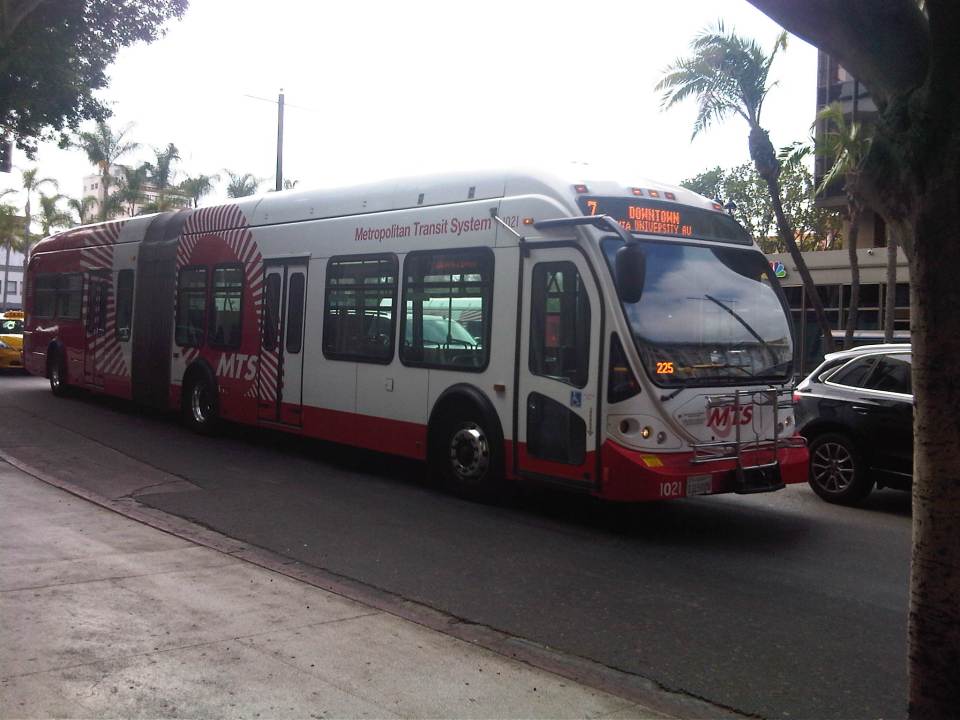 Articulated bus in downtown San Diego
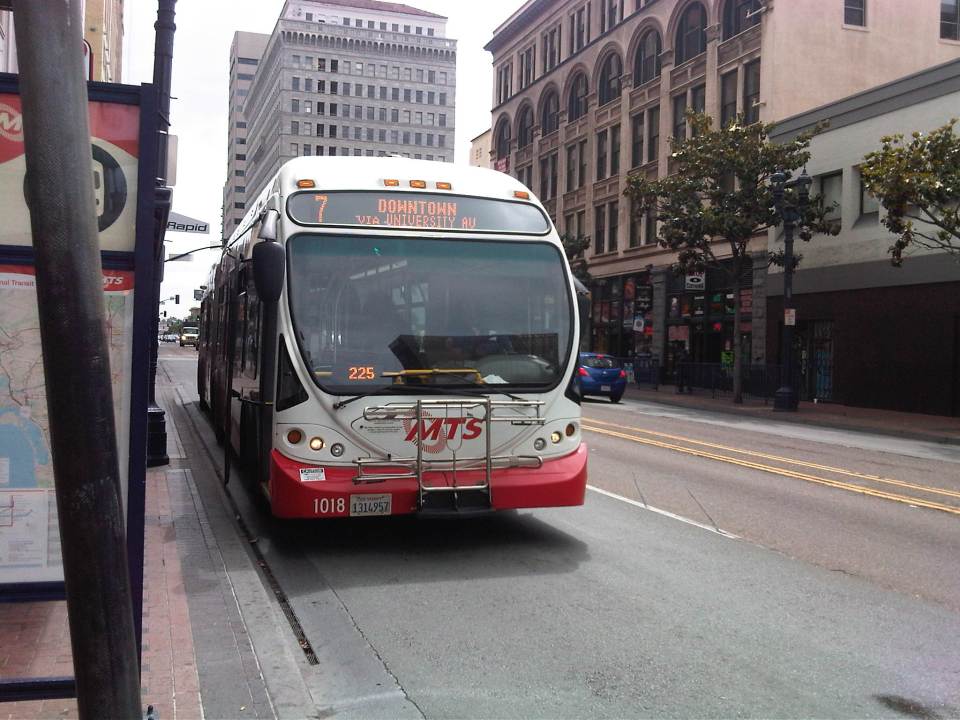 The contraption in front of buses are racks for bicycles
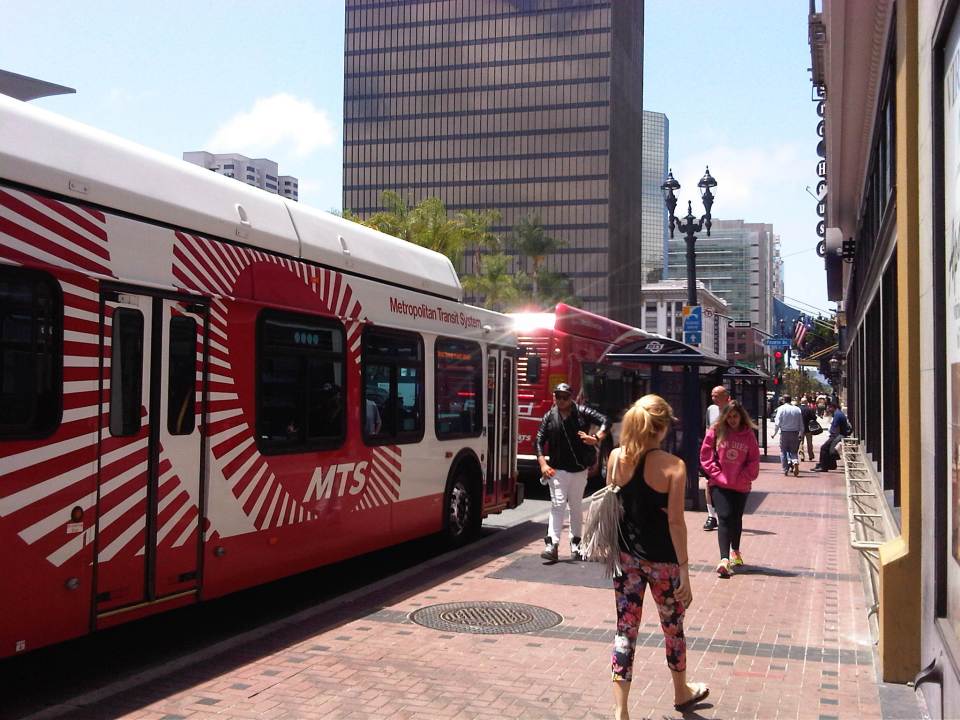 Bus stop in downtown San Diego
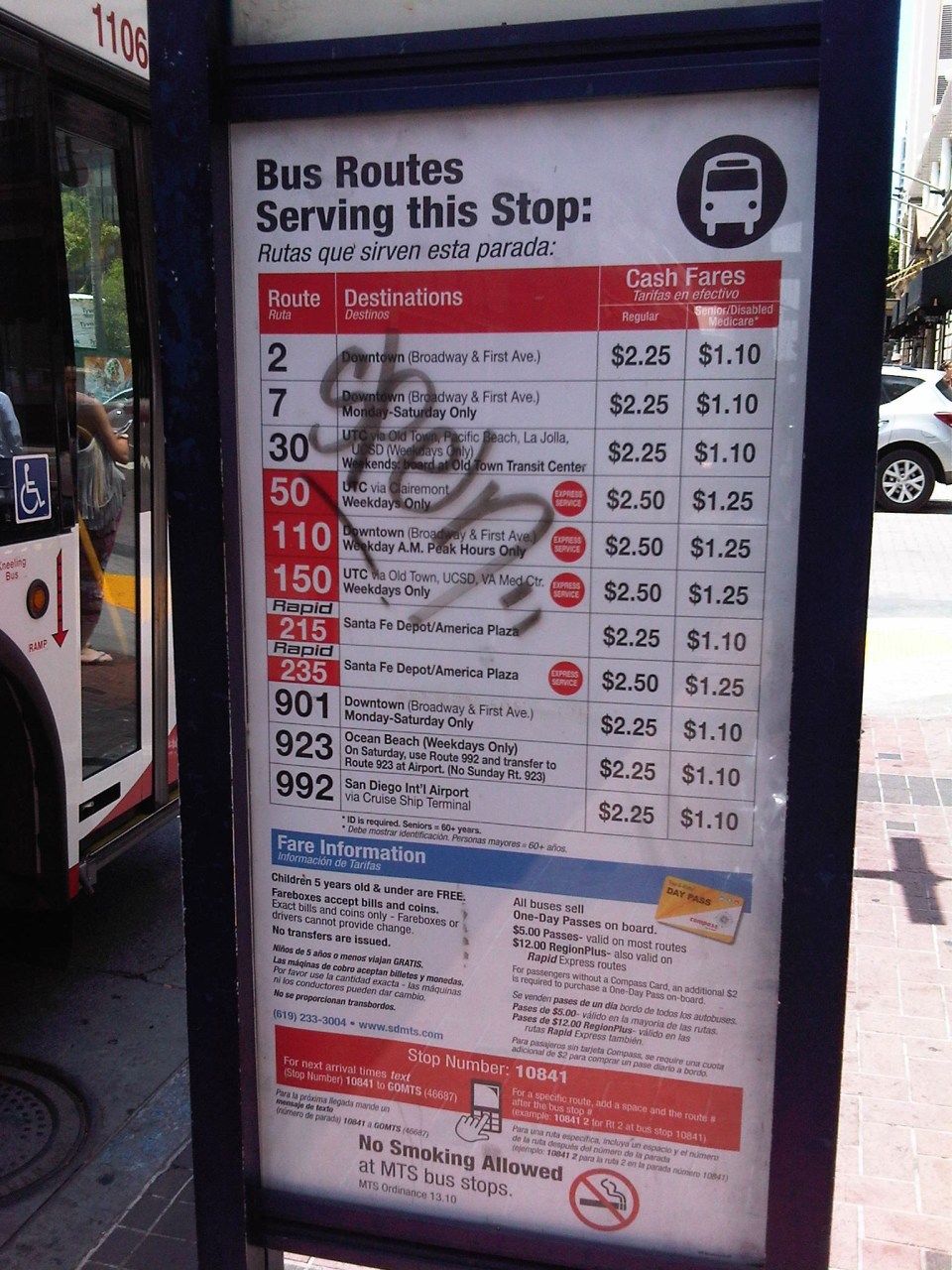 Information on bus routes, destinations and fares at bus stops – you can pay as you board the bus or purchase a ticket, pass or compass card in advance.
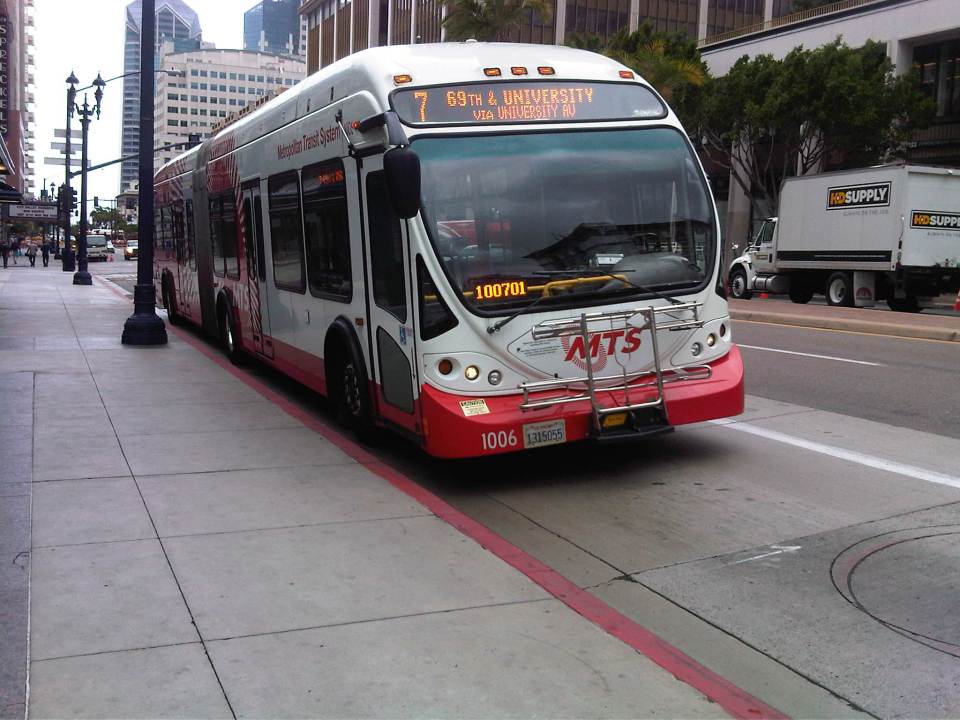 A bus serving the La Mesa-Downtown route via University Ave. – this is the bus you take from downtown San Diego to San Diego Zoo
 Bus interior shows few seats and much spaces for standees – enabling the vehicle to maximize its passengers
 The interior on the rear half of the articulated bus
San Diego is a city of just under 1.4 million people with a transport system that’s able to serve the demand for transport over the distances covered by its buses and trolleys. Compared to Philippine cities, San Diego’s transit system is one well oiled machine. Of course, it is more expensive if you convert dollars to pesos but then if you account for the standard of living (including living costs and salaries) and the quality of service provided by the trolleys and buses, then you have something Manila and other major cities in the Philippines would be envious of. Can we have something like San Diego’s transit system in the Philippines? We can but (and that’s a big ‘but’) it needs a lot of work and commitment to set-up and make something like this work.
–
Tom Bradley International Airport
Before our trip back to Manila, we passed by Los Angeles to visit with family and meet up with friends. We haven’t seen them for some time including cousins who live outside of LA but drove hours just to meet up. Needless to say, we had a great time meeting up with relatives and friends whom we only communicated with via internet. nd we also managed to squeeze in some touristy stuff like going to see the space shuttle Endeavor at the California Science Center.
On the day of our flight back home our cousin drove us to Tom Bradley International Airport. We normally booked an airport van or limousine but he was free that noontime so we had a free (and more comfortable) ride to the airport. Unfortunately, I couldn’t get photos of the check-in area as it was already crowded when we arrived and we had to split up as I was flying Economy while the wife was flying on Business Class. Here are a few photos I took at the airport:
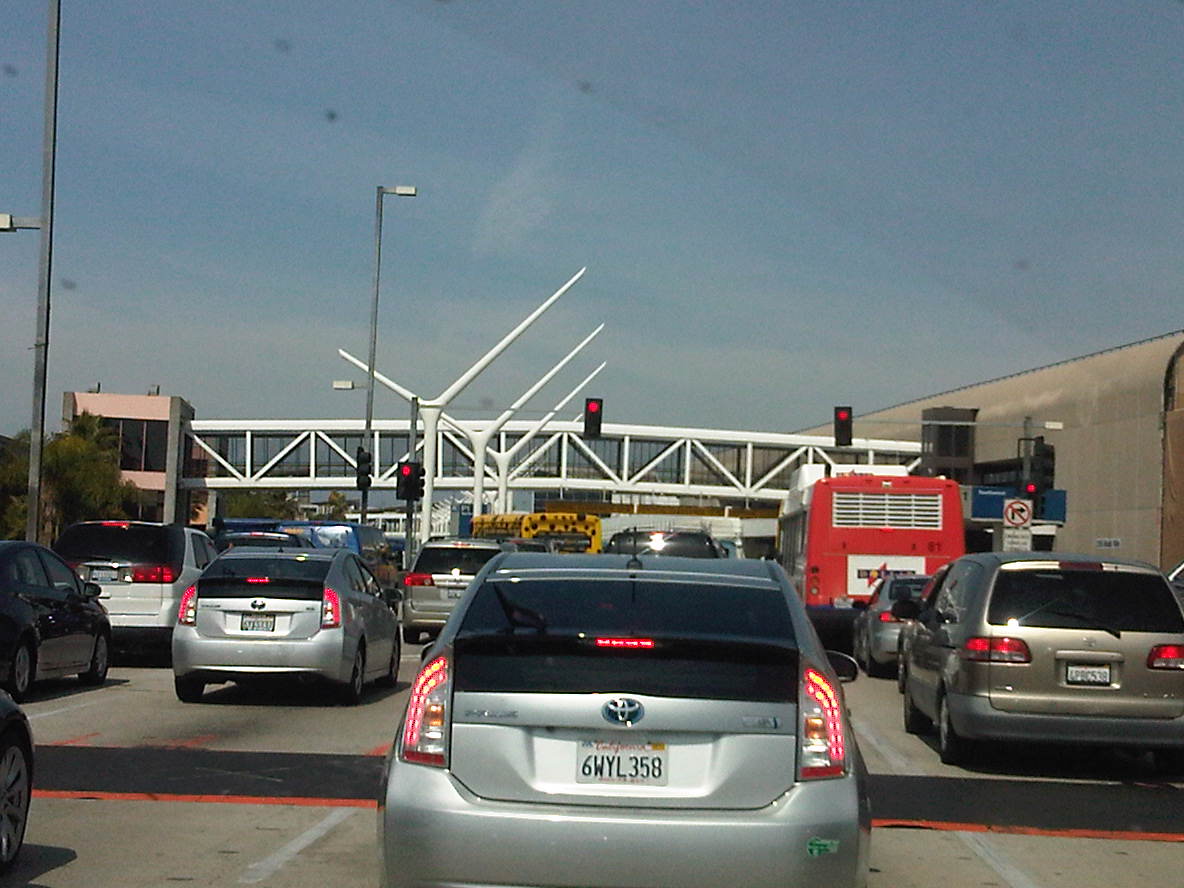
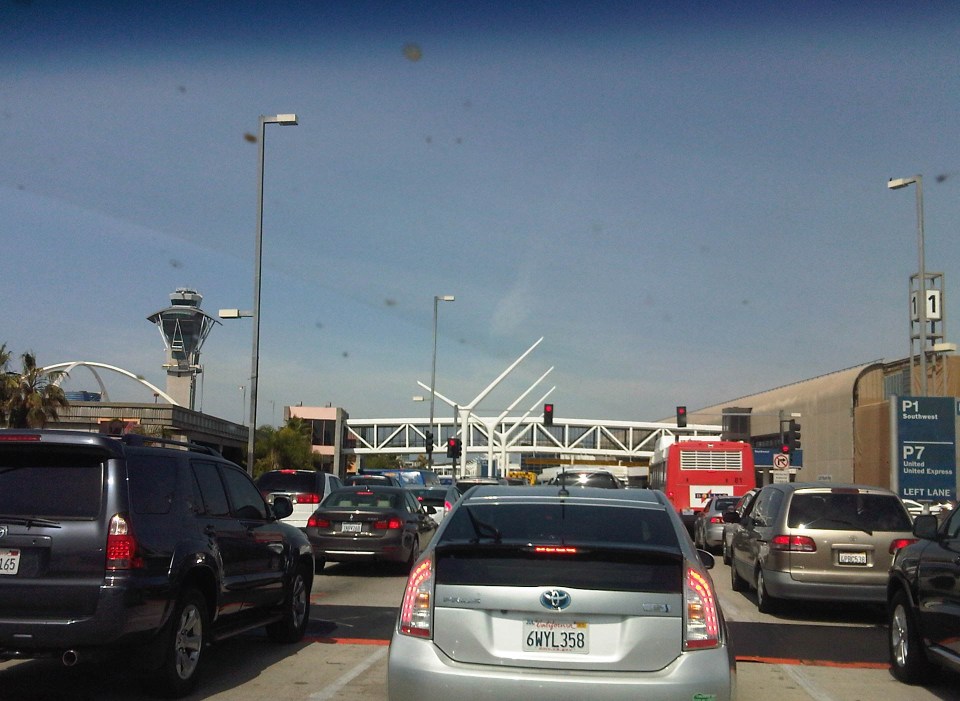 Traffic congestion at the airport driveway
 Upon clearing immigration and completing security checks, passengers are greeted by shops along the corridor to the boarding gates.
 Duty Free shops at LAX
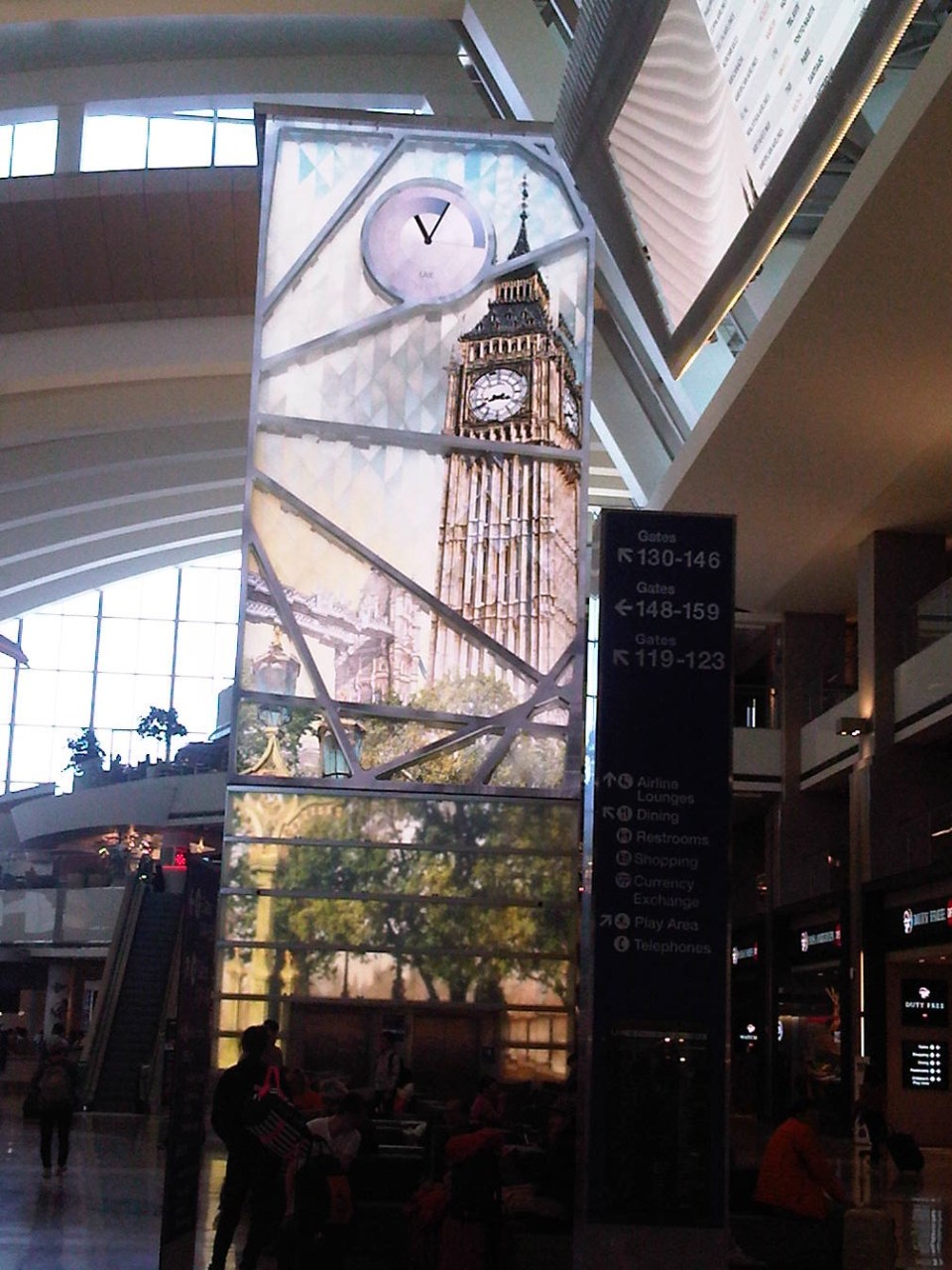 Giant video screens show the time and landmarks in other cities around the world
 As in many international terminals, there are many high end shops at LAX
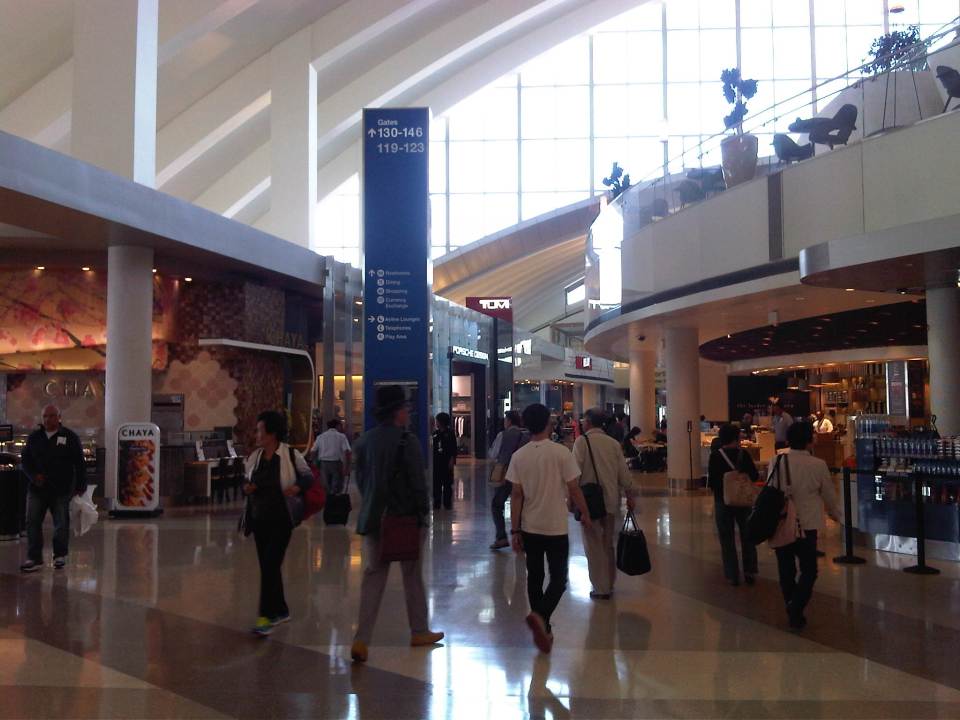 More shops, directions to boarding gates and other information are strategically located in the terminal.
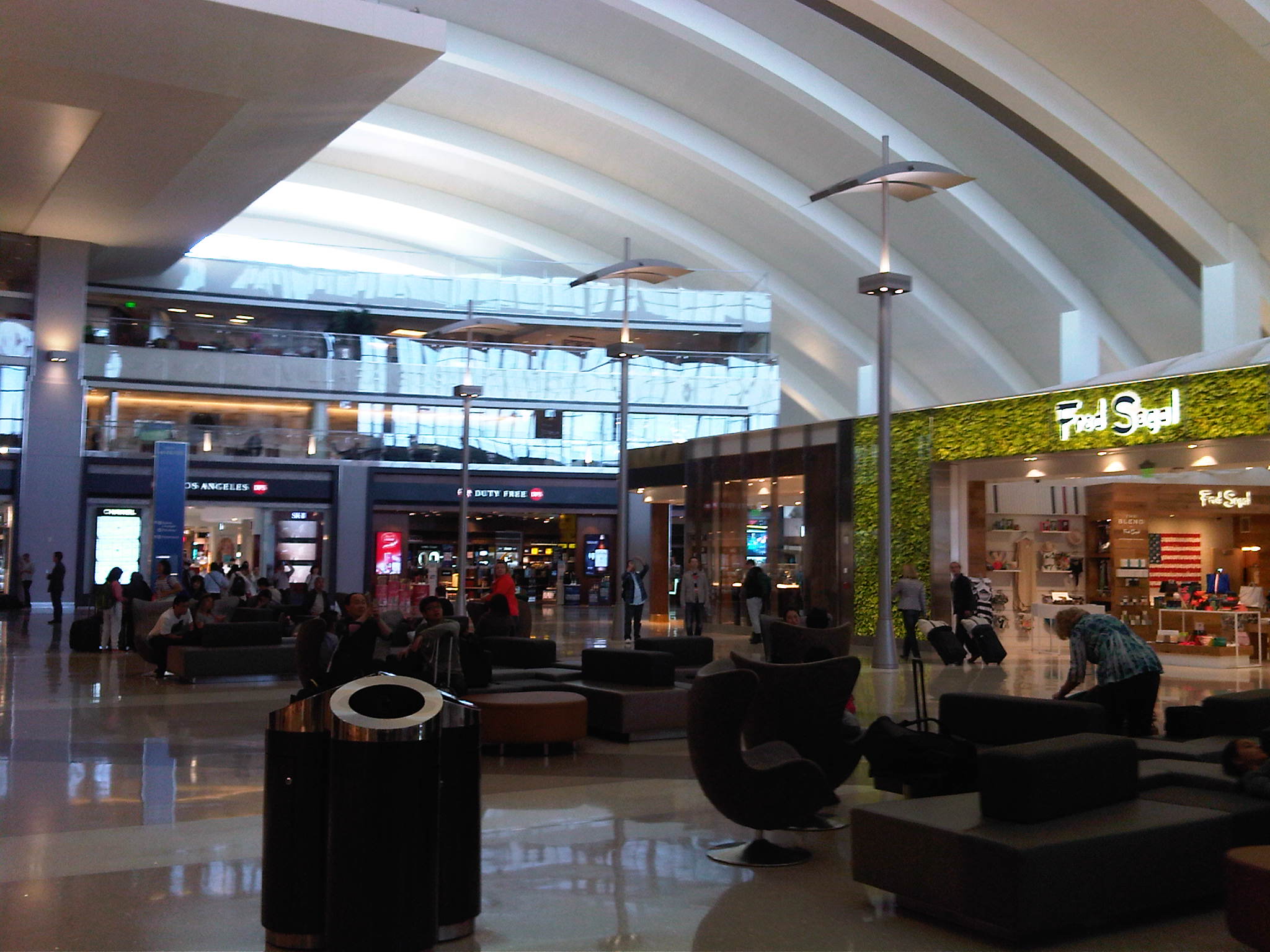 Passengers can lounge around the airport as there are many seating areas in the terminal.
 Passengers walking around or seated at the terminal
 Passengers can walk around the terminal to get the blood flowing if they prefer not to just sit and wait for their flights to board.
 Boarding gate for our flight
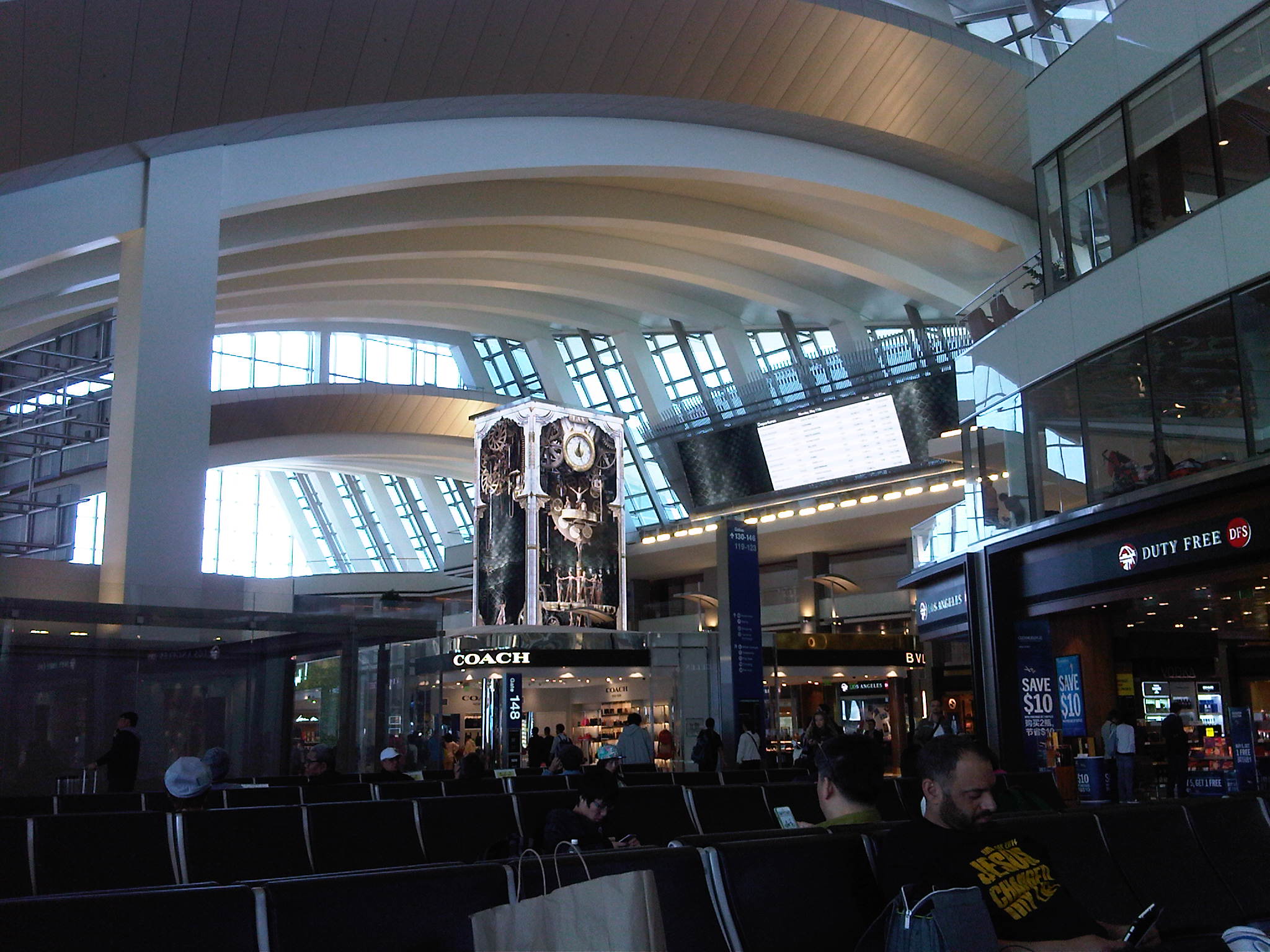 Passengers waiting near the boarding gate catch up on conversation, read or do whatever they prefer to while waiting for their boarding call.
 Another look at the information board on flights as well as the advertising screen at the terminal.
–
Transport research agenda
As promised, I am posting our research agenda from the last academic year. This has been revised every year since we established our undergraduate research program more than a decade ago. Back then, the document had been informal in the sense that it was not an official document that was submitted to the university for approval. Over the years, the agenda had been developed alongside that of the National Center for Transportation Studies and has evolved according to the current issues and concerns (including trending topics) in transportation.
A. Traffic Flow Theory and Analysis, and Traffic Engineering
1. Evaluation of Intersection Performance Considering Pedestrian Movement
2. Car-Following and Lane-Changing Models for Local Traffic Micro-simulators
3. Optimization of Traffic Signal Settings
4. Highway and Intersection Capacity and Level of Service
B. Highway Engineering
1. Local Pavement Design Practice
2. Coordination of Horizontal and Vertical Alignments
C. Intelligent Transport Systems (ITS)
1. Advanced Traveller Information and Navigation
2. Advanced Public Transportation and Travel Information
3. Microscopic Traffic Simulation Modelling
4. Advanced Parking Management
5. Integrated Fare Collection for Public Transport
6. Probe Car System for Road Safety and Travel Time Assessment
7. Development of Devices/Sensors for In-Vehicle Air Quality Measurement
8. ITS Support for PWDs, Senior Citizens and Women
9. Smart City and PUV Connectivity for Fully Automated Driving: Internet of Vehicles (IoV)
10. Advanced Traffic Data Collection Tools and Methods
D. Transport Safety
1. Road Safety Audit
2. Road Crash Data Analysis and Management System
3. Road-Based Public Transport Safety
4. Philippine Air Transport Safety
5. Philippine Maritime Safety
6. Safety and Comfort Assessment of Public Utility Vehicles
7. Safety Assessment of Buses Equipped with GPS
E. Public Transport
1. Indigenous Modes of Transport
2. Public Transport Operation and Management
3. Public Transport Station/Stop and Terminals
4. Assessment of Mass Transport Options (e.g. BRT, AGT, AFV)
5. Multi-Modal Transfer Stations in Urban Areas
F. Mobility Management
1. Parking Management Systems
2. Traffic Calming
3. Bikeways Planning and Management
4. Pedestrian Facilities and Walkability
5. Assessment of Freight Vehicle Restraint Schemes
G. Transportation, Environment, Energy and Vehicle Technologies
1. Fuel and Energy Efficiency of Alternative Fuel Vehicles for Public Transport
2. Roadside Air Quality Assessment and Modelling
3. Roadside and Airport Noise Modelling
4. Utilization and Customization of GHG Emissions Estimation Tools for Assessment of Avoid-Shift-Improve Policies and Transport Infrastructure Projects
5. Customized Local Road Vehicles for Public Transport (jeepneys and tricycles)
6. Transport Energy Demand
Note from the above agenda that there are few items that are very specific. The above are not working titles for researches but very general topics that can be the basis for formulating specific topics for each student/group that will be working on that topic. Not indicated in the agenda are information on which faculty members are assigned to each topic. Faculty members have various specializations and have contributed items to the agenda. Students choosing a particular topic will be assigned to the faculty member who will be guiding the students towards proposal formulation and eventually, research implementation.
–
 Caught (up) in traffic