
Home » 2017 (Page 11)
Yearly Archives: 2017
Responding to the transport impacts of road crashes
Last March 9, traffic was terrible along Marcos Highway and roads connecting to it including Imelda Avenue and Sumulong Highway due to a truck that slammed into the scaffolding of the Line 2 Extension across the Sta. Lucia Mall, and barely missing the newly constructed column supporting the girders and elevated tracks of Line 2.
 [Photo not mine but sent by an officemate who was glad to have taken his motorcycle that day instead of commuting by car.]
Following are comments I captured from Waze as I tried to get information about the traffic situation:


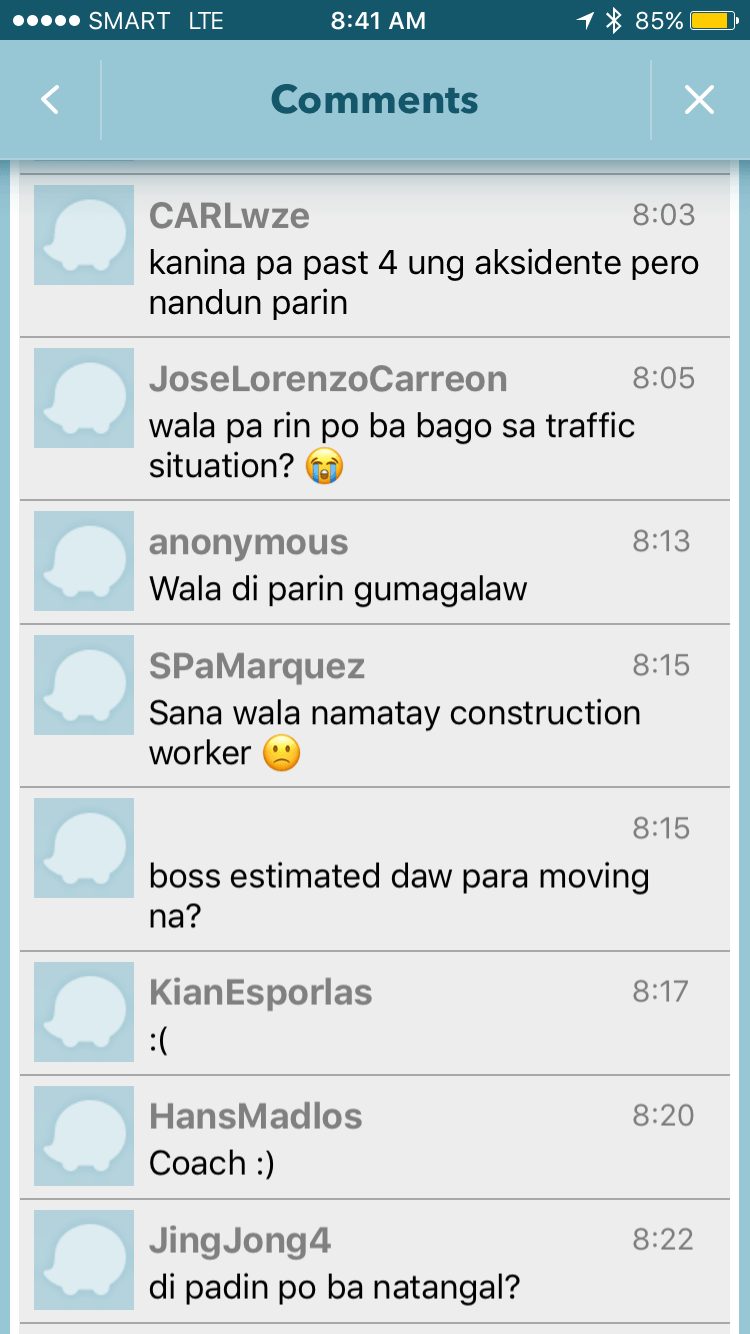
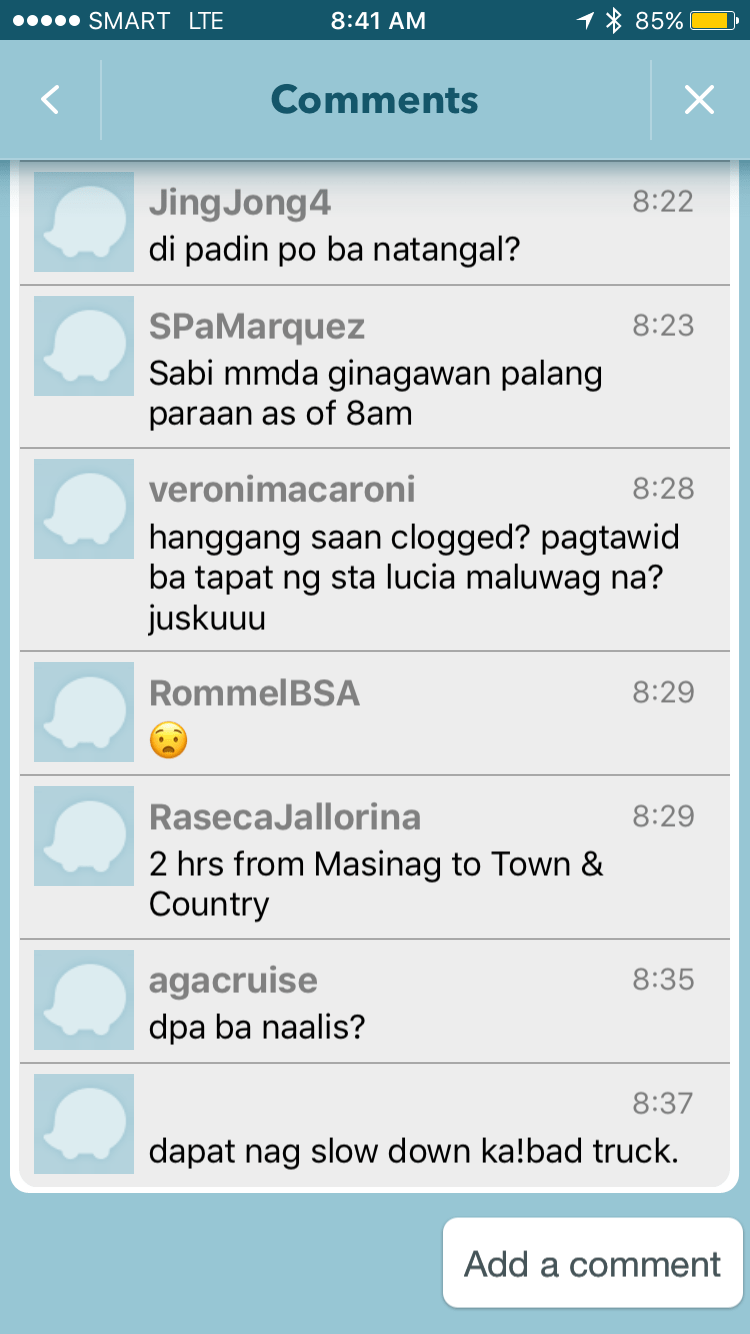
It is very clear from travelers’ comments that most were frustrated and many were angry about what seemed to be a very slow response from authorities in clearing the crash site and getting traffic to move faster. I myself wondered how a crash like this with its impacts manifesting in severe congestion along major roads was not dealt with as urgently as possible by so many entities that were not without capacity to act decisively. The front liner should have been the Metropolitan Manila Development Authority (MMDA) and there were at least four local government units directly affected by the congestion: Pasig, Marikina, Cainta and Antipolo. Surely, these LGUs could have done more if the MMDA couldn’t, in order to resolve the problem? If the availability of heavy equipment was an issue, weren’t there available equipment from Line 2 contractor, DMCI, or perhaps from the construction sites nearby (Ayala is constructing a huge mall near the area.)? Surely, they could lend a payloader or mobile crane that can remove the truck or at least help unblock the area?
I finally decided to turn back and work from home instead that day. Later, I learned that authorities had to stop traffic along Marcos Highway around 11:00 AM in order to tow the truck and clear the area for traffic to normalize. I hope this serves as a lesson in coordination among government entities and that future incidents like this will not results in a “carmaggedon” like Friday’s congestion. One thing that also became obvious is that travelers passing the area are all dependent on road-based transport and the primary reason why a lot of people were affected by the crash. The expanded operations of the Line 2, whenever that will be, will surely change transport in these areas and for the better.
–
MMDA statement on the odd-even scheme
The MMDA released a statement today about the much criticized Odd-Even scheme for EDSA that was floated on mainstream and social media. I will not comment on the statement but instead just reproduce the post on Facebook here:

What do you think?
–
Crowdsourcing solutions to traffic problems?
Some government agencies seems to have resorted to crowdsourcing via social media to either find or assess solutions for the worsening transport and traffic problems in Philippine cities, more specifically Metro Manila. This includes posts by the Department of Transportation (DOTr) and the Metropolitan Manila Development Authority (MMDA) about various topics ranging from public transport reform to travel demand management (TDM) schemes. From one perspective, the approach can be seen as something like a participatory approach towards finding a solution that is acceptable to most. I say so since the proposals or ideas come from what are supposed to be official accounts of these agencies and thus can be claimed as something that aims to engage the public in discourse towards finding solutions.
Following are screenshots from a public social media account and examples of the responses/comments he got for the post:


What do you think? Did MMDA do its part in analyzing or evaluating their proposal? I suspect that they did not perform an in-depth analysis despite the resources available to them. They do have technical staff and tools to do the analysis. Note that the agency acquired simulation software during the time of Bayani Fernando that they used to justify projects like the elevated U-turns at Kalayaan and the widening of Commonwealth Avenue. Their technical staff have also been training locally and abroad on transportation planning. A crowdsourcing exercise such as this seems more like a “trial and error” approach where those monitoring the responses/comments may opt instead to summarize the responses for the analyses and then determine whether to refine, push through or withdraw the proposal that was floated. I think the MMDA should do its part first (i.e., evaluate the proposal at both macro and micro levels) and then present the pros and cons of their proposal in both quantitative (e.g., improvement in travel speeds and travel times) and qualitative terms (i.e., improved productivity or quality of life for commuters).
–
Article on the beauty of mathematics
I interrupt my articles on transportation to share an article about a subject that’s actually very much related to transportation. I will just leave this link here:
The Beauty of Mathematics: It Can Never Lie To You
The article is by Siobhan Roberts and appeared in Wired magazine’s online site last March 4, 2017.
Enjoy!
–
Traffic congestion in Tagaytay
We got to see first-hand last weekend how terrible the traffic congestion in Tagaytay has become. Last year it was already bad but last weekend’s traffic was really awful. To be fair, not counted in the traffic jams mentioned here are roadworks (i.e., widening) currently being conducted by the DPWH along the Sta. Rosa – Tagaytay Road that have also contributed to the longer travel times to and from Tagaytay. The severe congestion is due to the intense developments in the city including high density residential and commercial developments in a city where transportation, including the road network, is not built to be able to handle the trips generated by such developments.
My brother took the following photos as we drove back to Manila:


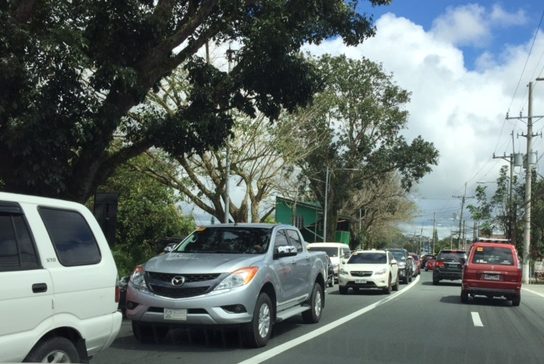


The photos pretty much describe how congested roads are. All two lanes are full with what is basically bumper-to-bumper traffic. The last photo was taken in front of the Estancia Hotel, which is about 1.4 km from the rotonda, and the queue appears to continue well beyond this area (i.e., past Starbucks). This is a result of the traffic management at the Tagaytay rotonda where, instead of allowing vehicles to move freely (which is how rotondas are supposed to function), traffic enforcers instead stop movements from the 3 legs one at a time. The problem here is that the congestion due to the Serin mall often reaches the rotonda, and so vehicles could not proceed to exit on that leg of the intersection. This condition affects traffic from all legs and results in long queues along the Aguinaldo Highway as well as both the rotonda-bound sides of the Tagaytay-Nasugbu Highway. Vehicles cannot make left turns to Serin or the Lourdes Church because of the median barrier set-up along the highway so all have to go around the rotonda. Quite frankly, I see very little or no options in as far as solutions go. The traffic is simply too much for the roads to handle.
–
Some views on Uber and Grab
I took screenshots of a DOTr social media post on Transport Network Companies (TNCs) and the comments made on the post. If the post is an accurate quote of the current LTFRB Chair, then it reveals how a top official of the LTFRB (and at the same time DOTr) thinks about such services and perhaps shows a lack of understanding for what these “innovative” companies are all about. I purposely put the word innovative in quotation marks because there are also challenges that Uber is currently facing.
But then can we blame the official and others of how they understand the business models of TNCs like Uber and Grab? Can we blame them when these companies’ models’ seem to be quite different from their original set-up that made them the popular modes that they are now in many countries? At the same time that they have become the bane of conventional taxis, it seems they are also killing off the good ones, too. In my opinion, Uber and Grab are treading a fine line between ridesharing/carsharing (their original model) and taxi services.
Here are some social media posts not too long ago regarding fare regulation being applied to TNCs:
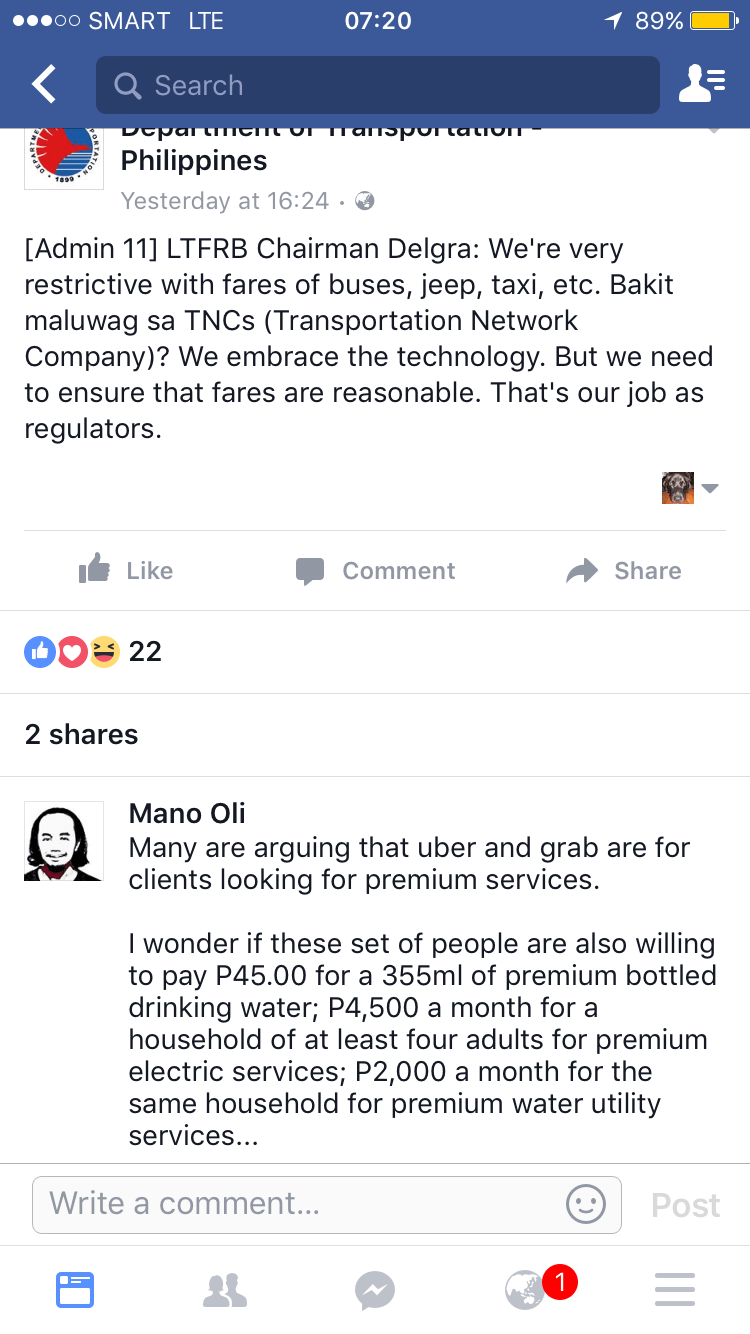

There are healthy (as well as inane) discussions online about TNCs. More recently, there were reactions when Uber appeared to take advantage of a nationwide jeepney strike. I guess people should take in different perspectives about TNCs and in the end, it is the commuters’ welfare that is important regardless of what modes of transport are available them. That welfare should be the priority of government and we should not blame the latter when they are actually doing their jobs.
–
The Tagaytay transportation predicament
The title of this article is actually a bit tame and on the diplomatic side of trying to describe transportation and traffic in this city that was once relaxed a retreat for many. I had wanted to end February on a good note and so I decided to defer posting this until March.
We used to frequent Tagaytay and liked spending some rest and recreation time there to the tune of being there almost once a month at one time. Needless to say, at the time travel to Tagaytay from our home in Antipolo took us only about 2 to 2.5 hours excluding our usual stop at Paseo in Sta. Rosa, Laguna. We liked the city so much that we even considered making it a second home; even inquiring and looking at properties there.
Fast forward to the present and it has become an excruciating travel with the highways leading to the city already congested. It didn’t help that when you got there, you also had to deal with serious traffic congestion. This started not a few years ago when the city approved developments by major players including Robinsons, SM and Ayala. The developments by SM and Ayala proved to be the backbreakers with Ayala coming up with the first mall in the city and SM operating an amusement park beside its prime acquisition that is the Taal Vista Hotel. Now, there is another mall under construction by Filinvest and right at the corner of the rotonda where the Aguinaldo Highway terminates.
Vehicles queue along the Tagaytay – Nasugbu Highway towards the Rotonda where Tagaytay traffic enforcers attempt to manage traffic but appear to create more congestion instead.
More on Tagaytay soon…
–
Article on housing affordability and sprawl
There is a new article from Todd Litman that discusses the state of housing in the context of affordability and sprawl. While this is mainly based on the experiences in the US and Canada, there are many other cities from other countries involved. I noticed an interesting comment on his Facebook post about the elephant in the room being culture. I would tend to agree with this view and in the case of the Philippines is perhaps also heavily influenced by our being under a repressive Spanish regime that was succeeded by an American-style. I say repressive because although there was a semblance of planning during the Spanish period, the urban form revolved around the plaza where church, government, market and schools were located. Social class defined residential ‘development’ also followed this with the wealthier families having homes closer to the center while those in the lower income classes where farther and perhaps even beyond the reach of the sound of church bells. The Americans changed much of that and introduced a larger middle class and the incentive of becoming home and land owners, which during the Spanish period was practically non-existent except perhaps to the buena familias and ilustrados. Fast forward to the present, being a land owner is still very much a status symbol along with being a car owner. Homes in the urban centers (e.g., Makati CBD, Ortigas CBD, BGC, etc.) are very expensive and people would rather reside in the periphery (thus the sprawl) and do their long commutes.
Here is a link to the article:
Unaffordability is a Problem but Sprawl is a Terrible Solution
[Litman, T. (2017) Unaffordability is a problem but sprawl is a terrible solution, Planetizen, Retrieved from http://www.planetizen.com, February 17.]
What do you think?
–
On vulnerability to crashes
A beloved aunt was hit by a jeepney as she walked to church yesterday. She was walking on a local road that didn’t have any pedestrian sidewalks because this was in a residential neighborhood with very low vehicular traffic. She sustained serious injuries and was brought to the hospital by the jeepney driver (good thing he did not flee as many likely would have done) and people who witnessed the incident. She is now in critical condition, unconscious and would likely have a very difficult time recovering considering her advanced age if she pulls through. Senior citizens involved in accidents, whether domestic or crashes like this, and who have sustained injuries like hers (i.e., fractured bones and damaged). Her prognosis is not so good and a cousin says it will take a miracle for her to recover from this very traumatic incident.
Many of us do not care about road safety and do not concern ourselves with making an environment that’s safe for all users. That is, until we or someone close to us become victims of crashes. What do we do about this? Do we become instant advocates of road safety? Do we suddenly look for initiatives that we can be a part of? Do we do the talk circuit and find opportunities to share our experiences and give our two centavos worth of advice? Did we really have to wait for these things to happen before we become active in promoting and realizing road safety? Or do we start now and become proactive whether or not we think we ourselves are vulnerable? We are all vulnerable road users. We are all potential victims or participants in crashes. And so we should all be involved in making or enabling a safer environment for everyone.
–
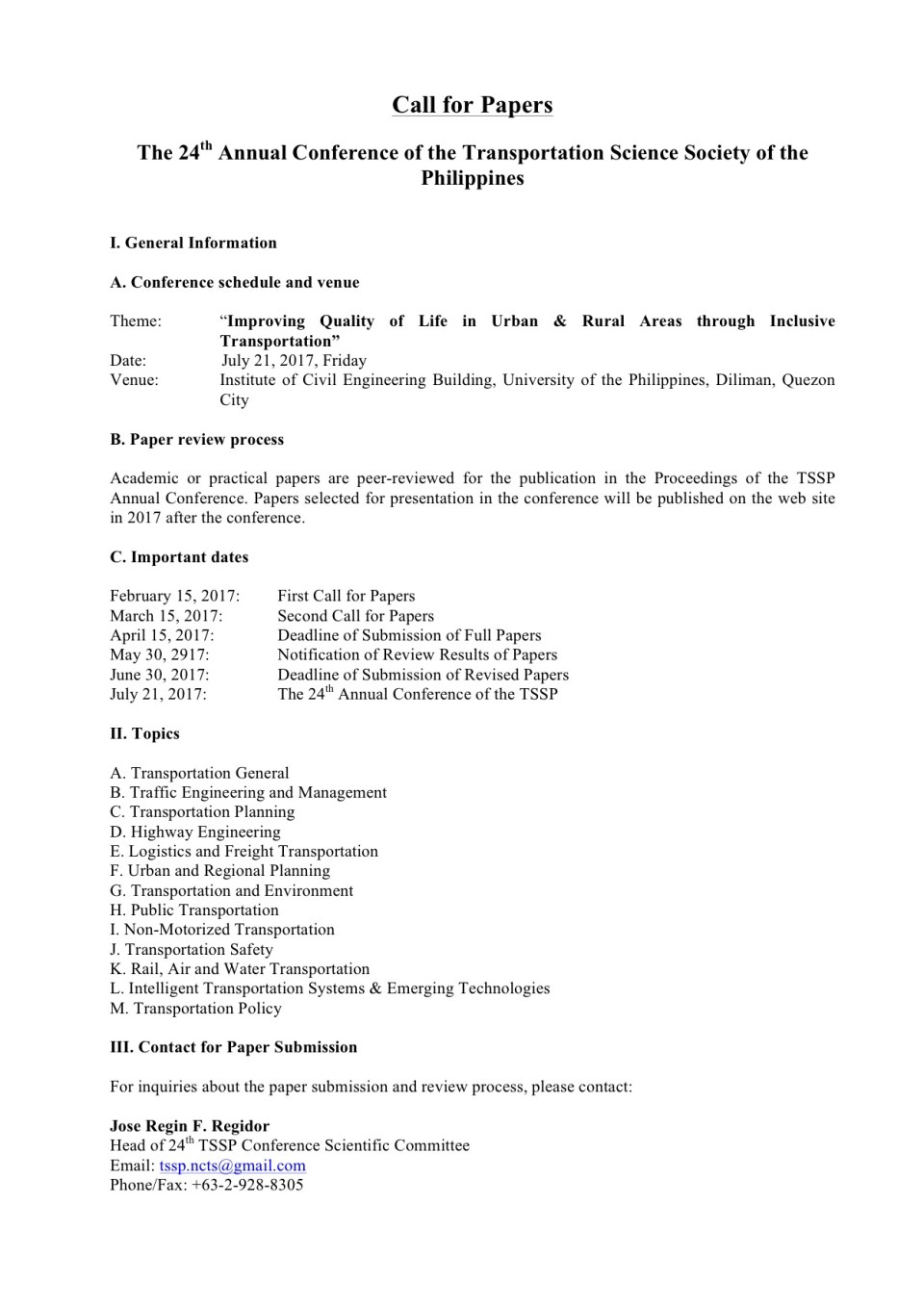
First call for papers for the TSSP 2017 conference
The first call for papers for the 24th Annual Conference of the Transportation Science Society of the Philippines came out last Wednesday, Feb. 15:
–
 Caught (up) in traffic