
Home » 2020 (Page 11)
Yearly Archives: 2020
Manila’s PUV stops
Last week, I went to a meeting somewhere at the Mall of Asia complex and took a couple of photos of the public transport stops in the City of Manila. These seem to be the most modern designs in the metropolis and bears a slogan – Ang Bagong Maynila (The New Manila).


I’ll try to get photos of stops from other LGUs of Metro Manila to compare with the photos above.
–
Politics: Questions on Succession
Here is another political post so click on another if this is not your thing. In a previous post, I wrote about politics in general and cited the example of Rizal politics. I write more about this topic based on my observations and assessment.
A big problem with patronage and clan politics is succession. Ipinamamana na lang ba ang posisyon sa gobyerno? (Are positions in government supposed to be like things that are handed down like inheritance?] Many cities and municipalities are like that and there are many so-called prominent families who hold top positions with some occupying Mayor, Vice Mayor and several Councilor positions. The more powerful ones also hold Governor, Representative and even Senator (which is a national post).
Rizal has very much similar circumstances with the congressional districts of the province and the capital city of Antipolo practically being dominated by certain families. The first district of Rizal has not had anyone except a Duavit while the second was for a while been held by a Rodriguez until a defeat in the last election by what seemed to be an upstart. He is actually from a political family from the southern Philippines whose been a good staff of the Ynares clan. Antipolo’s two districts are controlled by the Punos and the Acops. With both already juggling the post among their immediate families, there seems to be no one to end their dynasties. Even well-performing politicians like Cainta’s Nieto will be hard-pressed to run for Governor or Congressman.
It would take much more like perhaps a crisis or something disastrous for these well-entrenched politicians to be defeated. Nieto did it just when his predecessor was attempting to build a dynasty on the heels of subsequent disastrous floods in Cainta. But perhaps the case of Vico Sotto’s campaign and resulting upset of another dynasty in Pasig offers as a more interesting study of engaging and transformative politics? Let’s wait some more and see how things develop. Will they remain and sustain their momentum without losing (part of) their souls? Or will they end up being succumbing to the temptations of the ‘system’?
School shuttle bus service in Cebu
Almost 20 years ago, there was an initiative by the Metro Manila Development Authority (MMDA) involving the fielding of buses to take students of Ateneo and Miriam from certain pick-up points (e.g., SM North EDSA, White Plains, SM Marikina, etc.). That was in an effort to reduce the private vehicle traffic that clogs Katipunan during the weekdays. That did not meet any success and was scrapped. Years later another initiative was hatched with buses again provided with a pick-up point at SM Marikina. That is supposed to be still operational at present but one acquaintance observed that there are fewer passengers on this bus and that he fears it will soon be scrapped, too.
Last January, we chanced upon a bus service provided by the University of Cebu. The pick-up point was SM Consolacion, which was to the north of Cebu City. Consolacion town was the second town to the north after Mandaue City. We chanced upon this after observing the early arrival and formation of a queue by students at the still-closed mall. Security informed us of the service after we inquired with them. We were conducting surveys for a transport study we were doing in the area and were deploying our surveyors when we saw the students.
 University of Cebu School Service bus turning across SM City Consolacion towards the bay in front of the mall
 Students boarding the bus include what looks like grade school, high school and college students
The bus didn’t return for another pick-up, and there were no other buses or school service vehicles that arrived that morning so I guess this was a scheduled service with a capacity just enough for the number of students waiting that morning (typical number?). I do not know if these students are subscribed to or had to sign up for the service but there has to be a system of sorts so the university can assess what type of vehicle and the frequency for pick-ups. We were not able to observe if the bus returned sometime later that day for the return trips of the students.
We thought that such efforts are advantageous to many students and even faculty members and staff of the university. Such practices or services should be replicated by other schools as well and collectively may help alleviate congestion by reducing individual vehicle trips.
–
Jeepneys? No, they’re buses
I spotted this vehicle along my commute earlier today and couldn’t help but state that this is not a jeep or jeepney as DOTr or LTFRB seem to be marketing it to be. By all indications, this is a departure from the jeepney design and should be called a bus or mini-bus. Perhaps it can still be considered a jitney but that is a stretch. It wouldn’t hurt efforts towards route rationalization and public utility vehicle modernization to call this a bus or mini-bus. In fact, that should be a conscious effort towards changing mindsets about what vehicles are most appropriate or suitable for certain routes.

Premium Jeep beside a conventional one somewhere in Bayan-bayanan, Marikina City
–
On pollution due to ride shares
We close February with another article I share about ride sharing and its environmental impacts:
Hawking, A.J. (2020) Uber and Lyft generate 70 percent more pollution than trips they displace: study, The Verge, https://www.theverge.com/2020/2/25/21152512/uber-lyft-climate-change-emissions-pollution-ucs-study [Last accessed 2/29/2020]
I guess, this sort of validates our suspicion of ridesharing becoming unsustainable. Again, we note its origins when it had the potential to reduce car ownership and car use. The original ride shares were closer to carpooling as well as took advantage of under-utilized vehicles while giving extra income to people who could share their vehicles on-demand. Eventually, the ride shares morphed into taxis with people purchasing cars to get into the business. Soon, a lot of them were roaming the streets as they awaited bookings and this type of operations generated a lot of emissions. They might not have required more parking spaces like the conventional car users but this benefit was eventually overcome by the pollution they produced.
–
SLEX congestion
En route to Batangas the other day, we had to endure severe traffic congestion along C5 and SLEX. C5 was at its worst as it took us about 2 hours from Blue Ridge until SLEX. Descending from the flyover to SLEX, we were greeted by crawling traffic along the tollway, which was to us a slight surprise for the southbound direction. Normally, traffic would already be lighter compared with the northbound side that carried peak hour travelers inbound for Metro Manila.
Much of the ‘additional’ congestion along SLEX is attributed to the ongoing construction of the Skyway extension. Traffic management is particularly criticized and congestion very atrocious at Alabang on ground level beneath the viaduct. Buses are prohibited from using the viaduct and the traffic schemes have contributed to severe congestion. Through traffic along both sides of the tollway have been affected, too, with queues reaching Laguna.
 Preview: Passing the Alabang area, we observed that the queue from Alabang already stretched beyond what is visible to the eye.
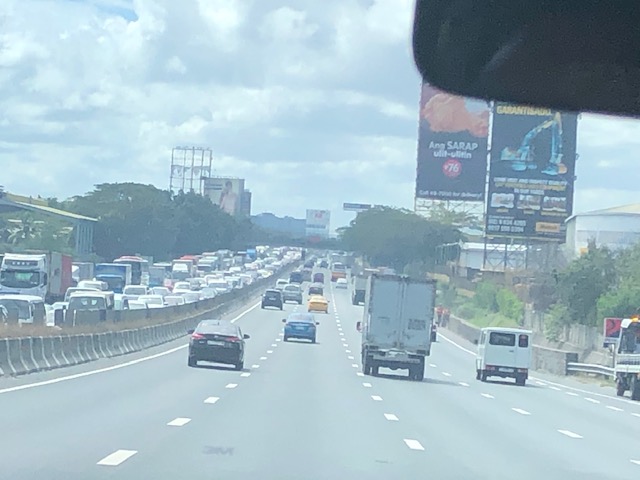 No end in sight: this is what we usually describe as a traffic jam condition with the density reaching its maximum value and speed at its lowest. Volume approaches zero for this case.
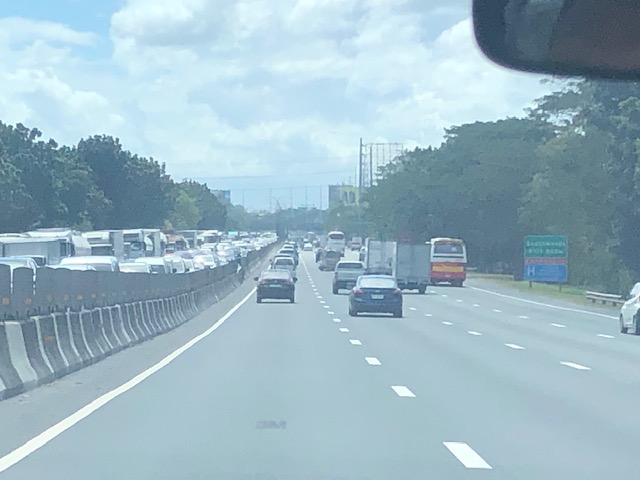 Horizon: The queue that morning reached the Southwoods exit of the SLEX. Approaching northbound travelers would have to endure severe congestion until Alabang.
On hindsight, I thought that we should probably have opted to fly between Quezon City and Lipa City. My colleague said that the contact person offered that option to us but that he turned it down because he gets dizzy riding helicopters. I wouldn’t know as I’ve never ridden on one. However, we also thought it wouldn’t be prudent for us to ride a helicopter from the university. It would seem to be the transport of VIPs and easily attracts unwanted attention. Yet, it would have been the more practical and speedy if not the less expensive option for the trip that day.
On the financial viability requirement for public transport operators
I came upon the news that the P2P Bus service between SM City North EDSA and SM Megamall suspended operations The Land Transportation Franchising and Regulatory Board (LTFRB) released a statement to clarify the circumstances surrounding the suspension, which apparently was the initiative of the operator rather than the agency. Apparently, too, some people were quick to attribute (blame seems to be the more appropriate adjective to describe how some netizens reacted) the suspension to LTFRB. Here is the statement posted on their social media page:
Land Transportation Franchising and Regulatory Board – LTFRB
February 23 at 7:52 PM ·LTFRB PRESS STATEMENT ON P2P OPERATIONS OF FROEHLICH TOURS, INC.
23 February 2020The Land Transportation Franchising and Regulatory Board (LTFRB) would like to clarify that it did not order the cessation of the P2P operations of Froehlich Tours, Inc. (FTI) which plied the SM North EDSA-SM Megamall and Trinoma-Park Square routes.
FTI was one of the first to be awarded with P2P routes in 2016. In November 2019, MAN Automotive Concessionaires Corporation (MAN) submitted a letter requesting the Board to look into the financial capability of FTI to maintain its operations, fund expenses that may arise from accidents, and continue to provide public service.
According to MAN, an exclusive truck and bus importer, assembler, and distributor, FTI initially acquired 17 bus units amounting to a total of P185.7 million from them. FTI was only able to pay P39.2 million which resulted in MAN having to repossess 12 bus units. To this day, P19.75 million is still left unpaid by FTI.
While these allegations are still under investigation by the Board, an inspection of the FTI bus units revealed that the company’s Provisional Authority, which allowed them to run and function as a public service provider, has already expired and no renewal was filed.
As of now, an order has been sent out to Froehlich Tours Inc. to submit its 2019 Financial Statement within a period of five (5) days from receipt of a copy. The hearing is reset, upon the agreement of both parties, on 3 March 2020 at the LTFRB Central Office.
Pending the outcome of the hearing, the Board shall adopt measure in the coming weeks to ensure that the riding public will be provided with the needed transport service on the routes affected.
–
There are two major points in the statement. One is on the financial viability of the operator and another is on the provisional authority granted by the LTFRB, which is a regulatory agency. The latter pertains to something more temporary and authoritative than a franchise, which is basically a license to provide transport services. These provisional authorities are often granted by the agency for so-called “missionary routes” as well as for supplementing the supply of vehicles during peak seasons like Christmas, Holy Week and Undas.
Financial viability is a requirement for all public transport operators. It is part of the formula for determining the viable number of units (i.e., vehicles) considering the fare that is to be charged to passengers taking into consideration the operating costs of operators. If this requirement was implemented strictly, a lot of operators would not be operating PUVs in the first place. The LTFRB, however, as well as its mother agency, the DOTr, have been lax about this requirement for so long a time that it is difficult to recall the last case where this was cited as a reason for suspending operations.
–
Inflight meals on Philippine Airlines
I recently wrote about the inflight meals on Cebu Pacific. This time I am posting photos of the inflight meals on Philippine Airlines. To be fair and accurate, the following photos show inflight meals on board international flights (MNL-SIN and SIN-MNL). The airline is a full service airline so PAL’s fares already included the meals.
 Beef and rice for the wife, but not because they ran out of chicken and pasta
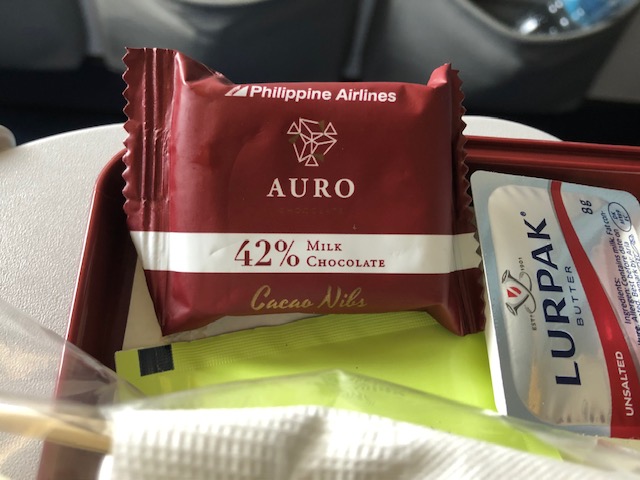 A pleasant surprise that came with our meal was our dessert in the form of an Auto chocolate bar. These were fine chocolates from Davao.
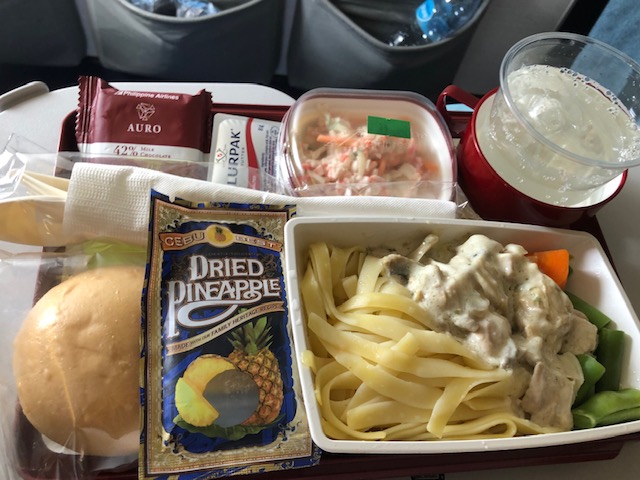 I opted for the chicken and pasta dish. The meal also included dried pineapple that you can have as dessert or snack (for later during the flight).
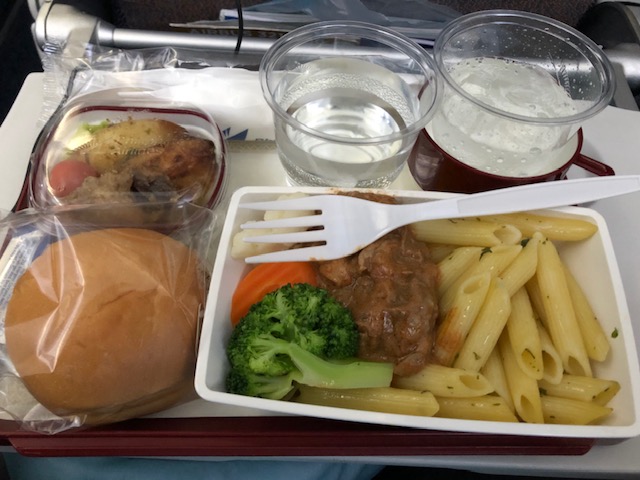 On the flight back to Manila, we both had beef and pasta
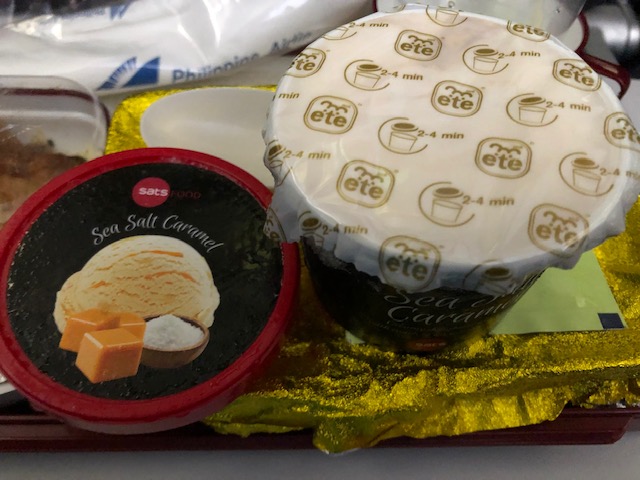 The surprise came in the form of dessert – ice cream!
 This was very good ice cream c/o of SATS, Singapore’s airline food concession
 Details on the ice cream on the container
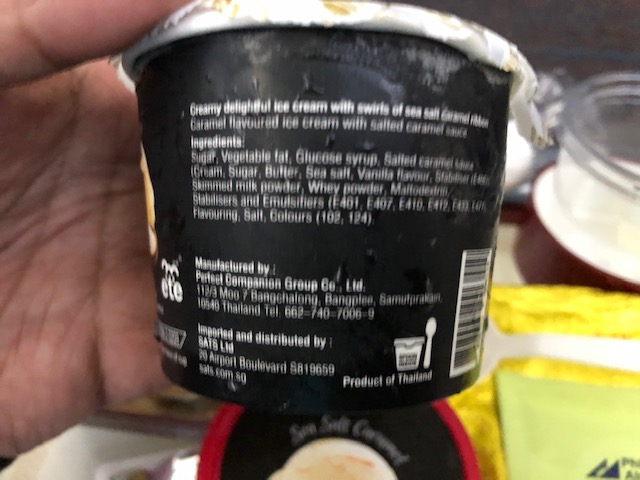 The ice cream was manufactured in Thailand
–
Scenic highways? On the irony of “Daang Kalikasan”
There’s a lot of buzz about new roads nearing completion in the provinces of Pangasinan and Zambales. What is touted as scenic highways became an instant hit and attracted a lot of visitors who apparently wasted little time in trashing the area. The recent news now state that the road has been closed due to the garbage and some road crashes attributed to the influx of tourists in the area:
Mountain roads linking Pangasinan, Zambales closed over accidents, trash
There were a lot of posts that appeared on my social media newsfeed about these roads and the scenery around them. While I have seen a lot of roads with splendid or even magnificent sceneries whenever I go on road trips, the first thing that came to my mind was a question whether the landscape was like that before. I suspected that there used to be forests on these mountains and that the trees were irresponsibly cut down (some people will use the word ‘harvested’ as if they grew and cared for the trees) and never replaced. Some friends from Zambales say there used to be trees there and another recalled old dirt roads in the areas used for logging. So it’s ironic that the road is named “Daang Kailkasan” when nature was practically raped by people who ravaged the land many years ago. Indigenous people who we often refer to as “katutubo” also would likely have never consumed more than what they needed. Scenic? Maybe ‘depressing’ is a more suitable term for these roads.
–
Eating at the Mactan Cebu International Airport
While NAIA Terminal 3 has several floors of shops and restaurants, it can get very crowded at the terminal. MCIA has renovated its domestic terminal to include a much improved food court inside (after checking in and passing security) the terminal and restaurants and shops outside. Its food avenue for passengers show us what a modern airport should have. MCIAA definitely did very well here and the design should be a good example for other airports, even domestic, to emulate.
 |
| Food court at MCIA domestic wing |
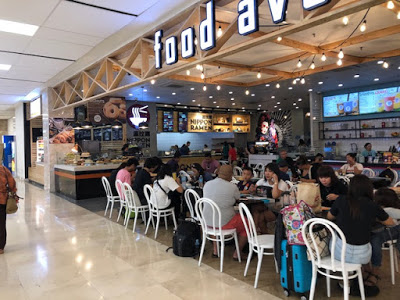 |
| There’s food for people of various preferences. You can have pizza, pasta, Filipino dishes, ramen, and of course, lechon |
I prefer to have some ramen if I have the time for a leisurely meal. Otherwise, I get my food from La Bella, which has pizza, pasta and paninis. They usually have freshly baked breads and pastries and I usually buy brownies from them. I take these home as my daughter and I love these fudgy treats.
–
 Caught (up) in traffic