
On the plastic barriers for jeepneys
The minimum requirements for conventional jeepneys prior to their returning to operations include the installation of barriers so as to have physical separation between passengers. Ideally, such separation should be a distance of at least one meter, which was initially relaxed to ‘one seat apart’, and then further relaxed to just the barrier separating passengers. You see various designs installed in jeepneys. I posted a couple in an earlier post showing examples of customized and DIY barriers. Here is another that looks like there was more effort involved in the making of the plastic barriers:
 Specially made plastic barriers with messages and graphics on social distancing printed on them.
 Jeepney drivers are obliged to reject or unload passengers not adhering to the protocols including those refusing to wear face masks and shields while commuting using public transportation modes. I assume that they are really doing this for their and their passengers’ safety and well-being.
–
On congested tollways during the pandemic
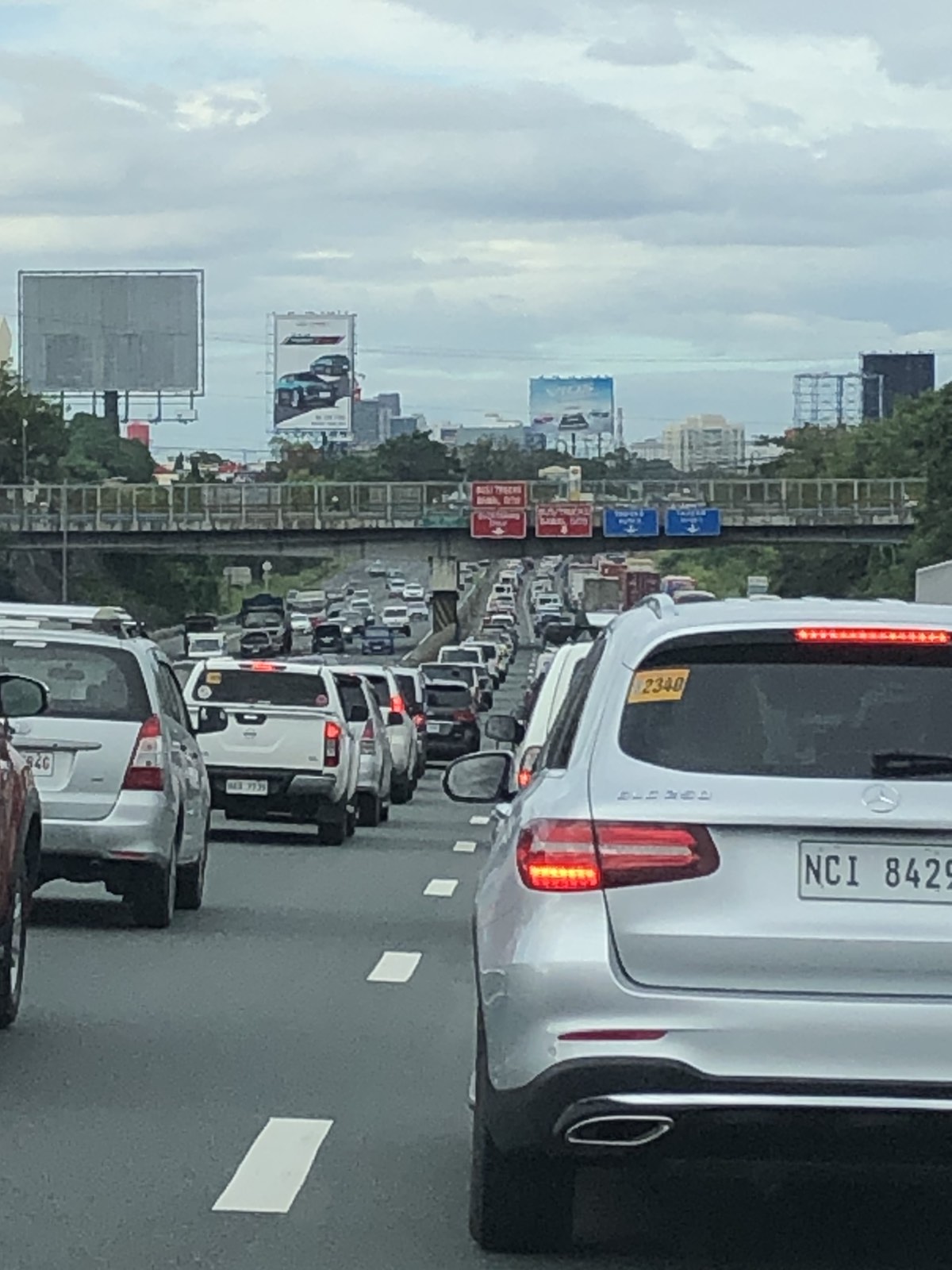
I finally was able to go on a long road trip yesterday as friends invited us to go on an excursion to Quezon to a prominent pottery artist’s place in the town of Tiaong. I first thought we would be going via the backdoor of Rizal since we were already in Antipolo but it turned out that it would be faster via the tollways route. Both Google and Waze recommend our route via C-6, SLEX and STAR to get to our destination. It could have been longer via the Manila East Road but which is a more scenic route. While it took us only 2.5 hours to get to our destination, it took an additional hour on the way back. Part of it was the congestion along the national highway between Tiaong and Sto. Tomas, Batangas but I was also a bit surprised about the congestion along SLEX on the way back (photo below) but saw that this was mainly due to vehicles filing towards the Skyway ramp in Alabang.
There was the expected congestion at the toll plazas as vehicles still need to slow down. It is not like the seamless, structure-less system in Singapore where their sensors can detect vehicles running at high speeds. The toll barriers are still there and the channels for one are relatively narrow. Then, there are travelers that seem hard in understanding that there are specific booths for cash payments. Also, there were occasions when the barriers did not lift immediately for one reason or another. That tends to slow down the processing of queued vehicles – a problem that my undergraduate students could probably take on after their lessons in queuing theory.
–
On planning our cities from a child’s perspective
Wouldn’t it be interesting to find how children would plan their cities? No, this is not the lego building kind of exercise but something closer to actual planning exercises where children not only act as planners but stakeholders themselves. We always say they are the future and that know that they will inherit whatever good or bad we are doing now, and yet they have little say in that future. Perhaps we should heed what they think our cities require?
Ergler, C. (January 4, 2021) “Young children are intuitive urban planners — we would all benefit from living in their ‘care-full’ cities”, The Conversation, https://theconversation.com/young-children-are-intuitive-urban-planners-we-would-all-benefit-from-living-in-their-care-full-cities-151365 [Last accessed: 1/15/2021]
–
On housing and transport
I am always amused about discussions and posts about transport and traffic where people appear to isolate the traffic as what needs to be solved, and where people criticize the latter and state that it is a transport and not a traffic problem. Both do not have the complete picture if that is what we want to start with. Land use, land development and the choices people make based on various other factors (including preferences) are among the other ingredients of the proverbial soup or dish that need to be included in the discussion. Remember land use and transport interaction? That’s very essential in understanding the big picture (macro) before even going into the details at the micro level. Why are there many car users or those who prefer to use private modes over public transport modes? Why do people prefer motorized over non-motorized modes? Maybe because people live far from their workplaces and schools? Why is that? Maybe because of housing affordability and other factors influencing choices or preferences?
Here’s a nice recent article on housing and transportation to enrich the discourse on this topic:
Litman, T. [January 7, 2021] “Housing First; Cars Last”, Planetizen, https://www.planetizen.com/node/111790?utm_source=newswire&utm_medium=email&utm_campaign=news-01112021&mc_cid=2985a82f48&mc_eid=9ccfe464b1 [last accessed: 1/13/2021]
–
On hover chairs
Here’s a quick share of an article presenting Segway’s attempt to become relevant:
So, A. (January 3, 2020) “Segway Is Bringing the Hoverchairs From WALL-E to Life,” Wired.
I still have to check though if this was the correct year for the article, which appeared in my recent Wired subscription considering it is already 2021. We now know that people have taken to active transport, particularly cycling or biking, during the pandemic. I place emphasis here on ‘active’ because anyone who’s watched Wall-e surely knows what humans there looked like. Active transport and not such hover chairs will likely be the mode of the future. Of course, there are suitable applications for these including perhaps a replacement for wheelchairs or enhanced transport for seniors and whoever may require such. But in general, perhaps we shouldn’t be dependent on these to move about.
–
On the RFID fiasco
Early December 2020, Metro Pacific Corporation suddenly had to deal with jam-packed toll plazas and queues that affected roads connecting to the North Luzon Expressways. Fast-forward and Valenzuela City apparently had enough of it and revoked the tollway corporation’s business permit. Later, matters were resolved with the tollways reverting to mixed toll collection to manage the queues at the toll plazas.
Prior to this, tollways corporation scrambled to meet the deadline set and re-set by the Department of Transportation (DOTr) through the Toll Regulatory Board (TRB) for contactless, cashless toll payments. The question is if there was enough time for tollway operators to acquire the best (not just the minimum required) system for this endeavor. There are some opinions that this was basically required on short notice and for the government to get some brownie points for this.
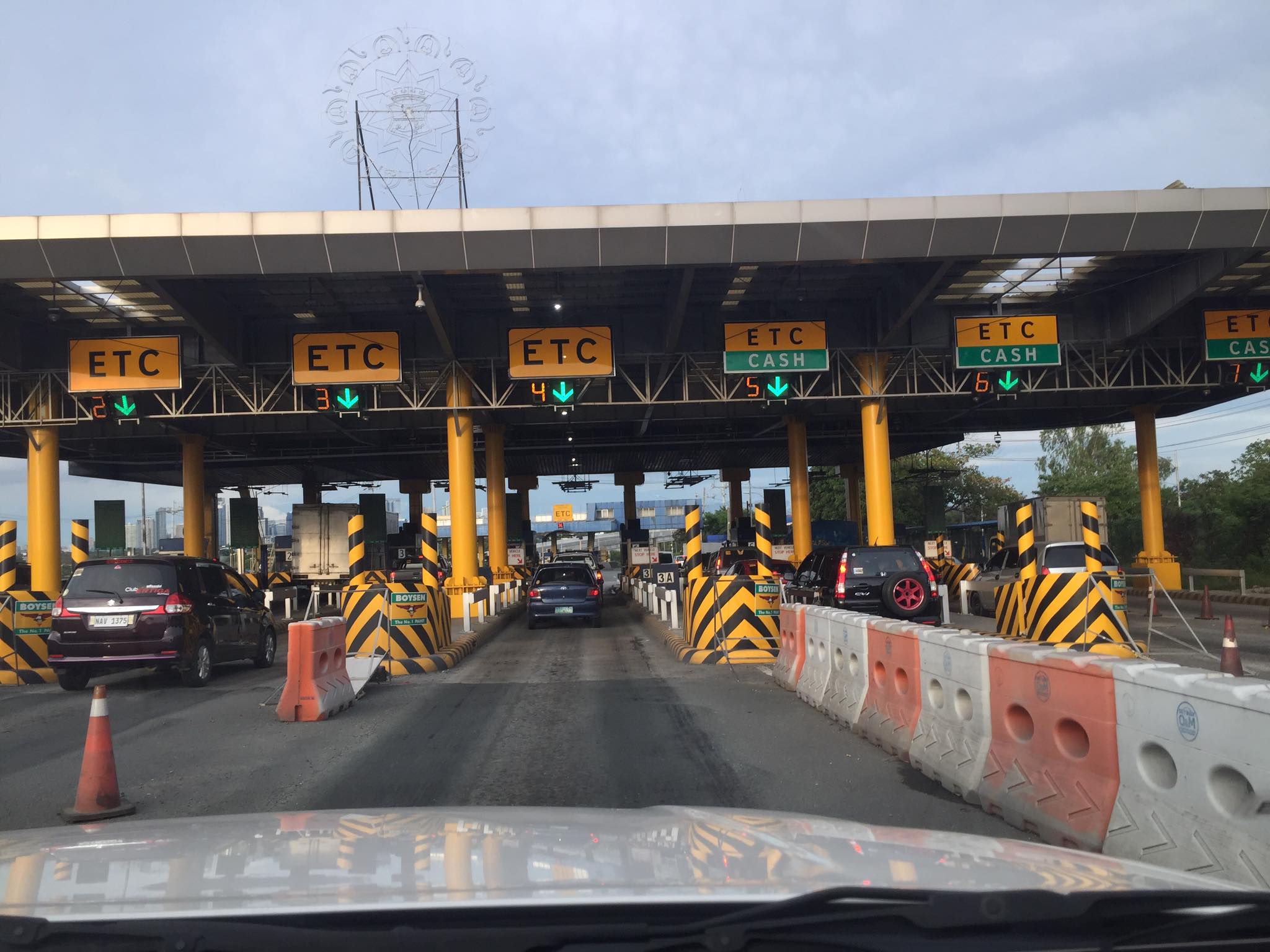
Were there issues about technology and the corresponding costs to the acquisition and deployment of the necessary devices for seamless, contactless, delay-free (in relative terms) transactions for tollways? Probably so. Those RFIDs and the readers installed at strategic locations along tollways (i.e., entries and exits) were certainly not state of the art or the best available out there. Singapore, for example, uses a more sophisticated system for their expressways where you no longer have toll plazas and you won’t have to slow down to be detected by the system. That system has corresponding costs but is perfect for the city state given that most roads are tolled anyway because of their road pricing policy. In the case of our tollways, not all travelers are actually going to utilize the tollways as frequently as it would necessitate them having to get either the Easy Trip or Auto Sweep tags. That is obvious from the relatively low penetration rates for electronic toll collection (ETC). So it still makes sense to have hybrid booths for those not availing the ETC option. Anyway, travelers will have to exercise disinfection protocols to ensure infections are prevented.
–
What to look forward to Philippine transportation in 2021
I usually wrote a year-ender for transport but somehow never got to it. I’ve spent much of the break working on projects that have been extended due to the pandemic’s impacts on their implementation. Two of these projects are being implemented in Zamboanga City where we are lucky to have hard-working counterparts and a very cooperative city government. I think given what have transpired in 2020, there’s much to expect in 2021. I also want to be hopeful and optimistic about the outlook for this year. So positive thoughts for now. Here are things to look forward to in 2021:
- More bike lanes around the country – these include the bike lanes to be constructed using the billions of pesos allocated for Metro Manila, Metro Cebu and Metro Davao. Is there a plan? None yet unless you count the sketch mapping exercise people have been doing. Sure, the DPWH came up with guidelines for bike lanes designs but these are a work in progress at best if compared to the existing guidelines from countries that have built and maintained bike facilities for a very long time now (e.g., Netherlands, Australia, even Singapore).
- Construction of a Bus Rapid Transit (BRT) in Cebu – this is a much delayed project (more than a decade in the making already) that needs to be implemented already. This year might just be the year? We certainly hope so. That EDSA carousel is still far from being the BRT the Philippines need to be a model system for its cities. I still think Cebu can be a better model for other cities than Metro Manila. And so a BRT success there has a better chance of being replicated in other cities that need a mass transit system now.
- More rationalized public transport routes in major cities – by ‘rationalized’ I am not limiting this to the government’s original rationalization program but also to the other reforms that are being introduced this year including service contracting. Whether the latter will work wonders, we’ll get a better idea of it this year. Will services be better? Will drivers improve the way they drive? Will this be cost-effective in the long run? These are just some of the questions that need to be answered, with some of those answers hopefully coming this year.
- Full scale construction of the Metro Manila subway – would you believe that there’s actually little work done for this project aside from the preparatory and PR work that have been the focus the past few years. It seemed like they’ve been doing realignments and groundbreakings every year. Meanwhile, they haven’t even started tunneling yet. To be honest, I don’t think there will be an operational subway by 2022. I’ve seen subways being built in Tokyo, Singapore and Vietnam, and you can’t do even a demo project in 1.5 years time.
- More air travel – as the vaccines are delivered and administered, there should be a feeling of more safety and confidence for people to travel again. Much inter-island trips are actually done via air travel. Airlines have lost a lot in the last year and are certainly going to come up with nice deals (I already saw a lot of promos from various airlines that I usually book for my flights – PAL, Cebu Pac, JAL and SIA.) Hotels and resorts, too, are welcoming tourists with great deals. So perhaps it will be a rebound year for tourism and…air travel.
- More rail transport in general – hopefully this year will be the year when the Line 2 extension becomes operational. Meanwhile, other projects like the PNR and Line 3 rehabs, the Line 1 extension, and Manila-Clark railway line construction continues. Perhaps this year will also see the construction of Mindanao Railways.
What do you think are things to look forward to in Philippine transportation in 2021?
–
On cycling fatalities and the way forward
I’ve read a few articles and social media posts about how its become more dangerous or risky for cyclists during the pandemic. The statistics and observations show that there is an increase in the number of cyclists. I am not even considering here the recreational ones (and I have observed that there are a lot more of them). I focus rather on those who use bicycles to commute between their homes and workplaces; or those who cycle to market or do their groceries. The danger lies mainly from motorists who have little or no regard for cyclists and pedestrians; choosing to hog the roads for themselves. And there seem to be more of these motorists these days, too, as people owning cars have opted to use these instead of taking public transportation.
Here’s a recent article about safety in the US. Those stats and assessments can be replicated here given the availability of data on kilometers traveled and crashes that are usually employed for risk assessments.
Marquis, E. (December 22, 2020) “Cars have killed almost 700 cyclists in 2020,” Jalopnik.com, https://jalopnik.com/cars-have-killed-almost-700-bicyclists-in-2020-1845934793
The only solution for our case really is to put up protected bike lanes. Local standards or guidelines need to evolve and the people behind these should be of progressive thinking rather than relying on “what has been done” or “what they have been doing”. That attitude will only give us poorly planned and designed infrastructure for cycling and walking. The coming year offers some opportunities for active transportation as the DOTr and the DPWH (plus the MMDA in the case of Metro Manila, and perhaps the LGUs where applicable) are supposed to implement major projects intending to produce the bike lanes and walkways for Metro Manila, Metro Cebu and Davao. The budget is in the billions of pesos so much is expected about these projects. Will they become models for other Philippine cities and municipalities to follow? Or will these be like going through the motions just to appease those calling for active transport facilities?
–
How many bike lanes can you make with…?
Someone in a social media group subscribe to posted about the future Bataan – Cavite interlink bridge that will cost 175.7 Billion Pesos for 32.15 kilometers (~5.465B PHP per km). That’s a lot of money but is understandable for a major infrastructure project that will required much state of the art engineering and construction for its implementation. I casually mentioned that it was a nice project but belongs to those I’d classify as “nice to have but not really necessary or urgent at this time.” Others were more direct in saying it was another “car-oriented” project. The price tag is quite hefty and a similar amount could have been used for other, more urgent projects around the country that could benefit more people than this bridge. So for the sake of discussion, let’s try to estimate how much of another project can we make out of the estimated cost for such a bridge.
Perhaps among the more popular items due to the pandemic are infrastructure and facilities for active transportation (i.e., walking and cycling). Many cities have initiated projects that encourage more walking and cycling in order to promote healthier lifestyles as well as to reduce car dependence. The Federal Highway Administration (FHWA) of the US estimates that bike lanes can be developed for $5,000 to $50,000 per mile depending on various factors and conditions. That’s 150,000PHP to 1.5M PHP per kilometer at 48PHP : 1 USD. [Ref: https://safety.fhwa.dot.gov/saferjourney1/library/countermeasures/10.htm] Using these numbers we can easily estimate how many kilometers of bike lanes we can produce for 175.7 B pesos. That simple division exercise will give us from 117 thousand (at 1.5M/km) to 1.171 million (at 150k/km) kilometers of bike lanes. For comparison, the Philippine national highway network is 32,932 kilometers. The numbers could mean bike lanes could laid out for the entire national road network with much to spare for provincial, city and municipal roads for connectivity. Funds can even be allocated to improve pedestrian facilities! This begs the question then of how such resources can be used in a more comprehensive manner to benefit a lot more people. From the bragging point of view, won’t such a bike lane network be more impressive than one bridge?
What else can you think about that can be funded by amounts similar to the Bataan – Cavite Bridge or other projects you can tag as “nice to have but not really necessary or urgent”?
–
On the burdens of car dependence
Here is a quick share today. This is another excellent article from Todd Litman who makes a great argument for why planning should move away from its being car-centric and contribute towards a significant reduction in society’s dependence on cars.
Litman, T. (December 15, 2020) “Automobile Dependency: An Unequal Burden,” Planetizen.com, https://www.planetizen.com/node/111535?utm_source=newswire&utm_medium=email&utm_campaign=news-12212020&mc_cid=e746a044a3&mc_eid=9ccfe464b1 .
Much have been said and written about this topic in many platforms including social media but in many of these, I noticed that the discussion often deteriorated into hating or shaming exercises rather than be convincing, constructive arguments for reforms in planning and behavior and preference changes in transport modes. Litman is always very fair and comprehensive and employs evidence or facts in his articles that should be clear for most people to understand. I say ‘most people’ here because there are still many who are among those considered as “fact-resistant”. Happy reading!
–
 Caught (up) in traffic