
On the war vs. cars and the need to engage in discussions on this topic
There is an increasing awareness for the problems brought about by car-oriented transportation in many cities and towns. These include needless widening of roads, road crashes, and traffic congestion. Then, there are also what we seem to take for granted like air pollution, noise and fuel consumption that are also attributable to the over-dependence on cars. Here’s a nice article about the arguments for more people-oriented transport and how having the latter will benefit us:
Marx, P. (2018) The war against cars will ultimately be won – and that’s good for everyone, https://medium.com/@parismarx/the-war-against-cars-will-ultimately-be-won-and-thats-good-for-everyone-a57b2983c81d [Last accessed: 12/7/2018]
Don’t get me wrong. Though the wording or title seems to stating that cars are “evil” we should still be grounded in the fact that there should be a balance among transport modes. There is still a need to determine which are most suitable for different people with different trip purposes and other characteristics. It is always easy to state (or shout out?) slogans or mantras for sustainable transport when in reality it is challenging to implement these given the various factors in play. That includes changing mindsets especially among the decision-makers. I like to recall what a good friend always asks/says when a discussion on this topic arises: “What mode do you use to travel between your home and office? If you’re dependent on a car, then perhaps its difficult to have the perspective of a public transport user or a cyclist or a pedestrian.” But then that statement also works the other way if you’re open-minded enough to understand why people are dependent on cars in the first place. Likely, the discussions will expand to include housing even the selection of schools for your children. And these types of discussions are exactly what we need to indulge in, and engage our leaders and those coming forward as candidates for elective posts next year.
–
Airport access by bus at NAIA Terminal 3
The recent trip also afforded me some quick photos of the arrival level driveway of NAIA Terminal 3. Here are some photos including those of airport taxis and buses serving the terminal and its passengers.
 The arrival level (ground level) driveway is not very crowded at 5:30 AM.
 From Bay 11 there are taxis and express (e.g., P2P) buses waiting for their passengers. There are booths on the terminal side for those making inquiries or booking their rides. That’s the Runway Manila pedestrian bridge connecting Terminal 3 to the Resorts World Manila complex at the top part of the photo.
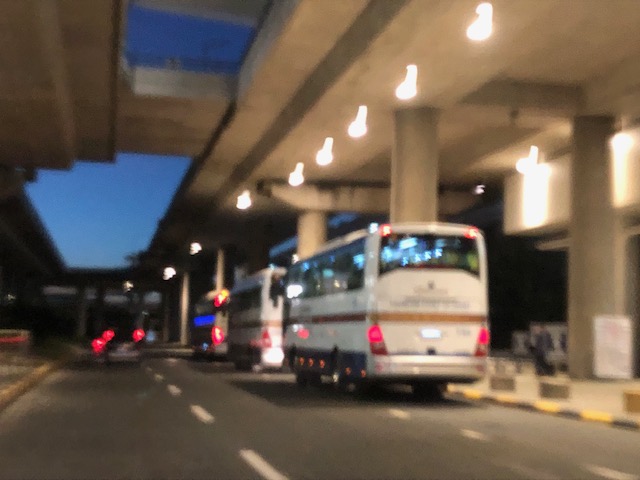 Airport P2P buses include those headed for Clark.
–
Another look at Laguindingan Airport
A quick trip to Cagayan De Oro allowed me to take a few more photos of the airport at Laguindingan. Here are more photos of the airport including the runway and the major buildings.
 A look at the length of Laguindingan’s runway as our plane turned towards the terminal
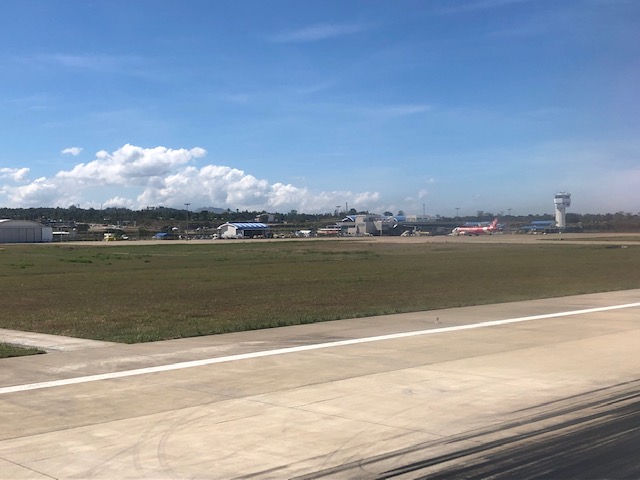 From L-R: hangar, cargo terminal, passenger terminal and control tower
 A closer look at (L-R) the cargo terminal, passenger terminal and control tower
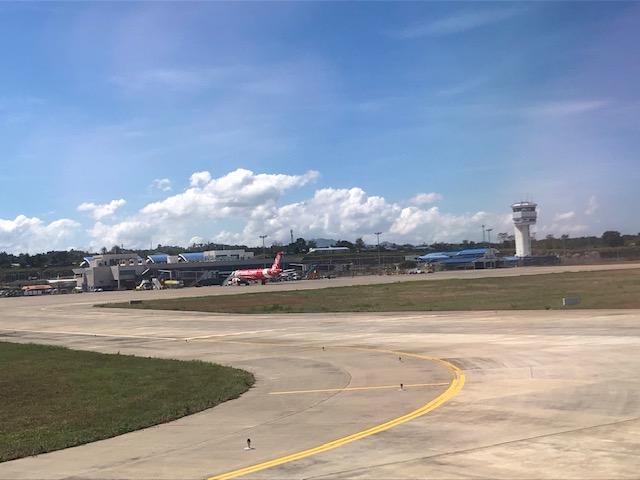 The passenger terminal and control tower
 Laguindingan’s cargo terminal
 Air Asia plane at the passenger terminal
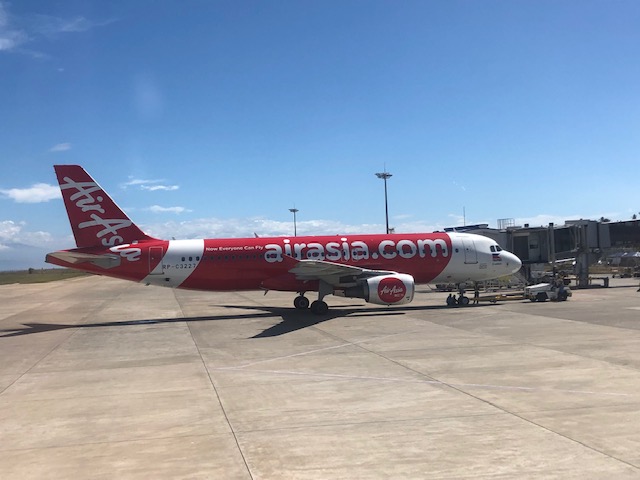 The Air Asia plane did not use the bridge for embarking/disembarking passengers
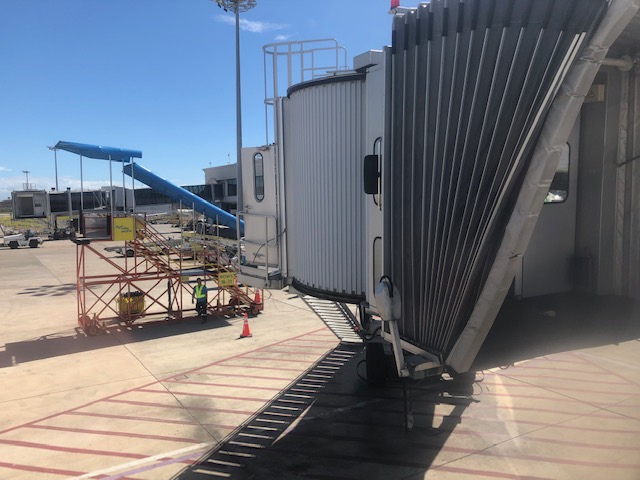 Bridge access to the terminal
 An arriving passenger’s view of transport service providers upon exiting the airport terminal
 Air traffic control tower.
–
On motorcycle ambulances and first responders
I’ve seen some articles about app-based motorcycle taxi TNC Angkas establishing what they claim as the first motorcycle ambulance service. To be accurate, they are marketing this as a first responder service rather than an ambulance so there’s something wanting about news articles highlighting the “ambulance” instead of “first responder” angle.
Here’s the post from February 2014 (4 years ago) that I wrote based on a documentary by GMA 7:
“Habal-habal ambulance,” https://d0ctrine.com/2014/02/01/habal-habal-ambulance/ [Last accessed: 12/2/2018]
Motorcycles have been used as ambulances particularly in rural parts of the country for quite sometime now. They are able to access areas that are difficult to access via 4- or even 3-wheeled vehicles. As a first responder type of service for medical purposes though, I have not seen any formal documentation or article about such application – yet. The service though is promising as you can observe emergency service vehicles like ambulances having trouble reaching their destinations due mainly to traffic congestion. First responders on motorcycles can have better chances and at the least perhaps provide the much needed first aid before the ambulances arrive. However, I think the jury is still out there in terms of how this will be a paid service. Do you pay (book?) first before someone comes to your aid or is payment made afterwards. This can be a sensitive issue and one that needs further assessment soon.
–
Signs of the times – road signs or ads?
A friend recently posted an episode on his vlog that featured the excessive signage we now find along many roads. I thought this was a relevant topic as, for one, there are many signs that are basically contributing to the “visual pollution” that tend to either distract travellers or make them numb about these signs. Hindi pa kasali dito ang mga LED/video ads that are now installed around the metropolis. Being a distraction means they may lead to road crashes. But then there is also the issue of clutter and obstruction. I noticed that many signs have been installed without consideration of the spaces required by pedestrians and cyclists. Many seem to have been forcibly installed at locations blocking the path of pedestrians.
 So which among these signs is the only one that should be there? Only one and that is the one in the middle informing travellers of the signalised intersection ahead. The others are basically ads masquerading as signs (directional signs to be more specific).
I avoid describing inappropriate signs as ‘illegal’ simply because the proponents were given permission for installation by local government units including the MMDA. LGUs seem to benefit from these as I also see inappropriate signs bearing the logos or slogans of LGUs. Meanwhile, the DPWH seems to be mum about this concern, which appears to be a non-issue among the government entities involved. What do you think about such ads pretending to be road signs?
–
On re-designing or re-imagining our transportation system for people
Here is another good read especially for those who advocate or even just beginning to appreciate the concept of people-oriented transportation:
VannPashak, J. (2018) “Design for humans as they are, not as you want them to be,” http://www.medium.com, https://medium.com/@jvannpashak/design-for-humans-as-they-are-not-as-you-want-them-to-be-ef95076c0988 [Last accessed: 11/23/2018].
In a recent symposium where I made a presentation about low carbon transport and visioning and re-imagining transport, I was asked how we can re-design our transportation to be more people-oriented than car-oriented. I replied that we have to do a lot of unlearning. That is, many planners and engineers would need to unlearn many things they’ve learned in school and those they got from their workplace. One convenient excuse for not coming up with a better design, for example, is that certain planners or engineers just followed what their offices or agencies have been doing. What if what their offices and agencies (and consequently their seniors at work) where wrong all these years and what was “ginagawa na” or “nakasanayan” have led to deficient outcomes? I even joked about whether these offices or agencies were “open minded” referring to a favourite by-line by networking companies. Being open-minded in the context of having people-oriented transport solutions would be difficult if everything was “nakakahon” because these were what you learned from school and/or the workplace. It is difficult to admit that something was and is wrong.
–
Article on induced demand and why more roads mean more traffic
Here is a nice article about induced demand, which is simply the additional traffic you get on top of the current and estimated traffic from “normal” growth based on the current transportation system and infrastructure once you introduce additional services and/or infrastructure. That is, there is additional trips/traffic generated for when you widen roads or construct a new transit system.
VannPashak, J. (2018) “More roads, same congestion,” http://www.medium.com, https://medium.com/@jvannpashak/more-roads-same-congestion-b2b437ecaa94 [Last accessed: 11/22/2018]
I think the more interesting part of the article is its mention of the work of Redmond and Mokhtarian, which the author provides in a link. Clicking this link brings you to a wealth of articles attributed to the two that are definitely worth reading especially for people seeking understanding for issues related to commuting. Many of the researches and the methodologies in the articles may be replicated for application in the Philippines, and should be taken on as research topics in what can be inter-disciplinary programs or projects.
–
The case for motorcycle taxis in Metro Manila and other Philippine cities
The proliferation of motorcycle taxis (habal-habal) in Metro Manila and other cities is an “open secret”. They have become popular in urban areas mainly due to their being able to go through heavy traffic thereby reducing travel times between origins and destinations. While there are generally other modes of transport to choose from, most of these are likely to be bogged down in traffic particularly along most major roads in our cities. Conventional public transportation, after all, are usually confined to their fixed routes and not having the flexibility to take other roads that are perceived to be less congested. Being “out of line” is a violation of their franchise provision spelling out which road they can take. Taxis and TNVS are more flexible but also would eventually have to contend with traffic. Cost is also a consideration for what are actually car traffic. Motorcycle taxis offer faster and cheaper transport despite the safety concerns.
 Motorcycle taxis in Cebu City – Angkas is very visible in Metro Cebu
 Non-Angkas motorcycle taxis are not so obvious and easily blend in with motorcycles with one (or more) passengers. The Angkas in the photo actually violates its own rules regarding number of passengers with the child also not wearing a helmet.
 An Angkas rider checking his smartphone for the next fare.
I’ve written before about the informal and formal terminals for these motorcycle taxis. They are still very much around and perhaps have multiplied since Angkas got the nod from the courts to continue operations despite being prohibited by the DOTr and the LTFRB, which still do not consider motorcycles as a safe form of public transport. Perhaps it is time to reconsider this policy and give people/commuters another option while we play catch-up with mass transportation? Perhaps the right way to go about this is to require motorcycle taxi service providers to have proper attire including easy to see/easy to identify vests and helmets (helmets should be required for both rider and passenger)? Perhaps their record should speak for the motorcycle taxi services, and people should be made aware of the risks and costs involved should they choose to take habal-habal to travel? And perhaps motorcycle taxis can help alleviate transport problems in our cities?
–
On school trip generation again
Traveling at noontime along Sumulong Highway in Antipolo City, I chanced upon the changing of morning and afternoon shifts for a national elementary or grade school. The scene is similar to that of the high school I posted previously but there were more people here considering many grade school children were with their parents or guardians, easily doubling (more?) the number of persons generated by elementary schools. However, there are few private vehicles generated by this public school and so congestion along Sumulong Highway is due to the sheer number of people entering, exiting and waiting at the school’s single gate and the tricycles manoeuvring in the area. I also noticed here that most people did not take a vehicle to go to/from school but walked to/from their homes. Again, this underlines the issue about where we send our children for schooling and how they commute. It also says something about the quality of schools that ‘force’ parents to choose the more exclusive ones located a good distance away from where they reside.
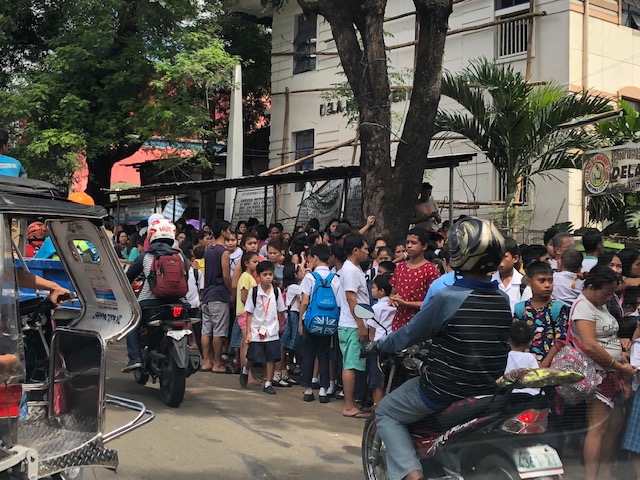 Students arriving at the school have to fall in line and wait for the morning batch to come out. There is very limited space outside the school so people including parents and guardians spill out of the sidewalks and occupy part of the curbside lane.
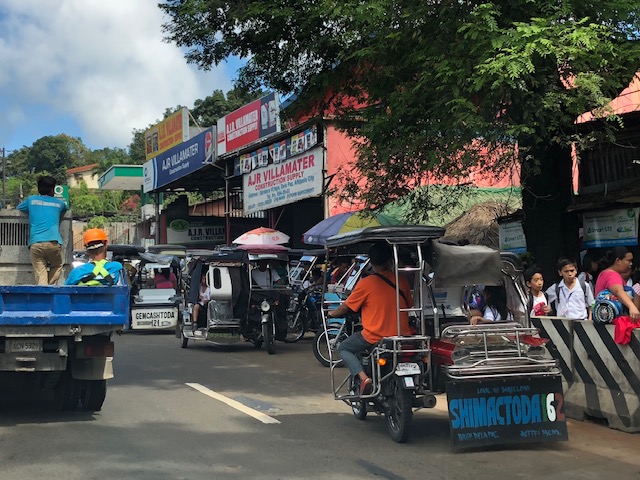 Causing some congestion were tricycles manoeuvring as they brought in students. Those waiting for their potential or intended (sundo) passengers were lined up along the curb side.
–
On school trip generation
I chanced upon the changing of the shifts for a national high school. This was the time of day when the morning shift students were dismissed (i.e., coming out of school) and the afternoon shift students were coming in.
 Students come out of the school to mainly either walk or take public transport (mostly tricycles) to their homes.
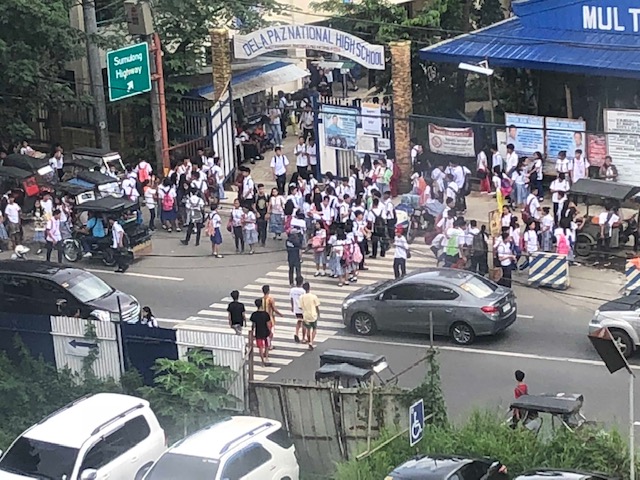 Most vehicles give way to people, especially students, crossing the busy street. There are usually traffic aides in the area who help manage traffic and to ensure pedestrians may safely cross or move about.
There are no severe traffic congestion here unlike those generated by many exclusive or private schools. There is actually a private school just beside this public high school that also generates significant private vehicle traffic but somehow manages not to congest this major road that’s part of the L. Sumulong Memorial Circle the way another private school congests Sumulong Highway in the mornings.
Is this simply because of the school being a public school as compared with private schools? Perhaps it is, given the perceived disparity in income classes concerning those going to typical public schools and those going to typical exclusive schools. But income disparity aside, wouldn’t it be possible for most students to just walk or take public transport to school? I actually envy the public school students in the photos above as they can walk to school. And that is because they likely live near the school, which is something that is a desirable situation if public schools are at least at par in quality with the more established private schools (especially the sectarian ones where many parents likely prefer their children to go to). This disparity in quality leads to people residing in relatively long distances away for the preferred schools to travel (often with their private vehicles) to and from the exclusive schools. The point here is that it really is more complicated than what it seems in terms of trip generation.
–
 Caught (up) in traffic