
On child-friendly cities
Here’s another article that I want to share. This time it is about child-friendly cities. Here is an article that present many good practice examples in other cities. Many are easily replicable in our towns and cities, and should be considered by local governments in order to enhance safety and health aspects in their jurisdictions.
Laker, L. (2018) “What would the ultimate child-friendly city look like?”, theguardian.com, https://www.theguardian.com/cities/2018/feb/28/child-friendly-city-indoors-playing-healthy-sociable-outdoors [Last accessed 3/9/2018]
–
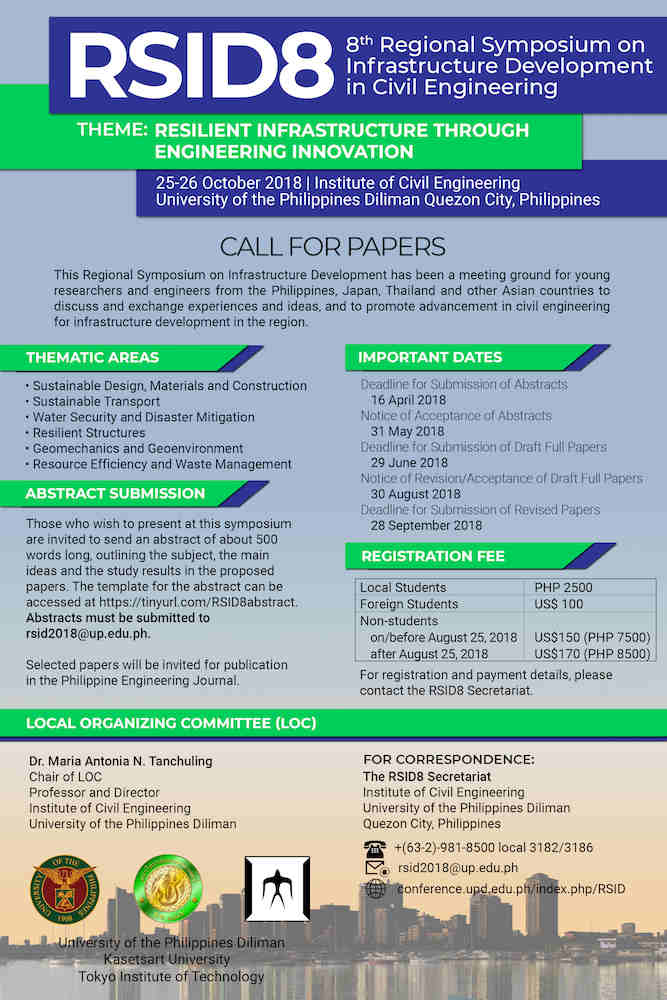
8th Regional Symposium on Infrastructure Development (RSID)
I would like to promote a symposium that our Institute of Civil Engineering (ICE) at the University of the Philippines Diliman will be hosting this year.
The Institute of Civil Engineering, University of the Philippines Diliman together with Kasetsart University (Thailand) and Tokyo Institute of Technology (Japan) is pleased to invite you to participate in the:
8th Regional Symposium on Infrastructure Development
in Civil Engineering (RSID8)
Theme: Resilient Infrastructure Through Engineering Innovation
Date & Venue: October 25-26, 2018 Institute of Civil Engineering,
University of the Philippines Diliman, Quezon City Philippines
Abstract Submission:
Those who wish to present in this symposium are invited to submit and abstract of about 500 words under the following themes:
Sustainable Design, Materials and Construction
Sustainable Transport
Water Security and Disaster Mitigation
Resilient Strudtures
Geomechanics and Geoenvironment
Resource Efficiency and Waste Management
Deadline for Abstract Submission: April 16, 2018
Template: tinyurl.com/RSID8abstract
Please see attached poster of call for papers for more details.
Kindly disseminate to your colleagues who may be interested.
For more information of the conference please contact:
Christian R. Orozco
RSID8 Secretariat
Institute of Civil Engineering
University of the Philippines Diliman
Email: rsid2018@up.edu.ph
Website: conference.upd.edu.ph/index.php/RSID
–
On the Pasig HOV lane experiment, again
I recently wrote about some thoughts on Pasig City’s HOV lane experiment along Julia Vargas Avenue. Here are a few more considering the experiment didn’t push through last February 28.
 Screen cap (courtesy of ABS CBN) showing the starting date for the HOV lane experiment. I think ‘HOV’ is more appropriate than ‘carpool’ since the requirement is for vehicles using the lane to have 4 or more passengers. Having only 2 passengers still qualify as a carpool.
I learned recently that the experiment has been put off to March 26, 2018:
 [Photo courtesy of Dulce Justiniani]
The current set-up has 2 lanes for motorised vehicles including a wide lane for HOV’s (including public utility vehicles like buses and vans). HOV’s here also include cars but those with at least 4 occupants. Here are a couple of photos showing us what could possibly happen should enforcement be weak given the configuration of the lanes along Julia Vargas:
 Private van running along the lane designated for HOV’s alongside a solitary cyclist on the bike lane.
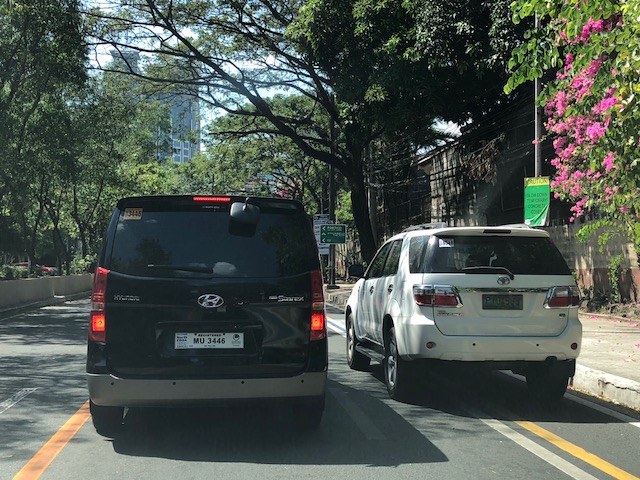 An SUV overtaking the van via the bike lane and the extra space of the HOV lane.
Wide lanes generally encourage higher speeds. I believe the way to go would be to have narrower lanes. And should these be considered, it would be possible to have 3 lanes for motorised traffic with one assigned for HOV’s and another for motorcycles. These are aside from the bicycle lane that I think should also be a protected lane. Protection here may be through the provision of “forgiving” physical dividers in the form of, say, rubber bollards.
Here’s how the Julia Vargas carriageway could be laid out:

Again, these are just suggestions for whoever are in-charge of the experiment-to-be along Julia Vargas Avenue. I hope that they are able to make some assessments even prior to the experiment. Such can be done using simulation software in order to have a handle on traffic related issues that may crop up during the implementation. Still, a big factor would be the enforcement aspects of the proposed policy for motor vehicles. Strict, firm and sustained enforcement would be necessary in order for this to succeed.
–
On prioritising pedestrians and promoting walking
We begin March with an excellent article that came out from curbed.com:
Walker, A. (2018) The case against sidewalks and how cities can create new avenues for pedestrians, curbed.com, https://www.curbed.com/2018/2/7/16980682/city-sidewalk-repair-future-walking-neighborhood [Last accessed 2/23/2018].
How do we improve the environment (i.e., facilities) to encourage people to walk? Do we simply clear up sidewalks? Widen them? Build overpasses and underpasses? What should be the context for improving pedestrian facilities for our cities and municipalities? What are the implications to planning and design?
–
Another walkability tool: Pedestrians First
The ITDP recently came out with a new walkability tool called Pedestrians First. Here’s the link to their site where you can download the tool. The tool was released in the recently concluded World Urban Forum held in Malaysia.
https://www.itdp.org/publication/walkability-tool/
Of course, there are other tools out there including one developed by Clean Air Asia, material on which may be found through the following links:
http://cleanairasia.org/walkability-study-in-asian-cities-4/
Our technical staff and my students are currently using the methodology developed by Clean Air Asia and have covered several major thoroughfares in Metro Manila and a highly urbanized city in studies that have been undertaken in the last 6 years. I already asked them to take a look at the new tool and see how this compares with the ones we are using.
–
On learning from the experiences of others about transit ridership
I again share an article; this time on transit ridership (or on the passengers using public transportation).
Buchanan, M. (2018) Lessons on Ridership, from the National Literature, transitcenter.org, http://transitcenter.org/2018/01/29/lessons-on-ridership-from-the-national-literature/ [Last accessed 2/21/2018]
Perhaps we can learn from the experiences of other cities in as far as public transport use is concerned? For example, what impacts emerging technologies and the sharing economy (e.g., ridesharing) have on public transport ridership and how to meet these challenges to retain a majority of public transport users over low capacity modes.
–
Progress of C-6 expansion and upgrading
The recent news about the groundbreaking for the C-6 expressway led some people to this site and looking for information on C-6. Here are more photos I took last month (January 2018):
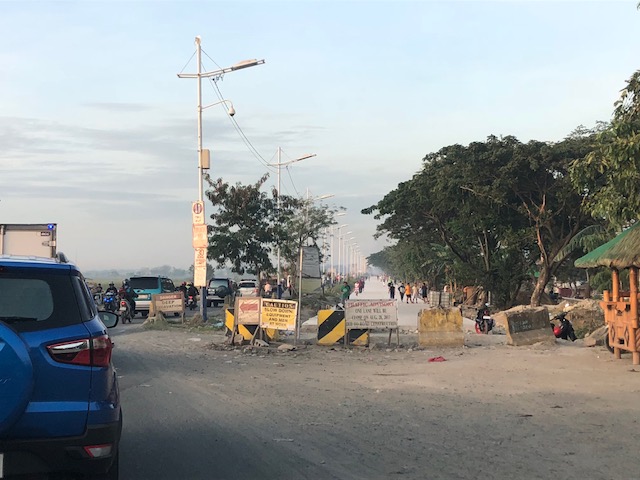 The future northbound lanes of C-6 is currently under rehabilitation and are being upgraded to Portland cement Concrete Pavement (PCCP). The new southbound lanes currently serve the two-way traffic.
 The sign is an old one and perhaps still in use as a barrier more than for information
 You see a lot of people jogging, walking and cycling along the finished road. It shows the demand for spaces for such activities, including recreation, and a similar situation may be observed along C5 before and along the perimeter of Libingan ng mga Bayani where a lot of people do exercises and other activities along road sections that are closed to vehicular traffic.
 With one lane completed the second lane is prepared for pouring of concrete. You can see the formworks along the median.
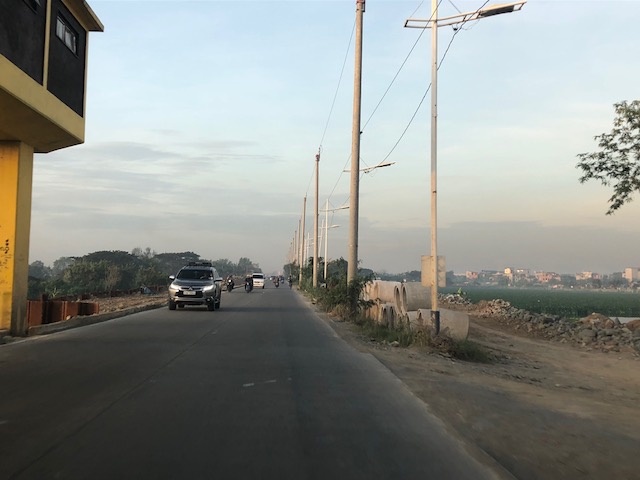 Other sections have yet to be prepared for concreting but have been stripped of the old pavement (Asphalt Concrete pavement or ACP).
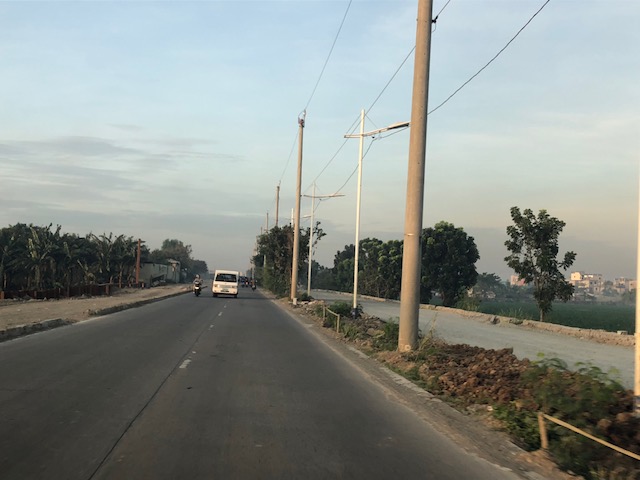 What you see here at right is the compacted base/sub-base layer. The forms have not been installed yet.
 Backhoe and roller at the worksite.
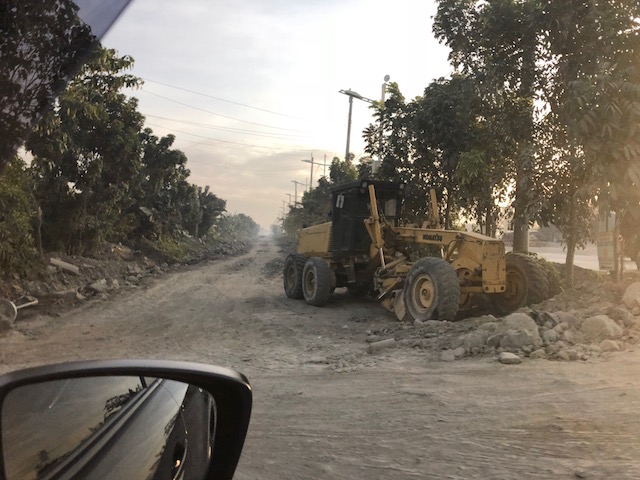 A grader in action.
I will post more photos later from the next time I pass by the area. From what I’ve hear so far, traffic has eased along the expanded Barkadahan Bridge but there are still bottlenecks to address along this alternative route. There will also be a need to have a higher capacity, less friction connection between C-6 and C-5 as traffic along C-6 increases and it’s become quite obvious that Taguig’s narrow streets cannot handle this increasing travel demand between the two highways. It makes sense to have a higher quality, limited access road for this purpose since Taguig roads are already congested and through traffic poses a safety hazard to the residential areas where vehicles travel through.
–
On the PUV modernisation program – Part 1
Much has been written about the government’s PUV (or jeepney?) modernization program so I wouldn’t really be reposting about these. Instead, I will be featuring some opinions, insights and observations about its implementation.
Following are photos of one e-jeepney model that the government appears to be promoting. This is the e-jeepney produced by Star8 that they claim to be have solar panels for charging while they are on the road. Of course, we know they are not wholly dependent on solar power and have to be charged the conventional way through an adaptor that’s plugged into a regular outlet. These e-jeepneys were supposed to supplement the reduced supply of public transport to mainly UP students, staff and faculty members when the i-ACT (Inter-Agency Committee on Traffic) conducted their “Tanggal Bulok, Tanggal Usok” campaign in the UP Diliman area. First-hand reports revealed otherwise as the e-jeepneys spent more time on stand-by and just charging at one of the buildings on campus.

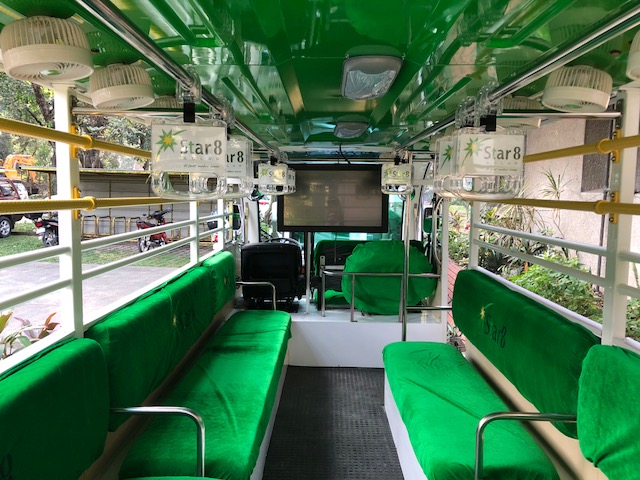


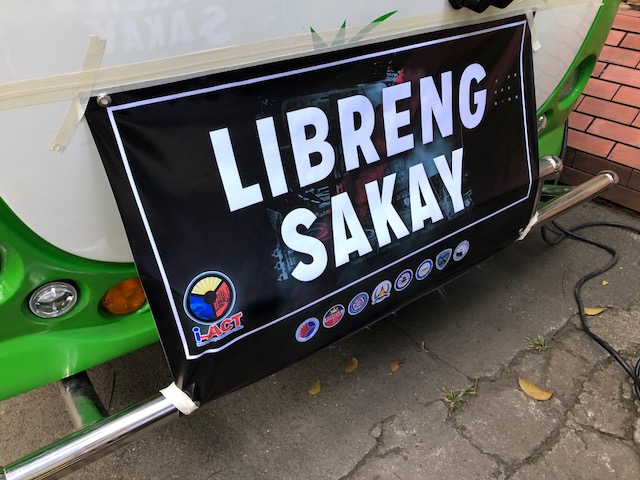
These are the same e-jeepneys that have been deployed and currently roaming around Tacloban City (promoting themselves?). The intent was for these to be the vehicles plying the new routes approved by the LTFRB/DOTr, which they claim was in response to the request made by Tacloban. The new routes though overlapped with many existing jeepney routes, clearly in violation of the general rule regarding overlapping routes, but allowed nonetheless by the regulating authority.
There are many allegations going around about e-jeepneys being forced upon operators and drivers given what has been regarded by progressive groups as unrealistic (read: unaffordable) financing schemes for the new vehicles. These are certainly not cheap, and double to triple the price of a ‘newer’ conventional jeepney. There are also suspicions about the strong motivation for the phaseout in favour of what are peddled as the successor (or replacement) to the jeepney. That includes a possible collusion among officials and the companies behind these vehicles and allegations (again) of some people likely gaining financially from the set-up. The DOTr and LTFRB PR machine, however, deny this and will gang up on anyone posting about this in their social media page.
–
On the Pasig HOV traffic experiment
Someone shared a post about a traffic scheme they will be implementing along Julia Vargas Avenue in Pasig City. The proposal is for the avenue to have a high occupancy vehicle (HOV) lane where vehicles with 4 or more occupants are to take one lane and all other vehicles the other. I am not entirely sure about the objective other than to promote high occupancies for vehicles. However, it would be nice to see how travellers will be behaving (e.g., complying) and how Pasig (with MMDA?) will be enforcing this scheme.
This is what a segment of Julia Vargas currently looks like with 2 wide lanes designated for motor vehicles (separated by the solid yellow line) and one narrow lane for cyclists (adjacent to the shoulder):
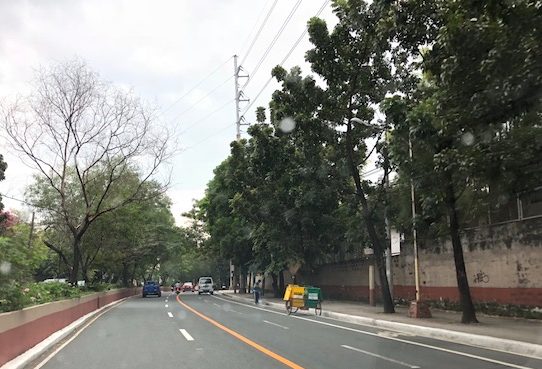
The intent is good but as a major link the scheme can be quite confusing especially for those who are not necessarily frequent users of this road. I assumed the yellow line was painted by the DPWH but it seems it was by Pasig. Perhaps they should have removed the old markings? Or maybe better if they rationalised the carriageway width to accommodate 3 lanes for motor vehicles and 1 wider lane for bicycles? From the photo above, it appears to me that it is possible to have 2 narrow lanes for general traffic and one wider lane for HOVs (in this case defined as having 4 or more occupants) and public utility vehicles. This configuration maximises the capacity of the road while having a the “best” lanes allocated for HOVs and bicycles.
I wish them success on this social experiment. Perhaps there can be valuable learnings from this including the need for connectivity to other links as well.
–
Airport airside congestion in London
My wife sent me this photo prior to taking off from London Heathrow on her way home.
 That’s a very long queue of planes waiting to take off!
This reminded me of the articles that came out about a multi-billion peso plan to expand the Ninoy Aquino International Airport with a giant terminal forming out of connecting Terminals 1, 2 and 4. Even with a huge terminal building with a much higher passenger capacity, NAIA still would’t be able to solve its congestion woes with only 2 (intersecting) runways. Take it from the capital city airports in the region including Singapore’s Changi that has multiple parallel runways that allow for almost simultaneous take-offs and landings. Such allows the airport to handle more flights – plain and simple.
–
 Caught (up) in traffic