
Home » Academe
Category Archives: Academe
Looking back on Philippine railway history
The Philippine Railway Conference 2025 is coming up soon. I am very glad to see a lot of people interested in rail – from the technical people running our railways to those involved in planning and management to the advocates and enthusiasts. Rail was not so “fashionable” or “glamorous” (to use these words liberally) many years ago. Perhaps people traveling and experiencing rail in countries where it has persevered and evolved plus social media have changed this – and for the better. Sharing here some papers that were the outcomes of an interdisciplinary research program led by the Third World Studies Center of UP. Rail, after all, is not just about the technical but also the social and human aspects of the mode.
The website for the Emerging Inter Disciplinary Research (EIDR) program supported by the UP System is still up and hosted by the Third World Studies Center. I think it’s something worth a Phase 2. The program leader, Dr. Ricardo Jose, is now retired from UP but is a Professor Emeritus of UP so he can still be engaged. Nevertheless, there are many at UP and other higher education institutions who can be involved in a program that should have a more expanded coverage. There were railways, after all, in other parts the country including Panay, Negros, Cebu and Mindanao.
–
On safety along boring roads
I saw this interesting article about “boring” roads. It seems to be consistent with anecdotal evidence about ordinary roads with unremarkable features especially along adjacent lands. What may be termed as “beautiful” and “remarkable” may not necessarily be distractions to road users. Rather, it may keep people’s attention on the roads and people outside cars or, as the article refers to them, non-motorist car injuries or fatalities. There seems to be some confusing outcomes or perhaps confusing use of terminology in how the article is written (i.e., how perceptions are stated in the article).
Wilson, K. (August 21, 2025) “Study: Boring Roads End Up With More Injuries For People Outside Cars,” Streets Blog USA, https://usa.streetsblog.org/2025/08/21/study-boring-roads-end-up-with-more-injuries-for-people-outside-cars [Last accessed: 8/27/2025]
Quoting from the article:
“Researchers at the University of Connecticut recently analyzed the emotional reactions of more than 81,000 volunteers to a trove of Google Street View images from 56 cities around the world — and found that certain recurring perceptions correlated tightly with how many car crashes involving vulnerable road users actually happened where those photos were taken.
Perhaps unsurprisingly, the participants were pretty good at gauging whether a road was “safe” for walking and biking just by eyeballing it and reporting on how safe it made them feel in general, adding further evidence to the pile that “perceived safety” is a critical metric that every transportation leader should take seriously. Streets that volunteers perceived as “wealthier” also tended to record lower crash volumes — which also might be intuitive, considering that some of the most obvious signs of neighborhood affluence can be great public infrastructure like smooth sidewalks, pristine bike lanes, and ample street lighting.
Roads that were rated as “lively,” meanwhile, were associated with higher crash volumes — though the researchers were careful to note that may just be because there were more people in those images, and crash rates per capita, or per pedestrian- or bike-mile traveled, might actually be lower in hopping human-centered areas.”
In that last paragraph, the term “lively” might have different perceptions depending on the people looking at images of streets. In our case, the street scene in Divisoria, for example, can be described as “lively” yet it may be safer than what is perceived in other countries, especially in the west. I think we have to be careful with the kind of studies as described in the article and to be fair, they did say that their study is still at an exploratory stage.
–
Article share: On AI as a tool for urban planning
Here is a quick share of an article on AI and its application to urban planning. I haven’t written about artificial intelligence here except maybe mentioning it along the lines of intelligent transport systems (ITS). There were what were termed as Expert Systems but AI now (including its potentials) is much more than the expert systems developed in the past.
Sanchez, T. (June 20, 2025) “In Urban Planning, AI Prompting Could be the New Design Thinking,” Planetizen, https://www.planetizen.com/blogs/135418-urban-planning-ai-prompting-could-be-new-design-thinking [Last accessed: 7/17/2025]
To quote from the article:
“Working across disciplines is essential. Collaborating with architects, landscape architects, engineers, artists, and technologists brings in diverse perspectives that can help spark new ideas. AI integrates knowledge and techniques from each of these fields. Contributing to a culture where planners feel free to experiment, where trying something new is encouraged rather than being frowned upon, is key to real innovation. Whether engaging with colleagues or prompting an AI model, creativity thrives in conversation and collaboration…
Cities should be shaped by creative thinking, and today’s challenges demand more of it than ever. Planners are in a unique position to combine deep local knowledge with new technologies, such as AI, to imagine, design, plan, and implement. AI should be seen not as a shortcut, but it has incredible potential as a partner or assistant with encyclopedic knowledge that helps planners stretch their creativity even further. As Wright advises, planners should challenge themselves with constraints to spark creativity: For instance, “What would you do if you had to write an entire zoning ordinance with 10 rules or less to make a sustainable built environment?” Such exercises encourage us to set clearer goals and find better solutions.
By combining traditional tools with emerging technologies, planners can design places that are not only functional but also vibrant, equitable, and resilient.”
What do you think about AI and its applications to urban planning including transportation and traffic?
–
Let’s act on road safety crisis!
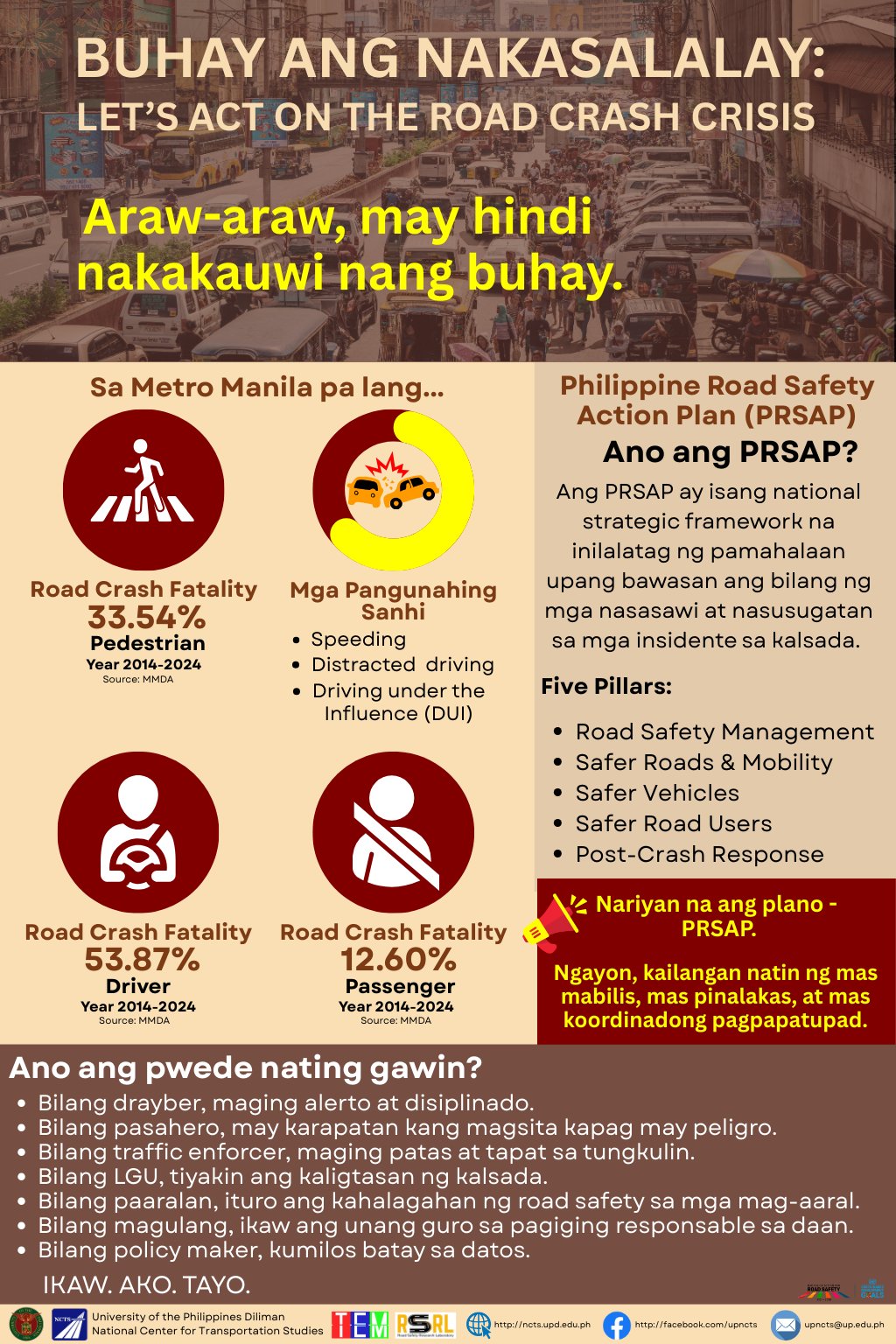
May is Road Safety Month. It’s quite ironic that we started the month with some of the most gruesome crashes including one at SCTEX and another at NAIA. There is indeed a crisis on road safety but many are in denial or perhaps insensitive to the impacts of these crashes. We need to act and only together can we be most effective in reducing the risks for all road users.
So what can one do? How can one contribute to making roads safer? Sharing this poster from the Road Safety Research Laboratory (RSRL) of the National Center for Transportation Studies (NCTS) of the University of the Philippines:
–
Article share: On improving the Philippines’ transport system
I share this article on the desire for a sustainable transportation system for the country. This was written by a former Assistant Secretary of the Department of Transportation (on secondment) who has returned to teach at the School of Urban and Regional Planning of the University of the Philippines Diliman. Here is the article published by the Philippine Daily Inquirer:
To quote from the article:
“The present condition of the Philippine public transport system is indispensable to the desired transition from more sustainable, in this case, electric forms of transportation—to a better public transportation system. A good public transportation system is defined by reliability, accessibility, safety, and security…
The imperative to consolidate is clear and crucial. It is not just a technical necessity, but a pathway to inclusive growth where all stakeholders benefit from the transition, and where we can truly create an inclusive and sustainable system for public transportation.
Improving public transportation, by making it cleaner, safer, and more accessible, will directly enhance the quality of lives of Filipinos.”
–
On transportation and global health – article share
I was supposed to write about the keynote lecture delivered during the 30th Annual Conference of the Transportation Science Society of the Philippines (TSSP). I am sharing instead an article written by Dr. Renzo Guinto who is an Associate Professor at the SingHealth Duke-NUS Global Health Institute based at the National University of Singapore.
Here is the link to his article on the Philippine Daily Inquirer: Health at the center of transport and mobility
I will not quote from the article and leave it to my readers to read and appreciate the articles content.
–
30th Annual Conference of the Transportation Science Society of the Philippines (TSSP)
I was not able to post on the conference itself but it was definitely a success including the pre conference workshop (Workshop for Young Researchers or WYRe) held for the benefit of young researchers in transportation science.
Here is the link to the TSSP’s official page featuring the program for the Technical Sessions: https://ncts.upd.edu.ph/tssp/archives/2972
There were 6 sessions with papers on public transportation, active transport, traffic engineering and others including port operations and safety. A total of 27 papers were presented and in attendance were more than 150 people, mostly from the academe. The conference was conducted in cooperation with the University of the Philippines Visayas and the City Government of Iloilo. When available, I will also later share information about the very informative and enlightening keynote lecture delivered in the morning of the conference on the topic of Global Health.
–
Technical sessions at the TSSP 2024 Conference
I am sharing here the latest draft of the technical sessions for the 30th Annual Conference of the Transportation Science Society of the Philippines (TSSP). The conference will be held in Iloilo City this coming September 13, 2024.
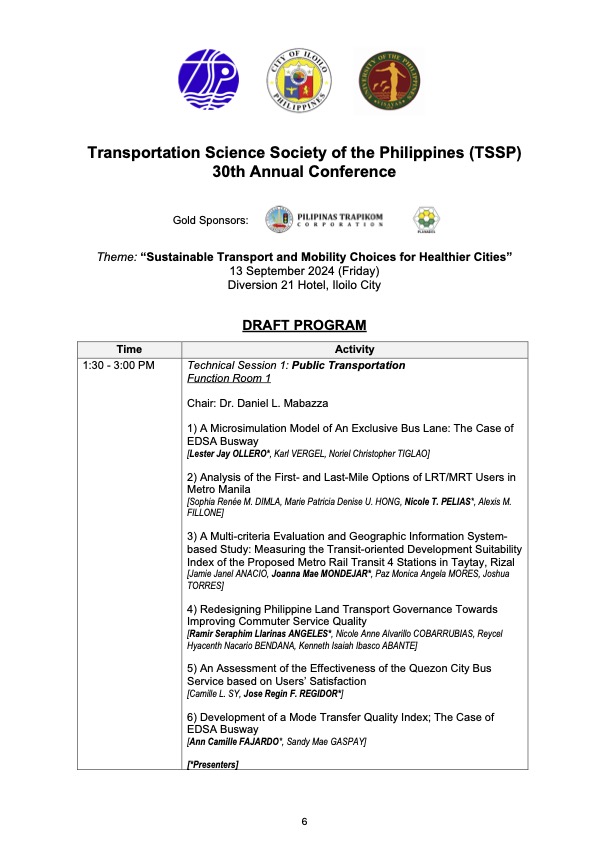
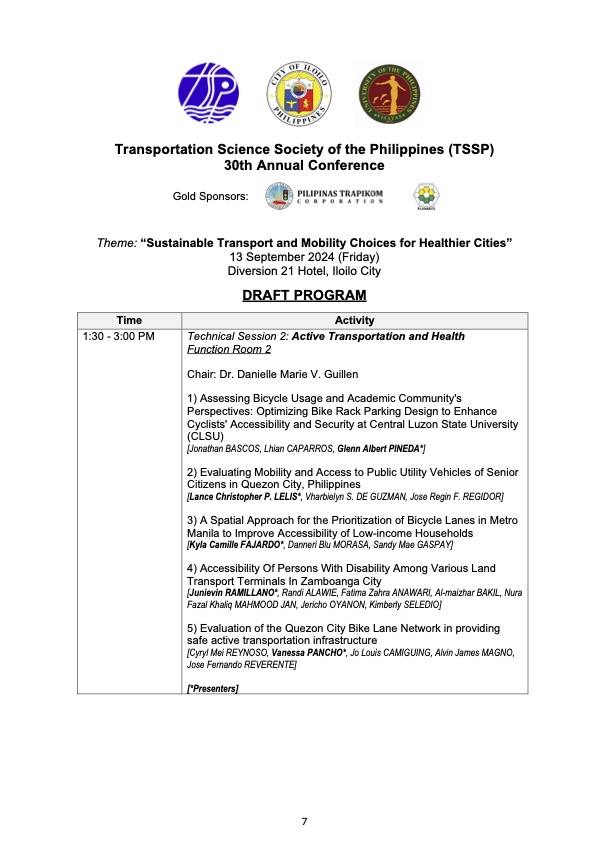
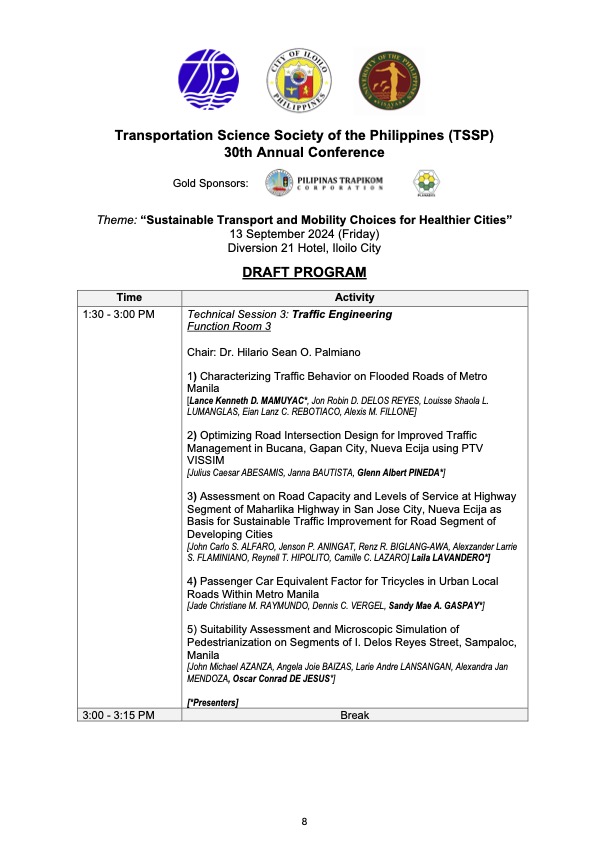
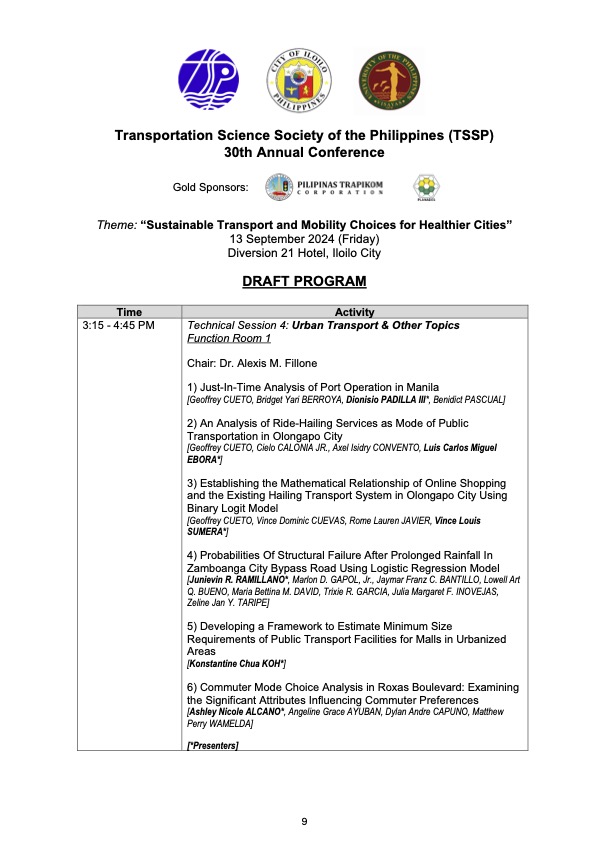
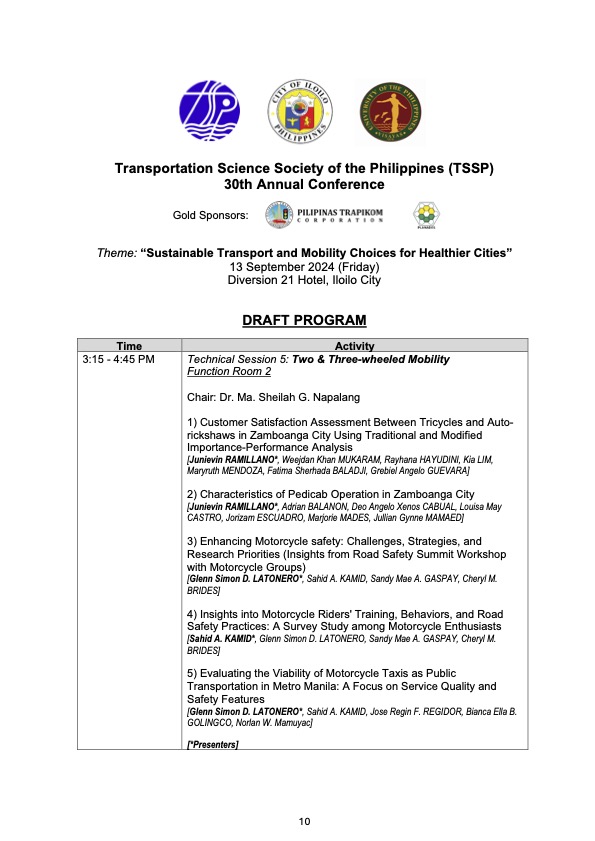
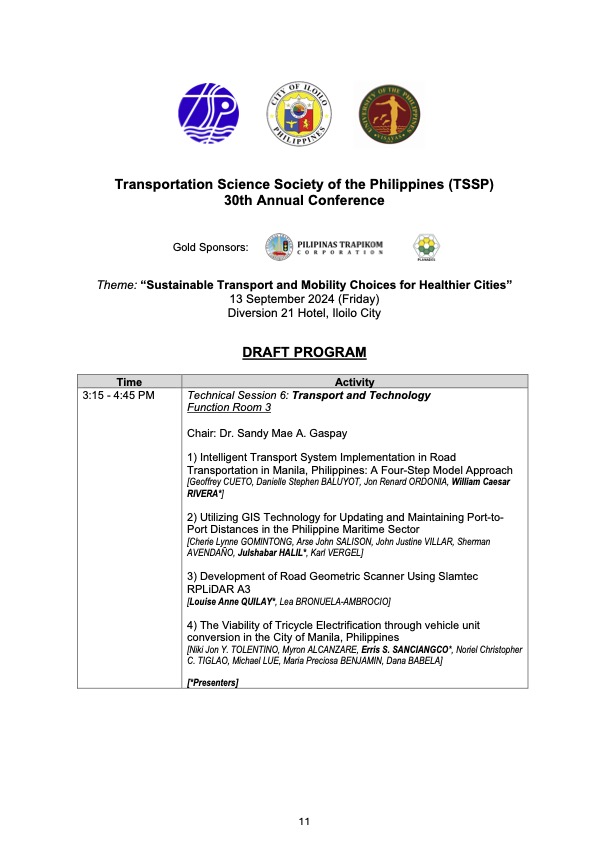
I will share the draft program for the morning plenary session in the next post.
–
Article share: Picking it up as we go: how transportation agencies can learn from university research
Here’s a quick share of an article on the JTA Research Lab. This is a good example of how transportation agencies can learn from university research and also how they can collaborate or cooperate with academe to formulate solutions to various transport problems or issues.
JTA Research Lab has been created to identify critical transportation policy questions, and get academics to help solve them. Pencils sharpened? Nathaniel P. Ford explains…
Source: Picking it up as we go: how transportation agencies can learn from university research
30th Conference of the Transportation Science Society of the Philippines
I am sharing here the First Call for Papers for the 30th Annual Conference of the Transportation Science Society of the Philippines (TSSP). The conference will be held in Iloilo City almost to the day of the last time it was held there in Sept. 12, 2014.
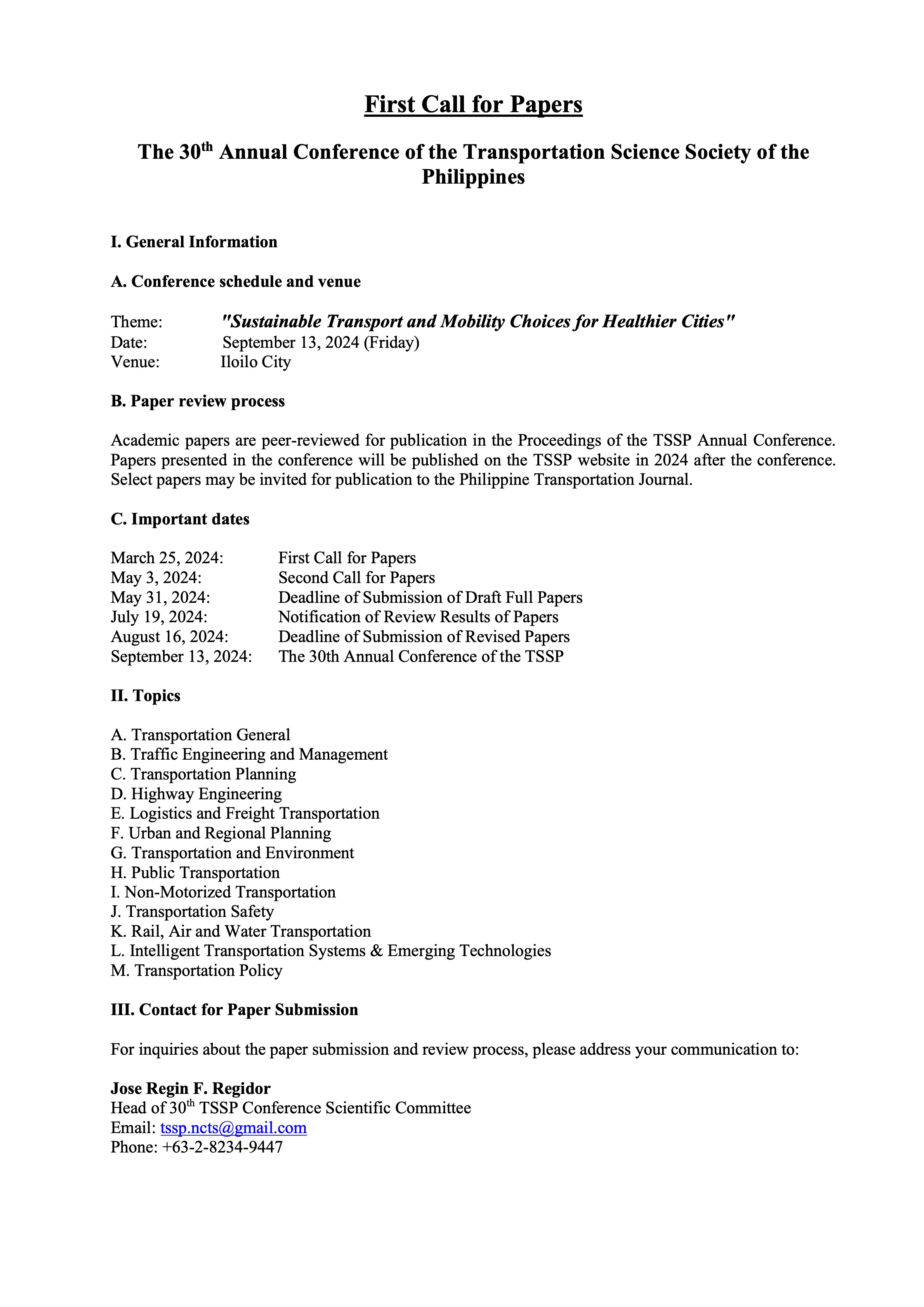
Information on past conferences may be found here: https://ncts.upd.edu.ph/tssp/conferences
–
 Caught (up) in traffic