
Home » Academe (Page 10)
Category Archives: Academe
Research topics on transport and traffic in the Philippines?
I noticed that this site has received a lot of hits for inquiries regarding undergraduate research topics. While we at UP have yet to start our first semester of the academic year 2015-2016, other schools have already started their semesters, trimesters or quarterms. I suspect students in their final or graduating year would be looking for topics for their research projects or, what some schools refer to as the undergraduate thesis projects.
I have written about our undergraduate researches at UP Diliman the past few years and listed down the topics our students have implemented for their undergraduate projects. In our case, we have 2 subjects that our students take during their final year – CE 190, a one unit course that focuses on the formulation and approval of the research project and CE 199, a three unit course for the implementation of the approved project. These are taken over 2 semesters, usually the last 2 that the student takes before graduating.
Unfortunately, not all schools would have the capability and capacity to advise students taking on topics on transport and traffic. I noticed that many schools and their advisers just let their students select topics of their own choice. Many provide minimal if any guidance to students. The latter often choose topics on current issues or problems without checking if they have the knowledge and tools to undertake substantive studies. Often too, it seems to us that the advisers are not capable of providing guidance to their own students and as such just let them seek advise elsewhere including people they would identify as resource persons but to whom they would be more dependent on for advice than their schools’ faculty members. Although their enthusiasm and interest in various topics are commendable and there are many out there who would be gracious and generous to share their time, knowledge and experience with these students, they cannot do so as regularly as full-time faculty members. In fact, it is unfair to these people whose times and resources are already constrained by their own responsibilities (e.g., a professor at DLSU also has his own students to guide and classes to teach).
Schools need to develop their own research agendas. That is so that students would be able to choose topics that their faculty can realistically and effectively guide their students instead of sending them out to become the burdens of others. These would include topics concerning local issues. Are there road safety issues at locations such as intersections near the school? Are the streets in the nearby CBD experiencing congestion? Is there an oversupply or lack of public transport services in the city or a nearby town? It seems awkward for a university in Pampanga, for example, to have students taking on a topic concerning EDSA-MRT or students of a university in Metro Manila taking on a topic on Mindanao railways, if their faculty have no relevant experiences or capabilities to properly guide the students.
I would encourage schools to identify topics concerning local issues first. As they say, charity begins at home, and working on solutions for local problems should be top of the agenda of any school. That includes us at UP and there are many topics that focus on issues in and around UP Diliman. If we can’t solve our own problems then how can we be believable in addressing those outside our direct influence area?
In the next post, I will share and example research agenda from the last academic year. This was the basis for our students selecting topics for their undergraduate researches and as starting points for our graduate students in formulating topics for their MS thesis.
–
Research agenda and topic selection
A friend asked me how topics for research are selected by our students. Were these assigned to them or were they able to select from a list of topics provided to them? The answer is actually “either” or in some cases, “both.” We provide a list of topics to our students and they get to select the topics. Some topics are quite popular so we ask students to state their first and second choices, and then ask faculty advisers to discuss the topics with the students to determine the specifics as well as whether groups can be composed to tackle certain topics.
The Institute of Civil Engineering’s six groups (Construction Engineering & Management, Environmental, Geotechnical, Structural, Transportation, and Water Resources) all have their own research agenda, which are typically classified for the short, medium and long terms, as well as for the main and sub-topics each group has identified. The agenda are regularly updated, at least once a year prior to the start of the academic year.
The current research agenda of the Transportation Engineering Group (TEG) includes topics under the following general headings:
- Traffic Engineering and Management/ Traffic Flow
- Public Transport Planning and Travel Demand Management
- Road Safety and Maintenance
- Transport, Environment and Energy
- Rail, Aviation and Maritime Transport
- Transportation and Technology
- Transport Logistics
The specific research topics under each category change according to several factors including the current researches being undertaken by faculty members. There is also a strong influence from the Engineering Research and Development for Technology (ERDT) program supported by the Department of Science and Technology (DOST). The TEG is also strongly associated with the National Center for Transportation Studies (NCTS) and researches have been supported by NCTS projects. In recent years, there has been a lot of topics dealing with issues at and around the University of the Philippines Diliman campus including studies on public transport (e.g., UP – Katipunan jeepneys, UP – North EDSA jeepneys, etc.) and traffic along major roads (e.g., Commonwealth Avenue, Katipunan Avenue, etc.). These studies are part of initiatives to help address “local” issues. The logic here is that if we cannot solve such “local” problems then we have no business trying to solve problems elsewhere. This is also part of the thinking of UP as a microcosm of the Philippines.
–
On doing research for your undergraduate course requirements
It’s that time of year again when we are swamped with requests for interviews from students taking undergraduate courses. These undergraduate courses include those on Science, Technology and Society, English, Communications, Architecture, Geography, Business, and Economics. These requests are not limited to students from our university but also come from students in other schools as well. While we are happy to oblige, granting interviews face-to-face or through correspondence (through email, of course), we are becoming wary about students not doing their part first before requesting an interview. In many cases, they just fire off a list of questions in the first email, probably hoping the addressee would be kind enough to answer all these questions in a comprehensive manner. That way, perhaps the student will be able to save on time and effort in doing his/her report. That’s right, let the expert answer all the questions and tell me what references I should list down in my report. If the student can’t understand what the expert wrote in reply or if the student thinks its not enough, then the latter could just send a follow-up with additional questions or request another interview.
Is this the right way to do research? I do not agree with this and perhaps the faculty handling their respective courses these students are enrolled under should take care in how they frame their requirements. It is as if they are passing on their responsibilities to other faculty members, experts in their particular fields, who would have to contend with requests for interviews or outright questions in their emails. That’s probably understandable for general education courses like English and STS, but not acceptable for undergraduate research projects that are supposed to be “capping” courses in their programs.
How do I address such inquiries in my mailbox? I do respond immediately and in fairness to the students whom I assume are somewhat misguided in his/her research work; particularly on how to conduct research. My usual reply is that I cannot accommodate the request due to my schedule followed by a counter-request for the student to send me his/her questions first (if he/she hasn’t done so in the first email). If I already have an idea of the students’ topics, then I would suggest some reading material or references first, and hopefully that can help the students frame their questions. That way, I can gauge if the students are really serious about their research or are just going through the motions. It’s difficult for me to be serious or passionate with my replies if the person on the other side of the proverbial table is not at all interested in the topic and treats the exercise as just another requirement for him/her to get a good grade.
Doing his/her part before even contacting experts mean the student needs to do some literature review. That can be in the form of research online and not the kind where the student will just mention a few articles (often opinion pieces) that they read on Rappler, Yahoo or other online sources. There’s a wealth of more scholarly and objective information now available on the net and UP students have access to journals, books and other references through the university’s libraries. These are privileges that they have already paid for as part of their tuition so why let these resources go to waste? I believe students can do a good job in their research projects if they are given proper guidance by their advisers or instructors, who should be the “first line of defense” against mediocrity in their studies at this level. Getting rarer these days are students who come in prepared and are really passionate about the topics they are studying.
–
The numbers that matter – some thoughts on data
Too often we are bombarded with statistics, numbers that are supposed to describe the state of things. This is especially true in transportation and traffic where there seems to be a lot of information or data circulating about all kinds of stuff usually including numbers of vehicles, speeds, quantities of people and goods transported, and so on.
There is a tremendous amount of data collected by many government agencies. These include traffic counts by the DPWH, port and airport statistics by the PPA and CAAP, and socio-economic data from all over the country by the NSO. There is also wealth of information that can be derived from various project reports whether these be infrastructure master plans or evaluations of policies and programs related to transport and traffic. Local governments that require transport impact studies for developments within their jurisdictions are supposed to compile the data contained in these reports, which include traffic counts and projections at roads and intersections, transport facilities inventories, and travel time and delay data among others essential for impact analysis.
Origin-Destination (OD) data are important for planning transport from the national to local levels. Inter-regional, inter-provincial or inter-city OD data for people and freight are essential for planning infrastructure that would be able to adequately and efficiently handle the traffic between regions, provinces and cities/municipalities. As it is impractical (i.e., costly) to determine the exact numbers of traffic for all modes on a very frequent basis, sampling is very important and the determination of sample size as well as the sectors and areas to be sampled are essential aspects of any study. The current MMUTIS Update and Capacity Enhancement Project (MUCEP) that is the long-delayed follow-up to the Metro Manila Urban Transportation Integration Study (MMUTIS), for example, required household information surveys (HIS) for an area that is now referred to as Mega Manila, which is basically comprised of Metro Manila, Region 3 and Region 4A. Such a large study area necessitates careful sampling in order for assumptions regarding the data aggregation and disaggregation to hold.
Often, for many studies concerning cities and regions, person trip and freight volume data are more valuable than vehicle trip data. Though vehicle volumes are important, the number of people traveling or the amount of goods being transported are a better basis for planning transport. This is especially true for passengers as it is desirable to have the numbers as the basis for determining the frequencies (how often and with what schedule) and capacities (vehicle size/passenger capacity), which need to be balanced or optimized according to the demand. This demand is variable throughout the year and the day and will definitely have implications on revenues. There are desirable schedules for passengers as well as for goods. Moreover, it is important to determine also the trip distances that would allow for the estimation of the number of trips in terms of passenger-km and ton-km units. Such information are useful for travel demand modeling and forecasting including the evaluation of suitable transport modes and service characteristics for passengers and freight.
[to be continued]
–
Undergraduate research topics on transportation for AY2014-2015
The Transportation Engineering Group (TEG) of the Institute of Civil Engineering (ICE) recently finalised the researches to be implemented by undergraduate students assigned to the group.
- Calibrating car-following and lane-changing models for local traffic micro-simulators
- Effects of clear yielding rules at weaving sections
- Evaluation of re-opening of traffic signals along Katipunan Avenue
- Shuttle service for University of the Philippines Diliman employees
- Analysing trip-cutting behaviour of jeepneys and UV express with respect tot he LRT Line 2 Santolan and Katipunan Stations
- Assessment of pedestrian facilities along Ortigas Avenue Extension and Marcos Highway
- Study on satellite parking system for UP Diliman
- Road safety audit checklist for expressways
- Study on Philippine National Railways (PNR) station congestion
- Using drones for analysis of weaving sections, and traffic circulation in roundabouts
- Air quality assessment at the Centennial Dormitory along C.P. Garcia Avenue
- Estimating bus passenger demand between UP Diliman and UP Los Banos
- Mode choice modelling of new transport systems
- On-road energy efficiency of alternative fuel vehicles
Note that several topics in the list are focused on issues concerning the UP Diliman campus. These are a continuation of studies geared at providing solutions to transport or traffic problems at UP’s flagship campus sprawled over an area of 493 hectares. The above are working titles at best as students taking up the topics are supposed to develop their research proposals (complete with literature review, methodology and budget) this semester and then implement these in the next semester. Since UP has already adjusted its academic calendar, research implementation will be undertaken from January to May 2015.
–
2014 Professorial Chair lectures on transport topics
The 2014 Professorial Chair Colloquium of UP Diliman’s College of Engineering was held from yesterday until today. Most of the lectures concerning transport were presented today. Here are some of the highlights of the lectures delivered this morning:
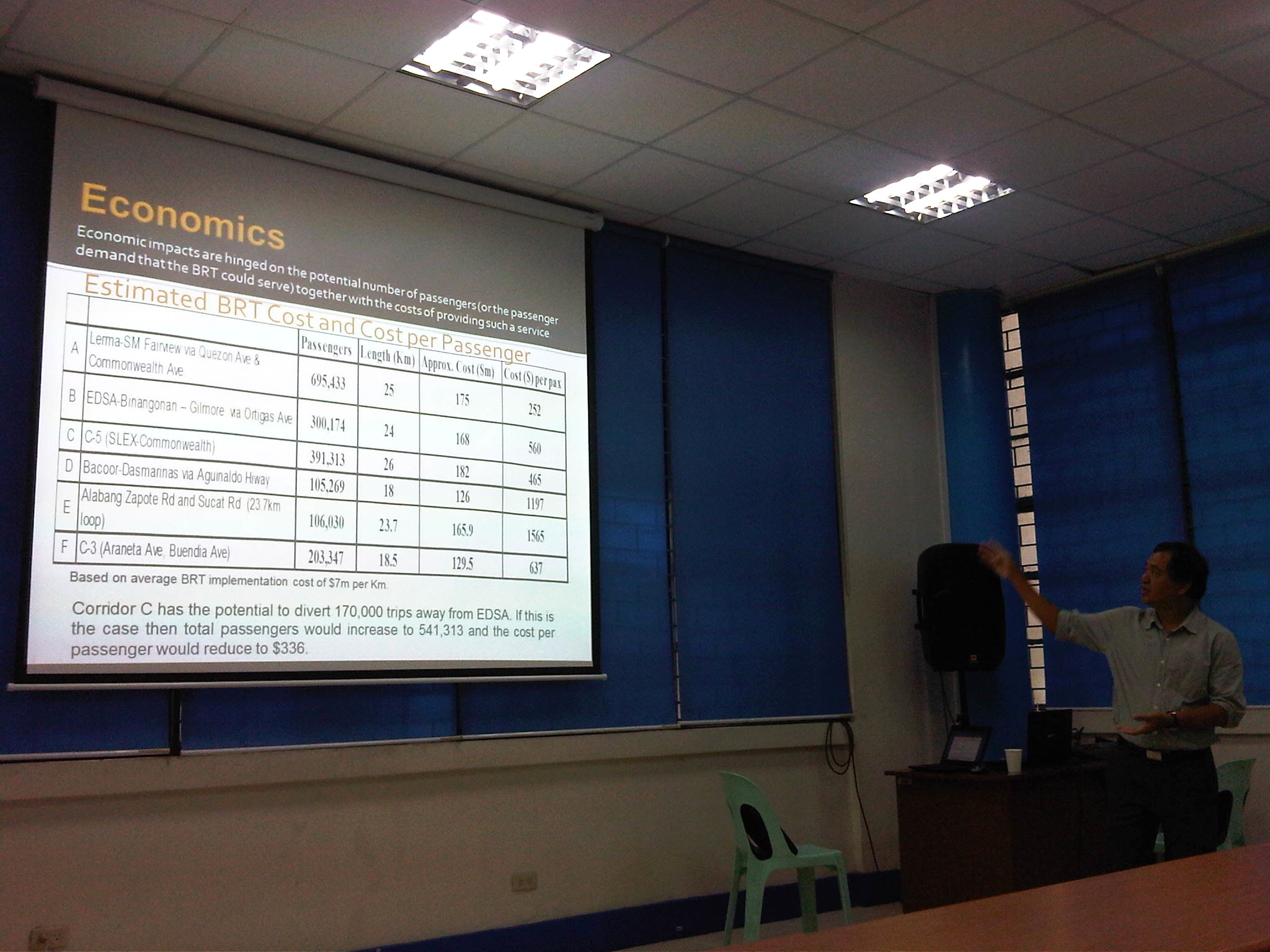 Dr. Ric Sigua, Director of the Institute of Civil Engineering, making a point about the economics of Bus Rapid Transit (BRT).
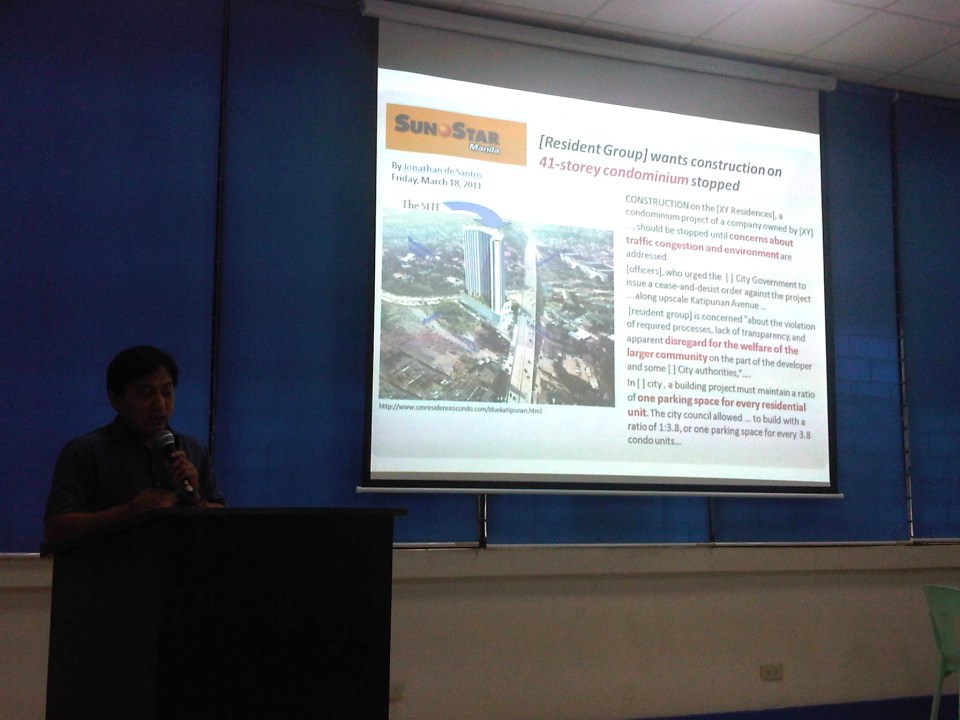 Dr. Sean Palmiano, Director of the National Center for Transportation Studies, explaining the finer points of traffic impact assessment for high density residential developments.
 Prof. Happy Denoga of the Department of Mechanical Engineering explaining on the advantages of hybrid systems for vehicles.
 Dr. Karl Vergel of the Institute of Civil Engineering talking about the on-road tests for jeepneys using B5 or 5% CME-blended fuels in a project commissioned by the Philippine Coconut Authority.
 Comparison of jeepney mileage using 2% and 5% blended fuels.
 Dr. Edwin Quiros of the Department of Mechanical Engineering’s Vehicle Research and Testing Laboratory (VRTL) discussing the dynamometer tests conducted for jeepneys using B5 fuel.
There were other presentations but unfortunately, I wasn’t able to attend these as lectures were spread among various venues at the college. That’s often the hang-up of having parallel sessions during these colloquiums. Nevertheless, it is nice to know that transport remains a popular subject for these lectures.
–
Transport related topics at the 2014 Professorial Chair Colloquium
The 2014 Professorial Chair Colloquium of the College of Engineering of the University of the Philippines Diliman will be held from August 28 – 29, 2014 at five venues at the college. Following are the transport-related topics to be presented at the colloquium:
Dr. Nathaniel B. Diola, “Performance Standards for Concrete Roads,” Prof. Jose Ma. Diago de Castro Professorial Chair in Civil Engineering [0830-0850, GE Theater, 4F, Melchor Hall, August 29]
Asst. Prof. Adeline A. Pacia, “A Study on the Application and Impact of Eco-Driving Seminars Conducted by UP-NEC,” Cesar E.A. Virata-Daikin Industries Ltd. UP Centennial Professorial Chair Award [1030-1050, GE Theater, 4F, Melchor Hall, August 29]
Dr. Ricardo G. Sigua, “Identification of BRT Corridors in Metro Manila,” Dean Reynaldo B. Vea Professorial Chair [0830-0850, Maynilad Room, 3F, Melchor Hall, August 29]
Dr. Jose Regin F. Regidor, “Philippine Transport on a Diet: Low Carb Systems for the Future,” Cesar A. Buenaventura Professorial Chair [0850-0910, Maynilad Room, 3F, Melchor Hall, August 29]
Dr. Hilario Sean O. Palmiano, “Traffic Impact Analysis (TIA) for Site Development in the Philippines,” Cesar Buenaventura UP Centennial Professorial Chair in Engineering [0910-0930, Maynilad Room, 3F, Melchor Hall, August 29]
Asst. Prof. Gerald Jo C. Denoga, “Development of a Parallel Hybrid Sprint Car,” Dean Ruben Garcia Professorial Chair Award [0930-0950, Maynilad Room, 3F, Melchor Hall, August 29]
Dr. Karl B.N. Vergel, “On-Road Test of 5% CME Biodiesel in Public Utility Jeepneys,” DATEM & ACES Professorial Chair [0950-1010, Maynilad Room, 3F, Melchor Hall, August 29]
Dr. Edwin N. Quiros, “Comparative Drive Cycle Fuel Economy of In-Use Public Utility Jeepneys Using 2% and 5% CME-Diesel Blends,” Ariston Delos Reyes Professorial Chair in Energy Engineering [1010-1030, Maynilad Room, 3F, Melchor Hall, August 29]
Asst. Prof. Joseph Gerard T. Reyes, “Comparison of the Characteristics of Coco-Methyl Ester Biodiesel with other Biodiesels,” Quezon Power Philippines Professorial Chair in Engineering [1030-1050, Maynilad Room, 3F, Melchor Hall, August 29]
The colloquium is open to the public.
–
Research topics for undergraduates?
Looking at the recent statistics for this site, I noticed the surge in interest on research topics for undergraduates. What they found were posts I made over the last few years that included lists of titles of researches being undertaken by our undergraduate students at UP Diliman Civil Engineering. In addition, there are also a lot of articles I posted about various topics on transport and traffic that could be used as basis for developing or identifying research topics for their undergraduate research work. There are a lot of problems or issues or challenges that the Philippines needs to solve. Thus, there should be a number of topics that students can choose from depending on their interest as well as perhaps the capacities or capabilities of their respective advisers to guide them in the implementation of their researches. Among the more “in demand” topics are those relating to road safety, public transport, traffic congestion, walking, cycling and even parking. Topics for undergraduate research should be something that could be implemented over a semester or two including the required review of literature, data collection (i.e., field surveys as well as secondary data collection from various sources) and the analysis of such data. Some topics can be more challenging than others and those requiring specific software (e.g., commercial rather than open-source) should not be encouraged if a school doesn’t have the resources. For the “techies,” topics involving development of software tools or apps may be encouraged as long as the objectives and data requirements are well defined and students don’t end up with useless products.
The National Center for Transportation Studies (NCTS) receives a lot of inquiries every year from students of various universities about research topics on transportation. Most of these are emails and letters without the endorsement of their advisers or teachers. And so we advise them to get the necessary endorsements first before they could do their researches at the Center. This gives the request a bit of a formality though we can only usually extend limited assistance as the Center’s resources are also limited. We have to state, however, that we are not in the business of advising or guiding students from other universities or colleges. That is the responsibility of your faculty whose job is to guide your students. The Center can provide whatever it has in terms of data or information but the specific data or information should first be identified by the students and their advisers by doing research on the topics of interest.
I have not yet posted on research topics for Academic Year 2014-2015 as UP has moved its academic calendar from June to August starting this year. At this time of year, we usually already have a list of topics for our students to choose from. These are topics that faculty have provided and which they could confidently guide students who would be under them (i.e., those who selected the topics they listed). It is highly likely that I would be selecting topics from some of the articles I have posted here and my co-faculty would be listing topics that address current issues or challenges in transport. Until perhaps the middle to last part of August when we would already know how many students will be assigned to our Transportation Engineering Group could we come up with a long list. By early September, our students would have selected their topics to embark on their undergraduate research work.
–
The Philippines’ National EST Strategy – Final Report
Friends and some acquaintances have been asking about whether there is a master plan for sustainable transport in Philippines. There is none, but there is a national strategy that should serve as the basis for the development and implementation of a master plan, whether at the national or local level. This strategy was formulated with assistance of the United Nations Council for Regional Development (UNCRD) through the Philippines’ Department of Transportation and Communication (DOTC) and Department of Environment and Natural Resources (DENR), which served as the focal agencies for this endeavour. The formulation was conducted by the National Center for Transportation Studies (NCTS) of the University of the Philippines Diliman. For reference, you can go to the NCTS website for an electronic copy of the National Environmentally Sustainable Transport Strategy Final Report.
 Cover page for the National EST Strategy Final Report
–
Food for thought – a few articles on transport and traffic
This will just be a quick post for now and I just wanted to share a few recent articles on transport and traffic from a favourite magazine – Wired:
What’s Up With That: Building Bigger Roads Actually Makes Traffic Worse
Why We’re Sad the Best Airport in the World Is Getting Even Better
The Hidden Genius and Influence of the Traffic Light
These are very well written, easy to understand articles on things we encounter everyday (traffic congestion, traffic signals at intersections) and when we travel long distance (airports). They show different perspectives of things we take for granted or assume we understand. An example of the latter includes notions that road widening or road construction will solve traffic congestion problems. Much of what goes around regarding road widening or road construction as solutions do not account for induced demand, which is basically additional traffic generated or encouraged by wider or new roads. The second article talks about Changi Airport, arguably the best in the world, and the high tech approaches they have employed or will employ in order to ensure efficient operations there. Such tools, I think, should be used in our airports especially NAIA where the long standing excuse is the limitations of the runway(s) and the airport terminals. Certainly, there are other issues that need to be addressed and going high tech and employing sophisticated methods for airport operations should alleviate problems until we ultimately build a new airport elsewhere. The third article takes a look into behaviour and mentions a “social contract” we have agreed to in order to reduce mayhem in our roads. This “social contract” as well as others related to it should be revisited and understood as they are very much a part of how we behave when we travel and have a significant effect on others around us.
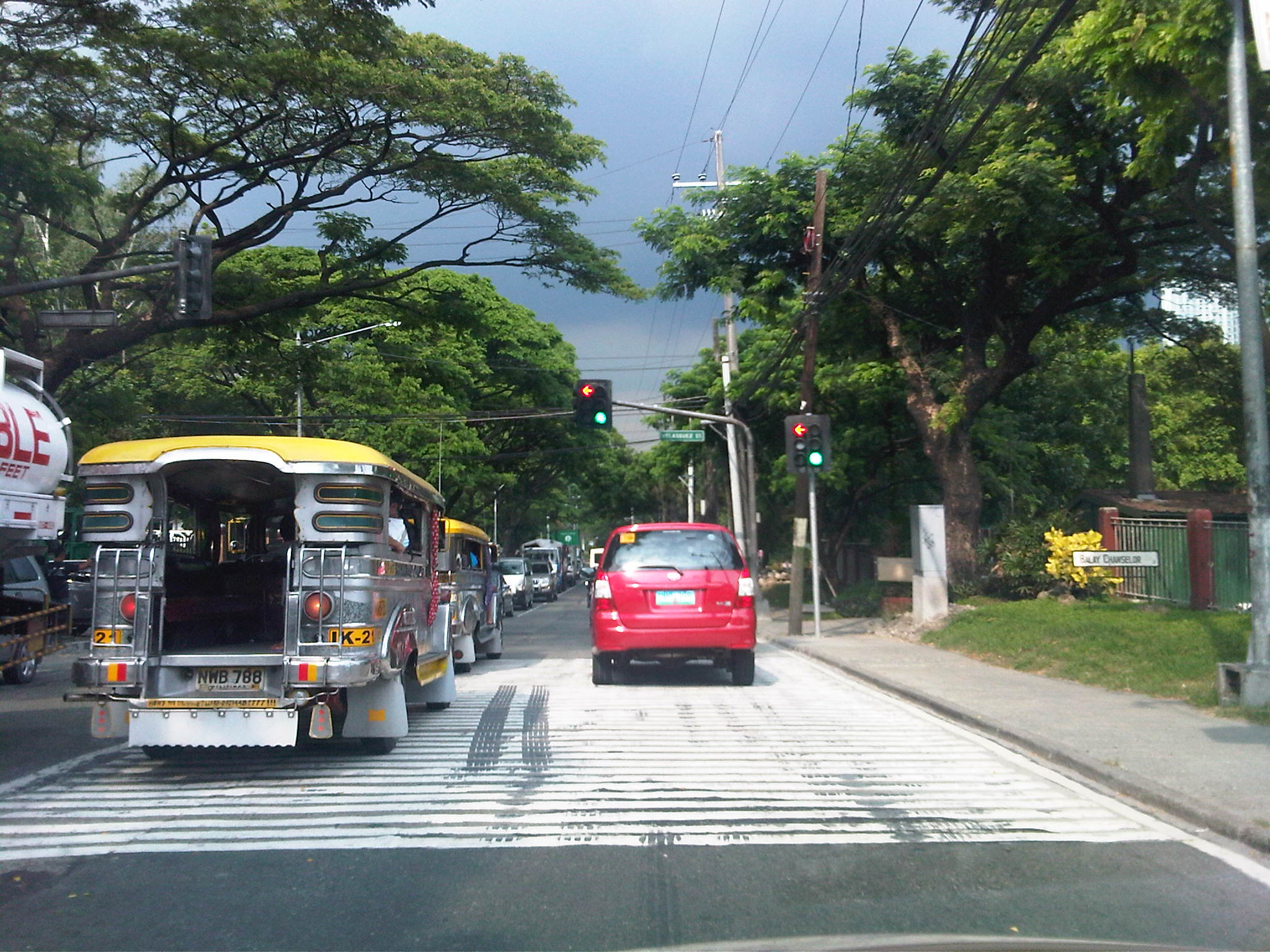 Traffic congestion and traffic signals along the 4-lane C.P. Garcia Avenue in UP Diliman
–

