
Home » Academe (Page 11)
Category Archives: Academe
Seminar on urban transport systems in the Philippines
The University of the Philippines Diliman, through its Institute of Civil Engineering and National Center for Transportation Studies, recently held a seminar on urban transport systems. The seminar was held last May 26, 2014 and presentations included one on urban transport in the Philippines by Dr. Cresencio M. Montalbo, Jr., an Associate Professor of the School of Urban and Regional Planning of UP Diliman and another on international best practices by Prof. Fumihiko Nakamura, Dean of the Institute of Urban Innovation of the Yokohama National University in Japan.
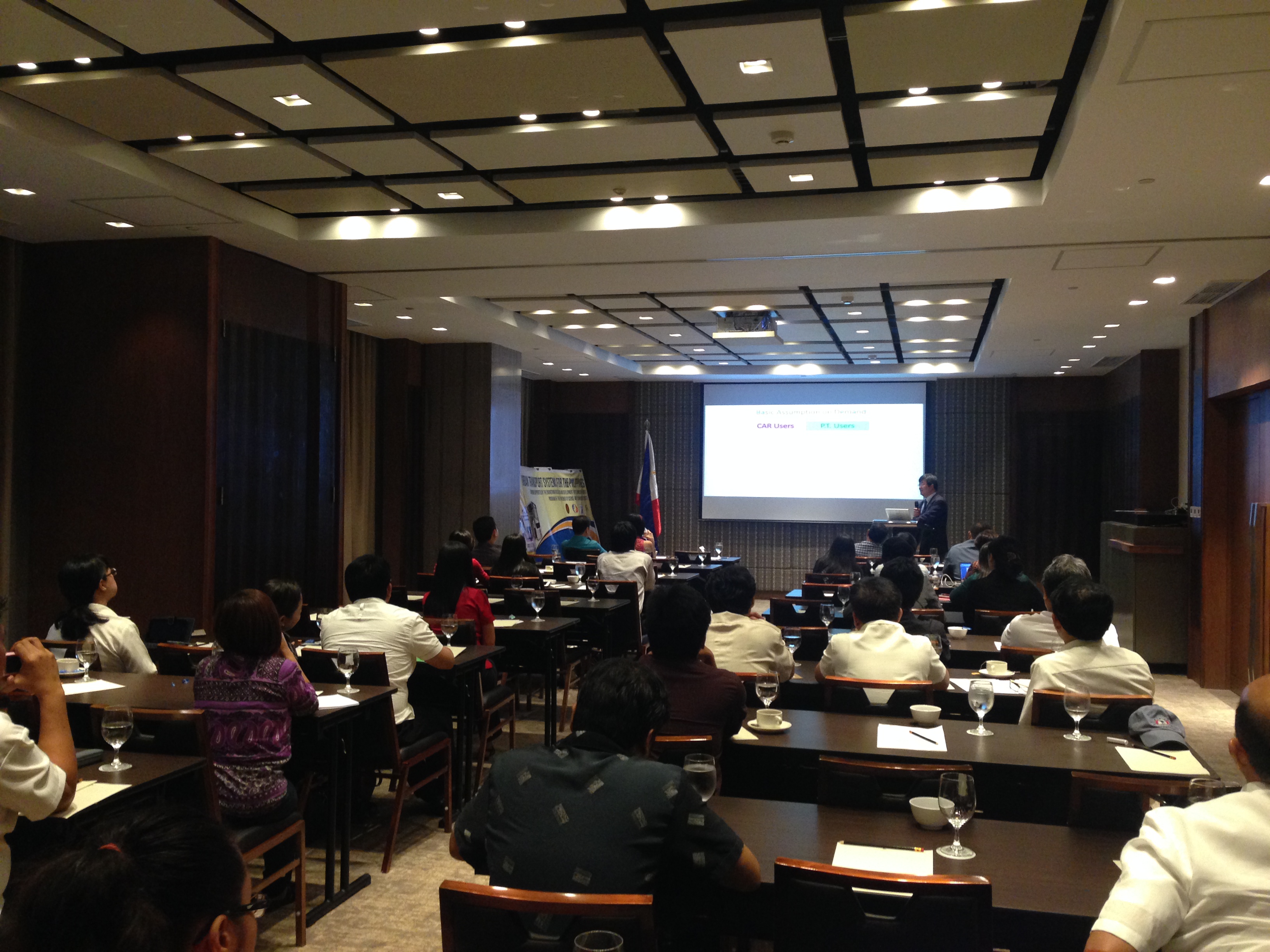 The seminar was held at the Aloe Room of the new Marco Polo Hotel at the Ortigas Center in Pasig City.
 Dr. Montalbo talking about the concept of “dignity of travel.”
 Prof. Nakamura discussing the concepts of “park & ride” and “kiss & ride” with respect to transit systems.
The presentations during the seminar may be downloaded from the NCTS website. The seminar was supported by the Engineering Research and Development for Technology (ERDT) program of the Department of Science and Technology (DOST).
–
A study on a long-term transport action plan for ASEAN
The National Center for Transportation Studies of the University of the Philippines Diliman participated in the project “Study on the Long-Term Action Plan for Low Carbon Transport in ASEAN.” The study was funded by the Nippon Foundation and implemented by the Institution for Transport Policy Studies (ITPS) and Clean Air Asia with experts coming from ASEAN countries including Indonesia, Malaysia, the Philippines, Thailand and Vietnam, and Mizuho of Japan, which led the development of the Backcasting and Visioning Tools employed in the study. Detailed case studies were performed for Indonesia through the Universitas Gadjah Mada and for the Philippines through the University of the Philippines Diliman.
The Final Symposium for the study was held last February 20, 2014 at the Hotel Okura in Tokyo, Japan. A link containing information on the study, the symposium program, information on speakers, and presentation files are hosted by the Japan International Transport Institute, which is affiliated with ITPS.
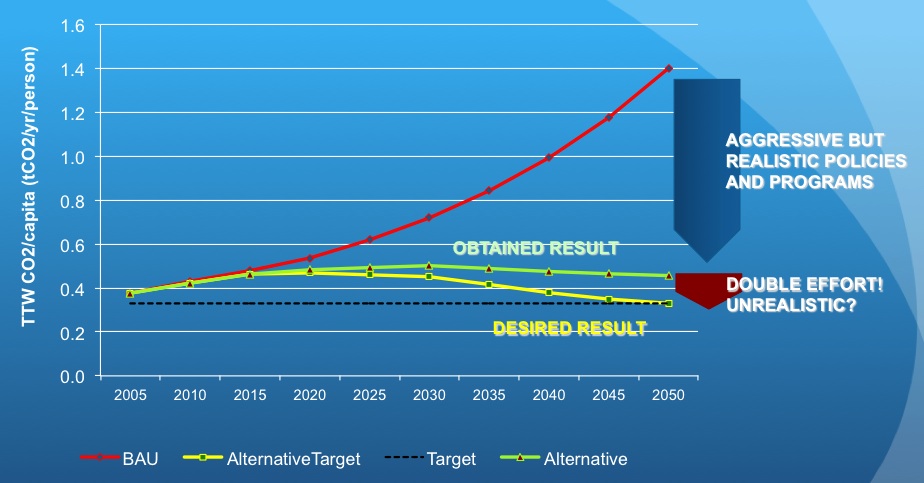 Graph of the result of backcasting for the Philippines using available transport data, policies and other information on various socio-economic and transport factors. (Image capture from the presentation by UP’s Dr. Regin Regidor)
–
On data requirements and requests from the NCTS
The National Center for Transportation Studies of the University of the Philippines Diliman regularly gets a lot of requests for transport and traffic data. Most of these requests are quite specific for traffic counts along various roads. In many cases these are national roads but there are also requests for data on local roads. While the center has a library and laboratories where data and other information are available, most of those we can provide for public consumption may be quite dated and would need to be validated or updated. In certain cases, data were derived from our projects with private entities and we are not at liberty to share these without the permission of our clients. Many of these information are covered by non-disclosure agreements since these may be sensitive information or may lead to revealing projects that are still in the pipeline and which clients might prefer to keep to themselves at the time for one reason or another.
The best we could do for data requests would be to refer them to the sources or those who are supposed to collect data first-hand. For traffic counts along national roads, for example, the Department of Public Works and Highways (DPWH) publishes data on Annual Average Daily Traffic (AADT) for sections of national roads throughout the country. Most if not all these counts are made through manual surveys. That is, a team of surveyors literally count the number of vehicles according to categories set by the DPWH as they pass along specific road sections. Complacency, however, coupled with varying degree of quality control or supervision for manual counts can lead to erroneous data. Also, in several cases, one colleague allegedly was able to spot some trending that led him to conclude that some counts are actually projections from previous years rather than those derived from actual counts that should have been performed! It is highly recommended for researchers to make representations to the DPWH District Engineering Office where their study area or site is located or perhaps contact the many bureaus under the department (e.g., Bureau of Construction, Bureau of Design, Bureau of Maintenance, etc.) for other types of information.
Another source for transport data is the Land Transportation Office (LTO), which has information on vehicle registration and licensing. Unfortunately, not all of these data are published or readily available to researchers. Also, specific data requests (e.g., vehicle engine age, fuels, demographics of licenses drivers, etc.) are not easily accessible and may require time to process. In the past, we have also had first hand experience of the private IT company under contract with the LTO suggesting a fee for data processing. For public transport, the primary source would be the Land Transportation Franchising and Regulatory Board (LTFRB), which would have information on road transport routes, franchises, number of units of buses, jeepneys or taxis, etc. These agencies are under the Department of Transportation and Communications (DOTC), which also has several other agencies under it.
While most local transport and traffic data (e.g., number of tricycles and pedicabs, traffic along local roads, etc.) are with local governments, LGUs generally do not have up-to-date transport and traffic data. Only a few conduct regular data collection or will have recent data that would be useful for any meaningful analysis. Even big cities that have been recipients of transport studies have not been able to update basic data like traffic counts and travel speed along major roads. Perhaps the only updated information they would have are AADT for national roads (care of the DPWH District Engineering Office) and data on the number of public transport vehicles like buses, jeepneys and tricycles within their jurisdictions. AADT data from the DPWH are limited to few stations along national roads and there are none for intersections where counts per movement are important for analysis. Meanwhile, public transport operational characteristics are not generally measured so only the number of registered vehicles are known, basically from the LTO, LTFRB and the local tricycle franchising office. And so for very specific data on specific roads, for example, it is recommended that primary data collection (i.e., field surveys) be conducted.
Contrary to popular belief, the Center no longer has copies of reports of the more recent major studies or projects on transportation and traffic. The DPWH and the DOTC no longer furnish the NCTS library with copies of such reports and this limits the recent materials in our library that can be used by researchers for whatever purpose they may have. And so, the center will usually refer researchers to these and other agencies for data or reports that they need for the work they are doing. If the Center knows specific people from the agencies who are involved in the study or project or have worked on the data that’s subject of the inquiry/request then the researcher will be referred to those people.
–
Dissertation defense
After a series of posts on my recent travels, here’s something on the serious side:
The oral defense of the dissertations of Ph.D. in Civil Engineering (Major in Transportation Engineering) Program doctoral candidates, Mr. Ernesto B. Abaya (staff/affiliate student/ERDT scholar) and Mr. Alex S. Ladaga (affiliate student/CHED scholar) with topics on transportation & environment and traffic flow theory, respectively, will be on October 21, 2013 (Monday) from 9:00 AM and from 1:00 PM at the National Center for Transportation Studies. Details are shown below:
ERNESTO B. ABAYA
“DEVELOPMENT OF DRIVE CYCLES & ESTIMATION OF FUEL CONSUMPTION FACTORS OF LIGHT DUTY VEHICLES IN METRO MANILA”
21 October, 2013, Monday, 9:00 AM at the Toyota Training Room, NCTS, UP Diliman
Dr. Edwin N. Quiros (UPD-DME), Panel Chair
Dr. Hilario Sean O. Palmiano (UPD-ICE), Panel Member
Dr. J. B. Manuel M. Biona (DLSU-COE), Panel Member
Dr. Karl B. N. Vergel (UPD-ICE), Panel Member (Adviser)
Dr. Ricardo G. Sigua (UPD-ICE), Panel Member (Co-adviser)
Abstract: The urban drive cycles for five different light duty vehicles (LDV) are developed in this study. Furthermore, the fuel consumption factors for each of the type of LDV are estimated. The study presents the methodology in the development of the drive cycles in which the speed profile of the specific type of vehicle is surveyed, downloaded and processed. In the survey of speed data, a Global Positioning System (GPS) device is used as an on-board instrument. The GPS device is placed on the dashboard of every surveyed vehicle and it recorded instantaneous speed in its memory. The speed data is downloaded from the device using software provided by the maker of the device (Garmin) called Mapsource. The speed data is processed using a program to execute the methodology in generating candidate drive cycles. The program creates drive cycles by randomly appending microtrips to form a minimum of twenty minute speed time profile. Furthermore, along with the generated drive cycle, the program also indicated how it compared with the target drive cycle by computing their individual absolute value difference of their joint speed-acceleration probability distribution. Ten drive cycles for each type of LDV are developed which have absolute value differences less than 20%. The final drive cycle is selected from the ten (10) candidate drive cycle developed from each type of LDV. The selected drive cycles are then used in the Vehicle Research and Testing Laboratory at UP College of Engineering, Mechanical Engineering Department, to estimate the fuel consumption factors of each type of light duty vehicle considered. The developed drive cycles for the different types of light duty vehicles, namely (1) private cars, (2) taxicabs, (3) public utility jeepneys, (4) asian utility vehicles express, and (5) light cargo vehicles have average speeds of 17.97 kph, 13.57 kph, 10.87 kph, 14.69kph and 8.43 kph respectively. The fuel consumption factors estimated for all the light duty vehicles tested in the chassis dynamometer laboratory ranges from 9 to 12 km/liter.
Keywords: light duty vehicles, drive cycles, chassis dynamometer laboratory
—
ALEX S. LADAGA
“EFFECTS OF GAP FORCING ON THE CAPACITY OF TWO LANE ROUNDABOUTS IN THE PHILIPPINES”
21 October, 2013, Monday, 1:00 PM at the Toyota Training Room, NCTS, UP Diliman
Dr. Karl B. N. Vergel (UPD-ICE), Panel Chair
Dr. Jose Regin F. Regidor (UPD-ICE), Panel Member
Dr. Hilario Sean O. Palmiano (UPD-ICE), Panel Member
Dr. Ma. Sheilah G. Napalang (UPD-SURP), Panel Member
Dr. Ricardo G. Sigua (UPD-ICE), Panel Member (Adviser)
Abstract: Traditional method in estimating roundabout capacities using gap acceptance theory involves the assumption that vehicles entering the roundabouts give way to vehicles running along the circulatory road. Parameters usually used include the critical gap and the follow up times used by the entry vehicles. Gap forcing persists in local roundabouts and this common Filipino driver behaviour renders the existing models derived from traditional assumptions unsuitable for local applications. The study embarks on the development of the simulation model which takes into account gap forcing in the estimation of capacity of roundabouts in the Philippines. It explores the feasibility of introducing more realistic driver behaviour assumptions and the inclusion of additional parameters to come up with a model suitable for local use.
Keywords: roundabouts, gap forcing, capacity
—
How to cite social media
Given the popularity of internet sources among researchers (especially the less experienced ones) these days, there is a tendency for many to rely on online resources rather than put some effort to browse actual libraries for references such as hard copies of books and journals. Research supervisors usually allow this for cases when the online resource happens to be electronic or digital versions of published material. There are both formal and informal sources online for such published material including online versions of journals managed by reputable publishers like SpringerOpen and Science Direct and websites by researchers and research centers themselves like the Victoria Transport Policy Institute. These are rich sources of refereed/reviewed material that are highly recommended for any literature review that students and researchers need to do before embarking on any serious work.
Nowadays, however, there have been a lot of other material found online including those on blogs, YouTube video, Twitter, Facebook and email that have been gaining acceptance as valid references. For example, it is possible that an interview may be conducted through an exchange of emails or via the chat features of Facebook. Lectures or talks like the popular can be found on YouTube or at TED. As such, these materials should be cited properly in research work.
I found this article on “How to cite social media…” on Facebook and below is a graphic that provides a guide for social media citation:

Obviously, I deliberately posted this material on proper citations here to remind people using or intending to use material from my posts in their research or other purposes. It is also quite timely considering the news featuring a plagiarist (i.e., a person passing off someone else’s work as their own).
–
Establishing an ITS society in the Philippines
The establishment of an ITS society in the Philippines is an idea that’s almost 2 decades old. I first learned about Intelligent Transportation Systems (ITS) while I was a graduate student at UP Diliman taking up transportation engineering in 1994. The interest was stoked by more exposure to ITS when I studied in Japan later and participated in the ITS World Congress held in Seoul, Korea in 1998. I presented a paper at the congress and was able to go around to look at the cutting edge in technology at the time that was applied to transportation. I also learned that there were three big ITS organizations at the time – one in the US (ITS America), in Europe (ERTICO) and in Asia (VERTIS).
I recall attending one meeting in 2002 when Dr. Ricardo Sigua, then on his second stint as Director of the National Center for Transportation Studies of the University of the Philippines Diliman presented the idea to a group that included then Department of Electrical and Electronics Engineering Chair Rowena Guevarra. The latter is now Executive Director of the Department of Science and Technology’s Philippine Council for Industry, Energy and Emerging Technology Research & Development (PCIEERD). At the time, the conclusion was that it was still premature for the Philippines to establish a formal ITS society considering that there were few who were actively involved in ITS research. I thought privately that people still had little understanding or appreciation of ITS and, at UP at least, we were not yet in an environment that enabled collaborative work among departments who are supposed to have the expertise to undertake ITS related research and perhaps be the core group for a society.
Flash forward to the present, there is an ITS program currently being funded by the DOST-PCIEERD and under it are several research projects. One project is already underway and is being implemented through a collaboration among civil engineering (transport), electrical and electronics engineering and computer science faculty and students of UP Diliman. There are also several projects in the pipeline from Ateneo, DLSU and Mapua. These researches combined with various ITS applications with the private sector (e.g., electronic toll collection, variable messages, apps for commuting, etc.) means there is much more awareness nowadays for ITS and its benefits. This may also mean that the time is right and ripe for an ITS society to be established to further its applications.
 Dr. Ricardo Sigua of the UP College of Engineering presenting on the proposal for the establishment of ITS Philippines.
On the forefront of the establishment of an ITS society in the Philippines is Dr. Ric Sigua, Professor at UP Diliman’s Institute of Civil Engineering and Fellow at the NCTS. He has been very active in ITS research and is currently project leader of the Philippines Manila Advanced Traffic Information System (PhilMATIS) project that is funded by the PCIEERD. Dr. Sigua has strong links with ITS Japan and is representing the country as observer in the regular ITS Congresses including the one to be held in Tokyo in October. During the ITS forum hosted by the NCTS in September 4, it was agreed that a core group will be established that will work towards forming a formal society. This will be led by the academe but will have the support of the private and government sectors. We look forward to what may be called ITS Pilipinas or ITS Philippines in the near future.
–
EASTS 2015 in Cebu
The Eastern Asia Society for Transportation Studies (EASTS) held its 10th conference recently in Taipei, Taiwan. I was supposed to go but another more important activity came up that required me to stay in Manila for the duration of the conference. It is my first time to miss an EASTS conference since I started regularly attending the conference in 2003 when the 5th conference was held in Fukuoka, Japan. Previous to that, I missed 3 straight – the 2nd held in Seoul, Korea, the 3rd that was also in Taipei, and the 4th in Hanoi, Vietnam.
I learned from friends and colleagues that the 11th conference will return to the Philippines after 20 years for the 21st anniversary of the society. While the inaugural conference was held in Manila in 1995, the 11th will be in Cebu in 2015. This is an exciting development for the Philippines, especially for those in the field of transportation including researchers and practitioners. In the past conferences, the host country is presented an opportunity to present more academic and practical papers than what are usually presented by the country when the conference is held elsewhere and participation is limited due mainly to limited resources for travel and accommodations overseas.
A friend posted a couple of images apparently taken from the presentation made by the delegation representing the Transportation Science Society of the Philippines (TSSP). I’m reposting these here as an early promotion of the conference in 2015.
 The iconic jeepney as mascot of the EASTS 2015 conference to be held in Cebu
 Logo for the EASTS 2015 conference in Cebu featuring the monument commemorating Magellan’s voyage that led him to the island in 1521.
–
Undergraduate research topics on Transportation at UP Diliman, 2013
Topics this year for undergraduate researches on transportation under the Transportation Engineering Group (TEG) of the Institute of Civil Engineering of the University of the Philippines Diliman are quite a mix. There are topics focusing on issues at the the UP Diliman campus, traffic signals, driver behavior, public transport, environment and aviation. Following are the current topics being developed and for implementation during this academic year 2013-2014:
- Development of a micro-simulation model for the UP Diliman College of Science complex
- Traffic impact analysis of new academic complexes in UP Diliman
- Study on parking supply and demand in UP Diliman
- Field testing of Smart Traffic Light, a video-actuated traffic signal system
- Pinoy driver behavior at uncontrolled intersections
- Characteristics of demand and operations of UP-Katipunan jeepneys
- Improving passenger flows at Metro Manila LRT/MRT stations
- Use of carbon footprint tool (TransCO2) to estimate carbon emissions and energy consumption of transportation measures
- Philippine air transport safety: analysis of incidents over the last decade
–
Special lectures on transportation after the 2011 tsunami in Japan
We recently had the honor of hosting two professors from the Tokyo Institute of Technology (Tokyo Tech). Prof. Tetsuo Yai was an adviser to two (2) faculty members of the Institute of Civil Engineering of UP Diliman and Dr. Daisuke Fukuda was adviser to a former student of ours who is now with De La Salle University. While both are in the transportation field, their laboratories are located in different campuses of Tokyo Tech. Prof. Yai’s laboratory is at the Suzukakedai campus in Yokohama while Dr. Fukuda’s lab is at the main campus in Ookayama where Prof. Yai used to have his laboratory.
Prof. Yai delivered a lecture on “The Progress of Miyako Recovery Plan from Tsunami Disaster” while Dr. Fukuda presented on the “Impacts of Rolling Blackouts on Railway Transport Service in Tokyo Metropolitan Area after the 2011 Tohoku Earthquake.” The lectures were held at the Toyota Training Room of the National Center for Transportation Studies (NCTS) with an audience comprised mainly of graduate and undergraduate students of Civil Engineering.
 NCTS Director Sean Palmiano opening the lectures and introducing Prof. Yai to the audience.
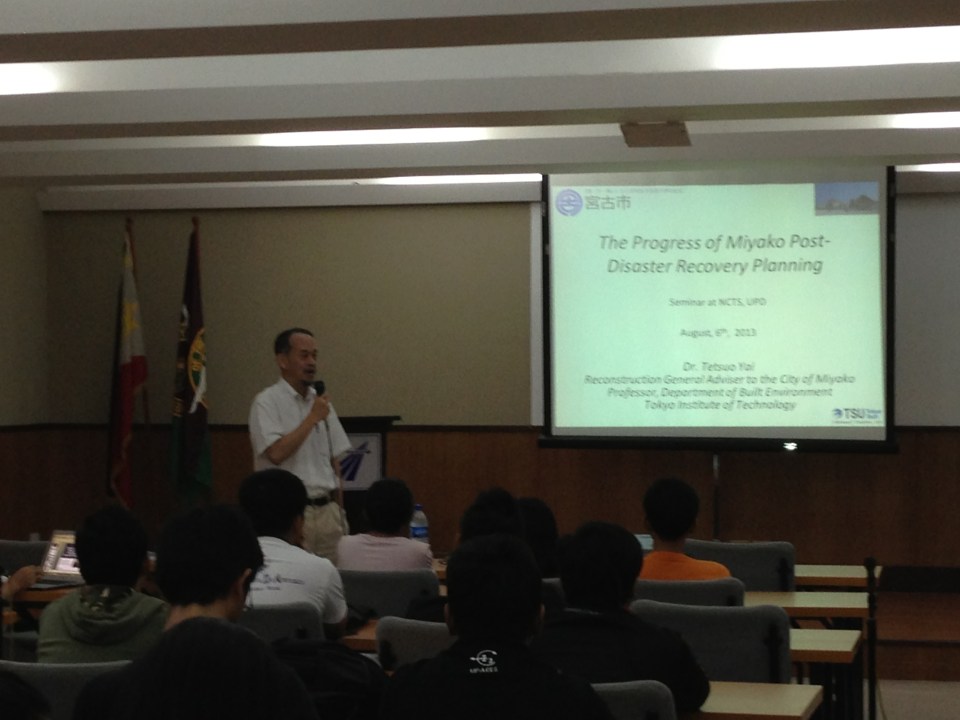 Prof. Yai introducing his topic and talking about the earthquake and tsunami that hit the Tohoku region in 2011.
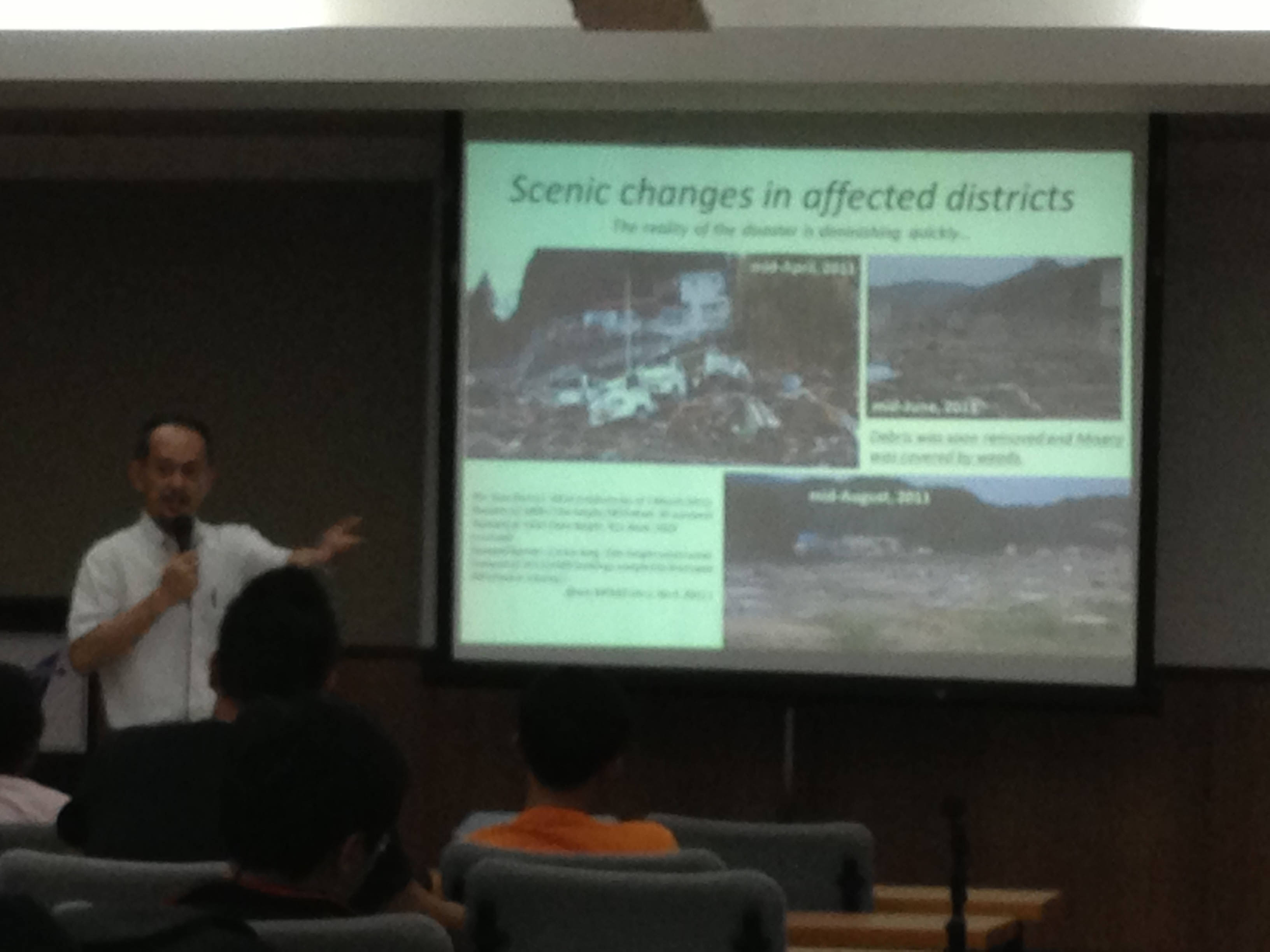 Prof. Yai explaining about the effects of the tsunami on Miyako City and the initiatives for recovery.
 Dr. Fukuda describing the urban rail network in the Tokyo Metropolitan Area.
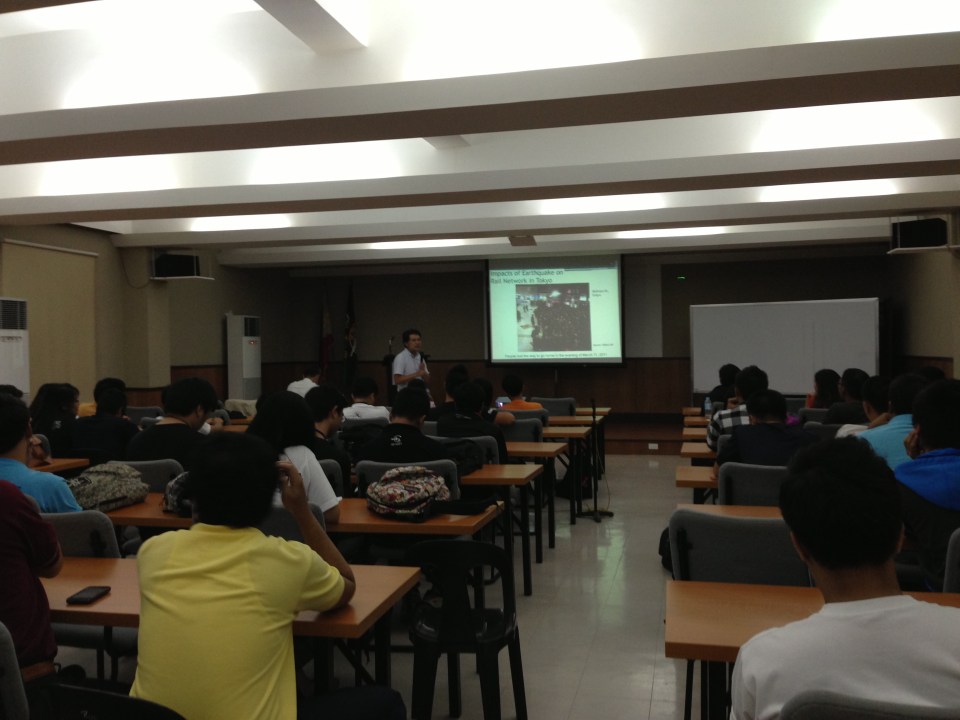 The lectures were well-attended.
 Dr. Fukuda explaining on the impacts of blackouts on rail transport and commuting times in Tokyo and its surrounding areas.
–
Transport related topics in the 2013 UP College of Engineering Professorial Chair Colloquium
The College of Engineering of the University of the Philippines Diliman is holding its Professorial Chair Colloquium on July 11 and 12, 2013. These will be held mainly at the Melchor Hall, which has been the home of the College since it transferred to Quezon City after the Second World War. The colloquium is an annual event where Professorial Chair holders deliver lectures on selected topics of research being undertaken in the various institutes and departments of the college.
On July 11, 2013 (Thursday) at the Geodetic Engineering Theater, 4th Floor, Melchor Hall, U.P. Diliman:
- Dr. Hilario Sean O. Palmiano, Institute of Civil Engineering, “Traffic Noise Perception in UP Campus Dormitories” [DMCI Developers Professorial Chair] – 0950 to 1010.
- Dr. Nathaniel B. Diola, Institute of Civil Engineering, “Blended Cement for Road Construction” [Prof. Jose Ma. Diago de Castro Professorial Chair in Civil Engineering] – 1010 to 1030.
- Dr. Ricardo G. Sigua, Institute of Civil Engineering, “Blackspots and Their Identification” [Primary Group of Builders Professorial Chair Award in Engineering] – 1050 to 1110.
On July 12, 2013 (Friday) at the Maynilad Room, 3rd Floor, Melchor Hall, U.P. Diliman:
- Dr. Jose Regin F. Regidor, Institute of Civil Engineering, “Transport Infrastructure, Poverty and Inclusive Growth” [Pozzolanic Philippines Inc. Professorial Chair] – 0910 to 0930.
- Asst. Prof. Gerald Jo C. Denoga, Department of Mechanical Engineering, “Optimization of Parallel-Series Hybrid Powertrain for Public Transportation” [Emerson Professorial Chair in Engineering] – 0930 to 0950.
- Dr. Karl B.N. Vergel, Institute of Civil Engineering, “Evaluation of Compliance of Specifications of Customized Local Road Vehicles (CLRV) with Local Regulations and International Standards” [Maynilad Professorial Chair] – 0950 to 1010.
- Dr. Edwin N. Quiros, Department of Mechanical Engineering, ” Coconut Methyl Esther (CME) Performance and Emission Characteristics Using a Common-Rail Direct Injection (CRDI) Engine” [Emerson Professorial Chair in Mechanical Engineering] – 1010 to 1030.
Dr. Palmiano is the current Director of the National Center for Transportation Studies (NCTS). Dr. Diola is the immediate past Director of the Building Research Service (BRS). Dr. Sigua is the head of the Road Safety Research Laboratory (RSRL) of the NCTS. Dr. Regidor is past Director of the NCTS. And Dr. Vergel is the head of the Transport & Environment Laboratory of the NCTS.
Asst. Prof. Denoga is the past Chair of the Dept. of Mechanical Engineering (DME) and has led teams in the design of vehicles that participated and won in international competitions on energy efficient vehicles, representing the country and the university in these contests. Dr. Quiroz is the head of the DME’s Vehicle Research and Testing Laboratory (VRTL).
These lectures as well as others on the mornings of July 11 and 12 are open to the public. Venues are at the Melchor Hall (along the Academic Oval), and the UPAE Hall and the EEEI Building at the College of Engineering Complex along Velasquez Street (across from the College of Science complex).
–

