
Home » Academe (Page 3)
Category Archives: Academe
Opinions on the current transportation situation?
Some people were asking me about what I thought about certain issues and reports on transportation. To be honest, while I am involved in some projects including one on road safety, I have been busy (or swamped is probably a more suitable term) with administrative duties at the university. While I take a peek from time to time, as is my habit, to see what’s happening, I have much less time to really engage or get involved in discussions. Whereas before, I easily get myself into typing comments and engaging in some discussions about transport issues particularly in social media, I now quite easily turn away and let it be. There are, after all, a lot of people experts, pundits, advocates, even trolls who are “slugging it out” with their opinions on just about anything on transport.
While I am amused at many discussions or posts, I now find myself not at all wanting to get involved unlike before. I think perhaps I have done my part and continue to do so in ways and avenues where I am more effective and where my time and effort is not wasted and more appreciated. I have never been the loud person in a room and have always tried to have my work speak for myself.
The indifference is the product of many factors and circumstances including becoming tired of doing interviews with conventional media. Nowadays especially, when media seems engrossed on having content by the minute; never mind the substance. Basta may ma-report or ma-post (As long as their is something to report or post).
Well, here’s a few thoughts about what seem to be trending these days:
- There is still a lack of public transportation supply considering the increasing demand (more people are back to their workplaces and schools are already reopening!). Government agencies still seem to be clueless or perhaps just want to push the original rationalization and modernization programs despite the pandemic changing the game for commuting demand. Due to the lack of public transport, more people are taking to private vehicles but certain observers apparently see only cars (which they automatically equate to ‘private vehicles’). Motorcycles are also increasing in numbers and allowing motorcycle taxis will mean people will turn to these for commuting/transport needs.
- Cable cars won’t solve Metro Manila transport or traffic woes. Even if one will consider where they will fit or may be suitable, this is still a band aid solution considering all the solutions including the ones that are obvious or staring us in our faces (yes, allow the conventional jeepneys and buses back for now) that are available but government stubbornly rejects. As for the senator who broached the idea, I think he did so mainly for media mileage (and the mainstream media quickly snapped it up!) – para mapag-usapan. As they say – it’s so showbiz!
- I still believe that the experiences from the pandemic strongly provide us with the evidence to support a continuation and sustaining work-from-home or remote work set-ups. This actually ‘solved’ traffic during the heights of the pandemic and yet we choose to revert to the old normal set-up. People are languishing, suffering as they spend long travel times in their commutes. These are unproductive time that people could have spent more efficiently and productively (not to mention more meaningful) at home.
- I support children going back to school but not for 100% of their times. We definitely know that a 100% study-at-home set-up is not for everyone and the last two years have affected our children including their need for face-to-face interaction with other children (classmates) and adults (teachers). Still, we can have a blended set-up where perhaps we can have children come to school 2 to 3 days in a week rather than the old normal of 5 to 6 (even 7 in some schools) days. Other tasks and learning activities can be done effectively at home. This also could help ease traffic and travel demand especially in urbanized areas.
More opinions in future posts!
–
On phasing out cars in cities
I’m sharing another article on reducing car dependence. The article was referred to by the previous series that I shared recently.
Nicholas, K. (April 14, 2022) “12 best ways to get cars out of cities – ranked by new research,” The Conversation, https://theconversation.com/12-best-ways-to-get-cars-out-of-cities-ranked-by-new-research-180642 [Last accessed: 5/20/2022]
Here are a few excerpts from the article:
“Question: what do the following statistics have in common?
The second-largest (and growing) source of climate pollution in Europe.
The leading killer of children in both the US and Europe.
A principal cause of stress-inducing noise pollution and life-shortening air pollution in European cities.
A leading driver of the widening gap between rich and poor urban residents.Answer: the vehicles on our streets, primarily the not-so-humble passenger car.”
also this:
“The research is clear: to improve health outcomes, meet climate targets and create more liveable cities, reducing car use should be an urgent priority.”
and this:
“To meet the planet’s health and climate goals, city governments need to make the necessary transitions for sustainable mobility by, first, avoiding the need for mobility (see Paris’s 15-minute city); second, shifting remaining mobility needs from cars to active and public transport wherever possible; and finally, improving the cars that remain to be zero-emission.”
You can also listen instead of reading it as it is a narrated article.
–
Articles on examining the role of the planning profession in both perpetuating and solving traffic congestion
Planetizen recently published a three-part series of articles examining the role of the planning profession in both perpetuating and solving traffic congestion:
Part 1: Brasuell, J. (April 13, 2022) “Planning and the Complicated Causes and Effects of Congestion,” Planetizen, https://www.planetizen.com/features/116834-planning-and-complicated-causes-and-effects-congestion [Last accessed: 5/17/2022]
Part 2: Brasuell, J. (April 20, 2022) “How Planning Fails to Solve Congestion,” Planetizen, https://www.planetizen.com/features/116914-how-planning-fails-solve-congestion%5BLast accessed: 5/17/2022]
Part 3: Brasuell, J. (May 12, 2022) “Planning for Congestion Relief,” Planetizen, https://www.planetizen.com/features/117153-planning-congestion-relief?utm_source=newswire&utm_medium=email&utm_campaign=news-05162022&mc_cid=34b0612d40&mc_eid=9ccfe464b1 [Last accessed: 5/17/2022]
I think these articles are a must read especially for students (and not just practitioners or professionals) and is sort of a crash course on transportation engineering and planning. It covers many concepts and learnings from so many decades and touches on certain programs that are most effective in reducing car trips. To quote from the article, the top 12 programs based on case studies in Europe are:
- Congestion Pricing (12-33% reduction in city-center cars)
- Parking and Traffic Controls (11-19% reduction in city-center cars)
- Limited Traffic Zones (10-20% reduction in city-center cars)
- Workplace Mobility Services (37% drop in car commuters)
- Workplace Parking Charges (8-25% reduction in car commuters)
- Workplace Travel Planning (3-18% drop in car use by commuters)
- University Travel Planning (7-27% reduction in car use by university commuters)
- University Mobility Services (24% drop in students commuting by car)
- Car Sharing (12-15 private cars replaced by each shared car)
- School Travel Planning (5-11% reduction in car use for school trips)
- Personalized Travel Planning (6-12% drop in car use share among residents)
- App-Based Incentives (73% – proportion of app users declaring reduced car use)
Are we ready to confront congestion and at the least start discussing these car trip reduction programs? Or are we content with the current discourse, which remains car-centric?
–
Some old drawing tools for clothoids
I took some photos of old (vintage if you prefer) drawing tools that I have at our laboratory at the university. We found this in the storage many years ago and people seem to have forgotten about them. Instead of heading for storage or being forgotten or worse, thrown away, we decided to keep them at our laboratory mainly to show our students how certain highway or street curves were drawn in the ‘old days’. I am currently the custodian of this and another set that I have kept at my other office at the civil engineering building.
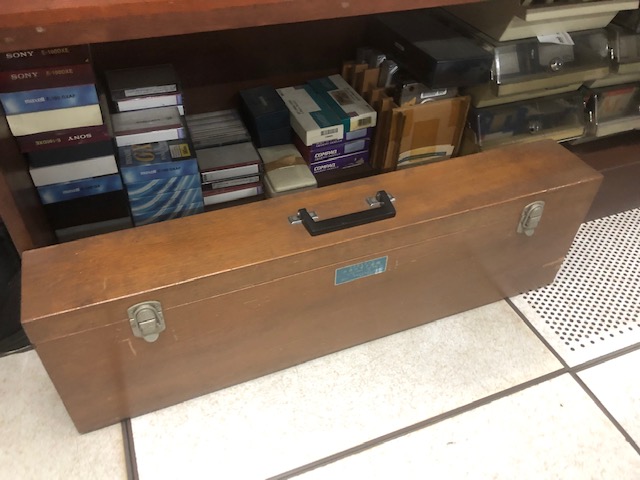 The wooden box is at my office at UP Diliman
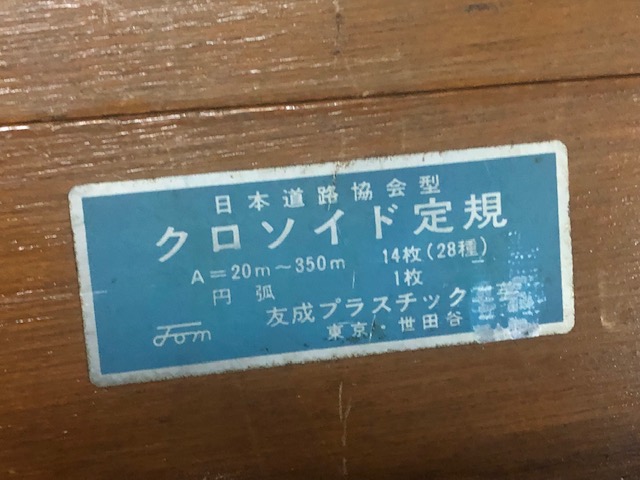 The sign basically translates to clothoid drawing tools made by a company based in Setagaya in Tokyo. There are 14 instruments in the box for clothoid parameter values of A = 20m to 350m.
 Opening the box shows slots holding instruments for drawing clothoids or spiral curves
 Some of the instruments from the case – the large one on top is for A = 300m and 350m (scale 1:1000)
 Comparison of size of instruments for (top) A = 60m and 65m, and (bottom) A = 30m and 35m (scale 1:1000)
 Instrument for A = 30m and 35m (Scale 1:1000)
 A protractor came along with the set but I assume other instruments such as a compass were used in drawing/drafting the curves.
I shall take photos of the other set when I get to visit the other office. These will be for records purposes as well as for posterity. These are practically museum pieces that are now perhaps rarely if even used.
–
Paper: Estimation of Transportation Energy Demand of the Philippines Using A Bottom-up Approach
Our paper from a conference last year is finally published in an open access journal. The paper is on the “Estimation of Transportation Energy Demand of the Philippines Using A Bottom-up Approach.” Here is the abstract of the paper:
“In the years 2000–2016, the sector with the largest share of total final energy consumption in the Philippines is transportation with an average share of 34.2%. The study aims to estimate the baseline transportation energy demand of road, maritime, air and rail transportation modes in 2016 using a bottom-up approach. Through a bottom-up approach and utilizing available transportation activity and fuel economy/energy efficiency data from secondary sources coupled with primary road transportation activity and fuel economy and railway operations survey data, the baseline transportation energy demand of the Philippines is estimated to be 12,956.1 ktoe in 2016. A comprehensive estimation of transportation energy demand of the country using bottom-up methodologies with more detailed transportation activity and vehicle fleet of the different transportation modes is implemented. Finally, the collection and keeping of certain data that are critical in the estimation of the transportation energy demand are recommended.”
Here is the link to the paper, which is published in the Asian Transport Studies, Vol. 8, 2022: https://authors.elsevier.com/sd/article/S2185-5560(22)00004-9
–
Cities and Automobile Dependence: What Have We Learned?
We end the year with an article from Todd Litman via Planetizen. The topic is something that we really need to ponder on as we or if we are to move towards more sustainable transportation for our cities and municipalities. The experiences during this Covid-19 pandemic should have provided us glimpses of how it could be if we put active and public transport above automobile dependence or car-centricity.
Source: Cities and Automobile Dependence: What Have We Learned?
The main article may be found here (in proper citation for academic/researchers reading this):
–
TSSP 2021 [27th Annual Conference]
The Transportation Science Society of the Philippines (TSSP) held its 27th Annual Conference last November 19, 2021. Here are the poster and program for the conference:
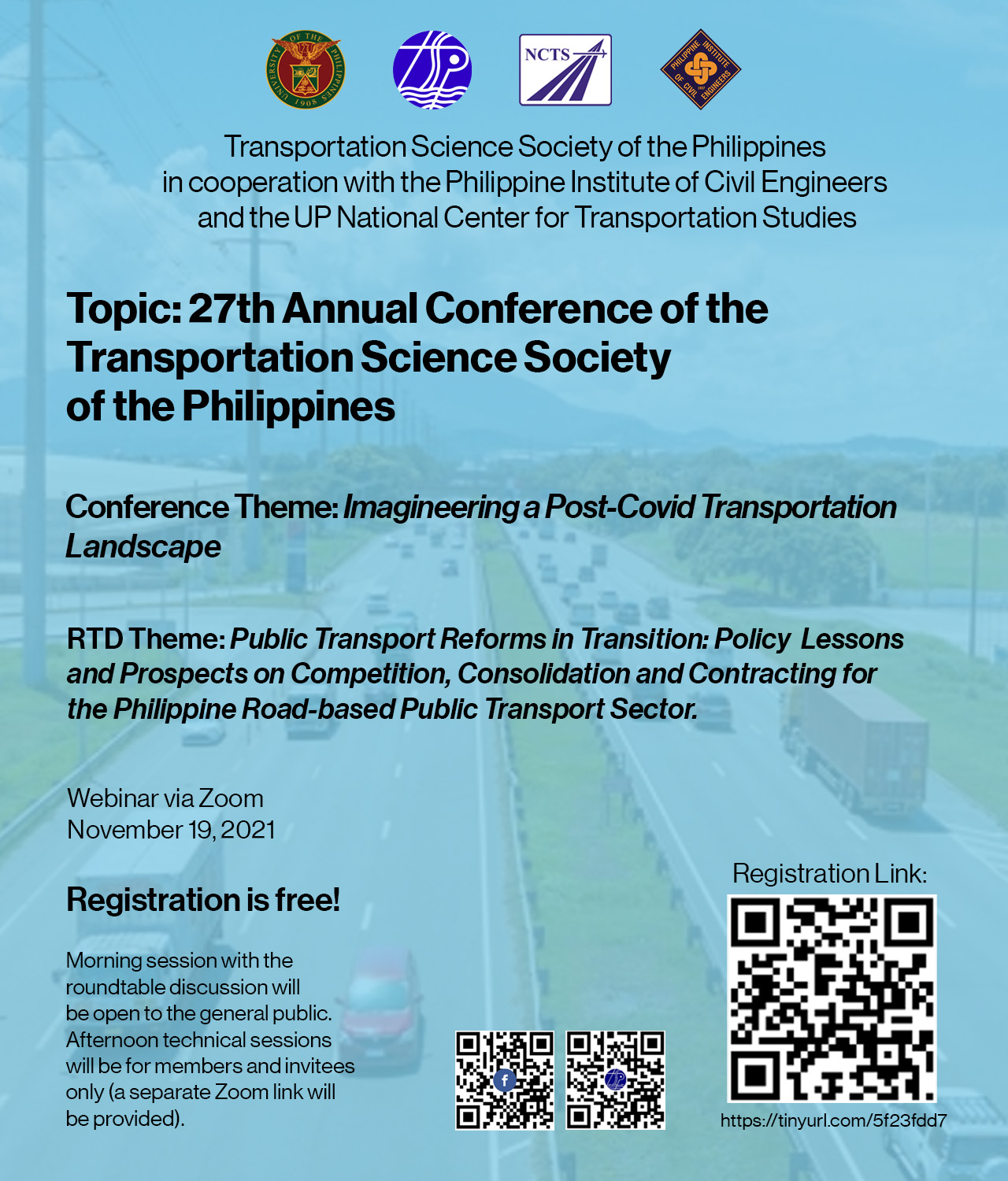
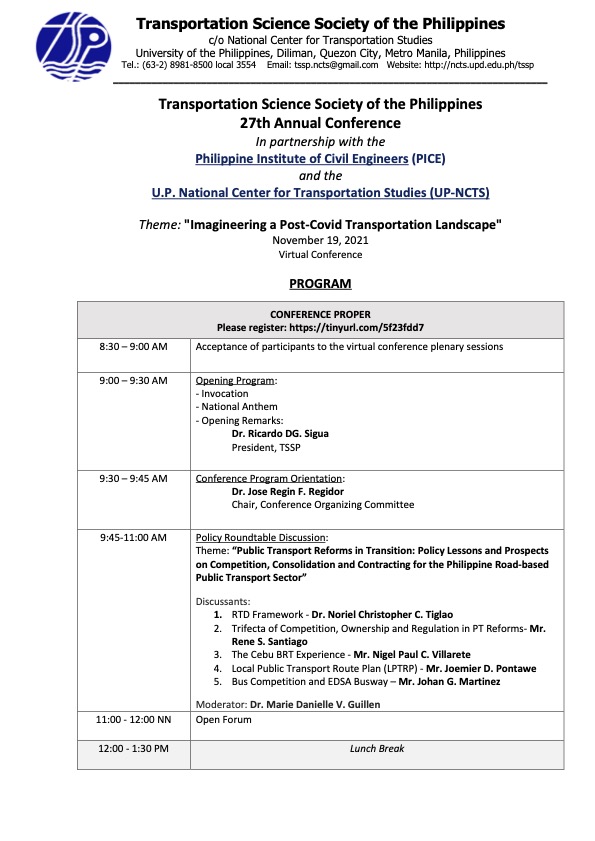
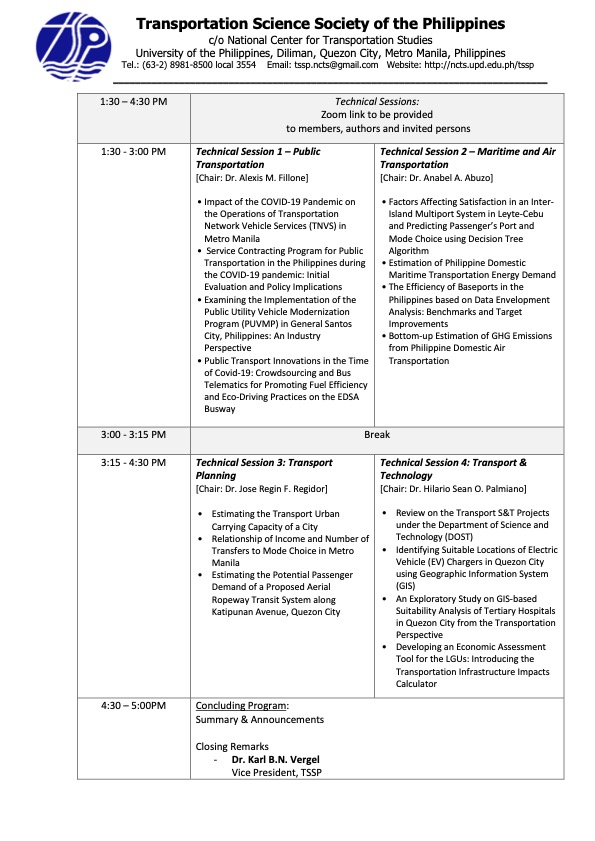
I initially intended to write about the conference before it was held but things got pretty busy last week so this is a post conference write-up. The organizers also announced the final program late (i.e., just a few days before the conference proper) so it seemed sort of anti climactic to post about it. Nevertheless, the conference proceeded as planned and the TSSP has announced it will be posting the proceedings on their official website. It is not yet there but here’s a link to the TSSP official website: http://ncts.upd.edu.ph/tssp/
–
Transportation topics at the College of Engineering’s Professorial Chair Colloquiums
The College of Engineering of the University of the Philippines Diliman started holding its annual colloquiums (plural because each Institute and Department under the College are holding their colloquium mostly during this last quarter of the year).
The Department of Mechanical Engineering already held theirs last September. There were four topics on transportation: 1) Dr. Gerald Ko C. Denoga (Fernando N. Serina Mechanical Engineering Professorial Chair) presented on “Reduction of Light Rail Transport Energy Demand via Powertrain Modeling and Optimization of Operating Parameters”; 2) Dr. Juvy A. Balbarona (Renato M. Tanseco Professorial Chair) presented on “Timetable Optimization for Light Rail Transit (LRT 1)”; 3) Asst. Prof. Roderaid T. Ibanez (Team Energy Professorial Chair) presented on “Energy Demand Quantification and Conservation Strategies of Bus Transport Terminal Facilities along EDSA”; and 4) Dr. Edwin N. Quiros (Federico E. Puno Professorial Chair) presented on “Fuel Economy Results from Diesel engine Tuning for Steady Speed and Drive Cycle Operation”.
There is one transport related topic in the Department of Computer Science colloquium. On October 25, Dr. John Justine S. Villar (Dean Reynaldo Vea Professorial Chair) will be presenting on the “Efficiency Measurement of Domestic Ports in the Philippines Using Data Envelopment Analysis.”
The Institute of Civil Engineering will be holding its colloquium on October 28 – 29, 2021 with the following transport-related topics: 1) Asst. Prof. Rosabelle Louise A. Caram (DCCD Engineering Corporation Professorial Chair), “Utilization of Plastic Laminates in Asphalt Cement Mastic”; 2) Dr. Hilario Sean O. Palmiano (David M. Consunji Professorial Chair in Engineering), “Validation of a Customized Local Traffic Simulator (LocalSim)”; 3) Dr. Jose Regin F. Regidor (Ambrosio Magsaysay Professorial Chair in Engineering), “Pedestrian Safety Assessment Within Public Elementary School Zones in Quezon City using Star Rating for Schools”; 4) Dr. Ricardo DG. Sigua (Dr. Olegario G. Villoria, Jr. Professorial Chair in Transportation/Logistics), “Study of Motorcycle Rider Casualties at Signalized and Unsignalized Intersections”; 5) Dr. Karl B.N. Vergel (Quintin and Norma Calderon Professorial Chair), “Estimation of Transportation Energy Demand of the Philippines”.
Other departments have not posted yet about their schedules or topics yet. The Electrical and Electronics Engineering Institute (EEEI), for example, will have their colloquium this coming October 25 but have not posted a detailed schedule yet. They usually have several transport-related topics including those on traffic signals, vehicle detection, and bike share innovations.
More details and updates including registration to these colloquia may be found at the UP College of Engineering Facebook page: https://www.facebook.com/updengg
–
Papers from the Philippines presented in the EASTS 2021 conference
Here’s a list of papers from the Philippines presented at the recent 14th International Conference of the Eastern Asia Society for Transportation Studies (EASTS). The local society, the Transportation Science Society of the Philippines (TSSP), is affiliated with EASTS being one of the founding societies for what is now the mother organization with members across Asia.
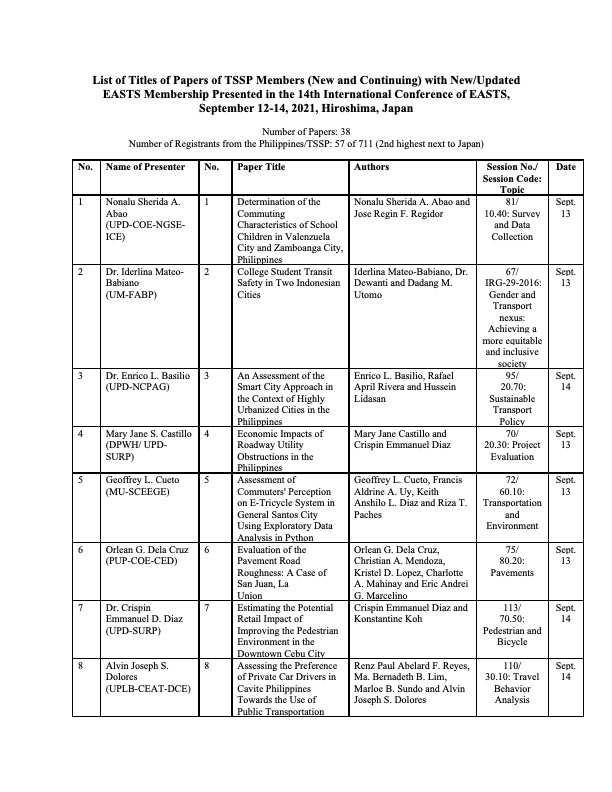


I thought the list would be helpful to those who come to this site to look for research topics. I guess it’s that time of the year for many university/college students who are looking for topics for their thesis or dissertation. There’s a nice mix of topics in the list and shows what are the current topics students and faculty from the different schools are engaged in. Many appear to be from research projects, which are a natural source for technical papers being submitted, presented and published in conferences or journals.
The TSSP is holding its own virtual conference in November 2021. I will also share about that and the papers to be presented in that conference in a future post. Currently, they have not finalized the program and papers submitted are still being reviewed.
–
EASTS 2021 Conference
I would have been in Hiroshima, Japan today if it weren’t for the pandemic. I would have been attending this conference from this weekend (September 12 to 14) where my colleagues and I will be presenting our papers at the respective sessions according to the topics of our work. This year, the conference is virtual and we submitted recorded presentations though presence during the sessions is still required to answer questions about the papers presented. A pre conference even was already held yesterday that attracted early career research in transportation. Here is the link to the conference hosted by Hiroshima University.
I have been to Hiroshima once but unfortunately it was a busy trip to the university and I could not go around. I had wanted to go the memorial to the atomic bomb attack on the city. The plan we had before the pandemic was to have a post conference trip to Kyoto and then proceed to Tokyo on what could have been another sentimental journey for me and close friends who have also studied in Japan. Perhaps there will be another opportunity soon and that we can already travel even with the restrictions or health protocols pertaining to Covid-19.
–
 Caught (up) in traffic