
Home » Academe (Page 7)
Category Archives: Academe
Statement on the proposed emergency powers to solve transport and traffic problems
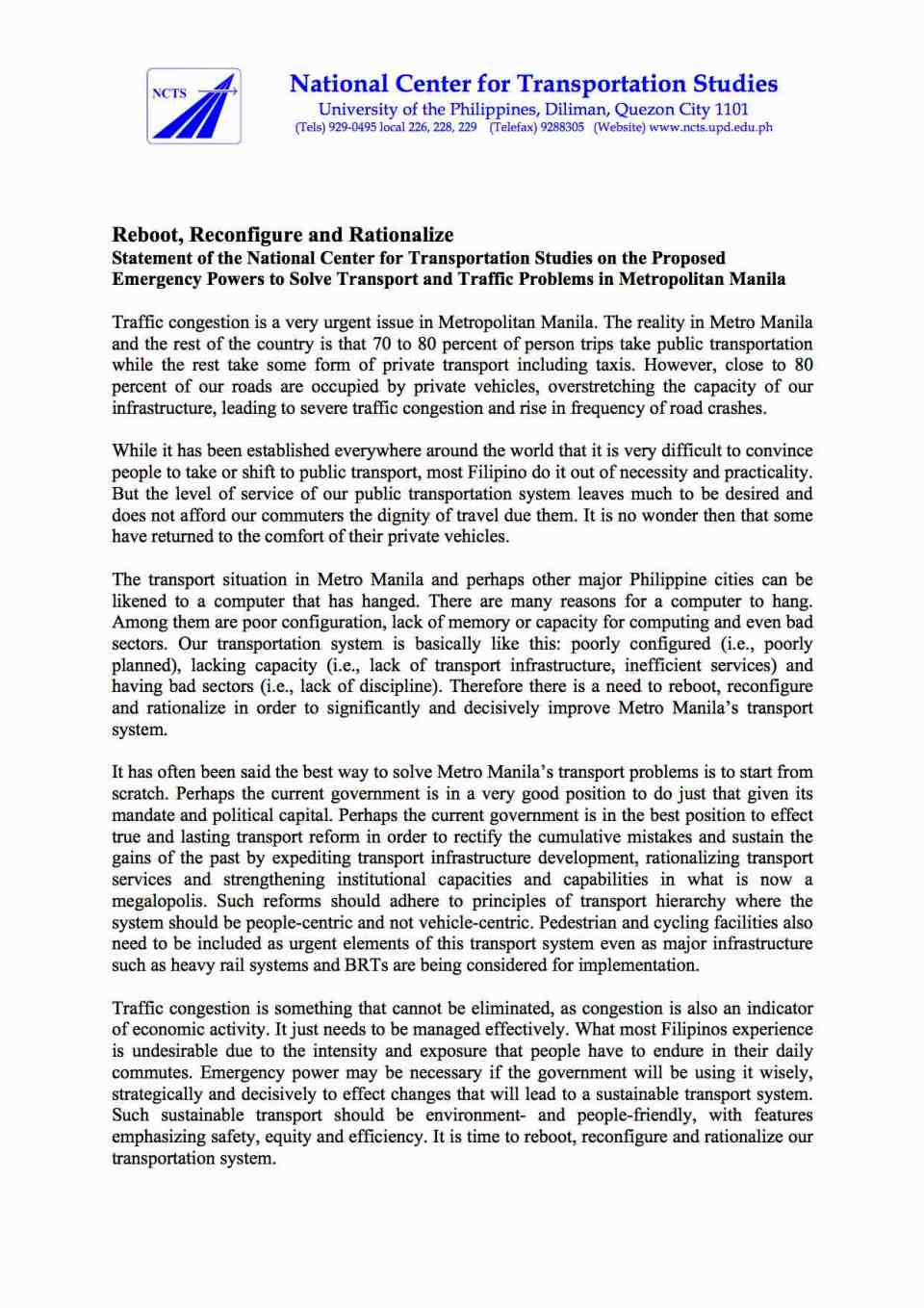
The National Center for Transportation Studies (NCTS) of UP Diliman submitted a statement to the joint Senate committees evaluating the proposal to grant emergency powers to the Philippines President in order to solve the transport and traffic problems in the country and especially in Metro Manila. Following is a copy of the one-page statement:
–
On being constructively skeptical on transport and traffic
Social media is full of news or what is being passed off as news about various transport projects or initiatives. These include a proposed subway line for Metro Manila, road sharing initiatives, inter-island bridges, gateway airports and others major infrastructure projects that are being conceptualized, planned, studied or designed. Too often, people who support the projects/initiatives brand those who do not share their enthusiasm and interest as skeptics and even simply “nega” or negative people. These supporters and their opposites are most likely those who fall under one or more of the following categories:
- Overly optimistic
- Unaware of the process towards a project’s realization
- Troll
- Naive
Hopefully, he/she is not of the third kind who basically are posting against anyone and don’t really have any valuable opinion or constructive comment to offer. There are many groups and individuals out there including those who claim to be fanatics of urban planning, railways and other things on transport. Some even get to write in mainstream media. Unfortunately, to the untrained minds their opinions passed on as expert advise appear to be legit and that can be especially true to people who are more inclined to believe them such as very fanatics and trolls I mentioned. It is very important that proper research is undertaken before any article is written. Otherwise, there will always be bias. Of course, some articles are written with bias a given and with the objective of misleading people.
When government officials (or candidates) claim something and offer nothing as concrete proof (e.g., numbers to support a claim of improving traffic), one has to think twice about believing them. One has to be critical of such claims. Promises are often just that – promises. It is important to ask how certain programs or projects will be delivered, how infrastructure will be implemented (i.e., through what mode of financing, timelines, etc.), and what would be its impacts (i.e., social, environmental, traffic). Of course, it should be expected that officials provide suitable answers to these queries.
It should also be expected for officials to understand that institutions such as the academic ones are there to provide objective criticism. Unfortunately, there are those in the academe who themselves have some agenda they are pushing and can be deliberately misleading and misinforming with their flawed assessments and statements. Then there are experts who offer nothing but negative comments. To these people, any idea not coming from them are essentially wrong and it is often difficult to deal with such people among whom are experienced engineers and planners. Being a skeptic is one thing but being a constructive skeptic. That is, one who offers solutions and also willing to tread the middle ground or some reasonable compromise based on the situation and conditions at hand.
This is why an evidence-based approach is needed and should be mainstreamed in many government agencies, particularly those that are involved in evaluations. National agencies like the NEDA, DOTr and the DPWH have the capacity and capability to perform quantitative analysis using recent, valid data. The quality of data tells a lot about the evidence to back up analyses, evaluations and recommendations. One must not forget that with quantitative analysis it is always “garbage in, garbage out”. That is, if you have crappy data, then you will have flawed analysis, evaluations and recommendations.
–
TSSP 23rd Annual Conference Proceedings
The 23rd Annual Conference of the Transportation Science Society of the Philippines (TSSP) was held at the University of the Philippines (UP) Diliman last August 8, 2016. It was hosted by the National Center for Transportation Studies (NCTS), which for some time was practically inactive in its dealings with the society. The conference was a very successful one with more than 170 participants, mostly students from the undergraduate programs of Mapua Institute of Technology (MIT), De La Salle University (DLSU) and UP Diliman.
The Proceedings of the 23rd Annual Conference contains 22 technical papers, which I have already listed in a previous post showing the technical program for the conference. The link is to the current website of the TSSP hosted by NCTS. Those wishing to have copies of the papers may download them directly from the link. Meanwhile, those interested in the presentations should contact the authors. Their contact information are stated in the paper and it is ethical to get the nod of the authors for their presentation file as these still fall under what can be defined as their intellectual property. I am aware of people who tend to get presentation slides and then pass them of as their work when they use the slides or the data/information therein. There are proper ways for citations of references and sources but sadly such ways are not observed by many.
–
TSSP 2016 Conference Program
I am sharing the banner and final program for the Transportation Science Society of the Philippines 23rd Annual Conference to be held on Monday, August 8, 2016. The final program features a Keynote Speech by the Undersecretary for Road Transport and Infrastructure Anneli R. Lontoc, a Panel Discussion on Road Safety, and technical sessions in the afternoon.


 –
–
TSSP 2016 Conference: Tentative Program
I am sharing below the tentative program for the 23rd Annual Conference of the Transportation Science Society of the Philippines (TSSP):

Soon, I will post on the list of papers to be presented for the Technical Sessions to be held in the afternoon part of the one-day conference.
–
TSSP 2016 Conference – August 8, 2016
I start August with an announcement, promoting the 23rd Annual Conference of the Transportation Science Society of the Philippines (TSSP). The theme of this year’s conference is “What Gets Measured, Gets Managed: Transportation, Data and Statistics.” The conference will have a panel discussion in the morning and parallel technical sessions in the afternoon.

The topic for the panel discussion is “Road Safety Data: Issues, Challenges and Opportunities”. Confirmed are resource persons from the Department of Transportation, the Department of Public Works and Highways, and the Global Road Safety Partnership Philippines. The session will feature presentations and reactions on agency or organization initiatives on road safety with emphasis on road safety data. An open forum will immediately follow for the audience to be able to participate in the discussions.
The afternoon will feature 4 parallel technical sessions where selected papers will be presented. These would be the output of researches from leading universities including the University of the Philippines, De La Salle University and Mapua Institute of Technology. I will post on the paper titles as soon as I get a copy of the program.
The one-day conference will be held at the National Center for Transportation Studies at the University of the Philippines in Diliman, Quezon City.
–
Introducing the New Director of the National Center for Transportation Studies
The National Center for Transportation Studies (NCTS) of the University of the Philippines Diliman has a new Director. Dr Ma. Sheilah G. Napalang of the School of Urban and Regional Planning (SURP) succeeds Dr Hilario Sean O. Palmiano of the College of Engineering. Dr Napalang becomes the 5th Director of the NCTS since the latter’s transformation from the Transport Training Center (TTC) in the early 1990s, not counting the two OICs over that period.
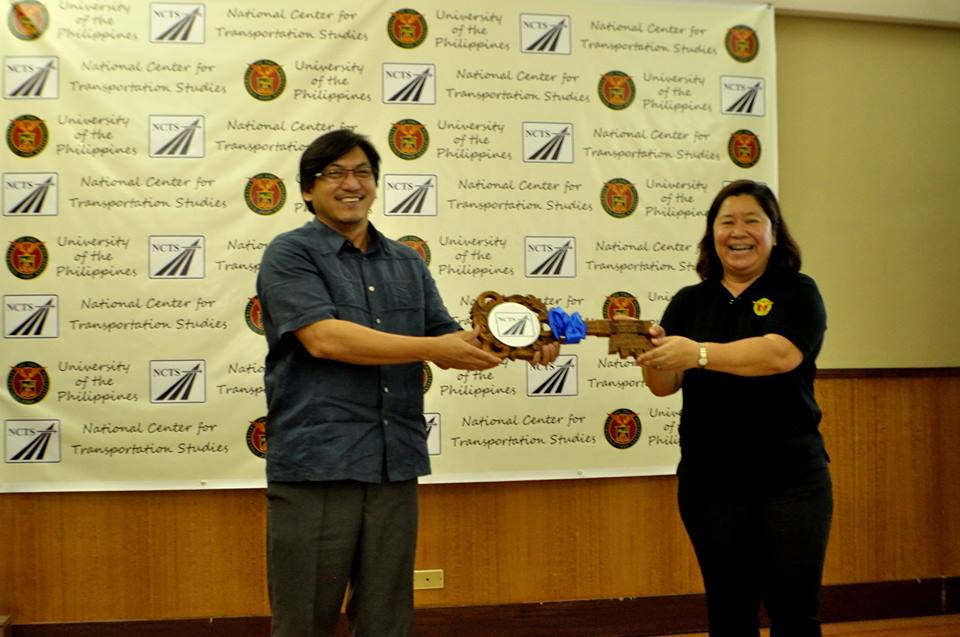 Dr. Napalang receives the symbolic key from Dr Palmiano
Dr Napalang was a former top senior technical staff of the NCTS before she joined the faculty of SURP after a short stint at the Asian Institute of Tourism (AIT) of the same university. Prior to joining UP, she was a faculty member and former Chair of the Department of Civil Engineering of Xavier University in Cagayan De Oro City in Mindanao. Dr Napalang obtained her B.S. Civil Engineering degree at Xavier University, her master’s at Virginia Tech in the US, and her doctorate at Tokyo Tech in Japan. She has done work on sustainable transport and the viability of transport systems. She has also contributed to the Cebu Bus Rapid Transit (BRT) project and the formulation of the National Environmentally Sustainable Transport (EST) Strategy. Her most recent publications are:
- Challenges of Urban Transport Development in Metro Manila: A look back at the last 40 years (lead author)
- State of Pavement Engineering in the Philippines and Implications on the Economic Life of National Roads (lead author)
These papers were presented at the recent 11th International Conference of the Eastern Asia Society for Transportation Studies (EASTS) held in Cebu City last September 2015.
Congratulations to Dr. Napalang for her new appointment, and thank you to Dr. Palmiano for his contributions as NCTS Director!
–
A new Director of the National Center for Transportation Studies
I learned a couple of days ago that there will be a new Director at the National Center for Transportation Studies (NCTS) at the University of the Philippines in Diliman soon. The new Director will be Dr. Ma. Sheilah G. Napalang who is a tenured faculty member of the university’s School of Urban and Regional Planning. She is to be the first woman head of the center, which used to be called the Transport Training Center that was created in the 1970s as part of the Japanese Government’s technical assistance to the Government of the Philippines to increase capacity and capability in transportation planning, engineering and management. Dr. Napalang will be the first Director from SURP since 2001 (since that time, all Directors were from the College of Engineering). She was a former senior technical staff of the NCTS before she joined the SURP and obtained her advanced degrees from the US (masters’ at Virginia Tech) and Japan (Dr. Eng. at Tokyo Tech).
More on this development and perhaps the turnover once everything is final and formalized.
–
Kids stuff for urban planning?
It’s been a busy latter part of the week and I haven’t had much time to finish a new article so I will just be sharing another interesting article, this time on urban planning. I spotted the article in my mailbox as part of a bulletin that I am subscribed to. Here’s a link to the article:
Teaching urban planning to pre-schoolers
It’s interesting to me as I am a teacher and I thought as I read this that we should probably be teaching transport planning or transport engineering to pre-schoolers as well. We are doing something like that for grade schoolers already in the form of road safety lessons. I am already curious about what topics to cover for pre-schoolers and how to teach them. Older children probably could go with SimCity and other computer games but pre-schoolers can be more of a challenge in terms of the tools you would need for them to learn. Using Lego is a brilliant idea and the same can be applied to transport as well in addition to maybe Matchbox and Tomica.
–
Readings for the new year
I wrote late last year about how the Christmas and New Year holidays allow me to catch up on some readings. These are mostly contemporary articles on transport and other topics rather than whole books (though I just finished one by George RR Martin during the semester). That post with three articles may be found in this link:
Some interesting readings on traffic engineering
I open the year with another post with a couple of interesting articles. One article reports on the newly opened bicycle ‘autobahns’ in Germany. ‘Autobahns’ basically refer to expressways or freeways. The new facilities for cycling represents what many will term as a paradigm shift for a country well known for its excellent automobiles. The concept of an expressway for bicycles actually makes sense in terms of safety and as a way to eliminate many if not all the factors that tend to discourage people from using bicycles for longer distance commutes. These do have the potential to reduce car usage (and traffic congestion) and ultimately also reduce pollution and fuel consumption. I am interested about the designs of these structures as the designs are also key to the development of similar infrastructure elsewhere including, hopefully, the Philippines.
Germany opens first stretch of bicycle ‘autobahn’
Another article is more thought provoking in the sense that it delves into labor and legal issues surrounding Uber and other ride sharing companies. These issues are valid and need to be discussed thoroughly not just in the US but elsewhere where ride sharing services have proliferated and profited. Many of the points pertaining to labor and compensation are valid, and I would like to think that these extend to the franchising issues that have been raised against ride sharing, which ultimately have implications on their business model. The legalese may be a turn-off to many who would argue that companies like Uber and Grab provide them with a good quality of service. But then that begs the question of whether they would have the same view if taxis were better than what they are now.
Road warrior: Is Uber ripping off its drivers?
Happy New Year and happy readings!
–
 Caught (up) in traffic