
Home » Behavior (Page 11)
Category Archives: Behavior
Children’s companions to and from school
In the recent 15th National Convention on Statistics, an interesting information is about the companions of school children when going to school and coming home from school. Note the change in companions from elementary school to high school.


The data above is from Zamboanga City. Is it the same or different in other Philippine cities or municipalities?
–
On making streets safer through woonerfs
One of the new things I learned when I was taking up transportation planning as an undergraduate student in the 1990s was about the woonerf. Our teacher then was a Visiting Professor from the Tokyo Institute of Technology. He introduced to us many concepts in that elective course that paved the way to a number of us proceeding to specialize in transportation. What is a woonerf? Well, here’s a nice article defining the woonerf and providing some examples:
Ionescu, D. (October 6, 2022) “What is a Woonerf?” Planetizen, https://www.planetizen.com/definition/woonerf?utm_source=newswire&utm_medium=email&utm_campaign=news-10062022&mc_cid=9d60b3d668&mc_eid=9ccfe464b1 [Last accessed: 10/10/2022]
To quote from the article:
“Translated as “living street,” a woonerf employs strategies like traffic calming devices and low speed limits to force drivers to slow down and safely share street space with pedestrians, cylists, and others, often without raised curbs separating cars and pedestrians. In the Netherlands, where the woonerf originated in the 1960s, motorized traffic within woonerf zones is limited to walking speed…
…A woonerf is not a pedestrianized street, but rather one where multiple users and vehicles co-exist. However, a woonerf can be converted to car-free uses using bollards or other barriers. The woonerf maintains utilitarian uses like loading docks and parking while making the roadway safer and more accessible to non-drivers.”
There should be many applications to the woonerf in the Philippines especially in areas where the dominant land use is residential and through traffic should be discouraged. This is goes well with the complete streets concept that is now being promoted and in fact pre-dates the concept and was well ahead of its time.
–
On animal – vehicle collissions
We feature a different type of road crash today – one involving wildlife and vehicles. This is not something new as I am sure you’ve seen all those road kills (usually cats or dogs) along many of our streets and highways. These don’t even include the frogs, birds and other animals that are killed by motor vehicle traffic. Here is an informative article on such crashes or collisions and what can be done to address them.
Skroch, M. (October 4, 2022) “The dreadful toll of wildlife – vehicle collisions – and what we can do about it,” Governing, https://www.governing.com/now/the-dreadful-toll-of-wildlife-vehicle-collisions-and-what-we-can-do-about-it [Last accessed: 10/10/2020]
To quote from the article:
“Advances in research technology over the past decade have revolutionized experts’ understanding of how wildlife move across landscapes and are now helping to resolve wildlife-vehicle conflicts that are rising due to increased development. One example is GPS collars that are affixed to big game, as well as other mammals and birds, and transmit electronic signals via satellite from some of the most remote regions in the U.S. to researchers throughout the country. This data captures exactly where and when animals move within large landscapes, enabling scientists and engineers to pinpoint where the construction of wildlife crossings — mostly overpasses and underpasses that help animals traverse highways — can most effectively improve motorist safety and facilitate animal migrations. Studies show that a well-placed underpass or overpass can reduce wildlife-vehicle accidents by over 90 percent, providing a high rate of return on federal and state investments in such structures.”
–
Back to the old normal in road safety?
Last week, I almost witnessed a multiple vehicle crash along Katipunan Avenue. Almost because we reached the location minutes after the incident happened and before the traffic build-up. Here are photos as we passed the area. You can see from the photos that there were already a lot of onlookers (i.e., miron and usyoso), most of whom were motorcycle riders taking photos of the vehicles involved. No one seemed to be helping those involved aside from the MMDA personnel who appeared to have just arrived as we passed the area.
 Miron and usyoso in the area near where a large truck plowed to the roadside near a residential area
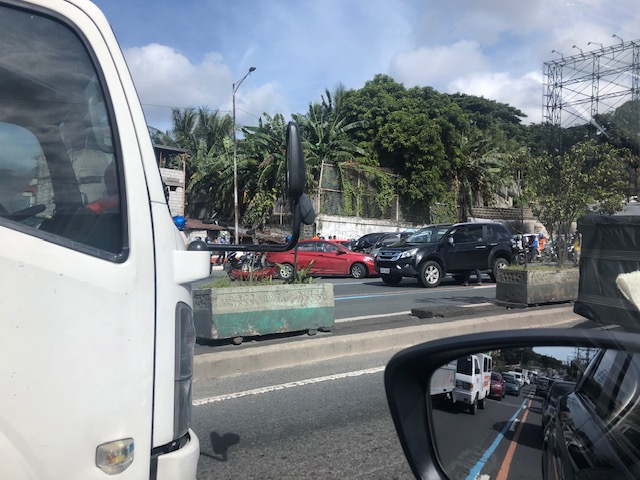 Some of the vehicles involved in the crash were this black SUV and the red car
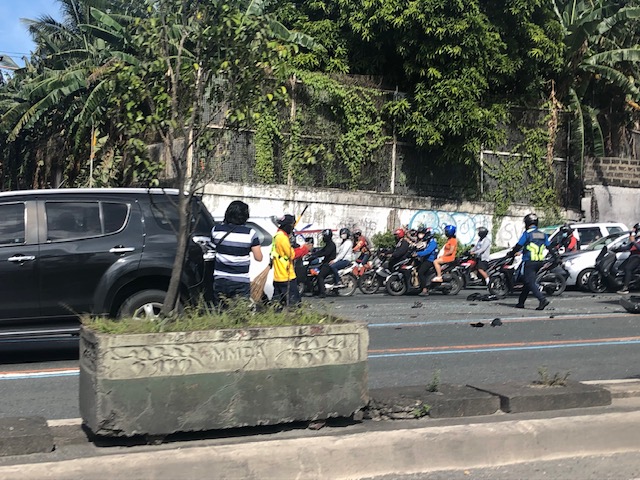 There were scattered debris from the vehicles involved.
 This truck and SUV collided probably as the truck attempted to avoid one of the vehicles
 Traffic jam quickly formed along the southbound side of the Katipunan-Aurora flyover
Traffic along the southbound side of Katipunan is usually heavy that time of day (around 8:00 AM). But there are sections including the flyover where vehicles typically speed up. Still, the likelihood of crashes is perceived to be low given the conditions unless a vehicle such as the truck in the first photo had some trouble with the driver losing control of the vehicle. It takes just one wayward maneuver or movement to initiate a chain reaction among other vehicles that would lead to a multiple vehicle crash.
Traffic has steadily returned to pre-pandemic levels and it seems that road crashes are also back and on the rise. Hopefully, the authorities such as the MMDA and the PNP will be monitoring traffic closely and address the issues contributing to road crash incidence such as reckless driving and defects in road facilities. I believe the data is available but are these being analyzed and evaluated in order to come up with the most suitable or appropriate solutions or countermeasures? Are there timely interventions to improve road safety along our roads?
–
On having daily walks to improve health and wellness
We begin October with an article about walking, health and wellness. I can relate to this article as we take daily walks, usually in the mornings. One positive outcome of the COVID-19 pandemic and the shift to more hours from home (rather than at the workplace) is that we have been able to schedule and increase time for our walks. And this has led to a healthier lifestyle for us.
To quote from the article:
“When it comes to brisk walking, “at these moderate levels of effort, you are able to increase your aerobic capacity,” Dr. Singh said. In addition to the long-term health benefits, such intensity would also lower blood pressure, moderate blood sugar levels and lower the risk for heart attacks and strokes.
The key is to walk at an intensity that is manageable but also slightly pushes the boundaries of what is a comfortable pace.
“That constant slow stress on your body is what leads to fitness gains,” Dr. Singh said. “If you’re just getting started, this is probably the easiest way to get started and stay committed, consistent and injury-free.””
Towards safer streets – on the best street improvements
We conclude the month of September with an article on road safety and particularly on best or good practices towards improving safety:
Brey, J. (September 16, 2022) “What Are the Best Safe-Streets Improvements,” Governing, https://www.governing.com/community/what-are-the-best-safe-streets-improvements [Last accessed: 9/29/2022]
The article points to improvements concerning pedestrians have the best results in terms of reducing the injury rose and death. To quote from the article:
“The data suggested that interventions which give more street space to pedestrians have the best results for lowering the risk of serious injury and death. Somewhat to the department’s surprise, that includes curb extensions, also known as “neckdowns,” which reduce the distance that pedestrians have to cover to cross a street. Those interventions were associated with a 34.1 percent decrease in deaths and serious injuries, according to the report.”
There is an interesting table in the article listing the top safety treatments in terms of injury change and KSI (killed or seriously injured) change. For the latter, the top treatments in order of highest change are:
- Pedestrian island
- Curb & sidewalk extensions
- Road diets
- Leading pedestrian intervals
- Protected bike lanes
- Turn calming
- Conventional bike lanes
With the push for more segregated bike lanes (as opposed to shared lanes), it is interesting to note from the article that:
“Another important takeaway was that conventional bike lanes, which involve little more than paint, did result in significantly fewer deaths and serious injuries. Protected bike lanes, which are separate from traffic by medians, parking space or other infrastructure, were more effective — but painted lanes are also useful…”
This a good reference and taking off point for those who are doing studies on road safety and want to contextualize it from the perspective of the complete streets concept.
–
On transit oriented development issues
I share this interesting article about some issues encountered in the US that affects transit operations and what planners term as transit-oriented development (TOD). While TOD remains a good concept and has been implemented successfully elsewhere (e.g., Japan, Korea, Singapore, European countries, etc.), the experience in the US may be quite different and even contrary. This underlines the importance of proper context when reading these articles that are likely written for an American audience (its published in a major US newspaper).
Sperance, C. (September 14, 2022) “Could it be the end of the line for transit-based development,” The Boston Globe, https://www.bostonglobe.com/2022/09/14/real-estate/could-it-be-end-line-transit-based-development/ [Last accessed: 9/24/2022]
The article describes how TOD came to be in the US:
“Even on a good day, when trains don’t derail or catch on fire, people move away anyway, looking for more space and the luxury of having their own car. But not everyone has the luxury to work from their living room in the burbs. The life sciences building boom in the area requires in-person work.
“We have a very strong economic engine that settled into places where people have to go to work, such as our academic institutions, our hospitals, and our labs,” Dimino said.
That’s a catalyst for transit-oriented development…”
The above quote looks to be very similar to what we have and are experiencing in many Philippine cities as well. I have mentioned and wrote about how housing affordability affects location choices in the Philippines. These choices of where to live ultimately affects transport mode choice and puts pressure on government to provide public transportation to connect suburbs to CBDs (i.e., residential areas to workplaces and even schools). We seem to be following the American model here and it does not help that the prices of residential units in the CBDs (and closer to workplaces) are not affordable to most people. The latter end up purchasing houses away from Metro Manila and in the adjacent provinces or Bulacan, Rizal, Laguna and Cavite. But it takes two to tango, as they say, and mass transit systems (their availability) also contributes to decisions of where to live. I conclude this post with another quote from the Boston Globe article:
“Transit will need to be an anchor and cornerstone of our future regarding equity, the economy, and climate and, therefore, will still be something that will have a relationship to housing decisions.”
–
On bicycles vs. self driving cars
You’ve probably seen this graphic, the top part of which is attributed to the Cycling Promotion Fund. The last image is reproduced in the lower part of the image but labeled to emphasize what space is required to transport 48 people on electric cars and autonomous or self-driving cars.
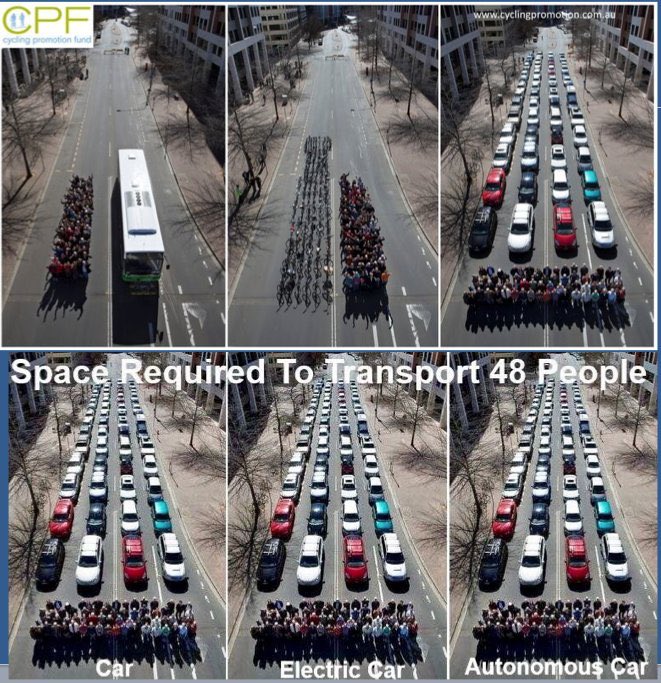
It is quite obvious that even if the current fleets of cars are replaced by electric and self-driving models, they will practically be the same problem in terms of road space occupied and the resulting congestion. So perhaps e-cars or autonomous cars are not really the solution we are looking for.
There is this nice article where the author articulates the how bikes (and active transport in general) should be the a more essential part of future transport and society than the automobile:
Collignon, N. (September 9, 2022) “Bikes, not self driving cars, are the technological gateway to urban progress,” Next City, https://nextcity.org/urbanist-news/bikes-not-self-driving-cars-are-the-technological-gateway-to-progress [Last accessed: 9/16/2022]
There are two quotable quotes from the article that I want to highlight here:
“Today the potential benefits from cycling on health, congestion, pollution and CO2 emissions are crystal clear and increasingly quantifiable, but the benefits of self-driving vehicles remain hazy. When ride-hailing companies like Uber and Lyft promised lower congestion and reduced car ownership, they instead increased congestion and led to a decline in transit ridership.”
and
“The concept of “jaywalking,” for example, is integral to the “car technology” of today. The crime of crossing a street without respecting the dominance of cars was invented by the car industry in the 1920s, who pushed hard to define streets as a place for cars, not people. Our car technology today is also defined by the restriction of movement it imposes on people.
When we begin to see technology through the lens of systems, it becomes clear that genuine technology-led progress will focus on dealing with the accelerating complexity of today’s world, not increasing the complexity of our tools.”
–
On micro transit and transportation gaps
I’ve written and shared articles before on how Paratransit, bicycles and micro transit helps alleviate the transport demand problems we are experiencing especially in highly urbanized cities. I think we should have as many options as possible for transport while also working towards the reduction of dependence on cars. Here’s an article that relates about experiences in the US:
Zukowski, D. (September 13, 2022) “Cities turn to microtransit to fill gaps in public transportation,” Smart Cities Dive, https://www.smartcitiesdive.com/news/microtransit-public-transportation-gaps-jersey-city-via/631592/ [Last accessed: 9/15/2022]
To quote from the article:
“Microtransit options are also helping to reduce the reliance on personal cars. “We’ve received feedback from people who say that because of Via they are now more consistently leaving their personal vehicle at home and using Via instead to travel within the city, which is exactly the kind of thing we want to see happen,” said Jersey City’s Patel.”
This final statement or paragraph in the article sums it up very well. Of course, we have to note that the experience in Asia is quite different especially in Southeast Asia where motorcycles are very popular and still on the rise in terms of their mode shares. While these may be considered micromobilities in western countries, they are definitely motorized private vehicles that, depending on how they are used and how the rider behaves, may be beneficial but at the same time also very dangerous for people.
–
On school bus services and the return to face-to-face classes
I did an interview last August with a major business daily but I couldn’t find it as published as part of an article. The topic was a very timely one as children return to schools for face-to-face (F2F) classes. Here are the questions sent to me and my responses as I remember them:
1. How will the transport sector cope with the expected increase in demand as more schools resume face-to-face classes?
For schools located in the cities, what we see is people opting to take private transportation in the form of cars or motorcycles to take their children to school. This is because public transportation supply is still not back to pre-pandemic levels while at the same time, parents and guardians and even students who commute by themselves (e.g., high school and college levels) may be hesitant to take public transportation as well as school service vehicles. The latter may be attributed to concerns about the safety particularly with regards to health (i.e., getting infected or exposed to Covid-19 if they take public transport or a vehicle where they share the ride with many other people). We need more public transportation capacity to be able to address the increased demand brought about by students coming back for face-to-face classes. We also need to have other options or alternatives for their safe journeys including walking and cycling for their commutes.
For schools in the rural areas, there may be little adjustment concerning transport since most schoolchildren walk or take motorcycles or tricycles to school. This is perhaps because most schoolchildren reside within the school district and do not have long commutes like what we have in many cities (e.g., most schoolchildren who study at schools like Ateneo, LaSalle, etc. likely live in another city or town rather than near the schools).
2. How many school buses are expected to resume operations? How many of them have permanently closed?
I currently don’t have the data on that but LTFRB should have reference or baseline data. School service vehicles are required to register with the LTFRB and perhaps a look at the number registered before and during the pandemic could show how many can be expected to resume operations nationwide and per region. LTO doesn’t have these numbers as they only register by vehicle type. We will not know from LTO data which jeepneys, vans or buses are used for school service. Most school service are tied to the schools the student of which they provide transport services to. If the school closed, then chances are that the school service may apply to other schools. That said, the last two years where schools operated online were a backbreaker to many school service and only the registered numbers with LTFRB can tell us just how many are not returning at least for this school year.
3. How does the surge in fuel prices affect the operations of those involved in school transportation? Will this affect the ability of teachers, schools staff and students to travel on-site?
School services might increase their rates, which are usually monthly or semi-monthly. This is to make up for the increase in fuel prices and vehicle maintenance as well. This will likely only affect students’ travel rather than those of their teachers or school staff. The latter group will likely take public transport or their own vehicles for their commutes. In their case, their travel may be affected by transport fare increase or their own fuel expenses if they use their own vehicles. They have little choice though because they have to travel to work. Student though may still enjoy some respite as many schools are adopting blended or flexible schedules that will only require students to do face-to-face classes on certain days of the week.
4. What’s the long term impact of the pandemic on the school bus industry?
People will remain to be apprehensive in letting their children share a school van or bus ride due to the pandemic. We can only promote vaccination and compliance with health protocols to ensure that schoolchildren will have safe journeys as far as Covid-19 is concerned. The return to face-to-face classes this school year will perhaps help determine if the pandemic will have a long term effect on the industry or if people’s (parents and guardians) trust to school bus services will return within the short term.
5. How can school bus drivers and operators cope with the challenges posed by the pandemic and rising fuel prices?
LTFRB issued Memorandum Circular 2022-066, which adds health protocols for school service:
• Regular examination of the drivers and conductors’ fitness to work by checking their body temperature and screening for symptoms related to COVID-19.
• Regular disinfection of frequently-touched surfaces, such as but not limited to seats, armrests, and handles.
• Mandatory wearing of face masks at all times by drivers and conductors, including passengers.School transport services must comply with these protocols and demonstrate the safety of their mode to convince people to return to using or subscribing to school service vehicles. Meanwhile, there is really no escaping rising fuel prices but collective transport in the form of school service vehicles are still more efficient and cheaper per passenger compared to using private vehicles; not to mention contribute to reducing traffic congestion along school routes. This must also be promoted (i.e., people made aware of the advantages) vs. private vehicle use.
–

