
Home » Behavior (Page 18)
Category Archives: Behavior
Of inequitable allocations and accessibility
In the news recently were figures released supposedly by Philhealth showing the top hospitals receiving reimbursements from the agency for claims relating to COVID-19. Southern Philippines Medical Center, a hospital in Davao City received 326M pesos while UP-PGH got 263.3M pesos. I was not surprised that my social media newsfeed included posts from both sides of the fence (The fence sitters among my friends on social media were not commenting about these anymore and seem content in just posting on food or whatever activity they were in.). Each were posting information divulged by the whistleblowers in the ongoing hearings on the issues pertaining to PhilHealth funds.
I will not go into the political aspect of this controversy but will just focus on the transportation aspects of the issue. I will just compare the top two hospitals in the list to simplify the assessment while mentioning others in general.
The claim that the hospital in Davao was the equivalent of PGH in Mindanao doesn’t hold water as the hospital does not treat even 10% of the cases that PGH is handling and for a much smaller geographical area. While UP-PGH is accessible to a larger population and for less travel times, SPMC is not as accessible to say people coming from other major cities like Cagayan De Oro or Zamboanga City. Yes, there are other major cities on the same island that have sizable populations with ‘catchment’ or influence areas comparable to Davao City. They, too, probably need funds to be able to treat COVID-19 patients. It is true that there are many other hospitals in the National Capital Region (NCR) that have the facilities to treat COVID-19 patients. However, many of these are private hospitals that tend to incur more costs for the patient and are not generally accessible (read: affordable) to most people who are of middle and low incomes. Thus, UP-PGH can be regarded as the frontliner among frontline hospitals.
What? There are other public or government hospitals in Metro Manila and surrounding provinces? True, but many of those have very limited capacities in terms of facilities and Human Resources. The same applies to Davao’s case as well because there are also medical centers and hospitals in surrounding provinces. And to round-out the resources available to these hospitals, local government units have also (over) extended their resources to hospitals. Perhaps the allocations and proportions can be explained in another way that is not the “apologist” but based on actual numbers pertaining to cases handled by the hospitals?
–
Painted lines are not enough for bike lanes
From the experiences of many biking or trying to bike in the Philippines, painted lines are not enough for bike lanes. Only recently, cyclists using bike lanes that did not have any physical barriers to deter motorists from encroaching have been involved in crashes, with at least a couple being reported as fatal for the cyclists. Here is an article on what cyclists need in order to ensure or at least improve the safety of their commutes.
UTC (2020) “White lines? Cyclists need more,” ITS International, https://www.itsinternational.com/its8/feature/white-lines-cyclists-need-more [Last accessed: 8/6/2020]
 Commuters on bicycles along the Marcos Highway bridge bike lane
Are there differences regarding cycling in different countries? From a somewhat cultural-behavioral perspective, perhaps there are studies (though I am not aware of them yet) about how peoples from different countries or cities behave with respect to cyclists whether or not there are bike lanes designated for the latter’s use. I recall my experiences cycling in Japan and drivers are generally respectful of cyclists on the roads. Pedestrians, too, are very tolerant of cyclists on the sidewalks or designated areas for walking. Of course, the cyclist would have to do their share of respecting others’ spaces, too, and should behave and position themselves accordingly while traveling.
–
On bicycles slowing down cars
There is a perception that cyclists tend to slow down other vehicles, mainly motorized, along roads. Again, such can be the experience of some that have been generalized and accepted as fact in most cases. However, if we look closely at the evidence, the perception may not be true for most cases after all. This article comes out of Portland State University:
Schaefer, J., Figliozzi, M. and Unnikrishnan, A. (2020) “Do bicycles slow down cars on low speed, low traffic roads? Latest research says ‘no’,” EurekAlert!, https://eurekalert.org/pub_releases/2020-07/psu-dbs072320.php [Last accessed: 8/1/2020]
Check out the wealth of information through the links found throughout the article that includes references to published material in reputable journals. EurekAlert! is from the American Association for the Advancement of Science (AAAS).
–
On the benefits of shared roads during the pandemic
There is evidence, and they are increasing, for the benefits of shared roads. Here is another quick share of an article supporting that:
Brown, M (2020) “Shared-use roads improve physical distancing, research shows,” Medical Xpress, https://medicalxpress.com/news/2020-07-shared-use-roads-physical-distancing.html%5BLast accessed: 7/30/2020]
With the situation in the Philippines and particularly in Metro Manila appearing to be worsening rather than improving, national and local governments should take heed of the evidence for shared-use roads and the importance of active transport to ensure people’s mobility will not be hampered. This is particularly important for our frontliners and other essential workers if we are to survive this pandemic.
–
On making roads safer for students
Here is a nice article from the National Academies of Science, Engineering and Medicine about how transportation research makes roads safer for students as they go back to school:
Transportation research makes the road safer for students to get back to school
There is a wealth of information there, and one should browse and perhaps download resources shared that can be useful references not just for those in North America but elsewhere towards making journeys between homes and schools.
 Scene near a public school in Zamboanga City [photo taken in June 2019]
We, too, have several initiatives towards making the journeys of children safer between their homes and schools. It is something that all of us find essential and worthwhile. Children, after all, represent our future and making their journeys safer gives them better chances to succeed in life. It also shows them examples that they can replicate for their own future children. I will write more about these as we obtain the data and perform our assessment.
–
The plight of commuters during GCQ
I write this on the eve of the imposition of Modified Enhanced Community Quarantine (MECQ). It is another unfinished article that was intended to be a quick post showing the typical conditions for commuters during the GCQ. Public transport supply was slow to return to adequate levels as the government took advantage of restrictions to impose route rationalization and modernization programs. The following scenes were common along my commuting routes:
 Commuters waiting for a ride near the provincial capitol
 The rains of the wet season added to the misery of the wait.
 Long queue at the public transport terminal at Robinsons Antipolo, which is the terminus for buses connecting Antipolo with Cubao and Ortigas Center.
 The queue reaches beyond the shaded areas of the terminal.
I think national government should be the one to provide for the public transport needs of frontliners (i.e., health care workers including doctor, nurses, medical technologists, pharmacists, etc.) and other essential workers. My definition of the latter are those required for logistics to function as well as those to ensure the required production or manufacturing for the rest of us who need to stay at home. Not everyone has the same, fair circumstances as there are those who can afford to stay at home and those who need to work for them to live, often on a day-to-day basis.
The pandemic has taken a toll not only on the physical but the mental health of many of us. Government rants and retorts are unnecessary and uncalled for given its dismal performance. I dare say dismal as the evidence shows certain local government units and the Office of the Vice President doing much, much more despite their limited resources. We are not in this quandary because government performed well and to the best of their people’s abilities. If that was their best then they have no business staying in their positions. If our health care system fails, then there is nothing to stop this pandemic from claiming much more than lives.
–
On data on mobility trends
There are actually a lot of data available on mobility if you know how to look for them. One good source is Apple. Yes, Apple has access to thousands of smart phones that allow them to track individuals (oh you didn’t know that?) movements. Here is the link to Apple’s data:
https://www.apple.com/covid19/mobility
And here is a graph showing mobility trends in the Philippines from that resource:


Some politicians and political appointees are now saying that we are in this predicament about COVID-19 because of a lack of discipline. That is bullshit. Many stayed home and/or reduced their movements. And then there’s that study showing 90% wore masks when they go out. No, it’s not lack of discipline that’s the problem but the lack of essential services and goods that are supposed to be delivered by those who are suppose to govern and the deficiencies from the start in addressing the spread of the virus especially from abroad. Perhaps these people criticizing Filipinos should look at their mirrors more closely and look left, right and across from they comfy seats to see what’s wrong with the way government has been handling the pandemic?
–
On the bicycle as the future of urban transport
Here is another quick post where I am sharing an article on the bicycle as the future of transport:
Dans, E. (2020) “Whichever way you look at it, the bicycle is the future of urban transport”, medium.com, https://medium.com/enrique-dans/whichever-way-you-look-at-it-the-bicycle-is-the-future-of-urban-transport-c40157625115 [Last accessed: 7/17/2020]
I’ve posted about this idea before here and on social media. While some people were engrossed or obsessed about self driving cars, I was asking them how this could be the future of transport when all this leads to is more cars on the roads, and perhaps roads designed to accommodate these vehicles. The evidence vs. self driving cars was already there and the pandemic only emphasized how this could not be the future of transport. Instead, we have something more basic and not even motor-powered – the bicycle. Come to think of it, there is also walking. But then the bicycle is more energy efficient and can take you over longer distances than your feet.
–
Whatever happened to those ‘enhanced’ pedestrian crossings?
Before the lockdowns, a lot of people seem to have become excited with what a private company did as part of their PR campaign (I’m certain about this because their ads feature these.). That is, they painted on the existing pedestrian crossings in Antipolo City along major roads such as Sumulong Highway and the Sumulong Memorial Circle. While coordination with the LGU was done, there seems to be none with the DPWH considering these are national roads and any matter concerning them are under the agency’s jurisdiction through their District Engineering Office. The following photos were taken prior to the lockdown and as you can see (if you were objective) there’s nothing really notable about them though they appear to enhance the existing crosswalks.
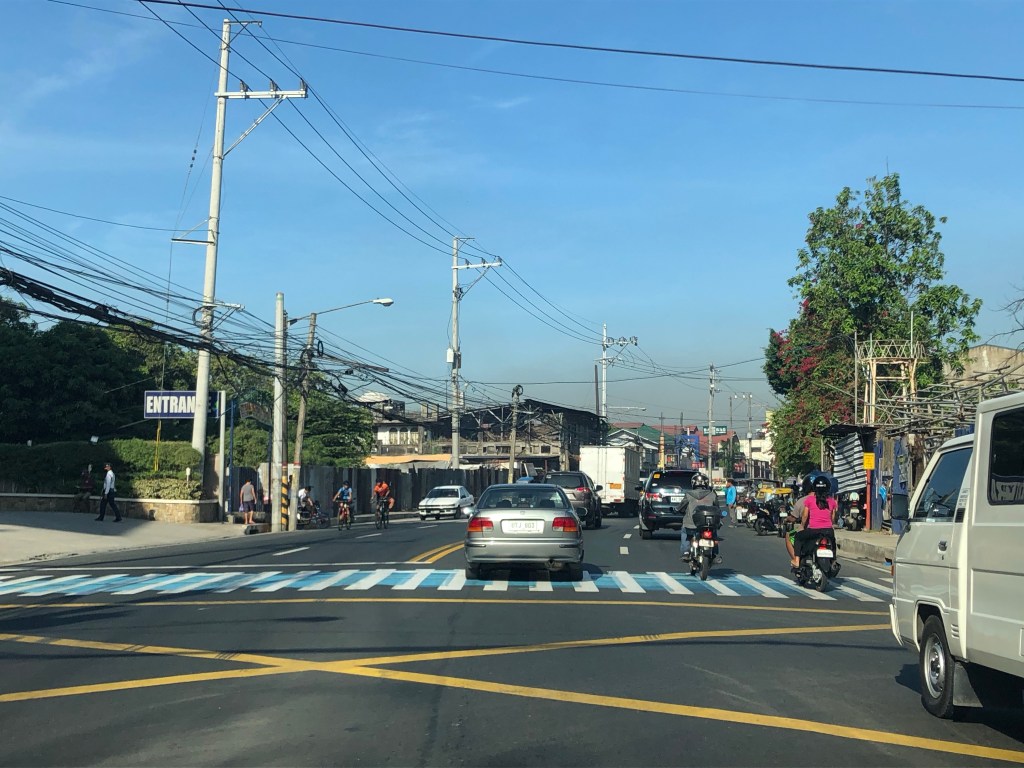
The artwork is practically invisible to motorists especially those on cars whose drivers’ eyes are lower than those driving SUVs, jeepneys, buses or trucks (i.e., larger and taller vehicles).
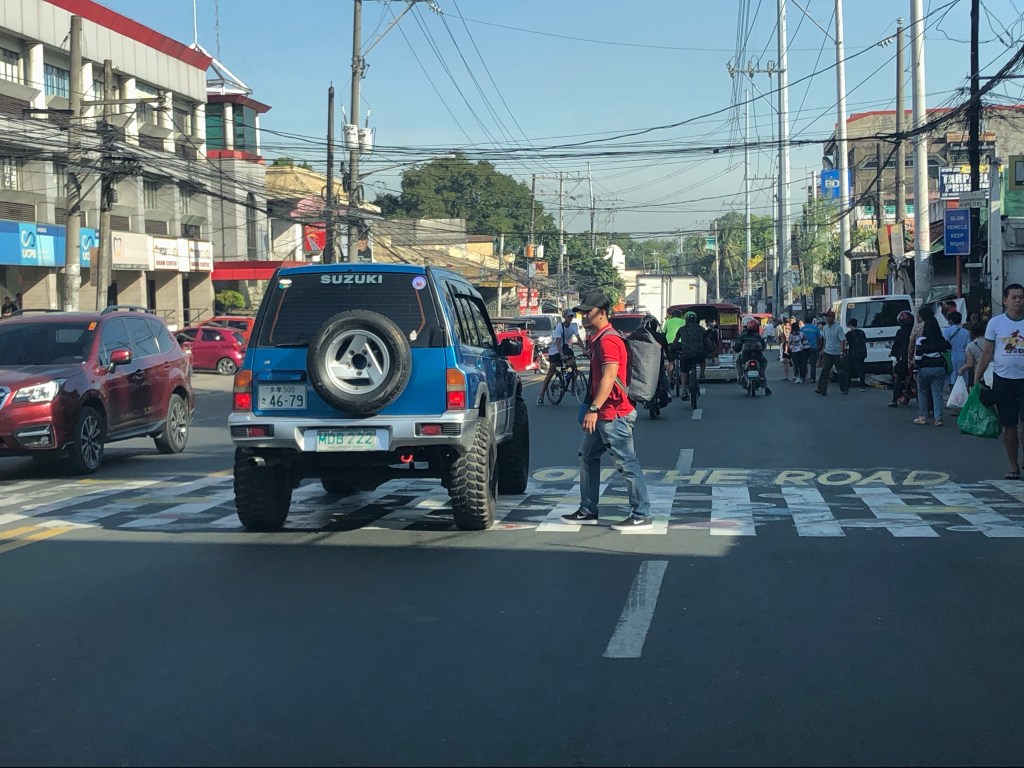
There is no strong evidence that such works enhance road safety.
There is no strong evidence that such works enhance road safety and you can check on this by doing either a quick or even an extensive search for literature proving significant impact. I guess the key here is to also install other devices such as a speed table or rumble strips for motorists to feel that they are approaching a pedestrian crossing. Also, perhaps instead of just painting on the crosswalks, they could have painted so as to widen the crosswalk. Then they could have increased the visibility for pedestrian crossings. That said, they should also have used the standard paints for these facilities that make them visible at night and could have been more resistant to weathering.
–
On people’s apprehension to use public transport
Public transport supply issues aside, there is also an apprehension to use public transport in the Philippines because of the perception that using public transportation will expose you to COVID-19 and lead to an infection. So far, this is far from the truth, which is that if proper precautions or countermeasures are applied (including physical distancing), public transportation can be safer than taking a car to move about.
Here is an article from the US co-written by Janette Sadik-Khan, who presided over the complete streets transformation in New York City. Aside from explaining how public transport can be safe, COVID-19-wise, the authors state that one must be most worried about conditions in places they go to including their workplaces, markets and yes, homes.
Sadik-Khan, J. and Solomonow, S. (2020) “Fear of Public Transit Got Ahead of the Evidence,” The Atlantic, https://www.theatlantic.com/ideas/archive/2020/06/fear-transit-bad-cities/612979/ [Last accessed: 6/25/2020].
Several groups have already called for jeepneys to resume services. Unfortunately, DOTr and LTFRB have other plans to implement; opting for a hard-push of the modernization and rationalization programs of the government. As such, despite the demand for public transport, the latter’s unavailability meant that many commuters had to take private vehicles to go to their workplaces. That meant those who usually could leave their cars home or at least opt for public transport most days reverted to their vehicles (note: the number coding scheme is still suspended for Metro Manila). Tricycles could only carry one passenger each; effectively making them 3-wheeler taxis. While train and bus operations have resumed, both have limited passenger capacities due to the physical distancing requirements.
Again, there are precautions and countermeasures that can be applied in order to ensure the reduction or minimization of infection risks. Public transport providers need to follow these guideline to prevent infections that can be attributed to public transport use, and help people trust in using these modes over cars.
–

