
Home » Behavior (Page 19)
Category Archives: Behavior
On public transport services during the pandemic
I’ve read a lot of discussions and recommendations pertaining to public transportation services (mainly its lack thereof) during the Enhanced Community Quarantine aka lockdown in most parts of the Philippines. Problem is, a lot of people had their mobility curtailed as most people did not have their own private vehicles (cars or motorcycles) to do essential trips (i.e., for groceries, market, drugstores, hospitals, etc.). These include so-called frontline workers, most especially those working in hospitals or clinics. Even the use of tricycles on a limited basis while adhering to physical distancing guideline was not allowed in many cities and municipalities. What do we really need to do now and in transition to address the lack of public transport services?
Here is a concise yet very informative article on transit:
Walker, J. (2020) “Cutting Transit Service During the Pandemic: Why? How? And What’s Next?”, Human Transit, https://humantransit.org/2020/04/cutting-transit-service-during-the-pandemic-why-how-and-whats-next.html [Last accessed: 4/23/2020]
Most of the points discussed and recommendations presented are applicable to our case in the Philippines. We should also accept the fact that we cannot go back to the situation prior to the ECQ, and that the new normal calls for a reduction in car use. Meanwhile, we still have to address the pressing issues and come up with a plan or maybe strategies for public transport that involved not just buses and trains but other modes as well like the jeepneys, vans and tricycles.
–
On walking, running and cycling for exercise during the Covid-19 pandemic
We had been walking in the early mornings prior to the so-called “total lockdown” implemented by our Barangay. There were others like us in our community who walked, jogged or cycled during the same time we took our walks. However, we all practiced physical distancing and used masks while outdoors. We could afford to do this because the village where we resided in had relatively wide streets and there were few houses and residents compared to other residential areas. In our case, we usually walked in areas where there were even fewer houses and people. It is highly unlikely we could get Covid-19 during our morning walks. Afternoons were different as we observed more people going around including those who appear to be joyriding with their motorcycles.
Is there actual evidence that walking, jogging, running or cycling actual aid the spread of Covid-19? So far, there isn’t and what we have are mostly simulations. Yes, simulations like those that appear in articles that are going around the internet; often shared in social media. Here is a more informative and objective article about this topic that articulates more the importance of physical activity (i.e., in the form of walking, jogging, running or cycling) in combatting the virus while also emphasizing the need for social or physical distance and the use of masks:
Niiler, E. (2020) “Are Running or Cycling Actually Risks for Spreading Covid-19?”, Wired, https://www.wired.com/story/are-running-or-cycling-actually-risks-for-spreading-covid-19/?bxid=5bd6761b3f92a41245dde413&cndid=37243643&esrc=AUTO_OTHER&source=EDT_WIR_NEWSLETTER_0_DAILY_ZZ&utm_brand=wired&utm_campaign=aud-dev&utm_mailing=WIR_Daily_041420&utm_medium=email&utm_source=nl&utm_term=list1_p4 [Last accessed 4/15/2020]
I appreciate the efforts of those in our Barangay to make sure no one gets infected (there are zero incidents so far). However, sometimes the overeagerness seem to trump the need to practice common sense in these times. I believe there is a need to make an even bigger effort to ensure people are able to maintain physical and mental wellness through exercise or activity. I believe we are in a community where people are educated, aware and responsible enough to make this work.
–
Is traffic congestion like a virus?
An article came up where the author explains the similarities of the coronavirus spread to the spread of traffic congestion. It is basically about modeling (and simulating) the spread while considering factors like the characteristics of the virus that are similar to traffic. I’m posting/sharing it here for future reference/reading:
Simon, M. (2020) “Turns Out, Traffic Spreads Like the Coronavirus”, wired.com, https://www.wired.com/story/traffic-spreads-like-disease/?bxid=5bd6761b3f92a41245dde413&cndid=37243643&esrc=AUTO_OTHER&source=EDT_WIR_NEWSLETTER_0_DAILY_ZZ&utm_brand=wired&utm_campaign=aud-dev&utm_mailing=WIR_Daily_040720&utm_medium=email&utm_source=nl&utm_term=list1_p2 %5BLast accessed: 4/8/2020]
–
Cityscapes and mountains
I’ve been reading about how a lot of people seem to be ‘discovering’ the mountains around Metro Manila. It is not as if these have suddenly appeared or that many have been obscured by pollution. For the latter, perhaps if you lived some distance and pollution was so bad that the smog was thick enough to hide mountains then it would be easier to not see them. In reality, I think most of these people have just been too busy not to see these mountains and other landscapes when they happen to be in plain sight. Perhaps people were too distracted by their daily routines that they didn’t have time or relegated these to the background as if they were noise to be filtered. Parts of the Sierra Madre from Antipolo to San Mateo and Rodriguez (Montalban) are common sights that are not usually appreciated as people go on their daily commutes and are caught in traffic.
Here are some of the mountains that are visible from strategic locations. In my case, I live in Antipolo and an area near my home allows me to see well known mountain landmarks from different provinces.
 Mt. Makiling in Laguna Province without the usual cloud cover of its peak
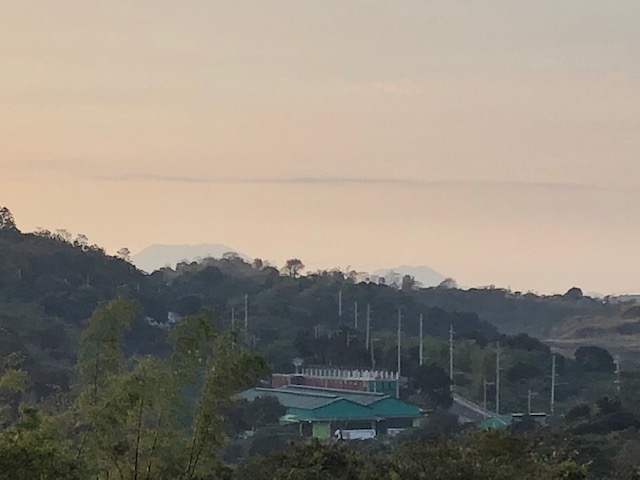 Mt. Banahaw and Mt. San Cristobal in Quezon Province are not usually visible unless its really one of those clear days.
 Mt. Arayat in Pampanga Province is visible at the right side of the photo. The view though is marred by rebars sticking out from a house under construction.
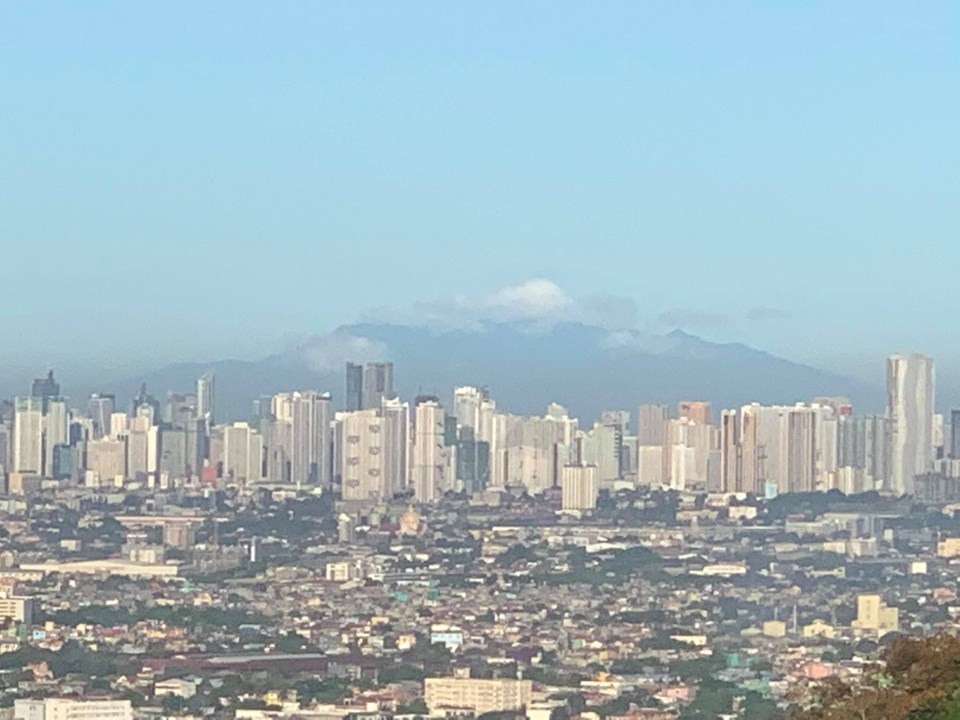 Mt. Mariveles in Bataan Province with cloud cover serves as a background for the Metro Manila cityscape.
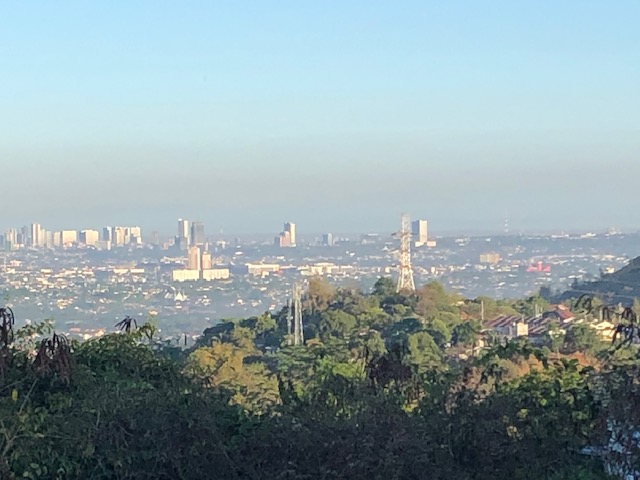 This is what Quezon City usually looks like with layers of smog making it difficult to ascertain any mountains that are visible on clear days.
I have photos of Mt. Natib, Mt. Malarayat and the Tagaytay Ridge that I will be posting here soon.
–
On changes in traffic patterns after the pandemic
We start April with a nice article from Cities of the Future. The article explains how traffic patterns will be changing due to Covid-19. They have already changed for most of us who have to deal with quarantines and lockdowns. And we should not expect things to go back to normal. “Normal” here, of course, is “Business As Usual” or was that. It is quite clear that we cannot and should not go back to BAU and it is probably going to be good for most of us. There will definitely be a lot of adjustments and sacrifices especially for commuters who have been dependent on cars for travel. The transport industry, too, will have to deal with the new supply and demand dynamics. And government should be up to the task of engaging and rethinking how policies and regulations should evolve to address issues coming out of the “new normal” in transportation.
Valerio, P. (2020) Traffic patterns are going to drastically be very different, says Micromobility expert , Cities of the Future, https://citiesofthefuture.eu/traffic-patterns-are-going-to-drastically-be-very-different/ [Last accessed: 4/3/2020]
–
Planning for the new normal – post Covid-19
There have been many discussions lately about urban planning and transport planning in relation to the pandemic currently gripping the world. There are opinions and assessments about topics such as population density, employment, public transportation, physical or social distance, as well as the prospects for reducing car dependence.
Here is a nice article that compiles some of the better articles on planning related to the current Covid-19 pandemic that’s affecting our planet:
Brasuell, J. (2020) Debating the Future of Cities, and Urban Densities, After the Pandemic, planetizen.com, https://www.planetizen.com/node/108814?utm_source=newswire&utm_medium=email&utm_campaign=news-03232020&mc_cid=a891454817&mc_eid=9ccfe464b1 [Last accessed 3/24/2020].
The world will never be the same after what everyone has gone through during this pandemic. Let us not wish we could go back to normal because, as the saying goes, that “normal” was what got us here in the first place.
Keep safe everyone!
–
Level of Service (LOS) and social distance for pedestrians
I was reviewing materials for my classes now that the latter have been suspended and we are switching to online teaching. I came upon the topic of level of service (LOS) for pedestrians – for walkways and sidewalks to be exact. Following is the LOS table for walkways and sidewalks (platoon-adjusted) with my note, and an illustration of walkway LOS thresholds with my annotations. The recommended minimum social distance is 1 meter. That translates to a space of 3.14159 square meters if we assume a circular area around a person.
 Platoon-adjusted means people are moving and grouped according to the speed of a lead person or persons dictating their walking speed.
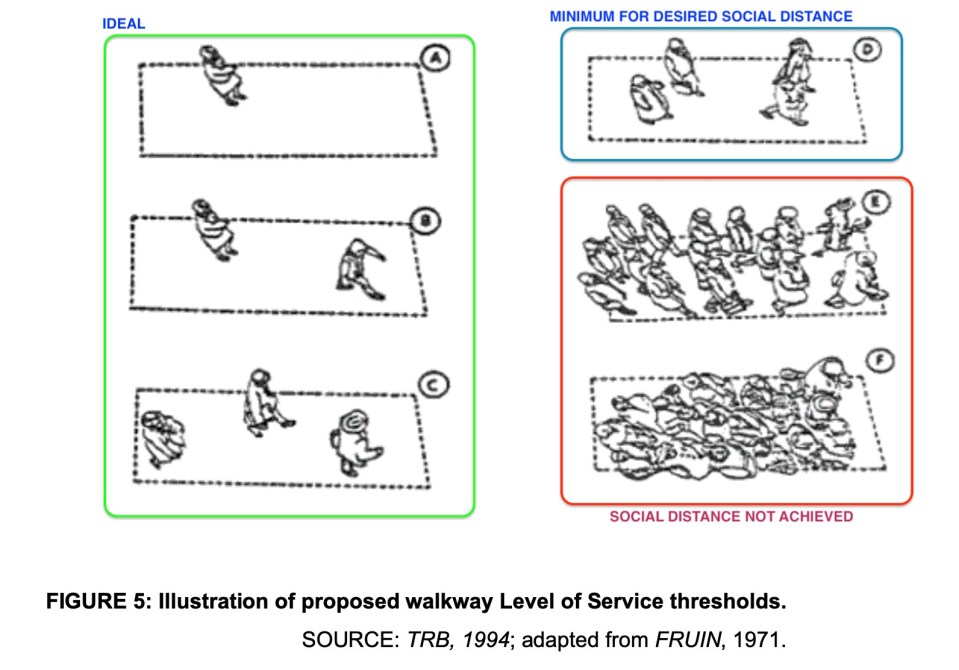 I annotated the illustration to show the minimum pedestrian spacing, the ideal spacing, and situations when the desired social distance is not achieved.
The big question now is if we can achieve the minimum given the mostly inferior pedestrian facilities we have in the country. Do you know of any areas where this can be achieved? BGC? Trinoma? MOA? UP Diliman Campus? Iloilo City’s Esplanade?
–
Scenic highways? On the irony of “Daang Kalikasan”
There’s a lot of buzz about new roads nearing completion in the provinces of Pangasinan and Zambales. What is touted as scenic highways became an instant hit and attracted a lot of visitors who apparently wasted little time in trashing the area. The recent news now state that the road has been closed due to the garbage and some road crashes attributed to the influx of tourists in the area:
Mountain roads linking Pangasinan, Zambales closed over accidents, trash
There were a lot of posts that appeared on my social media newsfeed about these roads and the scenery around them. While I have seen a lot of roads with splendid or even magnificent sceneries whenever I go on road trips, the first thing that came to my mind was a question whether the landscape was like that before. I suspected that there used to be forests on these mountains and that the trees were irresponsibly cut down (some people will use the word ‘harvested’ as if they grew and cared for the trees) and never replaced. Some friends from Zambales say there used to be trees there and another recalled old dirt roads in the areas used for logging. So it’s ironic that the road is named “Daang Kailkasan” when nature was practically raped by people who ravaged the land many years ago. Indigenous people who we often refer to as “katutubo” also would likely have never consumed more than what they needed. Scenic? Maybe ‘depressing’ is a more suitable term for these roads.
–
Comments on current transport issues – Part 3: On the obstacles to the PNR trains
2) On the obstacles to the PNR operations
We have done studies before when studies on the PNR were not considered fashionable. People who did research on rail transport were more interested in Lines 1, 2 and 3, and dismissed the PNR as a lost cause. There were many transportation experts who ridiculed it and even taunted PNR about their poor service. And yet we did our studies because we had an appreciation of the importance of this line and how it could play a major role in commuting if given the resources to improve their facilities. It was shown that the line could be more advantageous for commuters particularly those traveling between the southern parts of Metro Manila and Makati and Manila. These would be both workers and students who will benefit from the shorter travel times and less expensive fares. The downside then (and still at the present time) was the long headways between trains. That is, you can only catch a train every 30 minutes.
 This photo taken more than a decade ago show the typical conditions along many sections of the PNR. It is pretty much the same today and the agencies involved (DOTr and PNR) have done little to reduce the informal settlers along the line. No, they didn’t just appear now, and are throwing garbage, rocks and other debris on the trains. This was already happening years ago.
Fast forward to the present and they seem to be getting a lot more resources than the last 30+ years. A Philippine Railway Institute (PRI) has been created. New train sets have just been delivered and went into operation. Unfortunately, the new trains were met with rocks and other debris as they traveled along sections occupied by informal settlers. The incident damaging the new trains puts further emphasis on the need to the need to address the squatter problem along the PNR line. Should fences be built to protect the trains and passengers? Should people be relocated? I think both need to be done in order to secure the line and in preparation for service upgrades including more frequent train services (i.e., shorter intervals between trains). And we hope to see the DOTr and PNR working on this as they attempt to attract more passengers to use their trains.
–
Comments on current transport issues – Part 2: On motorcycle taxis
I continue with my comments on current and persistent transport issues. This time, I focus on one of two hot topics – motorcycle taxis or “habal-habal”.
1) On motorcycle taxis:
I am not a member of the Technical Working Group (TWG) that’s supposed to be evaluating the trial operations. I know one or two of the key members of the TWG and am surprised that they have not referred to the academe for studies that may have already been done about this mode of transport. I know there have been studies about it in UP and DLSU. Perhaps there are more from other universities in the country. Motorcycle taxis or “habal-habal”, after all, are practically everywhere and would be hard to ignore. Surely, researchers and particularly students would be at least curious about their operations? Such is the case elsewhere and many studies on motorcycle taxis have been made in the region particularly in Vietnam, Thailand and Indonesia, where these modes also proliferate.
The terms “trial”, “experimental” or “pilot” are actually misleading because motorcycle taxis have been operating across the country for so many years now. They are supposed to be illegal and yet they serve a purpose in the areas where they are popular. What is often referred to as an informal transport mode is ‘formal’ to many people who are not being served by so-called formal modes including the tricycle. Of course, one can argue that these terms (i.e., trial, experimental and pilot) refer to the app that are supposed to enhance the existing habal-habal operations.
I would strongly endorse motorcycle taxis but companies need to be held accountable should there be fatal crashes involving their riders. They are supposed to have trained and accredited them. The companies should also have insurance coverage for riders and passengers. LGUs tolerant of these should be watchful and do their part in enforcing traffic rules and regulations pertaining to motorcycle operations in favor of safe riding. This is to reduce if not minimize the incidence of road crashes involving motorcycle taxis.
I think one of the problems with motorcycle taxis is not really their being a mode of choice but the behavior of their drivers. While companies like Angkas and Joyride conduct training sessions with their riders, many revert to reckless on-road behavior including executing risky maneuvers in order to overtake other vehicles on the road. This is actually a given with many ‘informal’ motorcycle taxis (i.e., those not affiliated with the recognized app companies). But then this is also an enforcement issue because we do have traffic rules and regulations that are poorly enforced by authorities. Thus, there is practically no deterrent to reckless riding except perhaps the prospect of being involved in a crash.
I will refrain to include the politics involved in the issue of motorcycle taxis. I will just write about this in another article.
Coming up soon: hot topic #2 – Obstacles to the PNR operations
 Caught (up) in traffic