
Home » Behavior (Page 20)
Category Archives: Behavior
The problem with public transport in the Philippines…
There is a collage of two photos, one taken in 1975 and another in 2019, showing buses that managed to squeeze themselves into a jam. The 1975 photo was taken at the ramp of the overpass near Liwasang Bonifacio (Quiapo, Manila). There is a commentary describing the photo that attributes ‘monstrous daily traffic jams’ to the behavior of Filipino drivers. Special mention was made of public transport drivers and the photo showed proof of this. This was 1975 and motorization had not reached the levels we are at now so the arguably, traffic congestion was not as bad as the present we experience daily.

The problems pertaining to driver behavior persist today and probably even worsened along with the general conditions of traffic in Philippine roads. I say so since the volume of vehicular traffic has increased significantly from 1975 to the present and there are much more interactions among vehicles and people that have led to a deterioration of road safety as well. Traffic congestion and road crashes are asymptomatic of the root causes of most of our transport problems. And so far, it seems we have had little headway into the solutions. The photos speak for themselves in terms of how many people can easily put the blame on poor public transport services despite the fact that cars are hogging much of the road space. And what have authorities done in order to address the behavioral issues that lead to these incidents?
Someone joked that the guy in the 1975 photo who appeared to be posing in disbelief of what happened is a time traveler. The 2019 photo shows a similar guy with a similar pose though with more people around. Maybe he can tell us a thing or so about what’s wrong with transportation in the Philippines and provide insights to the solutions to the mess we have.
–
Comments on current transport issues – Part 1
I end the year with commentaries on transport issues. I recently responded to a request for an interview. This time, it was not possible to do it in person so we corresponded through email. Here are my responses to the questions sent, which are mainly about the public utility vehicle modernization program of the government.
· Will old-school jeepneys finally disappear on Philippine roads before the term of President Rodrigo Duterte ends, barely three years from now? What is a more realistic timeline of jeepney modernization?
Old school jeepneys won’t disappear from Philippine roads. For one, the modernization program has slowed down a bit and even the DOTr and LTFRB have stated and admitted that it is not possible to have 100% modernization before the end of term of the current administration. It’s really difficult to put a timeline on this because of so many factors that are in play including social, political, institutional and economic ones. The technical aspects are not issues here as there are many models to choose from and suitable for replacing jeepneys in terms of capacity.
· What are the bumps on road to jeepney modernization?
As mentioned earlier, there are many factors in play here. Economic/financial-related bumps pertain mainly to vehicle prices. The new models are quite pricey but it should be understood that this is also because the new ones are compliant with certain standards including technical and environmental ones that most ‘formally’ manufactured vehicles must pass unlike so-called customized local road vehicles (CLRV) like the conventional jeepneys. The financial package is not affordable to typical jeepney operators/drivers. The cost of a modern jitney (the technical term for these vehicle types) is close to an SUV and revenues may not be able to cover the combination of down payment, monthly payments, and operations & maintenance costs of the vehicle.
· Should local government units dictate the pace of jeepney modernization, not national agencies such as the Department of Transportation and the Land Transportation Franchising and Regulatory Board? Why?
I think the word “dictate” may be too strong a term to use. Instead, I prefer the word “manage”. After all, LGUs are supposed to capacitate themselves to be able to rationalize and manage public transport operations. That is why the DOTr and the LTFRB are requiring them to formulate and submit for evaluation and approval Local Public Transport Route Plans (LPTRP). Though the deadline was supposed to be 2020, the agencies have relaxed this deadline after few submissions from LGUs. Few because there were only a few who were capable or could afford consultants to prepare the plans for the LGUs. These plans should be comprehensive covering all modes of public transport including tricycles and pedicabs that are already under the LGUs. Buses, jeepneys, vans and taxis are still under the LTFRB. Plans may also contain future transport systems that are being aspired for by LGUs such as rail-based mass transit systems and other such as monorail or AGT.
· Transport groups like PISTON are against drivers and operators merging into cooperatives. Is consolidation into cooperatives unworkable? Why?
I think consolidation into cooperatives is workable and should be given a chance. Unfortunately, there are still few examples of successful transport cooperatives. And the success also depends on the routes served by their vehicles. And that is why there is also a need to rationalize transport routes in order to ensure that these are indeed viable (i.e., profitable) for drivers and operators.
Another angle here is more political in nature. Note that while PISTON and other like-minded transport groups oppose cooperativism, there are others that have embraced it and even went corporate to some extent. Perhaps there is a fear of a loss in power that the leaders of these opposition transport groups have wielded for a long time? Perhaps there’s a fear that success of cooperatives means the drivers and operators will turn to cooperativism and leave those transport groups? Surely there are pros and cons to this and groups should not stop being critical of initiatives, government-led or not, that will affect them. This should be constructive rather than the rant variety but government should also learn to accept these rather than dismiss them or be offended by them as is often the case.
–
More comments in the next year!
–
Some advantages of transit access – the case of a stadium and an arena
One of the advantages of having mass transit access to a major venue is that mass transit can carry more people than any other modes of transport to and from the venue. In the recent U2 concert held at the National Stadium in Singapore, we experienced first hand how a mass transit system is able to serve the surge in the demand to and from the Stadium Station of the SMRT’s Orange Line.
 People filing towards the station – most people calmly I say most because there were some who apparently were not so familiar with the ways in Singapore and tried to muscle their way into the crowd. Maybe its like that in their own countries?
 It was just like rush hour conditions at the station. Only, people weren’t going to work but home from the concert
Previous to this, I had similar experiences when I was residing in Japan. One time it was a surge in demand due to the popular fireworks display at Yamashita Park in Yokohama covered by three of JR Stations and the end station of the old Tokyu Toyoko Line. There was no Minato Mirai Line at the time that terminated at the park so people had only the JR Sakuragicho, JR Kannai and JR Ishikawacho Stations and the Tokyu Sakuragicho Station.
This is the weakness of the Philippine Arena, which can only be accessed via the NLEX and by road transport. The result for the larger capacity stadium’s hosting of a U2 concert resulted in horrendous traffic jams and hellish travel times for attendees. Friends stated that whatever high that they got from the concert was steadily depleted by their commutes to their homes. This will not improve even with Manila-Clark railway line because the line will be along the other side of the tollway. It won’t make sense for a branch to be constructed for the arena given the intermittent demand for the events it typically hosts in a year. But there can be a road transport connection to the nearest rail stations to at least alleviate the car traffic generated by the venue.
–
Sabit
A common sight along Philippine roads are overloaded public utility vehicles. It may be indicative of how difficult it is to get a ride because such is usually the case when there is a lack of public transport vehicles during peak periods (i.e., when transport demand is greater than the supply of vehicles). That lack maybe due to simply not enough vehicles to address the demand or that there is enough on paper and operating but they are not able to make the return trips fast enough. The first case means demand has grown but the number and capacity of vehicles have not kept pace with the demand. The second means that technically there are enough vehicles (franchises) but the traffic conditions along the route have worsened and has resulted in vehicles not being able to travel fast enough to cover the demand.
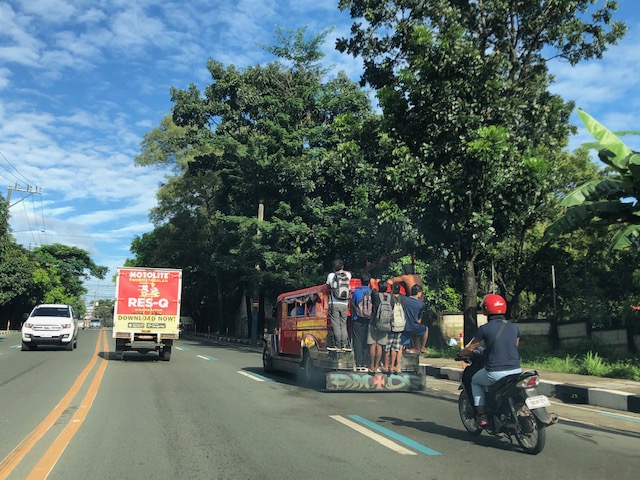 Jeepney with 6 passengers hanging by the back. All look like they are laborers or workers (construction?) but it is not uncommon to see students in their school uniform similarly dangling from jeepneys especially during the peak hours when its difficulty to get a ride.
Sabit is actually illegal and, if enforcers are strict, will incur apprehension and a ticket. Many local enforcers including those of the MMDA though are lax about this especially during peak periods. Jeepney drivers are more cautious when they know that Land Transportation Office (LTO) enforcement units are on watch as these are usually strict about passengers dangling from the vehicles. Newer jeepney/jitney models basically eliminated sabit as the doors are now on the right side of the jeepney instead of the back and there are no spaces or features to hold and step on to in the new models. It is for good as this is an unsafe situation for the passengers and there are reckless jeepney drivers who tend to exacerbate the situation by deliberately maneuvering the jeepney as if he wants passengers to fall off the vehicle. To those looking for a thrill (or death wish as a friend calls it), it is an exhilarating experience. But in most cases, it is a disaster waiting to happen.
–
Is there really a transport or traffic crisis in Metro Manila?
I was interviewed recently for a research project by students enrolled in a journalism class. I was asked by one in the group if we indeed have a transport crisis in Metro Manila. The other quickly added “hindi transport, traffic” (not transport but traffic). And so I replied that both terms are valid but refer to different aspects of the daily travel we call “commuting”. “Traffic” generally refers to the flow of vehicles (and people if we are to be inclusive) while “transport” refers to the modes of travel available to us.
“Commuting” is actually not limited to those taking public transportation. The term refers to all regular travel between two locations. The most common pairs are home – office and home – school. The person traveling may use one or a combination of transport modes for the commute. Walking counts including when it is the only mode used. So if your residence is a building just across from your office then your commute probably would be that short walk crossing the street. In the Philippines, however, like “coke” and “Xerox”, which are brands by the way, we have come to associate “commute” with those taking public transportation.
And so we go back to the question or questions- Do we have a transport and traffic crises? My response was we do have a crisis on both aspects of travel. All indicators state so and it is a wonder many including top government transport officials deny this. Consider the following realities for most commuters at present:
- Longer travel times – what used to be 30-60 minutes one-way commutes have become 60 – 120 (even 180) minute one-way commutes. Many if not most people now have double, even triple, their previous travel times.
- It is more difficult to get a public transport ride – people wait longer to get their rides whether they are in lines at terminals or along the roadside. The latter is worse as you need to compete with others like you wanting to get a ride ahead of others.
- People have to wake up and get out of their homes earlier – it used to be that you can wake up at 6:00AM and be able to get a ride or drive to the workplace or school at 7:00/7:30 AM and get there by 8:00 or 9:00AM. Nowadays, you see a lot of people on the road at 5:30AM (even 4:30AM based on what I’ve seen). That means they are waking up earlier than 6:00 AM and its probably worse for school children who either will be fetched by a service vehicle (e.g., school van or bus) or taken by their parents to their schools before going to the workplaces themselves.
- People get home later at night – just when you think the mornings are bad, afternoons, evening and nighttimes might even be worse. Again, it’s hard to get a ride and when you drive, traffic congestion might be at its worst especially since most people leave at about the same time after 5:00PM. Coding people and others not wanting to spend time on the road (instead working overtime – with or without additional pay) leave for their homes later and arrive even later.
- Less trips for public transport vehicles – traffic congestion leads to this. What used to be 6 roundtrips may now be 4. That affect the bottomline of income for road public transport providers. Given the increased demand and reduced rolling stocks of existing rail lines that includes rail transport.
To be continued…
—
Ortigas Center congestion
A couple of Thursdays ago, I was in the Ortigas CBD area to attend a conference on statistics. I hitched a ride with an old friend who was also going there and so we had some time to catch up on life and other topics we usually talked about since our college days. Being on the passenger seat also meant I had some opportunities to take photos of the traffic situation in the vicinity of the venue of our conference. Here are some photos I took of traffic in the Galleria – ADB area as we drove along ADB Avenue.
 Congestion along ADB Avenue across from Robinsons. The ADB building is shown ahead of the vehicles.
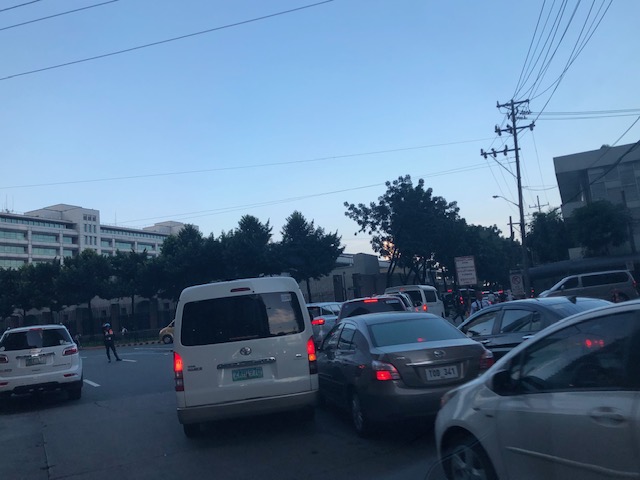 Most of the vehicles turned out to be turning towards Guadix and headed for Poveda. These are traffic generated by the exclusive school where most if not all students’ mode of transport is by car. This causes much of the congestion in the area at this time of day as well as during dismissals in the noontime and afternoon.
 Vehicles bound for Poveda (building is in the background) and EDSA.
 View of Ortigas bound vehicles filed along Sapphire Road – this photo was taken at the bridgeway connecting Crowne Plaza and Holiday Inn. The relatively uncontested road is the Robinsons’ driveway.
The photos show how dependent to cars many people working in the Ortigas CBD are. Many of them live outside of the CBD including those residing in the Rizal towns to the east of Metro Manila. The number of people using their own cars put so much strain on the major thoroughfares including and perhaps especially Ortigas Avenue, which serves as a main arterial connecting the CBD to many parts of Pasig, Quezon City (via C5) and the very progressive towns of Rizal Province such as Cainta, Taytay and Antipolo City.
It is a wonder why up to now, there is no mass transit system along Ortigas Avenue when the demand is very high and continuous to increase with the development of lands along it. SM, Robinsons and Megawide are among the major players now developing their plots of land to become high density commercial/office/residential areas. And these will surely translate into more trips generated and worse traffic congestion. Perhaps the mayors of Pasig, Cainta, Taytay and Antipolo plus the governor of Rizal can get together to discuss and agree about solutions where each LGU can contribute for the betterment of their constituents’ commutes?
–
Some commentaries on the jeepney modernisation
The nationwide transport strike last Monday elicited a lot of reactions from both supporters and opponents of the the initiatives to modernise the jeepney. Both sides have valid points but both, too, have weak points. Much has been discussed about the cost of acquiring new jeepneys to replace the old ones and whether you agree or not, these are really a bit steep to the typical jeepney driver-operator.
A low downpayment will certainly mean higher monthly amortisations. And most drivers/operators can only afford a low downpayment with or without the 80,000 pesos or so subsidy from the government. Even if you factor in some tax incentives, the net amount to be paid every month will still be too much for a typical driver/operator. Anyone who’s ever purchased a vehicle, new or used, through a loan should know this, and to deny it means you probably are privileged enough not to take out a loan.
Certainly there are exceptions like certain Beep operations that are supposed to be run like a company or cooperative, and where fleet management techniques allow these to operate more efficiently and cost-effectively. The latter supposedly allows the owners to recover their capital (return of investment) for the purchase of the new jitney units. The reality, however, is that not all routes are good enough for the required revenues and the better earning ones subsidize (forced?) those that are not profitable. The ‘company’ or ‘coop’ can therefore hide these unprofitable cases as the collective performance of the routes they operate along become the basis for assessment.
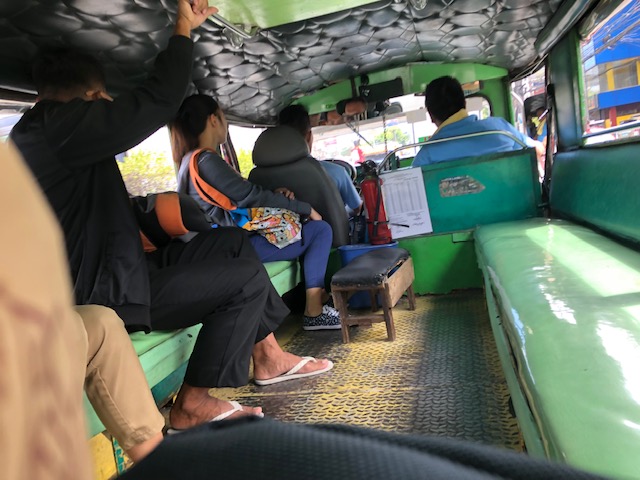 Snapshot inside a jeepney while waiting for it to fill with passengers
It is true that the business model (or what is passed off for one) for jeepney operations is flawed. More so if you place this in the context of transport demand for a metropolis like Metro Manila. That is why perhaps corporatization or cooperatives can probably help in terms of improving processes and practices (e.g., maintenance regimes, deployment). So perhaps this is where government should step in and be more aggressive in organising jeepney drivers and operators. I would even dare say that government should be willing to extend more financial support if significant change in public transport is to be achieved. The Office of the President, Senators and Congressmen enjoy a lot of pork and the numbers for a single year indicate that they can, if willing, purchase new jitneys for their constituencies perhaps focusing on the cities and retiring the old, dilapidated public utility vehicles. That, I think, is a more ‘intelligent’ use to these funds that are allegedly being misused by our politicians.
So, was the strike a success? I think the answer is yes it was. Government cannot deny this as it was forced to suspend classes in schools in order to address the impending shortfall of services during the strike and many LGUs were forced to provide free transport services (libreng sakay) in many forms (e.g., dump trucks, flat bed trucks, etc.). You can only say it was a failure if it was business as usual with commuters feeling minimal impact of the stoppage in jeepney operations.
–
On commuting characteristics in Metro Manila – Part 1
A friend posted the following two graphics showing commuting characteristics derived from a recent survey they conducted online. The 327 respondents are not much compared to the more comprehensive surveys like the ones undertaken by JICA and there are surely questions about the randomness of the survey. Online surveys like the one they ran can be biased depending on the respondents. This was mainly done via social media and through certain interest groups so statistically there may be flaws here. Still, there is value here considering there is often a lack of hard data on commuting characteristics especially those that are recent or current. We need these to properly assess the state of transportation or travel in Metro Manila and elsewhere.
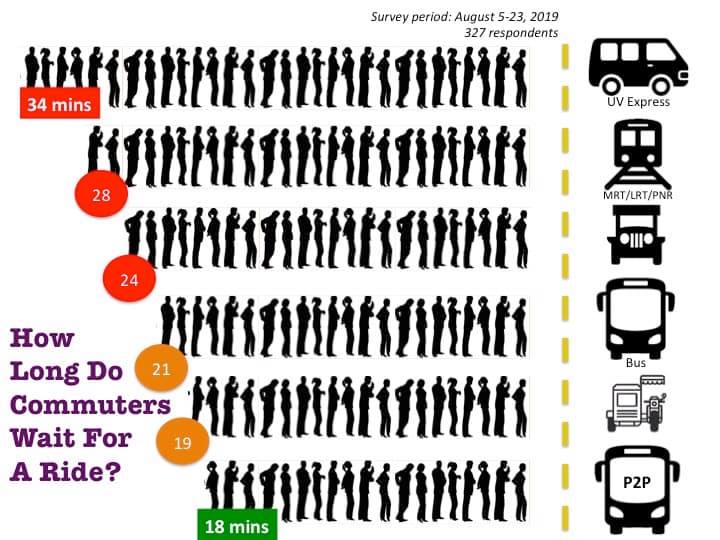 What’s lacking? Information on car and motorcycle users? And why the long waiting times? Are these really just because of a shortage in the supply of public transport vehicles thereby necessitating additional franchises? [Graphic and data courtesy of Toix Cerna via Facebook]
 Again, the mode shares reported are incomplete. With the exception of walking, car and motorcycle shares are substantial and significant. There is some info here about trip chains (i.e., the average of 2 rides per commute) but it is unclear what percentage of the trip is made using whatever mode is used. [Graphic and data courtesy of Toix Cerna via Facebook]
The absence of information about cars and motorcycles is glaring due to their significant share of commuters. Yes, the term ‘commuter’ actually refers to someone who regularly travels between home and office. By extension, this may also apply to travels between home and school. The term is not exclusive to public transport users as is often assumed. Walking between home and office qualifies as a commute.
I am curious about how commutes using cars and motorcycles would compare to public transport commutes. The comparison is quite useful to show, for example, the advantages and disadvantages of car use (this includes taxis and ride share). More detailed information may also reveal who among car or motorcycle users use these vehicles out of necessity rather than as one among many choices for their commutes. One thinking is that if public transport quality is improved, then many people will opt to use PT rather than their private vehicles. However, there is also the observation that in many cases, those already using PT are the first to shift from the lower quality service to the better one. I also wrote about this as I posted my worries about how successful can Line 7 and Line 2 extension be in reducing car use along their corridors. Perhaps the ones who will truly benefit are those who are already taking public transport, and car and motorcycle users will just continue with these modes?
In Part 2, I will share some data we collected more than a decade ago for a study on jeepneys in Metro Manila. I will use the information to explain another angle of this issue on public transport supply and demand.
–
Quick share: “The ‘War on Cars’ is a Bad Joke
Here is another quick share. This time it is an article that I think attempts to diffuse what some many people regard as a war on cars being waged by those who advocate for public and active transport.
Litman, T. (2019) The ‘War on Cars’ is a Bad Joke, Planetizen, https://www.planetizen.com/blogs/105877-war-cars-bad-joke?fbclid=IwAR2_SZHQeYEUGiU2G8RUw0Za6GrkR-2peD3eSjshpNUOg9-G5SpDWm6OnFI [Last accessed: 8/25/2019]
The author makes very strong arguments supported by evidence and data to place this topic in the right context. That is, there is no need to “wage war” or use arguments that are more on the hateful side and therefore not constructive to both sides. I think there should be a mutual understanding of the benefits (and costs) of having many options for transport or commuting. That said, infrastructure or facilities should not heavily favour one mode (car-centric?) for transport to be sustainable and healthy.
Sadly, many so-called progressives (yes, I am referring to the younger generations who are still in the idealistic stage of their lives) appear to be blind to understanding but instead opt for the hardline stance vs. cars and those who use them. Instead of winning people over and convincing those who really don’t need to drive to take other modes, they end up with more people becoming more apathetic or unwilling to take a stand vs. the status quo. This is the very same status quo that is definitely degrading quality of life and is described as an assault to human dignity.
–
Quick share: “The changing role of transport strategy”
Here is a nice article briefly discussing the evolution of transport strategy planning that have led to local transport plans:
Gleave, J. (2019) The changing role of transport strategy, Transport Futures, https://transportfutures.co/the-changing-role-of-transport-strategy-598fce17e9e9 [Last accessed: 8/24/2019].
More importantly, there is a very good discussion here of the recent developments and the need to change approaches in order to become more effective at the local level. The article explains that there should be an appreciation of the availability of resources including tools that allow people to be more engaged or able to participate in the planning process for their cities, municipalities or communities.
–
 Caught (up) in traffic