
Home » Behavior (Page 23)
Category Archives: Behavior
About the habal-habal again
There’s a nice article written by the current City Administrator of Cebu City, Nigel Paul Villarete. Paul has a regular column in a major daily and one that is always a good read. The article is a consolidation of previous articles he has written about the habal-habal or motorcycle taxi.
Villarete, N.P. (2018) “Habal-habal: the Two-Wheeler “Public” Transport in the Philippines,” http://www.streetlife.com, http://streetlife.villarete.com/habal-habal-the-two-wheeler-public-transport-in-the-philippines/?fbclid=IwAR06y9lrH-j6YtXRLf6rDL_JssnewNhR0b49dJ4Muc2PKyCzxeK50X6Ul6Y [Last accessed: 12/21/2018].
The article is relevant and current in its take on the motorcycle taxi and why it is important to consider this mode of transport as a form of public transportation. For one, it obviously gives people another choice for travel that is supposed to be able to cut down travel times compared to when they use conventional public transport or private vehicles. The question and perhaps the challenge to those operating such services is to prove that they are a safe mode of transport. Also, not to forget, is the question of fares and how to set the proper structure in order to protect people against abusive or excessive fares charged by the service providers.
There is news recently that the DOTr is convening a technical working group (TWG) to look into what they perceive as an issue on habal-habal. I wish the TWG well and hope that this will lead to something constructive including regulations that everyone can agree to. That said, I also believe that service providers, especially transport network company (TNC) Angkas, should exert more effort to prove they are a safe mode of transport rather than resorting to what appears to be more a fallacy of appealing to the emotions of people while trying to evade the legal constraints imposed on them. There is definitely a difference in motorcycle taxi operations in rural areas compared to those in the urban setting including the fact that they would have to deal with more vehicular traffic along urban roads. This means more interactions with other vehicles that may lead to an increased likelihood of road crashes involving motorcycle taxis if the latter don’t exercise safe driving practices.
–
On re-designing or re-imagining our transportation system for people
Here is another good read especially for those who advocate or even just beginning to appreciate the concept of people-oriented transportation:
VannPashak, J. (2018) “Design for humans as they are, not as you want them to be,” http://www.medium.com, https://medium.com/@jvannpashak/design-for-humans-as-they-are-not-as-you-want-them-to-be-ef95076c0988 [Last accessed: 11/23/2018].
In a recent symposium where I made a presentation about low carbon transport and visioning and re-imagining transport, I was asked how we can re-design our transportation to be more people-oriented than car-oriented. I replied that we have to do a lot of unlearning. That is, many planners and engineers would need to unlearn many things they’ve learned in school and those they got from their workplace. One convenient excuse for not coming up with a better design, for example, is that certain planners or engineers just followed what their offices or agencies have been doing. What if what their offices and agencies (and consequently their seniors at work) where wrong all these years and what was “ginagawa na” or “nakasanayan” have led to deficient outcomes? I even joked about whether these offices or agencies were “open minded” referring to a favourite by-line by networking companies. Being open-minded in the context of having people-oriented transport solutions would be difficult if everything was “nakakahon” because these were what you learned from school and/or the workplace. It is difficult to admit that something was and is wrong.
–
Article on induced demand and why more roads mean more traffic
Here is a nice article about induced demand, which is simply the additional traffic you get on top of the current and estimated traffic from “normal” growth based on the current transportation system and infrastructure once you introduce additional services and/or infrastructure. That is, there is additional trips/traffic generated for when you widen roads or construct a new transit system.
VannPashak, J. (2018) “More roads, same congestion,” http://www.medium.com, https://medium.com/@jvannpashak/more-roads-same-congestion-b2b437ecaa94 [Last accessed: 11/22/2018]
I think the more interesting part of the article is its mention of the work of Redmond and Mokhtarian, which the author provides in a link. Clicking this link brings you to a wealth of articles attributed to the two that are definitely worth reading especially for people seeking understanding for issues related to commuting. Many of the researches and the methodologies in the articles may be replicated for application in the Philippines, and should be taken on as research topics in what can be inter-disciplinary programs or projects.
–
On school trip generation
I chanced upon the changing of the shifts for a national high school. This was the time of day when the morning shift students were dismissed (i.e., coming out of school) and the afternoon shift students were coming in.
 Students come out of the school to mainly either walk or take public transport (mostly tricycles) to their homes.
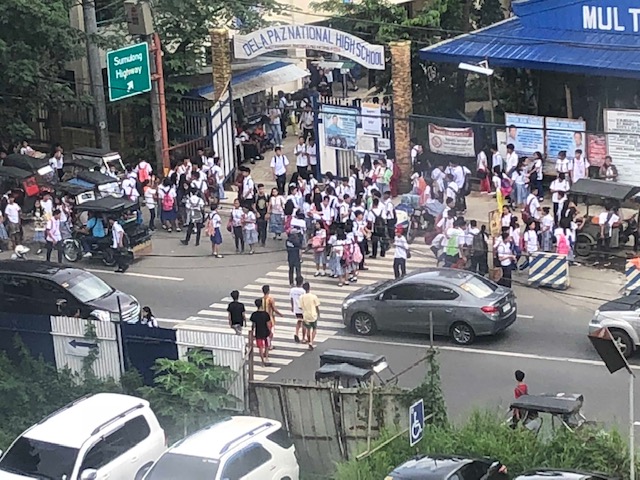 Most vehicles give way to people, especially students, crossing the busy street. There are usually traffic aides in the area who help manage traffic and to ensure pedestrians may safely cross or move about.
There are no severe traffic congestion here unlike those generated by many exclusive or private schools. There is actually a private school just beside this public high school that also generates significant private vehicle traffic but somehow manages not to congest this major road that’s part of the L. Sumulong Memorial Circle the way another private school congests Sumulong Highway in the mornings.
Is this simply because of the school being a public school as compared with private schools? Perhaps it is, given the perceived disparity in income classes concerning those going to typical public schools and those going to typical exclusive schools. But income disparity aside, wouldn’t it be possible for most students to just walk or take public transport to school? I actually envy the public school students in the photos above as they can walk to school. And that is because they likely live near the school, which is something that is a desirable situation if public schools are at least at par in quality with the more established private schools (especially the sectarian ones where many parents likely prefer their children to go to). This disparity in quality leads to people residing in relatively long distances away for the preferred schools to travel (often with their private vehicles) to and from the exclusive schools. The point here is that it really is more complicated than what it seems in terms of trip generation.
–
What the DPWH says about the installation of ads including those masquerading as signs
So what does the DPWH say about signs and their installation? The DPWH in their Highway Safety Design Standards (Part 2: Road Signs and Pavement Markings Manual) states the following:


It’s plain and simple and yet we find a proliferation of ads masquerading as signs and entities such as the MMDA and LGUs not properly (or strictly) implementing the provisions of the DPWH manual. It is also sad to see practitioners actively trying (and succeeding) to circumvent this provision in the DPWH manual.
–
More on ads masquerading as signs
I recently wrote about what I thought were ads masquerading as signs. It turns out a friend also took notice of similar signs along Katipunan and decided to make this a topic of his vlog. I learned that he has corresponded with the MMDA regarding this matter and even contacted the company behind these ads (I would prefer to call them what they really are.) to get their take on the matter. It turns out that the company is quite aware that what they are doing are basically not according to DPWH guidelines pertaining to signage. I wouldn’t and couldn’t say it is illegal since the MMDA and LGUs gave their approvals for these ads to be installed.
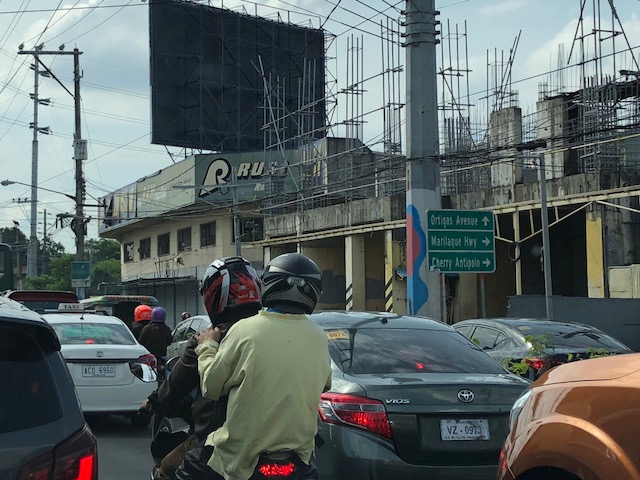 Approaching Cainta Junction from Antipolo, there is a sign that advertises Cherry Antipolo, which is all the way back and past Masinag Junction along Marcos Highway.
 Less than a kilometre away from Masinag Junction along Sumulong Highway, there’s another ad posing as a road sign and from a certain angle it covers a more important traffic advisory concerning the construction of the Line 2 Extension.
 This ad doesn’t even pretend anymore since all directions point to an Ayala Mall!
Following are examples of what may be tolerated and what must be disapproved and therefore removed. Guidelines are important so that the criteria for signs including ads masquerading as such will be clearly spelled out and approval/disapproval will not be
Logical: The photo below shows a sign installed by the DPWH showing the general directions for towns (Cainta, Taytay, Antipolo) or major thoroughfares (EDSA). The smaller sign is actually an ad for a mall but is located near a major junction (Cainta Junction – intersection of Ortigas Avenue Extension and Felix Avenue/A. Bonifacio Avenue) and may perhaps be tolerated as the mall is close by. Such a sign can be justified to assure or validate the direction to be taken by a traveler headed for this mall.

Not logical: The sign below is meters away from Masinag Junction in Antipol but advertises the same mall as the previous sign. It is not logical and should not have been approved since it is far from the destination mall and does not offer a validation or assurance for direction like the previous sign. In fact, the same mall chain has a branch nearby in the Masinag area and another one further on along the Marikina River. This sign should be removed as it adds to the clutter, the visual noise that makes people blind or numb to the actual road signs that require their attention.

[Disclaimer: For purposes of transparency, my colleagues and I also have worked as consultants for projects such as malls but never have we recommended for signs like these.]
–
On EDSA transport and traffic, again
There’s a recent decision by the Metro Manila Council (MMC) comprised of the mayors of the cities and municipality of Metro Manila and chaired by the Metro Manila Development Authority (MMDA) Chair that vehicles bearing only one passenger (the driver) will be banned from travelling along EDSA. The problem with this is that by banning cars with one passenger from EDSA, you only succeed in making other roads like C5 more congested. It’s a simple case of transferring traffic and worsening it elsewhere since you’re not doing anything to alleviate congestion along those roads. Did MMDA run this and other scenarios using analytical or simulation tools at their disposal? If so, can these be shown and used to explain the soundness of this policy approved by the MMC? I suspect they didn’t and likely depended more on gut feel based on the data they have including what is often reported as 70% of vehicles traveling along EDSA having only one passenger. Meanwhile, the state of mass transit along EDSA still sucks.
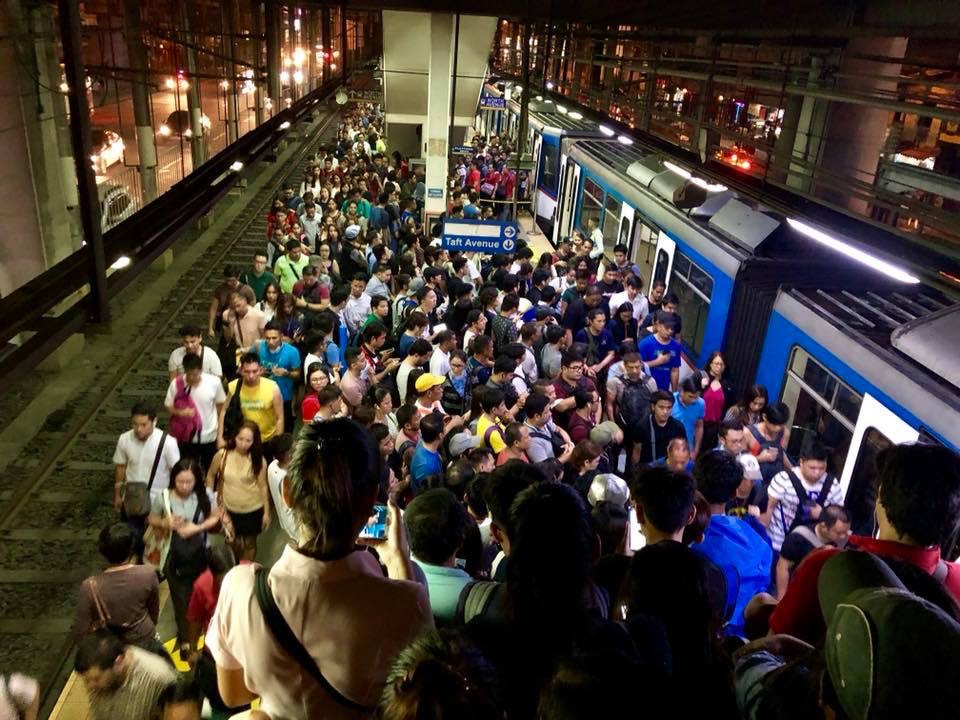 A very crowded Boni Avenue Station platform (photo courtesy of Mr. Raul Vibal)
Of course, the pronouncement from the MMDA launched quite a lot of memes on social media. Some people shared the typical quotes on planning (you know, like the ones about planning for people vs. planning for cars). Some offered their own ideas about how to “solve” traffic along EDSA. And so on…that only succeeded in showing how everyone had an opinion about transport and traffic. Everyone is an expert, so it seems.
Some thoughts and not in any order:
- The government can initially dedicate a lane each for express buses (a la Bus Rapid Transit or BRT). This idea has been circulating for quite some time now and has a good chance of succeeding. The DOTr is already deploying buses that they say are supplementing the MRT 3 trains (i.e., there aren’t enough trains running so passengers have the option of taking a bus instead). Running along the inner lanes of EDSA would mean, however, that they would have to find a way for passengers to cross the road and one idea would be for the stations to be retrofitted for this purpose.
- Those cars along EDSA are not necessarily for short trips so walking and cycling while needing space may have less impact in the immediate term for such a corridor. In the meantime, serious consideration should be made for bike lanes whether on the ground or elevated and improvements to walking spaces.
- But these efforts to improve passenger (and freight) flows should be a network-wide thing and not just along EDSA.
- It’s time to have serious discussions and perhaps simulations (even a dry run) of congestion pricing in Metro Manila. Congestion pricing for all major roads and not just one or two. Funds collected goes to mass transit, walkways and bikeways development. DOTr was supposed to have already discussed an Electronic Road Pricing (ERP) system like Singapore’s with the company and people behind the same in the city-state. That doesn’t seem to be moving along.
- Working and studying from home might work in terms of reducing vehicular traffic but then we generally have lousy internet services so that’s a barrier that needs to be broken down.
- How about legalizing, once and for all, motorcycle taxis? Many are opposed to this citing safety concerns but then we are running out of options outside the usual motherhood statements pertaining to building transport infrastructure. Think about it. Give it a chance. These motorcycles might just surprise us in a nice way; that is, helping alleviate congestion.
- Carpooling and lanes dedicated to High Occupancy Vehicles (HOV) would be good but the LTFRB made a pronouncement about these being illegal as they would be considered ‘colorum’. Such statements do not make the situation any easier and sends mixed signals as to the government’s being serious in considering all possible angles to improve transport and traffic particularly for commuting.
Do you have other ideas to share?
–
The future of walking?
Here’s another nice article on the most basic of all modes of transport for people – walking.
Levinson, D. (2018) “What will the footpath of the future look like?”, foreground.com.au, https://www.foreground.com.au/transport/future-footpath/?platform=hootsuite [Last accessed: 7/18/2018]
My only comment about this article is that perhaps the matters mentioned here pertaining to technology that is often associated with the mention of the word “future” is something that the more advanced countries might be concerned with. They are not necessarily applicable to many if not most cases in the developing world much like the talk about autonomous vehicles being exciting in developed countries but not so in others. So yes, the future of walking should still be for people to walk and for authorities to provide the facilities for this activity. Active transport, after all, is not about moving machines but for people to be on the move.
–
On illegal parking
The following photo pretty much sums up the topic for this post:
 How many violations do you see here? The driver of the dark coloured vehicle had three outstanding violations – parking on the pedestrian crosswalk, blocking a fire hydrant, and blocking a PWD ramp.
The penalty for such violations as shown above used to be a paltry 500 pesos. However, a third violation will lead to a suspension of revocation of the driver’s license of the offender. That is, if authorities such as the Land Transportation Office (LTO) are able to track these violations. The fines have been updated recently to 1,000 pesos. Illegal on-street parking is perhaps among the most frequently committed violations that usually contributes to traffic congestion as it occupies space and reduces road capacities. It also blocks the typical paths of cyclists. A variation of on-street parking where parts of the vehicles are on the sidewalk is also problematic as it deprives pedestrians walking space and may lead to road safety issues especially if pedestrians are forced to use the road.
How do we address such issues? These are matters that can easily be addressed by enforcement. Yes, the catch all for many of our transport and traffic ills happens to be enforcement or rather the lack of it in many instances such as what’s shown in the photo above. This is an enduring and perhaps festering issue among those tasked with enforcing traffic rules and regulations. And we can only hope that they are up to the challenge.
[Note: The photo above was taken in the University of the Philippines Diliman campus along the Academic Oval and just after the intersection with Apacible Street. UP people like to say that what happens on campus is a microcosm of society. I cannot but agree in the case of the situation shown.)
–
On the opposition to “complete streets”
I recently read an article about the opposition to road diets in California, USA:
Tinoco, M. (2018) “How to Kill a Bike Lane”, http://www.citylab.com, https://www.citylab.com/transportation/2018/05/how-to-kill-a-bike-lane/559934/?utm_source=SFTwitter [Last accessed: 5/20/2018]
So far, we know that at least three cities are progressive enough to implement road diets including Marikina City, Pasig City and Quezon City. Iloilo doesn’t count yet since their bike lane was constructed along the very wide Diversion Road. Our recommendations for Tacloban, if implemented by the city, will probably result in the second most comprehensive application of road diets/complete streets in the Philippines after Marikina, which implemented their bikeways network almost 2 decades ago. There are sure to be many who would be opposed to such schemes as many still have the view that streets are for motor vehicles. This car-oriented thinking is something that will be a challenge to advocates of people-oriented transportation systems. Hopefully, many can learn from experiences here and abroad on how to reclaim space for people leading to safer and more inclusive transport for all.
–

