
Home » Behavior (Page 24)
Category Archives: Behavior
Article on building support for walking and cycling infrastructure
There is another recent article on non-motorized transport (NMT). This is a good read and something that I think should be required for those who are little too serious or staunch about their advocacies.
Doyon, S. (2017) “Building support for walking and bicycling infrastructure” Public Square, A CNU Journal, https://www.cnu.org/publicsquare/2017/11/11/building-support-walking-and-bicycling-infrastructure (Last accessed 11/11/2017)
I believe that if you want to convince people to appreciate and support your cause, you should not take the hardline. Instead, there should be a more persuasive process for wooing people. This is especially true in transportation and the advocacies for walking and cycling. You will not get a lot of support, for example, by condemning car users and telling everyone they should bike instead.
–
Vested interests, Part 1
An old friend and I met up some time ago and he casually mentioned the ongoing transit projects, particularly one that has affected him along his commute via Commonwealth Avenue. He said he can’t wait until Line 7 was completed and running. Perhaps then, there will be less vehicles along Commonwealth and he can have a shorter (travel time) drive from his home to his office in Ortigas. This type of comment did not surprise me as it is a reality that many would still likely prefer to take their cars or perhaps opt for car-share services rather than take public transportation, even with a new and note efficient option like the Line 7 available.
I have read or browsed articles, both technical and anecdotal, about many drivers wanting (and even encouraging) others to shift to public transport in order to lessen the cars on the road. This is so they can benefit from the reduction in vehicular traffic (i.e., less congestion equals faster travel by car). One article in the US even went as far as saying that if you didn’t drive 60,000 miles per year then you probably didn’t need a car. This is understandable for those who probably are, by default, dependent on their cars. It is frustrating, if not ironic, for those who don’t have to drive or take their cars but opt to do so. The latter includes people who have shorter commuting distances and with less transfers (less inconvenience) in case they do take public transport.
Next: Ridesharing as sustainable transport?
–
Some thoughts on the ridesharing vs taxi issues in Metro Manila
A lot have been said and written about the issues concerning ridesharing and taxis in Metro Manila. There are the personal posts you read and are being shared around social media. There are the obviously sponsored posts and articles going around. These are usually by trolls but may also include some personalities who are more than willing to lend their names to a cause they think is worth taking on. Unfortunately, the supposed victim here is also an oppressor if one tries to delve into their operations and practices. The real victims here, aside from the commuters who patronize ridesharing, are drivers and operators.
I stated Metro Manila because there seems to be no serious issues on ridesharing or taxis in other Philippine cities. Why is that? Is it because taxis provide better services in other cities like say, Cebu, Davao or Iloilo? Is it because public transport in other cities are better compared to Metro Manila? Or is it because ridesharing companies cannot compete with local, taxi-like transport like tricycles? Let me put it like this: Metro Manila public transport has deteriorated in the past decades. This deterioration comes in many forms including the very slow development of mass transit systems and the continued dominance of road-based modes.
Private vehicle mode shares have increased significantly over the last four decades. In the 1970s, the estimated split between public and private transport was about 75/25. In the 1980s, it was close to 70/30 but with public transport enjoying just about 70% shares. In the 1990s, the 70% had already been breached with public transport share estimated to be about 68%. The 2000s saw public transport shares to have been eroded further, with closer to 65% of trips using public transport. The last decade likely saw the further rise of private transport shares with the rapid increase in motorcycle ownership and use and the emergence of ridesharing such as Uber and Grab. This, despite the increase in population for the metropolis and also the increase in road public transport vehicles particularly UV Express.
These road-based modes are generally low capacity and require so many vehicles to transport so many people. And yet people choose them (e.g., purchase and ride a motorcycle, patronize Uber or Grab, etc.) because their options for their commutes are generally worse off. Motorcycles are not for everyone and not everyone can afford to or want to own a car. And yet, there seems to be a sizable population wanting (not necessarily needing) to be driven to and from their homes, workplaces, schools or other places of interest but not via conventional taxis; as evidenced from the popularity of ridesharing services.
Perhaps the only way to resolve the issue lies not only in the drastic improvement of conventional taxi services. Operators and drivers have had a lot of chances to do this but there seems to be little positive change here. Maybe, and ultimately, the solution is in the expedited development of mass transit systems like rail transit lines and bus rapid transit (BRT). And so the initiatives of the current administration along such infrastructure projects are most welcome and may stave off the decline of public transport mode shares (revival?). Better public transport should help make commutes more bearable. Commutes should be safer, faster and relatively inexpensive compared to owning and operating a car. And may I add that using conventional public transport should be more attractive than ridesharing.
–
TSSP 2017 Conference
The Transportation Science Society of the Philippines (TSSP) holds its 24th Annual Conference tomorrow, July 21, 2017. It will be held at the National Center for Transportation Studies at the University of the Philippines Diliman, Quezon City. More than a hundred participants are expected to attend this 1-day affair.
The final program for the conference may be found in the following link:
http://ncts.upd.edu.ph/tssp/index.php/2017/07/17/tssp-conference-program/
The theme for this year’s conference is “Improving Quality of Life in Urban and Rural Areas Through Inclusive Transportation.” This is also the theme for the panel discussion in the morning. The afternoon will feature four parallel technical sessions where 18 papers will be presented.
The keynote lecture will be delivered at the start of the conference by Prof. Tetsuo Yai of the Tokyo Institute of Technology, who is also the current President of the Eastern Asia Society for Transportation Studies (EASTS) under whose umbrella the TSSP is part of. TSSP is a founding member of EASTS and actually preceded EASTS by a year.
–
New ruralism, anyone?
I found this interesting article that tackles what to me is a new concept although it shouldn’t be. The concept of new ruralism to me is somewhat going back to the basics. While urbanization seems to be an unstoppable force, there is still the need to preserve rural areas and also the way of life as well as the industries that we need to sustain urban living. Food production, for example, is something that is being advocated or promoted in urban areas but hasn’t really caught on. Farming seems to have lost a lot of people as it is perceived as backward and yet it is essential.
New Ruralism: Solutions for Struggling Small Towns [by Jared Green in The Dirt, June 14, 2017]
What do you think about this concept of new ruralism? Is it something that’s also applicable to the Philippines or is will it be just a fad?
–
Give way!
Road courtesy can be a scarce thing in many Philippine roads. In many road crash incidents, it can be quite obvious even to the casual observer that one of the problems we have is drivers and riders not practicing common courtesy. Hindi nagbibigayan. This is the case in most intersections where no traffic signals are installed and operational. Congestion occurs as drivers and riders try to impose their right of way over others. The absence of traffic personnel, even those who have limited capabilities managing traffic, further exacerbates the situation as motorists tend to ignore traffic personnel. Based on my observations, the most guilty of ignoring traffic rules and regulations including the enforcer on duty are motorcycle riders, followed by public utility vehicle drivers.
Below is a scene that greeted me one morning during my commute to my workplace. Maj. Dizon is a secondary national road passing through a residential area in Quezon City and Marikina; connecting C-5 with Marcos Highway.
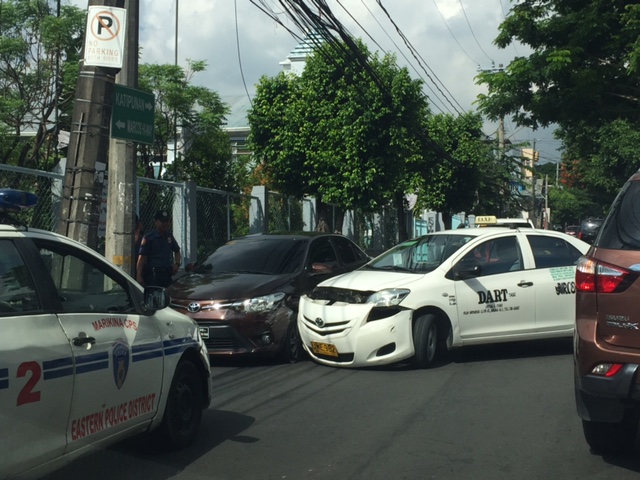
Who had the right of way here? Did the private car have the ROW and the taxi driver tried to impose himself (cut into the path of the private car) thinking that the private car driver will slow down to give way? Or did the taxi driver have the ROW but then the private driver decided to accelerate so as to prevent the taxi from completing the maneuver? Either are likely cases and are often the cause of crashes like this.
Other situations that are common are vehicles maneuvering (e.g., backing or turning) but tricycle drivers and motorcycle riders proceeding despite the clear ROW for the maneuvering vehicles. In certain cases, large vehicles like trucks have blind sides and have resulted in their inadvertently hitting motorcycles who riskily and recklessly maneuver with respect to the trucks.
How do we address such behavior? It likely is rooted from how drivers and riders learn to drive or ride so its starts with that stage. Many people learn to drive or ride from peers or their seniors (e.g., parent, uncle, family driver, company driver, etc.) while others learn via driving schools. Do they learn courtesy from their ‘teachers’? Are driving schools imparting this or just teaching people how to operate a vehicle? Then there is the licensing stage. The Land Transportation Office (LTO) is also responsible for assessing whether those applying for licenses are qualified. Both the written and practical exams should contain elements related to the practice of courtesy. And then there is the enforcement aspect, which has the burden of educating drivers and riders by accosting and reminding (lecturing?) motorists about proper driving and riding etiquette. Of course, you have to have capable enforcers in the field whether they be traffic aides or police officers.
–
Some articles on walking, biking and transit for wellness
Here are a couple of recent articles on walking, biking and transit:
Walk, bike, and transit benefits boost people of all incomes [McAnaney, P. in Greater Greater Washington, June 13, 2017]
“Bikes are happiness machines.” Behind the Handlebars with cyclist extraordinaire Joe Flood [Maisler, R. in Greater Greater Washington, June 7, 2017]
I posted these partly for future reference but also to promote walking, biking and public transport. These are essential elements for mobility anywhere and governments should ensure that people have these as options for traveling about and not be dependent on automobiles for transport.
–
On distracted driving vs. other, more urgent, traffic issues
Much has been written and said about the new law against distracted driving. The people who crafted the law, Senators and Congressmen, are in agreement that their intention was mainly to address the rampant use of gadgets including cell phones by motorists. Yet, when the agencies in-charge of implementation drew up the implementing rules and regulations (IRR), their interpretation was the subject of a lot of complaints. Many opined that the IRR didn’t take into consideration actual vehicle dashboard designs or that the definition of the term “line of sight” was open to interpretation. This necessitated another round of consultations with stakeholders leading to the infographic below:
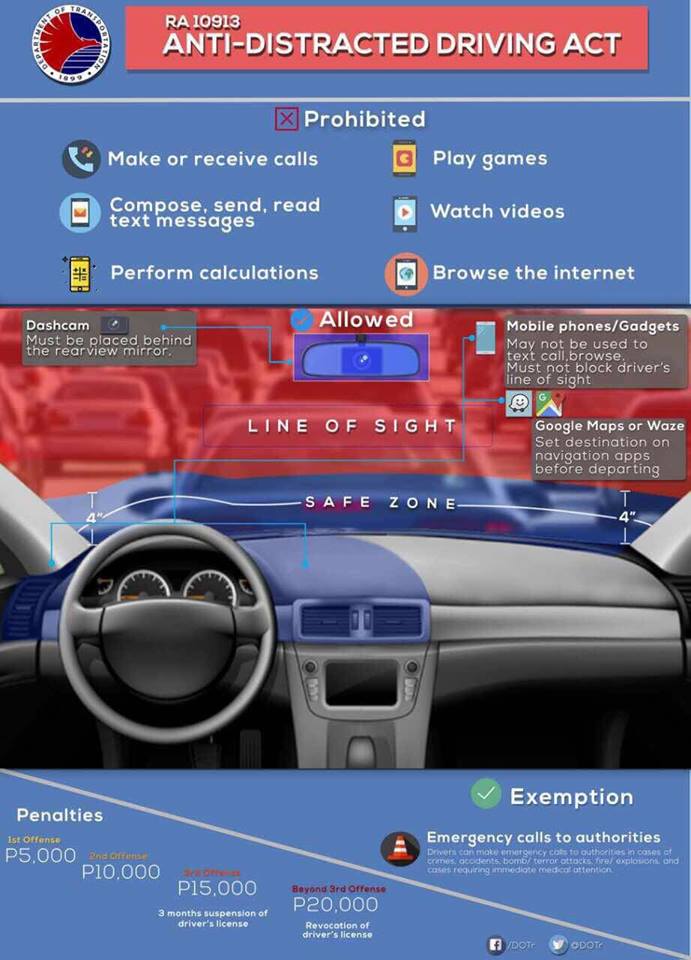
Frankly, I am more concerned about speeding, counter flowing and reckless weaving in traffic. These are equally if not more dangerous than many aspects of the distracted driving law. Quite serious would be the combination of distractions with any of the three behaviors mentioned. More disturbing would be the deliberate (definitely not distracted) or conscious acts of speeding, counter flowing and reckless weaving that are often the cases if one observes the incidence of these three driving behavior. We can only wonder about the likelihood of crashes due to these behaviors.
–
On slippery roads again
With the onset of the wet season, expect many roads to be slippery during and after rains. As such, extra care should be exercised by travelers especially motorists. It is easy to lose control of vehicles, especially motorcycles, when speeding or undertaking risky maneuvers like overtaking, counter flowing, and tailgating. Traffic enforcement units also need to be active in accosting motorists for risky behavior that may endanger the lives of not only the vehicle occupants but of other people as well like innocent pedestrians and cyclists minding their own business.
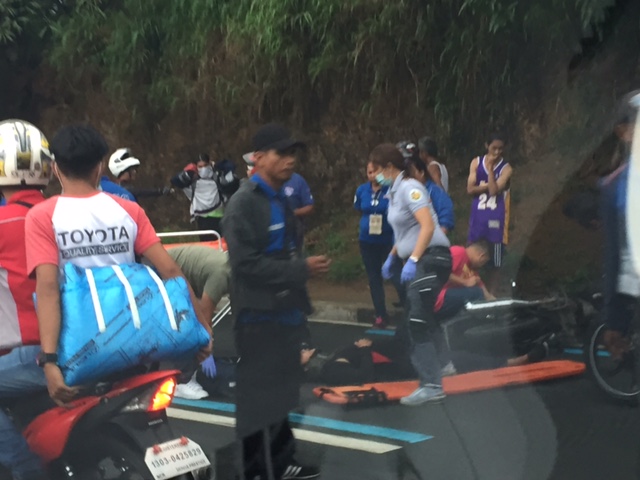
Following are a couple of photos of an incident along Sumulong Highway after rains in the area. Apparently, only a motorcycle rider was involved in what seems to be something that would be categorized as a “self accident”. No other motorists may have been involved although I suspect it could also be a case of a “near miss” where the rider lost control after almost hitting or being hit by an errant vehicle.

–
Road crash at NAIA Terminal 1 parking area
[Warning graphic content]
Last May 30, I was picking up my wife at the airport and heard a loud crash as I was getting my ticket for the NAIA Terminal 1 parking lot. I looked around but could not see anything that could concern me. As I rounded the driveway though, I noticed the vehicles in front of me already slowing down. This was the scene that greeted us:
 Van in an awkward position against the bushes of the parking lot fence and after colliding with a parked SUV. Security staff were already there and one person (the driver of the van?) seemed out of sorts.
As I continued my drive, I saw this gruesome scene of a person who was likely hit by the van when it crashed into the limited access gate of the parking lot:
 The casualty of the incident was lying on the ground with security personnel apparently more concerned about the damaged gate than attending to the person.
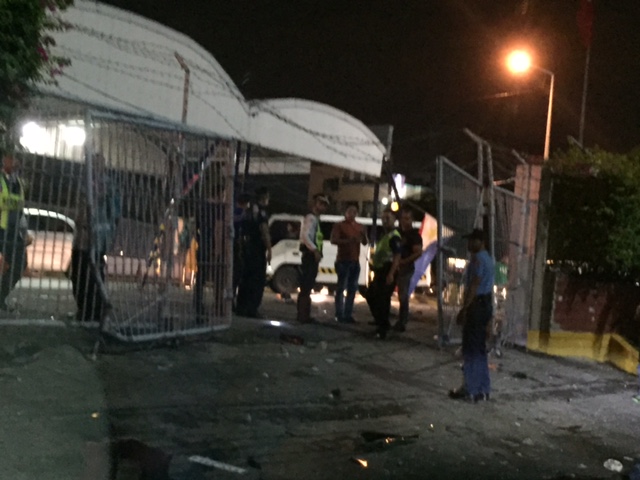 Another look at the damaged gate that the van punched through before finally crashing into the SUV and the bushes as shown in the first photo.
I’m not sure if this incident was featured in the news. It surely is something that would likely be not attract so much attention as it may not be as ‘newsworthy’ as other incidents that have happened recently. That is often the case with road crashes, which seem to be regarded as something typically occurring.
One thing we get and should realize from this is that everyone is indeed vulnerable from road crashes. The casualty in the photo (I assume only one) was likely someone who was there waiting for a relative or a client to arrive. Large groups and even whole families may be found at the airport parking lot as they wait for loved ones to arrive. The victim probably was just wiling his time, even texting people about his status, when tragedy struck that night.
–
 Caught (up) in traffic