
Home » Behavior (Page 26)
Category Archives: Behavior
“Semplang” – motorcycle self accidents
There is a Filipino word used for falling by yourself for whatever reason or factor – semplang. The term applies for those riding a bicycle or motorcycle where a person has basically no one to blame but himself/herself for falling. Of course, there will be factors like weather and road conditions. Wet, slippery roads can be very treacherous. So are roads with potholes and/or open manholes. In most cases, however, the rider’s skill more than the other so-called factors that could have affected his movement and balance.
 This is a case of a motorcycle rider losing his balance. I know because this happened as the motorcycle rider made a U-turn right in front of my vehicle at the slot across BF Steel in Cainta.
I am not certain about the condition of the rider in the photo above. While he looked shaken up (surprised?) by the incident, it did not seem to me as if he was moving abnormally (i.e., intoxicated or disabled). Perhaps its his skill that led to this? Such could not have been the case if he had sufficient training and experience and properly licensed to ride a motorcycle. Sadly, a lot of motorcycle riders are not well trained and gain skills only from experience. Yet, there are many who ride like they are stuntmen, often risking their lives and limbs as they maneuver (weave) through traffic.
–
More congestion along Ortigas Avenue Extension?
There are two malls currently under construction along Ortigas Avenue Extension – SM East Ortigas and Waltermart Taytay. Nearing completion is the SM East Ortigas, which looks like a very big mall. It is the former Ever mall beside Riverside Subdivision and close to one of DMCI Homes’ first developments. It will open on December 2 and there are already a lot of promotional tarps announcing this along major roads including C-5, Felix Avenue and, of course, Ortigas Avenue.
Waltermart is further up towards Tikling Junction. These two are actually from the same mother company SM, which has somewhat diversified its retail business so it now includes the SM malls, Savemore, Waltermart and the newly minted S-Mall. These two are sure to generate a lot of traffic and cause more congestion with the SM East Ortigas already in an area where Ortigas Ave. Extension is regularly congested. I am not aware of any studies conducted with respect to this mall but I assume there is a transport impact study somewhere. Personally, I would ask SM to look into the case of SM Novaliches for something sort of a solution to the traffic problem right in front of the mall. Quirino Highway is widest along the section where SM Novaliches is, with the mall providing a very generous setback to accommodate multiple lanes for traffic to flow smoothly at least in front of the mall. That seems possible with SM East Ortigas especially since there is practically only 2 lanes for the westbound direction of Ortigas Ave. Ext. at this area.
Waltermart is a different thing because it is in an area where there is generally no congestion along Ortigas Ave. Ext. I also assume there is a traffic study somewhere providing traffic management schemes or alleviation measures in case congestion occurs due to the mall and its high density residential development component (it is part of a complex called “The Hive”).
I am speculative about the expansive lot vacated by Mitsubishi Motors beside the Panasonic complex. I wonder if any of the big developers are acquiring it and perhaps developing it into a major mixed use project. There is also the lot where Consolidated Tobacco used to be just across Countryside Subdivision and close to SM East Ortigas. Such future developments require careful study for its transportation impacts and the Municipality of Cainta should take a proactive stance for major developments that will generate a lot of traffic. Ortigas Ave. Ext., even after some widening, remains as a road with high potential and regularity for congestion. Only a mass transit system can probably decongest it but that will take some time to realize.
–
Extreme commutes on a jeepney
I chanced upon this overloaded jeepney along Sumulong Highway. I counted eight people hanging behind the vehicle including the conductor. This is actually illegal and not just at present but always. The practice of hanging behind a jeepney is obviously unsafe and there is a high risk of people falling off. It would be a miracle not to have major injuries if one falls from the vehicle, and there is a high likelihood of fatality especially of a falling passenger gets hit by another vehicle trailing the jeepney.

‘Sabit’ or hanging on for a jeepney ride is more a necessity and males usually do this in order to get a ride home or to work. On many occasions, you will see men or boys in their office or school uniforms in the morning, braving it just so they won’t be late for work of school. While it is illegal, authorities seem to apprehend overloaded jeepneys from time to time (or according to some, just for show). I guess they, too, understand how difficult it is to get a ride and how this somehow allows people to get to their destinations. Surprisingly and despite reckless behavior among drivers, there seem to be few untoward incidents reported. Hopefully, public transport will improve so that people will not have to do such extreme commuting.
–
Seemingly minor violations that affect traffic and safety
The following photo shows one of the many minor violations that happen everyday along many roads and particularly at intersections. Motorcyclists and drivers frequently occupy spaces that are supposed to be clear of vehicles. The motorcycles and AUV below occupy the pedestrian crossing that is typically space for pedestrians and cyclists crossing the intersection. Both vehicles also are encroaching upon the intersection’s yellow box, which can be risky given that the intersection is signalised and other vehicles are given the right of movement according to the cycle settings of the intersection.
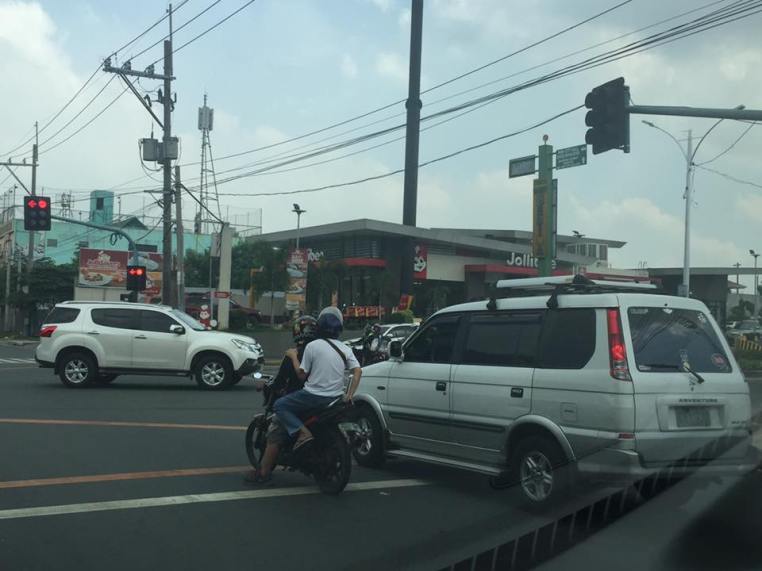
This and others like it are what seems to be minor incidents but in truth have a combining or cumulative effect on traffic streams that contribute to congestion as well as having implications on road safety. Pedestrians and cyclists are forced to go around the vehicles blocking their paths, likely putting them in harm’s way. Other motorists try to avoid these errant vehicles, which, like in the photo, may be blocking the path of vehicles proceeding towards the intersection leg to the right that is hidden in the picture. Motorists doing this must be apprehended by traffic officers/enforcers as these are clear violations of traffic rules. If one is to promote discipline among road users, then it should start with minor violations that tend to be disregarded by traffic enforcers.
–
Evidence from Montreal: Building bike lanes to reduce car use
I just wanted to share this article showing evidence of car use reduction (and therefore, car traffic along roads) with the provision of bicycle lanes.
Building Bike Lanes Really Does Get More People Out of Their Cars
The article though cautions readers against generalising or assuming great improvements. Some figures mentioned in the article including the following (I took the liberty of copying and pasting):
- “A 10% increase in bike accessibility resulted in only a 3.7% increase in ridership.”
- “…cycling infrastructure also reduced greenhouse gas emissions from cars by 1.7%, a reduction equivalent to converting transit buses to hybrids and electrifying commuter trains.”
These numbers are for the case of Montreal, Canada. Not mentioned are the number of cyclists, vehicle traffic volumes and other pertinent data that are useful in analysis. The article correctly points out the importance of using science (e.g., sound analysis based on good data) in order to convince governments to put up bicycle infrastructure. I would even add that this approach should also be applicable to pedestrian facilities.
–
Monuments to recklessness or carelessness?
Our recent trip to a resort in Batangas required for us to take a local road that was both narrow and winding. The roadside revealed what remained of a bus that was involved in a crash not too long ago. This was a crash where many of the passengers perished. Many of the fatalities were teachers who attended a workshop held in a venue in the area.
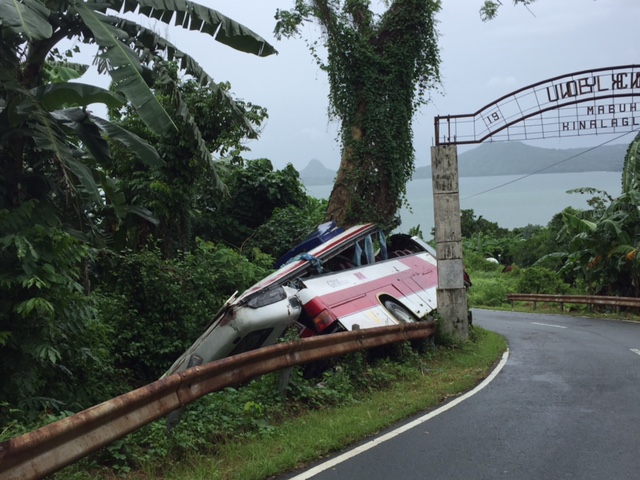 Remains of the bus wreck along the local road in Mataas na Kahoy, Batangas
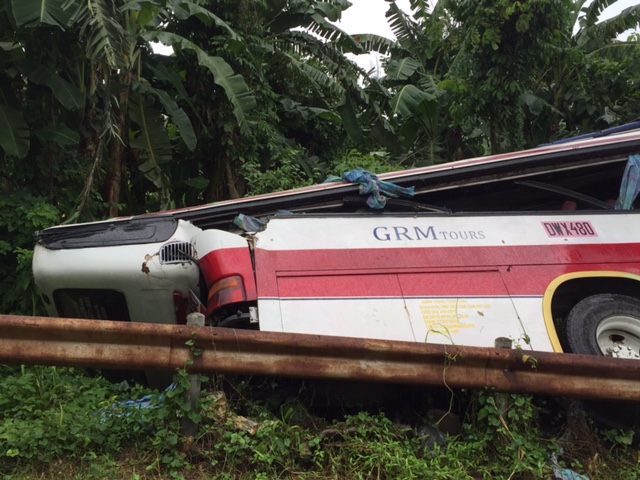 From the looks of the wreck, it is difficult to assume that no one perished here. Passengers seldom wear their seat belts when riding a bus and a crash would mean passengers literally flying around inside the bus. It would have been difficult to avoid serious injury at the least for those who were in the bus.
 This is the scene that will greet travellers to Mataas na Kahoy, Batangas. Gruesome but it drives the point regarding road safety. The wreck serves as a strong reminder to drive safely no matter what in order to avoid such incidents.
–
Addressing congestion due to school traffic congestion
There are two important traffic news stories yesterday:
- MMDA successfully clears parked vehicles outside La Salle Greenhills
- MMDA sets drop off, pick-up points for Ateneo students
For some reason that’s a bit surprising for many, the MMDA seems to have solved two of the most enduring issues on traffic congestion along two major thoroughfares. LSGH is along Ortigas Avenue while Ateneo is along Katipunan Avenue (C-5). Both have high trip generation rates and a significant percentage of their trip gen is comprised of private vehicles. While, Ateneo’s trip generation has led to traffic congestion due to the sheer number of trips the university attracts, the congestion due to La Salle is due to the poor traffic management and lack of parking spaces for vehicles attracted by the school.
I only wonder why it took so much time to address these problems considering the solutions mentioned in the articles are basically ones that could have been implemented years ago. In the case of La Salle, good old fashioned traffic enforcement apparently did the trick. But then, the MMDA even with the LGU constraint could have been stricter before whether when they were under Bayani Fernando (BF) or any of his successors as MMDA Chair. With Ateneo, the scheme is very similar if not the same as what BF proposed over a decade ago when he was MMDA Chair. At that time though a touchy issue was the U-turn scheme he installed along Katipunan that cost trees and the former service road on the west side of the avenue. We can only hope that these claimed ‘successes’ will be sustained and ensure smoother flow of traffic along the major roads they directly affect.
–
On the worsening state of road safety in Metro Manila and adjoining areas
Recent days have seen some serious road crashes occurring along major roads to the east of Metro Manila. A friend posted about a crash along Marcos Highway last June 10 at the still incompletely paved Marcos Bridge. No one was killed in the crash though the driver and passengers sustained serious injuries. However, there was a high potential for this to have been a fatal crash.
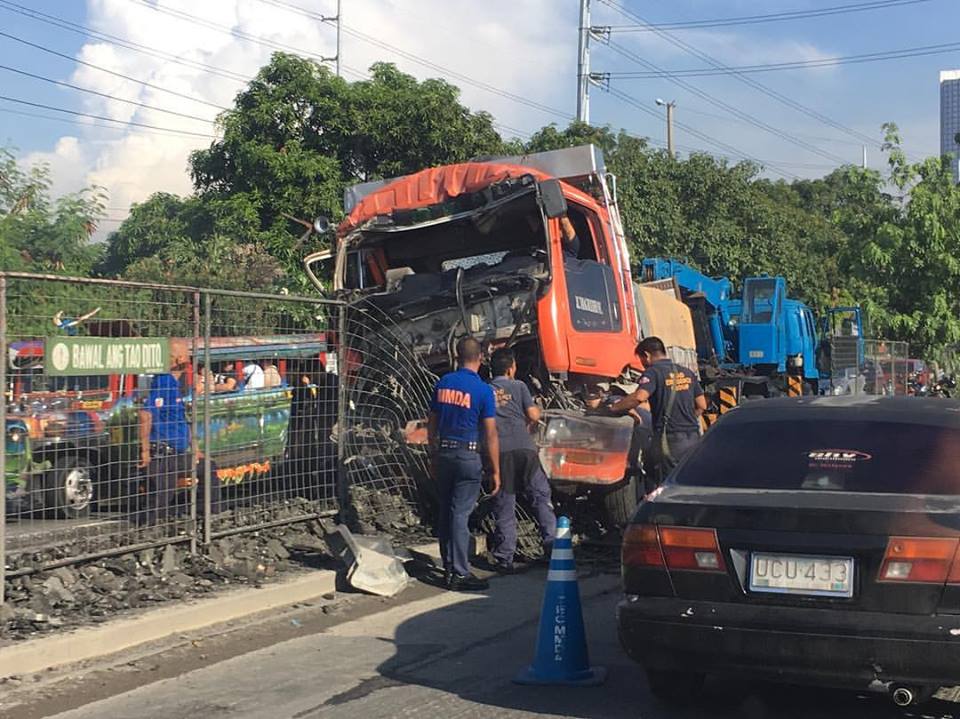 Crash involving a truck plowing into the steel fence and median of Marcos Highway near the Marcos Bridge along the eastbound direction of the highway. Both directions of the bridge’s carriageway’s asphalt overlay had been scraped off and remained neglected for several months until this morning when I observed workers laying out asphalt concrete along the eastbound lanes of the bridge.
An even more ugly crash occurred yesterday in Taytay, Rizal when a truck plowed into the tiangge are of Tatay’s public market killing scores of people and injuring more. Here is a link to some photos and videos about the Taytay crash. These two are but examples of what is happening along national and local roads all over the country with many not even being reported on mainstream or social media.
As I have mentioned in previous posts these crashes were all preventable. Truck operators and drivers need to regularly perform maintenance checks on their vehicles. Brakes are among the critical or essential parts that need to be checked especially with safety in mind. How many fatal road crashes have been reported involving brake failure? In the Marcos Bridge crash, there is also the need to make sure roads are well-maintained and projects not left out for months. In fact, poor road pavement conditions also contribute to traffic congestion as vehicles tend to slow down because of the roughness of the road (e.g., too many potholes). How can the next administration reinforce the enforcement of traffic rules and regulations as well as testing of private and public utility vehicles for these to be certified safe for driving along our roads? Will the Department of Transportation (DOT), the Department of Public Works and Highways (DPWH) and other allied agencies (e.g., LTO and LTFRB), local government units and private entities come up with a more aggressive effort to curb what seems to an increasing trend in road crashes? We hope so and look forward to positive change coming to our roads.
–
Road crashes in Antipolo
I open June with a post on road safety. Last week, I passed by many road crash scenes along my route between my home in Antipolo and my office in Quezon City. Many were the now common crashes involving motorcycles. And there were those involving vehicles that got too close to each other in heavy traffic (e.g., tailgating vehicles eventually bumping the vehicle ahead of them). I was able to get photos of the site of the more serious crashes.
 Head on collision of a car and owner-type jeepney along Marcos Highway near the junction with Amb. Neri Road. These crashes are largely preventable if drivers kept to their lanes and refrained from violating the rule of the double yellow line separating opposing flows of traffic. I’ve written about counter flowing before but focused on it leading to traffic congestion. A more serious repercussion would be crashes like this.
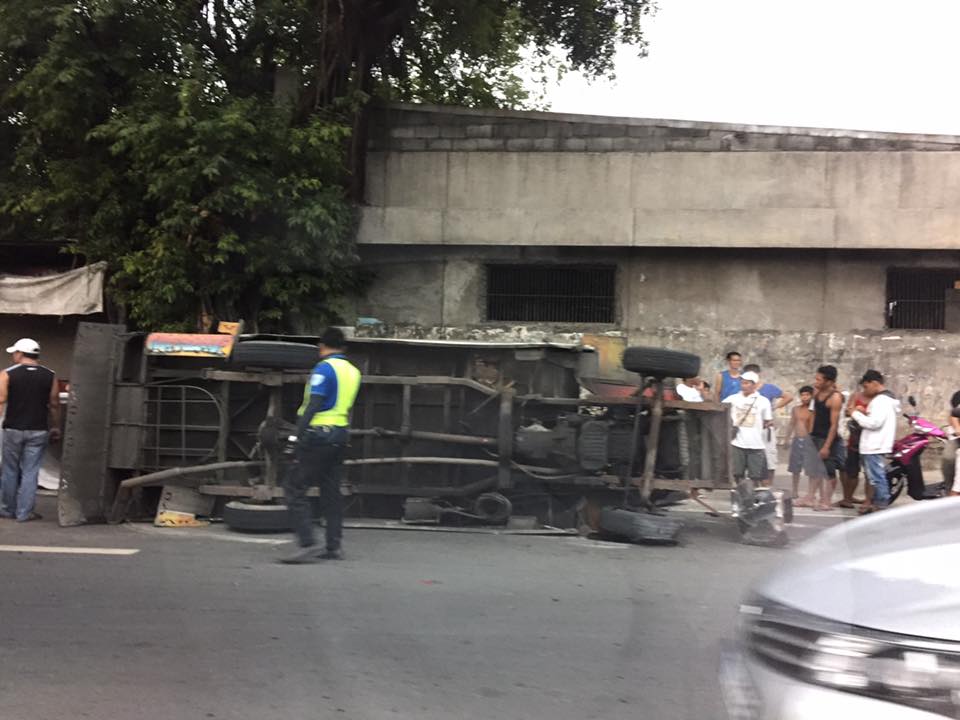 Overturned passenger jeepney along Marcos Highway in Mambugan, Antipolo. Speeding and unnecessary manoeuvres along this highway often has led to drivers losing control of their vehicles and, in this case, the vehicle turning over and likely hurting (hopefully not killing) passengers. This is again a very preventable crash considering it can be addressed by proper (read: safe) driving as well as enforcement.
 Final ‘resting place’ of a truck that apparently lost control along the Tikling bound side of Ortigas Ave. Extension in Barangay Dolores, Taytay. I’ve noticed many breakdowns and crashes involving trucks along this highway as well as Sumulong Highway and Marcos Highway. Many, it seems, involve poor maintenance of these vehicles as well as overloading. Poorly maintained vehicles may lose control with or without their loads and lead to such crashes that in many cases are fatal to innocent bystanders.
With the onset of the rainy season, many roads will be slippery and this will tend to make them more dangerous. In the cases I mentioned above, most crashes are not the fault of the roads or the infrastructure but of the drivers and/or operators of the vehicles. Most crashes are preventable and are caused by driver error, negligence or aggressive behaviour. It is often the nut behind the wheel who is responsible for such crashes rather than the vehicle or the road.
–
Are Filipinos willing to pay for good public transportation?
There is a nice article that appeared last April 1, 2016. I hope it is not an April Fool’s type of an article.
Why is the U.S. unwilling to pay for good public transportation?
Reading the article reminded me of a lot of similar concerns surrounding public transport projects currently being constructed and those in the proposal and pipeline stages in Philippine cities. It seems though that there are still many people who have little appreciation of the benefits of modern public transport systems. Aside from Metro Manila and perhaps Cebu City, there is little clamor for modern mass transit systems. People tend to take commuting for granted with modes that they have grown up with like buses, jeepneys and tricycles until they start to experience first-hand the pains of traveling using inferior transport on severely congested roads. But even then, most seem to take it in stride and carry on, carrying their crosses in a state of purgatory that seems to have no end in sight.
–
 Caught (up) in traffic