
Home » Behavior (Page 30)
Category Archives: Behavior
Enforcing bus lanes along Commonwealth Avenue
Commonwealth Avenue always seems to be the subject of road safety or traffic discipline initiatives every now and again. Quezon City together with partners in other government agencies like the Philippine National Police (PNP) and the Department of Transportation and Communications (DOTC) have embarked on another program aimed at reducing the occurrence of road crashes and other incidents along this busy corridor. It actually reminds me of the “traffic discipline zone” designation of Commonwealth not a decade ago and before public transport lanes were physically allocated along the highway.
They are failing miserably if I am to base success on observations of the behavior of drivers of public transport vehicles alone along this major highway. They get away with a lot of reckless driving including suddenly switching lanes, speeding, and tailgating. There are also cases where vehicles and pedestrians cross the wide highway at points that are prone to crashes. I am not aware of a lot of apprehensions being made of these reckless drivers along Commonwealth except perhaps at the foot of the Tandang Sora flyover where MMDA enforcers seem to be congregating on most days armed with one of two of the agency’s speed guns. But then it seems “business as usual” for the same drivers and riders along the rest of Commonwealth so the initiatives are not effective deterrents against irresponsible road use.
 You can always see buses on the wrong side of the road along Commonwealth Avenue especially along the section between Fairview Market and Regalado. They do this to get ahead of other buses and then bully their way to make a stop or turn right at an intersection.
 This bus in particular was weaving in traffic, bullying smaller vehicles to give way as it raced other buses along Commonwealth Avenue. Such behavior among public transport drivers is one of the major ingredients for road crashes.
It’s been a year now since the tragic crash involving an out of line provincial bus in the Cordillera. That was partly the result of poor monitoring and enforcement by the LTFRB. While the major reason for the crash was reckless driving (i.e., the driver was allegedly speeding at a critical section of the highway), this could have been avoided if the bus wasn’t operating in the first place. The very same policies along Commonwealth apply to these provincial buses and fatal crashes could’ve been avoided or minimised if the LTFRB can just exercise its mandate effectively.
–
On jaywalking, overpasses and informal terminals
I had some errands last December and decided to take public transport instead of taking our car and wasting time parking the vehicle. There was significantly less traffic at that time of the year because schools already on Christmas break and everyone else seemed to be on the slow side of the holiday mode (read: not in shopping mode). I needed to cross the wide road that is Quezon Avenue and there was a sign where I usually crossed that it was now prohibited to cross there. I had to take the overpass to get to the other side and to the jeepney stop to board one to get back to the university.
The overpass at the Quezon Ave.-Araneta Ave. intersection is under-utilized. I base this on the several times I’ve used the overpass. Most people prefer to cross at road level, taking advantage of the traffic signal cycle that allows for gaps in the traffic for pedestrians to cross safely. Of course, there are those who cross any time and seem to tempt fate by their behaviour. They seem to tempt also the MMDA traffic enforcers assigned in the area but from what I have observed, enforcement of the “no jaywalking” policy is usually lax or non-existent. People regularly cross at ground level in plain view of traffic enforcers.
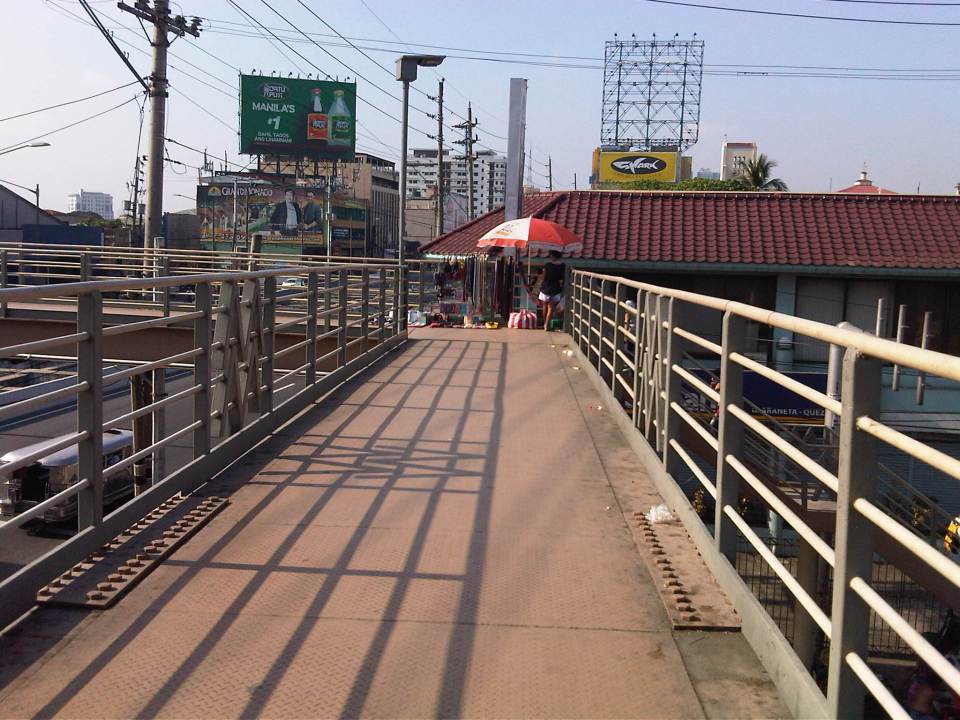 A vendor set-up at the corner of the pedestrian overpass at the Quezon Ave.-Araneta Ave. intersection. Obviously, there are few pedestrians using this overpass as most prefer to cross at ground level.
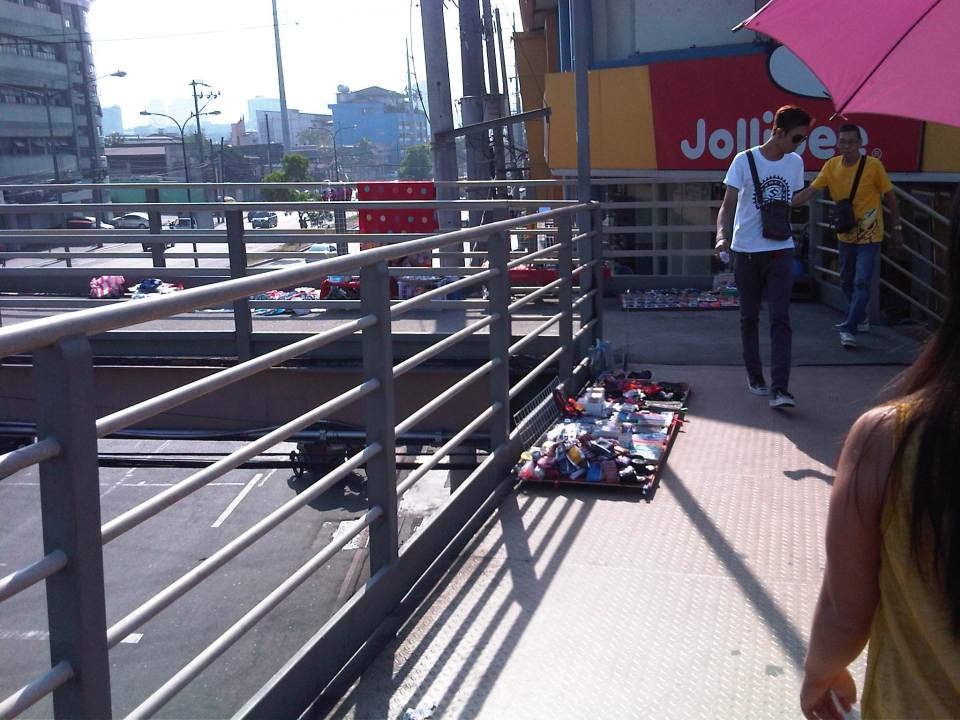 More vendors on the overpass – fortunately, there were few pedestrians using the overpass at the time. Its not the same for other overpasses that are crowded due in part to vendors occupying much of the facility.
 The stairs for many overpasses around Metro Manila are a bit on the steep side. That’s generally not okay with senior citizens, children or persons with disabilities.
There is an informal, on-street jeepney terminal right at the foot of the overpass. If you are in a hurry, its best to try to board a jeepney on the second lane as they are more likely to proceed when the approach is given a green light. From my experience, it takes about 2-3 cycles before the “queued” jeepneys finally cross the intersection. It takes that time to at least have several passengers for the jeepneys before it proceeds to cross the intersection. Most passengers here are transferring from jeepneys plying routes along Araneta Ave. There shouldn’t be an informal terminal here and jeepneys occupy 1-2 lanes of the road at a critical point – the intersection approach. This means intersection capacity is significantly affected and many vehicles could not proceed as they are blocked by the jeepneys. Special mention is made of vehicles wanting to make a right turn but have to go through this “gauntlet” of public utility vehicles. Again, there are MMDA enforcers in the area but it seems the jeepneys and the barkers hold sway and likely with the blessing of enforcers. Such situations are commonplace in Metro Manila and many other cities, and contribute to traffic congestion and other problems commuters regularly encounter.
–
Conditioning
Was traffic really bad yesterday, Dec. 21, or was it typical Friday traffic? A lot of people have been talking or posting about how traffic last Friday was expected to be the worst of the year. Apparently, it was not.
Based on posts on my social media accounts yesterday, it seems that traffic was not at all that bad in many parts of Metro Manila, especially along roads that were expected to be hellish in terms of congestion. One post stated that it him only an hour to travel from Ayala to Trinoma by bus. People usually post about really bad experiences about traffic congestion and this crowd-sourcing approach is usually very reliable. I went home early yesterday and it didn’t take me long to travel between stops for errands I had to do along the way home. Media also would have reported about terrible congestion along major roads including EDSA, C5 and the expressways.
Statements like what the MMDA made prior to Dec. 21 are typical of a psychological approach that some agencies seem to have been resorting to in order to manage people’s expectations and perceptions. Conditioning people’s minds is not a new strategy or tactic. The MMDA has been doing this a lot for as long as I can remember, including during the stint of its former chair Bayani Fernando. Many if not most of these “conditioning” activities are done through media with the agency making statements through its officials about issues such as traffic, garbage and flooding. This is no different to the perception of one agency making frequent “power point presentations” (a reference to projects involving the private sector) to announce much delayed projects supposedly for immediate implementation.
One opinion is that this is a form of damage control. People will usually have strong opinions about what government is doing to address issues like congestion. For people not react too strongly against agencies that are supposed to be responsible for the problem, the same agencies have anticipated and preempted the manifestation of their ineptness by stating the obvious ahead of its occurrence. This would not have been necessary if the agencies did what they were supposed to do in the first place. Hopefully, in the near future such conditioning and other psychological tactics will indeed not be necessary once programs and projects are finally implemented and help alleviate or solve problems.
–
Some questions on a gloomy Saturday morning
On gloomy Saturdays like today, I often tend to sort of contemplate on some questions coming from events and articles the past few days. I don’t really want to answer these questions right now and immediately but would rather let these and the follow-ups play around in my mind. I would rather not do some shout outs on social media about these questions as some friends tend to be sensitive and I don’t really want to make a lot of effort carefully framing posts on FB just so they won’t appear to be offending certain persons who might be over-zealous about their advocacies or who would be so defensive of their organizations. Here are some questions running around in my brain right now:
1. Does DENR have the mandate to require sidewalks and bikeways along all roads? Design and implementation-wise, isn’t this supposed to be under the DPWH (for national roads) and the LGUs (for local roads)? Is this more a policy statement? But then shouldn’t this come from DOTC?
2. Is going out of your way really the way to get noticed and be awarded? Are there no points for people doing a great job at what they are supposed to be doing?
3. Shouldn’t an agency first check if they are doing what they are supposed to do and the outcomes reflect their objectives? Are emissions testings and monitoring successful or do we still have a lot of smoke-belchers on our roads? If they already have their hands full with their tasks according to their mandate, shouldn’t they first mind their business before even encroaching into another agency’s tasks?
4. Does media have to give so much airtime to a driver of a luxury vehicle who assaulted a traffic enforcer?
5. Why does it seem to be so much fuzz about Uber? Is it just on social media? Do most other commuters give a damn about it when they really can’t afford availing such services?
6. Are government engineers bereft of an appreciation for the arts, culture and heritage? Are they too mechanical or dumb to understand what planning and design really is all about?
–
On doing research for your undergraduate course requirements
It’s that time of year again when we are swamped with requests for interviews from students taking undergraduate courses. These undergraduate courses include those on Science, Technology and Society, English, Communications, Architecture, Geography, Business, and Economics. These requests are not limited to students from our university but also come from students in other schools as well. While we are happy to oblige, granting interviews face-to-face or through correspondence (through email, of course), we are becoming wary about students not doing their part first before requesting an interview. In many cases, they just fire off a list of questions in the first email, probably hoping the addressee would be kind enough to answer all these questions in a comprehensive manner. That way, perhaps the student will be able to save on time and effort in doing his/her report. That’s right, let the expert answer all the questions and tell me what references I should list down in my report. If the student can’t understand what the expert wrote in reply or if the student thinks its not enough, then the latter could just send a follow-up with additional questions or request another interview.
Is this the right way to do research? I do not agree with this and perhaps the faculty handling their respective courses these students are enrolled under should take care in how they frame their requirements. It is as if they are passing on their responsibilities to other faculty members, experts in their particular fields, who would have to contend with requests for interviews or outright questions in their emails. That’s probably understandable for general education courses like English and STS, but not acceptable for undergraduate research projects that are supposed to be “capping” courses in their programs.
How do I address such inquiries in my mailbox? I do respond immediately and in fairness to the students whom I assume are somewhat misguided in his/her research work; particularly on how to conduct research. My usual reply is that I cannot accommodate the request due to my schedule followed by a counter-request for the student to send me his/her questions first (if he/she hasn’t done so in the first email). If I already have an idea of the students’ topics, then I would suggest some reading material or references first, and hopefully that can help the students frame their questions. That way, I can gauge if the students are really serious about their research or are just going through the motions. It’s difficult for me to be serious or passionate with my replies if the person on the other side of the proverbial table is not at all interested in the topic and treats the exercise as just another requirement for him/her to get a good grade.
Doing his/her part before even contacting experts mean the student needs to do some literature review. That can be in the form of research online and not the kind where the student will just mention a few articles (often opinion pieces) that they read on Rappler, Yahoo or other online sources. There’s a wealth of more scholarly and objective information now available on the net and UP students have access to journals, books and other references through the university’s libraries. These are privileges that they have already paid for as part of their tuition so why let these resources go to waste? I believe students can do a good job in their research projects if they are given proper guidance by their advisers or instructors, who should be the “first line of defense” against mediocrity in their studies at this level. Getting rarer these days are students who come in prepared and are really passionate about the topics they are studying.
–
Risky switching of lanes
Many Filipino drivers have the propensity for frequently changing lanes. These happen even at locations where they are not supposed to be changing lanes (e.g., at intersections, while going up or down a steep slope, at curves, etc.). Such maneuvers are risky and basically among the reasons why there are double yellow solid lane markings separating opposing traffic at these sections. I have seen many incidents where in a matter of seconds at least one person is suddenly inconvenienced by the crash. I say at least one person because whether traffic is light or heavy, there will be vehicles slowing down and causing a chain reaction of other vehicles slowing down to stop or avoid the vehicles involved in the collision. These incidents occur because of at least one person’s propensity for suddenly switching lanes.
 The rear bumper of a car gets torn-off (not just detached) by the bull bar of a vehicle whose driver decided to suddenly shift to the right. Apparently, the guilty driver was not able to factor his vehicle’s bull bar when he immediately encroached on the adjacent lane.
 A closer look at the damage on the vehicle in front of us. We had to change lanes ourselves in order to avoid the stopped car. We could only imagine the traffic build-up resulting from the incident at the C5-Lanuza intersection.
I’m not sure how these people learned to drive. Driving schools will likely claim that they did their part in instructing their students/clients the proper way to drive. However, going through driving school is not an assurance for responsible driving. What more can be said for people who learned to drive the informal way (i.e., taught by a friend, relative or other people). Of course, this could have been addressed early on if the licensing system under the Land Transportation Office (LTO) was a lot stricter and exercised due diligence in their licensing examinations.
–
Congestion due to roadworks at Sumulong-Olalia
The Sumulong Highway sections emanating from its intersection with Olalia Road have been experiencing traffic congestion in the mornings the past few days due to road works being undertaken at the intersection, and along Olalia Road and the Masinag-bound side of Sumulong Highway. Some days, traffic has been bearable and its just like having an ill-set traffic signal at the intersection where it would take you several cycles before getting through. Recently, however, many motorists have lost patience (or probably are simply pasaway) and have been encroaching on the opposing traffic lanes, much to the dismay of those who opted to follow rules. This panggugulang or going ahead of others need to be lessened with those guilty being apprehended or turned back to discourage future transgressions of traffic rules.
 Counter-flowing vehicles towards the Sumulong-Olalia intersection
 Queue at the curve towards the direction of Olalia Road
 A look at the side mirror shows a long line of vehicles along Sumulong. The queue sometimes reaches the strip of stalls selling cashew, suman, and other local delicacies.
There’s really very little one can do about traffic management in the area considering the limited space available for vehicles turning to/from Olalia Road. It’s basically one-way at the approach to Sumulong Highway so there will definitely be a queue along the outermost lane of Sumulong due to the constriction at Olalia. However, in the morning, there is an obvious difference in the directional distribution of traffic along Sumulong with most vehicles moving in the direction towards Masinag rather than to Antipolo Church. That means the Antipolo-bound traffic can fit along a single lane while opposing traffic can use three lanes – 2 bound for Masinag and 1 for Olalia. Enforcers may want to use traffic cones for this temporary traffic management scheme as without such tools, there is a tendency for a bit of confusion as impatient drivers resort to encroaching on the opposing lane (counter-flow) and resulting in more severe congestion (and unsafe conditions) as they attempt to merge with traffic at the intersection. Of course, that goes without saying that it only takes one idiot to counter-flow for others to follow.
–
The curious case of Uber in the Philippines
Before anything else, I must first state that I have not used Uber in the Philippines nor have I used it elsewhere. Its probably because I have not found a use for it…yet. In cities in other countries that I have traveled to, I often use public transport and cities with good mass transit systems have very high marks for me. There are taxi services in these cities and I have had mixed experiences with taxis in Bangkok and even Singapore. I think Japan’s taxis are excellent and locally, Iloilo’s taxis particularly that of one company should be the model for city taxi services in the country.
The services offered by Uber reminds me of the evolution of UV Express or FX services. Back in the 1990s, private vehicle owners/drivers saw an opportunity to “earn a few pesos” by offering a ride to people waiting along the road. An AUV driver, for example, bound for Makati from Quezon City would take in a few passengers for an agreed fee and the collection would help him defray costs of fuel as well as of maintenance for a trip that he would likely make alone if he didn’t offer rides to others. He had no coverage for his passengers should they be involved in a crash and they even conspired to claim they were carpooling or were friends if accosted by authorities (i.e., when suspected to be running a colorum vehicle). This is practically the same service offered through Uber. The only difference being that Uber employs an app to facilitate “service contract” between driver and passenger. The app basically makes the agreement discrete and unknown to regulators of transport services.
Like the predecessors of UV Express services, Uber service providers serve a segment of commuters who have difficulties getting a public transport ride and are likely also to be frustrated or disgruntled about the poor quality of public transport services. This is not limited to taxi services but encompass bus, jeepney, UV Express, tricycle and rail transport that a majority of commuters regularly take to go to their offices, schools or other destinations. I purposely omitted walking and cycling here as everybody essentially walks and cycling is not really a transport service along the lines of public utility vehicles.
Very recently, the Land Transport Franchising and Regulatory Board (LTFRB) ruled that Uber is illegal, basically classifying it as colorum – terminology for vehicles illegally operating as public transport. Is the agency totally wrong about their ruling against Uber? While I haven’t seen the decision or read any memos regarding this, I would assume that the board had its reasons and some of these are reasonable, sound bases for such a memo. For one, regular public transport services require insurance for carrying passengers. Regular insurance taken by private car owners covers the driver and the passengers who ride for free but public transport carry passengers for a fee (fares) and thus drivers and the operators have a bigger responsibility particularly with regard to safety. This question on liability is perhaps the biggest question for Uber and the people behind it. I think this will be a good topic for law schools to take up and perhaps a good subject for debates for and against the service.
However, the bigger question perhaps, and especially to netizens who vented their anger at the LTFRB for the decision against Uber, is: Are you really angry because of the LTFRB decision against Uber or because you are unhappy about transport services in Metro Manila (and elsewhere in the country general)? Online articles have become a feast for trolls as they typed in their scorchers for the agency but I am willing to bet most of these haven’t even taken an Uber vehicle prior to their posting their opinions online. Most know about Uber as a concept or as an app but haven’t read or learned about experiences elsewhere and why it has become popular or notorious depending on the conditions where it is operating. While people I know have used it and benefited from the service, there should still be safeguards for users who essentially do not know who will drive up to pick them up for their trip. Definitely, there are security and safety concerns that need to be clarified here. Also, would this lead to people who would take this up as a full-time job rather than as something more like a “for-hire” car or van-pool? And lastly, we should not be distracted and lose sight of the ultimate goal. That is, we should push for better transport systems and services so that Uber and other similar services would not be essential for our commutes. –
Bad P.R. for road sharing
A few articles came out of Sun Star Cebu recently regarding an activity over the weekend that was supposed to promote road sharing. I read four articles by different opinion writers. These may be found in the following links:
- A crazy exercise [Bobby Nalzaro, September 28, 2014]
- Sharing narrow roads [Opinion, September 29, 2014]
- Road sharing, road rage [Eddie Barrita, September 30, 2014]
- Green Loop’s faulty premises [Bong Wenceslao, September 30, 2014]
The first three articles seem to be more like reactions of motorists to activities that seek to promote road sharing and cycling in particular. The writers missed the point in so far as road sharing is concerned and are definitely biased towards the status quo in terms of road usage. However, some of their observations need to be qualified as certain roads seem to have been closed with little advise to the general public, many of whom take public transport. The last article is the more grounded one and explains the perspective of non-bikers who are public transport users. This is the calmer opinion among the four and expresses his points in a more objective manner.
I was not there and I haven’t read yet any articles from the organizers or participants to the activity. I would like to give them the benefit of the doubt in so far as their advocacy is concerned. But then one also has to consider the valid points raised by other road users whenever road sharing is equated to cycling rather than a more balanced mix that is focused towards maximising the number of people or amount of goods transported. It is not only a question of space but of efficiency of movement. Bicycles might be efficient in energy but unfortunately it is not the most efficient in terms of the number of people carried between origins and destinations. And we can never decongest our streets in order to make more space for cyclists and pedestrians if we cannot come up with efficient public transport systems that will encourage people to leave their cars or not to buy one in the first place. It can be argued that people are actually opting for motorcycles than bicycles for commuting – another trend that needs to be understood from the perspective of people making these choices for their transport needs.
–
Lane discipline
Among many peoples’ pet peeves in traffic would probably be the propensity for lane changing among many drivers and riders. This is especially true for wide multi-lane roads like Commonwealth Ave., Marcos Highway and EDSA. While it can be an understandable behaviour for free flowing traffic along long stretches where weaving can be executed safely, lane changes can be quite risky at intersections and may instantly lead to crashes. These are likely the bases for the swerving violations that the MMDA and other traffic enforcers became notorious for issuing for a time.
We chanced upon a scene at the Commonwealth Ave.-Mindanao Ave. intersection in Novaliches where a car seemed to have attempted to cut in front of a bus in order to make a turn but got hit by the bus. From the angle of the collision, it appears that the driver of the car likely maneuvered for a U-turn and made the critical assumption that he could beat the bus for the turn. It was obvious that the bus was in the right position while the car was not. This is often the case for drivers who do not care for positioning themselves along the correct lanes at intersections and seem to rely on their guile to get ahead of others. Such drivers might just be the same ones who would likely do counter-flows also to get ahead of others queued along the right traffic lanes.
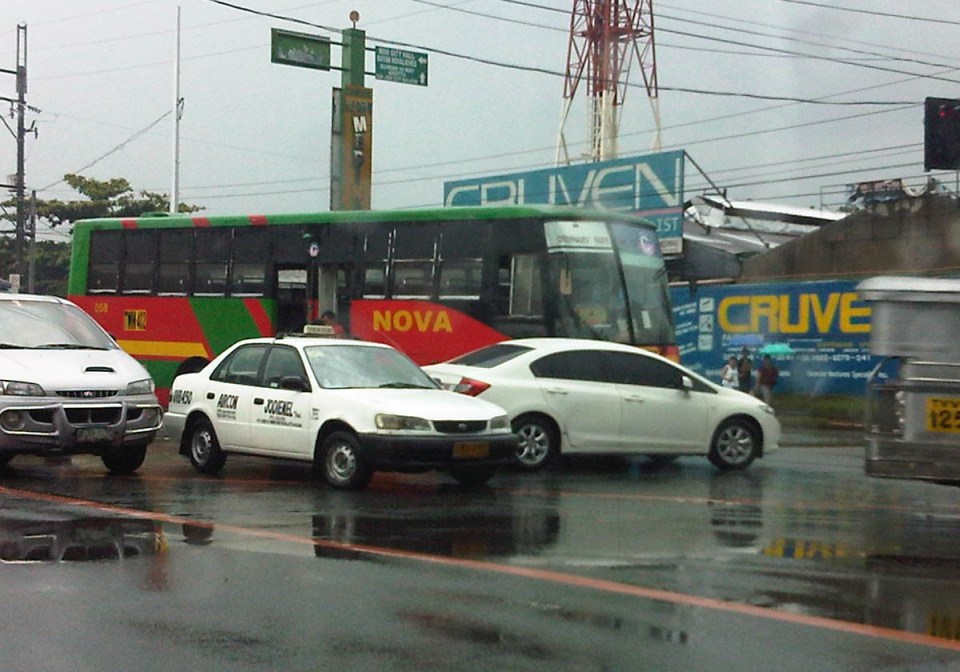 White car attempts to make a U-turn right in front of a bus and gets hit by the bus whose driver likely did not notice the white car sneaking in front of the vehicle.
Lane discipline becomes more important with the revival of traffic signals all around Metro Manila. In addition, it is also important for the appropriate lane markings to be placed at intersection approaches. Such markings are supposed to guide drivers where they should position themselves so that they will not block traffic going in another direction. These can also aid in the enforcement of lane discipline as vehicles on the wrong lanes can be apprehended. This was the case in Cebu City in the 1990s when the city adopted the SCATS traffic signal system, which employed detectors embedded on the pavement along the approaches to intersections. These detectors helped determine whether there is demand for a particular movement (left, through or right) and so requires lane discipline for the system to work effectively. –
 Caught (up) in traffic