
Home » Behavior (Page 34)
Category Archives: Behavior
Namumulaklak
The Filipino term “namumulaklak” usually refers to flowering plants when blossoms appear around the equivalent of springtime. This term has also been used to describe passenger behavior, sabit or to hang, particularly when public transport vehicles are already full and the more daring people hang at the door of the vehicle. When one says namumulaklak yung jeepney (the jeepney is like a flowering plant), this refers to a several passengers dangling from the rear door of the vehicle such as what is shown in the photos below. Perhaps the one who coined the phrase sees the jeepney as a bouquet with the people hanging behind as the flower buds?
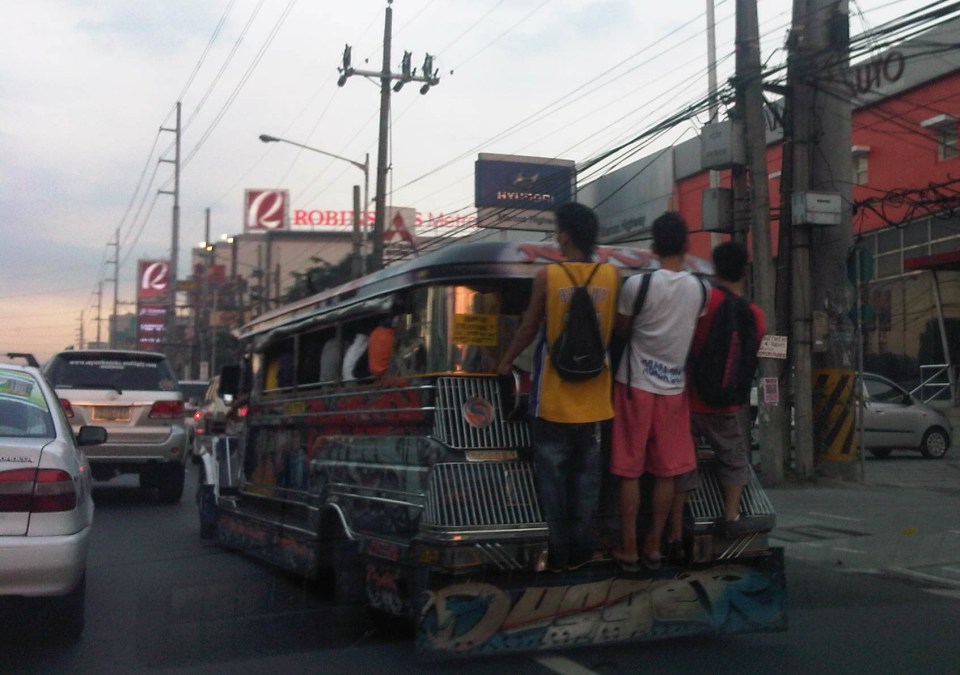 Jeepney along Marcos Highway in Pasig City
I took the preceding photo while traveling along Marcos Highway en route to Antipolo, Rizal. The corridor has been served by jeepneys as far as I can remember. The scene is one you’d see every time during peak periods despite prohibition of this practice by authorities. Jeepneys easily evade being apprehended as the driver or conductor of the vehicle usually accepts only a few hangers-on and asks the latter to dip their heads so police or traffic enforcers cannot easily see the violation as the jeepney approaches. One or two people hanging behind the jeepney is quite common and generally tolerated along many roads. Enforcers says they are usually against excessive sabit when the risks are higher that one would fall off the jeepney.
This behavior is not exclusive to Metro Manila jeepneys but may be observed in other cities and towns as well. In certain cases such as Baguio City in the north, there are even passengers on the roof of the vehicle. While more unsafe, the behavior is tolerated and, surprisingly, there are minimal incidents of people falling off. Some foreign tourists are even offered rides on the roof and those seeking some thrill often oblige and just try to keep a tight hold on whatever that will keep them from falling off the vehicle.
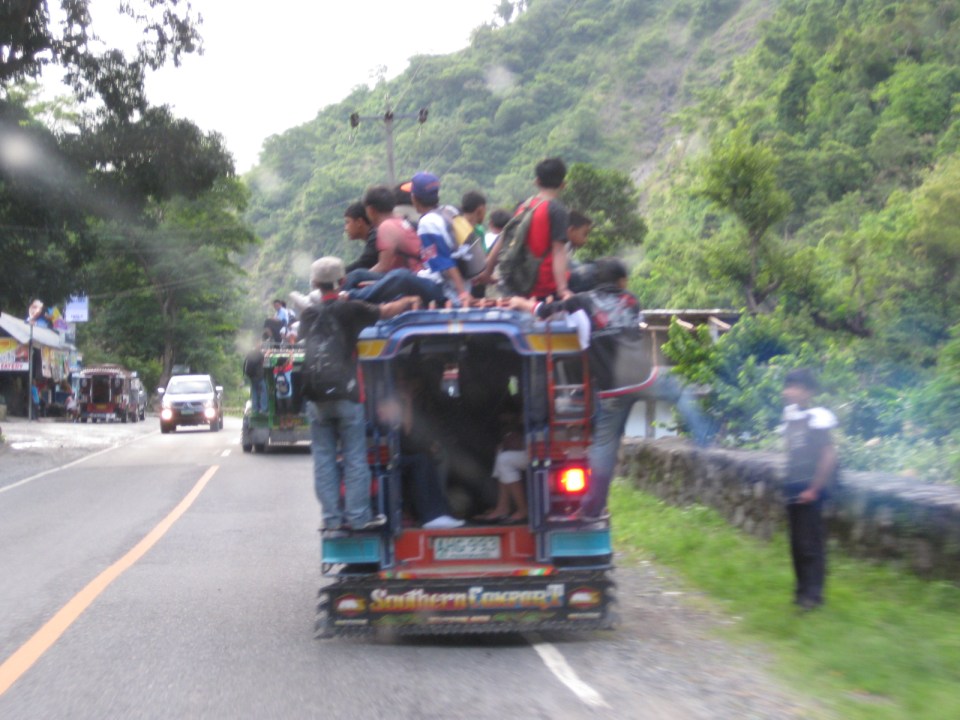 Jeepney along Kennon Road heading up to Baguio City
 Another jeepney along Kennon Road
 Jeepney along National Road in Bondoc Peninsula, Quezon
 Another jeepney along the national highway in Quezon
I used to hang behind jeepneys when I was commuting back during my college days. I had to take 2 jeepney rides between our home and UP Diliman. Those times it was quite difficult to get my first ride to or from the old jeepney terminal near Katipunan Avenue. To get a seat will take you a lot of time or would require one to go to Cubao where there are queues for jeepneys passing our village. Going to Cubao meant spending more for fares and so we would usually try to chance upon jeepneys with none or few sabit so we could be relatively safe under the rear roof of the jeepney rather than dangling outside. Many jeepney drivers seem to revel in trying to shake off people as they drive recklessly along the spacious Marcos Highway. Among the most notorious are jeepneys plying the Antipolo-Cubao via Sumulong Highway, Cubao-Montalban, Angono-Cubao (Double Highway) routes, particularly those which as regarded as patok (popular) jeepneys with their signature loud stereos blaring rock or hip hop music.
There are calls for enforcers to apprehend more violators and be firm with the law against such risky behavior on public transport vehicles. These calls are correct and there should be a strong campaign to reduce sabit. But what is usually lost in the road safety discussion is the reality that such behavior stems from the fact that there is unserved transport demand along the routes served by the jeepneys. This unserved demand means the supply side needs to be addressed first by determining why people are having difficulties getting seats when these are needed. It is not simply a coincidence that the time when it’s most difficult to get a ride is during the peak period. But this does not mean we have to provide all the vehicles with the equivalent number of seats during this time. Note that the resulting number of public utility vehicles will be excessive as they are not required during the rest of the day. The key is to understand that the travel speeds and turnaround times of public transport needs to be improved, and that means addressing congestion and not just increasing seating capacities for passengers by increasing vehicles. This is actually a daunting job and one that requires some clever analysis considering the overlapping routes in many Philippine cities. Perhaps one approach is really to simplify route structures and this can only be done if there are mass transit systems that can provide backbone services for most commuters.
–
On license plates
More than 2 years ago, the current administration made an inspired move after the President mentioned in his inaugural speech that he was among those who didn’t like “wangwang” (sirens) and associated these with abusiveness, of feelings of entitlement among road users. The use of sirens and other similar devices tells people that the user is an “important” person whose time is more valuable than others.
Whatever happened to the drive against “wangwang” in all its forms? The proliferation of commemorative plates, for one, can be a form of “wangwang.” While the Land Transportation Office (LTO) came up with a memo a few years ago providing clear instructions on how the commemorative plate should be displayed (i.e., on top or above the legal plate), many have returned to the practice of replacing the license plate (hiding it) with the commemorative one. This is especially true for those plates bearing police, military, government, and other agencies or organizations that can be used to make traffic enforcers think twice about apprehending a motorist for legitimate traffic violations. One sees such plates everywhere screaming “PNP,” “CIDG,” “NBI,” “PMA,” “Prosecutor,” “Councilor,” etc. and you know these are statements that are meant to intimidate traffic enforcers, which is often denied by the guilty party.
Then there is also the abuse of special plates, particularly those supposedly assigned to lawmakers. How many people have “8” as their license plates? Do children or staff of senators and congressmen enjoy the same privileges as the elected official? In the past, plates bearing “8” also indicated the district represented by the person supposedly using the vehicle. And so you would know, for example, if the person happens to be from the 1st District of Iloilo or the 3rd District of Quezon City. The same goes for vehicles bearing “16” and other special plates indicating someone holding a high position in government. Nowadays, even family members and staff members of these officials use the special plates, thereby extending to them the courtesies usually given to elected or appointed officials like not being covered by the number coding scheme in Metro Manila. This should not be the case for such “extensions” if we are to enforce the law firmly and fairly.
In certain cases, worse are those who use neither license plates or authorized commemorative ones. There seems to be a proliferation of people using personalized, souvenir or replica plates from other countries. These are often used in lieu of the rear license plates. These are claimed to be harmless since traffic enforcers usually check only the front plates for registration and compliance to number coding. However, there are implications for when the driver and the vehicle are involved in incidents such as traffic violations or crashes (e.g., hit and run incidents). While witnesses would probably be able to describe the car, the license plate cannot be recorded. Therefore, it would be quite difficult to trace the vehicle’s ownership information that could be retrieved from the LTO’s computer records to identify the violator or suspect in an incident.
 The legal plate is deliberately obscured on this one as it is hidden in the rear bumper.
 The plate suggests one is driving in Europe rather than along C-5 somewhere in Pasig City
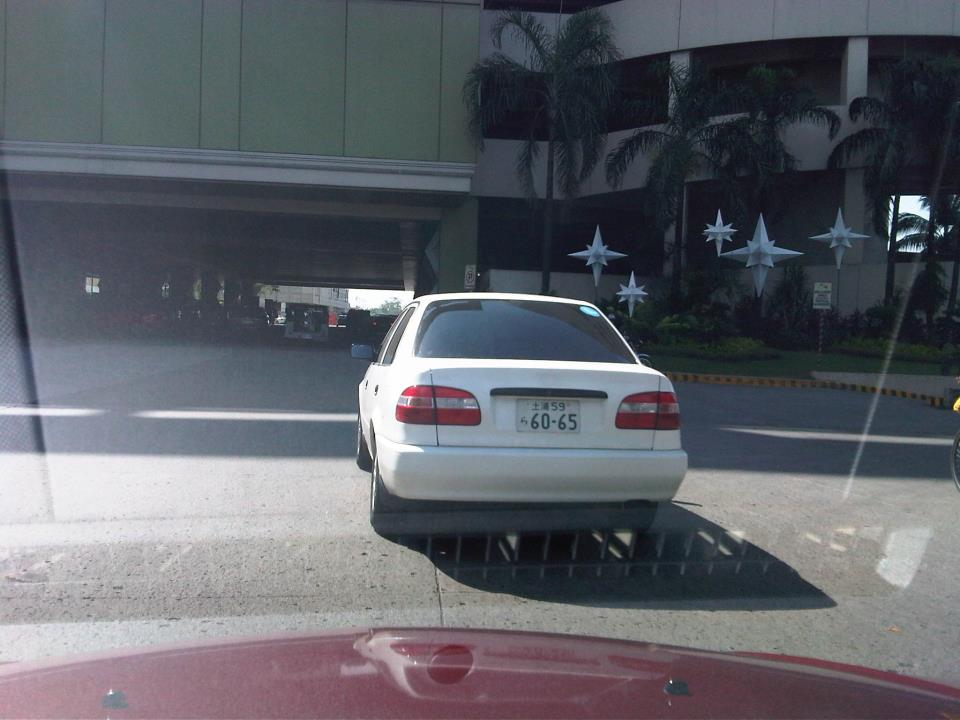 This one thinks he’s driving in Japan.
Perhaps the LTO and traffic enforcers who are deputized by the agency should also clamp down on these cases of violating RA 4136. The idea is to have a campaign similar to what was implemented to rid our roads of the annoying “wangwang” back in 2010. Such an initiative should help promote discipline on our roads in the sense that motorists would be more aware of traffic rules and regulations and that they cannot continue trying to circumvent basic laws.
–
Technical Papers on Sustainable Urban Transport
This is just a quick post to end this first month of the year. Following is a link to the website of the GIZ-supported Sustainable Urban Transport Project featuring the page with the latest technical papers. These represent some of the latest work on sustainable transport featuring good practices from developing and developed cities that can be used as guides or benchmarks for those dealing with transport issues in their respective cities or towns.
Commuting on the LRT Line 2
Metro Manila’s LRT Line 2 stretches from Santolan in Pasig City to Recto in the City of Manila. It is the only suburban railway line serving Metro Manila outside the PNR, and uses trains that have the highest passenger capacities compared to the LRT Line 1 and EDSA MRT (Line 3), which uses cars that can be categorized as light rail vehicles. Line 2 employs vehicles that would elsewhere be used for metros or surface heavy rail transit. I occasionally use Line 2 for commuting between Katipunan and Cubao but I must admit I haven’t used it to commute all the way to Manila. Following are photos I took on one commute between Katipunan and Cubao.
 Going underground – descending to the station at Katipunan, there are no escalators so most people have to use the stairs.
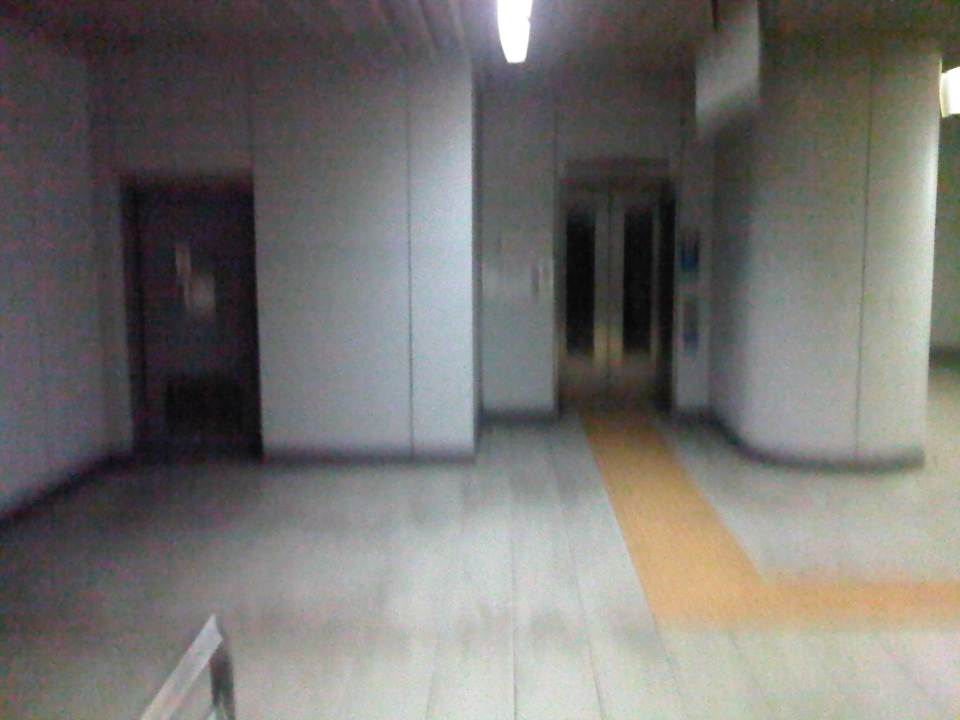 Accessibility – there are elevators for the physically-challenged including persons with disabilities (PWDs), senior citizens and pregnant women.
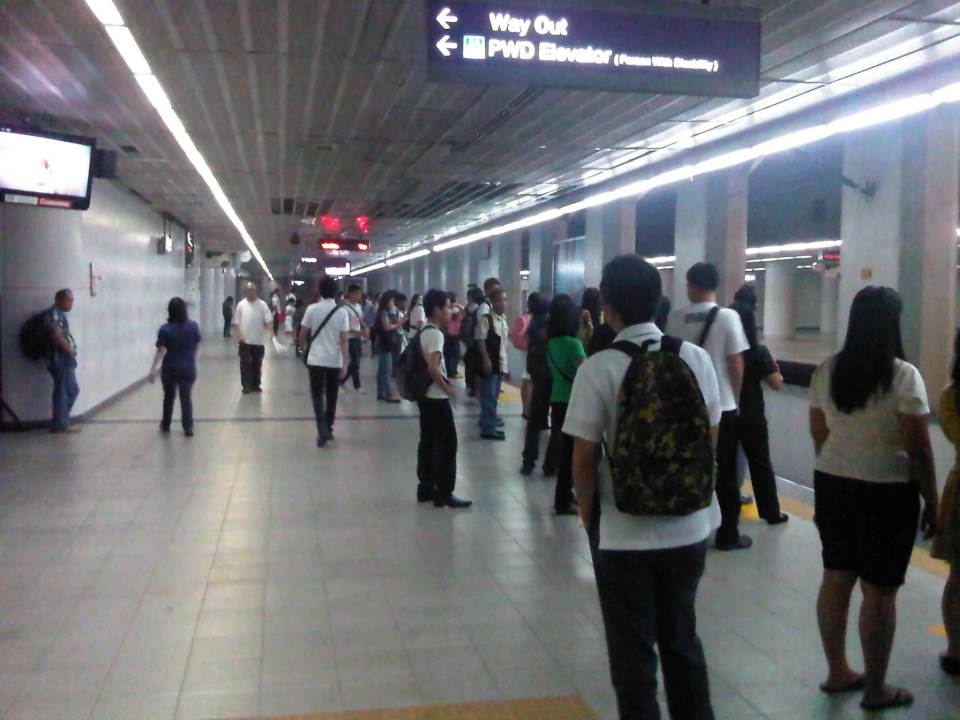 Katipunan Station platform – is underground and gives the feeling of being in a subway. There are directional signs to guide passengers but I think there should be more signs informing people about train arrivals and schedules. Note that most passengers do not form lines and are standing along and near the entire platform edge. This seems to indicate people are either undisciplined or there is little effort to establish order in boarding and alighting procedures.
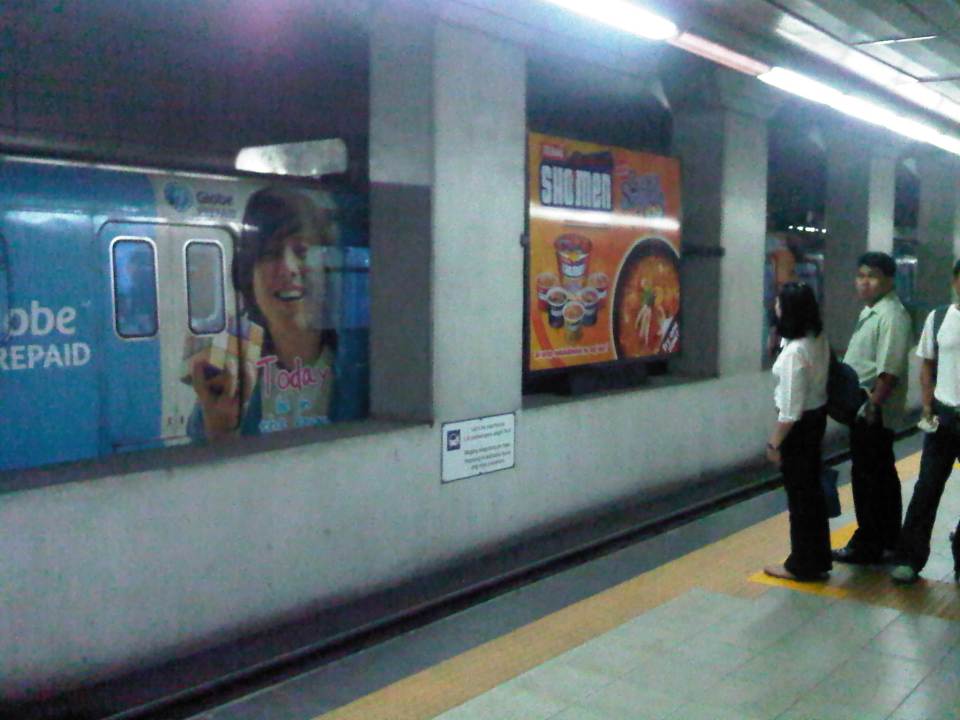 Passengers waiting along the platform form lines where the trains’ doors are supposed to be positioned once the vehicle is stopped. In other countries there are also signs along the median to guide passengers where to line up along the platform and to give way to people alighting from the trains before boarding the train. Such procedures are important for orderly operations. A train bound for Santolan Sta. is on the other side of the platform.
 Passengers boarding the train
 Stragglers hurrying to enter the train before the doors closed for departure. Like in other cities, some passengers attempt to board the train at the last second. Such situations can cause injury as people can get caught by the closing doors.
 Train leaving the Katipunan Station and bound for Recto in Manila
 Warning sign – signs inform passengers of the dangers along the tracks. In this case, the danger is in the form of high voltage wires as the trains are powered by electricity. There is a fine of PhP 50,000 (~USD 1,200) for anyone illegally going down to the tracks.
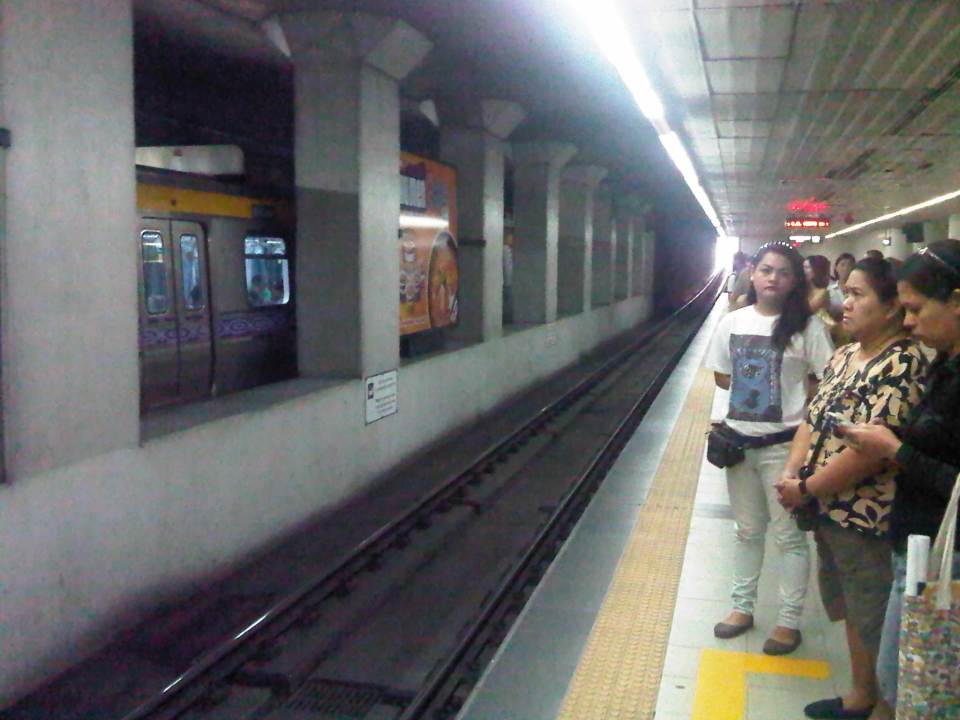 The yellow line defines the area where passengers should be safely behind and clear of the trains. There are dimples on the line, which are generally for the benefit of blind people using their canes to “feel” such lines for guidance.
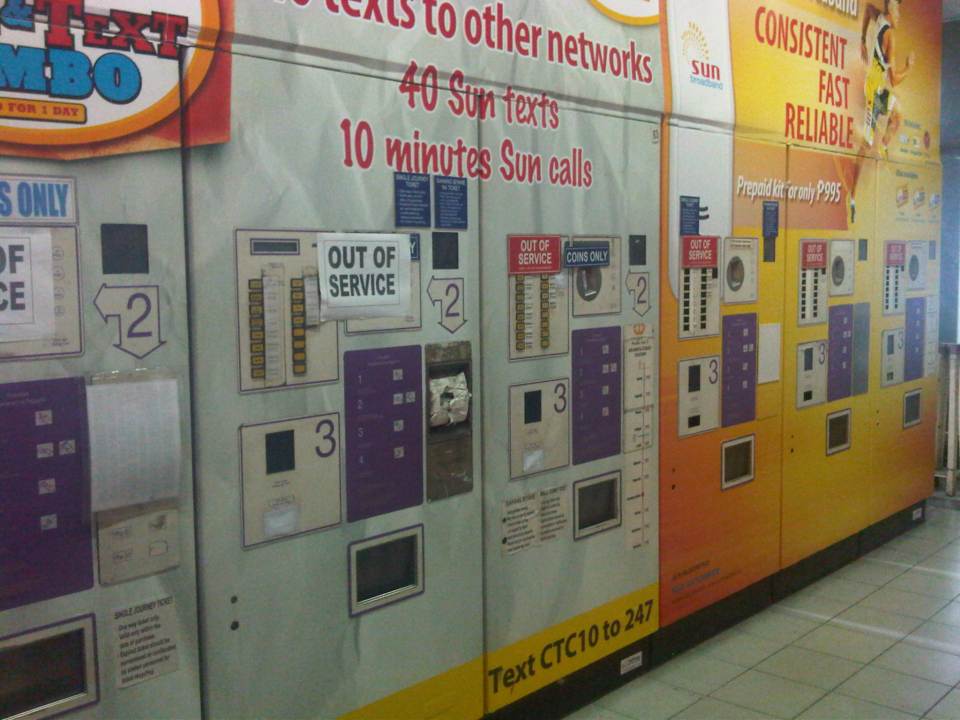 Defective – Most ticket machines were out of service. Those that weren’t marked as defective (just a few) had problems accepting coins. This issue regarding ticketing makes it inconvenient for most passengers to use the trains as they end of queuing along one or a few manned booths selling tickets at the stations. One would think that with so many options now available for fare collection (tickets, passes, cards, etc.) and the LRT’s already in operation for so many years that authorities would have already had a more efficient system in place for fare collection.
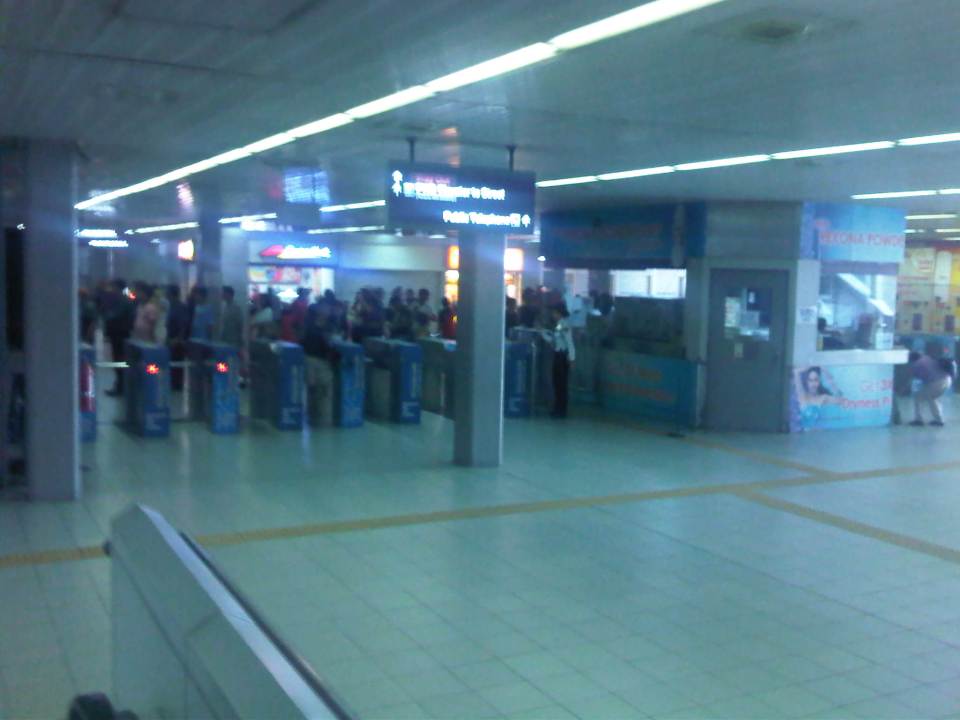 Turnstiles – there are enough turnstiles at the stations (in this case Cubao) but the queuing problem is not here but at the ticketing stage of the journey. Of course, there are also queues due to the security checks at the station but these are usually quicker compared to the time it takes for people to purchase tickets.
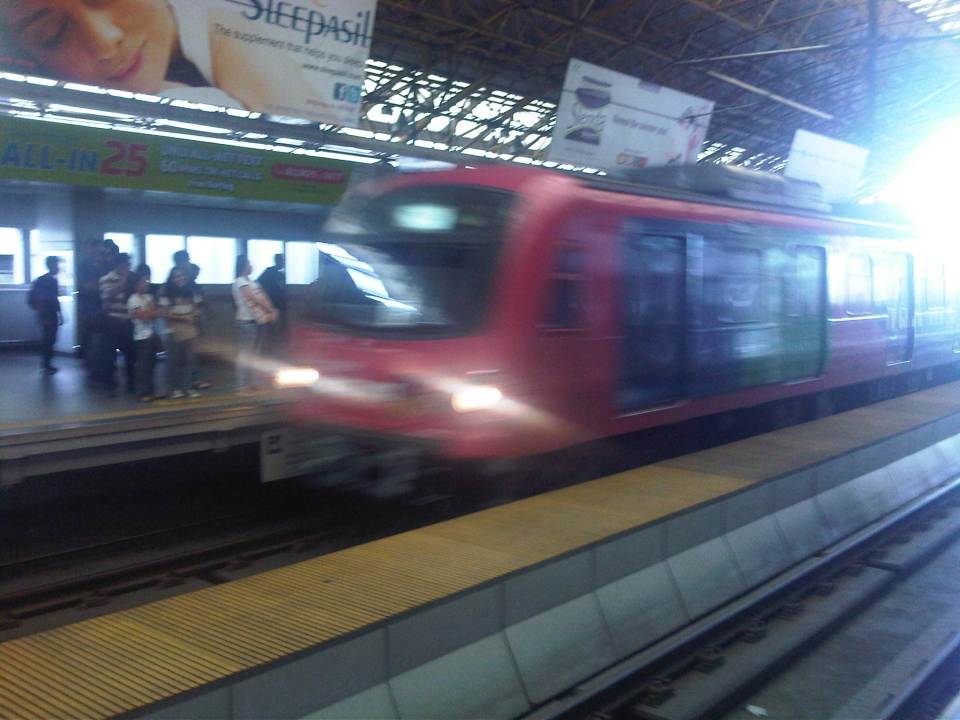 Westbound arrival – a train bound for Recto arrives at the opposite platform at Cubao Station.
 Departures – a train bound for Manila leaves Cubao Station while passengers form queues along the platform for trains bound for Pasig.
I tried to get photos of the connection between the Cubao Station and Gateway Mall but the pictures didn’t come out right (Note: I usually only use my cell phone to take quick photos.). The same was the fate of photos I tried to take between Katipunan Station (Exit at St. Bridget’s) and the UP-Katipunan jeepney terminal. In the latter case, the rains and the crown prevented me from taking photos. I will try to get better ones to post next time and perhaps that post will focus on the conditions around stations including their connectivity to other modes of transport (e.g., convenience of transfers) and other aspects such as walkability.
–
Sunduan at NAIA Terminal 1
Manila’s Ninoy Aquino International Terminal 1 has been named as the worst airport in Asia by a website that seems more focused on “sleeping in airports.” The same site ranks Changi, Incheon and Hong Kong as the top airports in the region and mentions a couple more in Southeast Asia in the top ten. Surprising for me is the low ranking for Changi’s Budget Terminal. One can practically sleep on the floor there as it is sparkling clean! But of course, I won’t encourage it as what’s not visible to thehuman eye might probably make one sick especially in places like airports where you have people from all over using the facilities. In fairness to the same site, it differentiates NAIA’s old Terminal 1 from the newer Terminals 2 and 3, which received fair assessments but again especially for sleeping. I think the value of such independent assessments is that they are very objective and given the power of social media, it informs people about the quality of facilities and challenge those in-charge to do better.
So to continue with my features on NAIA Terminal 1, I am featuring a few more photos from the perspective of someone waiting for or fetching a loved one, relative, friend or anyone arriving at the terminal from the building just across from the passengers’ arrival area.
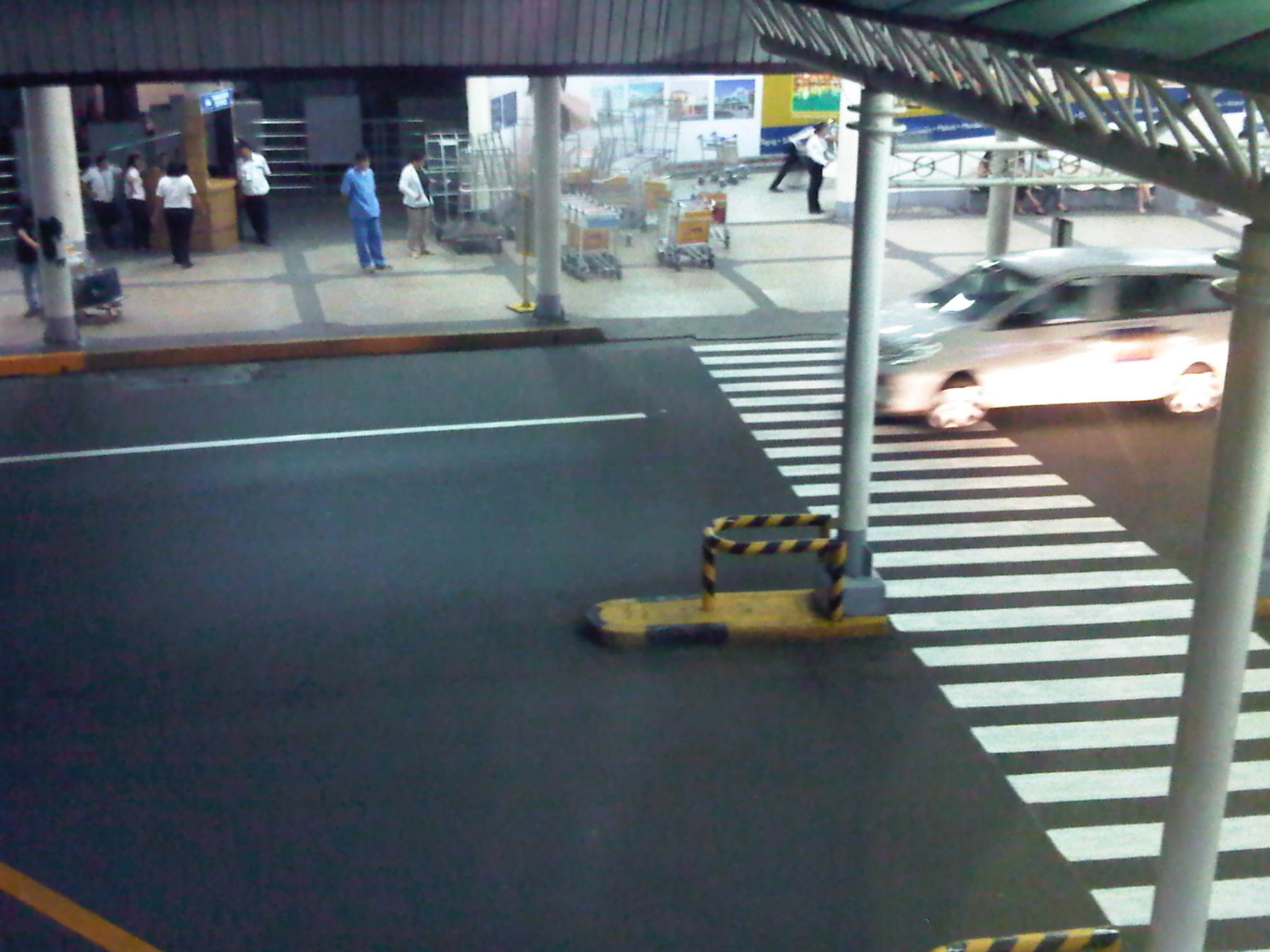 Before the mayhem – prior to the arrival of aircraft and exiting passengers, the area appears like a picture of calm with few people including airport staff.
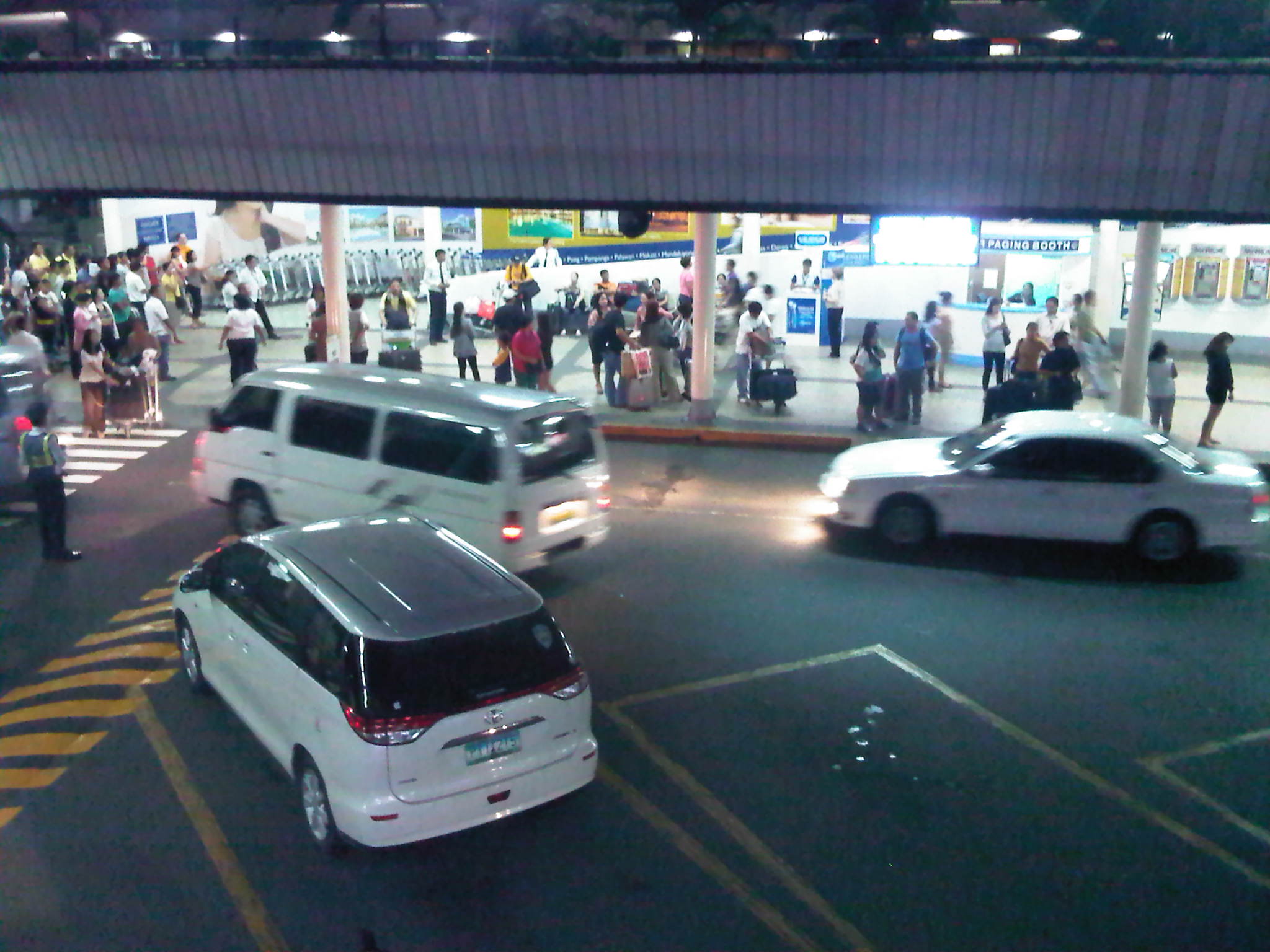 Here they come – passengers start accumulating at the area along with vehicles whose drivers have probably been notified of the arrivals
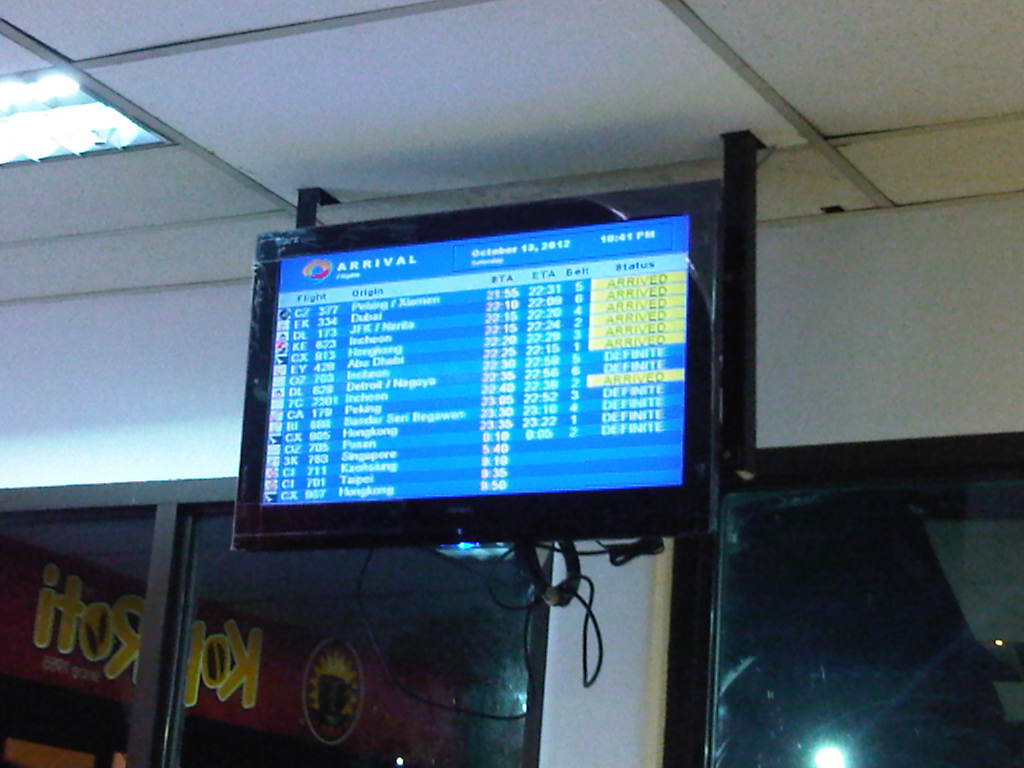 Information screen – there are several screens at the waiting area for people to check the aircraft arrivals
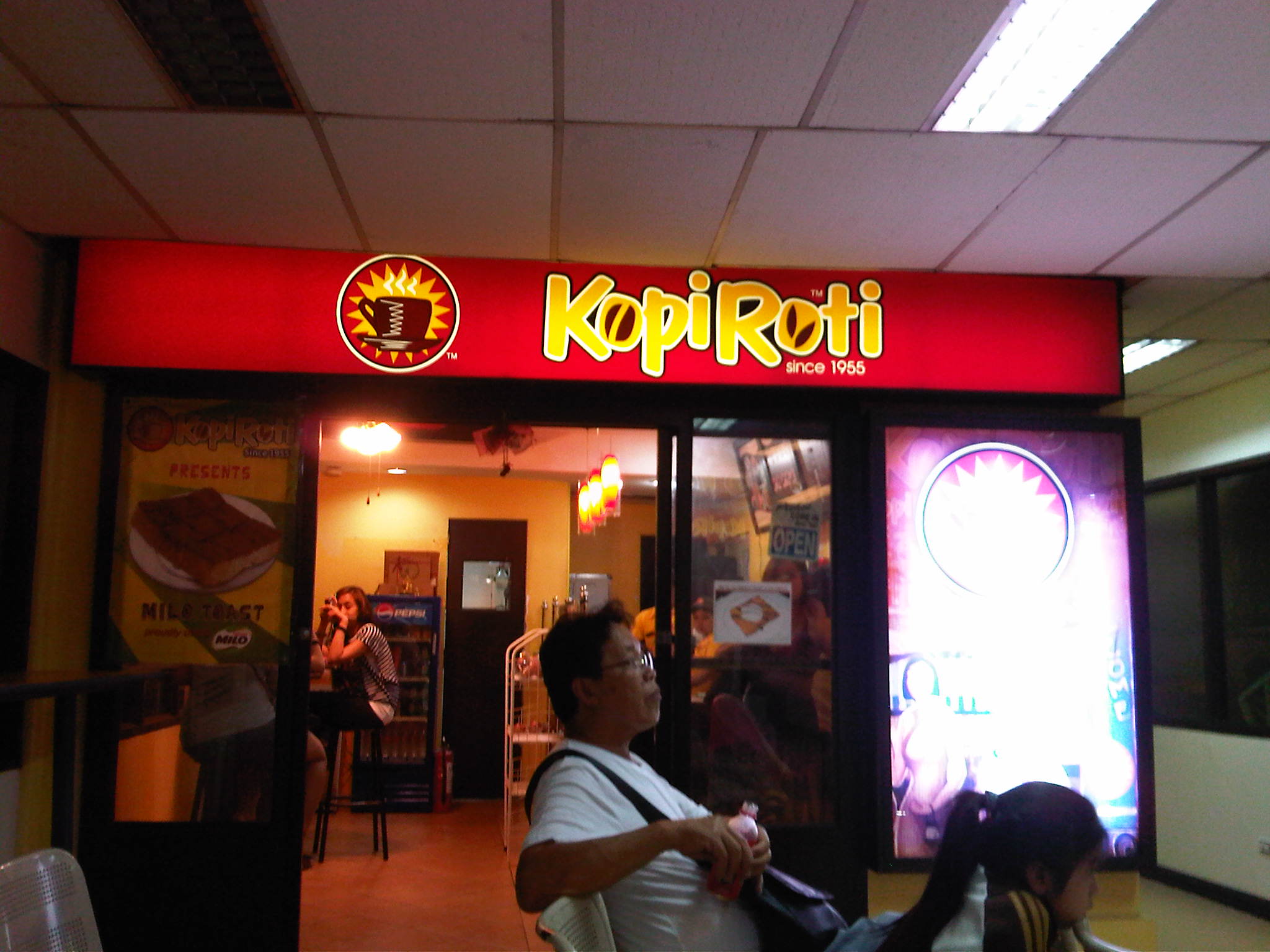 Refreshments – there are 3 concessionaires inside the building, all on the second floor, including one generic food stall and this one featured in the photo that’s quite popular for its coffee buns and kaya toast.
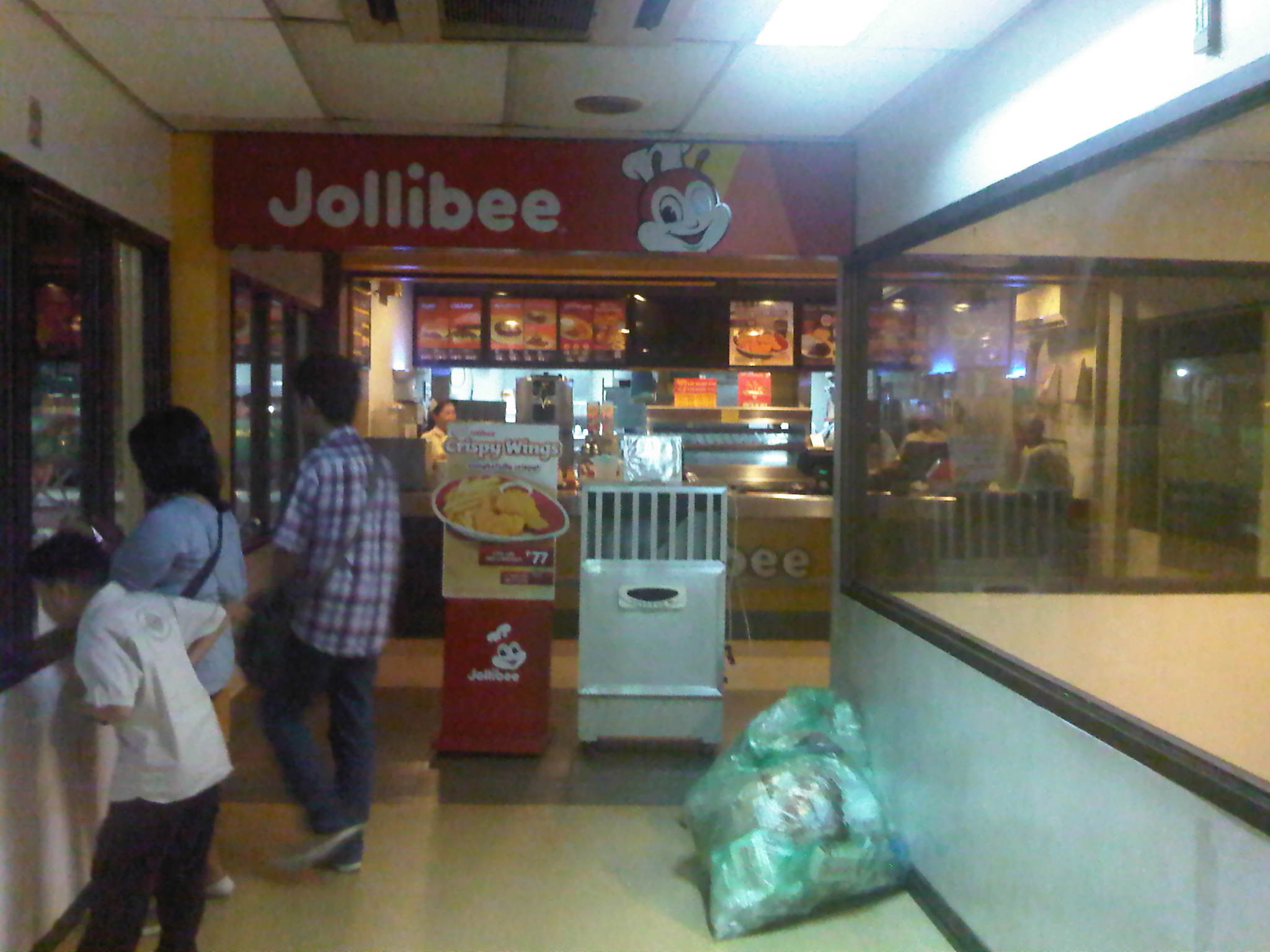 Fast food – the other concessionaire is a branch of the most popular and largest fast food chain in the Philippines
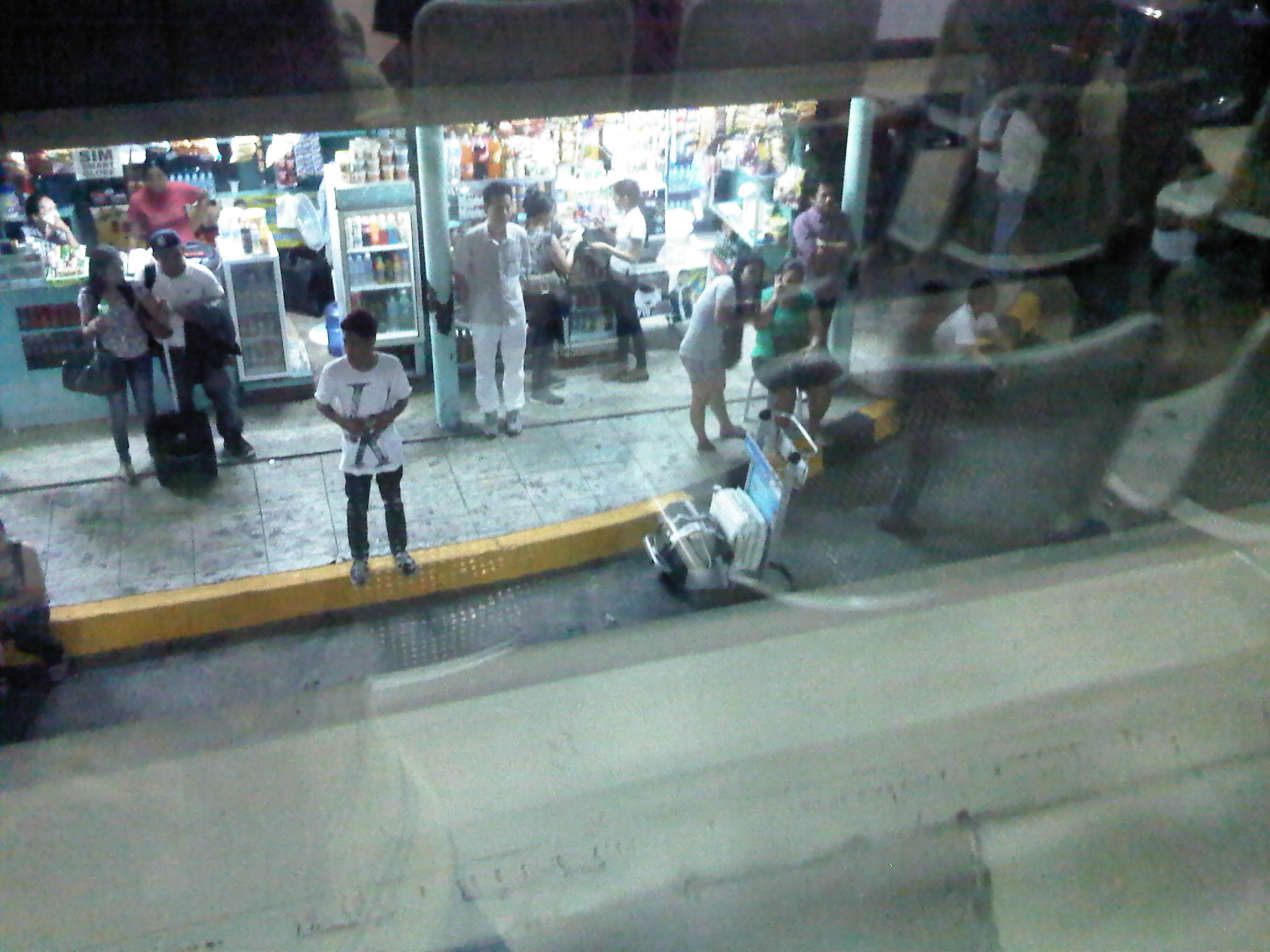 Kiosks and stalls – at the back of the building are kiosks and stores spread out in the open parking lot for people who’d rather wait in these areas. One will find here whole families and other groups loitering about or even picnicking as they wait for arriving passengers.
 Comfortable – the second level of the building is air-conditioned unlike the first level and so many people choose to lounge around the area. Most seats, however, are immediately taken and so a lot of people end up standing while watching out for people they’re fetching.
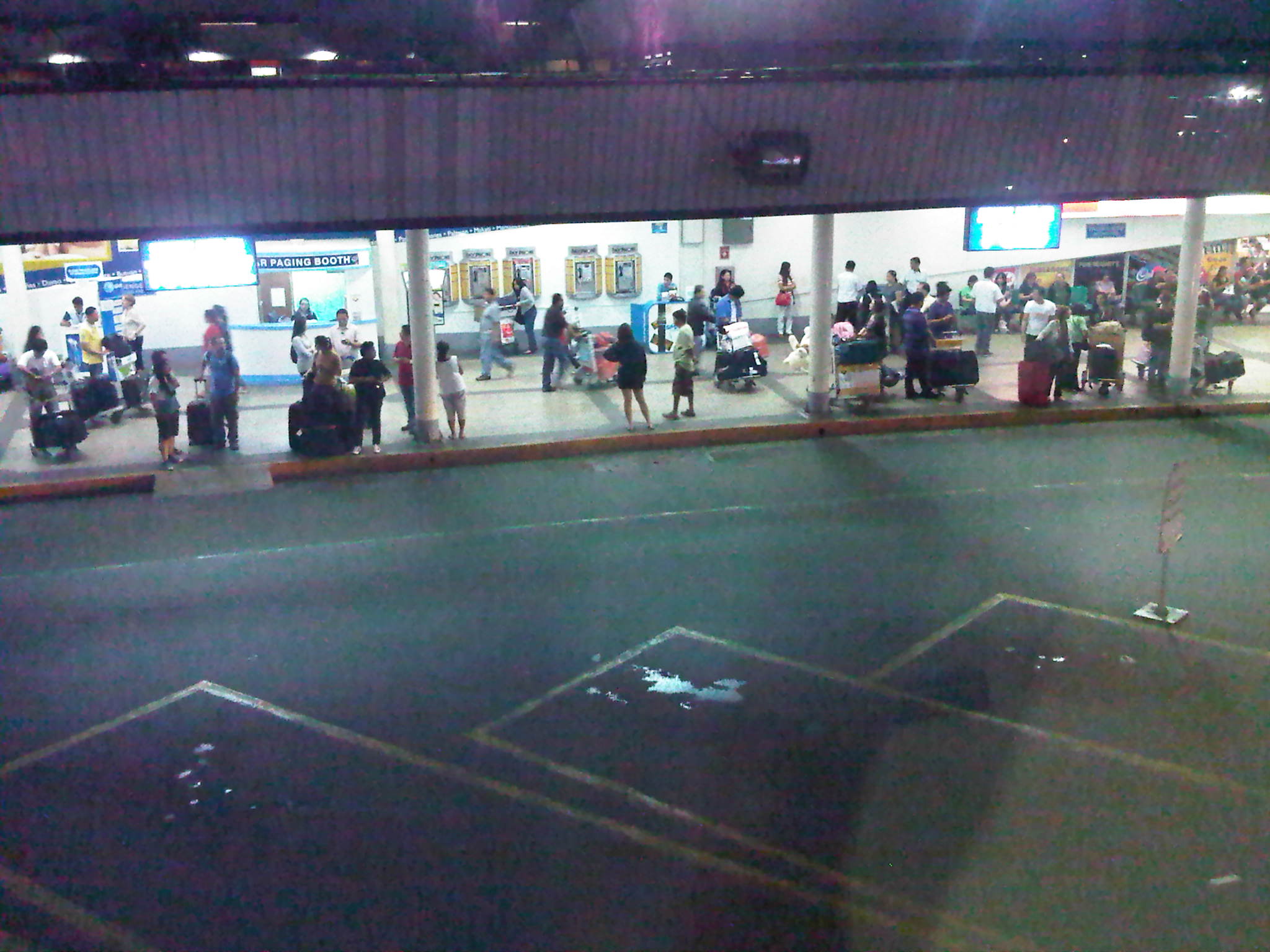 Waiting game – arrivals waiting for their sundo (people fetching them).
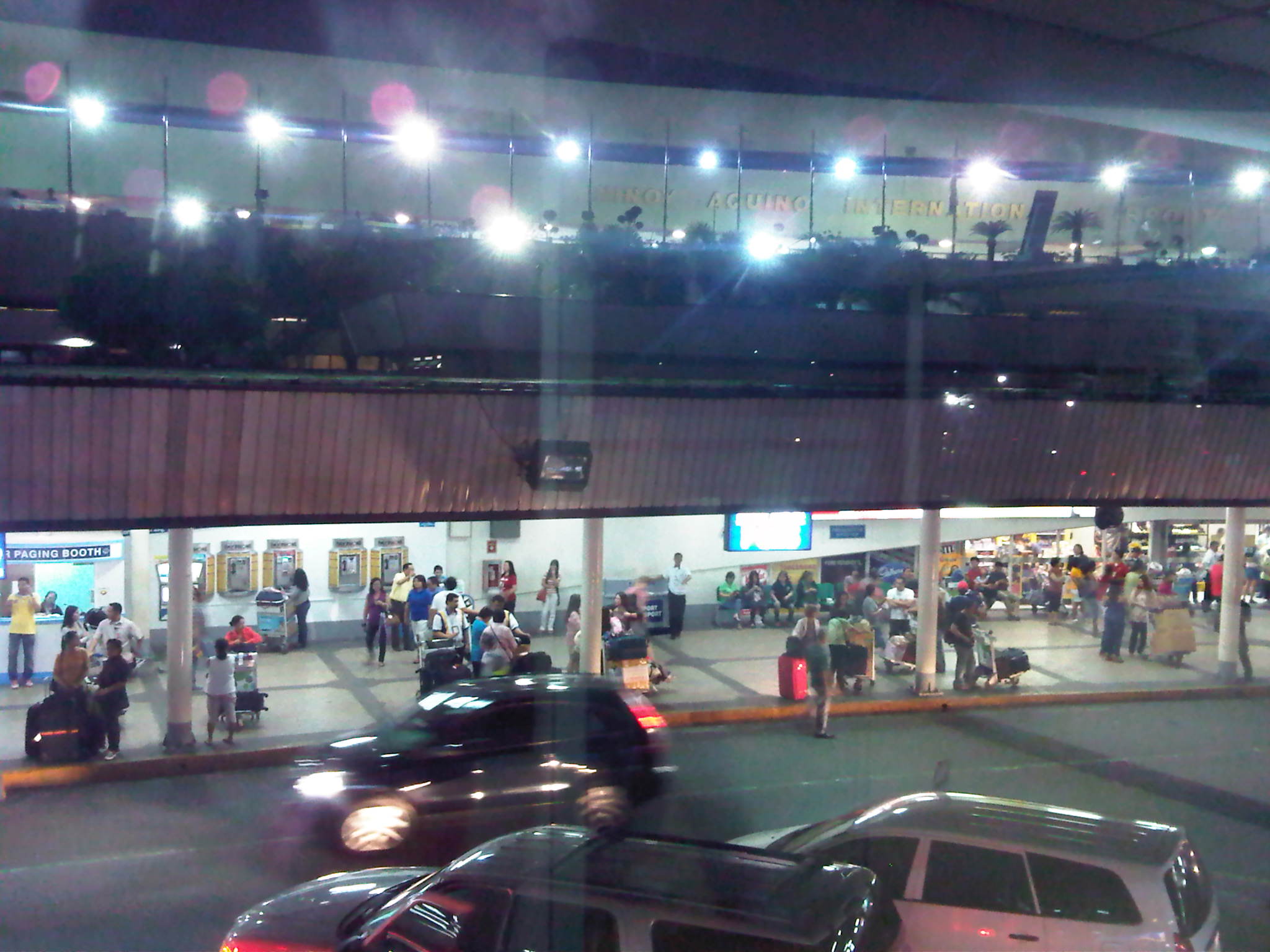 Another level – there is actually another driveway atop the one seen in the photo. The lights at the top of the photo are lined up along the driveway for the main terminal building, which is reserved for VIPs and others extended the privilege of using the driveway. All other passengers have to cross from the main terminal to descend towards the area shown and the lower driveway that’s level with the open parking lot.
 Congestion and mayhem – the arrival of several aircraft particularly from major origins like Hong Kong, Dubai and the US (via Narita and Nagoya) meant that the area would be very crowded with passengers, well-wishers and vehicles. People and drivers tend to disregard personnel trying to manage the people crossing between the terminal and the waiting area, and traffic along the driveway.
 Crowded house – the ground floor area of the building where passengers an well-wishers generally meet up is a very crowded area and airport personnel often struggle in controlling people from crossing over to the arrival area to personally fetch passengers, often with cause due to the amount of luggage (e.g., balikbayan boxes) passengers tend to bring with them when traveling to Manila.
NAIA Terminal 1 serves most international flights coming in and out of Manila that are not Philippine Airlines, Cebu Pacific or ANA (the only other foreign carrier using the larger and more modern Terminal 3). It definitely has seen better days and its current capacity and facilities are not suitable for the number of flights that it serves given that it wasn’t adequate from the time it started operation in the early 1980’s. There is the welcome news that T1 would be renovated and that a large reputable firm has been hired to do the unenviable task of improving this gateway. We can only hope that the project proceeds with little delay so that travelers would be able to avail of better services and perhaps allow this terminal to shed its tag of being the worst airport in Asia.
–
Take public transport…it’s good for you!
An article came out of the Philippine Daily Inquirer where a contributor wrote about her experience riding a jeepney ride from Ateneo to UP Diliman and then back after having lunch and some fishballs somewhere at the Shopping Center (more likely at the Coop rather than at the SC). The link to the article may be found below:
After being shared on social media like Facebook, the author and her article received a lot of flak from people whom I think didn’t quite get the lesson of the story – something deeper than how the writer related her story of her commute. Some found it amusing but others focused (more like ridiculed) on the Arneow aspect of the article. There is even a parody of the article where a blogger wrote about his “experience” riding an MRT train. I won’t post that here despite it being humorous as it is irrelevant to the points I will highlight in this post.
I think we should encourage more people who probably mainly travel by car and have little experience taking public transport to try taking a jeepney or bus ride. This experience (an honest one I believe for the writer) will be something that hopefully changes their perspective of transport (and life in general). Who knows? The person might one day be in a position to make a significant impact on our transport system. And we do need decision-makers who take public transport rather than private cars if only to have an appreciation of how it is for most other people who take public transport in this country.
I am reminded of experiences commuting in other countries where they have good public transport and people from most income levels take these everyday. Cars are used mostly during the weekends or when it is really necessary (e.g., emergencies, fetching someone at the airport, etc.). Snooty as some may seem, people have to be educated and have the experience of riding public transport in order to enlist them among the many clamoring for better transport services and facilities. Who knows that person might be able to influence well-placed people to make the decisions that will lead to the improvement we seek for public transportation. If you don’t use or haven’t used public transport, you likely to be detached from the reality that most other people encounter everyday as they travel between their homes and the workplaces or schools.
I reproduce the article from the Inquirer below for reference now and the future:
Lessons from a jeepney ride
Nicole Ki
Philippine Daily Inquirer, 12:43 am | Friday, September 7th, 2012It was lunchtime. My blocmate, who so badly wanted to go to the University of the Philippines (UP) for lunch, suggested that we go.
We were walking in the heat of the sun, and it had just started to get even warmer when we finally reached the underpass. Many jeepneys were parked, as barkers tried to lure passengers to ride.
I went through the motion with my blockmates and did whatever else they did throughout the commute; I was allowed to take public transportation only in college. I sat quietly, recalling how much I hated the thought of riding a jeepney, but how real it was that I was actually in one.
It didn’t turn out so bad; I didn’t experience the one-foot-in-and-the-jeepney-suddenly-jerks-pulling-you-in, like I did when I was a kid. That was my first jeepney ride, by the way.
I thought all jeepney drivers were impatient, like in the first ride I had. I guess I was wrong.
The jeepney came to a stop; finally we were at UP.
A short walk brought us to its Shopping Center. It had all sorts of stuff—photocopying shops, computer shops, a clothing store, mini restaurants, a barber shop, a hair salon, even a Bayad Center and Western Union; everything you could possibly ever need for school and more.
It was amazing. I had wanted to stop to look in every store, but we had a little less than an hour, and we still didn’t have a place to eat.
We continued walking until we reached a cafeteria which served cheap home-cooked meals. We all ooh-ed and ahh-ed with each bite, not only because the food was good but also because food here was cheaper than at Ateneo. Even if we were already full, we had set our minds to try out the famous UP isaw, kwek-kwek and fish balls.
We stumbled upon a stall which offered only fish balls. It took some 15 minutes for the food lady to fry them. As we looked at our watches, we knew we weren’t going to make it on time.
We walked some more to the nearest waiting shed to hail a jeepney. With our consolatory fish balls in hand, we saw kwek-kwek—but too late.
I had not expected the ride back to go as smoothly as the ride to UP. First off, I wasn’t seated in the farthest end anymore, nearest the door; I was nearest the jeepney driver. Just the thought of how I’d get off the jeepney at our stop made me cringe.
With all this negativity, I was genuinely surprised at how interesting my seat turned out to be! This was where the action happened, and I’m so glad I got to be in it.
“Para po.”
“Bayad ho.”
“Senior.”
“Estudyante.”
New language
When I first heard the passengers say these lines, I was amazed. It sounded like a new language to me altogether. The words sounded sincere and friendly. And since I was seated just behind the jeepney driver, most of the payments coming from these seemingly interesting human beings were passed to me. It felt like I had a sudden connection with all the passengers. I was suddenly part of something. I was wide-eyed in wonder. I got my P8 out of my pocket; “Bayad ho,” I said.
“Para po. Sa may National,” I said to the driver.
“Excuse me, bababa lang po,” I said to the person beside me, as I wiggled out.
And as I stepped down the jeepney and my feet hit the ground, a sudden realization hit me. Both of the jeepney rides I had that day, I realized, were a lot like life.
Our first experiences may not always turn out to be so great, like my first jeepney ride. We start just wanting to only try out things, and to test the ground, but as if with a sudden jerk, we’re pushed into a world we don’t know about yet. This would leave an unwelcome mark in our hearts, plus a bad memory, and this is usually the reason we stop and don’t give it another chance; we’re afraid to fail again.
But sometimes, life leaves us no choice; like this jeepney ride I was forced to take. I had unintentionally given public transportation another chance.
So if you tried something new for the first time and it didn’t turn out so well, try again. Don’t be like me, who had to wait for about 10 years just to be able to appreciate something. Who knows? It might be the most wonderful thing to ever happen to you.
It’s interesting how two simple jeepney rides can change your outlook in life. And guess what? I can honestly say I enjoyed them.
–
Some thoughts on transport and traffic while commuting between Cainta and Antipolo
Commuting from the Ortigas (Cainta) end of Imelda Ave. to its other end at Marcos Highway (near where Pasig, Marikina, Cainta and Antipolo meet), one should be able to observe and make a quick assessment of the positives and negatives of our local transport system. While there are more negatives at Cainta Junction and along Imelda Avenue, Marcos Highway definitely has improved particularly in terms of walkability. It is a commute that I have taken so many times since my childhood days and I can only now remember times when one could walk safely from one end to the other when there were far less vehicles than the volume that flows along Imelda Ave. these days.
Junction is still quite the mess despite some road widening at the intersection owing to various factors including the fact that the intersection simply cannot handle the volume of vehicles using it even after the elimination of some turning movements from Ortigas Ave. in favor of U-turns particularly for traffic coming from the eastbound side of Ortigas. It seems the traffic signal settings can no longer handle peak period traffic and manual traffic management probably aggravates the situation especially when enforcers employ the buhos technique of trying to dissipate as much of the queued vehicles per approach or movement. The latter technique does not take into consideration that the longer a movement or group of movements are allowed to move, there are corresponding build-ups in traffic along all other approaches. It is a vicious cycle (pun intended) that is supposed to be addressed by an optimally times signal system. Saturated conditions, though, are inevitable due to the sheer volume of vehicles using the intersection given that Junction is a catchment for vehicles from Rizal Province that ultimately uses Ortigas Ave. to head into Metro Manila in the mornings. The reverse is true in the afternoon to evening periods.
Imelda Avenue, which was also known for a time as Francisco Felix Ave., is plagued congestion due to notoriously bad pavement conditions, so many median openings, and high vehicle trip generation rates from the many residential subdivisions or village along the road. The pavement conditions are due mainly to damage brought about by trucks and, during the wet season, frequent flooding along many sections of the avenue. Bad pavement conditions and flooded streets significantly slow down traffic as Imelda Ave only has two lanes along each direction and is divided by a narrow median island that’s just enough for a few plant boxes and lamp posts.
There are mostly middle class subdivisions including the large Vista Verde, Village East, Karangalan, and Pasig and Cainta Green Parks along the road. There is also a DMCI medium rise development has its main access road also connecting to Imelda Ave. These villages generate much vehicle traffic and each have their own median openings that practically function as intersections along the entire stretch of the avenue. These openings create a lot of conflict between through traffic and vehicles entering and exiting the villages, especially those taking left turns to or from their gates.
While there are commercial establishments along the avenue, most were small and traffic generation characteristics were not so significant as to cause severe congestion. The first major generator in the middle of the avenue was a branch of the membership-concept Makro supermarket cum depot. Makro generated significant traffic but did not cause much congestion along the stretch in front of the Village East gate. It was eventually acquired by commercial giant SM and the branch is now an SM Supercenter that seems to be generating much more traffic than Makro did at its peak. While traffic studies are usually the norm before such developments are constructed given the trips attracted by SM, the congestion experienced along Imelda Ave has been reported to be generally un-managed despite the need for more disciplined loading and unloading by public transport, pedestrian movements and vehicle entries and exits.
Jeepneys are the main public transport mode along Imelda Ave. although there are tricycles serving the various subdivisions that often not only cross the road but also travel along Imelda Ave. for short distances. I remember in the 1970’s and early 80’s that the tricycles used to be the primary mode of transport from Junction and the Cainta Public Market as Imelda was not yet connected to the still to be completed and unpaved Marcos Highway. There was even a Metro Manila Transit Corp. bus service (probably missionary route and with low frequency of service) along Imelda Ave. that turned around near Kasibulan Village, one of the first subdivisions in the area. Many jeepneys are noticeably the patok or popular type known for their loud stereos and reckless driving. Still, there are the smaller, older jeepneys whose route connects either ends of Imelda Avenue. Most patok jeepneys are from the many longer routes between Rizal towns and Cubao overlapping along Imelda Ave (e.g., Angono-Cubao, Antipolo-Cubao, Binangonan-Cubao, Taytay-Cubao, etc.).
–
School traffic impacts – issues along Ortigas Ave., Part 2
I had written recently about traffic congestion along Ortigas Avenue that is due mainly to traffic generated by a private school in the area. In the previous post, the photos only show vehicles parked on the sidewalks on either side of the road. They did not show the actual traffic congestion experience. The parked vehicles seem more incidental and indirect than concrete evidence of congestion brought about by school traffic generation though they are a definite manifestations of parking generation, which is directly related to traffic generation.
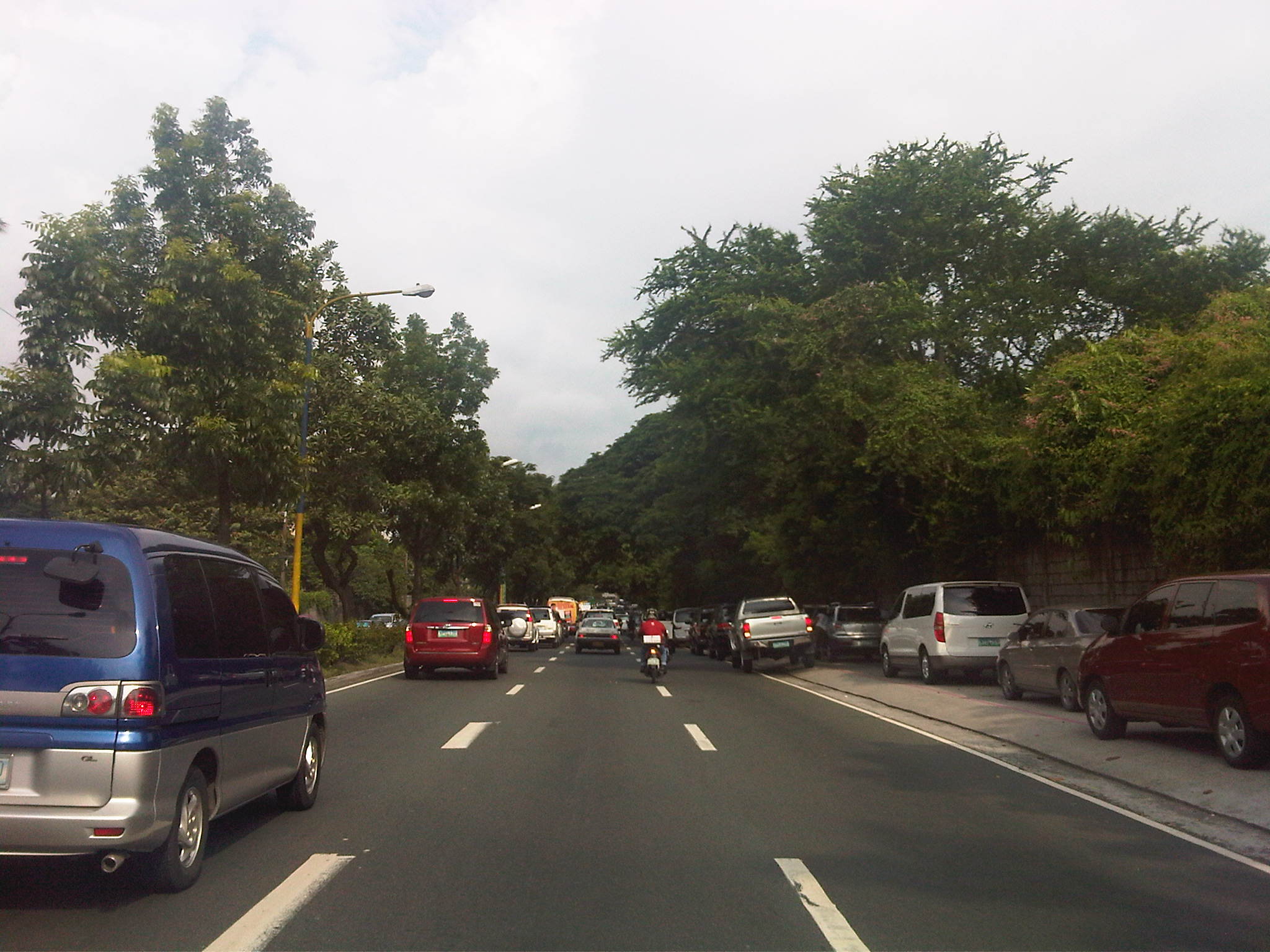 Parked vehicles on the sidewalk are seen as we approached the tail of a very slow moving platoon owing to the congestion generated by an exclusive school.
 Traffic jam with road capacity reduced by the parked and standing vehicles along the EDSA-bound side of Ortigas Ave. The trees are witnesses to the chronic traffic jams and help alleviate their impacts by absorbing emissions from the vehicle.
 Severe congestion as we approached the school – the overpass downstream in the photo is a reference for where the school is located
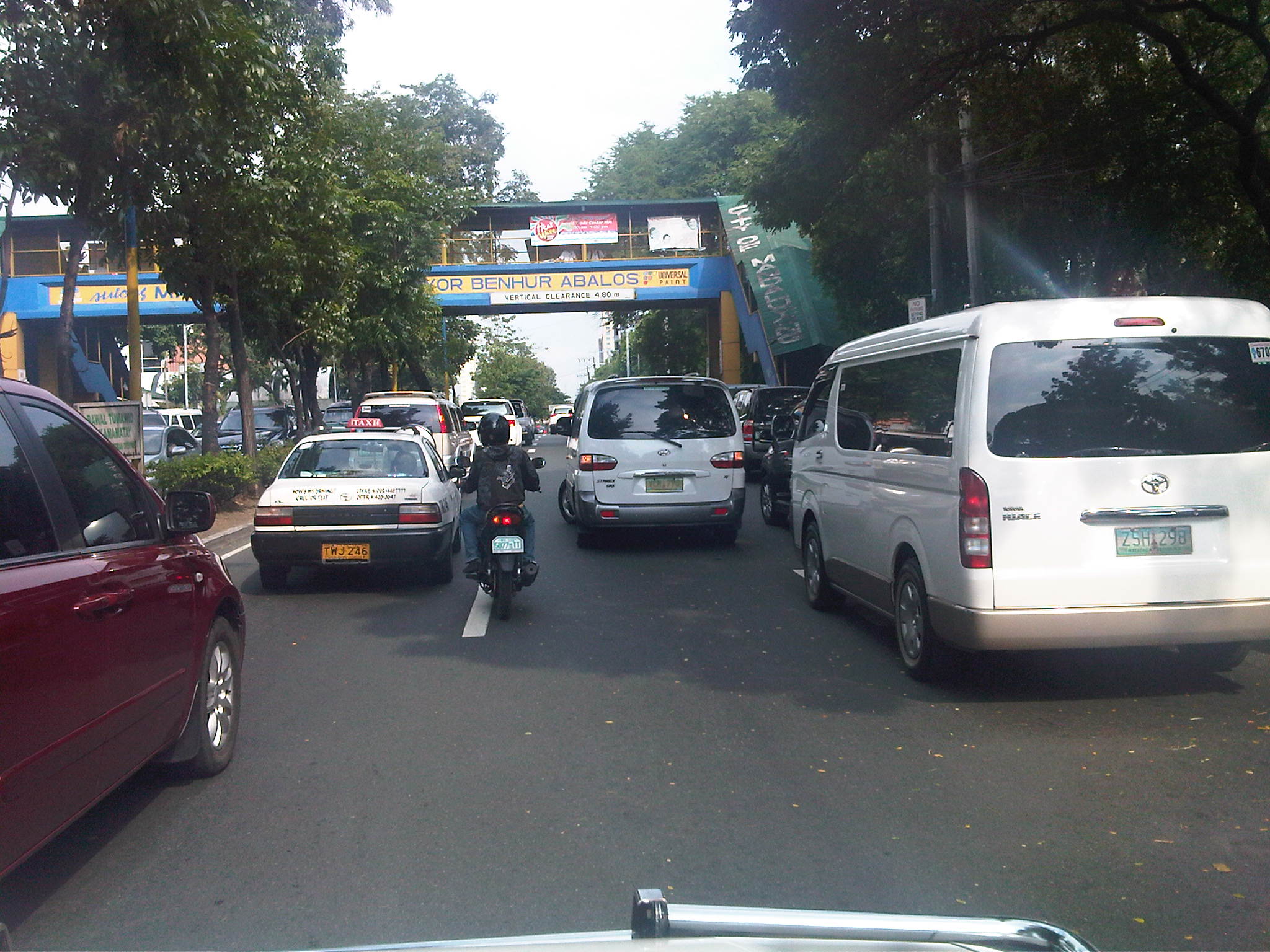 The overpass bears the name of the mayor of Mandaluyong City, where this school is located and which has jurisdiction, together with the MMDA, for traffic management in the area. At the time we passed the area though, there were no enforcers in the area despite the severe congestion. Is this because they gave the responsibility (or burden) of managing traffic to the school? Perhaps there was no need to post enforcers here as congestion is a regular thing and people seem to have been conditioned with the almost daily experience.
 The area at the foot of the pedestrian overpass actually functions as a pick-up and drop-off area for students of the school. As such, vehicles occupy not just the the sidewalk but also more than a lane of Ortigas Avenue. This effectively constricts traffic along this major road.
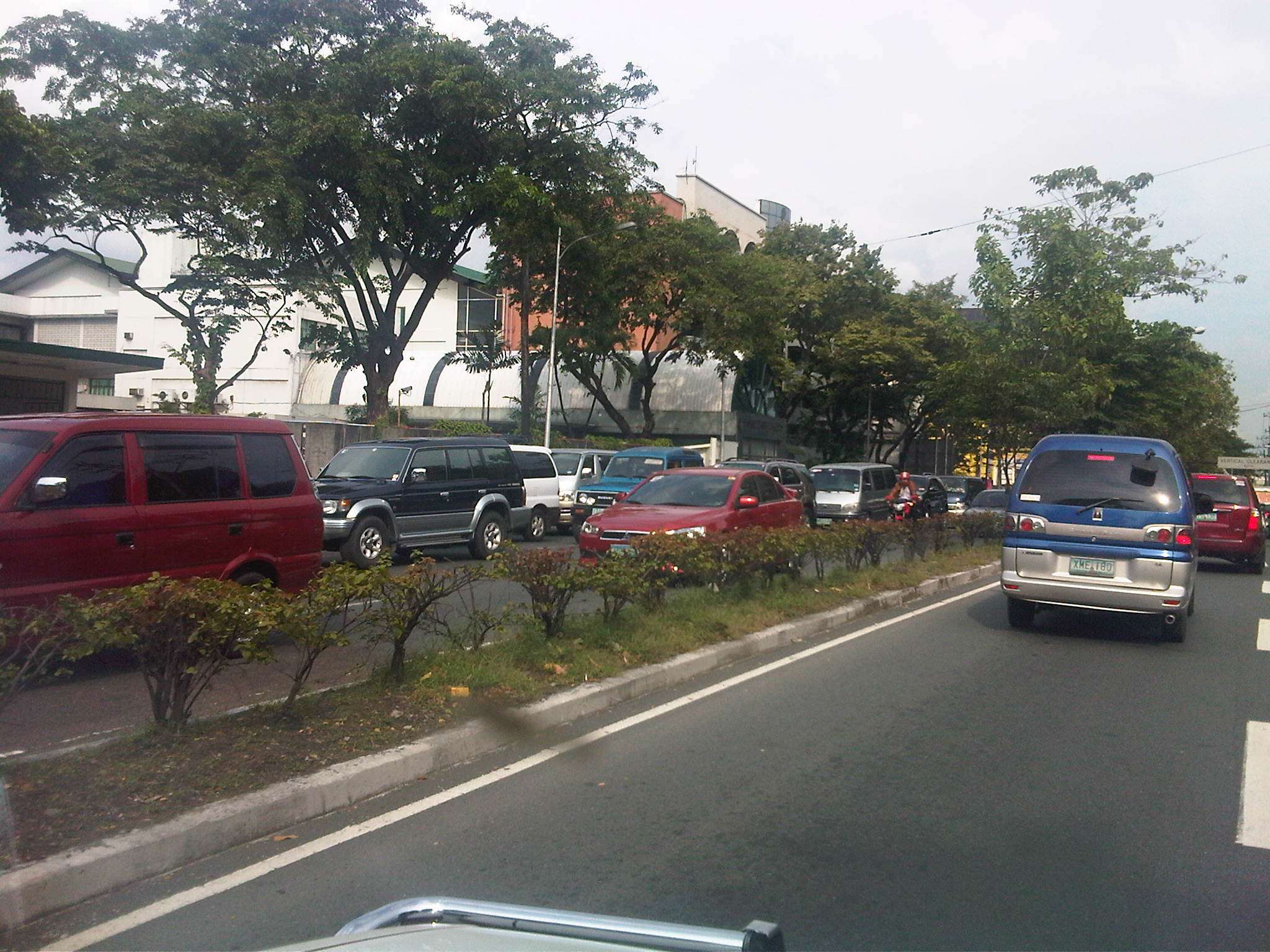 Traffic is slow along the San Juan-bound direction of Ortigas as vehicles waiting for their passengers (students of the school) are lined up and occupying the outermost and even the middle lane of the road.
 This queue is not entirely attributed to traffic generation by the school but is likely due to traffic management at the EDSA-Ortigas intersection, which is signalized. If the signal setting is not optimized or if the intersection is not cleared of straggler vehicles, traffic is backed up along all the approaches to the intersection. The tall building in the background hosts DOTC’s headquarters. I wonder if our officials are taking in the congestion that occurs almost daily (weekdays) and if they are even crosses their minds how to solve this problem and others like it around the country.
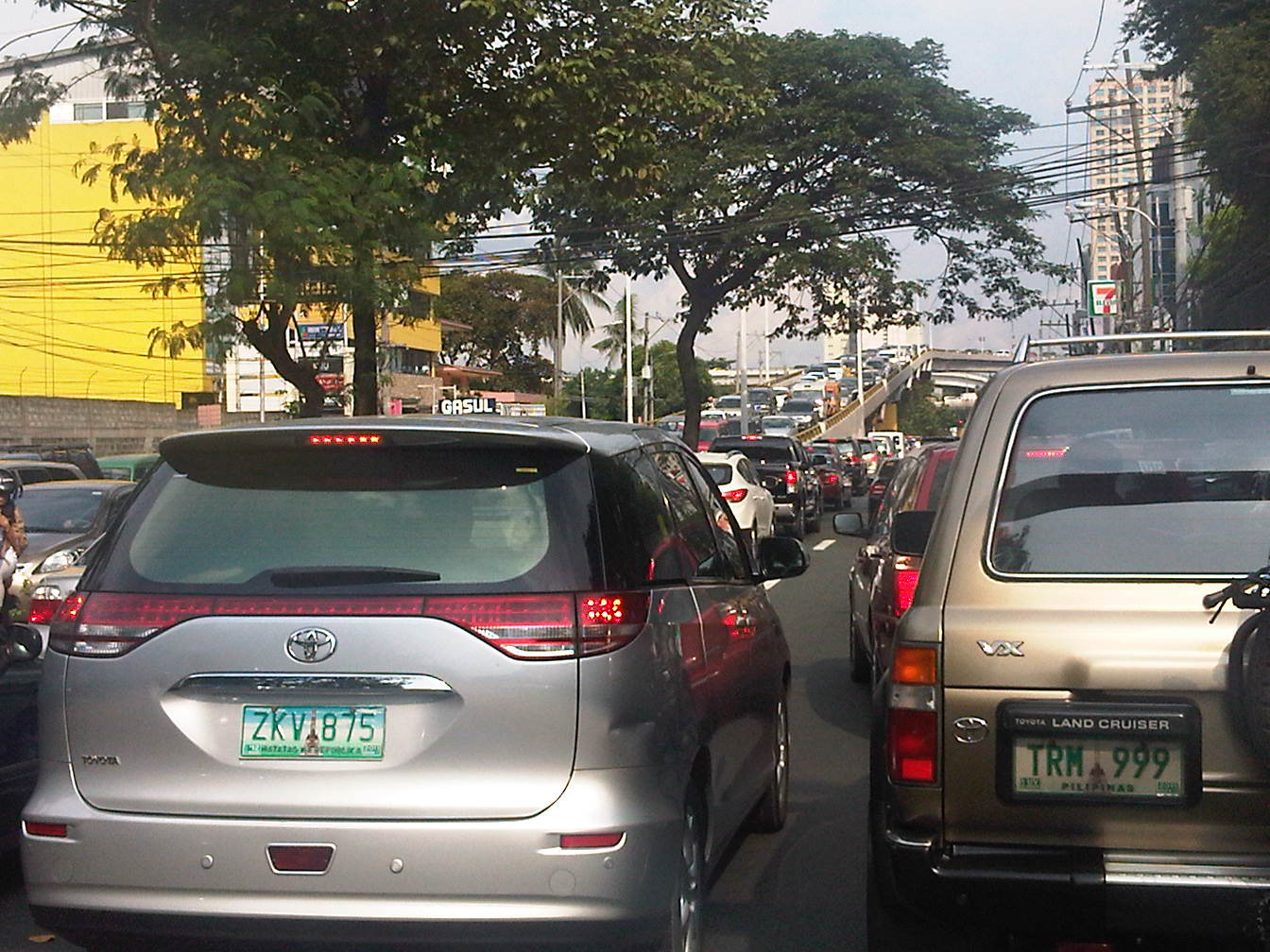 Proof that congestion is along both directions of Ortigas Ave. is seen in the middle of the photo where vehicles are also backed up along the overpass ramp coming from EDSA’s northbound side. For what it’s worth, the DOTC headquarters is right along this road at the building where the 7-Eleven (sign visible in the photo) is located.
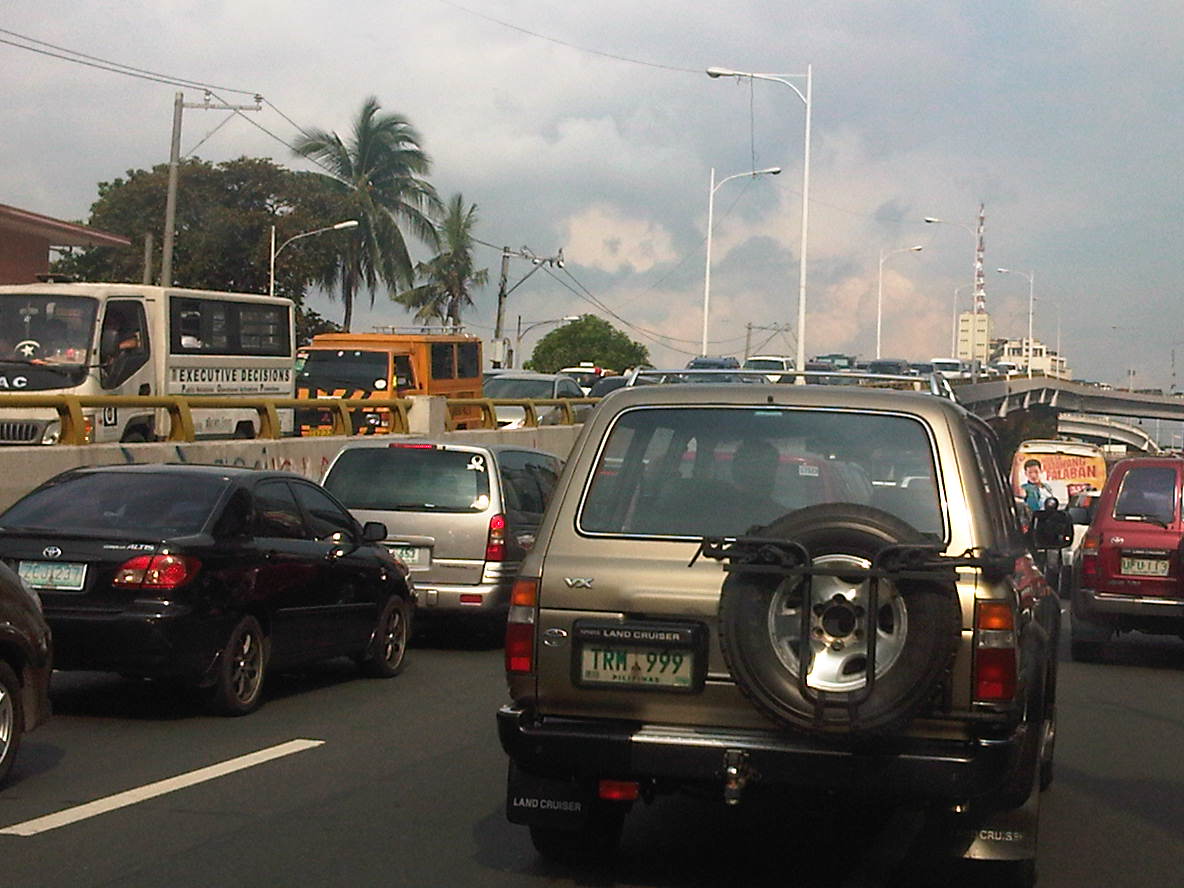 Another and even closer look of what is literally bumper-to-bumper traffic along both sides of Ortigas Avenue during the afternoon peak triggered by the exclusive school along its San Juan-bound side. Visible in the photo is the congestion along the overpass from EDSA.
–
Road right-of-way encroachments: Samar
Going around the country for projects, we always take a lot of photos about transportation including roads, bridges and transport modes. Thank goodness for digital cameras and cell phone cameras, and special mention to memory cards that have allowed us to take photos at will often only worrying about battery life. In a previous post, I wrote about encroachments to the RROW and featured some photos from field work we did in Palawan. This time, I was able to find a few choice photos taken from another project we did; this time in the island of Samar in the Eastern Visayas. In the following photos, one will see permanent structures already built along the roads – ones that are usually the most difficult to remove and the residents a challenge to be relocated.
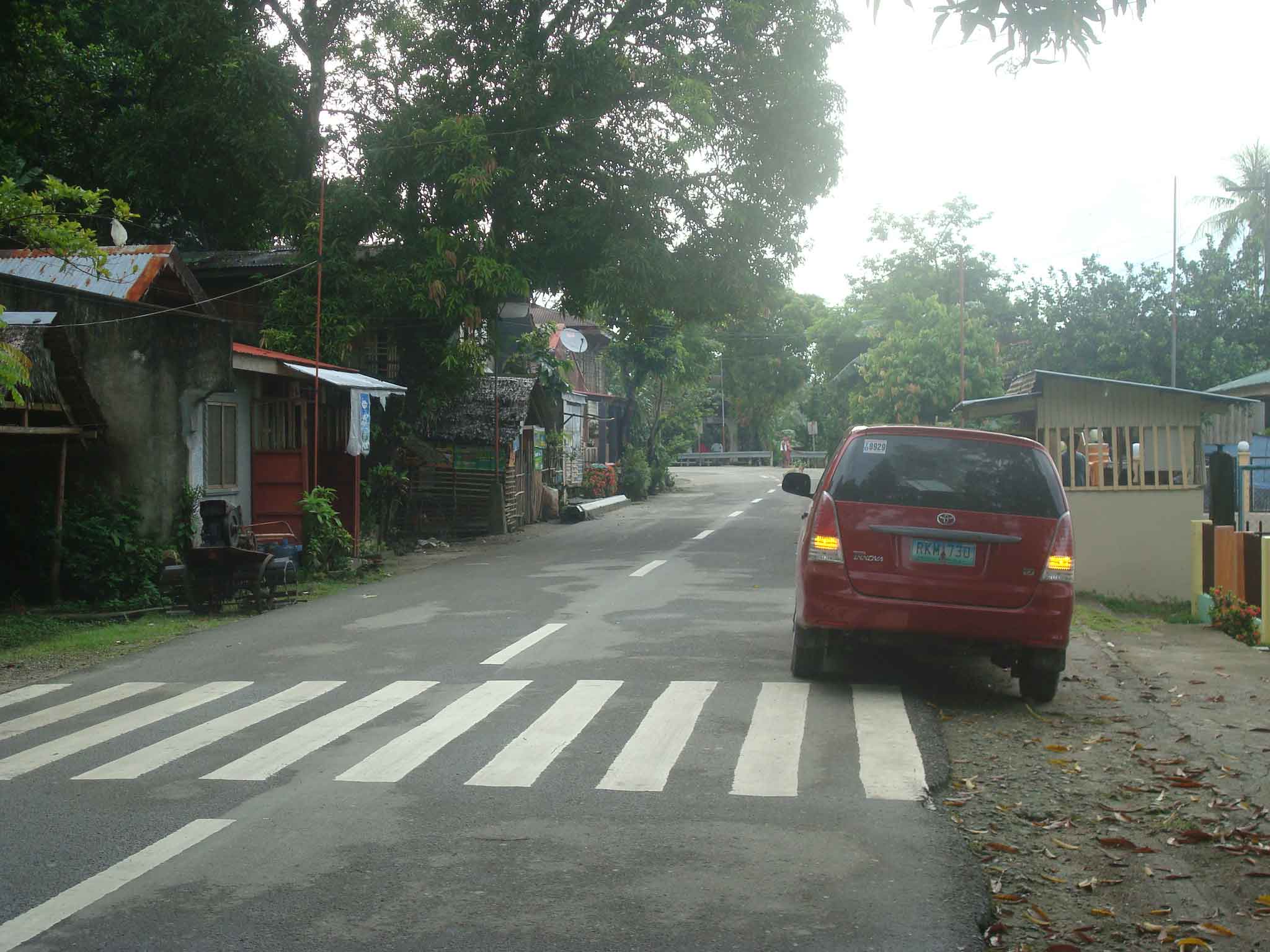 Houses built alongside the highway on what is supposed to be shoulder space. What looks like a booth in from tof the parked vehicle on the right is actually a guard post for the barangay. The barangay hall is located behind the fence visible at the right of the photo.
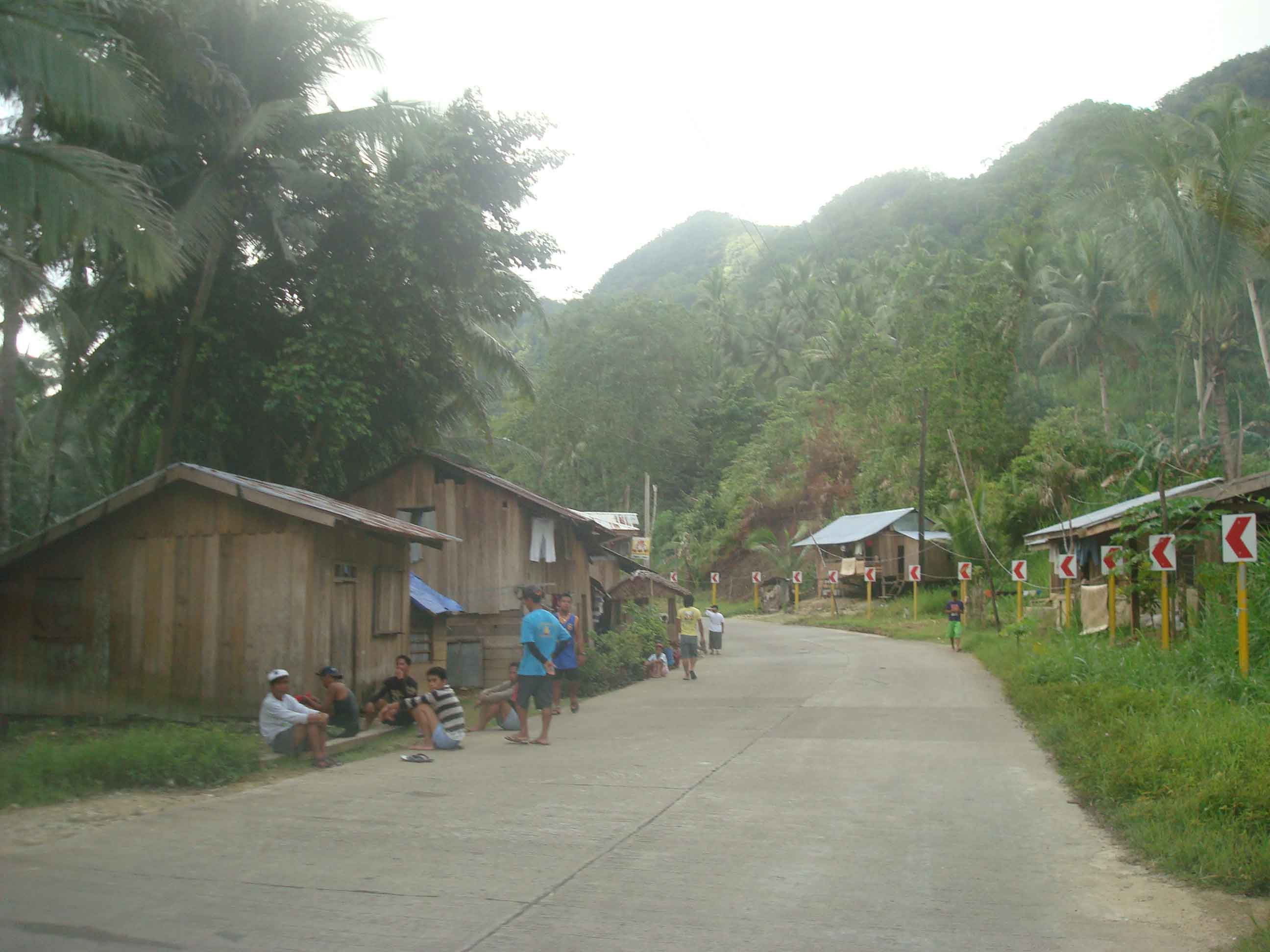 Makeshift houses along the secondary national road also on space usually where the shoulders are. Some houses are located at a hazardous part of the road (i.e., right at the curve and just behind the chevron signs).
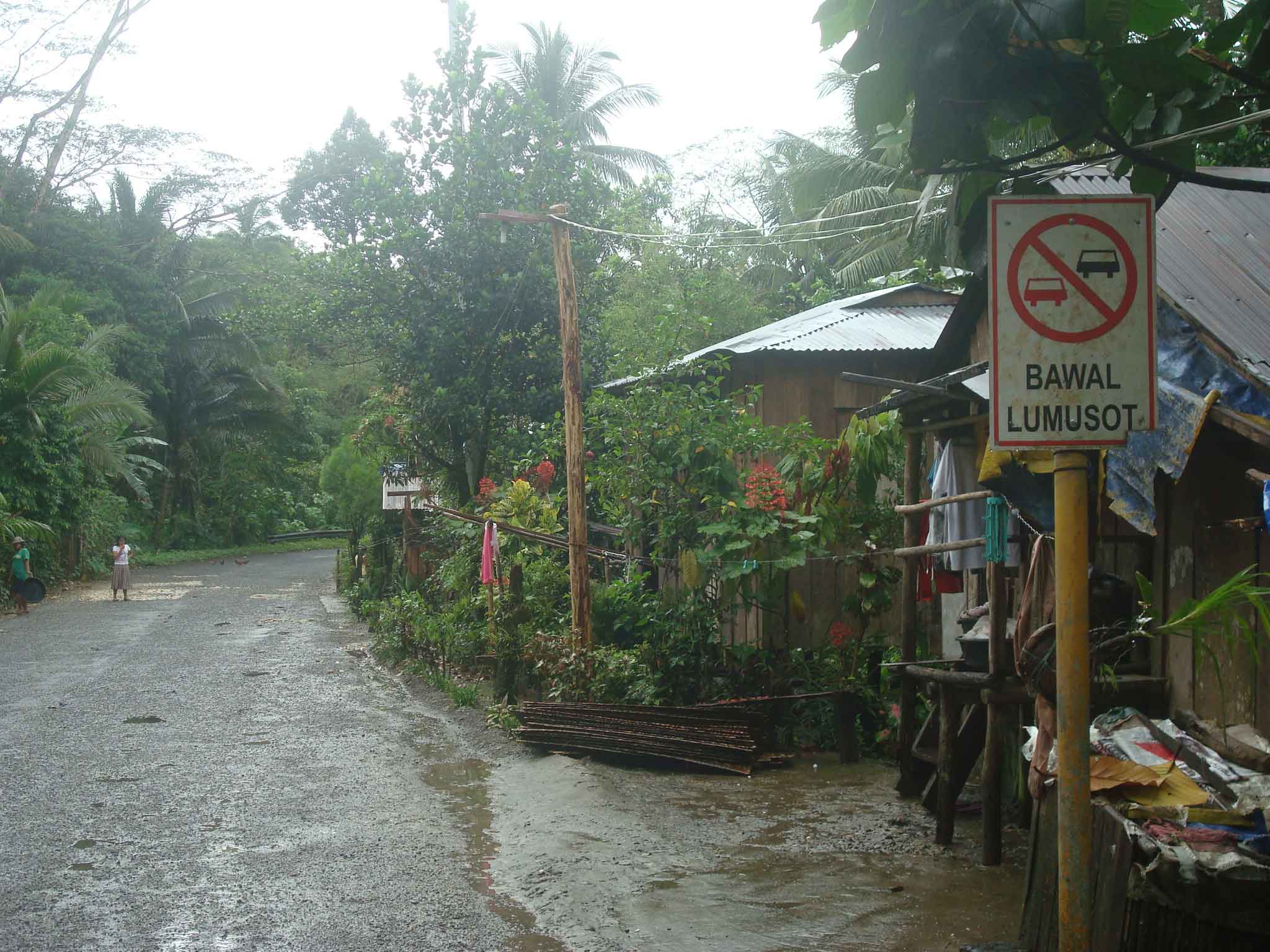 More houses with their fences encroaching on the RROW along a secondary national road in Eastern Samar – the sign on the right, while not exactly obstructed, will blend with the structures and will probably be unseen or unnoticed by motorists.
 Souvenir? – I have seen signs being stolen and displayed in some homes as trophies (actually an illegal act that can get one jailed and fined a hefty sum if caught by authorities). Some souvenirs are harder to take but can be integrated with the house interior or, in this case, as part of a store. Imagine knowing the exact location of a store in the area not through GPS but simply by knowing the exact kilometer post where the store was put up.
There are many other examples of RROW encroachments along other roads. These seem to be common along all types of highways where development along the roads are generally not regulated by local governments but present future problems when space is needed to widen roads to accommodate traffic. Is it an issue of cooperation between the DPWH and the LGUs (including the DILG)? Or is it mainly a local issue that is largely the responsibility of local authorities? Perhaps it is both and something that needs to be addressed to enhance road safety as well as to ensure that future headaches will be avoided when it is time to access the RROW.
–
Road right-of-way encroachments: Palawan
Encroachments to the road right of way (RROW) is quite common along many roads in the Philippines including national roads. While the DPWH has jurisdiction over the latter roads in as far as construction and maintenance is concerned, the agency does not have the resources to secure these roads. Such responsibility lies in the hands of local government units (LGUs), which are tasked to regulate land use at the local level ahead of the Housing and Land Use Regulatory Board (HLURB). Following are a few photos I took in one trip to Palawan where we did a few road safety audits of a national highway.
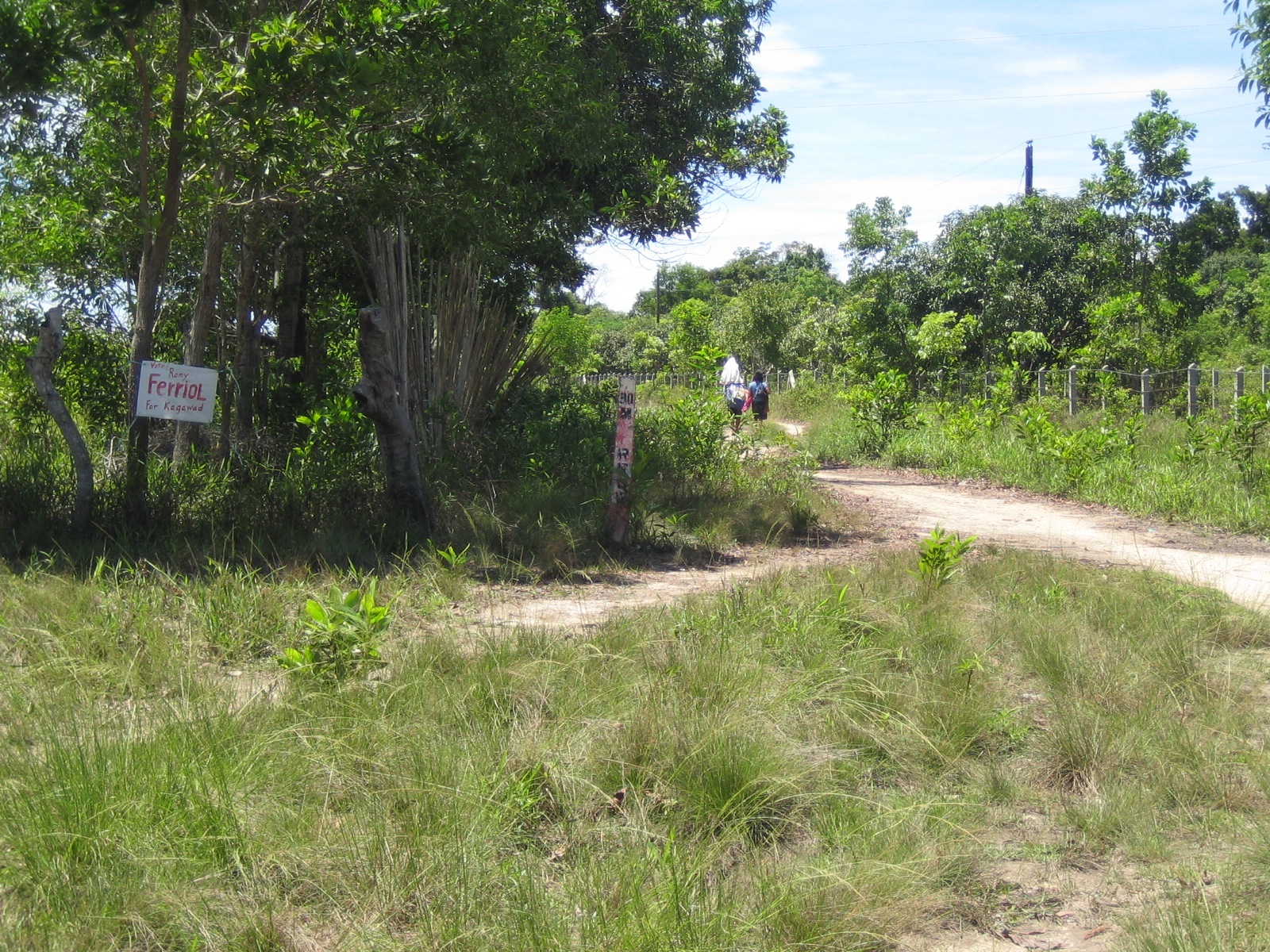 This RROW marker that doubles as a kilometer post along a highway in Palawan is located a few meters from the carriageway. While there are no developments or encroachments along this section, such markers could easily get lost.
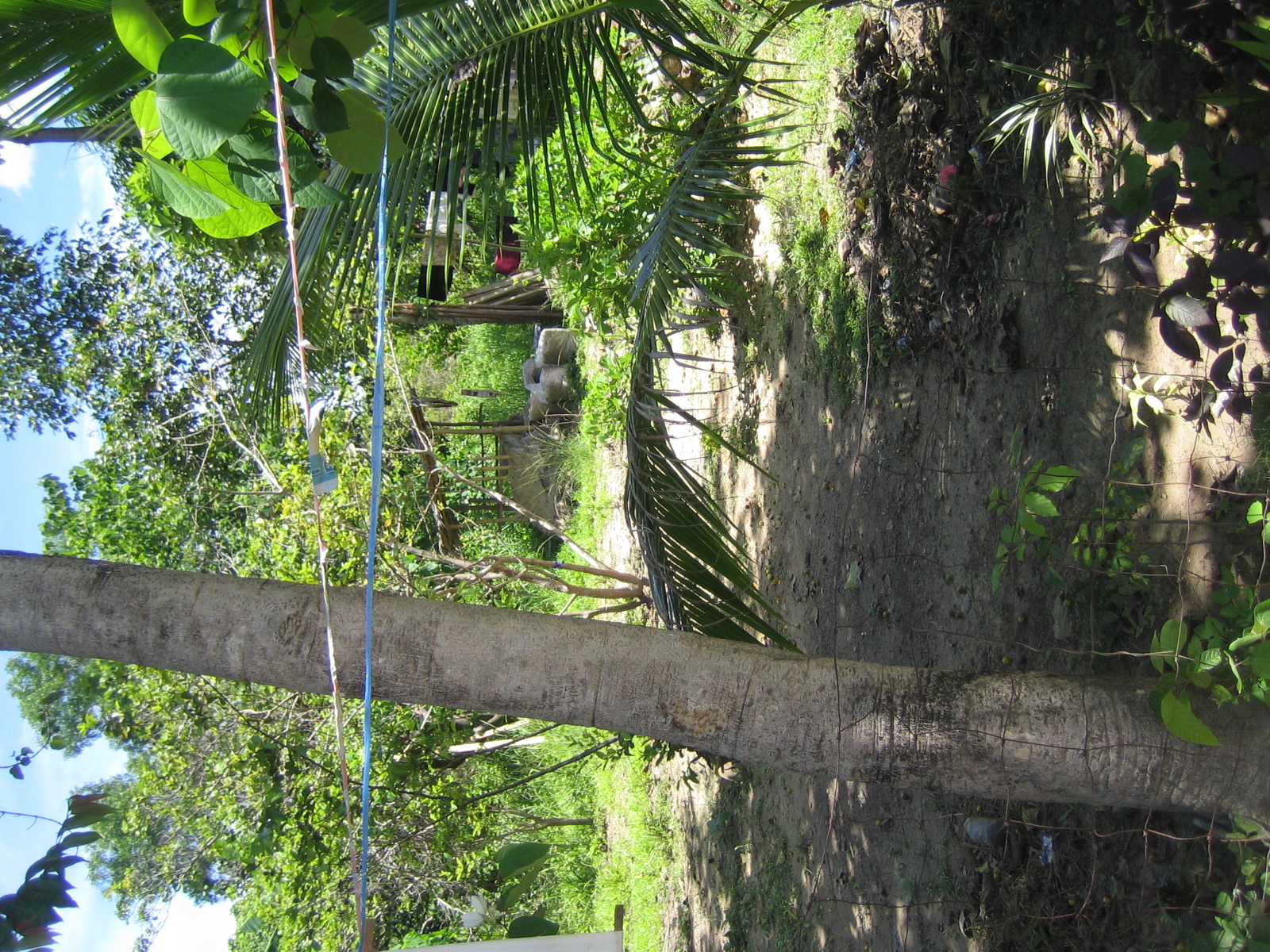 This one’s already behind the fence (and house) of a family encroaching on the RROW. Many of these people establish homes and even informal businesses (vulcanizing shops, makeshift stores, etc.) along the road with LGUs often turning a blind eye and in many cases even allowing people to register the lands as their own when in fact these have been reserved for future expansion of the road.
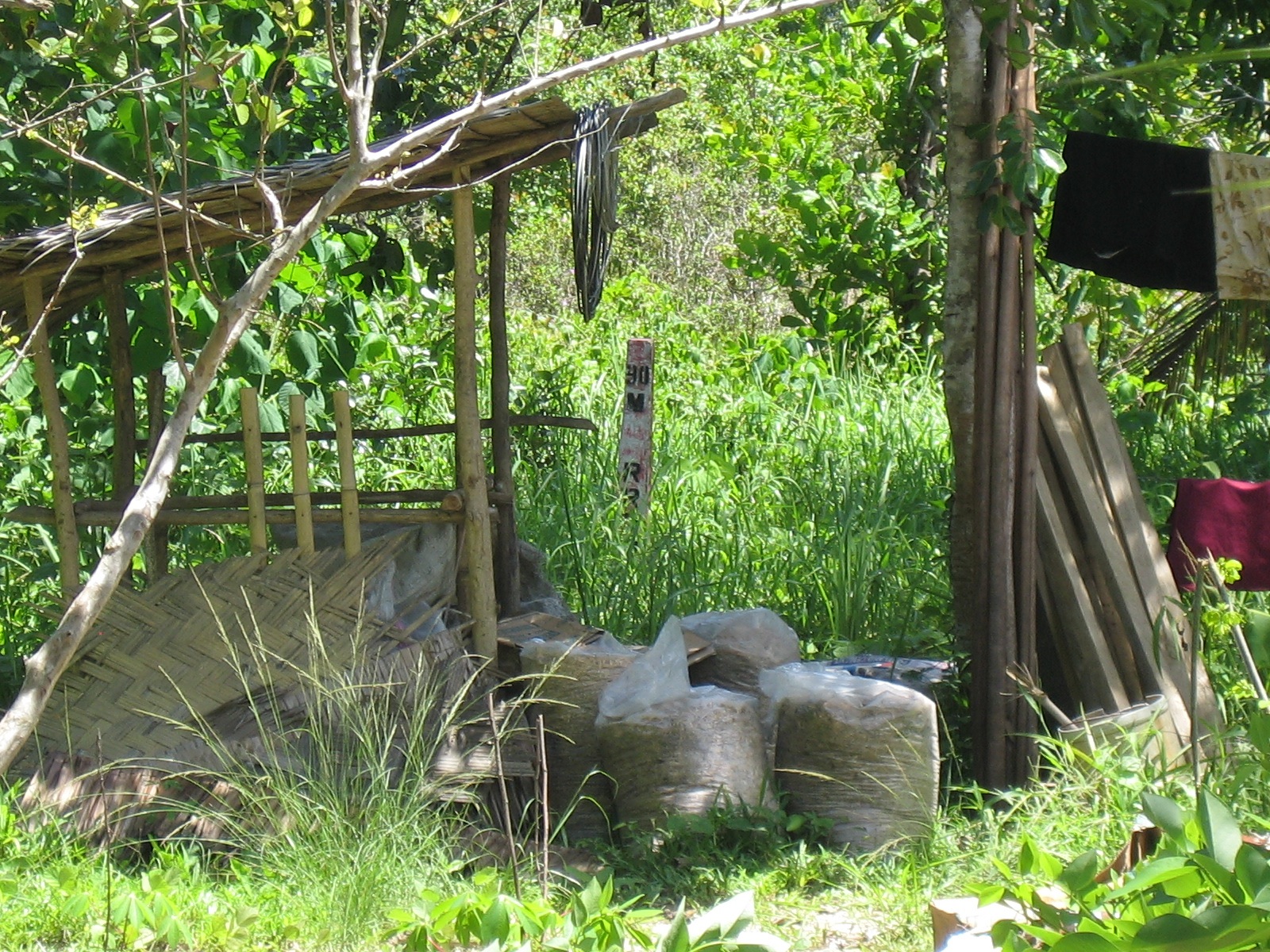 Zooming in on the marker shows it to be behind a storage shed where grain, lumber, bamboo and various other materials are piled up.
For most of these people who have encroached on the RROW, their actions are not illegal given that in many cases, the LGUs let them do so in order to develop areas along the road. The problem comes later when these developments and residents begin constricting traffic along the highways and demanding compensation when they are asked to move out to give way to road widening projects. It seems that the best approach is still for LGUs to do their part in regulating settlements along roads so that most if not all will locate outside the RROW. In other cases where it is obvious that development will come much later, it should be clear to settlers that the property is not theirs and will not be theirs, and that they would have to go sometime in the future when the road needs to be widened. This is not an easy thing for LGUs to accomplish but they should have system in place for this since it will considerably be more difficult later when the roadside has been settled with more permanent structures.
–
 Caught (up) in traffic