Home » Behavior (Page 36)
Category Archives: Behavior
Conflicting flows – driver and rider behavior in the vicinity of flyovers
Typical issues concerning traffic flow along sections approaching or departing from the ramps of vehicular overpasses or flyovers include weaving. Simple observations will reveal that a significant number of vehicles, regardless of whether private or public, passenger or freight, big or small, have a propensity to change lanes before and after a flyover. Such weaving behavior is a consequence of driving behavior in this country where many drivers and riders often are unmindful of planning their trips as well as the proper positioning of their vehicles while using the road. Many drivers and riders seem intent only in bypassing points of congestion and do not have any respect at all for the rights of other road users as well as for the rule of law along highways and streets.
I took the opportunity of taking a few photos after an interview conducted atop the pedestrian overpass along Commonwealth across from Puregold and near the Tandang Sora flyover. Below are a few photos taken during nightfall on Monday showing typical behavior of drivers and riders in the vicinity of the foot of the Tandang Sora flyover.
 Jeepneys occupying five (5) northbound lanes of Commonwealth Avenue, including the lane designated for motorcycles (delineated by the blue lines) – Most public utility vehicle drivers in the Philippines seem to abhor queuing and the prevailing practice is for most of them to try to bypass others by encroaching along the middle lanes. Instead of a First In First Out (FIFO) discipline that is desirable for conventional public transport operations, its more like a Last In First Out (LIFO) state along loading/unloading areas.
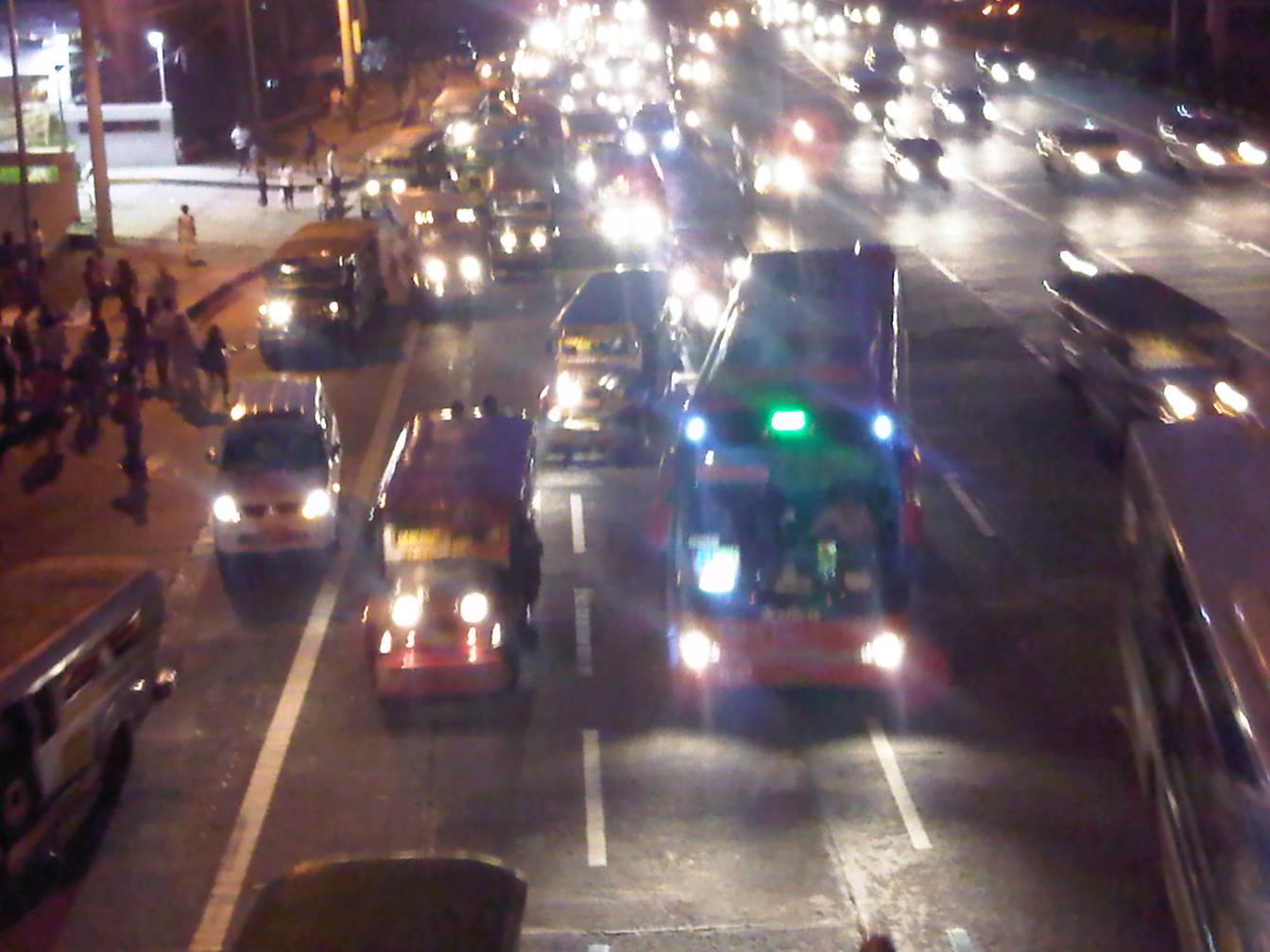 Buses joining the fray of vehicles in the same area – Note that practically 4 to 5 lanes of Commonwealth are occupied by buses, jeepneys and AUVs, effectively blocking motorcycles from using the lane designated for them. Such behavior in the vicinity of the foot of the Tandang Sora flyover also influences private vehicles to shift towards the inner lanes of the highway and unto the path of vehicles descending the flyover.
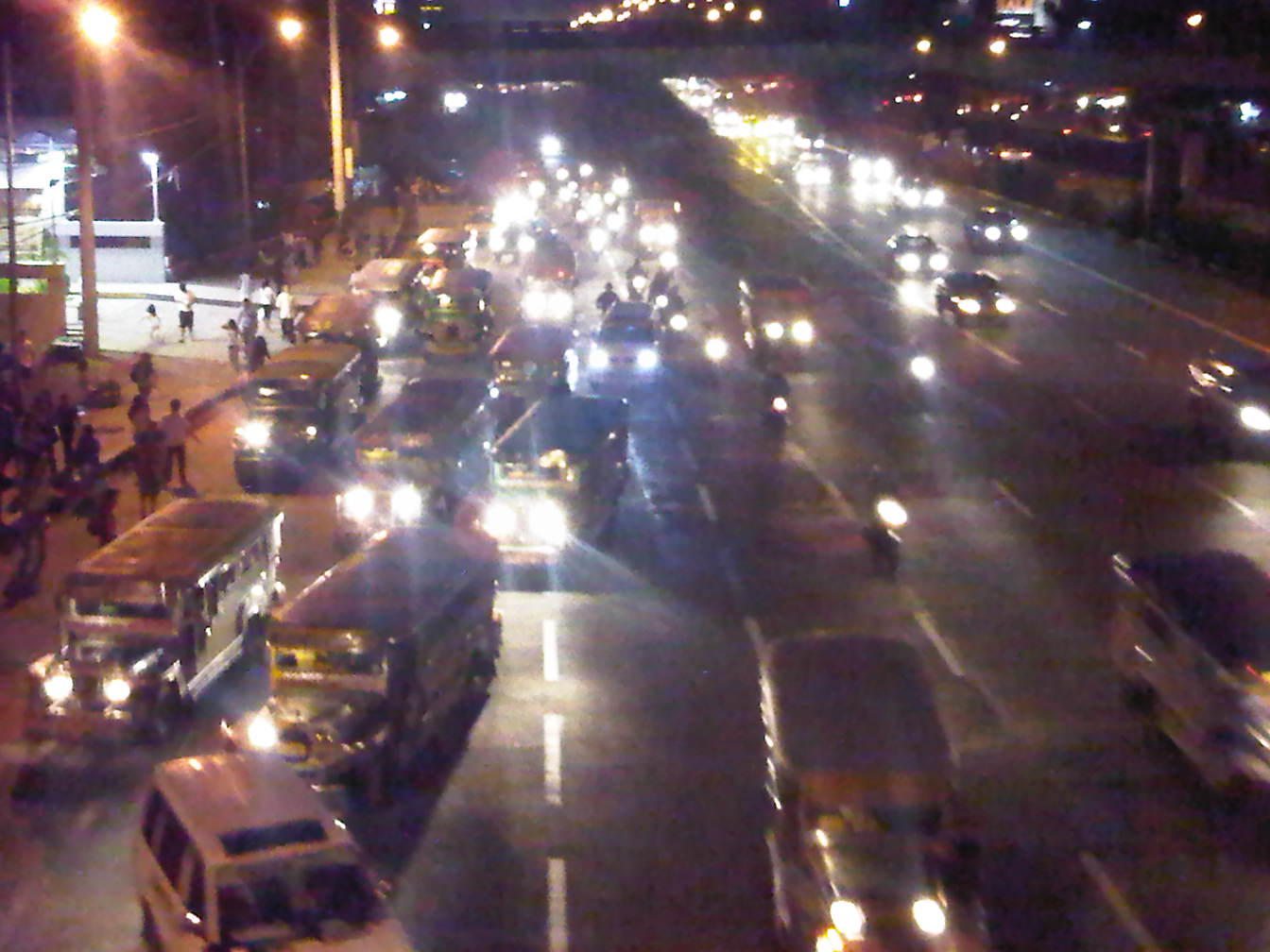 Motorcycles (they with the single headlights) using the 5th and 6th lanes of Commonwealth – riders have no choice in this situation where PUVs have occupied the motorcycle lane and behave as if they are the the only road users in the area. PUVs are observed as generally oblivious of the fact that road space is to be shared and basic courtesy is a requirement for smooth and safe flow to occur.
 As the traffic flow decreases, partly due to the control imposed by the traffic signal upstream at the Tandang Sora intersection, lanes become less congested – motorcycles are then able to return to their designated lane.
The chaotic situation shown in the photos could have been prevented or corrected if enforcers were in the area to manage traffic. There were none in the area, and I only found a few of them a couple of hundred meters downstream apprehending riders where traffic is already free-flowing. I thought perhaps that instead of focusing on apprehending riders, these enforcers were better off trying to address the mess upstream of their position. It is always both frustrating and disappointing to see enforcers diligently doing their jobs in the wrong locations along our highways. And all too often, the drivers and riders they apprehend are not the ones guilty of constricting traffic or posing dangers upon other motorists.
Katipunan parking predicament
Developments along Katipunan Avenue in Quezon City are good examples of fragmented land use and transport planning in Philippine cities. The developments, particularly the high rise condominiums have been the subject of much opposition from residents of subdivisions in the area as well as two major institutions of higher learning that have defined the stretch of Katipunan that has been developed in the 15 years. I mention 15 years because this is the period during which most of the high density developments along Katipunan have been constructed, apparently with the blessings of city hall. It is also in the last decade that schemes such as road widening and the U-turns were implemented.
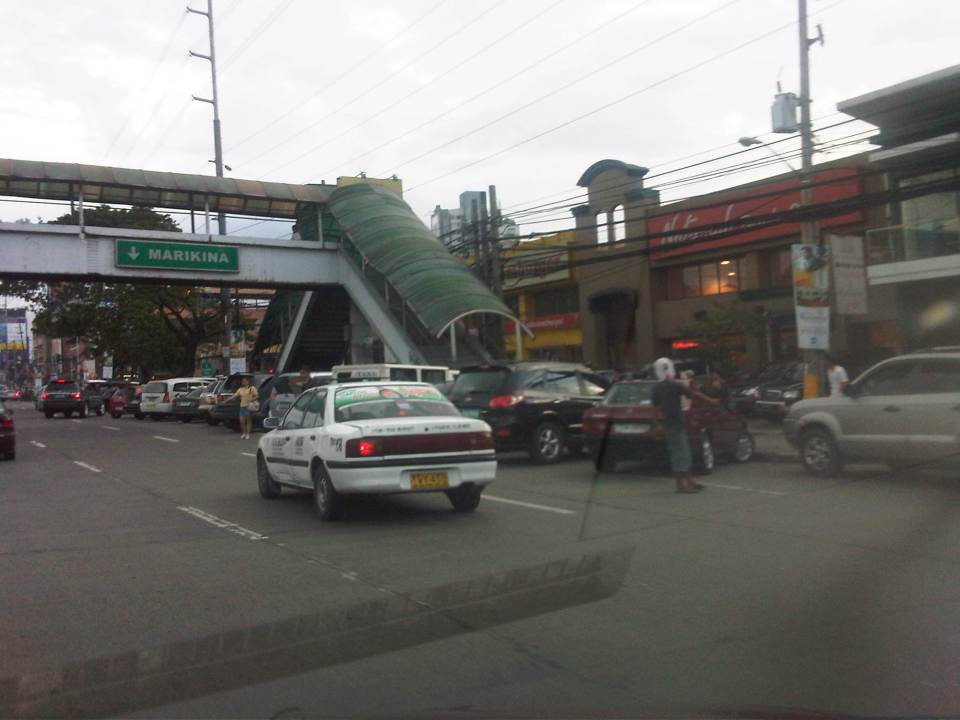
On-street parking along Katipunan at lanes that used to be part of what was a west service road. In many cases, onstreet parking has been the result of a violation of a very basic provision of the National Building Code, which prescribes the minimum number of parking slots for establishments such as restaurants, shops, banks and offices. Despite being quite outdated and disconnected with more progressive parking generation principles, the NBC should have been a basis for the local government to assess whether minimum guidelines are satisfied, and perhaps impose penalties on those who are not able to comply such provisions. This is a fundamental case where individuals (owners of parked vehicles) impose external costs (e.g., congestion and crash risk) upon the general public.
Another look at onstreet parking just beneath the pedestrian overpass across from Ateneo’s Gate 2 – restaurants along Katipunan are major traffic generators and despite the presence of public transport (jeepneys and tricycles) a significant number of trips generated by these establishments use private vehicles including cars, vans and SUVs. Katipunan’s pedestrian facilities are inadequate as there are practically no sidewalks, thereby forcing people to walk along the road. This exposes many and particulrly students to risks like getting sideswiped by vehicles driven by reckless drivers.
Waiting vehicles effectively occupying 2 lanes of Katipunan – many employ drivers who can stay with the vehicles while the occupants eat, shop or transact at establishments. In most cases, standing vehicles are practically parked vehicles as they occupy road space. High-rise residential condominiums along Katipunan may have complied with minimum parking requirements stipulated in the NBC but their trip generation characteristics considering the commercial establishments located at the same buildings surely require many more parking spaces than what are available.

Congestion along Katipunan’s southbound side – may be caused by onstreet parking, standing (waiting), or vehicle maneuvers with respect to the limited parking slots fronting most establishments along the road. One tutorial center located near a U-turn slot, for example, generates significant vehicle traffic that it affects both U-turn and through traffic. Meanwhile, traffic enforcers seem either ineffective or helpless in their efforts to manage traffic, including preventing vehicles from taking 2 lanes of Katipunan.

Standing/waiting vehicles in front of a new development along Katipunan – the new building hosts several establishments including a major bank, a book shop, a popular gym, and several restaurants or cafes. Despite the potential for vehicle attraction, only a few parking spaces were provided, leaving all other vehicles and their drivers on their own to find parking spaces or just occupy road space in front of the building. The footbridge across Ateneo’s Gate 3 has been extended to the building but this obviously has marginal impact in reducing vehicle generation and parking demand.

Another photo showing the parking situation in front of the new building – while traffic is generally a manifestation of economic activity, one opinion is that many developers are irresponsible by designing buildings that have inadequate parking and resulting in the general public bearing the burden of traffic externalities. Add to this local governments that turn a blind eye on such discrepancies in design (who reviewed the design that obviously violated the building code?) only to be on the receiving end of complaints. In some cases, LGUs probably will be forced to shoulder costs of providing solutions that developers should have covered in the first place if they were responsible enough or made responsible for mitigating negative impacts of their projects.
In the end, it is inevitable that we need to address the root of the problem, which pertains to land use planning and the zoning policies LGUs are implementing. Consistency is one thing and being circumspect about established guidelines is another. Sustainable development, after all, does not pertain to continuous transformation from low to high density development but more about balancing elements that would preserve the character of neighborhoods and communities, particularly and most importantly to ensure that quality of life is not compromised.
Risky behavior at intersections
I saw these three vehicles, two motorcycles and a car, slowly encroaching towards the center of the intersection of Katipunan and C.P. Garcia Avenues last night. The red light was clearly displayed along with the number of seconds remaining that was indicated in the countdown timer installed along the southbound approach of the junction. They seemed to be unaware of the significant amount of time remaining before the green light. Worrisome was their being unmindful of the trucks turning left to C.P. Garcia from the northbound approach of Katipunan. Many of these trucks were the big trailer types that could easily wreck the car or crush the motorcycles should they mistakenly cross their paths. Requiring more space for their turning movements, many trucks encroach upon the second and third lanes from the median and would probably have hit one of the vehicles that were already past the nose of the median island on our side of the road.

There was no yellow box or markings clearly indicating the clear area for the intersection. However, it was quite clear where vehicles should stop considering there was a pedestrian crossing (incorrectly painted as zebra despite the traffic signals) at the approach of the intersection and vehicles should stop before these markings. The driver of the vehicle to our left obviously wanted to follow the example of the black car and already positioned his car over the pedestrian crossing. Is this a manifestation of being swapang or maybe the thinking that you want to be ahead of the rest?
Such behavior and others similar to this are risky and may lead to crashes that could have been prevented if the drivers and riders followed basic traffic rules and regulations. In fact, aside from the potential for road crashes, congestion due to clogged intersections are often due to many drivers and riders not following the rule of keeping an intersection open. Such a rule applies even when the green light is given to a particular movement considering that the intersection exit ahead is already full and further movement and the resulting queue will only block other movements once the lights change. The yellow box is supposed to define “no-man’s land” in as far as designating exactly which space should be clear of vehicles to facilitate traffic flow and as a matter of courtesy among drivers and riders. These are very basic principles in driving and among those consistently and constantly being violated. Meanwhile, traffic enforcers are either ignorant of these rules and prefer to just stick to catching violators of the number coding scheme or playing blind as they may have practically given up trying to enforce the rule while managing traffic. Perhaps they should try harder and be persistent in order to influence behavior change? After all, the last time I checked there are so many other rules and penalties other than swerving or violating number coding.
What irritates you?
Early this week, we realized that only one of the regular hosts of our weekly radio program, Wangwang ng Bayan, would be available for the live broadcast. Being the last week of regular classes didn’t help as we had to consider conflicting schedules that seemed to feature a lot of double and even triple booking of certain time slots. Wednesday proved to be a difficult day what with a mix including undergraduate research presentations, a college board meeting, field survey orientations and our radio program. Good thing that it didn’t become the nightmare we were anticipating as we were able to agree on how to divide ourselves and distribute our times and attentions to the various tasks at hand that day. I won’t delve into the details of what we did with the others but will just talk about how we were able to manage with our radio program.
We figured that we had to have a topic that would be easy for one host and our assistant to tackle while the other host and the producer were out. I figured that an easy topic would be about what irritates us when we’re on the road whether as drivers/motorists, passengers or pedestrians. We would ask our listeners to pitch in on what they thought were their pet peeves on transport and traffic. The result was a very lively show with the host and her assistant fielding questions and comments on just about anything under the sun and on the street.
Prior to the show, we ran a simple survey among our center’s staff, some students and our trainees in our Traffic Administration Course. The survey outcomes allowed us to have a handle on what we can anticipate for responses to the question we would be posing on air. After all, there should be common pet peeves regardless of whether one is driving, riding, walking or cycling. I even volunteered my own top ten list of what irritates me when I’m on the road. These are:
1. Jaywalking/pedestrians crossing anywhere;
2. PUB or PUJ weaving at high speeds in traffic;
3. PUV’s loading/unloading in the middle of the road;
4. Vehicles especially private cars cutting into my lane;
I can go on and identify more pet peeves but it is unnecessary and the top ten pretty much drives the point in as far as irritating things are concerned. When coming up with the list, I eventually felt a little frustration as I came to realize that many of these pet peeves have not been addressed despite many being glaring examples of how chaotic traffic and transport can be in this country. What irritates us the most is the collective chaos we experience everyday, and what seems to be our helplessness and the futility of authorities in addressing these manifestations of an inadequate transportation system.
But there is hope considering that my and other people’s list seem to have lost an entry – wangwangs, or the illegal/improper use of sirens. The success of a campaign enforcing against wangwangs last year showed many of us how it can be done and done right. Perhaps, as I’ve suggested in previous posts, the strategy could be to tackle these irritations one at a time. No MacArthur didn’t return to the Philippines direct from Australia. He liberated lands one island at a time, slowly but surely. Perhaps that should be the approach for us to eventually reduce the list until there are none at all that irritates us. And what a country we would be when we finally realize that progress requires discipline and a bit of soul searching that starts with simple questions like “what irritates you?”
——-
Wangwang ng Bayan can be heard on AM radio. Just tune in to DZUP 1602, the last station on the dial. Livestreaming available over at www.dzup.org
 Caught (up) in traffic