
Home » Economics (Page 10)
Category Archives: Economics
The Philippines’ National EST Strategy – Final Report
Friends and some acquaintances have been asking about whether there is a master plan for sustainable transport in Philippines. There is none, but there is a national strategy that should serve as the basis for the development and implementation of a master plan, whether at the national or local level. This strategy was formulated with assistance of the United Nations Council for Regional Development (UNCRD) through the Philippines’ Department of Transportation and Communication (DOTC) and Department of Environment and Natural Resources (DENR), which served as the focal agencies for this endeavour. The formulation was conducted by the National Center for Transportation Studies (NCTS) of the University of the Philippines Diliman. For reference, you can go to the NCTS website for an electronic copy of the National Environmentally Sustainable Transport Strategy Final Report.
 Cover page for the National EST Strategy Final Report
–
On sustainability and inclusiveness of pedicabs
“Sustainable transport is inclusive but inclusive transport is not necessarily sustainable.” Is this statement true? If yes, why and to what extent? This is not a philosophical take at transport. There seems to be some conflict in that statement but there should really be no confusion once you delve into the essence of sustainability and define the limits of inclusiveness. The statement is true to the extent that all sustainable forms of transport can be inclusive. These are transport modes that are friendly to all genders, all ages, all economic classes, and regardless of physical ability. However, there are transport modes that are inclusive in the same context stated but are unsustainable from the perspectives of suitability, efficiency and energy.
For example, non-motorized transport (NMT) in the form of pedicabs (also called trisikad or padyak) are sustainable from the perspective of energy. They are most suitable for operation along minor roads, especially those in residential areas. However, if the same pedicabs operate along national roads and mixed with motorized traffic, these become a nuisance and contribute to traffic congestion. Such operations also put passengers at risk, exposing to potential crashes as pedicab drivers tend to violate road traffic rules (e.g., moving against traffic).
 Pedicabs along the Quezon Avenue Service Road near Agham Road.
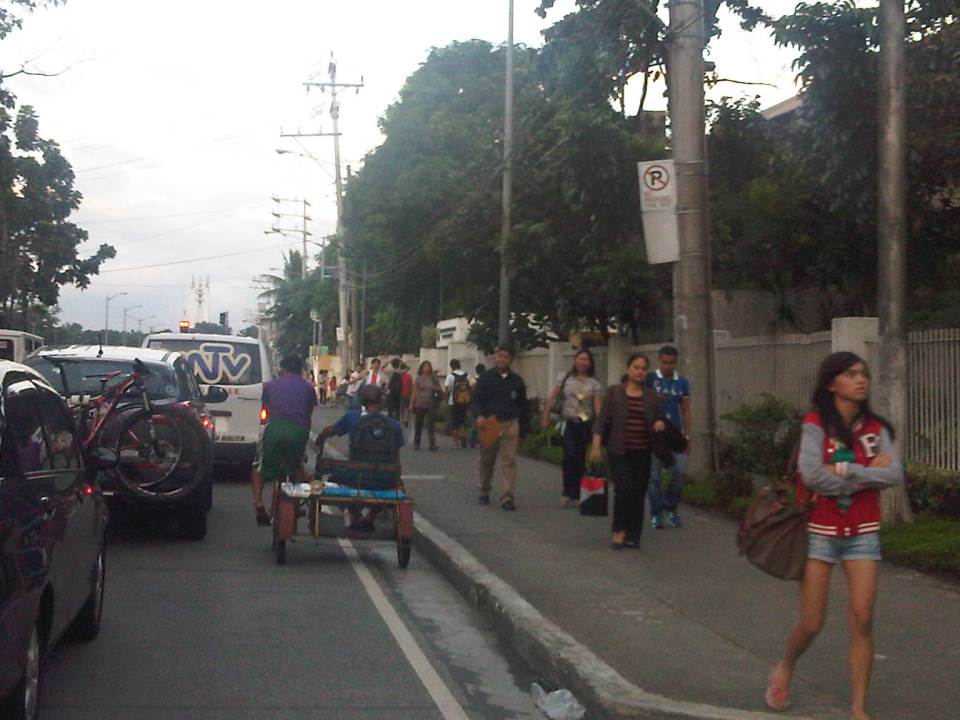 Pedicab ferrying passengers from the Quezon Ave. MRT-3 station to destinations along Agham Road.
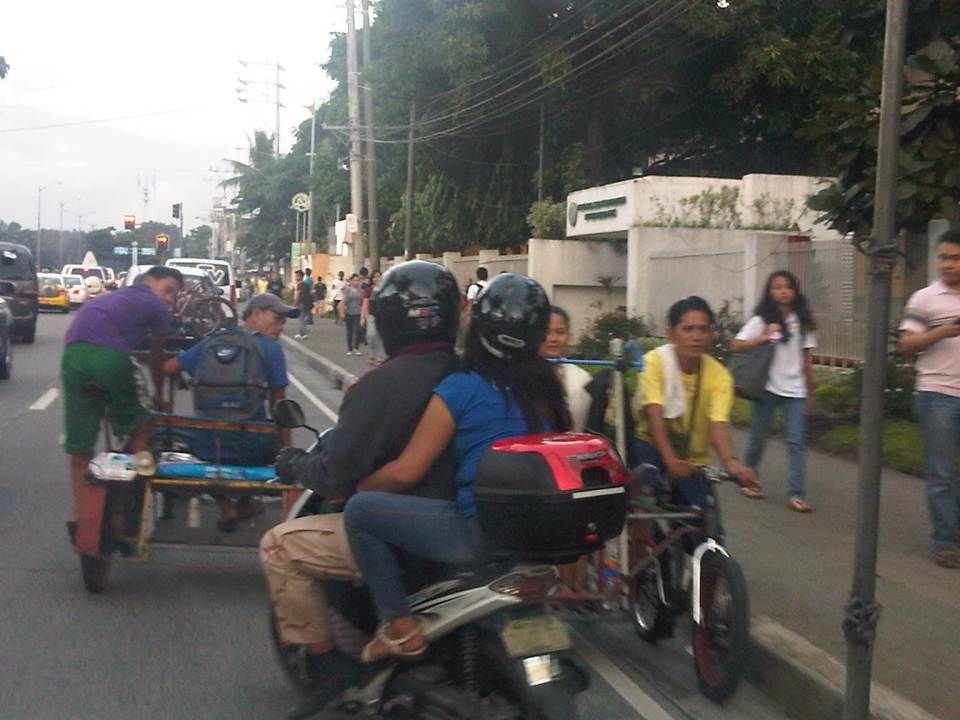 Counter-flowing pedicab along Quezon Ave. just outside the National Grid Corporation (formerly Napocor) office.
Pedicabs have another dimension, which is often cited as a reason for its very existence. It is a source of livelihood for many people. Whether this is something that needs to be encouraged is the subject of debates often involving discussions on poverty and governance. That is, pedicabs are often owned and/or operated by low income people and their numbers translate into votes for local officials who tolerate pedicabs and even encourage them as a form of livelihood. It is, after all, like the jeepneys and tricycles before it, supposed to be a simple investment that generates income for the owner/operator/driver. People have glorified or romanticized the pedicab as various designs have displayed the creativeness (or even artistry) of the Filipino. However, just like other modes of transport, the pedicab should function within a hierarchy based on its suitability with respect to other modes that are similarly appropriate for a certain range of conditions. Hopefully, such concepts are understood by stakeholders if only to effect the rationalization of transport services and correct certain notions pertaining to inclusiveness and sustainability for such modes.
–
Proposal for a Special Mass Transit Support Fund
There are three bills currently being discussed at the Senate that were filed by Sen. Ralph Recto. These propose the restructuring of the special funds derived from the Motor Vehicle Users’ Charge (MVUC) in order to allocate funds for mass transportation.
Senate Bill 446 – An Act Creating The Special Mass Transit System Support Fund, Reallocating The Disposition of Monies Collected From The Motor Vehicle User’s Charge, Amending For The Purpose Sections 7 And 8 Of Republic Act No. 8794, Otherwise Known As The Motor Vehicle User’s Charge Act of 2000.
Senate Bill 611 – An Act Creating The Special Mass Transit System Support Fund To Provide Additional And Long-Term Funding To Priority Mass Transit Projects In The Greater Metro Manila Area, Amending For The Purpose Sections 7 And 8 Of Republic Act No. 8794, Otherwise Known As The Motor Vehicle User’s Charge Act of 2000.
Senate Bill 621 – An Act Creating The Special Mass Transit System Support Fund Amending For The Purpose Sections 7 And 8 Of Republic Act No. 8794, Otherwise Known As The Motor Vehicle User’s Charge Act of 2000.
The National Center for Transportation Studies (NCTS) was requested to submit a position paper on these bills by the Senate Committee on Public Works that is chaired by Sen. Ferdinand “Bongbong” R. Marcos, Jr. The Center drafted one and submitted the 4-page document to the Committee secretariat last October 16, 2013. A copy of the position paper may be downloaded from the following link:
NCTS PositionPaper MVUC 16Oct2013
The Senate Committee on Public Works held a public hearing last October 17, 2013 at the Lorenzo Tanada Room at the Senate. The NCTS Director, Dr. Hilario Sean O. Palmiano, was invited as a resource person for the hearing and joined representatives of agencies such as the DPWH, DBM, DOF, LTO and the Road Board in providing insights and comments on the proposed bills. The same agencies were also requested to provide pertinent data for the committee to evaluate the proposed changes to R.A. 8794. Such data include information on past disbursements and approved projects that used the special funds under the MVUC.
–
Dream plan for the Greater Capital Region?
A report came out last Saturday on a major daily about a JICA study estimating losses of as much as 2.4 Billion pesos per day due to traffic jams experienced in Metro Manila. Not mentioned was the 1.0 Billion pesos per day estimated losses for the Bulacan, Rizal, Laguna and Cavite areas that are at present considered part of what has been loosely defined as Mega Manila or the Greater Capital Region (GCR). That’s 3.4 Billion pesos per day of lost productivity and potential income that if reduced, could generate resources that could be distributed to the rest of the country. The JICA estimate, as reported by NEDA, is the product of a study that is in its concluding phase that looked into transport for an area comprised of Metro Manila, Region 3 (Central Luzon) and Region 4A (Southern Tagalog or Calabarzon). The main objective of the study was to come up with a Transport Infrastructure Framework and Roadmap for the GCR that would guide planners and engineers, and most importantly decision-makers (i.e., our leaders) in identifying and prioritizing transport infra projects that would ultimately improve the way we travel in the GCR.
While I am not at liberty at present to divulge the details of this study as the entirety has not been made public yet, I can say that the study was comprehensive and the conclusion an urgent reminder to what needs to be done for transport in the GCR. The latter is necessary because we have failed to deliver on the transport infrastructure required by Metro Manila and its surrounding areas since the late 1970s adn early 1980s when some decisions were made that were detrimental to public transport development and, to my view, inhibited and limited us from implementing a much more efficient transport system than what we have now. In my own conversations with the person who led the study, I can understand his own frustrations as he was himself a witness to the deterioration of transport in this country. Much of this deterioration have been attributed to a lack of political will to make the hard decisions in relation to transport. These decisions include those pertaining to the rationalization of transport services like phasing out jeepneys and tricycles where they are no longer suitable and committing to the implementation of mass transit projects that have been delayed for decades now.
 Network of recommended rail rapid transit (RRT) lines for the Manila Metropolitan area in 1973 (UTSMMA, 1973)
Perhaps we are at a crossroads in terms of transport in this country. Perhaps our leaders should listen to the clamor of their constituents for better transport systems in our cities, for more efficient ways to move about. Perhaps, too, we could finally see what’s really at the end of the tunnel rather than the proverbial light that we have always seen, frustratingly, for the past few decades. Perhaps the current administration will prove itself the catalyst for transforming transport in this country towards what it has preached as a “straight path.” Will we have a champion or champions who would push for the realization of a dream plan for transport? Whoever should step forward would definitely get my vote in 2016!
–
Flash floods and traffic congestion
Traffic last night along most of Metro Manila’s roads were a nightmare. It took many people hours before they could reach their homes from their offices and schools. The main reason cited for the horrendous traffic jams was the weather. It has been raining almost every afternoon in Metro Manila and its surrounding areas due to the combination of a tropical depression east of the island of Luzon and the intensified monsoon rains (Habagat). Rainfall intensity combined with a high percentage of the water translating into runoff contributed to flash floods all around Metro Manila including some that were waist-high, rendering the road impassable to most vehicles. However, while a lot of motorists and commuters were simmering along many roads last night, I couldn’t help but notice that most vehicles in the photos circulating in social media sites and news footage are private vehicles. Buses along EDSA occupied only the outermost lane for most stretches of the road. Meanwhile, conspicuous is the space in the middle of EDSA, which is the ROW for the MRT-3 tracks.
One lesson we learned last night was something we already knew all along and have failed miserably to address – we need better public transport in Metro Manila. Could there have been less cars on the roads affected by flash floods brought about by the heavy rains yesterday? Could commuters have had an easier way of traveling between their offices or schools and their homes? The answer is yes, that is, we could have built the necessary public transport infrastructure years ago. While there is a need to be transparent and have a corruption-free (is there such a thing?) process for planning, funding, designing, and constructing public transport infrastructure, we must realize that these are all systems that we should have had long ago, and further delay only dooms mobility and accessibility in our cities. Our leaders seem to be too engrossed with processes and making sure they won’t get entangled in controversies or lawsuits that they forget that time is ticking and all other people are caught in the mess that is the traffic congestion we experience every day. I wonder if at least some of our decision-makers for transport and traffic were caught in the monstrous jams last night? Maybe getting caught in one would change their perspectives and give them a sense of urgency for the task at hand? Or maybe, and likely, they were sitting behind their cars and burning time on their notebooks or tablets while their drivers were trying to maneuver in traffic? Frankly, we deserve better transport than what we have but then we don’t get to decide what gets built and when such infrastructure will be built, if at all. We could, however, do our part in lobbying (or demanding) for better transport.
Taken by a good friend commuting to his home last night:

From the GMA News website:
–
Poverty should not be entrusted to economists | Social Watch
Saw this article shared on Facebook. I thought it was a relevant piece with respect to a work I am currently doing, relating transport infrastructure and services with economic growth in the Philippines. With the release of the latest poverty statistics in the country late last month, there has been a lot of discussions regarding inclusive growth as poverty incidence across the country is still quite high though there have been gains in many provinces based on the statistics.
Poverty should not be entrusted to economists | Social Watch.
I suddenly remember the experience we had while doing field work in the island of Samar where we performed a road safety audit for a national road. While coordinating with the barangays along the highway for our traffic surveys, we observed that people were generally poor but in the financial sense – they didn’t have money and many didn’t have regular jobs. I say this because I would like to qualify the way we define poverty that is biased on the monetary aspect. From what we saw, people were not hungry as they had food like fruits and vegetables. Perhaps to get other items, they trade or barter what they have with what they needed (e.g., vegetables for rice, fish for rice, etc.). Still, the point is for these same people to generally benefit from the economic gains that is supposed to be experienced by the country. Is the growth trickling down to these people and therefore inclusive? Or is it enjoyed only by a few and especially our elite classes, and therefore exclusive? So far, what I have seen out there is the latter case and not the former.
–
Daniel Romualdez Airport in Tacloban
I had been to Tacloban only once before and was not able to take some photos of the airport. This time around, I was able to get a few photos as I checked in for my flight back to Manila. Tacloban Airport is among the busiest airports in the country serving more than 1 million passengers annually. Tacloban is the regional center of Eastern Visayas and is the only airport in that region with jet airline (A319s and A320s) service. Despite the increasing demand due to growth in both industry and tourism, the airport is limited by its runway and terminal. A planeload of passengers already crowd the pre-departure area on a regular basis and conditions in the area is not at all comfortable. While there is a room for changing diapers and another for breastfeeding (thanks to DOTC’s Gender Awareness and Development program), there are few other amenities at the terminal.
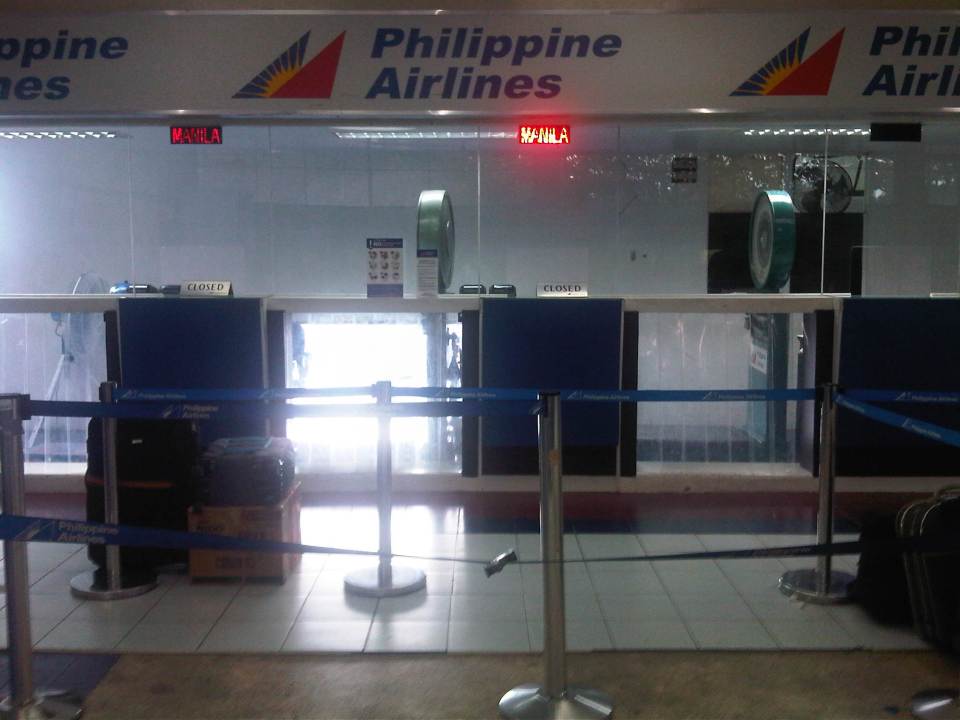 Philippine Airlines check-in counter
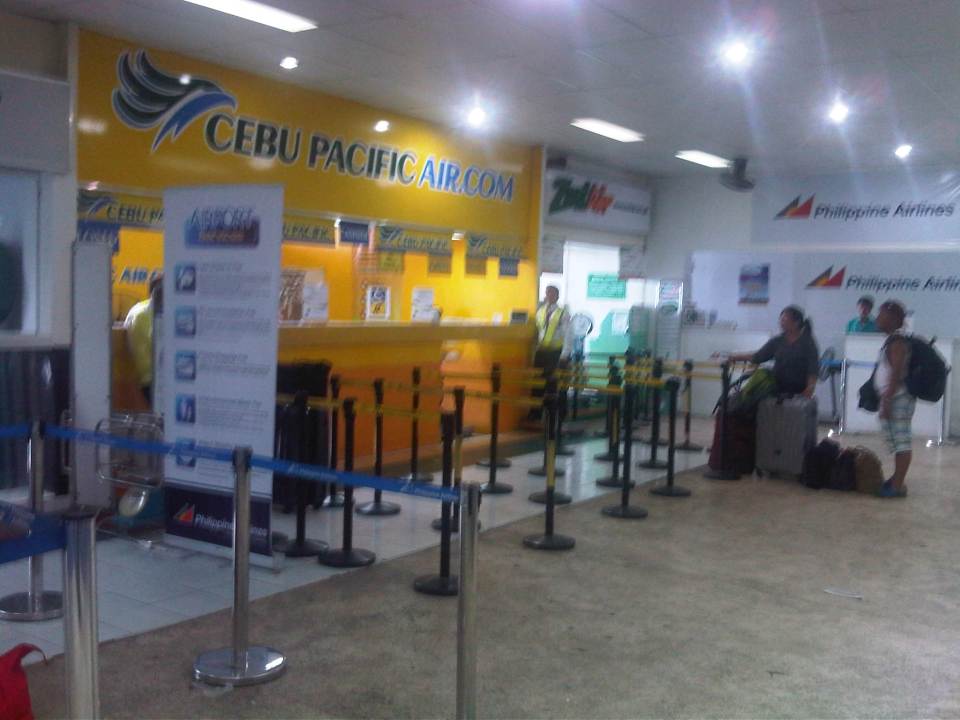 Cebu Pacific and Zest Air check-in counters
 Ceb Pac passengers waiting to board the aircraft on the tarmac
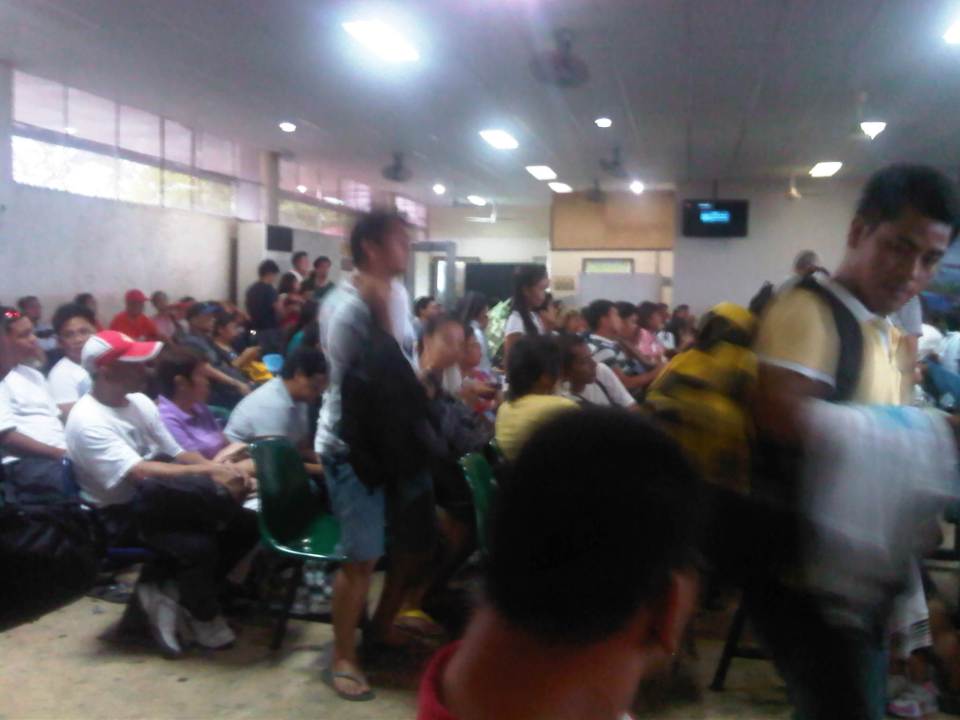 Another shot of the crowded pre-departure area
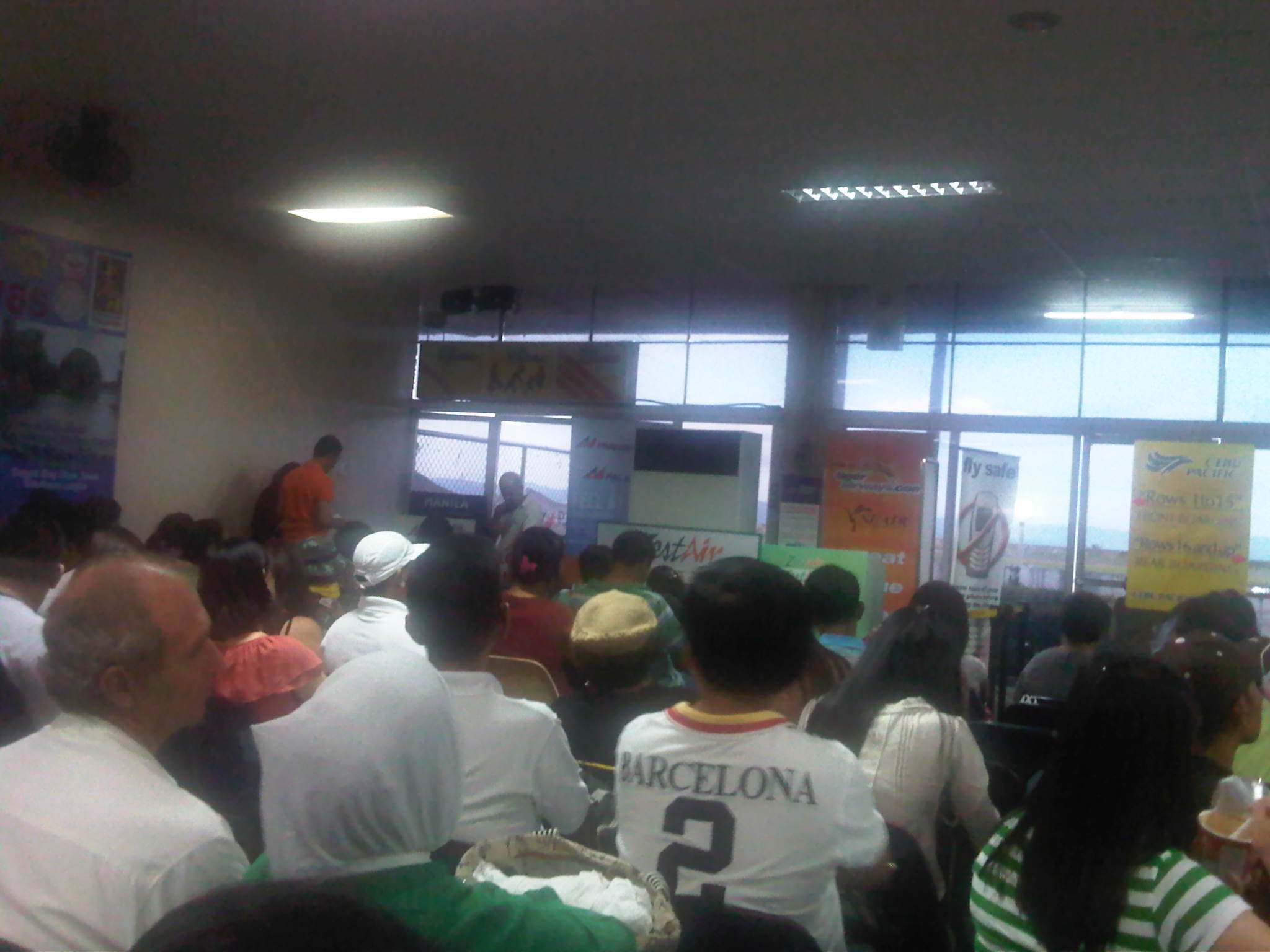 PAL passengers waiting for their plane to arrive
Tacloban Airport is due for expansion with a new terminal proposed for construction nearby. The land where the new terminal will be constructed has been acquired and cordoned off and I was told that the runway will be lengthened. I am just not sure if DOTC or CAAP has acquired the lands necessary for the runway component of the project but upgrading the runway for the airport to accommodate wide bodied aircraft will indeed require much land. Nevertheless, it is a project that is long overdue and needed to push for development of the region, which has one of the higher incidence of poverty at 37.2% for Region 8. Leyte has a 31.9% poverty incidence while Southern Leyte is at 36.4%. Neighboring Samar provinces have even worse statistics with Western Samar at 36%, Northern Samar at 43.7% and Eastern Samar at a staggering 59.4% poverty incidence. These stats are based on the figures recently released by the National Statistical Coordination Board (NSCB) based on the Family Income and Expenditure Survey (FIES) conducted in 2012.
–
Poverty Statistics in the Philippines
The National Statistical Coordination Board (NSCB) of the Philippines recently released poverty statistics as of the first semester of 2012. The report is based on the outcomes of the Family Income and Expenditure Survey (FIES) conducted by the National Statistics Office (NSO) in July 2012. Both agencies are under the National Economic Development Authority (NEDA). The stats on poverty incidence are shown in the following link:
In relation to these poverty figures, the NEDA Director General Arsenio Balisacan issued the following statement:
STATEMENT OF SEC. BALISACAN AT THE PRESS CONFERENCE ON THE 2012 FIRST SEMESTER POVERTY STATISTICS
I am curious to see how much of family expenditures go to transport. Clearly, the state of the country’s transportation system is a significant factor in development and the government’s initiatives towards inclusive growth will not prosper if we continue to have inefficient transport across all modes for both people and goods.
The Economic Case for Rail Subsidies
Today, I’m sharing a nice article on rail subsidies from The Atlantic Cities:
Loss of productivity due to congestion and inefficient public transport
I recently read two articles appearing in a major Philippine daily and a popular online site. The first one is an article that appeared in the Philippine Daily Inquirer – “PH economy losing $3.27B in human productivity due to traffic mess” – last September 25, 2012. The other article was posted on Rappler – “Traffic and infrastructure delays cost the Philippines” – last September 27, 2012. These were articles written after the authors’ attendance of what was an Energy and Infrastructure Forum last Sept. 25 where a transport official mentioned a recent study in his talk that estimates productivity losses of about 3.27B USD per year from Metro Manila traffic alone.
 Traffic congestion along Commonwealth Avenue
 Unusual traffic management scheme along Ortigas Avenue
The study from the National Center for Transportation Studies that was mentioned in both articles was actually first featured in a Yahoo! Philippines article – “Traffic congestion costs Metro Manila P137B per year” – that appeared a month earlier in Aug. 28, 2012. The study being referred to is actually a paper presented by Dr. Jose Regin F. Regidor in his Professorial Chair lecture at the University of the Philippines Diliman’s College of Engineering Colloquium in early August 2012. A copy of the paper may be found below:
Prof Chair 2012 JRFR 02July2012
The main reference for this paper is the study on congestion costs that was produced by the National Center for Transportation Studies back in 2000. Credits go to the core team of Dr. Ricardo Sigua (Institute of Civil Engineering of UP Diliman), Dr. Noriel Tiglao (now with the National College of Public Administration and Governance) and Dr. Val Teodoro (now in the US) for the study. The
Economic Impacts of Traffic Congestion in Metro Manila – Cover+Chap 1 and 2
Economic Impacts of Traffic Congestion in Metro Manila – Chap 3
Economic Impacts of Traffic Congestion in Metro Manila – Chap 4 and 5
Economic Impacts of Traffic Congestion in Metro Manila – Appendix
A much needed update may be possible in the next two years once the traffic model for Metro Manila is updated and calibrated using new data from Household Informations Surveys (HIS) and other transport and traffic surveys under the current MUCEP study that is supported by the Japan International Cooperation Agency (JICA). Hopefully, such a model can be updated and calibrated more often in order to assess losses due to congestion and our continuing inability to provide the necessary infrastructure to alleviate the situation. While the paper and the study mentioned above focus on productivity losses, it should be emphasized that there are other costs that should be highlighted including those related to health (respiratory diseases and road crash fatalities and injuries), energy (fuel consumption and inefficiencies), and emissions (carbon and other GHG).
–

