
Home » Economics (Page 6)
Category Archives: Economics
Article on evaluating transport equity
Here is another quick share of an article on transportation equity:
Litman, T. (February 2, 2022) “Evaluating Transportation Equity: ITE Quickbite,” Planetizen, https://www.planetizen.com/news/2022/02/116058-evaluating-transportation-equity-ite-quickbite [Last accessed: 2/4/2022]
Transportation equity is a very relevant, very timely topic as people in the Philippines are just beginning to understand and weigh the advantages of having more efficient transport in the forms of active and public transport over private vehicles.
–
UPSE Discussion Paper on Martial Law and the Philippine Economy
To those who were looking for references on the Philippine economy during the Martial Law years, look no further than a recent discussion paper from the UP School of Economics (UPSE). To quote from their social media post:
UPSE Discussion Paper No. 2021-07 (November 2021)
📌Title: Martial law and the Philippine economy
🖊Authors: Emmanuel S. de Dios, Maria Socorro Gochoco-Bautista, Jan Carlo Punongbayan
📄Abstract: Part of a proposed anthology, this article provides a concise review of the economic performance during the period of the Marcos dictatorship (1972-1985) from a comparative historical perspective. We examine the external events and internal policy responses that made possible the high growth in the early years of martial law and show that these are integral to explaining the decline and ultimate collapse of the economy in 1984-1985. The macroeconomic, trade, and debt policies pursued by the Marcos regime—particularly its failure to shift the country onto a sustainable growth path—are explained in the context of the regime’s larger political-economic programme of holding on to power and seeking rents.
📖 Read the full paper here: https://econ.upd.edu.ph/dp/index.php/dp/article/view/1543/1027
https://econ.upd.edu.ph/dp/index.php/dp/article/view/1543/1027
Why is this relevant to transportation in the country? Economic performance and policies during that period strongly influenced if not practically dictated infrastructure development during the period. Add politics to the mix and you get what ultimately affected future administrations in terms of debt servicing and other financial or fiscal issues that needed to be addressed due to the debt incurred during that period.
We should learn from this and hopefully not repeat it. Unfortunately, the fiscal discipline and reforms during the previous administration appear to have been abandoned and the current spending and borrowing spree will likely handicap future administrations. Are there bad debts around? Probably! And so there will likely be a need to do some due diligence during the transition to a new administration after the elections this year.
–
On the role of women in transportation
I found this podcast on “Advancing the Role of Women in Transportation” on the AASHTO thread:
This reminded me of the Women in Transport Leadership (WiTL) group that friends formed a few years ago. They are active in promoting the role and relevance of women in transport as well as equity in transportation.
–
On “universal basic mobility”
You’ve probably heard or read about the concept of “universal basic income.” The concept has been discussed and implemented or attempted in some countries including those that have successfully tinkered with their social welfare systems. Here is an article that presents and discusses the idea of universal basic mobility:
Descant, S. (December 22, 2021) “‘Universal Basic Mobility’ Speaks to a City’s Values,” Government Technology, https://www.govtech.com/fs/universal-basic-mobility-speaks-to-a-citys-values [Last accessed: 12/24/2021]
It was in graduate school back in the 1990s when I first encountered the concept of the ‘transportation poor’ and ‘transport poverty’. While the term suggests people who are generally in the low income classes, the actual definition of transport poverty is more complicated and comprehensive than that. While sustainable transport and its current versions have always discussed the more fad issues on public transport, low carbon transport, active transport, etc., specific engagements on the more rad topic of equity in transportation have not been as common. Perhaps this current issue and discussions on the government’s “no vaccination, no ride” policy will open doors for equity to be out in the open?
–
On transport equity
To start the year 2022, I’m sharing another article by Todd Litman. I thought this was a timely one as this is basically about transport equity and the results despite competent planners and perhaps good intentions.
Litman, T. (December 21, 2022) “Good Planners: Bad Outcomes. How Structural Biases Can Lead to Unfair and Inefficient Results,” Planetizen, https://www.planetizen.com/blogs/115621-good-planners-bad-outcomes-how-structural-biases-can-lead-unfair-and-inefficient?utm_source=newswire&utm_medium=email&utm_campaign=news-12232021&mc_cid=35d4ce69aa&mc_eid=9ccfe464b1 [Last accessed: 12/27/2021]
There should be similar studies for the Philippine case. We need to understand and correct bad practices including those related to an over-reliance to what is referred to as “old school” practices (i.e., “nakasanayan na”, “ginagawa na noon pa”, and so on), which is what young engineers and planners are taught by the “old boys” in certain agencies as an initiation of sorts if not part of their ‘continuous orientation’ at these offices.
–
Cities and Automobile Dependence: What Have We Learned?
We end the year with an article from Todd Litman via Planetizen. The topic is something that we really need to ponder on as we or if we are to move towards more sustainable transportation for our cities and municipalities. The experiences during this Covid-19 pandemic should have provided us glimpses of how it could be if we put active and public transport above automobile dependence or car-centricity.
Source: Cities and Automobile Dependence: What Have We Learned?
The main article may be found here (in proper citation for academic/researchers reading this):
–
On the key transformations needed to achieve sustainable, low carbon transport
Also related to COP26, I am sharing material from the Sustainable Low Carbon Transport (SLOCAT) partnership, of which our center is part of. SLOCAT recently released the 11 key transformations for sustainable low carbon land transport urgently needed to meet the climate targets. Here’s a link to their site:
SLOCAT also has the following Wheel of Transport and the Sustainable Development Goals (SDG’s) on the same site. The Wheel illustrates the four cross-cutting themes: equitable, healthy, resilient and green.
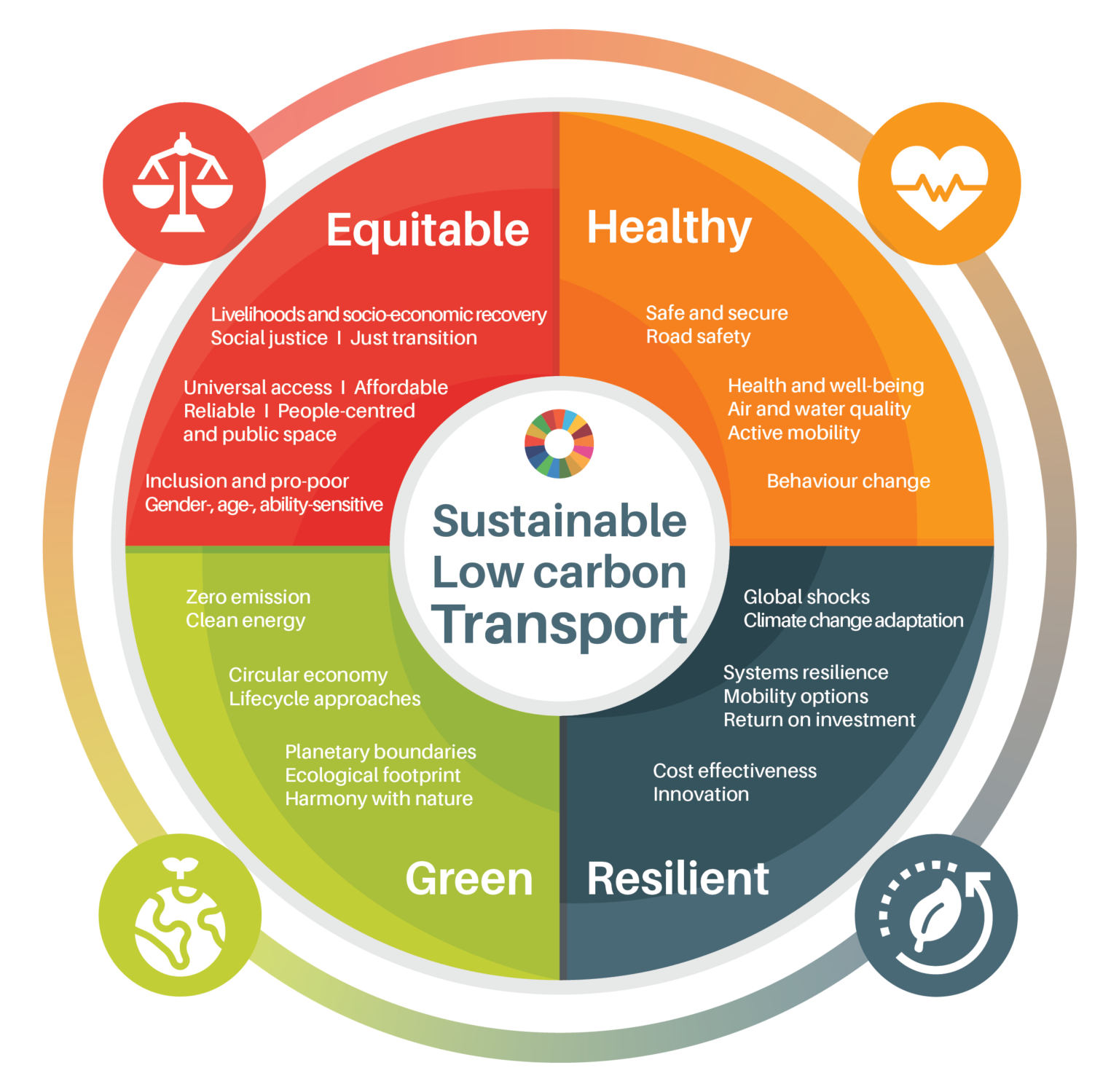
In the SLOCAT site, they list the following to support the transformations:
Overarching approaches to apply across transport modes and sub-sectors overtime
- Put people first, not vehicles and technology
- Co-create and communicate a compelling vision and targets
- Guide short- and medium-term action with clear, coherent political messages
- Combine push and pull measures: Regulate and incentivise
- Link policies within and beyond transport for synergies
- Prioritise resources by social and sustainable value for money
- Engage, empower and coordinate stakeholders across government levels and sectors
- Build capacity and improve data
- Implement pilots to learn and share, then roll out at scale
–
On quantifying the benefits of bike share
I’m sharing another article that presents a quantification of Such articles and studies are gaining interest as cycling or biking becomes a popular choice for many seeking an alternative to their usual or former modes of transport. It helps that there are many initiatives promoting active transport in general and cycling/biking in particular.
Wilson, K. (July 23, 2021) “Study: Bike Share Saves the U.S. $36 Million Public Health Dollars Every Year,” StreetsBlog USA, https://usa.streetsblog.org/2021/07/23/study-bike-share-saves-the-u-s-36-million-public-health-dollars-every-year/ [Last accessed: 8/6/2021]
While the article is about bike share, the conclusions can be extended to cycling/biking in general. The article points to at least 3 major areas where benefits can be derived: safety, air pollution (reduction) and physical activity. To quote:
“I think the message to cities is that bike share — and biking in general, though that’s harder to quantify in the way we do in this study — can contribute a lot to their long term goals,… Most cities want to improve quality of life, the economy, the climate, and their public health outcomes. Bike share does all those things.”
–
Article on sustainable mobility
Here is a quick share of an article from Cities Development Initiative for Asia or CDIA. The title may already be quite cliche by now (i.e., along the lines of the slogan “move people, not cars”) but the message is clear and cannot be emphasized enough especially as people grapple with the impacts of the pandemic on transportation. For the reader, take note of the avoid-shift-improve framework, which is quite useful in describing what needs to be done in order to address the climate impacts of transportation systems.
Cities Development Initiative for Asia (April 22, 2021) “Sustainable Mobility is About Moving People, Not Vehicles,” cdia.asia, https://cdia.asia/2021/04/22/sustainable-mobility-is-about-moving-people-not-vehicles/ [Last accessed: 5/2/2021]
–
On building the ideal city from a transportation perspective
There’s a not so old article that popped in my timeline of articles I’ve read the past years. I thought I would make a quick share of it here. It is a good read and something that will never be irrelevant for as long as we have not redeveloped our cities and municipalities for transport equity and sustainability. Here’s a takeaway from the article:
“The ideal city is a place where lots of different kinds of people with lots of different amounts of money can live and work. It has to be easy to get around without a car, even for people whose bodies can’t ride bikes or hop over potholes, and for people who have kids to drop off on the way to work and groceries to buy on the way home, and maybe flowers to buy next door to the dry cleaner’s. These are places where people want to live, because it’s nice there. The fact that those places also adapt to and mitigate climate change instead of causing it is a bonus.”
Here’s the article from last year:
Rogers, A. (April 1, 2020) “Build Cities for Bikes, Buses, and Feet—Not Cars,” Wired, https://www.wired.com/story/cities-without-cars-san-francisco-jeff-tumlin/?bxid=5bd6761b3f92a41245dde413&cndid=37243643&esrc=AUTO_OTHER&source=EDT_WIR_NEWSLETTER_0_ENGAGEMENT_ZZ&utm_brand=wired&utm_campaign=aud-dev&utm_mailing=WIR_Classics_042921&utm_medium=email&utm_source=nl&utm_term=WIR_Daily_TopClickers [Last accessed: 4/30/2021]
–

