
Home » Electric Vehicles (Page 2)
Category Archives: Electric Vehicles
On a different kind of transport – electric suitcases
Here’s an interesting article for Sunday. I guess you’ve probably seen these at airports and even malls?
Unseen Japan (February 3, 2025) “Japan Warns Against Use of Electric Suitcases ,” Medium.com, https://unseenjapan.medium.com/japan-warns-chinese-travelers-against-use-of-electric-suitcases-d3eb946f2980 [Last accessed: 2/23/2025]
To quote from the article:
“Electric suitcases act as miniature people-movers, preventing people from having to walk from point A to point B in sprawling locations like airports. With a speed of 10 to 13kph, they’ve proven especially popular among tourists from China.
They’re also somewhat dangerous. On top of the danger of running into other passengers, people can lose their balance and take nasty spills.
The devices have proven a nuisance outside of airports, too. Last year, police in Osaka charged a woman for riding an electric suitcase on a sidewalk. Riding the device violates Japan’s motor vehicle laws, as it’s not legally classified as an e-scooter. It also violates the law around motorized vehicles on the sidewalk, which are only allowed for certain devices that restrict their top speed to 6kph.”
While these “act as people-movers”, I don’t think these could be regarded as transport under the category of micromobilities. If these are allowed to proliferate, then these will create new problems and come into conflict with active transport. What do you think?
–
Article share: On improving the Philippines’ transport system
I share this article on the desire for a sustainable transportation system for the country. This was written by a former Assistant Secretary of the Department of Transportation (on secondment) who has returned to teach at the School of Urban and Regional Planning of the University of the Philippines Diliman. Here is the article published by the Philippine Daily Inquirer:
To quote from the article:
“The present condition of the Philippine public transport system is indispensable to the desired transition from more sustainable, in this case, electric forms of transportation—to a better public transportation system. A good public transportation system is defined by reliability, accessibility, safety, and security…
The imperative to consolidate is clear and crucial. It is not just a technical necessity, but a pathway to inclusive growth where all stakeholders benefit from the transition, and where we can truly create an inclusive and sustainable system for public transportation.
Improving public transportation, by making it cleaner, safer, and more accessible, will directly enhance the quality of lives of Filipinos.”
–
Technical sessions at the TSSP 2024 Conference
I am sharing here the latest draft of the technical sessions for the 30th Annual Conference of the Transportation Science Society of the Philippines (TSSP). The conference will be held in Iloilo City this coming September 13, 2024.
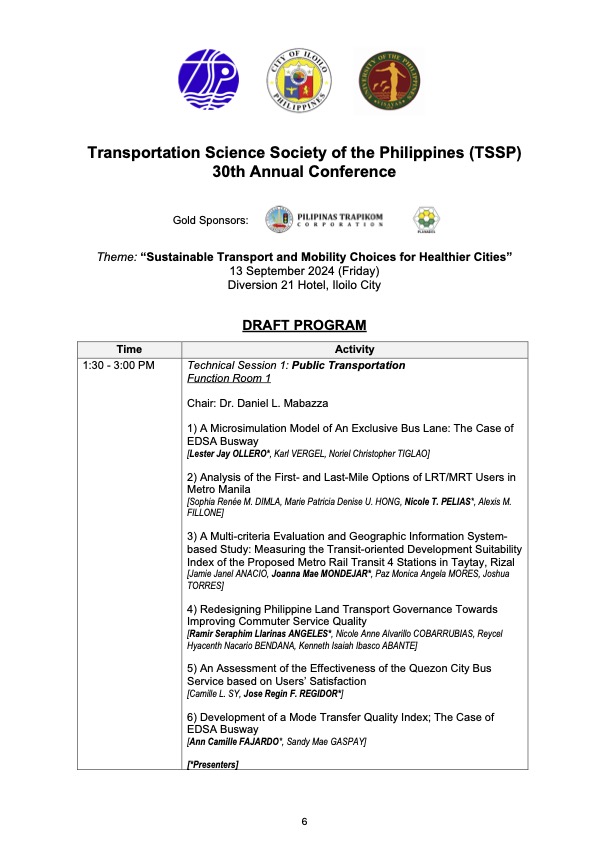
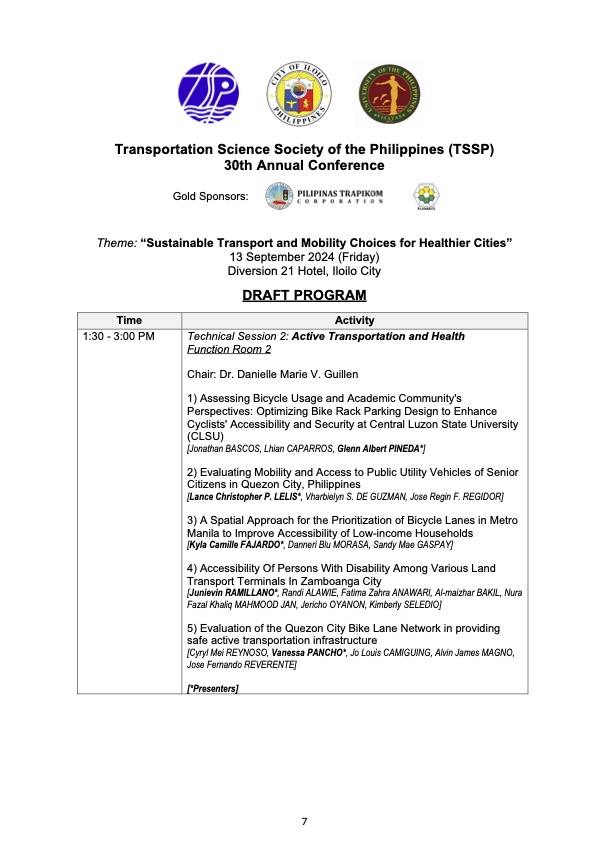
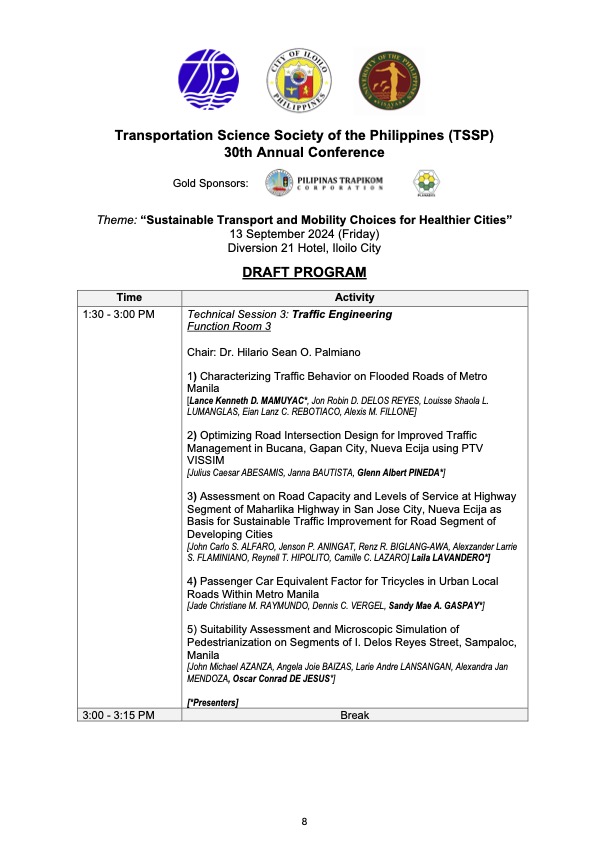
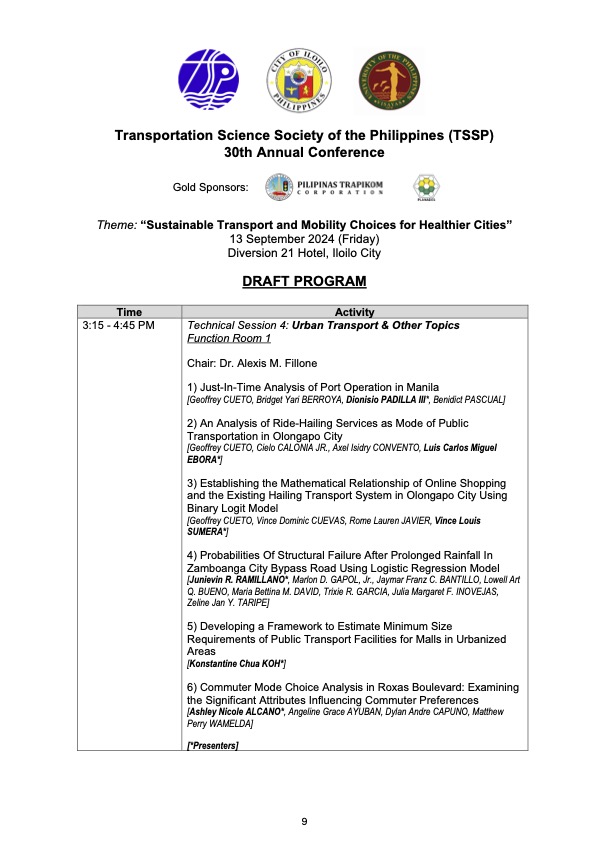
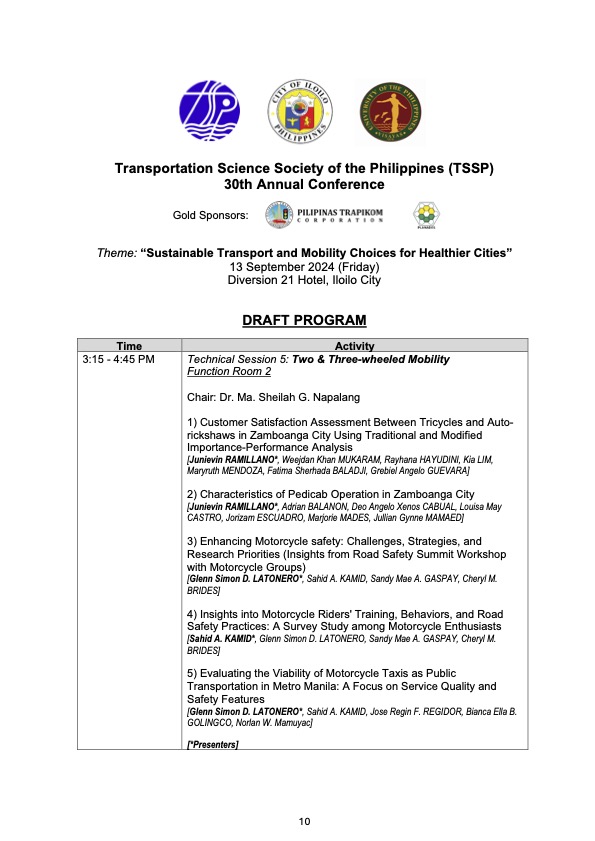
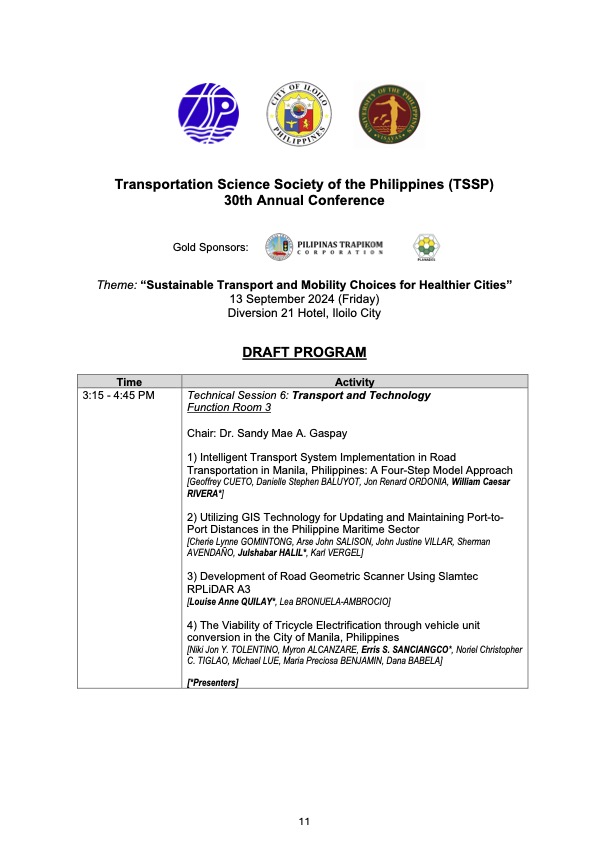
I will share the draft program for the morning plenary session in the next post.
–
On the current issue about 2 and 3-wheeled electric vehicles
Electric vehicles are again in the news due to the proposed policies regarding them that the government is planning to implement. These include banning them from national roads and requiring their registration as well as their drivers having licenses. While it seems simple enough to many, there are complexities involved here due to the provisions of a law incentivizing the e-vehicle adoption and use.
Most recently, the Electric Vehicle Association of the Philippines or eVAP released a statement regarding the proposed policies on electric vehicle use. Here is their press release, which is available from their official Facebook page:

I tend to agree with the eVAP statement more than the stand of other organizations or entities. Perhaps its because I know many people behind eVAP (at one time I was one of their advisers) and trust that their statement is based on informed discussions not just among themselves but their partners and cooperators among different sectors including the government.
–
29th Annual Conference of the TSSP
The Transportation Science Society of the Philippines (TSSP) held its 29th Annual Conference today, December 7, 2023. Following is the program for the conference, which featured a panel discussion in the morning and technical sessions in the afternoon.


This was the first mainly face-to-face or in-person conference for the society since 2019. Previously, the conferences were online. As reported in the concluding part of the program, there were 84 participants who showed up at the venue while there were 30+ participants who were online via Zoom.
There were a couple of awards at the conference. These were the Best Paper Award and the Best Presentation Award. The Best Paper Award, based on the scores garnered from the blind review of the papers went to:
Maria Belen Vasquez and Jun T. Castro of UP Diliman for their paper entitled “Exploring Travel Patterns of Mobility of Care in Guiuan, Eastern Samar: Assessment of Gender and Sociodemographic Factors Using Spatial Analysis”
There was a tie for the Best Presentation Award. The two were Ms. Vasquez for the presentation of the paper on the Mobility of Care in Eastern Samar, and Mr. Erris Sancianco for the presentation of a paper he co-authored with Noriel Christopher Tiglao, Niki Jon Tolentino, Gillian Kate Hidalgo, Mary Joy Leanda, and Lester Jay Ollero entitled “Evaluating the Fuel Efficiency and Eco-Driving Potential of the EDSA Carousel using On-Board Diagnostics (OBD) and Mobile Crowdsourcing“. These papers will likely find their way to the Philippine Transportation Journal’s next issue.
Though it was not announced, a likely venue for the next conference will be Vigan, Ilocos Sur in the Northern Philippines. The likely host will be the University of Northern Philippines, the premier state university in that province. Previously and most recently, the conference was held in Cebu City (hosted by the University of San Jose-Recoletos) in 2019 and before that in Cagayan De Oro City (hosted by Xavier University) in 2018. TSSP was already organizing the 2020 conference when the pandemic struck and the country went on a lockdown. That conference was supposed to have been held in Baguio City in Benguet, and to be hosted by St. Louis University.
More information on the conference may soon be found at the TSSP’s official website: https://ncts.upd.edu.ph/tssp/
–
The wrong message for electric and hybrid vehicles
There are two billboards along Katipunan Avenue, each displayed to face either the northbound or southbound traffic along the busy thoroughfare. The ad by a major Japanese automaker is a sales pitch for one of its electric vehicle models. The ad states one of the incentives or come-ons for electric and hybrid vehicles granted by government (in this case the Metro Manila Development Authority) to encourage people to buy electric or hybrid vehicles; ideally to replace their fossil fuel-powered vehicles.
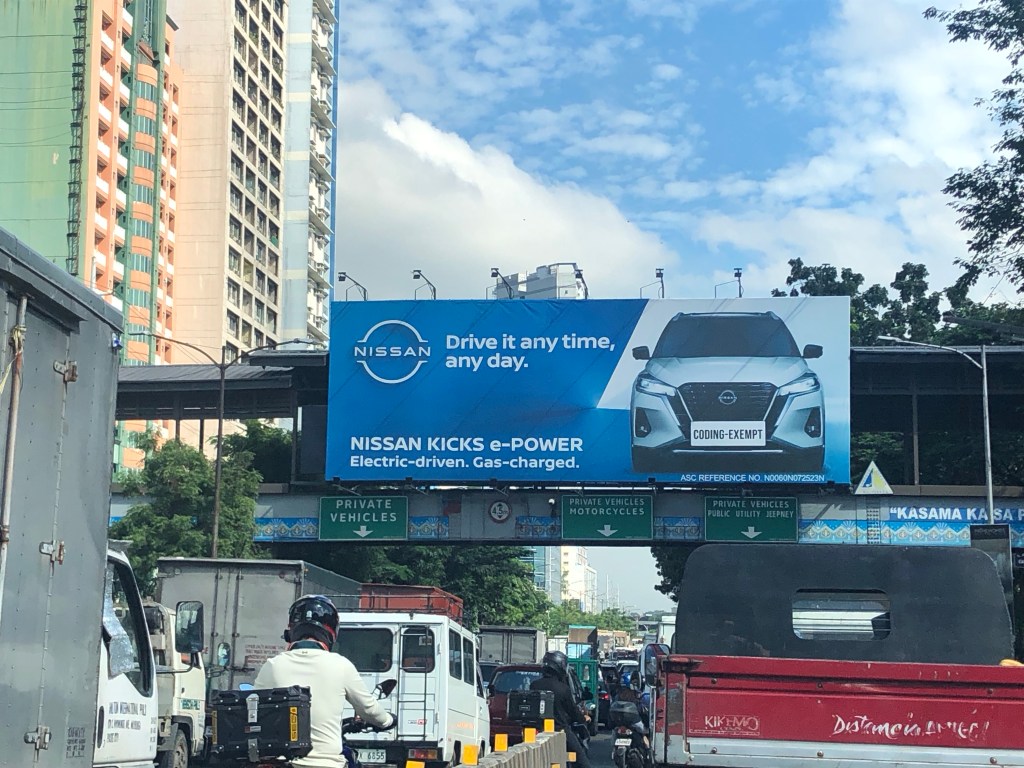 Electric and hybrid vehicles in Metro Manila are exempt from the MMDA’s number coding scheme. The ad is clear about that especially as a selling point for the vehicle featured.
At this point, more electric and hybrid vehicles would probably translate to more traffic congestion. They will just be replacing the conventional vehicles if not adding to them. The incentive will actually backfire vs. the MMDA since the number coding scheme will eventually be rendered ineffective (di pa ba?) with the addition of these coding-exempt vehicles.
–
Recent transport features of fast-food restaurants
We went to a McDonald’s drive thru a couple of weeks ago to get some food before picking up our daughter at her school. We decided to go a new branch along the way from the office and found a new feature at the fastfood chain’s parking area – electric vehicle charging stations. There were two slots where e-vehicles can re-charge while owners eat at the branch.
 Electric vehicle charging station at the new McDonald’s branch along Sumulong Highway (Mambugan, Antipolo)
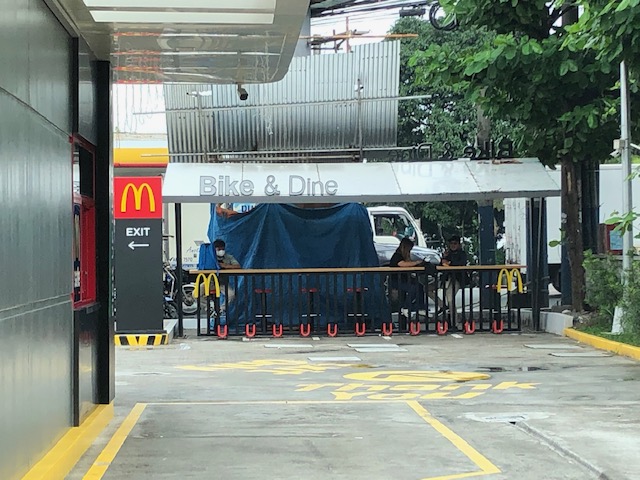 Bike dining station – you can park your bike at one side and have a comfy seat while eating and drinking on the other side
The bike and dine is not a new feature but one that McDo has installed in many of their new branches and retrofitted old one with during the pandemic. Still, we hope they have this in and the charging stations in most if not all their standalone branches. Of course, other chains should follow suit especially rival Jollibee, which has more branches and an even wider network of companies (e.g., Chowking, Greenwich, etc.) under it. This will help in promoting both cycling and e-vehicles.
–
On electric vehicles overshadowing public transportation
There seems to be much ado about electric vehicles. Here in the Philippines, there is much hype about hybrid and electric cars as incentives are now in place for people to purchase them at reduced prices and in Metro Manila at least, there is that additional incentive of these vehicles being exempted from the number coding (vehicle restraint) scheme. Here’s an article
Woodhouse, S. and Mohsin, S. (January 26, 2023) “EV Hype Overshadows Public Transit as a Climate Fix,” Bloomberg, https://www.bloomberg.com/news/articles/2023-01-25/public-transit-gets-left-behind-in-us-climate-change-conversation [Last accessed: 1/28/2023]
Some quotes from the article pretty much describes why we must focus on improving public transportation to increase or at least retain riderships:
“If we want to reduce carbon emissions we can’t just have technology-focused answers…
“Buses and trains have a fraction of the greenhouse gas impact of private cars, whether internal combustion or battery-powered, according to the International Transport Forum. A 2021 study from the National Academies of Sciences, Engineering, and Medicine concluded that the energy saved by passengers in the US using public transit rather than personal vehicles saved 63 million metric tons of carbon dioxide in 2018 — roughly the equivalent of taking 16 coal-fired power plants offline for a year…
“In the postwar era, the US prioritized building out its road network, leaving transit behind. For decades, highways and roads have consumed about 80% of federal transportation funding, with transit getting only 20%. In 2019 state and local governments spent $203 billion on highways and roads alone, with a quarter of expenditures coming from federal transfers. At the local level, continued car use is fueled by suburban development patterns and land-use practices like minimum parking requirements, which require developers to set aside space for vehicles. Outside of major cities, transit options are often limited, and historically low level of public support translate into poor convenience and reliability…
“We’re not going to be able to successfully fight climate change — and prevent more damage to the climate — without heavily investing in mass transit and specifically public transit.”
Here is something I shared last year:
https://d0ctrine.com/2022/09/16/on-bicycles-vs-self-driving-cars/
You’ve probably seen the image that evolved from the original comparison of 50 people on cars, bus and motorcycles from Munster, Germany. The variant is 50 people on conventional cars, 50 people on electric cars and 50 people on self-driving cars. That is another perspective (road capacity and congestion-wise) of how electric vehicles will affect traffic.
–
On electric vehicles and road safety
Electric vehicles are still basically motorized vehicles and should be treated so on the roads. While the previous models were slow and small, many of the newer ones coming out of the factories have similar performance features (e.g., speed, power, etc.) and dimensions as conventional vehicles. Many conventional models have electric or hybrid variants as companies attempt to attract customers using their tried and tested models and brands. BMW, for example, has electric sedans that are practically the same in interiors and exteriors with their conventional models. It is not surprising that vehicle safety researchers are now studying how electric vehicles fit into the road safety conundrum. I am sharing this brief but informative article that describes the efforts of the Insurance Institute for Highway Safety (IIHS) of the US in studying the EVs and safety:
Tucker, S. (December 27, 2022) “How electric cars are creating new challenges in car safety,” MarketWatch, https://www.marketwatch.com/story/how-electric-cars-are-creating-new-challenges-in-car-safety-11671646057?mod=technology [Last accessed: 12/29/2022]
To quote from the article:
“It’s comforting to know that EVs will face the same tests as gas-powered cars. But the fact that the IIHS worried it might need to build new equipment to accommodate them illustrates something important.
At the rate the auto industry is modernizing toward EVs, almost all of us will be driving them someday. But there will inevitably be an overlap period when some cars on the road are electric, and others are gas-powered.
In an accident, weight matters…
Crash tests can only estimate the likelihood of injury to someone inside the tested car. They can’t predict injuries in the other car. And we’re all about to share the roads with other cars that dramatically outweigh ours.”
–
On modified, fossil fuel kick scooters
You’ve probably seen one of these micromobility modes but take a closer look and you will notice a more spruced-up version of what you thought was an electric kick scooter (EKS). No, this one in the photos is not electric-powered but running on an internal combustion engine. It is a modified, fossil fuel-powered scooter.
 You can see the modifications on the scooter – the engine and the gas tank.
 These can be hard to detect for drivers or riders and can be risky at night time when visibility is a major factor for those using these vehicles.
I’ve seen these modified scooters along my typical commuting routes. They seem to be faster than the regular EKS. They also appear to have more power for uphill or climbing as I’ve seen these having no trouble ascending to Antipolo via Sumulong Highway or Ortigas Avenue Extension. As for maneuverability, I cannot really make an assessment except for what I’ve observed. But what worries me is that there are also reckless riders of these vehicles who tend to weave in traffic whether its congested or free flowing. If it’s difficult to anticipate the movement of motorcycles and bicycles along highways and streets, it’s even more with these scooters. But before you react and say that drivers and riders need to be slowing down (and all that jazz), remember that it takes two to tango. Even if you do slow down or practice safe driving or riding, if that other person will be reckless then there will be an increased likelihood for a crash to happen.
–
 Caught (up) in traffic