
Home » Electric Vehicles (Page 3)
Category Archives: Electric Vehicles
On bicycles vs. self driving cars
You’ve probably seen this graphic, the top part of which is attributed to the Cycling Promotion Fund. The last image is reproduced in the lower part of the image but labeled to emphasize what space is required to transport 48 people on electric cars and autonomous or self-driving cars.
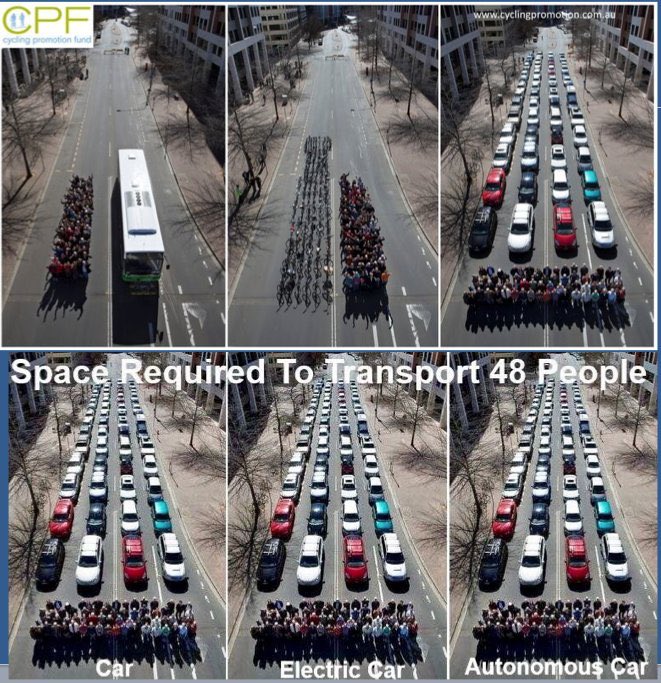
It is quite obvious that even if the current fleets of cars are replaced by electric and self-driving models, they will practically be the same problem in terms of road space occupied and the resulting congestion. So perhaps e-cars or autonomous cars are not really the solution we are looking for.
There is this nice article where the author articulates the how bikes (and active transport in general) should be the a more essential part of future transport and society than the automobile:
Collignon, N. (September 9, 2022) “Bikes, not self driving cars, are the technological gateway to urban progress,” Next City, https://nextcity.org/urbanist-news/bikes-not-self-driving-cars-are-the-technological-gateway-to-progress [Last accessed: 9/16/2022]
There are two quotable quotes from the article that I want to highlight here:
“Today the potential benefits from cycling on health, congestion, pollution and CO2 emissions are crystal clear and increasingly quantifiable, but the benefits of self-driving vehicles remain hazy. When ride-hailing companies like Uber and Lyft promised lower congestion and reduced car ownership, they instead increased congestion and led to a decline in transit ridership.”
and
“The concept of “jaywalking,” for example, is integral to the “car technology” of today. The crime of crossing a street without respecting the dominance of cars was invented by the car industry in the 1920s, who pushed hard to define streets as a place for cars, not people. Our car technology today is also defined by the restriction of movement it imposes on people.
When we begin to see technology through the lens of systems, it becomes clear that genuine technology-led progress will focus on dealing with the accelerating complexity of today’s world, not increasing the complexity of our tools.”
–
On micro transit and transportation gaps
I’ve written and shared articles before on how Paratransit, bicycles and micro transit helps alleviate the transport demand problems we are experiencing especially in highly urbanized cities. I think we should have as many options as possible for transport while also working towards the reduction of dependence on cars. Here’s an article that relates about experiences in the US:
Zukowski, D. (September 13, 2022) “Cities turn to microtransit to fill gaps in public transportation,” Smart Cities Dive, https://www.smartcitiesdive.com/news/microtransit-public-transportation-gaps-jersey-city-via/631592/ [Last accessed: 9/15/2022]
To quote from the article:
“Microtransit options are also helping to reduce the reliance on personal cars. “We’ve received feedback from people who say that because of Via they are now more consistently leaving their personal vehicle at home and using Via instead to travel within the city, which is exactly the kind of thing we want to see happen,” said Jersey City’s Patel.”
This final statement or paragraph in the article sums it up very well. Of course, we have to note that the experience in Asia is quite different especially in Southeast Asia where motorcycles are very popular and still on the rise in terms of their mode shares. While these may be considered micromobilities in western countries, they are definitely motorized private vehicles that, depending on how they are used and how the rider behaves, may be beneficial but at the same time also very dangerous for people.
–
On electric vehicles and informal transport
I’ve been involved in studies on electric vehicles and their applications in the past. I continue to take part in studies about informal transport including continuing research on motorcycle taxis or “habal-habal” as they are called in the Philippines. The combination of the two is an interesting research area and there are many topics that can be developed as we determine the most appropriate applications for electric vehicles. Here is an interesting article on electrifying informal transport that sets the context for research:
Ribet, L. (August 30, 2022) “The role of data in electrifying informal transport,” Slocat partnership, https://slocat.net/the-role-of-data-in-electrifying-informal-transport/ [Last accessed: 9/9/2022]
To quote from the article:
“However, electric two-and-three wheeler startups, informal transport retrofitting pilots and e-bus initiatives cannot be the only answer to the mobility challenges facing developing cities. Phasing out oil-reliant public transportation is needed and investing in electric mobility solutions may well improve the overall picture quite substantially, but there is a far larger challenge that is omitted from these ambitions: addressing the complex operations of informal transport systems that characterise lower-income countries’ urban mobility. Electrifying minibus taxis is not synonymous with more reliable, affordable and convenient public transport, and we need to prioritise the understanding and improvement of overall informal transport systems data first.”
–
How can e-scooters become a safer way to travel?
I’ve shared some articles and opinions about electric scooters. Here is another one that delves into the safety about these vehicles that have become quite popular in the US. Here in the Philippines, they still seem to be in infancy in terms of popularity and to some, are seen as more a novelty and touristy rather than a mode of transport for the typical work trips.
Donahue, B (June 11, 2022) “How to Make Electric Scooters Become a Safer Way to Travel,” Bloomberg, https://www.bloomberg.com/news/features/2022-06-11/how-to-make-electric-scooters-safer [Last accessed: 6/18/2022]
To quote from the article:
“Dediu believes that in time micromobility will attain critical mass, as other modes of transit have already done, and that infrastructure will come as the user base grows. “We didn’t build airports and then have airplanes show up,” he’s said. “I’m confident, given the history, that we’ll see things like more safe roadways for micromobility vehicles.” “
 Scoot-to-work at BGC, Taguig, Metro Manila
It is not really about the vehicle but the environment in which it is being used. One can say a lot about walking, for example, being dangerous but without touching on the why and the how its become a dangerous or risky mode of travel. It’s the lack of infrastructure or facilities as well as the car-oriented environment (that includes archaic laws and other regulations) that make active mobility and micro mobility modes dangerous or risky. If we can address these basic issues, then perhaps we can entice more people to use these modes more often and for the most trips we make everyday.
And don’t forget that these modes are the most fuel efficient! Saves you from the every increasing prices of fuel!
–
On electric vehicles not being the fix we need for transport
Much has been said and written about how electric vehicles could be the game changer for transport. Those include supportive material and also those that are more critical and provide different perspectives to EVs. Here is another article that discusses EVs in the context of the avoid, shift, improve framework:
O’Riordan, V. (November 30, 2021) “Electric vehicles aren’t a fix for carbon emissions. These 3 things need to change—fast,” Fast Company, https://www.fastcompany.com/90700832/electric-vehicles-arent-a-fix-for-carbon-emissions-these-3-things-need-to-change-fast [Last accessed: 12/17/2021]
There’s a recent article about the environmental impacts of manufacturing EVs including the batteries used by these vehicles. I will share that in another post.
–
On e-scooters
One of the so-called new mobility modes is the e-scooter. It is categorized as a micro mobility mode and in appearance is no different from a kick scooter with the difference lies in the former being motorized. Not all are powered by electric motors as I’ve seen ones that are gas-powered (small internal combustion engines). The latter are noisy and have emissions but seem to be more powerful especially when encountering inclined road sections (e.g., going up to Ortigas Center from C5, going up to Antipolo). Some seem to be customized for more power as I’ve seen motorcycle shops doing what looks like modifications and not just repairs.

I’m sharing an article below about e-scooters and their involvement in road crashes in Europe:
Meaker, M. (December 7, 2021) “E-scooters are everywhere in Europe. So are grisly accidents,” Wired, https://www.wired.com/story/escooters-accidents-europe/?bxid=5bd6761b3f92a41245dde413&cndid=37243643&esrc=AUTO_OTHER&source=EDT_WIR_NEWSLETTER_0_DAILY_ZZ&utm_brand=wired&utm_campaign=aud-dev&utm_content=WIR_Daily_120721&utm_mailing=WIR_Daily_120721&utm_medium=email&utm_source=nl&utm_term=P4 [Last accessed: 12/9/2021]
I think the proverbial jury is still out there in as far as these vehicles are concerned. Safety-wise, there should be concern if users speed up and zig-zag through traffic. These are the same concerns in the European cities mentioned in the article. Personally, I don’t see these vehicles gaining as much popularity for typical commutes compared to the bicycle, which has seen a surge in use during this pandemic and with bike lanes (pop-up and permanent) in place in many areas. These same bike lanes are now also being shared by these e-scooters. I think more people will opt for the motorcycle, which comes in different sizes and engines, and which provides more in terms of versatility of use. But again, there are risks involved here and perhaps some e-scooter users are mimicking the undesirable, risky motorcycle rider behavior. Are they e-scooter users to be regarded and treated as drivers or riders considering they are using motorized vehicles? Perhaps the government should be working on this and other relevant, current policy (if not regulations) to e-scooter use.
–
On ‘electric cars’ still being ‘cars’
With the current climate talks in the background, there is also a parallel discussion on the impacts of electric vehicles and self-driving cars. Will they help solve our transport or traffic problems? Perhaps e-cars will contribute to the reduction of emissions and greenhouse gases. Perhaps they can also help in reducing dependence on fossil fuels. But can they alleviate congestion? Or will they just promote more car-dependence? Here’s a nice article from early this year that discusses the “big problem” with electric cars:
I also read another article about the issues concerning the batteries (e.g., lithium batteries) used by these e-vehicles. We are only beginning to see how difficult it is to deal with the waste of used batteries not just from e-vehicles but from other sources as well. Renewables like solar, for example, requires batteries for storage. These are issues that need to be addressed ASAP. Otherwise, it will be a losing proposition for people in general as they end up with modes of transport that are not sustainable for the future. Perhaps we can just walk or bike?
–
On electric vehicles in the Philippines – current situation and prospects
Here’s a quick share of an article on electric vehicles in the Philippines:
Fernandez, H.A. (September 7, 2021) “Electric vehicles in the Philippines: a mottled green solution,” Eco-Business, https://www.eco-business.com/news/electric-vehicles-in-the-philippines-a-mottled-green-solution/ [Last accessed: 9/8/2021]

It is interesting that the article cites past studies that covered not just e-vehicles but the bigger picture for transport. I think most if not all people who were doing work on low carbon transport including the modeling of scenarios for the long term were not able to anticipate something like Covid-19 disrupting activities around the world and curbing emissions so drastically in the last year. The so-called ‘old normal’ situation has not returned but some say that even with the pandemic affecting transport, we still won’t be able to attain the targets necessary to stave off global warming. The bottomline is that we need more aggressive actions and probably, shifting to e-vehicles is one of those that combined with others will help achieve targets.
–
On defining the 15-minute city
I have shared articles and briefly written about the concept of the 15-minute city on this blog. Here is another discussing how a 15-minute city is defined:
(February 8, 2021) “Defining the 15-minute city,” Public Square, https://www.cnu.org/publicsquare/2021/02/08/defining-15-minute-city [Last accessed: 8/10/2021]
Here is an image from the article:
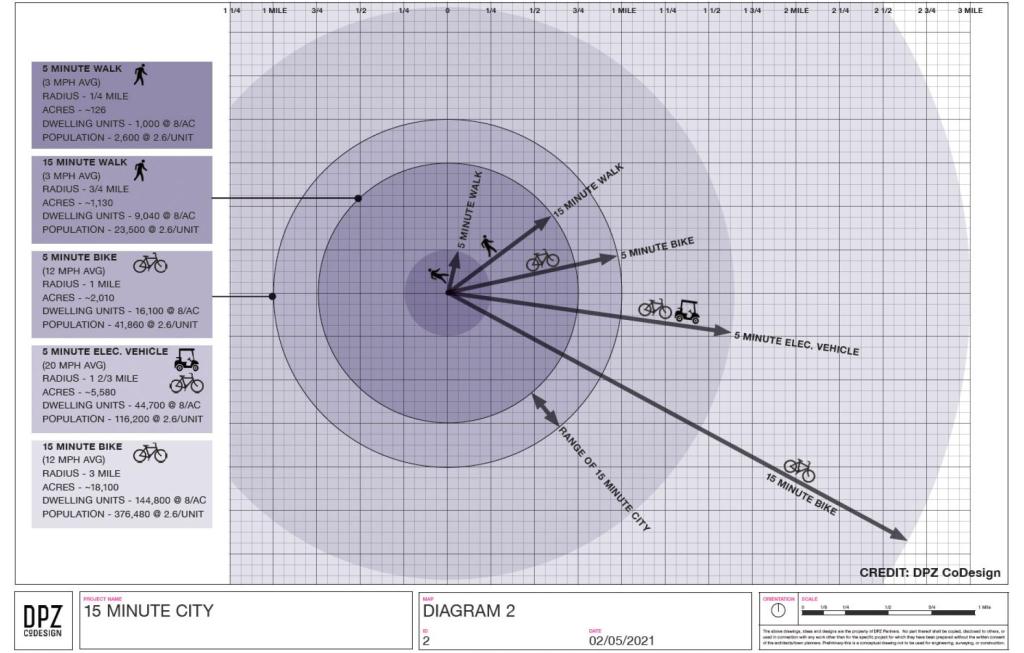
Again, it is important to contextualize these concepts. I share these as references and topics for discussion. Of course, I have my own opinions about this and I have written about those in previous posts. I guess in the Philippine context, we can include the pedicab or non-motorized three-wheelers in the discussion. These are also very popular modes in many cities and municipalities despite their being also prohibited along national roads like their motorized counterparts. It would be nice to have more visuals in the form of maps that show travel times for essential destinations or places like hospitals, markets, grocery stores, workplaces and, of course, homes. I assume there is at least someone, somewhere who perhaps have made multi-layer maps of this sort and attempted to related them along the lines of this concept of a 15-minute city (or perhaps the even older “compact cities”).
–
Article on the new mobilities
Here’s a quick share of an article on what is described as the new mobilities:
Litman, T. [June 30, 2021] “Planning for New Mobilities: Preparing for Innovative Transportation Technologies and Services,” Planetizen.com, https://bit.ly/2U99Hlw [Last accessed: 7/3/2021]
What exactly are these new mobilities? To quote from the article:
“New Mobilities
- Active Travel and Micromobilities. Walking, bicycling, and variations, including small, lower-speed motorized vehicles such as electric scooters, bikes, and cargo bikes.
- Vehicle Sharing. Convenient and affordable bicycle, scooter, and automobile rental services.
- Ridehailing and Microtransit. Mobility services that transport individuals and small groups.
- Electric Vehicles. Battery-powered scooters, bikes, cars, trucks, and buses.
- Autonomous Vehicles. Vehicles that can operate without a human driver.
- Public Transport Innovations. Innovations that improve transit travel convenience, comfort, safety, and speed.
- Mobility as a Service (MaaS). Navigation and transport payment apps that integrate multiple modes.
- Telework. Telecommunications that substitutes for physical travel.
- Tunnel Roads and Pneumatic Tube Transport. New high-speed transport networks.
- Aviation Innovation. Air taxis, drones, and supersonic jets.
- Mobility Prioritization. Pricing systems and incentives that favor higher-value trips and more efficient modes.
- Logistics Management. Integrated freight delivery services.”

–
 Caught (up) in traffic