
Home » Electric Vehicles (Page 4)
Category Archives: Electric Vehicles
On the safety of e-scooters
There’s recent news about the Department of Science and Technology (DOST) launching a smart scooter system in Cauayan City, Isabela. This should be considered a positive thing in light of the scooter’s sudden popularity as a mode of transport. There are, however, much to be determined in terms of this vehicle being a safe mode of transport. Singapore, for example, has released guidelines for its use in its streets while there have been mixed reactions among American cities on how these vehicles should share spaces with other modes including walking and cycling. Here is a nice article about scooter safety that should point the way towards how we should go about in assessing safety:
Chang, A.Y.J. (2020) Demistifying e-scooter safety one step at a time, https://medium.com/@annieyjchang/demystifying-e-scooter-safety-one-step-at-a-time-956afcf12d75 [Last accessed: February 3, 2020]
As a parting shot in other cases, I have always asked: Would this have been an issue or a popular mode if we had good public transportation as well as decent pedestrian and cycling infrastructure? The answer could be a simple ‘no’ for our case in the Philippines where much is to be desired in terms of PT, pedestrian and cycling infra. But e-scooters seem to have attractive quite a few in developed cities including those with good PT, pedestrian and cycling infra. The jury is still out there if this was just a fad or perhaps, as some claim, part of the evolution for improved mobility.
–
National Transport Policy is out!
The National Transport Policy is out and there’s a lot of buzz about the wording of the policy. NEDA released the following infographics on their official Facebook page:
 Definition of what the policy is about
 Hierarchy of transport modes (note the emphasis on walking and cycling)
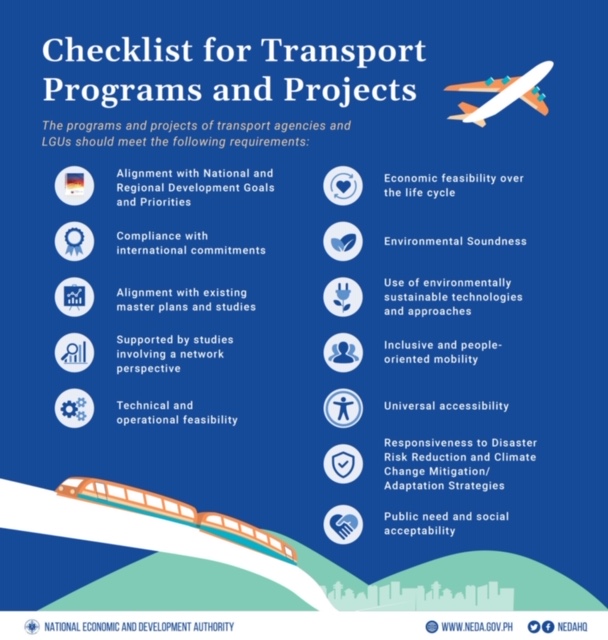 Checklist for programs and projects: I am already anticipating what proponents will be writing to justify projects according to this checklist.
I will reserve my commentaries for future blogs. There is really a lot to discuss about this policy and how it will implemented (properly or improperly), There are lots of different ideas, advocacies, interests and agendas on transportation that come into play here. And we can only hope that the policy and its implementing rules and regulations will be clear enough (not vague as to have so many loopholes) for this policy to effect transformation and inclusive and sustainable development.
–
New publication on urban transport by ITDP and UC-Davis
There is a new publication on urban transportation from Institute for Transportation and Development Policy (ITDP) and the University of California-Davis. The link may be found here:
Three Revolutions in Urban Transportation

The content reminded me of similar exercise we did back in 2013-2014 for ASEAN where we did visioning and simulations for low carbon transport in the region by 2050. Electrification was a major assumption for the Philippine case as electric vehicles were gaining ground (they seem to be in a limbo now) back then and on the verge of a breakthrough. Not yet evident for the Philippines was the eventual rise of sharing, and though the idea is out there, automation seems to be too high tech for the country (even Metro Manila) for now.
–
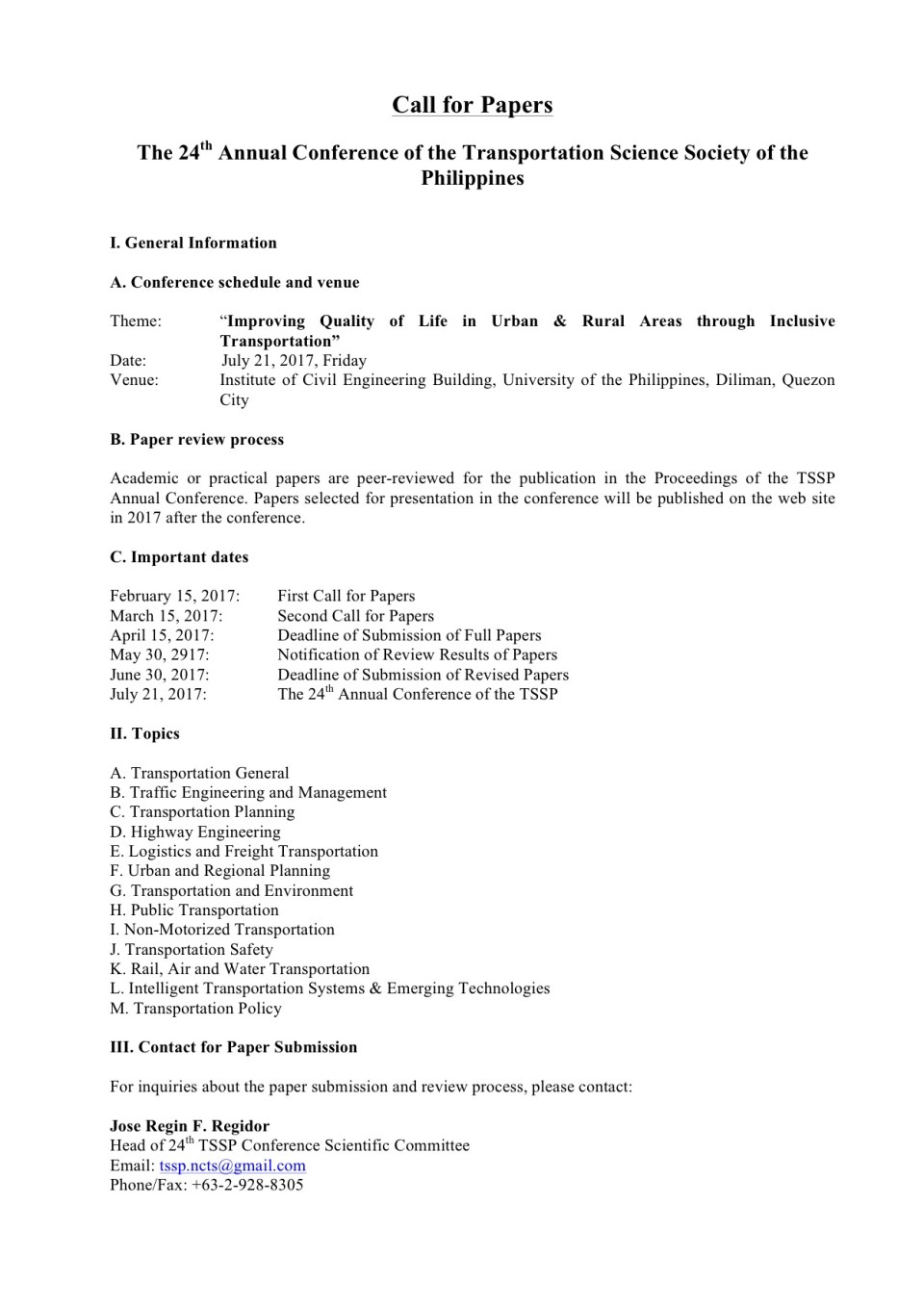
First call for papers for the TSSP 2017 conference
The first call for papers for the 24th Annual Conference of the Transportation Science Society of the Philippines came out last Wednesday, Feb. 15:
–
Research topics for transportation engineering and planning for 2016-2017?
I observed from my site’s statistics that there have been a lot of interest on research topics in transportation engineering and planning. I regularly post on the undergraduate research topics our students have engaged in. At this point in the first semester of the current 2016-2017 academic year, topics have not yet been assigned and we have only learned how many students have been assigned to our research group. As such, we are still in the process of determining who takes on which topic. Following are topics we have identified in addition to those that had no takers the previous semesters:
Traffic engineering
- Anatomy of congestion along EDSA
- Anatomy of congestion along C-5
- Segregated lane for motorcycles
- Impacts of the MMDA’s truck lane policy along C-5
- Congestion study in the vicinity of UP Town Center
- Assessment of through traffic for the UP Diliman campus
Public transportation
- Connectivity study for UP AGT and MRT 7
- Feasibility of bus services beyond Masinag junction
- Characterization of Internal Public Transportation Operation in UP Diliman and Viability of Introduction of Electric Vehicles
- Modelling the Public Transport System of UP Diliman Campus Using CUBE Travel Demand Software
- Estimation of Passenger Demand for New Transit System for UP Diliman Using Discrete Choice Model
- Characteristics of motorcycle taxis in the Philippines [Habal-habal, skylab, etc.]
Road safety
- Severity of injuries of motorcycle riders (helmet and non-helmet users)
Pedestrian & non-motorised transport
- A study on walkability along Ortigas Avenue
- A study on the characteristics of bike share users in the UP Diliman campus
Transport & Environment
- Assessment of Roadside Air Quality along C.P. Garcia Avenue in the Vicinity of UP-ICE Compound
Other topics
- Study on the mobility of PWDs in Metro Manila
- Assessment of ridesharing in the context of sustainable transport
I’m sure there are other topics but I’m not aware of the specifics at present. Also, we welcome the ideas of our students should they already have topics in mind as long as these preferably fall under the research agenda of our Institute. The topics listed above may appear to be specific but these are still basically very general and can be refined after the students establish their scope and limitations. They can only do that once they have undertaken a decent enough literature review for them also to have a more firm appreciation of their chosen topics. I will post again on this later this year when students would have already put in substantial work on their research proposals (i.e., the objective for this semester).
–
Mainstreaming e-trikes?
The big news on electric vehicles in the Philippines today is about what the City of Manila has announced as a phaseout of tricycles and pedicabs (i.e., motorized and non-motorized three-wheelers):
Manila will say goodbye to old school tricycles and pedicabs on October 15
According to the article, these will include conventional tricycles, kuligligs (bicycles fitted out with motors or generators + sidecar), and pedicabs. Manila has thousands (about 25,000 according to the article) of these plying roads where they are not supposed to be (tricycles and pedicabs are prohibited by law from traveling along national roads especially as public transportation). From the article, it seems to me that the date mentioned will be the start for a pilot in the Binondo area. No details are given as to how exactly the local government of Manila will be going about replacing 25,000 tricycles, kuligligs and pedicabs with 10,000 e-trikes, including how the e-trikes will be financed and what will happen to the phased out tricycles and pedicabs. We are, however, hopeful that Manila will be successful and perhaps be a model for other LGUs to emulate.
–
Latest model electric jeepney
In case my readers missed my feature on the recent electric vehicle summit hosted by Meralco, here are a few photos of the latest model of the electric jeepney. Note the passenger door is no longer at the rear but at the side across from the driver. They have also added a distinctive snout to the vehicle. This model is the latest from PhUV, which also manufactures electric tricycles.
 Profile of the electric jeepney currently in use for a Department of Energy-funded project being undertaken jointly by the National Engineering Center (NEC), the National Center for Transportation Studies (NCTS) and the Vehicle Research and Testing Laboratory (VRTL) of the Department of Mechanical Engineering; all of the University of the Philippines Diliman.
 A peak at the interior shows the passenger seats in bench layout and a more generous headroom for passengers.
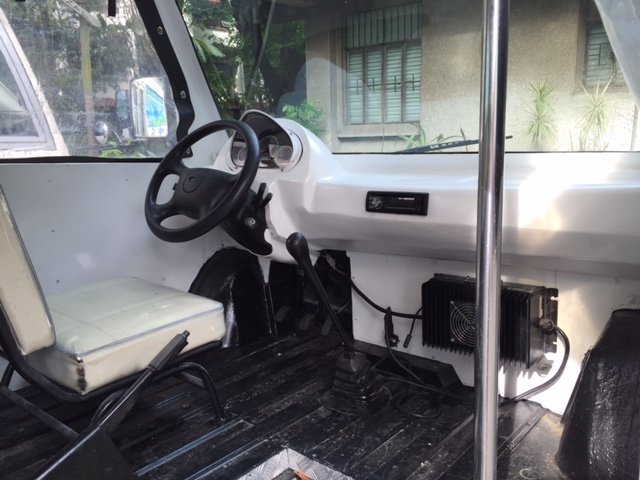 Driver’s seat and panel. There is space to install fare collection machines like the ones that can enable the use of BEEP cards by passengers.
 E-jeepney front showing the distinctive face from its conventional ‘ancestors/predecessors’. A colleague noted that perhaps the manufacturer should add some accessories like horses or airplanes on the hood.
This model is already similar in size with the big COMET electric jitneys. They also run on a more powerful electric motor that will enable these vehicles, according to the maker, to climb slopes like those along the route of Antipolo jeepneys. We hope that this design gets mainstreamed (read: replace conventional jeepneys) along the many existing jeepney routes not just in Metro Manila but in other cities as well.
–
Electric vehicle deployment in the Philippines
Electric vehicles have been around in the Philippines for quite some time now. Most of these have been electric 2- and 3-wheelers with electric tricycles or e-trikes being the most visible. Of course, there are also electric 4-wheelers in the form of jitneys or e-jeeps. The electric vehicle wave has not caught on with private transport with the exception of those who bought electric scooters or motorcycles (but these are few and are not in significant numbers compared to those using conventional motorcycles).
The following map from the Electric Vehicle Association of the Philippines (EVAP), the organization of e-vehicle manufacturers, importers and advocates in the country. It shows where electric vehicles are operating, what kind of vehicles and the manufacturer for the model in use in those places.

This is not a comprehensive rendering of the presence of e-vehicles throughout the country as there are also e-trikes and e-jeepneys in many other cities and towns as well. Perhaps EVAP only illustrated where e-vehicles have made significant strides or presence. I believe that with the right conditions including policies, incentives and infrastructure, e-vehicles will continue their rise among transport in the Philippines. Energy mix aside, e-vehicles have a great potential to reduce air pollution and noise, reduce fossil fuel consumption, and also has a potential to reduce road crashes. Cheaper operating costs from e-vehicles can also help increase income (i.e., take home pay) of public transport drivers and operators. It would be nice to find champions for electric vehicles in the incoming government especially from the heads of agencies like the Department of Transportation and Communications (DOTC), the Department of Interior and Local Government, the Department of Trade and Industry (DTI), the Department of Environment and Natural Resources (DENR), and the Department of Energy (DOE), among others that have a direct hand in transforming our fossil fuel dependent transport sector to an environment-friendly one.
–
Electric vehicle models at the 5th Electric Vehicle Summit – Part 2
I already featured a lot of the electric vehicle models that were on display at the 5th EV Summit and this second part adds to those in the Part 1. There are some new models in the following photos including a mini-bus model that features a lot of doors and a similarly-designed jitney model. I took photos of the interiors as well to give the reader an idea of the layout of these models and perhaps imagine how they could fit as potential public utility vehicles.
 Electric minibus model
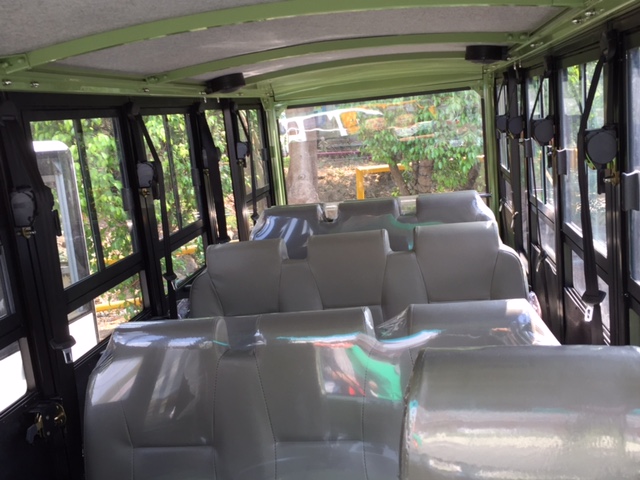 Interior of the minibus showing rows of seats
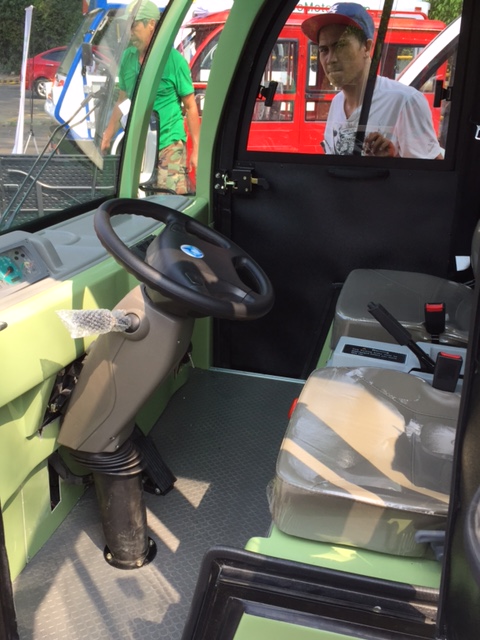 Driver and front seats
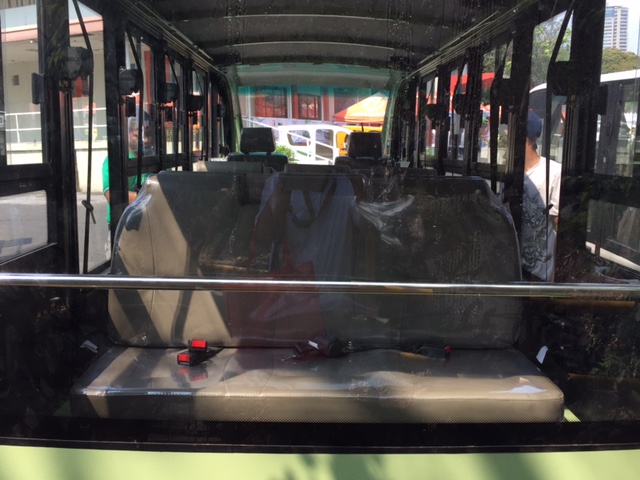 Rear seats facing the back instead of the front – the large window gives passengers a nice clear view of following vehicles, among others.
 The minibus had many doors (8 total) to allow passengers to board and alight from each row.
 Front of the mini-bus featuring a single large wiper
 Jeepney-sized version of the minibus also featured multiple side doors (6 of them for this vehicle).
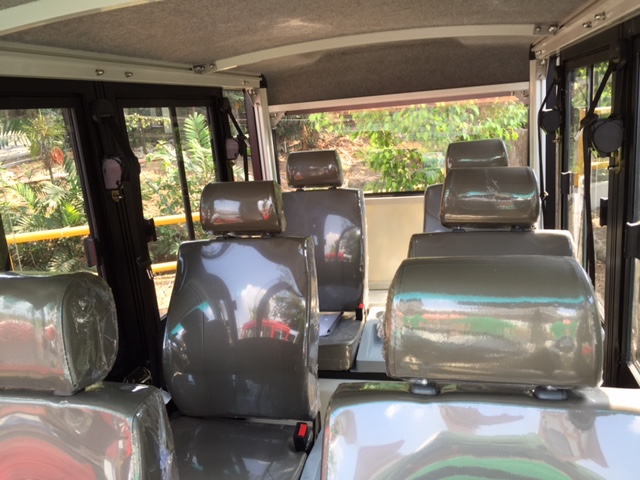 Seats inside the jitney
 Dashboard and steering wheel of the electric jitney
 Another look at the latest model of the electric jeepney
 The door is at the curbside
 Driver’s seat
 Bench seat layout for the e-jeepney
 Front view of the e-jeepney featuring a pronounced and familiar snout
 Setting up for display and demo
 Star8’s e-trike model featuring a side door instead of one at the rear
 Bench seat layout for Star8’s e-trike
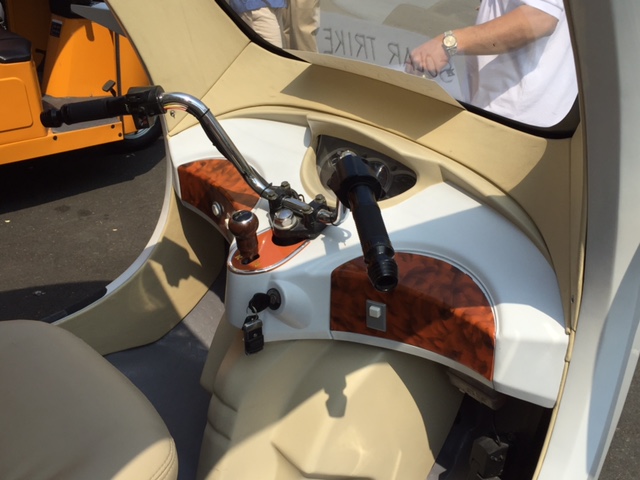 Dashboard and driver seat for the Star8 e-trike
 Star8’s tuktuk design for the e-trike
The variety of electric vehicle models and the increase in the number of industry players is encouraging. Interest in electric vehicles have steadily increased over the past half decade. Perhaps the government should have a stronger role as catalyst or enabler for this industry to flourish and perhaps transform not only the public transport scene but also for people to adopt e-vehicles for private use. This can only be done if the proper incentives are in place that include policy, fiscal and financial instruments favoring electric vehicles as well as their hybrid relatives. These will go a long way towards a low carbon transport future for the country.
–
Electric vehicle models at the 5th Electric Vehicle Summit – Part 1
The 5th Electric Vehicle Summit was held last April 14-15, 2016 at the Meralco Multi-Purpose Hall. Following are photos I took at the summit where many current electric vehicle models were on display and demonstration. Many of the photos show variants of the electric tricycle designs from various manufacturers that conform with the design promoted by the Asian Development Bank (ADB). These are basically in the form of the Thai tuktuk and similar to Cagayan De Oro’s motorella.
 Go Electric e-trike by ToJo Motors
 E-trike model by Clean Air Transport Solutions, Inc.
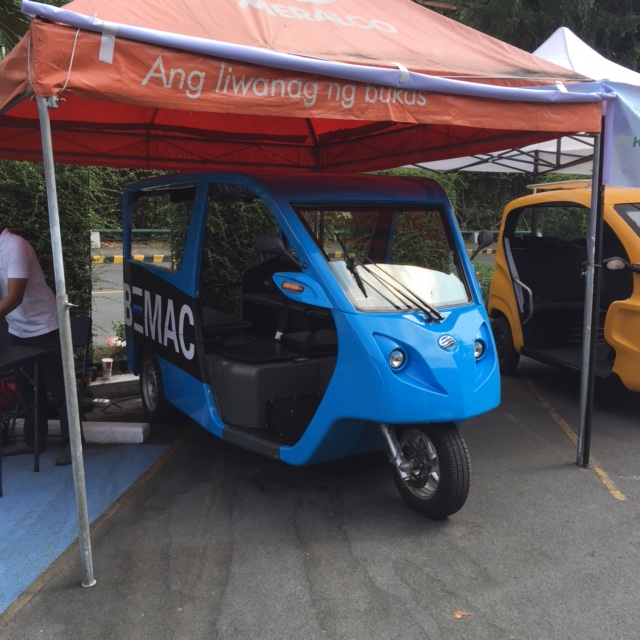 BEMAC e-trike model – the company recently landed a big contract to produce e-trikes.
 E-trike by Kyto Green Technologies Co., Ltd.
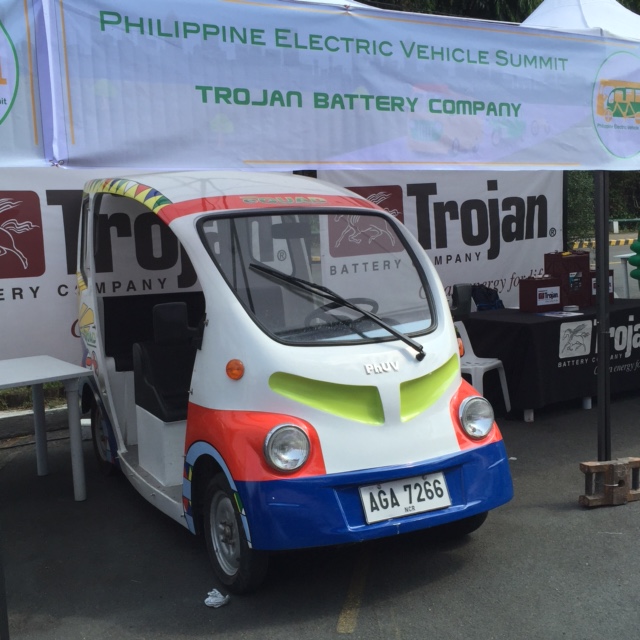 Electric car (4-wheeler) by PhUV powered by Trojan batteries
 E-trike model by Green Mobility Service
 PhUV’s e-trike variants
 E-trike and charging station by KEA
 Exhibitors setting up their booths and electric vehicles
 Conventional vehicle converted into electric by Le Guider International
 E-trikes by Guider Power
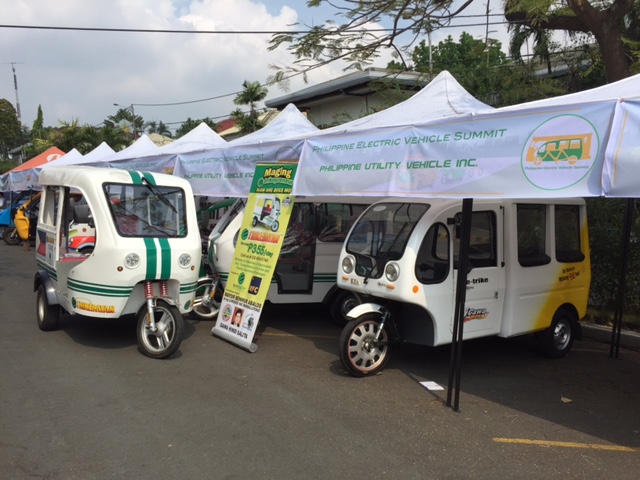 Another look at PhUV’s e-trikes
 Electric motorcycles by Alternative Energy Trailblazer, Inc.
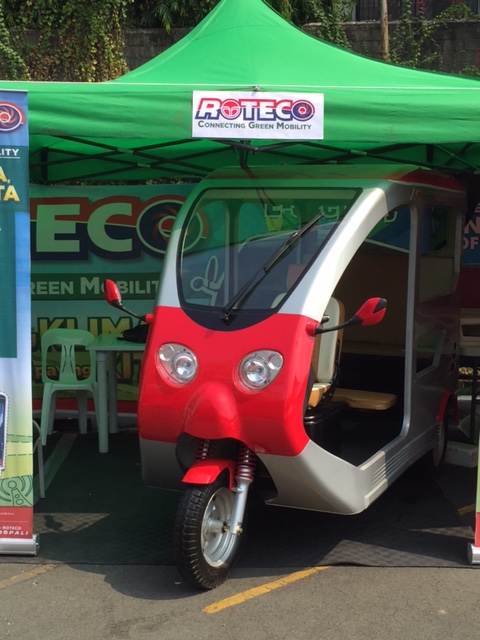 E-trike by Roteco
 SunE-trike and Roteco booths at the summit exhibition area
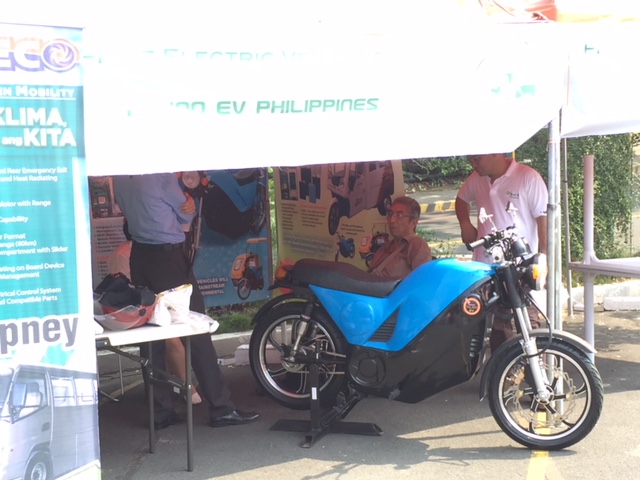 Sporty electric motorcycle model by Talino EV – this can be paired with a sidecar to serve as an e-trike.
 The ToJo Motors booth
 Electric vehicles powered by solar energy by Star8
 E-vehicle models by Clean Air Transport Solutions, Inc.
 Latest model e-jeepney by PhUV featuring side door and a higher ceiling
To be continued…
–
 Caught (up) in traffic