
Home » EST (Page 13)
Category Archives: EST
The case for bike lanes
There is a strong push for more bike lanes to be developed along both major and minor roads. Many pop-up bike lanes that were implemented and permanent bike lanes constructed in 2020, mostly during the lockdowns, to address the needs of ‘frontliners’ who opted to bike to work have been retained and even upgraded to adhere to guidelines issued by the DPWH. While these bike lanes are not yet as comprehensive as desired and most are not the protected types, recent developments have threatened their existence and consequently the safety of cyclists (especially bike-to-work) and the promotion of cycling as a primary mode of transport.

We need to transform our streets where it is possible in order to take advantage of the increasing popularity of cycling that has convinced some people to select cycling at least for their last mile trips and hopefully for the most part(s) of their commute. From a transport planning perspective, we should also determine if these mode shifts can be sustained and perhaps increased with proper integration of public transport and active transport thrusts.
The recent removal of protected bike lanes or barriers that serve to protect cyclists using the lanes in some cities are examples of regression rather than progression. These come as a surprise as these cities have made leaps and bounds so to speak in developing their bike lane networks. Where did the orders to do so originate and are staffs of these cities communicating, discussing and coordinating these actions? Apparently, there are internal conflicts and perhaps, I dare say here, politics involved. It is also possible that within LGUs, the concepts, visions and plans for transportation are not harmonized or understood making one project by one clique unacceptable to another or others. I know from personal experiences that LGU traffic engineering & management and operations staff are often not in synch with their planning counterparts. This is not and should not be a given since both need to collaborate in order to address transport and traffic issues that need more comprehensive and progressive approaches compared to what have been practiced before.
LGUs cannot rely on strategies and tactics that are along the lines of “ganito na ginagawa noon pa” or “ganito na inabutan ko”, which only proves these were ineffective (i.e., why not try other techniques, methods or strategies instead?). Transformations and paradigm changes to solve transport problems cannot be achieved by denying the change, innovation or new ideas required for emerging as well as persistent issues/problems.
–
On electric vehicles not being the fix we need for transport
Much has been said and written about how electric vehicles could be the game changer for transport. Those include supportive material and also those that are more critical and provide different perspectives to EVs. Here is another article that discusses EVs in the context of the avoid, shift, improve framework:
O’Riordan, V. (November 30, 2021) “Electric vehicles aren’t a fix for carbon emissions. These 3 things need to change—fast,” Fast Company, https://www.fastcompany.com/90700832/electric-vehicles-arent-a-fix-for-carbon-emissions-these-3-things-need-to-change-fast [Last accessed: 12/17/2021]
There’s a recent article about the environmental impacts of manufacturing EVs including the batteries used by these vehicles. I will share that in another post.
–
On roadway expansions and induced demand
We start December with another shared article. Here is another excellent article from Todd Litman about roadway expansions and induced demand:
Litman, T. (November 28, 2021) “The Roadway Expansion Paradox,” Planetizen.com, https://www.planetizen.com/blogs/115395-roadway-expansion-paradox?utm_source=newswire&utm_medium=email&utm_campaign=news-12022021&mc_cid=89cc0b2638&mc_eid=9ccfe464b1 [Last accessed: 12/3/2021]
Note the list of references at the end of the article for further reading.
–
On the key transformations needed to achieve sustainable, low carbon transport
Also related to COP26, I am sharing material from the Sustainable Low Carbon Transport (SLOCAT) partnership, of which our center is part of. SLOCAT recently released the 11 key transformations for sustainable low carbon land transport urgently needed to meet the climate targets. Here’s a link to their site:
SLOCAT also has the following Wheel of Transport and the Sustainable Development Goals (SDG’s) on the same site. The Wheel illustrates the four cross-cutting themes: equitable, healthy, resilient and green.
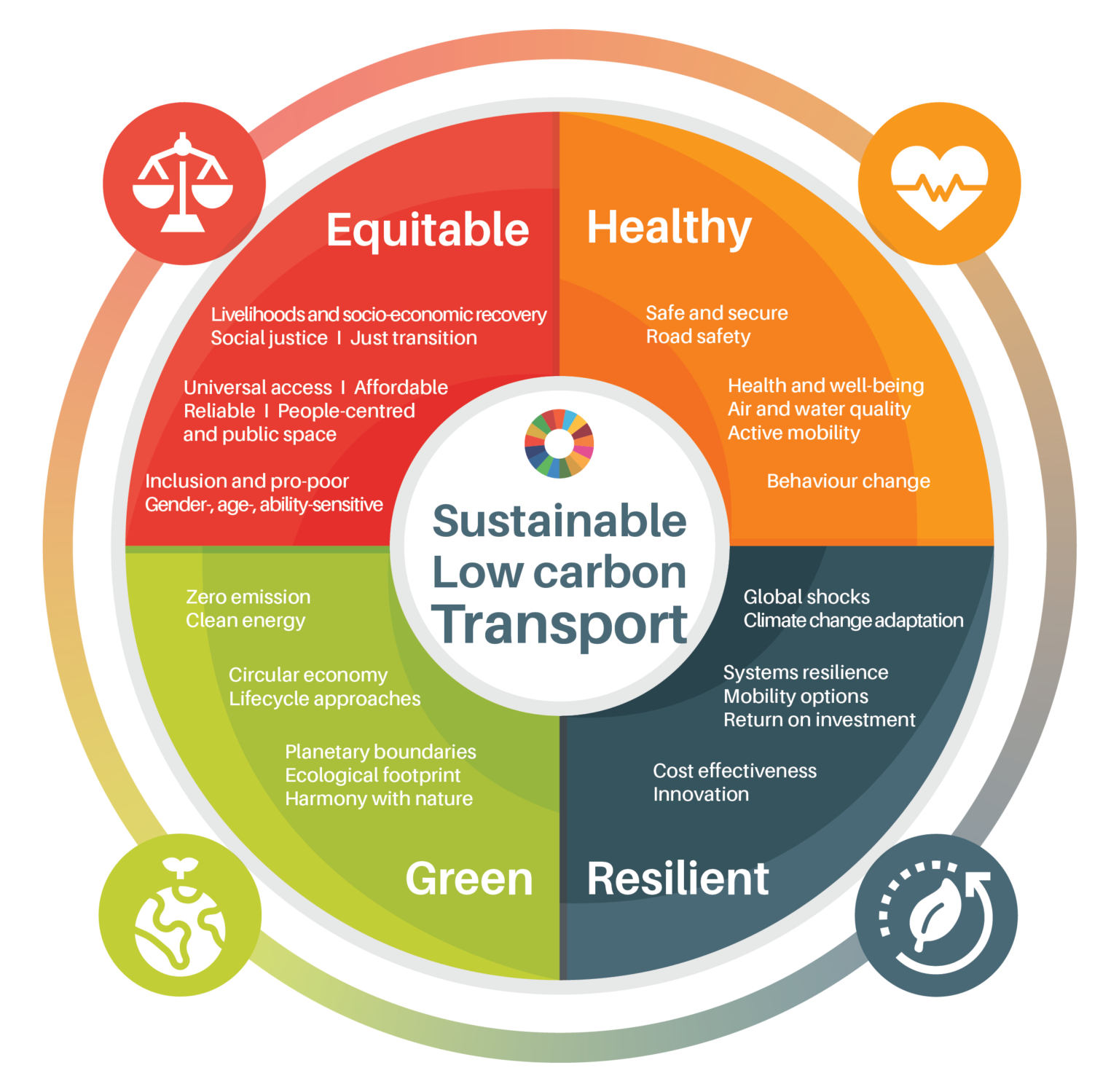
In the SLOCAT site, they list the following to support the transformations:
Overarching approaches to apply across transport modes and sub-sectors overtime
- Put people first, not vehicles and technology
- Co-create and communicate a compelling vision and targets
- Guide short- and medium-term action with clear, coherent political messages
- Combine push and pull measures: Regulate and incentivise
- Link policies within and beyond transport for synergies
- Prioritise resources by social and sustainable value for money
- Engage, empower and coordinate stakeholders across government levels and sectors
- Build capacity and improve data
- Implement pilots to learn and share, then roll out at scale
–
Parking: minimum or maximum
The National Building Code (NBC) of the Philippines stipulates the minimum number of parking spaces or slots per type of establishment and intensity of development (i.e., according to area or other parameters). These established provisions are generally called parking minimums. The NBC’s provisions are already archaic by current standards and need to be revised but not in the way it was apparently developed. The NBC needs supporting evidence from studies (are there any dependable ones around?) on parking requirements including those for bicycles and motorcycles. These should clearly not include or impede the requirements of pedestrians. And local government units must be required to enforce these NBC provisions.
Here is an article that discusses the proposal for new limits on parking, particularly in large developments in Boston, Ma. in the US:
The article points to this one:
City of Boston (September 20, 2021) Maximum Parking Ratios, https://www.boston.gov/departments/transportation/maximum-parking-ratios [Last accessed: 10/19/2021]
I must admit that I still have to do a lot of reading on this. There are some who are calling for the abolition of parking minimums but you just can’t do this so abruptly without understanding the context and current set-up. We are not Boston or San Francisco or Hong Kong or Singapore in terms of the transport infrastructure and services and the progressiveness of policies including those governing or covering housing and other factors that come into play with transportation. Sprawl and the resulting pressures (requirements for efficient travel) on the transportation system is not transport’s fault or responsibility alone like what some articles or infographics make it appear to be. It is very much about land use and land development, and the policies and the political economy behind these developments.
–
On the 12 global road safety performance targets
The UN recently released the Global Plan for Road Safety. I’m just sharing their graphic on the global road safety performance targets:

I will try to discuss each one in future posts especially as I am involved one way or another in trying to realize these targets. Note, too, that these targets are further categorized among the five pillars mentioned at the foot of the graphic. These are (1) Road safety management; (2) Safer roads and mobility; (3) Safe vehicles; (4) Safe road users; and (5) Post-crash response.
–
We need to do more to reduce transport emissions
I did some work on long term action plans on low carbon transport for the ASEAN region before. We were able identify many of interventions that were being implemented as well as those that can be done to reduce transport emissions. Such reductions for the region would ultimately contribute to alleviating global warming. Unfortunately, while ASEAN is a significant contributor to emissions, it pales in comparison to emissions by individual countries like China and the US. If these two and others in the industrialized world do not commit to reducing their emissions, all work will come to naught. Here is an article that serves as a pre-event write-up for COP26, a major climate summit that will be held in Glasgow in the coming days.
–
Safe streets for children
We have been working with UNICEF and several partner organizations on a project on Child Road Traffic Injury Prevention (CRTIP). The Final Reports for the two pilot cities, Valenzuela City and Zamboanga City, have been submitted and represents over 2 years work including during the lockdowns due to the Covid-19 pandemic. The latter part of project implementation indeed became a challenge as we couldn’t travel and engage face-to-face or conduct field surveys like how we did in the first part of the project. Still, I believe we were able to accomplish much and most of what we initially set out to do. Here are the covers of the Final Reports we submitted to UNICEF and we understand will be officially or formally transmitted to the two cities.


The reports narrate the surveys conducted for 25 schools in Zamboanga and 41 schools in Valenzuela. Each initially had selected 25 schools but Valenzuela pushed for an additional 16 schools midway into the project. The SR4S tool developed by iRAP was used for the assessments of critical areas around the schools. The initial assessments were used to identify interventions to improve safety in these areas and recommendations were submitted for consideration of the cities as well as the DPWH where applicable (i.e., the DPWH has jurisdiction over national roads and improvements proposed along these). While some interventions were implemented, others and many were delayed mainly due to Covid-19.
We also conducted a survey to determine the commuting characteristics of schoolchildren in both cities. Since most schools were public schools, it was no surprise that most children lived near the schools or within the school district (which is basically the catchment area for these schools). Thus, it also came as no surprise that most schoolchildren came by foot (walking), motorcycles (riding with a parent) or motor tricycle. There’s a lot of information and takeaways from the data but unfortunately, we could get the bigger, more complete picture of Valenzuela City because they selected only elementary schools covering students from Grades 1 to 6. Zamboanga had a more robust data set with both elementary and high schools, covering Grades 1 to 12. The information derived from these surveys were also analyzed and related to the SR4S assessments. The commuting survey results and SR4S assessment are subject of two technical papers presented in the recent EASTS 2021 conference hosted by Hiroshima University.
What’s next? We are now drafting a proposal for a Phase 2 of the project. We hope to continue and reinforce and follow-up on the recommended interventions from Phase 1. We also hope to be able to work on the CRTIP data hub that was only partly completed due to the many constraints faced by that part of the project. I will post here from time to time about some of the outcomes from the surveys and assessments.
–
On Transit, Urban Equity and Sustainability
Here is another quick share of an article about public transport, urban equity and sustainability:
Descant, S. (September 2021) “How Can Transit Deliver Urban Equity and Sustainability?”, Government Technology, https://www.govtech.com/transportation/how-can-transit-deliver-urban-equity-and-sustainability [Last accessed: 9/21/2021]
The article discusses how the Covid-19 pandemic clearly shows the role of public transportation in the lives of a lot of people. There is that opportunity to significantly if not radically improve public transportation now more than ever. Surely governments and their transit or regulating agencies have thought about this. While the pandemic led to situations that are not necessarily clean slates for many, there are definitely opportunities here and there to implement change that will increase benefits for transit users while attracting non-users to shift from their preferred modes (i.e., private vehicles). Here’s a takeaway from the article:
“We know that public transportation is the solution. So there needs to be a commitment at the federal level, not just in terms of funding, but also integrating public transportation deeper into the fabric of society, through land use policy and through other transportation access policies — the sidewalk and bike lane piece — with the data and payment apps as well…”
What improvements do you think should and can be done now given the pandemic situation? Are these still timely or have we figuratively “missed the bus”, so to speak?
On electric vehicles in the Philippines – current situation and prospects
Here’s a quick share of an article on electric vehicles in the Philippines:
Fernandez, H.A. (September 7, 2021) “Electric vehicles in the Philippines: a mottled green solution,” Eco-Business, https://www.eco-business.com/news/electric-vehicles-in-the-philippines-a-mottled-green-solution/ [Last accessed: 9/8/2021]

It is interesting that the article cites past studies that covered not just e-vehicles but the bigger picture for transport. I think most if not all people who were doing work on low carbon transport including the modeling of scenarios for the long term were not able to anticipate something like Covid-19 disrupting activities around the world and curbing emissions so drastically in the last year. The so-called ‘old normal’ situation has not returned but some say that even with the pandemic affecting transport, we still won’t be able to attain the targets necessary to stave off global warming. The bottomline is that we need more aggressive actions and probably, shifting to e-vehicles is one of those that combined with others will help achieve targets.
–
 Caught (up) in traffic