
Home » EST (Page 37)
Category Archives: EST
Simplify
I still remember what our calculus teacher told us while discussing a problem in integration. At the time, I believe he was setting up the working equation for a problem involving trajectories. He was reminding us that in problem solving it was very important to remember how to “kiss.” As we were practically in awe of him, he followed up by asking us what “kiss” meant. He called on one of our classmates and then another, all the while smirking like a child who thought he alone knew the answer to his question. “Kiss,” he said, meant – keep it simple, stupid. Of course, the last word was intended to drive home the point with a little sarcastic humor to a class of sophomores, most of whom were engineering students. Years later, perhaps its time we realize and accept that we do indeed need to “kiss.” This time, we need to apply the same principle to public transport.
In the past few weeks as I and my colleagues pondered the development of public transport planning support system that would include, among others, a franchising module specifically for Mega Manila and generally for other Philippine cities, I came to the obvious conclusion – “kiss.” It seems that based on the secondary data we got from the LTFRB and the DOTC, and the primary data derived from field surveys validating routes and allowing us to estimate both supply and demand that Mega Manila public transport has become so complicated due to the overlaps and tangles that are the bus, jeepney and AUV routes in this mega city. Through the years and despite opportunities to untangle the mess of routes, there was no strong effort to do so and today, there seems to be little interest in rocking the boat that is the current state of public transport in this country.
It is often asked why, despite having EDSA-MRT, have the numbers of buses along EDSA seemed to have increased instead of the logical decrease as the rail system covered much of the demand along its corridor of operation. One answer seems to be related to provincial buses since continuously increasing populations outside Metro Manila coupled with better roads have led to more economic activity that translates into more travel (and person trips).
The same is true for origins and destinations within the National Capital Region and thereby affects the supply side for buses for city operation. Yet, there is always the specter of colorums or illegally operating buses that are often difficult to catch and to distinguish from the legitimate units. There are even allegations that some unscrupulous operators allow colorums among their ranks in order to generate more revenue.
However, such situations are not exclusive to EDSA. There are the similar questions pertaining primarily to jeepneys along corridors already served by LRT 1 (since 1984) and LRT 2 (since 2004). Why have authorities allowed most jeepneys to continue plying routes along these two lines? Why are there no strong efforts to rationalize (a word very much abused when referring to public transport in Philippines) routes to complement established mass transport systems rather than to compete with them? Is it really a matter of political will among our leaders especially those in-charge of our transport agencies? Are there conflicting interests, some probably vested, among politicians, transport groups and operators themselves? And are we dead serious about addressing, once and for all, the challenges of putting in place a public transport system that is both modern and sustainable?
Why is it that transport systems in cities such as Tokyo, Singapore, Hongkong and those in Europe and the US appeal to us? What is different about the transport systems in these countries especially those cities that have similar if not larger populations and sprawl? Is it their high tech attributes? Is it their fare systems? Or, if we look close enough, is it their simplicity? It should be noted and emphasized that these cities follow closely the ideal hierarchy of public transport services. In a nutshell, this is where high capacity modes form the backbone of the transport system while lower modes complement these, acting as feeders from the main lines. This is simplicity as applied to public transportation.
Mathematicians, scientists and chess grandmasters then and now have often invoked the principle of simplification to solve problems of different magnitudes. It is quite a common approach for the most complex predicaments since it is also believed that a system that is too complex and requiring so many inputs is impractical and unmanageable – precisely the descriptions for public transport systems in this country. Perhaps one city should show the way in coming up with a proof of concept for simplicity. Maybe that will be Cebu once it builds what is touted as the country’s first BRT line. Maybe that will be Davao should it implement possible recommendations pertaining to sustainable transport from an ongoing study. But I hope it will be Metro Manila, not necessarily at a grand scale but something that will show signs of life in an otherwise deteriorating system.
Replicating success
In his inaugural speech, P-Noy stated his disdain for “wang-wang,” referring to the abusive of the sirens by certain people. “Wang-wang” then symbolized how these people practically claimed privilege over other people haplessly caught in traffic jams. The mere reference to “wang-wang” and the marching orders for the PNP-HPG and the LTO to crack down on the abuse led to an aggressive, fast and effective campaign that resulted in the confiscation of illegal sirens. In effect, the campaign brought back the sirens to its original purpose. And that is to get the attention of motorists for them to give way to emergency vehicles such as ambulances and fire trucks.
I’ve always wondered after that successful campaign why our agencies can’t replicate this for other traffic violations as well. Surely, a similar campaign will go along way in establishing firm enforcement of traffic rules and regulations – something that has been cited time and again as what needs to be done to bring order to the traffic mess we experience everyday.
Perhaps we can start off by listing something like a Top Ten rules that are violated and apply the “wang-wang” campaign to these. I nominate the following to be included in the Top Ten:
1. Counterflowing
2. Use of illegal license plates
3. Speeding
4. Jaywalking
These combined with another aggressive campaign but this time on the environment side (i.e., no-nonsense emission testing and anti-smoke belching) should help ease traffic in many major thoroughfares. These could all be under the banner of a Traffic Discipline Zone (TDZ) or corridor and if implemented properly may help bring respect back to our traffic enforcers. I am optimistic that enforcement will go beyond just being a motherhood statement and that its contributions would be very significant.
Capacity Building
We’ve been quite busy at the National Center for Transportation Studies during this month of September. So far, we’ve conducted 3 training programs in the during each week of the month. Each program was conducted over a period of 5 days. We held the 3rd offering of the Traffic Administration Course (TAC-3) from September 6-10, 2010. That was followed by a Road Safety Audit training course for sister companies the Manila North Tollways Corporation (MNTC) and the Tollways Management Corporation (TMC) from September 13-17, 2010. And only yesterday, we completed the first offering of the Advanced Traffic Administration Course (ATAC) for participants from the Metro Iloilo-Guimaras Economic Development Council (MIGEDC) and sponsored by the Japan International Cooperation Agency (JICA). Also last week, I was among the a handful of participants for a special training on Eco-Driving conducted by Dr. Taniguchi of the Eco Drive Promotion Division of The Energy Conservation Center, Japan. Hopefully, the knowledge and experience gained from the training will allow me and my colleagues to share Eco-Driving to other drivers and enable the promotion and application of Eco-driving in the Philippines.
Next week, we will be resuming the Public Utility Vehicle Drivers’ Training Program, which is offered in cooperation with the Land Transport Franchising and Regulatory Board (LTFRB). This is a 3-day course that was formulated for PUV drivers in order for them to have a re-education of sorts. In the course, the fundamentals of traffic rules and regulations, road signs, ethics and customer service are taught by select lecturers from the DOTC, the PNP and UP. Such education is a necessity considering that most PUV drivers have not undergone any formal training considering how most of them were able to get their licenses. There is a tremendous amount of actual and anecdotal evidence out there pertaining to how most PUVs are driven. Hopefully, this course will benefit them and influence them to drive safely and prevent the loss of more lives as a result of crashes they may become involved in.
Motorcycle lanes
There have been proposals to have exclusive lanes for motorcycles along major roads. The rationale for such proposals is the increasing number of road crashes involving motorcycles. It is assumed that having exclusive lanes will result in a significant decrease in motorcycle involvement in crashes since it is further assumed that with exclusive lanes, there will be fewer interactions among motorcycles and other motor vehicles. There are evidences to support these assumptions.
Anyone observing traffic along our roads can easily see that the biggest reason for the rapidly increasing number of road crashes involving motorcycles is the behavior of motorcyclists. Motorcyclists have the propensity to weave in traffic, heavy or not, often splitting lanes and catching drivers unaware. This behavior frequently results in crashes, most of which involve only damage to property and thus are usually relegated as minor incidents that are not newsworthy. However, crash statistics with both the MMDA (for Metro Manila) and the DPWH (for national roads) indicate that motorcycle crashes with fatalities are alarmingly increasing, and therefore require intervention. Motorcycles’ notoriety are now the among the pet peeves of many drivers, regardless of whether they drive cars, public transport or even trucks.
There are still many riders who do not wear helmets. And not a few bring their gear but choose not to wear these; a habit that has led to jokes about helmets being for elbows or shoulders rather than for heads. This is despite a Helmet Law stipulating penalties that are supposed to discourage non-compliance. The practice significantly increases the chances of having fatalities in crashes, especially considering that there are no restraints for riders or other protective devices for motorcycles like seatbelts and airbags that are already standard features for many other motor vehicles.
There is a bill filed before the Senate, SB 871, which stipulates the delineation of one-meter wide lanes for exclusive use of motorcycles. The bill has a provision directing the DPWH and local government units to designate motorcycle lanes, presumably for both national and local roads. SB 871 proposes fines (i.e., not more than six (6) years of imprisonment or a fine of not less than Five Thousand Pesos (PHP 5,000.00) but not more than Twenty Thousand Pesos (PHP 20,000.00), or both, at the discretion of the court) for motorcyclists using other lanes. There is no mention of penalties for drivers of vehicles encroaching on lanes designated for motorcycles.
While the bill is well meaning, it begs the question of whether its provisions are enforceable once the bill becomes a law given the extent of our national road system. After all, there are many laws that are not effectively enforced but were also designed to instill road discipline among drivers and riders, and to ultimately make roads safer for all users. And motorcycle riders are among those commonly seen as violators of road traffic rules and regulations.
In urban areas, for example, where many roads have multiple lanes, space for motorcycles may be derived from existing lanes but may lead to congestion due to the decrease in road capacities. In some cases, motorcycle lanes of at least one meter may be constructed by taking part of medians (e.g., islands) or shoulders. However, along roads where there are no medians, motorcycle lanes from shoulders may lead to conflicts with public transport vehicles that operate along the outer lanes of the road. Further, it is noticeable that there are no shoulders in most urban roads in the Philippines and there are also many instances where roadside parking is allowed or tolerated. And deriving motorcycle lanes from pedestrian rights of way such as sidewalks is definitely not recommended.
In the case of most national roads including rural highways, there are only 2 lanes and shoulders on either side that are most likely unpaved. Road rights of way are often unsecured, with structures such as houses and shops encroaching within the RROW and leading to shoulders being utilized for parking or other purposes. The DPWH Highway Planning Manual does not stipulate motorcycle lanes or even pedestrian walkways as standard specifications for typical national roads. And it is supposed that a law emanating from bills such as SB 871, should encourage if not mandate a review of road design standards to include provisions for motorcycles, and perhaps more importantly, for pedestrians and non-motorized transport (NMT) as well.
Other countries such as Malaysia have already incorporated in their road design manuals lanes that are for the exclusive use of motorcycles, bicycles and other NMTs. These have reportedly improved safety so much that their governments approved the budgets for implementing the provisions for roads where there is significant motorcycle traffic. Perhaps the Malaysian example is proof of the concept that having motorcycle lanes will indeed improve road safety. It should only be emphasized that road design improvements can go only so far if a key element, enforcement, is lax or nonexistent. Without this key element, motorcycle lanes in this country will just be destined for the ningas cogon hall of shame.
–
For more information about motorcycle lanes and road safety, one may refer to the website of the International Road Assessment Program. They also have a Flickr account showing their activities in Southeast Asia.
The pitch for electric public transport
Electric vehicles have been in operation as public transport modes in the Philippines since 2007 when electric three-wheelers were introduced at the Bonifacio Global City in Taguig City, Metro Manila. At the time, the City Government of Taguig bought the pitch by the proponents of the E-Trike and supported their trial operations that have since expanded but are yet to be legitimized due to the vehicles not being registered with the Land Transport Office. These could not “legally” charge their passengers since they also did not have franchises with the Land Transport Franchising and Regulatory Board (LTFRB) nor with the local government (i.e., like conventional tricycles).
 E-trike in Fort Bonifacio
Meanwhile, around the same time, another electric vehicle was introduced in the Visayas. In this case the vehicle was in the form of a national icon – the jeepney. Electric jeepneys were first built out of China and directly imported as a “proof of concept.” What were initially launched in Bacolod and Silay Cities in Negros Occidental were examined by local partners based in Manila, and eventually a locally manufactured E-jeepney came out in 2009, care of the Motor Vehicle Parts Manufacturers Association of the Philippines (MVPMAP) and Motolite with assistance from the Dutch Stichting Doen. The project quickly gained proponents including two very influential mayors and their cities – Binay of Makati and Hagedorn of Puerto Princesa. It is to the credit of the cooperation between the Institute for Climate and Sustainable Cities (iCSC, the original proponents of the E-jeepney) and Makati City that there are currently two E-jeepney lines in that city. But while the vehicles have been registered with the LTO (using the conspicuous orange plates), they have yet to be granted franchises by the LTFRB. The vehicle gained more attention when the newly elected Vice President Binay rode the vehicle to the inauguration. Currently, the E-jeepney is subject to studies at the National Center for Transportation Studies of the University of the Philippines and has gained interest from private firms as well as other researchers. Together, the E-jeepney and the E-trike represent the strongest cases for electric vehicle applications in public transport.
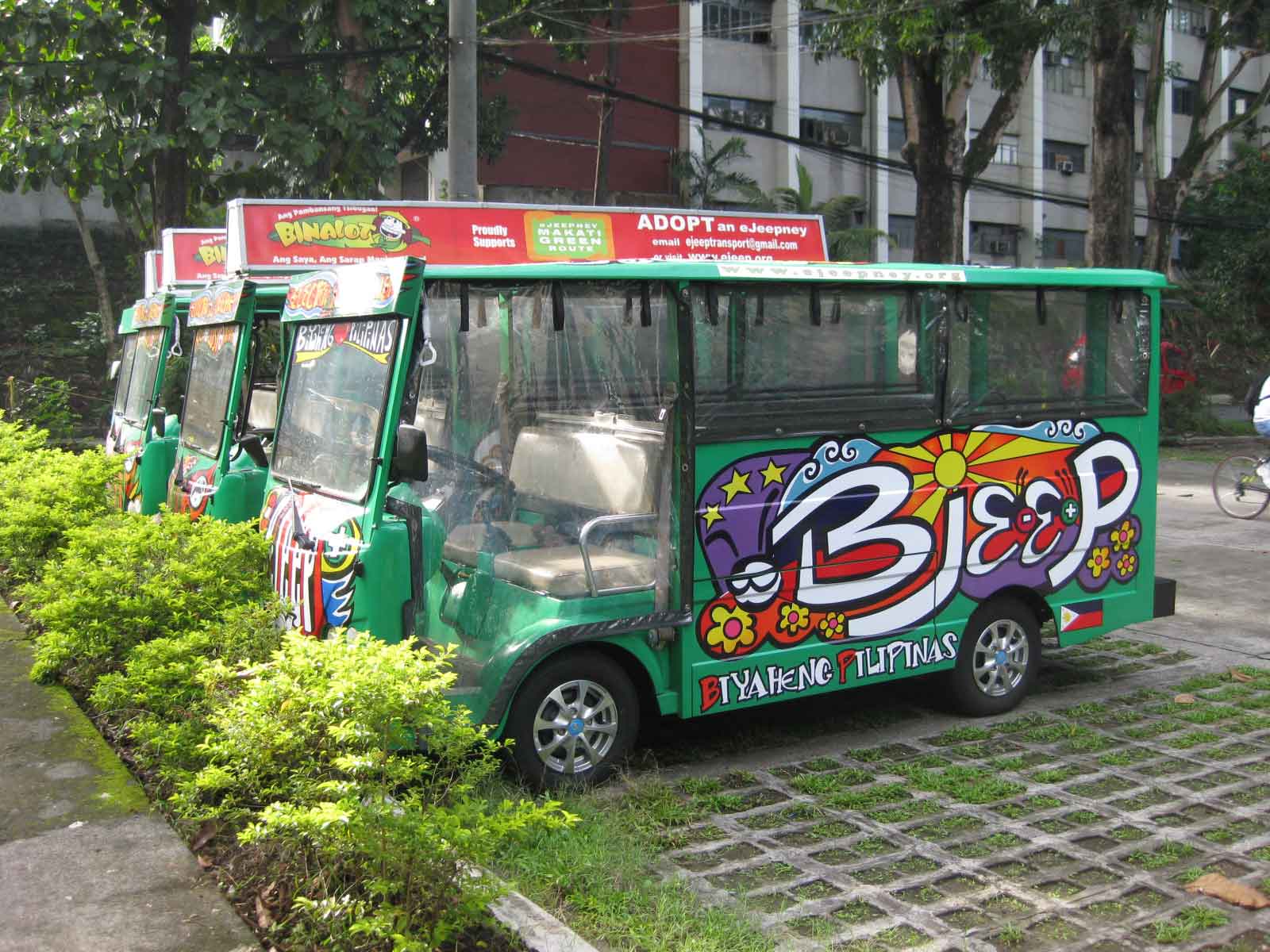 Electric jeepneys parked at UP Diliman – the Bjeep is the one used by Vice President Binay during the inaugurations
I reproduce below a news item from the GMA News website that features an initiative from the ADB that may finally push electric vehicles to gain a significant share of trips across the country:
The Asian Development Bank is offering as much as $280 million in loans for the Philippine government to finance a proposed re-fleeting program for tricycle drivers and operators shifting to electric motorbikes or e-bikes.
“The loan will be coursed through ADB conduit banks like Land Bank of the Philippines for re-lending to tricycle drivers who may want to shift into using e-bikes,” Environment Secretary Ramon Jesus Paje told reporters in a briefing Tuesday.
He said ADB will give 30 e-bikes as donation to city governments in the Metropolis.
“ADB wants to us to sample the bikes to see for ourselves that these machines are totally pollution-free. No emissions, less pollution,” he said.
If all Philippine tricycles are e-bikes, the country can save much as 20 million metric tons of carbon footprints a year.
“We could go into carbon trading. That will earn us dollar equivalent which we can use to offset a portion of the loan,” said Paje.
Tricycle drivers can save up to P300 in daily fuel costs with the use of e-bikes.
“Four hours of charging would only cost P40 compared to P340 for fossil-based fuels. The acquisition cost is about 20 to 30 percent higher than fuel-fired motorcycles but the overhead cost is certainly lower,” Paje said.
Of the total 5 million tricycles in the country, 2.8 million are in Manila.
The department said that the shift to e-bikes would reduce pollution 25 percent to 30 percent in the country’s urban centers by 2011.
As of 2009, the country’s total suspended particulates – a concentration of micro pollutants in the air – in all cities and urban centers is 134 micrograms per normal cubic meters, which is 48 percent beyond the normal standard of 90 micrograms per normal cubic meters.
The major sources of these particulates are diesel vehicles and coal-burning power plants. Dust from unpaved roads and construction activities contribute to the rise in particulates especially during summer months.
Vehicles contribute as much as 80 percent to air pollution, while the remaining 20 percent are from industries.
Department monitoring shows that more than 50 percent of vehicles are registered without prior actual testing by accredited Private Emission Testing Centers.
“If all vehicles are tested for emission prior to registration, the 30 percent reduction in particulates will be easily realized,” Paje said. —With MR Gavin/VS, GMANews.TV
The ADB initiative comes at a critical time when the national government is still finding its way with regards to local public transport modes, particularly how the tricycle has established itself as the primary (sometimes, the only) public transport option in cities and municipalities across the country. It is inevitable that the issue of proliferation and regulation of tricycles will have to be addressed. National and local government would have to discuss the nuances of the Local Government Code in as far as public transport operations, franchising and fare setting are concerned. On top of this, the time is critical also because there is a strong call for environmental sustainability; one that is anchored on the increasing awareness for climate change and its impacts. The long-standing perception is that the conventional tricycles contribute to the continuing degradation of our environment as the collective emissions from these vehicles effectively suffocate our cities, and the key is for local governments to realize this and be a major player in transforming local transport into the environment-friendly kind. It is, after all, in the best interests of their constituents that clean air be pursued to ensure that there will be a bright future for their cities and this country.
Through Traffic – Part 1
As I was reviewing a paper concerning a study on vehicles utilizing residential streets as alternate routes to congested arterials, I couldn’t help but compare the circumstances described by the authors to the current situation at the University of the Philippines Diliman campus. It is a classic case of motorists who, having free access to roads regardless of the nature of the land use, will choose to take this roads in order to bypass what they perceive to be congested roads. The objective is simple, take the route where travel time is significantly less, thereby getting to your destination faster. Such traffic is often termed as through traffic mainly since they do not have any other purpose along the street.
While the paper I was reviewing focused on a single street in a residential district somewhere in Tokyo, the problem in UP Diliman is much more complicated. The UP Diliman campus occupies 493 hectares of prime land in Quezon City, the largest component of Metropolitan Manila. The campus is located between two major thoroughfares – Commonwealth Avenue and C.P. Garcia Avenue (more popularly known by its former name, Katipunan Avenue as well as its designation in the basic circumferential and radial network for Metro Manila, C5). It used to be that campus roads were fair game to general traffic bypassing the traditional connection of Commonwealth and Katipunan at Tandang Sora (where the intersect). The latter being a narrow 2-lane, undivided street often congested because of truck traffic and the operations of tricycles serving the dense residential areas at either side of the road. Many vehicles, particularly private cars because trucks were not allowed to use campus roads, came through the campus via its Main Gate along University Avenue and its other gate along Ylanan Road (along Commonwealth) and exit via gates along Magsaysay Avenue (Asian Center), Schuster Street (Narra Residence Hall), or Velasquez Street (NIGS), and vice versa.
Due to the increasing volume of through traffic, the University agreed to grant right-of-way to what was to become C.P. Garcia Avenue (later downgraded by the MMDA to C.P. Garcia Street), which practically separated the academic areas from the residential areas located in the south portion of the property. Traffic has since shifted significantly from campus roads to C.P. Garcia but there has been a resurgence of through traffic in the past 3 years mainly due to C.P. Garcia being congested during peak periods. Most through traffic in the morning are vehicles bound for private schools along Katipunan Avenue and these are clearly indicated in the stickers on the windshields of the vehicles as well as the characteristic uniforms of students on-board. There are also significant traffic from motorists bound for the Pasig/Mandaluyong (e.g., Ortigas CBD) and Makati/Taguig (Bonifacio and Makati CBDs) via C5. Such traffic have significantly and detrimentally imposed themselves on the University, affecting the community and more specifically its academic constituents.
No Car? No Problem!
It’s been months now since I’ve had a car. Lost old reliable to Ondoy last year and decided to commute part-time (I still drive when I’m with the wife.) to work. Sometimes, I am able to get a ride from officemates to our subdivision’s gate but that doesn’t happen often considering my work hours.
One night, I decided to walk home from SM Marikina partly out of necessity and partly out of choice. Of course, it can be argued that I made the choice out of necessity or that it was a necessary choice given the circumstances but these are just semantics. The choice to walk and the choice to commute is something that was essential to re-establish a routine I came to know and appreciate when I was still a student both here and in Japan – but mostly in Japan where I lived for some time.
I used to walk a lot during my stays in Japan. It’s always a delight to take long walks as long as the environment is conducive. I started walking when I stayed in the University dormitory that was a kilometer away from my laboratory. I also walked when I got off the train station to get to the church. This was no easy task considering that Sacred Heart in Yamate was located atop a hill. I could tell then that I was healthy as I didn’t have to make stops as I negotiated the steps to the cathedral.
When I transferred to an apartment (or mansion as the Japanese called it), I walked more from the nearest train station to my laboratory. Again, since the university was essentially on top of a mountain, the walk to school was a workout of sorts. I usually covered the distance without any stops but aided apparently by a piece or two of candy that I consumed while trekking. At times, the candies would be replaced by cold drinks during the summer and hot chocolate during the winter. I remember the hot can turning cold even before I reached the comfortable warmth of my laboratory. Of course, the walks back to my homes away from home was always the easier, mainly downhill and usually with the company of friends who were similarly heading home and using the same train station.
I enjoyed my walks in Japan mainly because the environment was conducive to walking (and commuting). The design of the steps, the pedestrian crossing facilities and the sidewalks, not to mention the driver discipline and courtesy in that country allowed for safe walks. Proof of this, I believe, is seeing a lot of children and elderly people walking (and commuting).
In contrast, it was both smoggy and noisy along Marcos Highway. I always had to watch out for vehicles that might sideswipe me as I walked near the carriageway when I ran out of sidewalk or foot path. I was lucky that it didn’t rain that night. I can only imagine walking in the rain and most parts of the foot paths transformed into mud. If so, I could also imagine that people would have to walk on the carriageway, risking life and limb to speeding jeepneys and reckless trucks. And in Philippine streets, I know for a fact that private cars aren’t that good either. You just assume that they won’t be joyriding and looking for people to splash water from the puddles forming on the road.
People who are supposed to find solutions to our traffic problems should try walking and commuting to see how bad traffic and our transport systems are. People who walk would always be able to notice what facilities are needed to enhance the experience and to ensure that walking would be a safe, enjoyable and healthy activity. Road safety audits, after all, are not performed while riding a vehicle but while traversing the length of the road and making detailed observations of its features. Such details will allow the auditor(s) to recommend specific measures based on well-grounded assessment. It is a lesson I know from first-hand experience both as a pedestrian and a road auditor. Perhaps it is a lesson a lot of people would be better of learning and applying. It is a lesson that will probably make our lives better and our cities a nicer place to live in.
Transport Forum
It’s that time of year again when the ADB holds and hosts a Transport Forum at their office in Manila. This forum is expected to attract more people than usual as the ADB will be presenting its new Sustainable Transport Initiative. Its new because it was formulated after Copenhagen and attempts to link transport with climate change. Thus, climate change mitigation and adaptation are among the general topics in the forum.
As usual, there will also be the sessions on urban transport, road traffic safety, rural transport, etc. Of particular interest to me will be the presentations by iRAP and GRSP on road safety on Wednesday aside, of course, to the Keynote Speech on road safety to be delivered by the International Ambassador for Road Safety who happens to be the actress Michelle Yeoh. I will have my chance to meet her sometime in the afternoon as she leads the laying of a time capsule for the proposed Road Safety Park at the UP Diliman campus.
I was actually at the ADB today and joined a meeting by the Partnership on Sustainable Low Carbon Transport (SLoCaT). Unfortunately, I couldn’t join the afternoon session as I had to rush back to the University for another engagement. The National Engineering Center held a forum on Public Service where I presented on NCTS activities including training, research and extension work in the last 5 years. At the end of my presentation, I showed a sneak preview of projects already in the pipeline including shamelessly plugging Michelle Yeoh’s visit to UP for the Road Safety Park.
For a more detailed schedule of the ADB Transport Forum, you can google the same and this will lead you to the ADB website and links to pdfs containing the schedule from May 25-27.
Parking as an election issue – Conclusion
Parking as an election issue – Part 2
Parking or the lack of it for many establishments is partly due to the obsolete minimum parking provisions stipulated in the National Building Code. A review of this guide reveals extensive shortcomings that will always result in inadequate parking spaces when followed to the letter. In a recent project I was involved in, for example, following the NBC would have led to the conclusion (and God-forbid the recommendation) that 20 to 21 parking slots would be sufficient for a 245-bed hospital! Meanwhile, parking generation rates from abroad (Note: We don’t have local rates.) suggest a more realistic 431 slots.
Architects, engineers and developers are quick to interpret minimum parking space requirements as equivalent to the required number of slots. However, it is obvious that NBC minimum parking provisions will never be a sufficient basis for estimating the number of parking spaces to include in designs. Trip and parking generation rates have been developed in other countries and have been the basis for determining a suitable and reasonable number of parking spaces. These rates are based on trip or travel behavior and factors in typical dwell (parking) times for various types of land use. Thus, there are different parking generation rates for fast food joints when compared with fine dining restaurants. There are also different parking rates between condominiums and subdivisions, and the same applies to different types of offices.
The major shopping malls have become more aware of this and have provided more than enough parking spaces for car-using customers. In many cases, there is only the perception of parking being inadequate because drivers will also have preferences on parking space location within a lot or building. One shopping mall manager mentions that even during the Christmas holidays when mall trip generation typically peaks, their parking building’s top floors are not filled up and motorists would rather wait for slots on levels closer to the bridges to the mall.
One issue that is almost always raised by establishments regardless of type or size is the cost of providing parking spaces. Indeed, it is cheaper to mark spaces along the roadside or arrange for the use of vacant lots for the one’s purposes. But what happens when the same open lots are developed to make way for other buildings and road space is required to address traffic congestion? In the case of high rise condominiums, the cost of a parking slot is not included when one purchases a unit. The price of a slot can even be as much as a studio unit. Thus, residents would often resort to parking along streets or renting for overnight parking in nearby lots or buildings.
The experience in Makati has shown that parking can indeed become a serious problem. Makati streets were used as parking lots and office buildings could not accommodate the increasing number of vehicles owned by employees who were becoming more and more capable of buying cars. The latter is a natural phenomenon due to continuing economic development and the resulting increase in incomes. Those who can afford new cars would probably purchase one (or more) while those with less budget will acquire used vehicles. It took some time before Makati was able to build parking buildings and enforce strict roadside parking policies including pay parking managed by the city’s parking unit.
Schools are major traffic generators attracting many car users. Some campuses are fortunate that they have vacant lots or seldom used roads at their disposal. However, as one can see through fences, committing vacant lots to parking is not at all the wisest usage for such space. And as one song goes, should we “pave paradise to put up a parking lot?” On the other extreme, and there are many such cases, schools do not have the space for parking. One such school along Ortigas Avenue imposes its parking problems on the general public when cars and school service vehicles take up lanes along the major arterial as well as occupy sidewalks while waiting for their passengers.
For public places like churches, parks, markets and the like, accessibility to public transportation is often used as an excuse for not planning and providing for parking spaces. The argument is that since these are public spaces, they attract mostly commuters. What is not stated is the reality that these same public spaces also attract car and motorcycle users that when proportioned with commuters would require a significant number of parking spaces. This is very much the observation near places of worship, public markets and parks where traffic congestion is likely caused by vehicles parked along streets and even on sidewalks. [In many cases, there aren’t even sidewalks so people use the streets anyway.]
[Next: The case of Quezon City, and Conclusion]
 Caught (up) in traffic